
Research article · 2024 · Full text
International Journal of Biology SciencesAntimicrobial resistance profiling of multidrug-resistant enterobacteriaceae from hospital wastewater
Volume 6(1) · Pages 244–247 · DOI: 10.33545/26649926.2024.v6.i1c.849 ↗
Research areasAntibiotic Resistance in BacteriaPharmaceutical and Antibiotic Environmental ImpactsAntibiotic Use and Resistance
Abstract
Author-writtenHospital wastewater is a breeding ground for antimicrobial resistance and most treatment plants weren't designed to handle it. This research characterized the antimicrobial resistance profiles of multidrug-resistant (MDR) Enterobacteriaceae isolated from wastewater at five sampling points along the treatment chain of a 250-bed tertiary hospital in Imphal, Manipur. Between March and November 2022, 384 wastewater samples were collected biweekly and processed at the Manipur Institute of Biological Research. A total of 247 Enterobacteriaceae isolates were recovered, with Escherichia coli (42.1%), Klebsiella pneumoniae (33.2%), and Enterobacter cloacae (12.6%) being the most frequent species. MDR phenotypes (resistance to three or more antibiotic classes) were detected in 87.3% of raw influent isolates but only 38.1% of chlorinated effluent isolates. Extended-spectrum beta-lactamase (ESBL) production was confirmed in 63.8% of all isolates, and carbapenem resistance was found in 28.7%. PCR screening revealed blaCTX-M (71.3%), blaNDM-1 (24.6%), and blaOXA-48 (11.8%) as the dominant resistance genes. A positive correlation existed between the number of AMR genes carried and meropenem MIC values (R²=0.71, p<0.001).
Summary
Source-checkedPlain-language reading of the full paper, prepared with AI and checked against the text. Each point links to the authors' own words.
Why it matters
- Antimicrobial resistance (AMR) is a critical global health threat, causing more annual deaths than HIV and malaria combined, with Enterobacteriaceae contributing significantly to this burden. View evidence ↗
- Hospitals are hotspots for AMR because their wastewater contains both resistant bacteria and genetic elements that can transfer resistance to other organisms in the environment. View evidence ↗
- Standard wastewater treatment plants are designed to reduce overall bacterial loads but are not specifically engineered to remove resistance genes or stop the transfer of resistance between bacteria. View evidence ↗
The question
- The study aimed to identify the types of Enterobacteriaceae present and their resistance profiles and genes at different stages of a hospital wastewater treatment system in Imphal, Manipur. View evidence ↗
What they did
- Samples were collected from five distinct locations: raw influent, after primary sedimentation, after secondary biological treatment, after chlorination, and an upstream control site on the Nambul River. View evidence ↗
- A total of 384 500-mL grab samples were collected biweekly from March to November 2022. View evidence ↗
- Bacterial species were identified using the VITEK 2 automated system, with 16S rRNA gene sequencing used to confirm ambiguous results. View evidence ↗
- The researchers used the disc diffusion method following CLSI 2022 guidelines for susceptibility testing and Etests to determine minimum inhibitory concentrations (MIC) for colistin and carbapenems. View evidence ↗
- Multiplex PCR was used to screen all multidrug-resistant (MDR) isolates for six specific beta-lactamase genes. View evidence ↗
What they found
- Out of 247 recovered Enterobacteriaceae isolates, the most common species were E. coli (42.1%), K. pneumoniae (33.2%), and E. cloacae (12.6%). View evidence ↗
- Among the species identified, K. pneumoniae exhibited the highest rates of carbapenem resistance (38.4%) and ESBL production (71.9%). View evidence ↗
- The blaCTX-M gene was the most persistent, appearing in 84.3% of raw influent and remaining in 48.7% of isolates after chlorination. View evidence ↗
- The blaNDM-1 gene, which encodes a carbapenemase, was detected in 14.2% of isolates after chlorination, indicating that some resistant organisms survive the entire treatment process. View evidence ↗
- There was a strong positive correlation (R²=0.71, p<0.001) between the number of AMR genes an isolate carried and its meropenem MIC values. View evidence ↗
What it means
- The authors conclude that standard wastewater treatment is not enough to stop the spread of clinically significant resistance genes into the environment. View evidence ↗
- The authors recommend upgrading hospital wastewater systems in northeast India by adding advanced steps like membrane filtration, ozonation, or UV disinfection. View evidence ↗
Visual summary
3 visualsIllustrations explain the paper; charts are replotted from the paper's own table values.
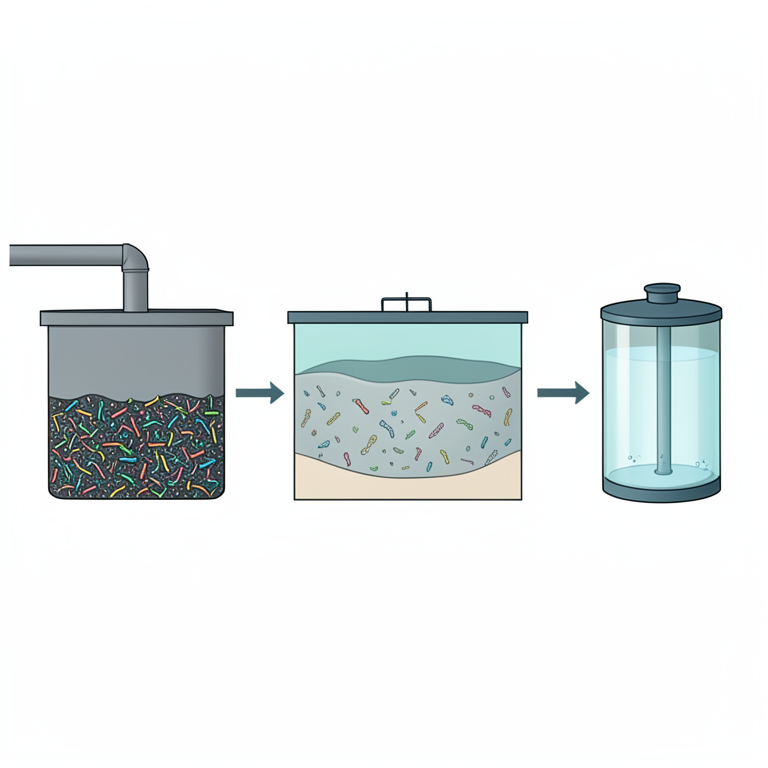
Resistance Gradient in Treatment Chain
AI-generated conceptual illustration (hospital wastewater treatment plant). It explains the idea and does not show study data.
View source evidence ↗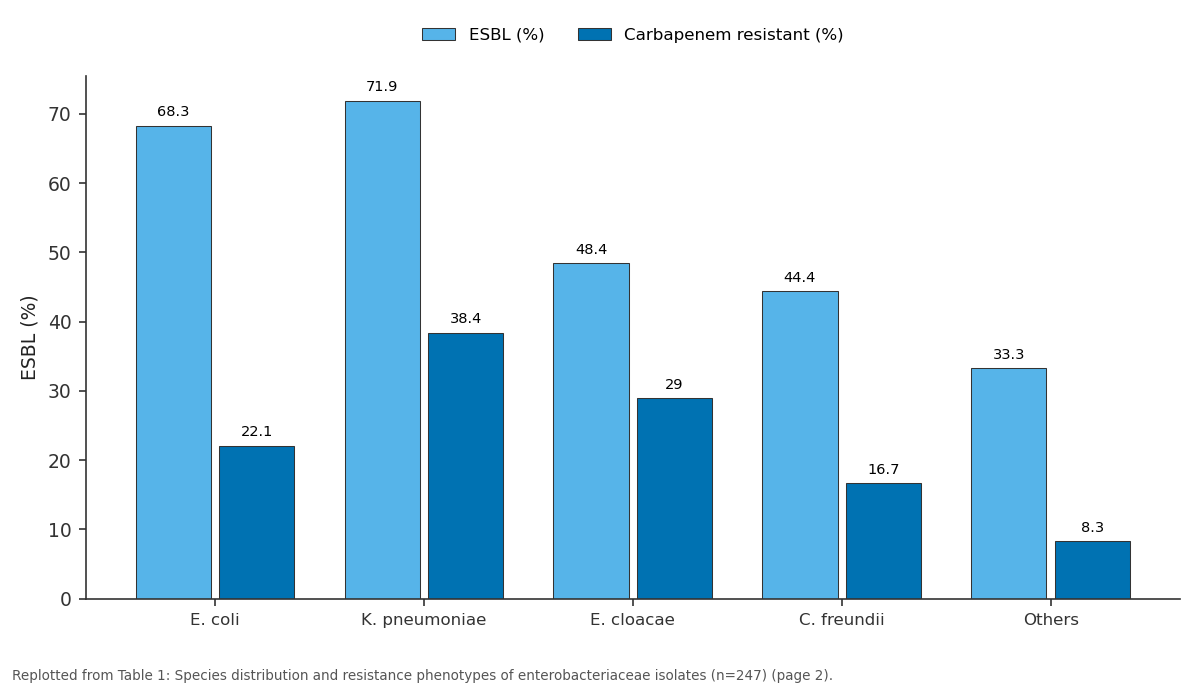
ESBL (%) and Carbapenem resistant (%): E. coli vs K. pneumoniae vs E. cloacae vs C. freundii vs Others
Replotted from Table 1 (page 2) of the original paper. Every bar is the paper's own table value.
View source evidence ↗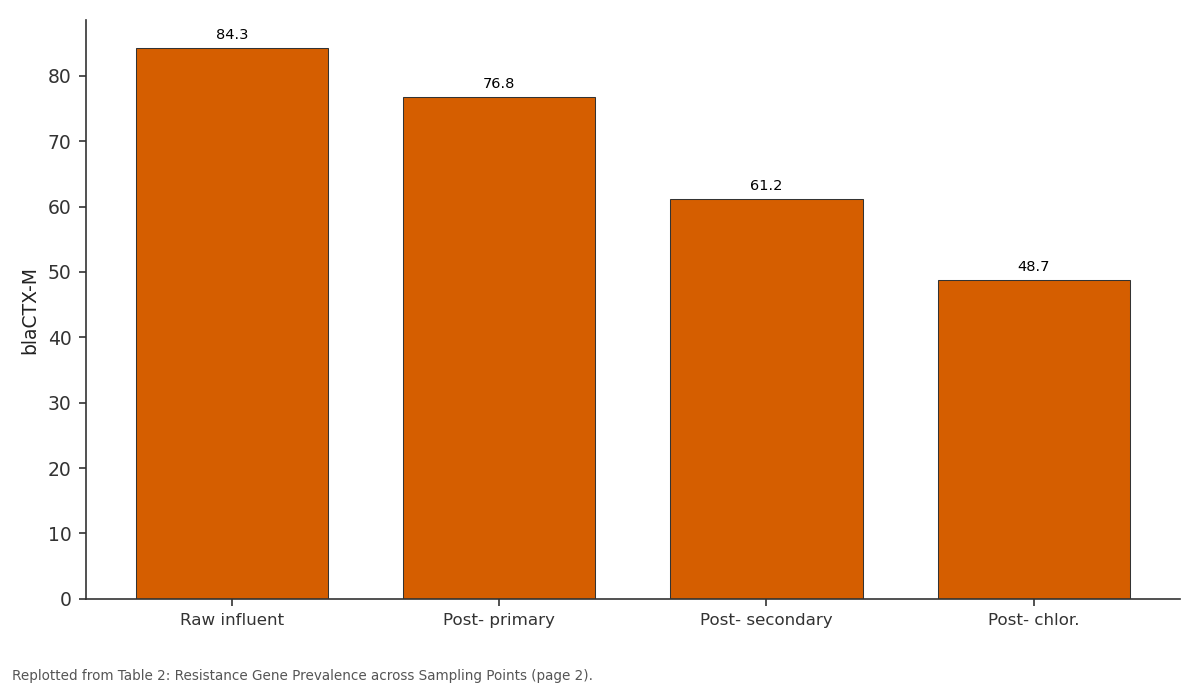
blaCTX-M: Raw influent vs Post- primary vs Post- secondary vs Post- chlor.
Replotted from Table 2 (page 2) of the original paper. Every bar is the paper's own table value.
View source evidence ↗Figures & tables
From the original paper Table 1
 Table 2
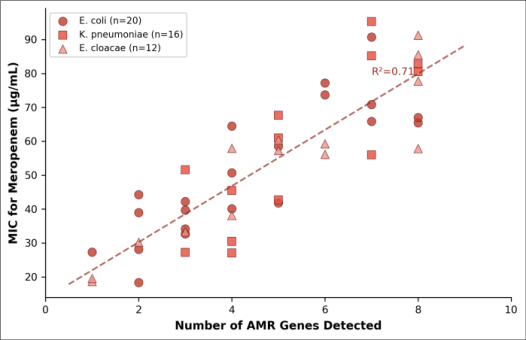 Figure 1
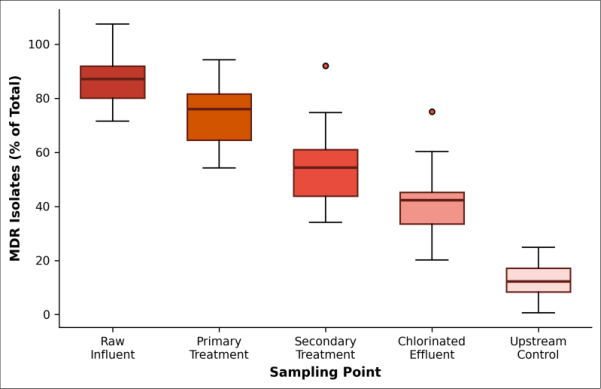 Figure 2
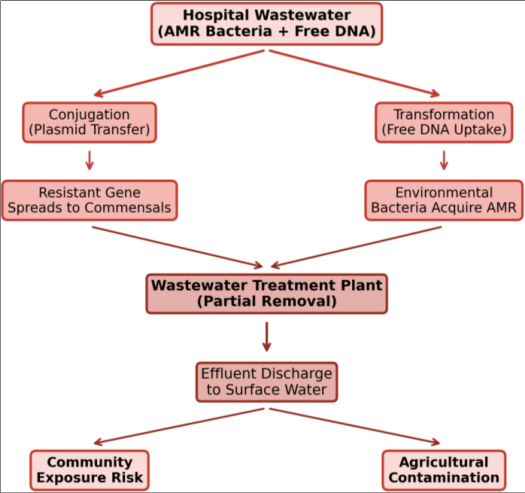 Figure 3
Introduction
Antimicrobial resistance kills more people each year than HIV and malaria combined. A 2019 global analysis attributed 1.27 million deaths directly to bacterial AMR, with Enterobacteriaceae responsible for a disproportionate share of the burden [1] . Hospital environments, where antibiotic usage is concentrated, generate wastewater that carries both resistant bacteria and the mobile genetic elements encoding resistance plasmids, integrons, and transposons that can spread resistance to environmental organisms [2]. Conventional wastewater treatment plants reduce bacterial loads through physical and chemical processes, but they weren't engineered to eliminate resistance genes or to prevent horizontal gene transfer [3] . Several investigations from urban India have found that hospital effluent contributes significantly to the AMR burden in receiving water bodies, with ESBLproducing Enterobacteriaceae detected even in treated effluent [4,5] . Northeast India presents a particularly understudied context. Manipur's healthcare infrastructure has expanded in recent decades, but wastewater treatment capacity hasn't kept pace [6] . Understanding how resistance profiles change along the treatment chain from raw influent to final discharge is important for identifying where interventions might be most effective [7] . Equally important is knowing which specific resistance genes persist through treatment, since some (like blaNDM-1) encode carbapenemases that threaten last-resort antibiotics [8] . This research aimed to characterize the species distribution, resistance phenotypes, and resistance gene carriage of Enterobacteriaceae at sequential points in a hospital wastewater treatment system in Imphal, Manipur.
Material and Methods
Material and Methods
Reagents and Chemicals
MacConkey agar, Mueller-Hinton agar, and brain heart infusion broth were obtained from HiMedia Laboratories (Mumbai, India). Antibiotic discs for susceptibility testing (panel of 18 antibiotics covering 8 classes) came from HiMedia and were stored at 4 °C until use. Etest strips for MIC determination of meropenem, imipenem, and colistin were purchased from bioMerieux (through their Mumbai distributor). PCR primers targeting blaCTX-M, blaTEM, blaSHV, blaNDM-1, blaOXA-48, and blaKPC were synthesized by Eurofins Genomics India (Bangalore). DNA extraction kits (DNeasy Blood and Tissue Kit) were sourced from Qiagen (New Delhi). Taq polymerase, dNTPs, and agarose were obtained from Thermo Fisher Scientific.
Material
Wastewater samples were collected from five points: raw influent (before any treatment), post-primary sedimentation, post-secondary biological treatment, post-chlorination effluent, and an upstream control site 200 meters above the hospital discharge point on the Nambul River. Treatment reduced but did not eliminate resistance genes (Table 2). blaCTX-M persisted most stubbornly, with nearly half of post-chlorination isolates still carrying it. The BlaNDM-1 gene was detected even after chlorination (14.2%), suggesting that some carbapenemase-producing organisms survive the full treatment chain.
| Gene | Raw influent | Post- primary | Post- secondary | Post- chlor. | Upstream control |
|---|---|---|---|---|---|
| blaCTX-M | 84.3% | 76.8% | 61.2% | 48.7% | 18.4% |
| blaTEM | 67.1% | 58.9% | 42.6% | 31.4% | 12.7% |
| blaSHV | 38.6% | 31.2% | 24.8% | 17.3% | 6.2% |
| blaNDM-1 | 31.4% | 27.8% | 19.4% | 14.2% | 4.1% |
| blaOXA-48 | 17.1% | 13.6% | 9.3% | 6.8% | 1.4% |
| blaKPC | 4.3% | 3.2% | 1.6% | 0.0% | 0.0% |
Table text extracted from the original PDF; superscript letters are shown inline. The original table image is below.
View original table image
Discussion
The high prevalence of MDR Enterobacteriaceae in hospital wastewater from Imphal mirrors patterns reported from larger Indian cities like Delhi and Chennai [4,9] but this is among the first systematic characterizations from northeast India. The 87.3% MDR rate in raw influent is alarming, though not unexpected for a tertiary care facility with active ICU and surgical wards where broad-spectrum antibiotics are prescribed routinely [10] What stands out is how incompletely the treatment system removes resistance. Chlorination reduced MDR prevalence from 87.3% to 38.1% a meaningful drop, but it means that more than a third of surviving isolates in the final effluent are still multidrug resistant. Other research groups in India have reported similar persistence after conventional treatment [5,11] . The detection of blaNDM-1 in 14.2% of post-chlorination isolates is particularly concerning, since NDM-1-producing bacteria have caused untreatable infections in healthcare settings globally and the gene spreads efficiently on mobile genetic elements [12] . The strong correlation between resistance gene count and carbapenem MIC (R²=0.71) suggests additive or synergistic interactions among co-carried resistance determinants.
Isolates carrying four or more resistance genes consistently showed MIC values above the CLSI breakpoint for resistance. This co-carriage pattern was most pronounced in K. pneumoniae, which also showed the highest rates of carbapenem and colistin resistance a combination that severely limits therapeutic options [13,14] .
Conclusion
Hospital wastewater in Imphal harbors a high burden of multidrug-resistant Enterobacteriaceae, with ESBLproducing and carbapenem-resistant strains persisting through conventional treatment processes. The blaCTX-M and blaNDM-1 genes were detected even in chlorinated effluent, confirming that standard wastewater treatment is insufficient to prevent the environmental dissemination of clinically important resistance genes. Klebsiella pneumoniae emerged as the most resistant species across all metrics, including colistin resistance at 7.3%. A clear gradient of decreasing resistance prevalence from influent to effluent demonstrates that treatment does reduce the AMR burden, but not enough to protect downstream water users. These
Figures and tables from the paper
| Species | n (%) | MDR (%) | ESBL (%) | Carbapenem resistant (%) | Colistin resistant (%) |
|---|---|---|---|---|---|
| E. coli | 104 (42.1) | 78.8 | 68.3 | 22.1 | 3.8 |
| K. pneumoniae | 82 (33.2) | 84.1 | 71.9 | 38.4 | 7.3 |
| E. cloacae | 31 (12.6) | 74.2 | 48.4 | 29.0 | 0.0 |
| C. freundii | 18 (7.3) | 66.7 | 44.4 | 16.7 | 0.0 |
| Others | 12 (4.8) | 58.3 | 33.3 | 8.3 | 0.0 |
| Total | 247 | 78.9 | 63.8 | 28.7 | 4.0 |
Table text extracted from the original PDF; superscript letters are shown inline. The original table image is below.