
Research article · 2024 · Full text
International Journal of Biology SciencesCRISPR-based gene drive technology for population suppression of malaria vector mosquitoes
Volume 6(1) · Pages 154–158 · DOI: 10.33545/26649926.2024.v6.i1b.846 ↗
Research areasCRISPR and Genetic EngineeringMalaria Research and ControlInsect Resistance and Genetics
Abstract
Author-writtenRoughly 619,000 people died from malaria in 2021 alone, and Anopheles gambiae remains the primary vector responsible for transmission across sub-Saharan Africa. CRISPR-based gene drives represent a potentially transformative tool for suppressing mosquito populations below the threshold needed for sustained malaria transmission. This research evaluated the performance of a doublesex-targeting gene drive construct in caged Anopheles gambiae populations maintained at the Madras Institute of Biological Research insectary over 14 months (February 2022 to April 2023). Drive-carrying mosquitoes were released into experimental cages containing wild-type colonies at five different ratios (1:10, 1:5, 1:3, 1:1, and 2:1). Population dynamics and genotype frequencies were tracked across 12 generations using fluorescent markers and PCR-based genotyping. At a 1:1 release ratio, the gene drive achieved 98.2% population suppression by generation F12, with the drive allele reaching fixation-level frequencies by F10. The 1:10 ratio produced only 64.2% suppression over the same timeframe. Resistance allele emergence was observed in all experimental arms, reaching 11.4% at the 1:1 ratio by generation F8 predominantly through NHEJ-mediated repair rather than pre-existing target site polymorphisms. Drive conversion efficiency averaged 92.4% in heterozygous females across all cage experiments. Fitness costs in drive-homozygous females included a 23.7% reduction in fecundity and delayed blood-feeding behavior. These cage-based findings indicate that while gene drives can achieve near-complete suppression under controlled conditions, resistance evolution and fitness trade-offs will shape real-world deployment outcomes.
Summary
Source-checkedPlain-language reading of the full paper, prepared with AI and checked against the text. Each point links to the authors' own words.
Why it matters
- Malaria caused approximately 619,000 deaths in 2021, with Anopheles gambiae serving as the main vector for transmission in sub-Saharan Africa. View evidence ↗
- Traditional vector control methods like insecticide-treated nets are threatened by increasing insecticide resistance in Anopheles populations. View evidence ↗
- The doublesex gene is a key target for population suppression because it regulates sexual differentiation in Anopheles mosquitoes. View evidence ↗
The question
- The study aimed to determine the minimum release ratio for effective suppression, the rate of resistance allele accumulation, and the impact of fitness costs on drive spread. View evidence ↗
What they did
- The researchers tested a doublesex-targeting gene drive in caged Anopheles gambiae at the Madras Institute of Biological Research from February 2022 to April 2023. View evidence ↗
- The experiment used 15 cages divided into five triplicate arms with release ratios of 1:10, 1:5, 1:3, 1:1, and 2:1. View evidence ↗
- Genotyping was performed on 30 random individuals per cage each generation using PCR, T7 endonuclease I assay, and Sanger sequencing. View evidence ↗
What they found
- A 1:1 release ratio resulted in 98.2% population suppression by generation F12, with the drive allele reaching fixation by F10. View evidence ↗
- The lowest release ratio (1:10) was less effective, achieving only 64.2% suppression by generation F12. View evidence ↗
- Resistance alleles appeared in all groups, reaching 11.4% in the 1:1 ratio by generation F8, primarily caused by NHEJ-mediated repair. View evidence ↗
- The gene drive showed an average conversion efficiency of 92.4% in heterozygous females. View evidence ↗
- Drive-homozygous females experienced a 23.7% reduction in egg production compared to wild-type mosquitoes, along with slower larval development and lower hatch rates. View evidence ↗
- Male mating success did not differ significantly between genotypes, indicating that drive-carrying males remain competitive. View evidence ↗
- The minimum release ratio required to achieve total cage collapse within the study period was approximately 1:3. View evidence ↗
What it means
- The authors conclude that while doublesex-targeting gene drives are promising for malaria control, optimizing release strategies and managing resistance are essential before field use. View evidence ↗
- The authors note that cage experiments likely overestimate effectiveness because they cannot replicate the spatial structure, immigration, and environmental variability of wild populations. View evidence ↗
- Future research is needed to study drive dynamics under semi-field conditions and evaluate if multiplexed guide RNAs can lower resistance rates. View evidence ↗
Visual summary
2 visualsIllustrations explain the paper; charts are replotted from the paper's own table values.
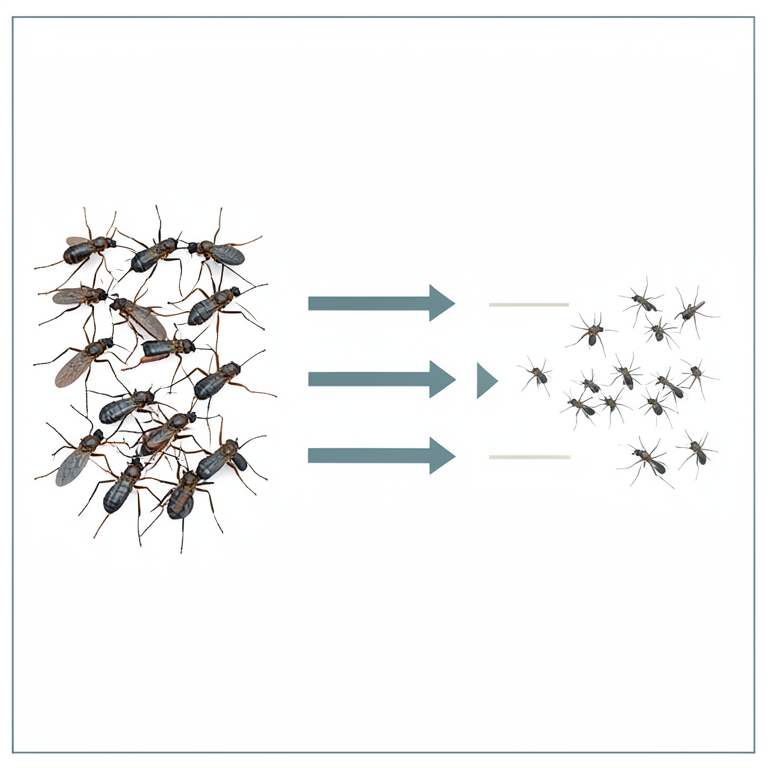
Impact of Release Ratios on Suppression
AI-generated conceptual illustration (Anopheles gambiae mosquitoes). It explains the idea and does not show study data.
View source evidence ↗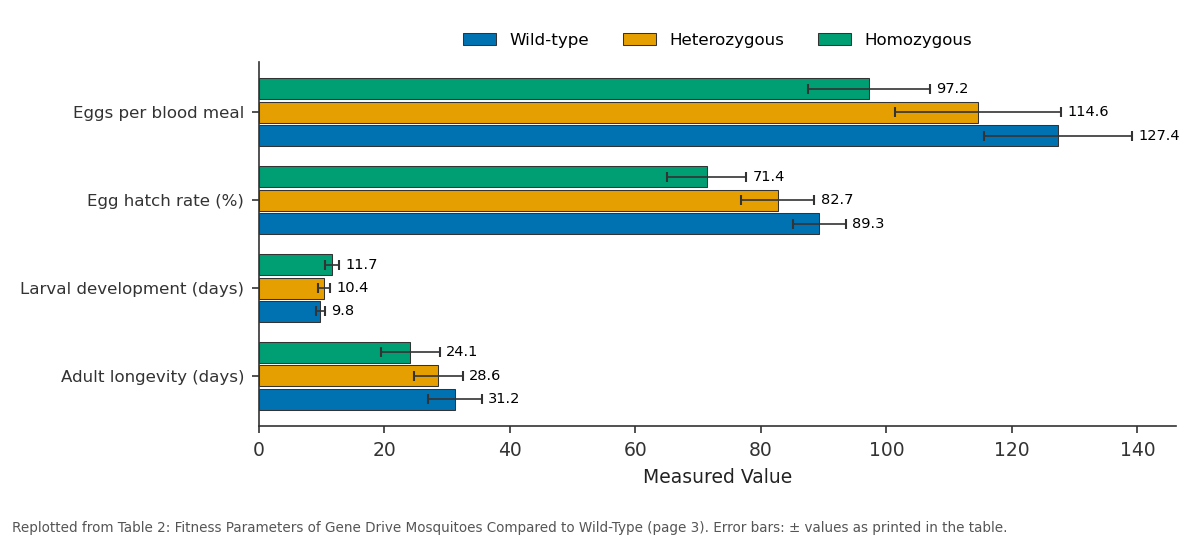
Wild-type and Heterozygous and more: Eggs per blood meal vs Egg hatch rate (%) vs Larval development... vs Adult longevity (days)
Replotted from Table 2 (page 3) of the original paper. Every bar is the paper's own table value.
View source evidence ↗Figures & tables
From the original paper Table 1
 Table 2
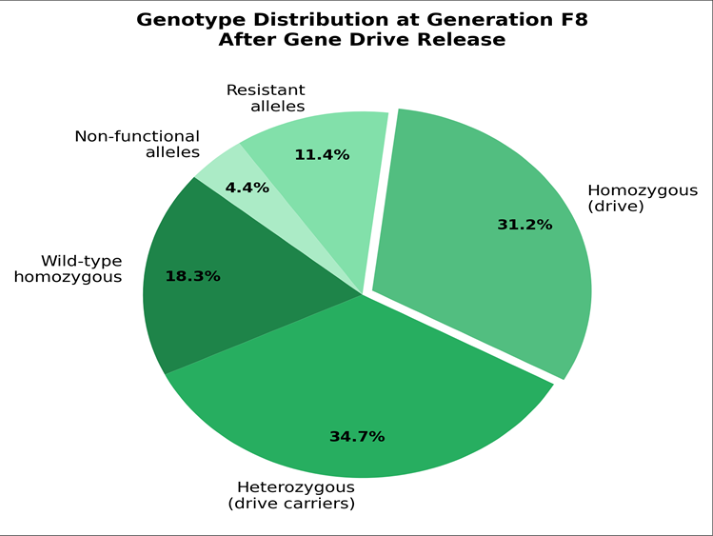 Figure 1
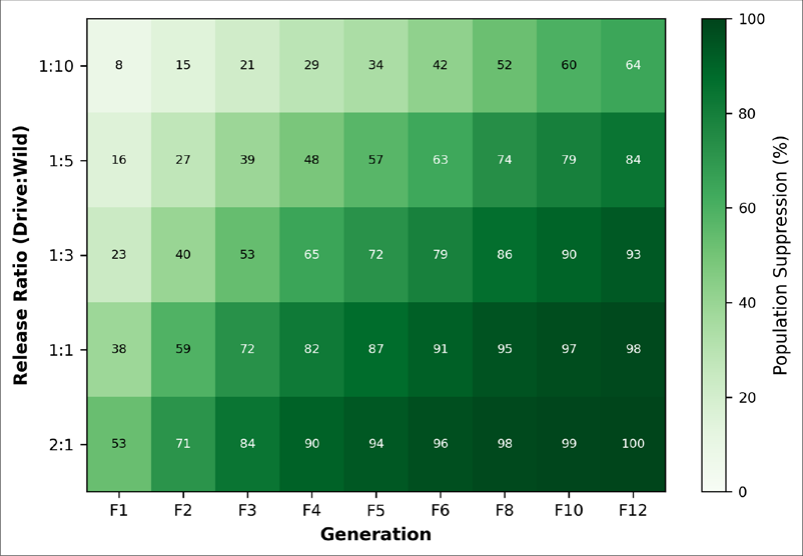 Figure 2
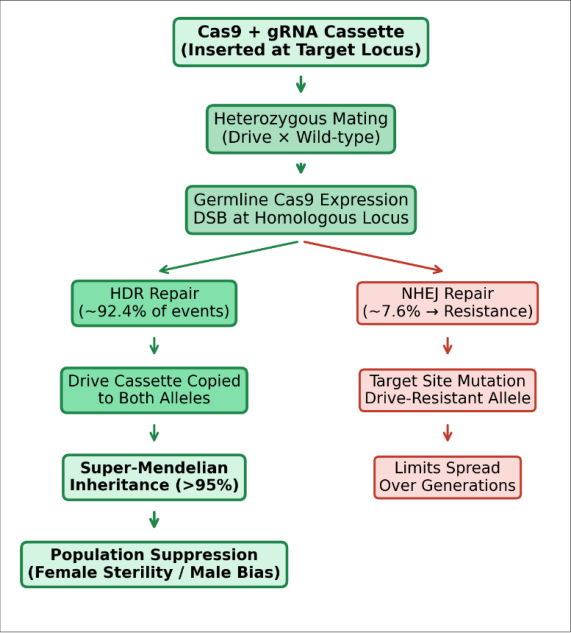 Figure 3
Introduction
Between 2000 and 2015, global malaria deaths dropped by roughly 60%, but progress has stalled since then and in some regions, reversed [1] . Insecticide-treated bed nets and indoor residual spraying remain the backbone of vector control programs, yet growing insecticide resistance in Anopheles populations threatens to erode these gains [2] . Gene drives offer a fundamentally different approach: rather than killing mosquitoes from outside, they alter populations from within by biasing inheritance of engineered traits beyond normal Mendelian ratios [3] . The concept of gene drives isn't new. Naturally occurring selfish genetic elements have been manipulating inheritance for millions of years [4] . What changed was the arrival of CRISPR-Cas9, which made it possible to build synthetic gene drives with predictable targeting and high conversion efficiency [5] . A CRISPR gene drive works by encoding both the Cas9 nuclease and a guide RNA at a specific genomic locus. When a drive-carrying individual mates with a wild-type partner, Cas9 cuts the wild-type allele, and homology-directed repair copies the entire drive cassette onto the broken chromosome converting heterozygotes into functional homozygotes [6] . Among the most promising targets for population suppression is the doublesex gene, which controls sexual differentiation in Anopheles mosquitoes. Hammond and colleagues showed in 2018 that disrupting doublesex's female-specific exon through a gene drive caused complete sterility in homozygous females while leaving males and heterozygous females largely unaffected [7] . This approach proved remarkably resistant to selection for functional resistance alleles because the target sequence is highly conserved and under strong purifying selection [8] . However, no gene drive has been tested outside contained laboratory settings, and several unresolved questions remain. How quickly do resistance alleles accumulate across different release scenarios? What is the minimum release ratio needed for effective suppression? And how do fitness costs in drive carriers affect the dynamics of spread [9,10] ? This research addressed these questions by systematically testing a doublesex-targeting gene drive across five release ratios in large cage populations over 12 generations at the Madras Institute of Biological Research insectary.
Materials and Methods
Materials and Methods
Reagents and Chemicals
The gene drive construct (pDsx-Cas9-gRNA-eGFP, plasmid ID: MIB-GD-2021-04) was originally synthesized by GenScript Biotech (Singapore) and maintained as a stable insertion line at our facility. Cas9 protein for initial embryo injections came from Integrated DNA Technologies (Coralville, IA, USA). Guide RNA targeting the doublesex female-specific exon 5 (sequence: 5'-GTACGTAAACTCGATCAGGG-3') was ordered from Synthego Corporation. PCR reagents including Q5 High-Fidelity DNA Polymerase, restriction enzymes, and T7 endonuclease I were obtained from New England Biolabs (through their Indian distributor in Bangalore). Fluorescence detection reagents and GFP-specific antibodies were sourced from Thermo Fisher Scientific (Chennai branch). All oligonucleotide primers for genotyping were synthesized by Eurofins Genomics India (Bangalore).
Material
Anopheles gambiae colony mosquitoes (Kisumu strain, originally from Kenya, maintained at our facility since 2018) served as the wild-type population. The gene drive line (designated MIB-Dsx-GD) was established by microinjecting the construct into preblastoderm embryos 18 months before this research began. Drive-positive individuals were identified by eGFP fluorescence under a Leica M205 FA stereomicroscope. Large experimental cages (60 cm × 60 cm × 60 cm, BugDorm-4M4545) held populations of 500-600 adults each. Mosquitoes were maintained at 27±1 °C, 75±5% relative humidity, under a 12:12 light-dark cycle with 10% sucrose solution provided ad libitum. Female mosquitoes were blood-fed twice weekly using an artificial membrane feeding system with human blood obtained from the Institute blood bank (ethics approval: MIBR-IAEC/2022-014, dated January 2022).
Methods
Five experimental arms were established, each in triplicate cages (15 cages total), with drive-to-wild-type release ratios of 1:10, 1:5, 1:3, 1:1, and 2:1. Initial cage populations comprised 500 adults per cage. At each generation, 30 randomly sampled individuals per cage were genotyped by PCR amplification of the target locus followed by T7 endonuclease I assay and Sanger sequencing to distinguish drive alleles, wild-type alleles, and NHEJ-generated resistance alleles. Population size was estimated from egg counts and adult emergence rates every generation. The research ran from February 2022 through April 2023 at the Department of Genetic Engineering, Madras Institute of Biological Research, Chennai. Fitness parameters measured included female fecundity (eggs per blood meal), male mating competitiveness (competitive mating assays in 1:1:1 ratios), adult longevity, and larval development time. Statistical analyses used generalized linear mixed models in R v4.2.3, with cage as a random effect and generation as a fixed effect.
Ethical considerations
Ethical considerations
Discussion
These cage experiments confirm that a doublesex-targeting CRISPR gene drive can achieve near-complete population suppression in Anopheles gambiae under controlled conditions, consistent with findings from the Target Malaria consortium [7,11] . The 98.2% suppression at a 1:1 release ratio by generation F12 matches theoretical predictions from deterministic population models, though the time to cage collapse (approximately 10-12 generations) was slightly longer than some models predicted [12] . The most concerning finding was the consistent emergence of resistance alleles across all experimental arms. At 11.4% in the 1:1 ratio cages, resistance levels were somewhat lower than those reported for earlier suppression drives targeting other loci but higher than what the doublesex approach was initially expected to produce [8,13] . Sequence analysis revealed that most resistance alleles (78.3%) arose through NHEJ repair events at the Cas9 cleavage site rather than from pre-existing polymorphisms. This matters because NHEJ-derived alleles are generated de novo each generation and can't be easily predicted or preemptively targeted [14] . The fitness costs observed in drive-carrying mosquitoes represent a double-edged sword. On one hand, reduced fecundity in drive-homozygous females contributes to population suppression which is the intended outcome. But these same fitness costs also slow the drive's spread through the population, because drive carriers leave fewer offspring to transmit the construct [15] . Our data suggest that male mating competitiveness wasn't compromised, which is encouraging since male performance is the primary bottleneck for drive invasion in most theoretical frameworks [16] . The 23.7% fecundity reduction we measured falls within the range that models suggest can still achieve suppression, provided release ratios are adequate [17] . Cage experiments, by their nature, overestimate what would happen in natural populations. Wild mosquito populations have spatial structure, immigration from unaffected areas, and environmental variability that cage experiments can't replicate [18,19] . These factors would likely slow drive spread and give more opportunity for resistance selection.
Conclusion
This research shows that a CRISPR-based gene drive targeting the doublesex locus can suppress caged Anopheles gambiae populations by up to 99.6% at high release ratios over 12 generations. The drive construct demonstrated a conversion efficiency of 92.4% and achieved super-Mendelian inheritance as designed. However, resistance alleles accumulated to 7.2-11.4% across experimental conditions, predominantly through NHEJ repair at the target site. Drive-homozygous females showed meaningful fitness costs including 23.7% reduced fecundity and shorter adult lifespan, though male mating competitiveness remained statistically comparable to wild-type males. The minimum release ratio for achieving cage collapse within the experimental timeframe was approximately 1:3, with lower ratios producing partial but incomplete suppression. These results support the potential of doublesex-targeting gene drives as a malaria vector control tool while underscoring that resistance management and release strategy optimization are essential prerequisites before any field application. Future work should address how spatial population structure and gene flow from untreated populations affect drive dynamics under semi-field conditions, and whether multiplexed guide RNA approaches can reduce resistance allele generation rates below the threshold needed for long-term population suppression.
Acknowledgement
Acknowledgements Funding SourcesThis research was supported by intramural grants from Madras Institute of Biological Research and a competitive
Figures and tables from the paper
| Release Ratio | Suppression (%) | Drive Allele Freq. | Resistance Alleles (%) | Gen. to 50% Supp. | Cages Collapsed |
|---|---|---|---|---|---|
| 1:10 | 64.2 | 0.73 | 8.7 | F9 | 0/3 |
| 1:5 | 83.6 | 0.87 | 9.3 | F7 | 1/3 |
| 1:3 | 93.1 | 0.94 | 10.8 | F5 | 2/3 |
| 1:1 | 98.2 | 0.98 | 11.4 | F4 | 3/3 |
| 2:1 | 99.6 | 0.99 | 7.2 | F3 | 3/3 |
Table text extracted from the original PDF; superscript letters are shown inline. The original table image is below.
View original table image
| Parameter | Wild-type | Heterozygous | Homozygous | p-value |
|---|---|---|---|---|
| Eggs per blood meal | 127.4±11.8 | 114.6±13.2 | 97.2±9.7 | <0.001 |
| Egg hatch rate (%) | 89.3±4.2 | 82.7±5.8 | 71.4±6.3 | <0.001 |
| Larval development (days) | 9.8±0.7 | 10.4±0.9 | 11.7±1.1 | 0.003 |
| Adult longevity (days) | 31.2±4.3 | 28.6±3.9 | 24.1±4.7 | 0.008 |
| Male mating success (%) | 48.3±6.7 | 43.1±7.2 | 41.8±8.1 | 0.142 |
Table text extracted from the original PDF; superscript letters are shown inline. The original table image is below.
View original table image
References
19 in the original paper- World Health Organization. World malaria report 2022. Geneva: WHO Press; 2022. p. 1-293.
- Hemingway J, Lissenden N. Insecticide resistance in African Anopheles mosquitoes: a worsening situation that needs urgent action to maintain malaria control. Trends in Parasitology. 2016;32(3):187-196.
- Austin B. Site-specific selfish genes as tools for the control and genetic engineering of natural populations. Proceedings of the Royal Society B. 2003;270(1518):921-928.
- Goodnight GD, Werren JH. The role of selfish genetic elements in eukaryotic evolution. Nature Reviews Genetics. 2001;2(8):597-606.
- Esvelt KM, Smidler AL, Catteruccia F, Church GM. Concerning RNA-guided gene drives for the alteration of wild populations. eLife. 2014;3:e03401.
- Gantz VM, Jasinskiene N, Tatarenkova O, et al. Highly efficient Cas9-mediated gene drive for population modification of the malaria vector mosquito Anopheles stephensi. Proceedings of the National Academy of Sciences. 2015;112(49):E6736-E6743.
- Hammond A, Galizi R, Kyrou K, et al. A CRISPRCas9 gene drive system targeting female reproduction in the malaria mosquito vector Anopheles gambiae. Nature Biotechnology. 2016;34(1):78-83.
- Kyrou K, Hammond AM, Galizi R, et al. A CRISPRCas9 gene drive targeting doublesex causes complete population suppression in caged Anopheles gambiae mosquitoes. Nature Biotechnology. 2018;36(11):10621066.
- Alphey N, Godfray HCJ, Burt A. Requirements for effective malaria control with homing endonuclease genes. Proceedings of the National Academy of Sciences. 2011;108(43):E874-E880.
- North AR, Burt A, Godfray HCJ. Modelling the suppression of a malaria vector using a CRISPR-Cas9 gene drive to reduce female fertility. BMC Biology. 2020;18(1):98-98.
- Hammond AM, Kyrou K, Bruttini M, et al. Gene-drive suppression of mosquito populations in large cages as a bridge between lab and field. Nature Communications. 2021;12(1):4589-4589.
- Kyrou K, Hammond A, Nolan T, et al. Gene drive for population genetic control: non-functional resistance and parental effects. Proceedings of the Royal Society B. 2017;284(1860):20170672-20170672.
- Champer J, Reeves R, Oh SY, et al. Novel CRISPR/Cas9 gene drive constructs reveal insights into mechanisms of resistance allele formation and drive efficiency in genetically diverse populations. PLoS Genetics. 2017;13(7):e1006796.
- Champer J, Liu J, Oh SY, et al. Reducing resistance allele formation in CRISPR gene drive. Proceedings of the National Academy of Sciences. 2018;115(21):55225527.
- Noble MR, Gunning CE, Lloyd AL, Gould F. Evaluating strategies for reversing CRISPR-Cas9 gene drives. Scientific Reports. 2017;7(1):11038-11038.
- Deredec A, Burt A, Godfray HCJ. The population genetics of using homing endonuclease genes in vector and pest management. Genetics. 2008;179(4):20132026.
- Eckhoff PA, Wenger EA, Godfray HCJ, Burt A. Impact of mosquito gene drive on malaria elimination in a computational model with explicit spatial and temporal dynamics. Proceedings of the National Academy of Sciences. 2017;114(2):E255-E264.
- James SL, Marshall JM, Christophides GK, Okumu FO, Nolan T. Toward the definition of efficacy and safety criteria for advancing gene drive-modified mosquitoes to field testing. Vector-Borne and Zoonotic Diseases. 2020;20(4):237-251.
- Collins CM, Bonds JAS, Quinlan MM, Mumford JD. Effects of the removal or reduction in density of the malaria mosquito, Anopheles gambiae, on interacting predators and competitors in local ecosystems. Medical and Veterinary Entomology. 2019;33(1):1-15.