
Research article · 2026 · Full text
International Journal of Biology SciencesSeaweed: An innovation in global food sector
Volume 8(5) · Pages 166–169 · DOI: 10.33545/26649926.2026.v8.i5c.844 ↗
Research areasSeaweed-derived Bioactive CompoundsMarine and coastal plant biologyFood Industry and Aquatic Biology
Abstract
Author-writtenSeaweed is traditionally consumed in countries like Japan, China, and South Korea. This is now gaining worldwide recognition as a sustainable, nutritious, and climate-friendly food source. Global cultivation of algae, dominated by seaweeds, grew by half a million tonnes in 2025. However, India is in the infant stage of the seaweed culture. About 200 species are being commercially cultivated along the coasts of Tamil Nadu, Gujarat and around Lakshadweep and Andaman & Nicobar Islands. Now the expansion of cultivation going along the coastal line. India has set an ambitious target to produce over 1.12 million metric tonnes (MT) of fresh seaweed by 2025-26 under the Pradhan Mantri Matsya Sampada Yojana (PMMSY). The main varieties include Chlorophyta (green algae), Phaeophyta (brown algae) and Rhodophyta (red algae). This initiative aims to scale up production from roughly 34,000-74,000 tonnes currently, with a long-term goal of fostering a major industry for coastal livelihood. The present review highlights the various types of seaweeds and their potential applications and uses.
Summary
Source-checkedPlain-language reading of the full paper, prepared with AI and checked against the text. Each point links to the authors' own words.
Why it matters
- Seaweed is traditionally eaten in East Asian countries and is increasingly recognized globally as a sustainable and nutritious food source. View evidence ↗
- The global food supply may need to increase by 50-70% to keep up with current consumption patterns due to rapid population growth. View evidence ↗
- Seaweeds are large marine algae that grow in coastal and brackish waters at depths up to 118-120 meters. View evidence ↗
The question
- The objective of this review is to examine the different types of seaweeds and their potential uses and applications. View evidence ↗
What they did
- Seaweeds are categorized into three main divisions, green (Chlorophyta), brown (Phaeophyta), and red (Rhodophyta), based on their photosynthetic pigments. View evidence ↗
- Under the Pradhan Mantri Matsya Sampada Yojana (PMMSY), India aims to produce more than 1.12 million metric tonnes of fresh seaweed by 2025-26. View evidence ↗
What they found
- Out of more than 20,000 seaweed species worldwide, only 221 (1.1%) are utilized commercially. View evidence ↗
- The protein content in seaweeds varies from 5% to 47% of their dry weight. View evidence ↗
- Carbohydrates are a major component of seaweed, making up 30-60% of its composition. View evidence ↗
- Seaweeds have a low total fat content, ranging between 1% and 5%. View evidence ↗
- The mineral content of seaweeds is frequently 10 to 20 times higher than that found in land-based vegetables. View evidence ↗
- Dietary fiber, primarily soluble, makes up 25-75% of the dry weight of marine algae. View evidence ↗
- Polyphenols found in seaweed may act as antioxidants that protect the body from free radical damage. View evidence ↗
- The species Saccharina japonica has been used to produce bio-oil for green electricity generation. View evidence ↗
- Extracts from the red seaweed Gracilaria salicornia have been used to create bioplastic films. View evidence ↗
What it means
- The authors conclude that seaweed is a sustainable and nutritious resource with great potential to improve nutritional security, particularly in coastal areas. View evidence ↗
- The authors note that seaweed remains underutilized in India compared to its widespread use in East Asian and Western countries. View evidence ↗
Visual summary
1 visualsIllustrations explain the paper; they do not show study data.
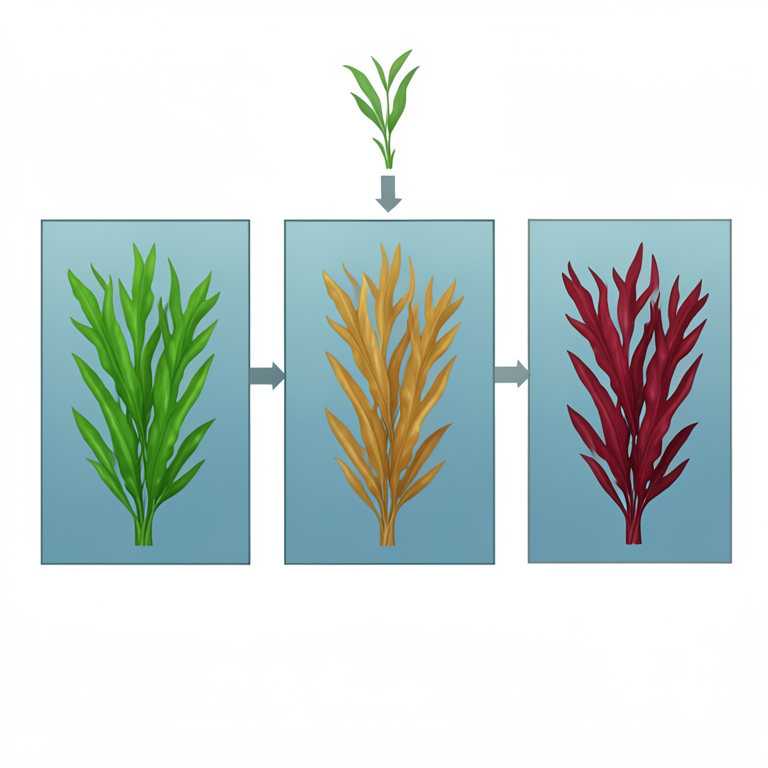
Seaweed Classification
AI-generated conceptual illustration (Green, brown, and red seaweeds). It explains the idea and does not show study data.
View source evidence ↗Figures & tables
From the original paper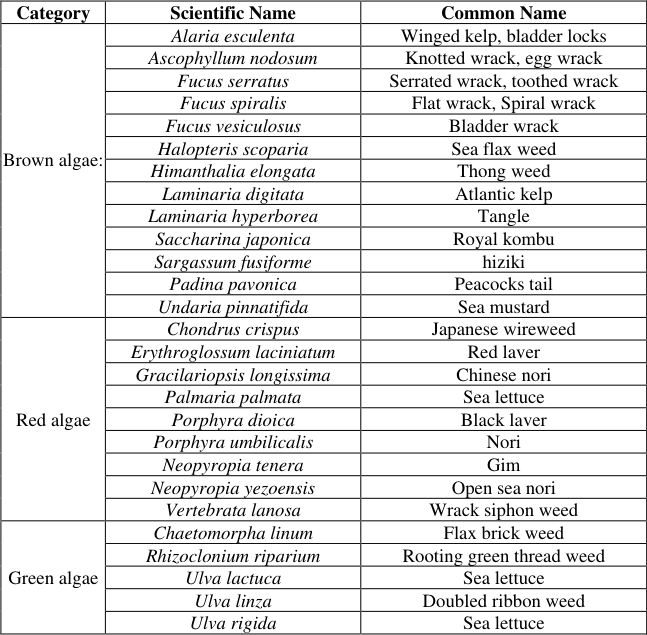 Table 1
Introduction
Seaweeds are macroscopic benthic marine algae growing in marine and shallow coastal waters and brackish water habitats up to a depth of 118 -120 m where negligible amount of photosynthetic light is available (Chapman, 1970; Okazaki, 1971) [5,6] . They are primitive type of plants can be very tiny, or quite large, growing up to 30 meters long. Seaweeds found attached to rocks in the intertidal zone, washed up on the beach and floating on the ocean's surface. It's widely used as food, fertilizer, animal feed, and in industry, and it plays an important ecological role in marine ecosystems. Seaweeds are found in the coastal region between high tide to low tide and in the sub-tidal region up to a depth where 0.01% photosynthetic light is available (Dhargalkar, 2004) [11] . Seaweeds are often considered as sea vegetables because of their nutritional values and one of the most important renewable resources found in the marine environment. Seaweeds have been used as animal feed since ages. Seaweeds have been mentioned in Chinese literature for 2500 years ago (Tseng et al., 2004) [27] . Greeks were using seaweeds as animal feed in as early as first century BC. However, its use as feed was localized in coastal European countries such as Ireland, Iceland, Norway, France, Spain, and Portugal (McHugh, 2003; Kumar and Kaladharan, 2007) [21] . In many parts of the world, they are frequently used as food and feed ingredients, and in several European and Asian countries, as well as Japan, China, and Korea, they are considered a delicacy (Mir et al., 2018). Due to the rapid increase of world population in current scenario, the globe will need to produce 50-70% more food to sustain current consumption patterns (Dey et al., 2025) [9,23] . In Asia, seaweeds have been used for centuries in salads, soups and as low-calorie dietetic foods. The dietary fibre which constitutes 25-75% of the dry weight of marine algae and represents their major component, is primarily soluble fibre (Jimenez-Escrig and Sanchez-Muniz, 2000, Premarathna et al., 2022) [25] . Nowadays, dietary fibre from different food sources is in focus as they decrease the risk of coronary artery disease. The capacity of seaweed polysaccharides to lower serum cholesterol levels seems to be due to their ability to disperse in water, retain cholesterol and related physiologically active compounds and inhibit lipid absorption in the gastrointestinal tract (Jimenez-Escrig and Sanchez-Muniz, 2000) [18] . Over 20,000 species of seaweeds are found globally, yet only 221 (1.1%) are used commercially. This includes 145 species for food consumption and 110 species for the production of phycocolloids (Chennubhotla et al., 2013, Yadav et al., 2020) [7,30] . Marine macroalgae have been used as food for centuries, especially in Asian coastal regions (Bast, 2014 & Wilding et al., 2021) [2,29] . In recent years, seaweed has gained global attention as a nutrient-dense, sustainable, and functional food with applications in animal feed, bio-based products, pharmaceuticals, and aquaculture due to its nutritional aspects. Edible seaweeds provide a substantial source of dietary fibre, protein, vital fatty acids, vitamins, minerals, and a variety of useful polysaccharides (Bhaskar & Miyashita, 2005, Rajasulochana et al., 2010) [3,26] . Additionally, seaweeds are also gaining importance as healthy food for human consumption as it is one of the best sources of both water and lipid soluble vitamins like thiamine, riboflavin, βcarotene, and tocopherols. The Japanese have been eating raw fish, sticky rice, and other foods in combination with seaweed called as "Nori" for at least 1,500 years (Pati et al., 2016) [24] . Apart from their utility as a source of food, food derivatives, proteins, etc., in India seaweeds are mostly employed for the industrial production of phycocolloids such as agar-agar, alginate, and carrageenan, but not for culinary purposes (Dhargalkar & Pereira, 2005) [12] . India has good potential for seaweed farming, especially along the Tamil Nadu, Gujarat, Andhra Pradesh, and Lakshadweep coasts, with species like Kappaphycus and Gracilaria. There are also rich seaweed beds around Mumbai, Ratnagiri, Goa, Karwar, Varkala, Vizhinjam and Pulicat in Tamil Nadu and Chilka in Orissa (Kaliaperumal, 1993) [19] . Out of approximately 700 species of marine algae found in both inter-tidal and deep-water regions of the Indian coast, nearly 60 species are commercially important. Agar yielding red seaweeds such as Gelidiella acerosa and Gracilaria sp. are collected throughout the year while algin yielding brown algae such as Sargassum and Turbinaria are collected seasonally from August to January on Southern coast. The surveys conducted by Central Salt and Marine Chemicals Research Institute (CSMCRI) and Central Marine Fisheries Research Institute (CMFRI), along with other research organizations, have clearly demonstrated that the coastal belts of South India possess abundant and diverse seaweed resources (Gopalakrishnan., 2024) [14] . On the West Coast, especially in the state of Gujarat, abundant seaweed resources are present on the intertidal and subtidal regions (Dhargalkar & Deshmukhe, 1996) [10] . These resources have great potential for the development of seaweed-based industries in India which are nutritional important in the diet. Basically, depending upon the photosynthetic pigments in seaweeds, these were classified into three major divisions such as Chlorophyta (green algae), Phaeophyta (brown algae) and Rhodophyta (red algae) (Chapman & Chapman, 1980) [5,6] . There are about 900 species of green seaweed, 4000 red species and 1500 brown species found in nature (Dawes, 1998) [8] . As the natural seaweed can be had fresh, cooked, dried or as a supplement diet. Sea lettuce Source: Banach et al., 2020 [1] Seaweeds have long been important contributors to food security and livelihoods around the world, delivering benefits through diverse food and non-food applications. Its food uses are especially relevant in Asia, which has a history of over 2000 years of consuming the commodity either fresh as salads in Malaysia and Indonesia or processed as "Nori" (Cai et al., 2021) [4] . The nutritional benefits of seaweed depend on the type (brown, green or red) and whether it's raw, cooked or dried. Overall, seaweed has ten times higher minerals of many vegetables. They are rich in polysaccharides, a type of carbohydrate, that is used by the food industry as a thickener and emulsifier. These polysaccharides also act like dietary fibres and promote gut health as a prebiotic food source for beneficial gut bacteria. Seaweed is a good source of follows:
e) Minerals
Seaweeds are exceptionally rich in minerals like Iodinesupports thyroid function, Calcium, Iron, Magnesium, Potassium, Zinc and Selenium. Mineral content is often 10-20 times higher than in terrestrial vegetables.
Uses of seaweed
• Human food: nori, wakame, kombu (common in Asian diets) • Aquaculture & agriculture: organic fertilizer, soil conditioner, feed additive • Industry: agar, alginate, carrageenan (food, pharma, cosmetics)
Environmental benefits
• Carbon sequestration • Nutrient removal (useful in integrated multi-trophic aquaculture -IMTA) • Coastal habitat and shoreline protection Health benefits of seaweed Seaweed's natural plant chemicals (phytochemicals) and low calories and fat make it a nutritional powerhouse or superfood.
Lowers risk of certain diseases
Seaweed has several nutrients that help prevent disease, including polyphenols and omega-3 fatty acids. It's also high in carotenoids like beta-carotene and lutein. Some studies suggest that polyphenols in seaweed act as antioxidants, helping protect against the damaging effects of free radicals (Michalak et al., 2022) [22] . Cell damage from free radicals can lead to cancer, autoimmune disease, Alzheimer's disease and other life-changing conditions.
Improves gut health
Seaweed is rich in polysaccharides. This carbohydrate acts like dietary fiber and serves as a food source (prebiotic) for healthy bacteria in the gut. Seaweed has other healthy fibres including cellulose.
Industrial applications of seaweed
Saccharina japonica have been largely applied in the bio-oil production, which can be used as a combustion fuel for green electricity generation (Zeb et al., 2017) [31] . Red seaweed extracts like Gracilaria salicornia were used as a raw material for the synthesis of bioplastic film (Hi et al., 2016), as a multiproduct source for biotechnological, nutraceutical, and pharmaceutical applications with Gracilaria gracilis (Francavilla et al., 2013) [13] and as a flavour supplement like savoury source for seafood products with Gracilaria fisheri (Laohakunjit et al., 2014) [20] . Other seaweeds like carrageenan are used to make traditional medicinal teas and cough medicines to cure cold, bronchitis, chronic cough with Chondrus crispus and to cure diarrhoea, constipation and dysentery by Mastocarpus stellatus red seaweed species (Holdt and Kraan, 2011) [17] . The red algae, namely Gelidium and Gracilaria, are commercially important in the agar industry and provide bioremediation properties when cultured in effluent waters. Hanjabam et al. (2017) [15] investigated the nutritional impact of adding seaweed to jerky, a snack made from tuna, a marine species.
Conclusion
India's coastline harbours an extensive diversity of seaweed species, presenting a rich resource of bioactive compounds and essential minerals with numerous health benefits. Despite seaweed being widely consumed in Western and East Asian countries, it remains relatively underutilized in the Indian subcontinent. The ongoing depletion of marine resources in Indian waters, there is an increasing need to explore unconventional resources such as seaweed to develop commercially valuable food products. Seaweed is a highly nutritious, functional, and sustainable food resource with immense potential to address nutritional security, especially in coastal regions. With proper cultivation, processing, and awareness, seaweed can play a major role in future food systems, aquaculture, and public health. Seaweed, offers promising potential due to its nutritional richness and functional properties, which make it suitable for value-added products in the food industry as per present market demand.
Figures and tables from the paper
| Category | Scientific Name | Common Name |
|---|---|---|
| Brown algae: | Alaria esculenta | Winged kelp, bladder locks |
| Ascophyllum nodosum | Knotted wrack, egg wrack | |
| Fucus serratus | Serrated wrack, toothed wrack | |
| Fucus spiralis | Flat wrack, Spiral wrack | |
| Fucus vesiculosus | Bladder wrack | |
| Halopteris scoparia | Sea flax weed | |
| Himanthalia elongata | Thong weed | |
| Laminaria digitata | Atlantic kelp | |
| Laminaria hyperborea | Tangle | |
| Saccharina japonica | Royal kombu | |
| Sargassum fusiforme | hiziki | |
| Padina pavonica | Peacocks tail | |
| Undaria pinnatifida | Sea mustard | |
| Red algae | Chondrus crispus | Japanese wireweed |
| Erythroglossum laciniatum | Red laver | |
| Gracilariopsis longissima | Chinese nori | |
| Palmaria palmata | Sea lettuce | |
| Porphyra dioica | Black laver | |
| Porphyra umbilicalis | Nori | |
| Neopyropia tenera | Gim | |
| Neopyropia yezoensis | Open sea nori | |
| Vertebrata lanosa | Wrack siphon weed | |
| Green algae | Chaetomorpha linum | Flax brick weed |
| Rhizoclonium riparium | Rooting green thread weed | |
| Ulva lactuca | Sea lettuce | |
| Ulva linza | Doubled ribbon weed | |
| Ulva rigida | Sea lettuce |
Table text extracted from the original PDF; superscript letters are shown inline. The original table image is below.
View original table image
References
31 in the original paper- Banach JL, Hoek-Van Den Hil EF, Van Der Fels-Klerx HJ. Food safety hazards in the European seaweed chain. Compr Rev Food Sci Food Saf. 2020;19(2):332-364.
- Bast F. Seaweeds: ancestors of land plants with rich diversity. Resonance. 2014;19(2):149-159.
- Bhaskar N, Miyashita K. Lipid composition of Padina tetrastomatica (Dictyotalea, Phaeophyta), brown seaweed of the West coast of India. Indian J Fish. 2005;52:263-268.
- Cai J, Lovatelli A, Aguilar-Manjarrez J, Cornish L, Dabbadie L, Desrochers A, et al. Seaweeds and microalgae: an overview for unlocking their potential in global aquaculture development. FAO Fish Aquac Circ. 2021;(1229).
- Chapman VJ. Seaweeds and their uses. London: Methuen; 1970.
- Chapman VJ, Chapman DJ. Seaweed as animal fodder, manure and for energy. In: Seaweeds and their uses. London: Chapman and Hall; 1980. p. 30-61.
- Chennubhotla VS, Rao MU, Rao KS. Exploitation of marine algae in Indo-Pacific region. Seaweed Res Util. 2013;35(1-2):1-7.
- Dawes CJ. Marine botany. New York: John Wiley & Sons; 1998. p. 480.
- Dey S, Santra M, Choudhury M, Ghosh AR, Samanta P. Food waste generation and its industrial utilization: an overview. Environ Sci Pollut Res. 2025;32(12):74937512.
- Dhargalkar VK, Deshmukhe GV. Subtidal marine algae of the Dwaraka coast (Gujarat). Indian J Mar Sci. 1996;25(4):297-301.
- Dhargalkar VK, Kavlekar DP. Seaweeds-a field manual. Goa: National Institute of Oceanography; 2004.
- Dhargalkar VK, Pereira N. Seaweed: promising plant of the millennium. Sci Cult. 2005;4:62-66.
- Francavilla M, Franchi M, Monteleone M, Caroppo C. The red seaweed Gracilaria gracilis as a multiproducts source. Mar Drugs. 2013;11(10):3754-3776.
- Gopalakrishnan A. Role of CMFRI in seaweed mariculture in India and development of high-value compounds and biomass utilization for Atmanirbhar Swasth Bharat. 2024.
- Hanjabam MD, Zynudheen AA, Ninan G, Panda S. Seaweed as an ingredient for nutritional improvement of fish jerky. J Food Process Preserv. 2017;41(2).
- Hii SL, Lim JY, Ong WT, Wong CL. Agar from Malaysian red seaweed as potential material for synthesis of bioplastic film. J Eng Sci Technol. 2016;7:115.
- Holdt SL, Kraan S. Bioactive compounds in seaweed: functional food applications and legislation. J Appl Phycol. 2011;23(3):543-597.
- Jimenez-Escrig A, Sanchez-Muniz FJ. Dietary fibre from edible seaweeds: chemical structure, physicochemical properties and effects on cholesterol metabolism. Nutr Res. 2000;20(4):585-598.
- Kaliaperumal N. Seaweed culture. In: Handbook on aquafarming-seaweed, sea urchin and sea cucumber. Cochin: MPEDA; 1993. p. 9-22.
- Laohakunjit N, Selamassakul O, Kerdchoechuen O. Seafood-like flavour obtained from the enzymatic hydrolysis of the protein by-products of seaweed (Gracilaria sp.). Food Chem. 2014;158:162-170.
- McHugh DJ. A guide to the seaweed industry. Rome: FAO; 2003.
- Michalak I, Tiwari R, Dhawan M, Alagawany M, Farag MR, Sharun K, et al. Antioxidant effects of seaweeds and their active compounds on animal health and production a review. Vet Q. 2022;42:48-67.
- Mir I, Sushila N, Bhat IA, Dar SA, Dar JY, Muralidhar A, et al. Fucoidan: a sulphated polysaccharide and its bioactive potential in aquaculture. Aquac Times. 2018;4:17-21.
- Pati MP, Sharma SD, Nayak L, Panda CR. Uses of seaweed and its application to human welfare: a review. Int J Pharm Pharm Sci. 2016;8(10):12-20.
- Premarathna AD, Tuvikene R, Fernando PHP, Adhikari R, Perera MCN, Ranahewa TH, et al. Comparative analysis of proximate compositions, mineral and functional chemical groups of 15 different seaweed species. Sci Rep. 2022;12(1):19610.
- Rajasulochana P, Dhamotharan R, Murugakoothan P, Murugesan S, Krishnamoorthy P. Biosynthesis and characterization of gold nanoparticles using the alga Kappaphycus alvarezii. Int J Nanosci. 2010;9(5):511516.
- Tseng CK. Seaweed cultivation for the elimination of marine pollution arising from animal mariculture. In: Marine science into the new millennium: new perspectives and challenges. Proceedings of the AsiaPacific Conference on Marine Science & Technology; 2002 May 12-16; Kuala Lumpur, Malaysia. Kuala Lumpur: Ministry of Sciences, Technology & Innovation; 2004. p. 449.
- Vinoj Kumar V, Kaladharan P. Amino acids in the seaweeds as an alternate source of protein for animal feed. J Mar Biol Assoc India. 2007;49(1):35-40.
- Wilding C, Tillin HM, Corrigan SE, Stuart E, Ashton IA, Felstead P, et al. Seaweed aquaculture and mechanical harvesting: an evidence review to support sustainable management. Natural England. 2021;117.
- Yadav S, Palanisamy M, Murthy G. Seaweed resources of Kerala coast and its economic potential. Madras Agric J. 2020.
- Zeb H, Park J, Riaz A, Ryu C, Kim J. High-yield bio-oil production from macroalgae (Saccharina japonica) in supercritical ethanol and its combustion behaviour. Chem Eng J. 2017;327:79-90.