
Research article · 2026 · Full text
International Journal of Advanced Chemistry ResearchMolecular interaction studies of aqueous l-proline using volumetric measurements at various temperatures
Volume 8(5) · Pages 10–16 · DOI: 10.33545/26646781.2026.v8.i5a.668 ↗
Research areasThermodynamic properties of mixturesDiffusion Coefficients in LiquidsChemical and Physical Properties in Aqueous Solutions
Abstract
Author-writtenA detailed volumetric investigation of L-proline was undertaken in pure water and in aqueous media containing potassium chloride (electrolytic additive) and D-glucose (non-electrolytic additive). Density data were recorded within the molality interval 0.03-0.20 mol·kg⁻¹ over the temperature range 288.15-318.15 K at atmospheric pressure. Using the experimental density values, several thermodynamic quantities such as apparent molar volume(Vϕ ) limiting apparent molar volume (Vϕ0 ), limiting apparent molar transfer volume (ΔtrVϕ0 ) and Hepler’s parameter were determined. These volumetric functions were employed to examine the nature of molecular interactions, particularly solute-solvent and solute-solute associations, and their temperature dependence. The obtained results demonstrate that both KCl and D-glucose markedly modify the hydration and solvation characteristics of L-proline. The study provides useful information regarding intermolecular behaviour in biologically significant aqueous systems and clarifies the effect of co-solutes on hydration phenomena.
Summary
Source-checkedPlain-language reading of the full paper, prepared with AI and checked against the text. Each point links to the authors' own words.
Why it matters
- Amino acids serve as the basic building blocks of proteins, and studying their properties in solution provides critical insights into how proteins fold, remain stable, and recognize other molecules. View evidence ↗
- Because proteins are too complex and large for direct study, researchers use amino acids as simpler model compounds to investigate microscopic intermolecular interactions. View evidence ↗
- The presence of co-solutes in a system can change how biomolecules behave by interacting with them directly or by altering the structure of the surrounding water. View evidence ↗
The question
- The study aims to determine how temperature and the addition of co-solutes affect the interactions between solute-solvent and solute-solute in binary and ternary liquid systems. View evidence ↗
What they did
- The researchers performed a volumetric study of L-proline in three environments: pure water, water with potassium chloride (an electrolyte), and water with D-glucose (a non-electrolyte). View evidence ↗
- Density measurements were taken at atmospheric pressure across a temperature range of 288.15 to 318.15 K and a molality range of 0.03 to 0.20 mol·kg⁻¹. View evidence ↗
- An Anton Paar DSA 5000M digital densimeter-sound analyzer was used to measure the density and ultrasonic velocity of the solutions. View evidence ↗
What they found
- In all studied systems, density increased linearly as L-proline concentration rose, but decreased slightly as temperature increased due to the thermal expansion of the solvent. View evidence ↗
- The apparent molar volume (𝑉𝜙) was positive across all tested temperatures and concentrations, which indicates strong interactions between the solute and solvent. View evidence ↗
- The apparent molar volume increased significantly in the D-glucose medium, indicating stronger solute-solvent association, while it showed a decreasing trend in KCl solutions. View evidence ↗
- Both co-solutes produced positive transfer volume values, which suggests that hydrophilic-hydrophilic interactions are predominant. View evidence ↗
- The systems mostly showed positive Hepler parameter values, indicating that both D-glucose and KCl act as structure makers in aqueous L-proline solutions. View evidence ↗
What it means
- The authors conclude that D-glucose has a stronger influence on the interaction behavior of L-proline than KCl does. View evidence ↗
- While L-proline generally acts as a structure breaker, it exhibits structure-promoting characteristics in the presence of D-glucose, which increases the ordering of the solvent network. View evidence ↗
Figures & tables
From the original paper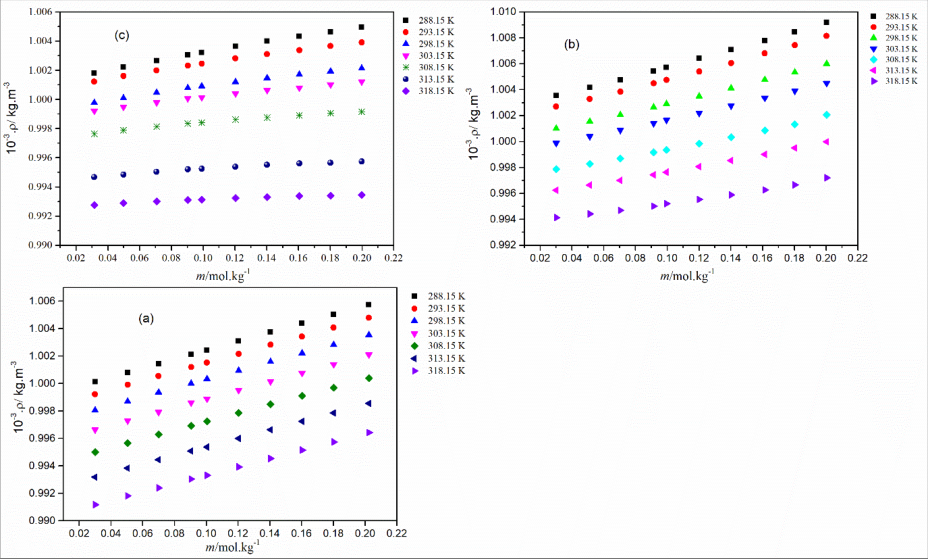 Figure 1
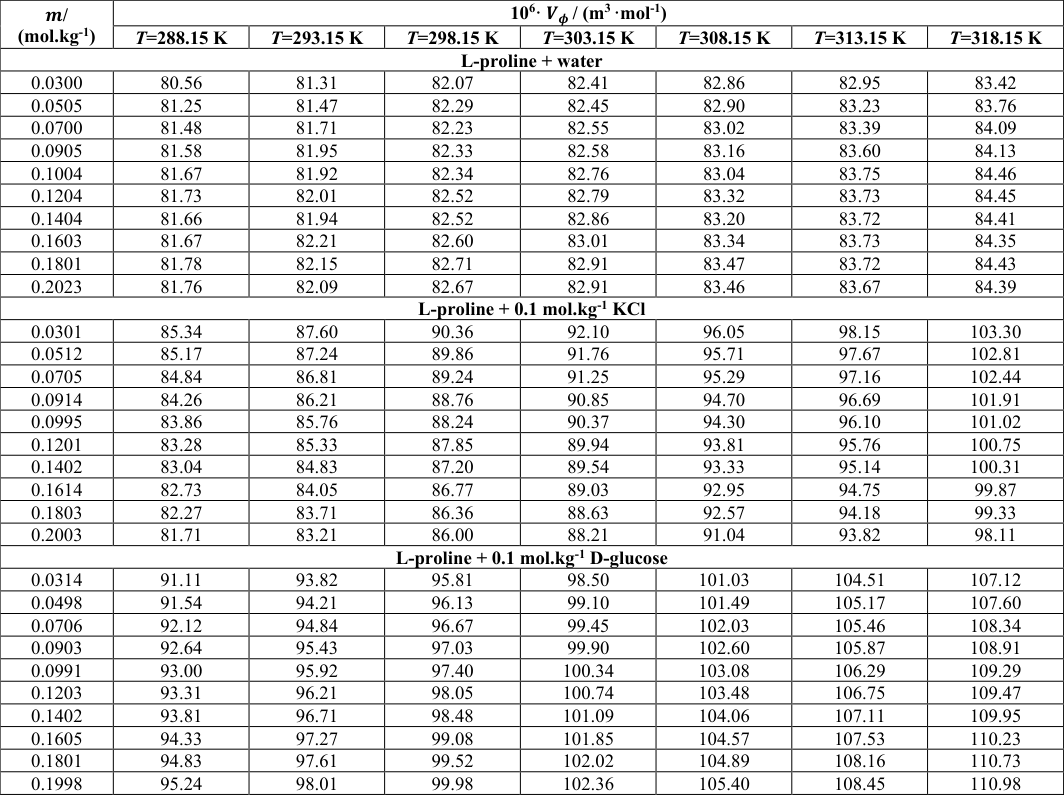 Table 1
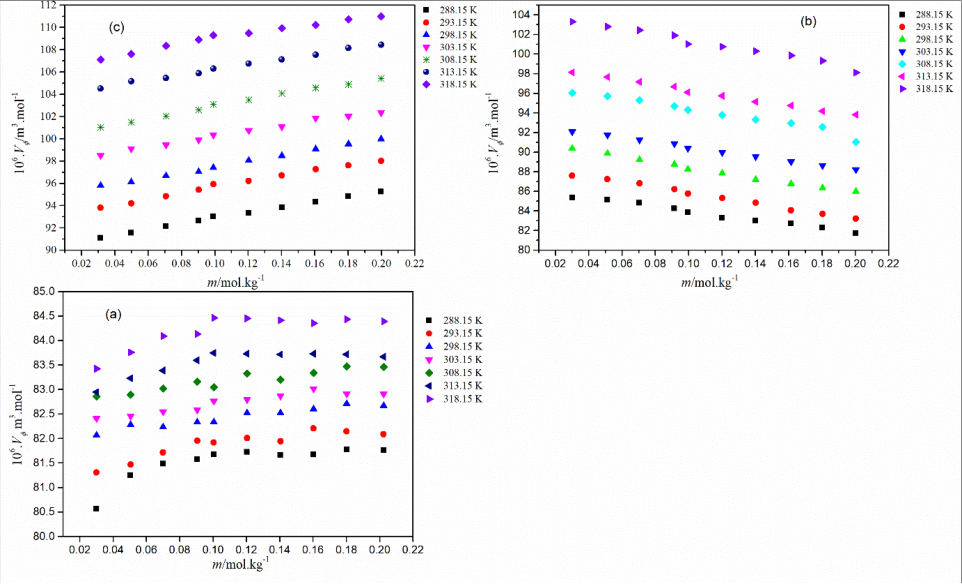 Figure 2
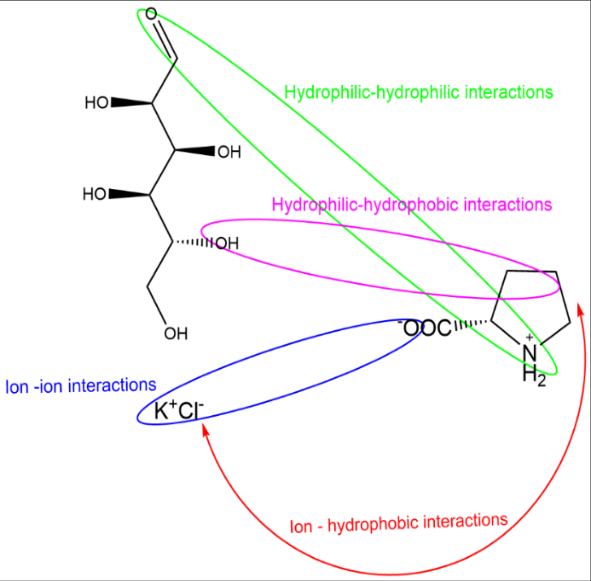 Figure 3
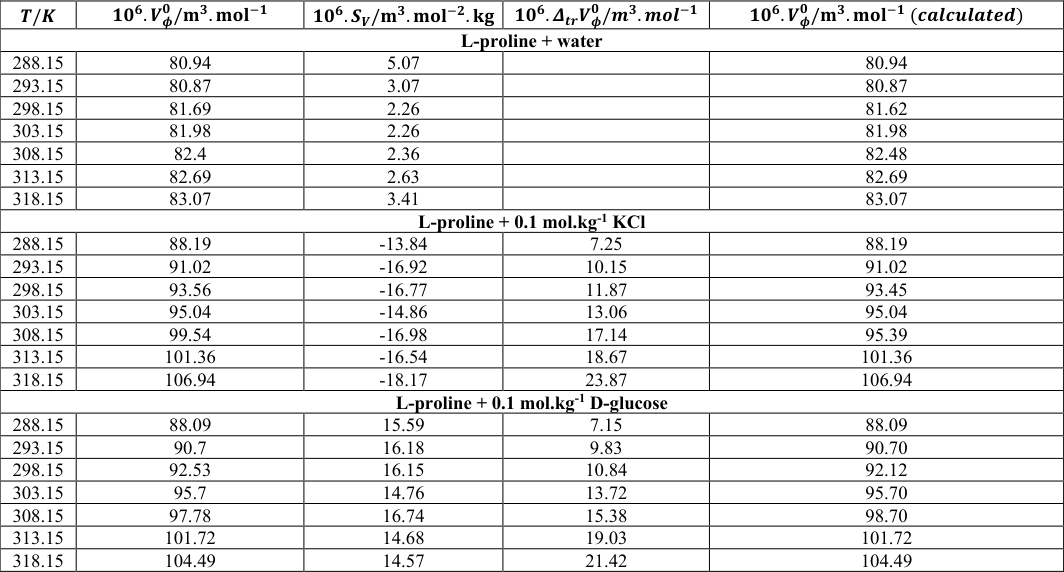 Table 2
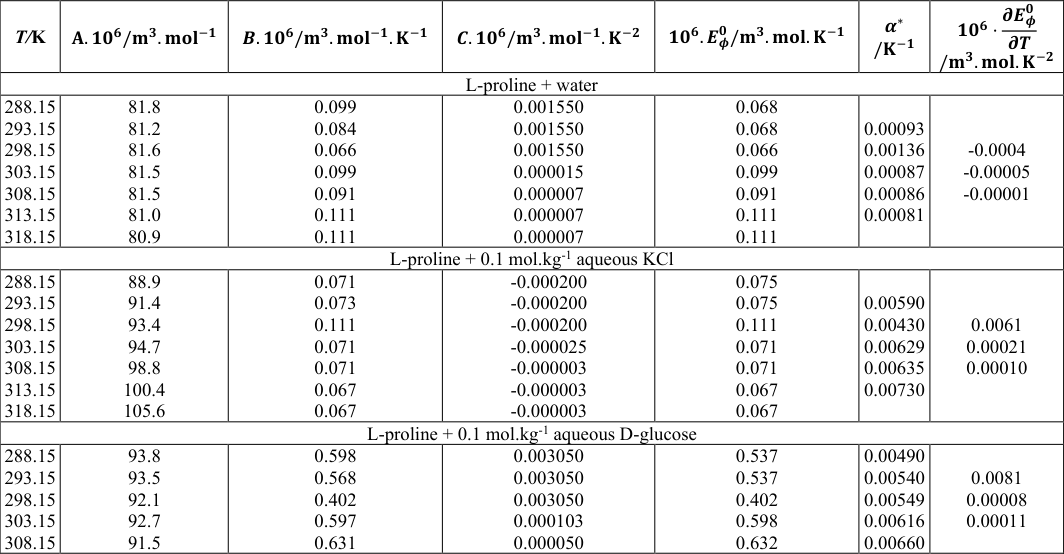 Table 3
Text
ordering of the solvent network. Owing to these characteristics, D-glucose represents an appropriate model compound for examining nonelectrolyte effects on solvation and hydration behaviour [4,5] . In the present investigation, density measurements of Lproline were carried out in aqueous KCl and aqueous Dglucose media over a broad temperature range. From these measurements, various volumetric and thermodynamic parameters were evaluated. The central aim of this work is to explore the influence of temperature and co-solutes on molecular interactions, particularly solute-solvent and solute-solute interactions, in binary and ternary liquid systems.
Materials and Methods
Materials and Methods
Materials
L-proline, potassium chloride and D-glucose used in this study were procured from Sigma-Aldrich (India). All reagents were of analytical-reagent purity and employed without additional purification. Prior to use, the compounds were dried in a vacuum oven at 343.15 K and subsequently stored in a vacuum desiccator containing fused anhydrous calcium chloride for more than 48 h.
Instrumentation and Experimental Procedure
Deionized distilled water with conductivity lower than 0.1 μS•cm⁻¹ was supplied by an Evoqua purification unit. Solutions were prepared gravimetrically at ambient temperature within the concentration range 0.03-0.20 mol•kg⁻¹ and utilized immediately after preparation. Weighing was performed using a Sartorius Quintix analytical balance (Model 125D-101N) having an accuracy of ±0.01 mg. Density and ultrasonic velocity measurements were obtained using an Anton Paar DSA 5000M digital densimeter-sound analyzer (Austria). The instrument operates on the Pulsed Excitation Method, providing density accuracy up to 0.007 kg.m⁻³. The corresponding sensitivities for density and sound velocity measurements are 1×10 -3 and 1×10 -2 m.s⁻¹, respectively. Estimated standard uncertainties were 0.5 kg.m⁻³ for density and 1.0 m.s⁻¹ for sound velocity. Temperature regulation was maintained by an integrated PT100 thermostat with stability of ±0.01 K. Prior to each measurement sequence, calibration was verified using deionized water throughout the investigated temperature range. The liquid sample was positioned between two piezoelectric transducers; one generated ultrasonic waves of nearly 3 MHz frequency, while the other detected the transmitted signal.
Results and Discussion
Results and Discussion
Density Behaviour
Densities of aqueous L-proline solutions and ternary systems containing 0.01 mol.kg⁻¹ KCl or 0.1 mol.kg⁻¹ Dglucose were measured at temperatures from 288.15 K to 318.15 K over different solute concentrations. The experimental observations indicate that density increases almost linearly with increasing concentration of L-proline in all systems studied. Conversely, at constant concentration, density decreases slightly with rise in temperature due to thermal expansion of the solvent medium. These findings are graphically represented in Figure 1.
Apparent Molar Volume(𝑉 𝜙 )
The apparent molar volume (𝑉 𝜙 ) was evaluated from density data using the expression:
where M denotes molar mass of the solute, m is molality, and ρ and ρ 0 represent densities of solution and solvent, respectively. The calculated values are reported in Table 1 and graphically shown in Figure 2 [6,7] . Positive values of 𝑉 𝜙 were obtained for all concentrations and temperatures, suggesting strong interactions between solute and solvent molecules. Increasing temperature resulted in higher 𝑉 𝜙 values, indicating enhanced solvation effects. In aqueous D-glucose medium, 𝑉 𝜙 increased noticeably, reflecting stronger solute-solvent association, whereas a decreasing trend was observed in KCl solutions [14][15] .
| 𝒎/ (mol.kg-1) | 106· 𝑽 / (m3 ·mol-1) 𝝓 | — | — | — | — | — | — |
|---|---|---|---|---|---|---|---|
| T=288.15 K | T=293.15 K | T=298.15 K | T=303.15 K | T=308.15 K | T=313.15 K | T=318.15 K | |
| L-proline + water | |||||||
| 0.0300 | 80.56 | 81.31 | 82.07 | 82.41 | 82.86 | 82.95 | 83.42 |
| 0.0505 | 81.25 | 81.47 | 82.29 | 82.45 | 82.90 | 83.23 | 83.76 |
| 0.0700 | 81.48 | 81.71 | 82.23 | 82.55 | 83.02 | 83.39 | 84.09 |
| 0.0905 | 81.58 | 81.95 | 82.33 | 82.58 | 83.16 | 83.60 | 84.13 |
| 0.1004 | 81.67 | 81.92 | 82.34 | 82.76 | 83.04 | 83.75 | 84.46 |
| 0.1204 | 81.73 | 82.01 | 82.52 | 82.79 | 83.32 | 83.73 | 84.45 |
| 0.1404 | 81.66 | 81.94 | 82.52 | 82.86 | 83.20 | 83.72 | 84.41 |
| 0.1603 | 81.67 | 82.21 | 82.60 | 83.01 | 83.34 | 83.73 | 84.35 |
| 0.1801 | 81.78 | 82.15 | 82.71 | 82.91 | 83.47 | 83.72 | 84.43 |
| 0.2023 | 81.76 | 82.09 | 82.67 | 82.91 | 83.46 | 83.67 | 84.39 |
| L-proline + 0.1 mol.kg-1 KCl | |||||||
| 0.0301 | 85.34 | 87.60 | 90.36 | 92.10 | 96.05 | 98.15 | 103.30 |
| 0.0512 | 85.17 | 87.24 | 89.86 | 91.76 | 95.71 | 97.67 | 102.81 |
| 0.0705 | 84.84 | 86.81 | 89.24 | 91.25 | 95.29 | 97.16 | 102.44 |
| 0.0914 | 84.26 | 86.21 | 88.76 | 90.85 | 94.70 | 96.69 | 101.91 |
| 0.0995 | 83.86 | 85.76 | 88.24 | 90.37 | 94.30 | 96.10 | 101.02 |
| 0.1201 | 83.28 | 85.33 | 87.85 | 89.94 | 93.81 | 95.76 | 100.75 |
| 0.1402 | 83.04 | 84.83 | 87.20 | 89.54 | 93.33 | 95.14 | 100.31 |
| 0.1614 | 82.73 | 84.05 | 86.77 | 89.03 | 92.95 | 94.75 | 99.87 |
| 0.1803 | 82.27 | 83.71 | 86.36 | 88.63 | 92.57 | 94.18 | 99.33 |
| 0.2003 | 81.71 | 83.21 | 86.00 | 88.21 | 91.04 | 93.82 | 98.11 |
| L-proline + 0.1 mol.kg-1 D-glucose | |||||||
| 0.0314 | 91.11 | 93.82 | 95.81 | 98.50 | 101.03 | 104.51 | 107.12 |
| 0.0498 | 91.54 | 94.21 | 96.13 | 99.10 | 101.49 | 105.17 | 107.60 |
| 0.0706 | 92.12 | 94.84 | 96.67 | 99.45 | 102.03 | 105.46 | 108.34 |
| 0.0903 | 92.64 | 95.43 | 97.03 | 99.90 | 102.60 | 105.87 | 108.91 |
| 0.0991 | 93.00 | 95.92 | 97.40 | 100.34 | 103.08 | 106.29 | 109.29 |
| 0.1203 | 93.31 | 96.21 | 98.05 | 100.74 | 103.48 | 106.75 | 109.47 |
| 0.1402 | 93.81 | 96.71 | 98.48 | 101.09 | 104.06 | 107.11 | 109.95 |
| 0.1605 | 94.33 | 97.27 | 99.08 | 101.85 | 104.57 | 107.53 | 110.23 |
| 0.1801 | 94.83 | 97.61 | 99.52 | 102.02 | 104.89 | 108.16 | 110.73 |
| 0.1998 | 95.24 | 98.01 | 99.98 | 102.36 | 105.40 | 108.45 | 110.98 |
Table text extracted from the original PDF; superscript letters are shown inline. The original table image is below.
View original table image
Limiting Apparent Molar Volume (𝑉 𝜙 0 )
The limiting apparent molar volume (𝑉 𝜙 0 ) was determined by extrapolating plots of 𝑉 𝜙 versus molality to zero concentration using Masson's relation:
where values observed in some systems imply stronger solutesolute interactions, while negative values suggest comparatively weaker association effects [8,9] .
Limiting Apparent Molar Volume of Transfer (𝛥 𝑡𝑟 𝑉 𝜙 0 )
The limiting apparent molar transfer volume was evaluated from:
The values of 𝛥 𝑡𝑟 𝑉 𝜙 0 for all the studied systems are reported in Table 2. Depending upon the co-sphere overlap model regarding the values of 𝛥 𝑡𝑟 𝑉 𝜙 0 there is negligible contribution from (solute + solute) interactions and hence they provide information regarding (solute + solvent) interactions. The various interactions that occur between amino acid and solvent molecules are graphically represented and can be summarised as follows, 1. (hydrophilic + hydrophilic) interactions (between hydrophilic groups of L-proline and hydrophilic groups of KCl/D-glucose). 2. (ion/hydrophilic + hydrophobic) interactions (between ions of KCl/hydrophilic groups of D-glucose and hydrophobic centres of L-proline.
| 𝑻/𝑲 | 𝟏𝟎𝟔. 𝑽𝟎/𝐦𝟑. 𝐦𝐨𝐥−𝟏 𝝓 | 𝟏𝟎𝟔. 𝑺 /𝐦𝟑. 𝐦𝐨𝐥−𝟐. 𝐤𝐠 𝑽 | 𝟏𝟎𝟔. 𝜟 𝑽𝟎/𝒎𝟑. 𝒎𝒐𝒍−𝟏 𝒕𝒓 𝝓 | 𝟏𝟎𝟔. 𝑽𝟎/𝐦𝟑. 𝐦𝐨𝐥−𝟏 (𝒄𝒂𝒍𝒄𝒖𝒍𝒂𝒕𝒆𝒅) 𝝓 |
|---|---|---|---|---|
| L-proline + water | ||||
| 288.15 | 80.94 | 5.07 | 80.94 | |
| 293.15 | 80.87 | 3.07 | 80.87 | |
| 298.15 | 81.69 | 2.26 | 81.62 | |
| 303.15 | 81.98 | 2.26 | 81.98 | |
| 308.15 | 82.4 | 2.36 | 82.48 | |
| 313.15 | 82.69 | 2.63 | 82.69 | |
| 318.15 | 83.07 | 3.41 | 83.07 | |
| L-proline + 0.1 mol.kg-1 KCl | ||||
| 288.15 | 88.19 | -13.84 | 7.25 | 88.19 |
| 293.15 | 91.02 | -16.92 | 10.15 | 91.02 |
| 298.15 | 93.56 | -16.77 | 11.87 | 93.45 |
| 303.15 | 95.04 | -14.86 | 13.06 | 95.04 |
| 308.15 | 99.54 | -16.98 | 17.14 | 95.39 |
| 313.15 | 101.36 | -16.54 | 18.67 | 101.36 |
| 318.15 | 106.94 | -18.17 | 23.87 | 106.94 |
| L-proline + 0.1 mol.kg-1 D-glucose | ||||
| 288.15 | 88.09 | 15.59 | 7.15 | 88.09 |
| 293.15 | 90.7 | 16.18 | 9.83 | 90.70 |
| 298.15 | 92.53 | 16.15 | 10.84 | 92.12 |
| 303.15 | 95.7 | 14.76 | 13.72 | 95.70 |
| 308.15 | 97.78 | 16.74 | 15.38 | 98.70 |
| 313.15 | 101.72 | 14.68 | 19.03 | 101.72 |
| 318.15 | 104.49 | 14.57 | 21.42 | 104.49 |
Table text extracted from the original PDF; superscript letters are shown inline. The original table image is below.
View original table image
(ion-ion) interactions between zwitterionic centres of
L-proline and ions of KCl. Positive transfer volume values were obtained for both cosolutes, indicating predominance of hydrophilic-hydrophilic interactions according to the co-sphere overlap model proposed by Gurney, Frank, and Evans [10][11][12][13][14][15][16][17] . These interactions arise mainly between polar groups of amino acids and the hydrophilic moieties of KCl or D-glucose. Table 2 reports the 𝑉 𝜙 0 , 𝑆 𝑉 and 𝛥 𝑡𝑟 𝑉 𝜙 0 values for all the systems under study.
Temperature Dependence and Structure-Making/Breaking Effects
The variation of limiting apparent molar volume with temperature is described by:
According to Hepler's criterion,
Table 3. Empirical parameters of Eq. ( 4), limiting apparent molar expansivity (𝐸 𝜙 0 ) of solute, coefficient of thermal expansion (𝛼 * ) and
Hepler's constant (𝜕𝐸 𝜙 0 𝜕𝑇 ⁄ ) for L-proline in aqueous and in aqueous solutions of 0.1 mol.kg -1 KCl and 0.1 mol.kg The sign of this parameter provides information regarding structure-making or structure-breaking tendencies of solutes. Positive values correspond to structure-promoting behaviour, whereas negative values indicate disruption of solvent structure [18][19][20] . The present systems predominantly exhibited positive values, suggesting that both co-solutes act as structure makers in aqueous L-proline solutions. The thermal expansion coefficient was calculated using:
The obtained 𝛼 * values indicate comparatively stronger solute-solvent interactions in aqueous KCl and D-glucose systems than in pure aqueous L-proline solutions [21][22][23][24][25] .
Conclusion
The present investigation offers a comprehensive volumetric examination of L-proline in aqueous as well as mixedsolvent environments containing potassium chloride and Dglucose. The evaluated thermodynamic parameters reveal that solute-solvent interactions become progressively stronger with increasing temperature, as evidenced by the rise in apparent molar volume and limiting apparent molar volume values. Among the investigated co-solutes, D-glucose exerts a more pronounced influence on the interaction behaviour of Lproline compared with KCl. This difference may be attributed to the extensive hydrogen-bonding capability and structural characteristics of glucose molecules in aqueous media. In contrast, the electrolyte KCl primarily affects the system through ion-solvent interactions and electrostatic effects.
The calculated Hepler parameters indicate that L-proline predominantly behaves as a structure breaker in most of the studied solutions. However, in aqueous D-glucose medium, the amino acid exhibits structure-promoting characteristics, suggesting enhanced ordering of the surrounding solvent network. Such behaviour highlights the important role of cosolutes in modifying hydration structure and intermolecular association patterns. Overall, the present findings improve the understanding of amino acid-solvent and amino acid-co-solute interactions in biologically relevant systems. These observations are valuable for interpreting the influence of ions and nonelectrolytes on amino acid solubility, conformational stability, and hydration behaviour. Furthermore, the study provides useful insight into the role of co-solutes in protein denaturation and renaturation phenomena, where amino acids are often employed as simplified model compounds. Knowledge of these thermophysical properties also contributes to a better understanding of protein folding mechanisms, molecular stability, and solvent-mediated biochemical processes.
Acknowledgement
AcknowledgmentsThe author is thankful to Fr. Praveen D'Souza, Principal of St. Francis de Sales College, Nagpur for providing all support and encouragement during this work.
Figures and tables from the paper
References
25 in the original paper- Singh V, Chhotaray PK, Banipal PK, Banipal TS, Gardas RL. Volumetric properties of amino acids in aqueous solutions of ammonium based protic ionic liquids. Fluid Phase Equilibria. 2015;385:258-274.
- He FJ, MacGregor GA. A comprehensive review on salt and health and current experience of worldwide salt reduction programmes. Journal of Human Hypertension. 2009;23(6):363-384.
- Gennari FJ. Hypokalemia. New England Journal of Medicine. 1998;339(7):451-458.
- DeFronzo RA. From the triumvirate to the ominous octet: a new paradigm for the treatment of type 2 diabetes mellitus. Diabetes. 2009;58(4):773-795.
- Mueckler M, Thorens B. The SLC2 (GLUT) family of membrane transporters. Molecular Aspects of Medicine. 2013;34(2-3):121-138.
- Singh V, Chhotaray PK, Banipal PK, Banipal TS, Gardas RL. Volumetric properties of amino acids in aqueous solutions of ammonium based protic ionic liquids. Fluid Phase Equilibria. 2015;385:258-274.
- Banipal TS, Singh H, Banipal PK. Volumetric and viscometric properties of some sulpha drugs in aqueous solutions of sodium chloride at T = (288.15 to 318.15) K. Journal of Chemical & Engineering Data. 2010;55(9):3872-3881.
- Jengathe SP, Dhondge SS, Paliwal LJ, Tangde VM, Mondal S. Effect of sodium chloride and myo-inositol on diphenhydramine hydrochloride drug in aqueous solution at different temperatures: volumetric and acoustic approach. Journal of Chemical Thermodynamics. 2015;87:78-87.
- Dunn LA. Apparent molar volumes of electrolytes. Part 3-Some 1-1 and 2-1 electrolytes in aqueous solution. Transactions of the Faraday Society. 1968;64:29512961.
- Ryshetti S, Chennuri BK, Noothi R, Tangeda SJ, Gardas RL. Volumetric properties of betaine hydrochloride drug in aqueous KCl solutions at different temperatures. Thermochimica Acta. 2014;597:71-77.
- Redlich O. The molal volume of electrolytes. Journal of Physical Chemistry. 1963;67(2):496-496.
- Belibağlı KB, Ayranci E. Viscosities and apparent molar volumes of some amino acids in water and in 6 M guanidine hydrochloride at 25 °C. Journal of Solution Chemistry. 1990;19(9):867-882.
- Kumar H, Behal I, Singla M. Effect of L-serine and Lthreonine on volumetric and acoustic behaviour of aqueous metformin hydrochloride solutions. Journal of Chemical Thermodynamics. 2016;95:1-14.
- Franks F, Evans M. Free volume and entropy in condensed systems III. Journal of Chemical Physics. 1945;13:507-507.
- Gurney R. Ionic Processes in Solution. New York: McGraw-Hill Book Company; 1953.
- Pal A, Kumar B. Volumetric and acoustic properties of binary mixtures of ionic liquid [bmim][BF4] with alkoxyalkanols. Journal of Chemical & Engineering Data. 2012;57(3):688-695.
- Zafarani-Moattar MT, Izadi F. Effect of temperature and concentration of KBr or KNO₃ on volumetric and transport properties. Journal of Chemical & Engineering Data. 2011;56(6):2818-2829.
- Franks F, Quickenden MAJ, Reid DS, Watson B. Calorimetric and volumetric studies of dilute aqueous solutions. Transactions of the Faraday Society. 1970;66:582-589.
- Kumar H, Kumari S, Behal I, Sharma SK. Molecular interactions of sucrose in aqueous citrate solutions. Journal of Chemical Thermodynamics. 2018;125:17-31.
- John R, Tangde VM, Khaty NT, Dhondge AS, Dhondge SS. Volumetric and acoustic studies of aqueous amino acids in electrolytic and non-electrolytic solutions. Journal of the Indian Chemical Society. 2022;99(3):100370-100370.
- Sinha B, Sarkar A, Roy PK, Brahman D. Physicochemical properties of L-alanine in aqueous silver sulphate solutions. International Journal of Thermophysics. 2011;32(10):2062-2078.
- Terasawa S, Itsuki H, Arakawa S. Contribution of hydrogen bonds to the partial molar volumes of nonionic solutes in water. Journal of Physical Chemistry. 1975;79(22):2345-2351.
- Hepler LG. Thermal expansion and structure in water and aqueous solutions. Canadian Journal of Chemistry. 1969;47(24):4613-4617.
- Roy MN, Dakua VK, Sinha B. Partial molar volumes and viscosity B-coefficients of sodium molybdate mixtures. International Journal of Thermophysics. 2007;28(4):1275-1284.
- Cabani S, Conti G, Matteoli E. Partial molal expansibilities of organic compounds in aqueous solution. Journal of Solution Chemistry. 1976;5(11):751-763.