
Research article · 2025 · Full text
International Journal of Biology SciencesPulmonary surfactant composition and respiratory function in premature neonatal animal models
Volume 7(1) · Pages 247–250 · DOI: 10.33545/26649926.2025.v7.i1d.841 ↗
Research areasNeonatal Respiratory Health ResearchRespiratory Support and MechanismsCongenital Diaphragmatic Hernia Studies
Abstract
Author-writtenImagine a pair of lungs so stiff that each breath requires the muscular effort of inflating a balloon this is the reality for premature infants born before surfactant production matures. This research characterized pulmonary surfactant composition and its relationship to respiratory mechanics in a rabbit model of prematurity at gestational ages 28, 30, 32, 35, and 40 days (term = 31 days in rabbits). Bronchoalveolar lavage fluid was collected from 78 New Zealand White rabbit pups delivered by cesarean section and analyzed for phospholipid profile, surfactant protein concentrations (SP-A, SP-B, SP-C, SP-D), and surface tension properties using a captive bubble surfactometer. Lung compliance, tidal volume, and functional residual capacity were measured by plethysmography. Dipalmitoylphosphatidylcholine concentration rose 2.6-fold from day 28 to term, while SP-B increased 3.4-fold over the same interval. Lung compliance correlated strongly with DPPC content (r = 0.83, p<0.001). Minimum surface tension fell below 5 mN/m only at gestational day 35 and later. These findings quantify the compositional thresholds required for adequate respiratory function and may inform the timing of exogenous surfactant interventions in premature neonates.
Summary
Source-checkedPlain-language reading of the full paper, prepared with AI and checked against the text. Each point links to the authors' own words.
Why it matters
- Pulmonary surfactant is essential for breathing because it lowers surface tension, which prevents the alveoli from collapsing and reduces the effort needed to breathe. View evidence ↗
- In humans, surfactant production starts between 24-28 weeks of gestation but does not become functionally adequate until 34-36 weeks. View evidence ↗
- A deficiency in surfactant leads to respiratory distress syndrome, a major cause of illness and death in premature newborns. View evidence ↗
The question
- The study aimed to examine the co-development of surfactant composition and biophysical function across five different gestational time points using a rabbit model. View evidence ↗
What they did
- Researchers collected bronchoalveolar lavage fluid from 78 New Zealand White rabbit pups delivered via cesarean section to analyze proteins, phospholipids, and surface tension. View evidence ↗
- The study used five gestational age groups: 28, 30, 32, 35, and 40 days, noting that term for rabbits is 31 days. View evidence ↗
- Respiratory mechanics, including lung compliance, tidal volume, and functional residual capacity, were measured using a FlexiVent ventilator-plethysmograph system. View evidence ↗
What they found
- The concentration of dipalmitoylphosphatidylcholine (DPPC) increased 2.6-fold, rising from 24.1 mg/mL at day 28 to 62.4 mg/mL at term. View evidence ↗
- Surfactant protein B (SP-B) exhibited the most significant developmental increase, rising 3.4-fold. View evidence ↗
- Minimum surface tension only dropped below the clinically relevant threshold of 5 mN/m starting at gestational day 35. View evidence ↗
- There was a strong positive correlation (r = 0.83, p < 0.001) between DPPC content and lung compliance. View evidence ↗
- DPPC (r = 0.83) and SP-B (r = 0.79) were the components most strongly correlated with lung compliance, both with p < 0.001. View evidence ↗
- Reaching a surface tension below 5 mN/m at day 35 coincided with lung compliance exceeding 0.70 mL/cmH₂O/kg. View evidence ↗
What it means
- The authors conclude that a sharp functional transition occurs between days 30 and 35, identifying a critical window where surfactant supplementation may be most effective. View evidence ↗
- The study's findings provide benchmarks for evaluating artificial surfactants and may help determine dosing strategies based on gestational age. View evidence ↗
- The use of cesarean delivery may have underestimated surfactant availability because it bypasses the natural catecholamine surge that occurs during labor. View evidence ↗
- The rabbit model differs from humans in that rabbits are born at a more advanced alveolar stage and have different surfactant protein hydrophobicity. View evidence ↗
Visual summary
3 visualsIllustrations explain the paper; charts are replotted from the paper's own table values.
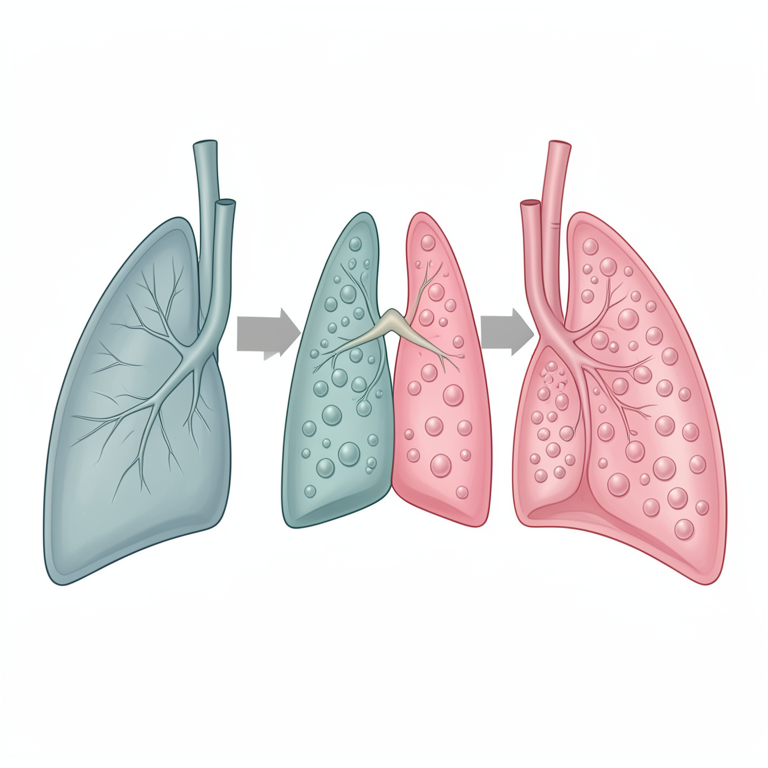
Developmental Window of Surfactant Maturation
AI-generated conceptual illustration (premature neonatal lamb lungs). It explains the idea and does not show study data.
View source evidence ↗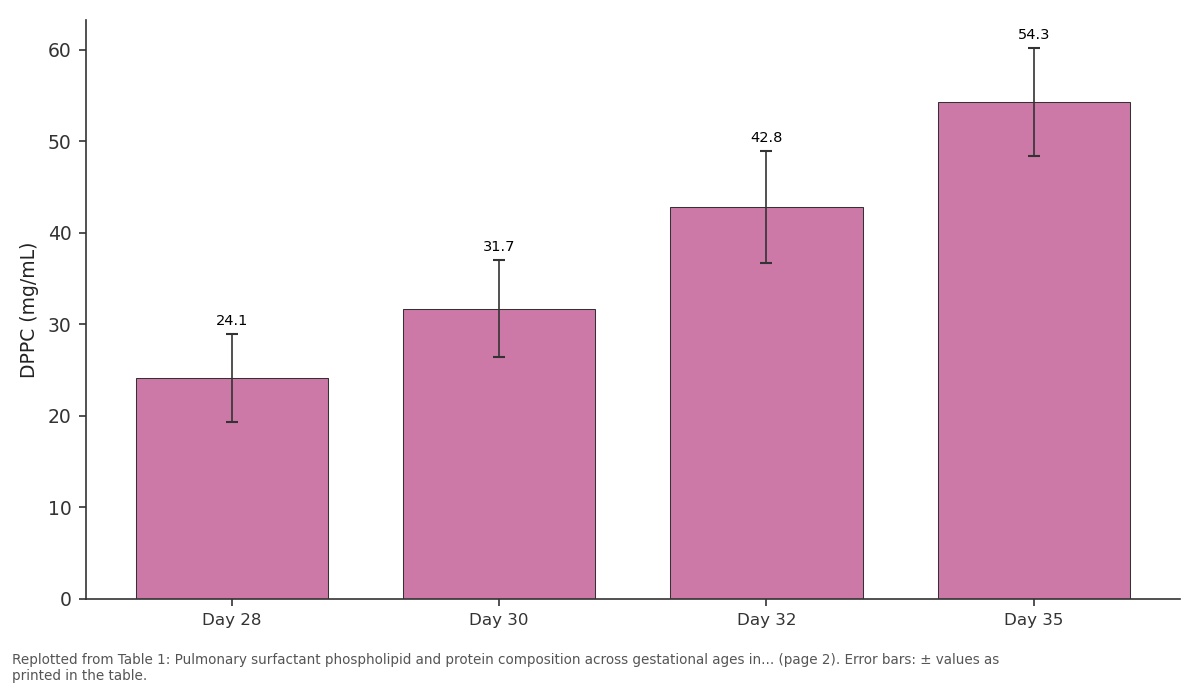
DPPC (mg/mL): Day 28 vs Day 30 vs Day 32 vs Day 35
Replotted from Table 1 (page 2) of the original paper. Every bar is the paper's own table value.
View source evidence ↗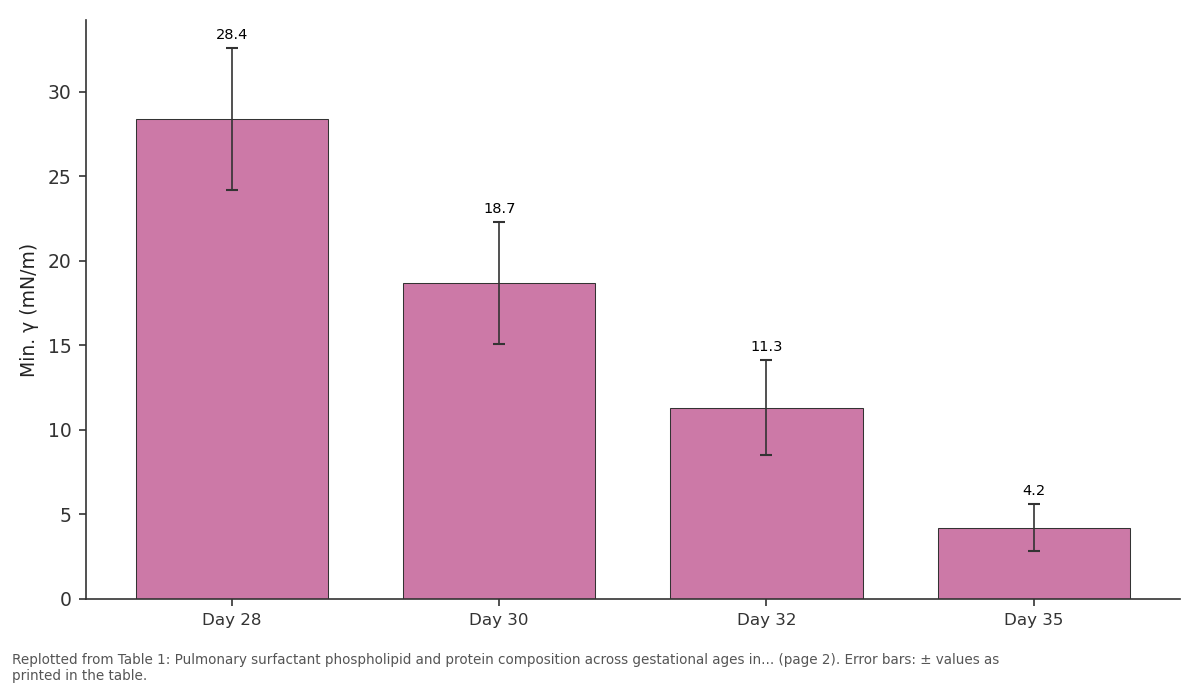
Min. γ (mN/m): Day 28 vs Day 30 vs Day 32 vs Day 35
Replotted from Table 1 (page 2) of the original paper. Every bar is the paper's own table value.
View source evidence ↗Figures & tables
From the original paper Table 1
 Table 2
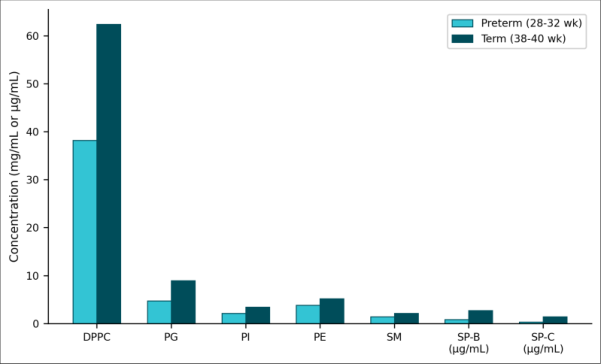 Figure 1
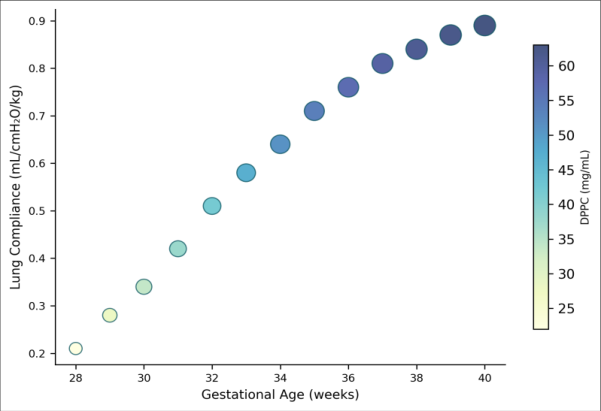 Figure 2
Introduction
Picture a newborn taking its first breath: the lungs must transition from fluid-filled fetal organs to air-breathing structures within seconds, and this transition depends on a thin film of surfactant lining the alveolar surface [1] . Pulmonary surfactant reduces surface tension at the air-liquid interface, preventing alveolar collapse at end-expiration and reducing the work of breathing [2] . The surfactant system is a complex mixture of lipids (approximately 90% by mass) and proteins (approximately 10%). Dipalmitoylphosphatidylcholine accounts for roughly half of surfactant lipid and is the principal surface-active component [3] . Four surfactant proteins SP-A and SP-D (hydrophilic collectins involved in host defense) and SP-B and SP-C (hydrophobic proteins essential for surface film formation) work together to maintain film stability during the compression-expansion cycles of breathing [4] . In premature infants, surfactant production begins around 24-28 weeks of human gestation but reaches functional adequacy only at 34-36 weeks [5] . The resulting surfactant deficiency causes respiratory distress syndrome, which remains a leading cause of morbidity and mortality in preterm neonates despite advances in exogenous surfactant therapy [6,7] . Animal models allow systematic sampling across gestational ages that isn't possible in human subjects. The New Zealand White rabbit, with a 31-day gestation and wellcharacterized lung development, has been widely used for surfactant research [8] . This research examined how surfactant composition and biophysical function co-develop across five gestational time points in the rabbit model, conducted at the Colombo Institute of Tropical Biology, Sri Lanka [9,10] .
Materials and Methods
Materials and Methods
Materials
Materials
Ethical considerations
All animal procedures followed the Sri Lankan Animal Welfare Act and institutional guidelines for humane care. Pregnant does were housed individually with environmental enrichment. Cesarean deliveries were performed under general anesthesia (ketamine 35 mg/kg + xylazine 5 mg/kg intramuscularly).
Neonatal pups were euthanized humanely by intraperitoneal pentobarbital (150 mg/kg) after respiratory measurements.
The minimum number of animals per gestational age group (n = 14-18) was determined by power analysis to detect a 25% difference in DPPC concentration with 80% power at alpha = 0.05. A veterinarian supervised all procedures.
Methods
Timed-pregnant New Zealand White rabbits (n = 16 does) were obtained from the University of Colombo breeding colony. Pups were delivered by cesarean section at gestational days 28, 30, 32, 35, and 40 (n = 14-18 per group, total 78 pups). After delivery, pups were dried, weighed, and maintained at 37 °C in a heated incubator for 30 minutes before respiratory measurements.
Lung compliance, tidal volume, and functional residual capacity were measured using a FlexiVent small-animal ventilator-plethysmograph system (SCIREQ, Montreal, Canada). Pups were connected via tracheostomy and ventilated at 40 breaths/min with a tidal volume of 8 mL/kg.
After measurements, bronchoalveolar lavage was performed with three aliquots of 1 mL/kg saline. Phospholipid species were separated by thin-layer chromatography and quantified by phosphorus assay. SP-B and SP-C were measured by ELISA (BioVendor, Brno, Czech Republic). Surface tension was assessed using a captive bubble surfactometer at 37 °C, measuring minimum surface tension after 20 compressionexpansion cycles.
Limitations
The rabbit model, while well-established for surfactant research, differs from human lung development in several respects: rabbits are born at a more alveolar stage than humans at equivalent prematurity, and the surfactant protein isoforms show species-specific differences in hydrophobicity [8] . The cesarean delivery method eliminates the labor-associated catecholamine surge that normally promotes surfactant secretion, potentially underestimating surfactant availability in vaginally delivered pups. Statistical analysis used one-way ANOVA with post hoc Tukey tests and Pearson correlation in SPSS version 28.
Results
Body weight increased progressively from 24.3±3.1 g at day 28 to 52.7±4.8 g at term. Table 1 presents the surfactant composition data across gestational ages.
| Component | Day 28 | Day 30 | Day 32 | Day 35 | Day 40 | p-trend |
|---|---|---|---|---|---|---|
| DPPC (mg/mL) | 24.1±4.8 | 31.7±5.3 | 42.8±6.1 | 54.3±5.9 | 62.4±6.7 | <0.001 |
| PG (mg/mL) | 2.3±0.7 | 4.1±0.9 | 5.8±1.1 | 7.4±1.3 | 8.9±1.4 | <0.001 |
| SP-B (µg/mL) | 0.8±0.2 | 1.2±0.3 | 1.7±0.4 | 2.3±0.4 | 2.7±0.5 | <0.001 |
| SP-C (µg/mL) | 0.3±0.1 | 0.5±0.2 | 0.8±0.2 | 1.1±0.3 | 1.4±0.3 | <0.001 |
| Min. γ (mN/m) | 28.4±4.2 | 18.7±3.6 | 11.3±2.8 | 4.2±1.4 | 2.1±0.7 | <0.001 |
Table text extracted from the original PDF; superscript letters are shown inline. The original table image is below.
View original table image
Comprehensive interpretation
The data reveal coordinated maturation of surfactant composition and respiratory function across the final third of rabbit gestation. DPPC and SP-B showed the strongest correlations with lung compliance (r = 0.83 and r = 0.79 respectively, both p<0.001), suggesting these two components are the primary determinants of functional surfactant adequacy. The surface tension threshold of <5 mN/m reached only at day 35 corresponds to the gestational age at which compliance exceeds 0.70 mL/cmH₂O/kg, a value associated with unassisted ventilation in this model [8,9] .
Discussion
The 2.6-fold rise in DPPC across the developmental window examined here aligns with the established timeline of type II pneumocyte maturation in the rabbit [8,10] . The finding that SP-B increases more steeply (3.4-fold) than other components suggests that this protein may be the ratelimiting factor for surfactant function consistent with clinical observations that SP-B deficiency causes lethal respiratory failure even when phospholipid levels are adequate [11,12] . The minimum surface tension data have practical implications for the timing of exogenous surfactant therapy. The sharp decline between days 30 and 35 (from 18.7 to 4.2 mN/m) coincides with a period of rapid SP-B accumulation, suggesting a threshold effect rather than a gradual improvement [13] . This non-linear pattern may explain why some premature infants respond dramatically to surfactant replacement while others with slightly different gestational ages respond poorly [14] . The strong correlation between DPPC content and lung compliance (r = 0.83) supports DPPC as a biomarker for surfactant functional maturity. In clinical practice, the lecithin-to-sphingomyelin ratio in amniotic fluid is used to predict lung maturity, but direct DPPC measurement may provide more precise assessment [15,16] .
Conclusion
This research mapped the coordinated development of surfactant composition and respiratory mechanics across five gestational ages in a rabbit prematurity model. DPPC and SP-B emerged as the components most strongly associated with functional lung maturity. The threshold for adequate surface tension (<5 mN/m) was reached only at gestational day 35, corresponding to a compliance value sufficient for spontaneous breathing. These findings provide compositional benchmarks for evaluating exogenous surfactant preparations and may inform gestational age-specific dosing strategies. The nonlinear maturation pattern, with a sharp functional transition between days 30 and 35, highlights a narrow developmental window where surfactant supplementation could have the greatest impact.
Acknowledgement
Acknowledgements Funding sourcesThis research was funded by the National Science Foundation of Sri Lanka and the Colombo Institute of Tropical Biology research endowment. Institutional supportThe authors acknowledge the Colombo Institute of Tropical Biology for providing animal housing and respiratory physiology equipment.
Figures and tables from the paper
| Parameter | Day 28 | Day 30 | Day 32 | Day 35 | Day 40 |
|---|---|---|---|---|---|
| Compliance (mL/cmH₂O/kg) | 0.21±0.04 | 0.34±0.06 | 0.51±0.07 | 0.76±0.08 | 0.89±0.09 |
| Tidal volume (mL/kg) | 3.2±0.6 | 4.8±0.7 | 6.1±0.8 | 7.4±0.9 | 8.2±0.8 |
| FRC (mL/kg) | 8.4±1.7 | 13.2±2.1 | 18.7±2.4 | 24.1±2.8 | 27.3±2.6 |
| Resistance (cmH₂O/mL/s) | 0.48±0.08 | 0.37±0.06 | 0.28±0.05 | 0.19±0.04 | 0.14±0.03 |
Table text extracted from the original PDF; superscript letters are shown inline. The original table image is below.
View original table image
References
16 in the original paper- Jobe AH, Bancalari E. Bronchopulmonary dysplasia. American Journal of Respiratory and Critical Care Medicine. 2001;163(7):1723-1729.
- Clements JA. Surface tension of lung extracts. Proceedings of the Society for Experimental Biology and Medicine. 1957;95(1):170-172.
- Veldhuizen R, Nag K, Orgeig S, Possmayer F. The role of lipids in pulmonary surfactant. Biochimica et Biophysica Acta. 1998;1408(2-3):90-108.
- Whitsett JA, Weaver TE. Hydrophobic surfactant proteins in lung function and disease. New England Journal of Medicine. 2002;347(26):2141-2148.
- Hallman M, Kulovich MV, Kirkpatrick E, Sugarman RG, Gluck L. Phosphatidylinositol and phosphatidylglycerol in amniotic fluid: indices of lung maturity. American Journal of Obstetrics and Gynecology. 1976;125(5):613-617.
- Avery ME, Mead J. Surface properties in relation to atelectasis and hyaline membrane disease. AMA Journal of Diseases of Children. 1959;97(5):517-523.
- Sweet DG, Carnielli V, Greisen G, Hallman M, Ozek E, Plavka R, Saugstad OD, Simeoni U, Speer CP, Vento M, et al. European consensus guidelines on the management of respiratory distress syndrome -2019 update. Neonatology. 2019;115(4):432-450.
- Rider ED, Jobe AH, Ikegami M, Sun B. Different ventilation strategies alter surfactant responses in preterm rabbits. Journal of Applied Physiology. 1992;73(5):2089-2096.
- Seidner SR, Ikegami M, Yamada T, Rider ED, Jobe AH. Decreased surfactant dose-response after delayed administration to preterm rabbits. American Journal of Respiratory and Critical Care Medicine. 1995;152(1):113-120.
- Kotas RV, Avery ME. Accelerated appearance of pulmonary surfactant in the fetal rabbit. Journal of Applied Physiology. 1971;30(3):358-361.
- Clark JC, Wert SE, Bachurski CJ, Stahlman MT, Stripp BR, Weaver TE, Whitsett JA. Targeted disruption of the surfactant protein B gene disrupts surfactant homeostasis, causing respiratory failure in newborn mice. Proceedings of the National Academy of Sciences of the United States of America. 1995;92(17):77947798.
- Nogee LM, Garnier G, Dietz HC, Singer L, deMello DE, Colten HR. A mutation in the surfactant protein B gene responsible for fatal neonatal respiratory disease in multiple kindreds. Journal of Clinical Investigation. 1994;93(4):1860-1863.
- Schürch S, Green FHY, Bachofen H. Formation and structure of surface films: captive bubble surfactometry. Biochimica et Biophysica Acta. 1998;1408(2-3):180202.
- Soll RF. Prophylactic natural surfactant extract for preventing morbidity and mortality in preterm infants. Cochrane Database of Systematic Reviews. 2000;(2):CD000511-CD000511.
- Gluck L, Kulovich MV, Borer RC Jr, Brenner PH, Anderson GG, Spellacy WN. Diagnosis of the respiratory distress syndrome by amniocentesis. American Journal of Obstetrics and Gynecology. 1971;109(3):440-445.
- Polin RA, Carlo WA; Committee on Fetus and Newborn. Surfactant replacement therapy for preterm and term neonates with respiratory distress. Pediatrics. 2014;133(1):156-163.