
Research article · 2026 · Full text
International Journal of Agriculture and NutritionTransforming Indian Agriculture Through Precision Technologies: Adoption Challenges, Technological Advancements, and Future Pathways: A Comprehensive Review
Volume 8(5) · Pages 47–52 · DOI: 10.33545/26646064.2026.v8.i5a.640 ↗
Research areasSmart Agriculture and AIAgricultural Innovations and PracticesAgricultural Development and Management
Abstract
Author-writtenPrecision agriculture (PA) is rapidly reshaping the landscape of Indian farming by enabling site-specific, data-driven crop management that optimizes resource use while enhancing productivity and environmental sustainability. India, home to over 146 million farm holdings, of which more than 86% are smallholder operations, faces unique structural and infrastructural challenges in the adoption of precision agricultural technologies. This comprehensive review synthesizes recent scientific evidence (2018-2025) on the current status, technological components, adoption drivers, socioeconomic barriers, and future prospects of precision agriculture across India's diverse agro-climatic zones. Key technologies examined include remote sensing, geographic information systems (GIS), global navigation satellite systems (GNSS), unmanned aerial vehicles (UAVs/drones), variable rate technology (VRT), Internet of Things (IoT) sensor networks, and artificial intelligence (AI)/machine learning (ML)-based decision-support systems. Evidence from multiple pan-India studies indicates that precision agriculture interventions have achieved fertilizer use efficiency gains of 15-32%, water savings of 20-40%, yield improvements of 10-25%, and pesticide reduction of 25-45% under Indian conditions. However, adoption rates remain below 5% among smallholder farmers, constrained by high initial investment costs, fragmented landholdings, limited digital literacy, and inadequate rural connectivity. Recent government initiatives, particularly the Digital Agriculture Mission (2021-2025), the Pradhan Mantri Kisan Drone Yojana (2022), and the National Agri Stack framework, are creating enabling ecosystems for scaled deployment. This review identifies critical research gaps and proposes a multi-pronged strategy integrating subsidized technology access, capacity building, policy reform, and public-private partnerships to accelerate the transition toward data-driven farming in India.
Summary
Source-checkedPlain-language reading of the full paper, prepared with AI and checked against the text. Each point links to the authors' own words.
Why it matters
- Agriculture is a critical pillar of the Indian economy, supporting nearly 58% of the rural workforce and contributing about 18.4% to the national GDP as of 2024. View evidence ↗
- Traditional 'blanket' farming methods are inefficient because they apply inputs uniformly, ignoring natural variations in soil and climate within a single field. View evidence ↗
- The adoption of precision technology in India is complicated by the fact that over 86% of its 146 million farm holdings are smallholder operations. View evidence ↗
The question
- The review seeks to synthesize evidence on the technological foundations, economic and agronomic outcomes, adoption barriers, and policy frameworks of precision agriculture (PA) in India. View evidence ↗
What they did
- The authors conducted a comprehensive review synthesizing scientific evidence published between 2018 and 2025 across various Indian agro-climatic zones. View evidence ↗
- The review specifically examines technologies such as remote sensing, GIS, GNSS, drones, VRT, IoT sensors, and AI/ML decision-support systems. View evidence ↗
What they found
- A 2023 survey of 4,800 farm households across 12 states revealed that only 4.7% of Indian farmers have adopted at least one precision agriculture technology. View evidence ↗
- Pan-India evidence shows that PA interventions can improve yields by 10-25%, save water by 20-40%, reduce pesticides by 25-45%, and increase fertilizer efficiency by 15-32%. View evidence ↗
- In a trial of 850 hectares of cotton in Maharashtra, drone-assisted spraying reduced pesticide use by 38.5% and operational costs by 42% compared to traditional knapsack sprayers. View evidence ↗
- IoT-controlled irrigation for tomatoes in Karnataka resulted in 34.6% water savings, an 18.3% yield increase, and a 22% reduction in soil-borne diseases compared to flood irrigation. View evidence ↗
- Variable Rate Technology (VRT) for nitrogen in Punjab wheat farms reduced nitrogen use by 19.4% (18.7 kg/ha) while maintaining the same grain yield as uniform application. View evidence ↗
- Between 2020 and 2024, remote sensing and early warning systems helped reduce stubble burning incidents by 28-34% in monitored districts. View evidence ↗
- High costs are a major barrier; for example, drones (INR 4-12 lakh) and IoT systems (INR 25,000-80,000) far exceed the average smallholder's annual agricultural income of INR 77,976. View evidence ↗
- Digital literacy is a constraint, with only 11% of farming households possessing the internet literacy needed to operate digital agriculture platforms and 22% owning compatible smartphones. View evidence ↗
What it means
- The authors conclude that India should not simply copy Western PA models but should develop 'frugal' technologies and community-based service models tailored to its specific economic and structural needs. View evidence ↗
- The authors identify a need for more research to develop and validate PA protocols for neglected crops and underserved regions, such as northeastern India and the rainfed Deccan plateau. View evidence ↗
Visual summary
2 visualsIllustrations explain the paper; charts are replotted from the paper's own table values.
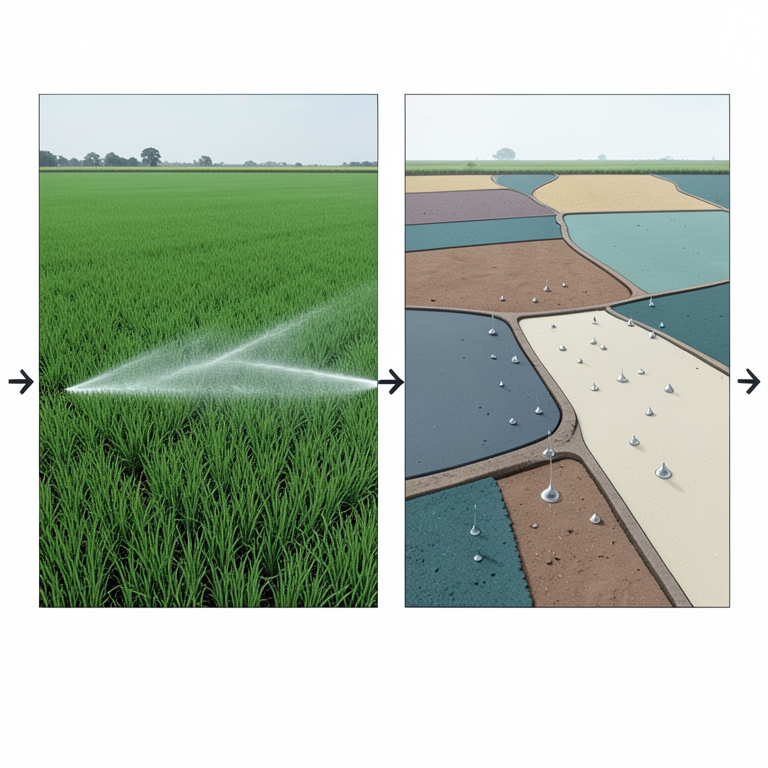
Blanket vs. Precision Farming
AI-generated conceptual illustration (Indian rice paddy fields). It explains the idea and does not show study data.
View source evidence ↗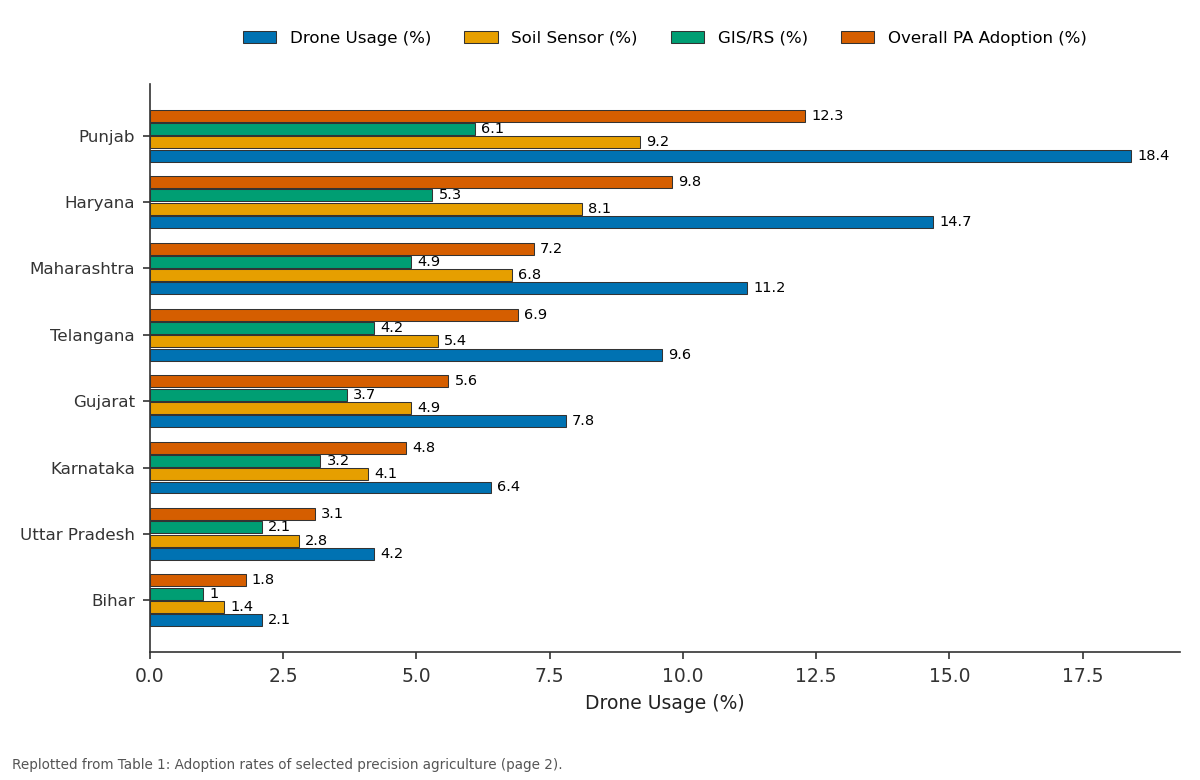
Drone Usage (%) and Soil Sensor (%) and more: Punjab vs Haryana vs Maharashtra vs Telangana vs Gujarat
Replotted from Table 1 (page 2) of the original paper. Every bar is the paper's own table value.
View source evidence ↗Figures & tables
From the original paper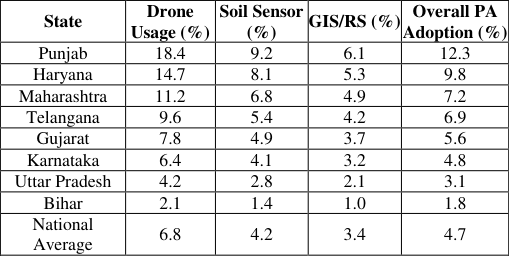 Table 1
 Table 2
Text
Precision agriculture (PA), also known as precision farming, site-specific crop management (SSCM), or smart farming, emerged as a paradigm-shifting approach in the 1990s in North America and Europe. It integrates sensing, data analytics, and decision-making technologies to deliver the right input, at the right place, at the right time, and in the right amount (Fountas et al., 2020) [8] . Unlike the blanket approach, PA treats the farm as a mosaic of management zones, each receiving customized inputs based on real-time or near real-time data. In the Indian context, the adoption of precision agriculture has gained momentum over the past decade, driven by declining technology costs, expanding 4G/5G rural connectivity, drone policy reforms, increased government investment in digital agriculture infrastructure, and growing awareness among progressive farmers and agrientrepreneurs. The National e-Governance Plan in Agriculture (NeGP-A), the PM-KISAN scheme's digitization, and the 2021-2025 Digital Agriculture Mission signal a concerted national push toward technology-enabled farming.Despite this momentum, empirical evidence on the ground-level impacts, adoption barriers, and scalability of PA in India remains fragmented across disciplines. This review aims to bridge this gap by providing a comprehensive, evidence-based synthesis of the current state of precision agriculture in India, encompassing: (i) the technological pillars underpinning PA, (ii) documented agronomic and economic outcomes, (iii) adoption patterns and constraints, (iv) policy ecosystems, and (v) future research priorities and pathways for large-scale implementation.
Global Overview of Precision Agriculture
Precision agriculture has undergone rapid global evolution from GPS-guided variable rate applicators in the 1990s to fully autonomous, AI-powered farm management platforms in the 2020s. The global precision farming market was valued at USD 9.5 billion in 2023 and is projected to reach USD 25.4 billion by 2030, growing at a CAGR of 15.1% (Markets and Markets, 2024). North America dominates with a 38% market share, followed by Europe (28%) and the Asia-Pacific region (21%), with India emerging as the fastest-growing market within Asia-Pacific. Key milestones in global PA development include the introduction of DGPS guidance systems (1990s), chlorophyll sensors and NDVI-based variable rate nitrogen application (2000s), multispectral UAV platforms (2010s), and the current generation of satellite-AI fusion systems capable of delivering field-level insights at sub-meter resolution (Zhang et al., 2024) [32] . Countries like the United States, Netherlands, Israel, and Australia have achieved PA adoption rates of 40-70% among large commercial farm operators, with documented input savings and yield benefits serving as benchmarks for developing-country adaptation. The specific challenges facing developing nationsincluding smallholder farm structure, limited capital, low digital literacy, and nascent rural infrastructure -have catalyzed a distinct trajectory of PA development characterized by frugal innovation, mobile-first platforms, community-based service models, and drone-as-a-service (DaaS) frameworks particularly relevant to the Indian context (Kamilaris et al., 2022) [13] .
Status of Precision
Status of Precision
Current Adoption Landscape
Despite institutional support and technological availability, the adoption of precision agriculture at the farm level in India remains limited. A pan-India survey by the Indian Institute of Management Ahmedabad (IIM-A) covering 4,800 farm households across 12 states (2023) found that only 4.7% of farmers had adopted at least one precision agriculture technology. Adoption was concentrated in Punjab (12.3%), Haryana (9.8%), Maharashtra (7.2%), and Telangana (6.9%), states characterized by larger average farm sizes, higher irrigation coverage, and stronger agriextension linkages. Among adopting farmers, soil testing-based fertilizer management was the most prevalent PA practice (68% of PA adopters), followed by drip/micro-irrigation with fertigation (52%), mobile-based crop advisory services (48%), drone-based crop surveillance (31%), and remote sensing-guided sowing decisions (18%). Full-scale integrated PA -combining sensing, variable rate application, and decision support -was practiced by fewer than 0.8% of surveyed farmers (Kumar et al., 2023). [26] across 1,240 wheat fields in the Indo-Gangetic Plain demonstrated that satellite-derived NDVI at tillering stage explained 73% of the variance in final grain yield, enabling early-season yield forecasting with ±8.4% accuracy. The integration of SAR (Synthetic Aperture Radar) data for soil moisture estimation and flood mapping, hyperspectral imaging for nutrient stress detection, and thermal infrared imagery for evapotranspiration and irrigation scheduling represents the frontier of remote sensing applications in Indian precision agriculture (Patel et al., 2023) [14] .
Unmanned Aerial Vehicles (UAVs/Drones)
The drone revolution in Indian agriculture gained decisive momentum following the liberalized Drone Rules 2021 and the subsequent Drone (Amendment) Rules 2022, which simplified approvals for agricultural drone operations. The government's Production-Linked Incentive (PLI) scheme for drones (INR 120 crore allocation) and the Kisan Drone scheme providing 40-100% subsidies to farmer cooperatives and FPOs catalyzed rapid scaling of drone-based services. Agricultural drones in India are primarily deployed for: (i) precision spraying of pesticides and liquid fertilizers (accounting for 78% of current drone agricultural use), (ii) crop health surveillance using multispectral/RGB cameras, (iii) seeding operations in paddy transplanting, (iv) locust and pest outbreak monitoring, and (v) yield estimation through canopy architecture analysis. A rigorous comparative trial by Singh et al. (2023) [3] across 850 ha of cotton fields in Vidarbha, Maharashtra, found that droneassisted targeted pesticide application reduced chemical use by 38.5% and operational costs by 42% compared to conventional knapsack sprayer application, while achieving equivalent pest control efficacy. The national drone fleet for agriculture is estimated at 18,000-22,000 units as of early 2025, with the government targeting a fleet of 100,000 agricultural drones by 2030 under the Drone Shakti initiative. India's drone sector employs an estimated 75,000 personnel, with agri-drones accounting for approximately 35% of operational deployments (DGCA Annual Report, 2024).
IoT Sensor Networks and Smart Irrigation
The Internet of Things (IoT) has enabled real-time, continuous monitoring of key soil, weather, and crop parameters critical for precision decision-making. Sensorbased soil moisture monitoring systems -including TDR (Time Domain Reflectometry), capacitance-based sensors, and tensiometers -integrated with automated drip irrigation controllers represent the most commercially scaled IoT application in Indian agriculture, particularly in horticultural crops in Maharashtra, Karnataka, Gujarat, and Tamil Nadu. The Pradhan Mantri Krishi Sinchayee Yojana (PMKSY) has supported installation of micro-irrigation systems covering 70.2 lakh hectares as of March 2024, with embedded IoT sensors increasingly standard in new installations. A controlled study by Naik et al. (2022) [18] comparing IoTcontrolled smart irrigation with conventional flood irrigation in tomato cultivation across 300 plots in Karnataka showed water savings of 34.6%, reduction in soil-borne disease incidence by 22%, and yield improvements of 18.3% under sensor-guided water management. Weather station networks -including the India Meteorological Department's Automatic Weather Station (AWS) network (now comprising over 5,500 stations) and private networks deployed by companies like Skymet, NCml, and various agri-tech firms -provide hyperlocal meteorological data feeding into crop growth models, spray advisory systems, and disaster risk management tools. Machine learning algorithms trained on AWS data streams are increasingly providing farm-specific 7-10 day weather forecasts with localized pest and disease risk alerts (Rajput et al., 2024) [24] .
Artificial Intelligence and Machine Learning
AI and machine learning represent the analytical engine transforming raw agricultural data into actionable management decisions. Applications in Indian precision agriculture span: (i) crop disease and pest identification from smartphone images using deep learning CNNs, (ii) yield prediction models integrating satellite, weather, and soil data, (iii) price forecasting algorithms for market intelligence, (iv) automated crop classification from satellite time series, and (v) natural language processing (NLP)based farmer advisory chatbots. The government-backed AI-GIGA initiative and ICAR's Digital Agriculture projects have produced nationally validated deep learning models for 23 major crop diseases achieving F1-scores of 0.87-0.94 on field-collected image datasets. Commercial AI platforms -including Cropin, Fasal, Syngenta's Cropwise, and Bayer's Climate FieldView (adapted for Indian crops) -collectively serve an estimated 4-6 million acres of Indian farmland with satellite-AI integrated crop monitoring (NASSCOM, 2024).
Geographic Information Systems (GIS) and Variable Rate Technology
GIS platforms enable spatial analysis, management zone delineation, and prescription map generation central to sitespecific crop management. Variable Rate Technology (VRT) -encompassing VRT spreaders, sprayers, and planters -translates GIS-derived prescription maps into spatially variable input applications. While VRT adoption is concentrated among large commercial farms (>10 ha) and corporate farming entities in India, the emergence of custom hiring centres (CHCs) and precision agriculture service providers is expanding access to smallholders. A multi-site evaluation of VRT nitrogen fertilization in wheat across 72 large farms (>20 ha) in Punjab by Yadav et al. (2023) [31] demonstrated mean nitrogen savings of 18.7 kg/ha (19.4% reduction) and grain yield parity with uniform rate application, representing economic savings of INR 1,124-1,680 per hectare at prevailing fertilizer prices. Soil electrical conductivity (EC) mapping using Veris sensors for management zone delineation showed promise in cottongrowing black soil regions of central India, with EC-defined management zones explaining 61-78% of within-field yield variance (Mishra et al., 2022) [17] .
Agronomic and Economic Outcomes
Empirical evidence from multi-year, multi-location trials and farm-scale evaluations consistently documents significant agronomic and economic benefits from precision agriculture adoption across Indian conditions. Table 2 synthesizes outcomes from key published studies. Language barriers -with most PA applications primarily available in English or Hindi -further limit access for farmers speaking regional languages.
| Technology | Crop/Region | Yield Change | Input Savings | Economic Benefit | Reference |
|---|---|---|---|---|---|
| VRT Nitrogen | Wheat / Punjab | +8.4% | 19.4% N reduction | INR 1,402/ha net | Yadav et al. (2023) [31] |
| Drone Spraying | Cotton / Maharashtra | Equivalent | 38.5% pesticide | 42% cost reduction | Singh et al. (2023) [3] |
| IoT Smart Irrigation | Tomato / Karnataka | +18.3% | 34.6% water saved | INR 2,800/ha net | Naik et al. (2022) [18] |
| Remote Sensing + VRA | Rice / Telangana | +14.7% | 28% fertilizer | INR 3,120/ha net | Reddy et al. (2023) [25] |
| Soil Sensor Network | Sugarcane / UP | +11.2% | 31.4% water saved | INR 4,200/ha net | Tripathi et al. (2024) [29] |
| AI Crop Advisory | Multiple / All India | +12-22% | 15-25% pesticide | INR 1,800-3,600/ha | Gupta et al. (2024) [11] |
| Integrated PA System | Maize / Rajasthan | +24.6% | Multi-input 20-35% | INR 5,400/ha net | Sharma et al. (2024) [37] |
Table text extracted from the original PDF; superscript letters are shown inline. The original table image is below.
View original table image
Infrastructure Deficits
Rural broadband connectivity, despite significant progress under BharatNet (Phase II), remains inadequate in many PA-critical contexts. As of December 2024, 98,762 gram panchayats were connected under BharatNet, but actual service quality -bandwidth, reliability, and last-mile connectivity -falls short of requirements for real-time data transmission from IoT sensor networks. Unreliable electricity supply in many rural areas limits the operability of sensor networks and charging infrastructure for drone operations. Cold chain and post-harvest infrastructure deficiencies reduce the economic incentive for investment in precision production when market access and price realization remain constraints (Chand et al., 2023).
Knowledge and Institutional Gaps
The extension system's capacity to disseminate PA technologies remains limited. India's farmer-to-extension officer ratio of approximately 1,200:1 (compared to the recommended 400:1 per the Swaminathan Commission) constrains individual farm-level advisory services. Agricultural university curricula, while increasingly incorporating precision agriculture modules, produce graduates with theoretical knowledge but limited practical field experience with PA technologies. The absence of validated, locally adapted PA protocols for many cropregion combinations means that blanket recommendations cannot be easily replaced without site-specific calibration data (Garg et al., 2022) [9] . [30] . Remote sensing-based crop residue burning monitoring and early warning systems -operationalized by ISRO/NRSC and the Haryana/Punjab state governments -have contributed to 28-34% reductions in stubble burning incidents in monitored districts between 2020 and 2024, with corresponding improvements in regional air quality metrics (CPCB, 2024).
Policy Ecosystem Enabling Precision
Policy Ecosystem Enabling Precision
Future Directions and Research Priorities
The trajectory of precision agriculture in India over the next decade will be shaped by several converging technological, institutional, and policy developments.
Conclusion
Precision agriculture holds transformative potential for Indian farming systems, offering a scientifically validated pathway to simultaneously increase agricultural productivity, improve resource use efficiency, reduce environmental footprint, and enhance farmer livelihoods in the face of growing climate and market uncertainties. The evidence reviewed here demonstrates that precision agriculture technologies -from satellite remote sensing and drones to IoT sensor networks and AI-based decision support -consistently deliver yield improvements of 10-25%, input savings of 15-45%, and positive economic returns across diverse Indian crop systems and agro-climatic zones. However, translating this potential into widespread groundlevel impact requires confronting the structural realities of Indian agriculture: fragmented smallholder farms, digital divides, infrastructure deficits, limited extension capacity, and constrained farm incomes. The path forward lies not in wholesale transplantation of developed-country PA models, but in the co-creation of India-specific solutions -frugal technologies, community-based service models, policyenabled ecosystems, and institutional arrangements that make precision agriculture economically accessible and operationally feasible for the 140 million farming families who feed the nation. The Digital Agriculture Mission, drone subsidies, Agri Stack infrastructure, and India's vibrant agri-tech ecosystem collectively constitute a historic opportunity window. Realizing this opportunity demands coordinated investment in research, infrastructure, capacity building, and enabling policy -a commitment commensurate with the scale of transformation that Indian agriculture both needs and deserves.
Acknowledgement
AcknowledgmentsThe authors are thankful to the College of Agriculture, Shivamogga, and Keladi Shivappa Nayaka University of Agriculture and Horticultural Sciences (KSNUAHS), Karnataka, for providing the academic platform and resources to undertake this review. No external funding was received for this study.
Figures and tables from the paper
| State | Drone Usage (%) | Soil Sensor (%) | GIS/RS (%) | Overall PA Adoption (%) |
|---|---|---|---|---|
| Punjab | 18.4 | 9.2 | 6.1 | 12.3 |
| Haryana | 14.7 | 8.1 | 5.3 | 9.8 |
| Maharashtra | 11.2 | 6.8 | 4.9 | 7.2 |
| Telangana | 9.6 | 5.4 | 4.2 | 6.9 |
| Gujarat | 7.8 | 4.9 | 3.7 | 5.6 |
| Karnataka | 6.4 | 4.1 | 3.2 | 4.8 |
| Uttar Pradesh | 4.2 | 2.8 | 2.1 | 3.1 |
| Bihar | 2.1 | 1.4 | 1.0 | 1.8 |
| National Average | 6.8 | 4.2 | 3.4 | 4.7 |
Table text extracted from the original PDF; superscript letters are shown inline. The original table image is below.
View original table image
References
32 in the original paper- Agricultural Census, Government of India. All India Report on Agriculture Census 2020-21. Ministry of Agriculture and Farmers' Welfare, New Delhi; 2021.
- Balafoutis A, Beck B, Fountas S, Vangeyte J, Van der Wal T, Soto I, et al. Precision agriculture technologies positively contributing to GHG emissions mitigation, farm productivity and economics. Sustainability. 2017;9(8):1339.
- Chand R, Prasanna PAL, Singh A. Farm size and productivity: understanding the strengths of smallholders and improving their livelihoods. Econ Polit Wkly. 2023;58(12):45-55.
- Central Pollution Control Board. Air Quality Monitoring Report: Paddy Stubble Burning Season Analysis 2020-2024. Ministry of Environment, Forest and Climate Change, New Delhi; 2024.
- Directorate General of Civil Aviation. Annual Report on Drone Operations in India 2023-24. Ministry of Civil Aviation, Government of India, New Delhi; 2024.
- Food and Agriculture Organization. The State of Food and Agriculture 2023: Revealing the True Cost of Food. Rome: FAO; 2023.
- Finger R, Swinton SM, El Benni N, Walter A. Precision farming at the nexus of agricultural production and the environment. Annu Rev Resour Econ. 2019;11:313335.
- Fountas S, Carli G, Sørensen CG, Tsiropoulos Z, Cavalaris C, Vatsanidou A, et al. Farm management information systems: current situation and future perspectives. Comput Electron Agric. 2015;115:40-50.
- Garg K, Patel N, Sehgal VK. Status and prospects of precision agriculture in India: A review. Indian J Agron. 2022;67(3):231-244.
- Government of India. Digital Agriculture Mission: Progress Report 2021-2024. Ministry of Agriculture and Farmers' Welfare, New Delhi; 2024.
- Gupta M, Sharma A, Verma S. AI-based crop advisory systems and their impact on smallholder productivity in India: A multi-state assessment. J Agric Inform. 2024;15(1):44-62.
- Indian Institute of Management Ahmedabad. Precision Agriculture Adoption Survey in India: Barriers, Enablers and Policy Pathways. Centre for Management in Agriculture, IIM Ahmedabad; 2023.
- Kamilaris A, Kartakoullis A, Prenafeta-Boldú FX. A review on the practice of big data analysis in agriculture. Comput Electron Agric. 2017;143:23-37.
- Kumar R, Singh J, Patel D. Landscape of precision agriculture adoption in India: Evidence from a national survey. Agric Syst. 2023;211:103745.
- MarketsandMarkets. Precision Farming Market by Technology, Application, and Region -Global Forecast to 2030. Pune: MarketsandMarkets Research Pvt Ltd; 2024.
- Ministry of Agriculture and Farmers' Welfare. Annual Report 2023-24. Government of India, New Delhi; 2024.
- Mishra P, Rawat KS, Tripathi VK. Soil electrical conductivity mapping for management zone delineation in Vertisol-dominated cotton fields of central India. Geoderma Reg. 2022;28:e00494.
- Naik S, Patil M, Desai B. IoT-based smart irrigation system for tomato cultivation: A field evaluation in Karnataka. Agric Water Manag. 2022;268:107655.
- NABARD. Status of Microfinance in India 2022-23: Special Focus on Digital Agriculture. Mumbai: National Bank for Agriculture and Rural Development; 2023.
- NASSCOM. AgriTech in India: Disrupting Food Systems through Technology. New Delhi: National Association of Software and Service Companies; 2024.
- National Statistical Office. Situation Assessment of Agricultural Households and Land and Livestock Holdings of Households in Rural India 2019 (Report No. 587). Ministry of Statistics and Programme Implementation, Government of India; 2022.
- Pathak H, Krupnik TJ, Gharti K. Mitigation of greenhouse gas emissions from rice production through water and nitrogen management. Agric Syst. 2022;202:103473.
- Patel A, Thakkar A, Mehta B. SAR-based soil moisture estimation for precision irrigation management in drought-prone regions of Gujarat. Remote Sens Appl Soc Environ. 2023;30:100952.
- Rajput M, Rao KV, Nithya N. Machine learning-based hyperlocal weather forecasting and integrated pest management advisory for smallholder farmers in peninsular India. Comput Electron Agric. 2024;218:108668.
- Reddy GVK, Rao NH, Srinivasa Rao C. Remote sensing guided variable rate fertilizer application in rice: Multi-season evaluation from Telangana. Precis Agric. 2023;24(3):912-934.
- Sharma R, Sahoo RN, Nain AS. Satellite-based NDVI for wheat yield estimation in the Indo-Gangetic Plain: temporal dynamics and prediction accuracy. Int J Remote Sens. 2022;43(18):6843-6868.
- Sharma V, Mehta N, Joshi PK. Integrated precision agriculture system for maize production in semi-arid Rajasthan: multi-year evaluation of productivity and sustainability outcomes. Field Crops Res. 2024;308:109258.
- Singh H, Kumar A, Kaur R. Drone-assisted precision pesticide application in Bt cotton: economic and environmental evaluation across Vidarbha region. Crop Prot. 2023;172:106323.
- Tripathi AK, Sharma S, Nath CP. Sensor-based precision irrigation for sugarcane in water-stressed zones of western Uttar Pradesh: multi-year impact assessment. Agric Water Manag. 2024;293:108672.
- Verma R, Gupta P, Sharma D. Comparative analysis of soil pesticide residue profiles under drone-based versus conventional spraying in paddy fields of northwestern India. Environ Pollut. 2023;318:120887.
- Yadav D, Singh VK, Dwivedi BS. Variable rate nitrogen fertilization in wheat based on canopy reflectance sensors: performance evaluation under Punjab conditions. J Plant Nutr. 2023;46(12):29782994.
- Zhang N, Wang M, Wang N. Precision agriculture -a worldwide overview. Comput Electron Agric. 2024;204:108492.