
Research article · 2024 · Full text
International Journal of Biology SciencesAllergic sensitization patterns and IGE cross-reactivity among pollen allergens in subtropical regions
Volume 6(1) · Pages 235–238 · DOI: 10.33545/26649926.2024.v6.i1c.839 ↗
Research areasAllergic Rhinitis and SensitizationFood Allergy and Anaphylaxis ResearchAsthma and respiratory diseases
Abstract
Author-writtenLeading allergy specialists have long noted that patients in tropical and subtropical regions respond differently to immunotherapy than those in temperate climates and widespread IgE cross-reactivity among pollen allergens may be the reason. This research mapped sensitization patterns and cross-reactivity profiles for eight dominant pollen allergens in 318 allergic rhinitis patients from Hyderabad, Telangana, using skin prick testing and serum-specific IgE measurements. Patients aged 6-72 years were enrolled between March 2022 and February 2023 at Deccan College of Biological Sciences allergy clinic. Grass pollen (Cynodon dactylon) was the most common sensitizer overall (38.7%), but age-stratified analysis revealed that dust mites dominated in children (42.1%), while weed pollen (Parthenium hysterophorus, 36.4%) was most prevalent in adults. Polysensitization to three or more allergen groups occurred in 57.2% of patients. IgE cross-reactivity, assessed by inhibition ELISA, was highest between Cynodon and Cyperus grass pollens (67.3% cross-inhibition) and between Parthenium and Amaranthus weed pollens (58.4%). Component-resolved diagnostics using recombinant allergens showed that profilin and polcalcin panallergens accounted for 41.8% of positive skin test results in polysensitized patients, suggesting that a substantial proportion of apparent multi-allergen sensitization reflects cross-reactive IgE rather than independent primary sensitization.
Summary
Source-checkedPlain-language reading of the full paper, prepared with AI and checked against the text. Each point links to the authors' own words.
Why it matters
- Subtropical cities such as Hyderabad have a complex allergenic environment because warm temperatures allow for continuous pollen production throughout the year. View evidence ↗
- Distinguishing between primary sensitization and cross-reactivity is critical for treatment, as immunotherapy for non-primary allergens may be ineffective and wasteful. View evidence ↗
- Panallergens, such as profilins and polcalcins, are conserved proteins that often cause apparent polysensitization through cross-reactivity. View evidence ↗
The question
- The study aimed to identify age-specific sensitization patterns for eight local allergens in Hyderabad, measure IgE cross-reactivity, and determine the role of panallergens in polysensitization. View evidence ↗
What they did
- The study enrolled 318 patients with physician-diagnosed moderate-to-severe persistent allergic rhinitis in Hyderabad between March 2022 and February 2023. View evidence ↗
- Participants were divided into three age groups: children (n=87), adults (n=164), and elderly (n=67). View evidence ↗
- Skin prick testing was conducted using eight pollen allergens covering grasses, weeds, trees, and other plant sources. View evidence ↗
- IgE cross-reactivity was measured using inhibition ELISA to test the binding of patient sera to different allergen extracts. View evidence ↗
- Component-Resolved Diagnostics (CRD) for profilin and polcalcin were performed on the 182 polysensitized patients. View evidence ↗
What they found
- Cynodon grass pollen was the most frequent sensitizer overall at 38.7%, followed by dust mites (37.4%) and Parthenium weed pollen (31.6%). View evidence ↗
- Polysensitization (reactivity to three or more allergens) was most prevalent in adults (62.8%) compared to children (48.3%) and the elderly (47.8%). View evidence ↗
- Cross-reactivity between different plant families was lower, with grass-weed inhibition averaging 24.8%. View evidence ↗
- Among polysensitized patients, 41.8% (76 of 182) reacted to the panallergens profilin and/or polcalcin. View evidence ↗
- In patients reacting to panallergens, an average of 2.4 out of 4.1 positive skin tests were attributed to cross-reactivity rather than primary sensitization. View evidence ↗
What it means
- The authors recommend the routine use of component-resolved diagnostics in subtropical Indian populations to ensure immunotherapy targets genuine primary sensitizations. View evidence ↗
Visual summary
3 visualsIllustrations explain the paper; charts are replotted from the paper's own table values.
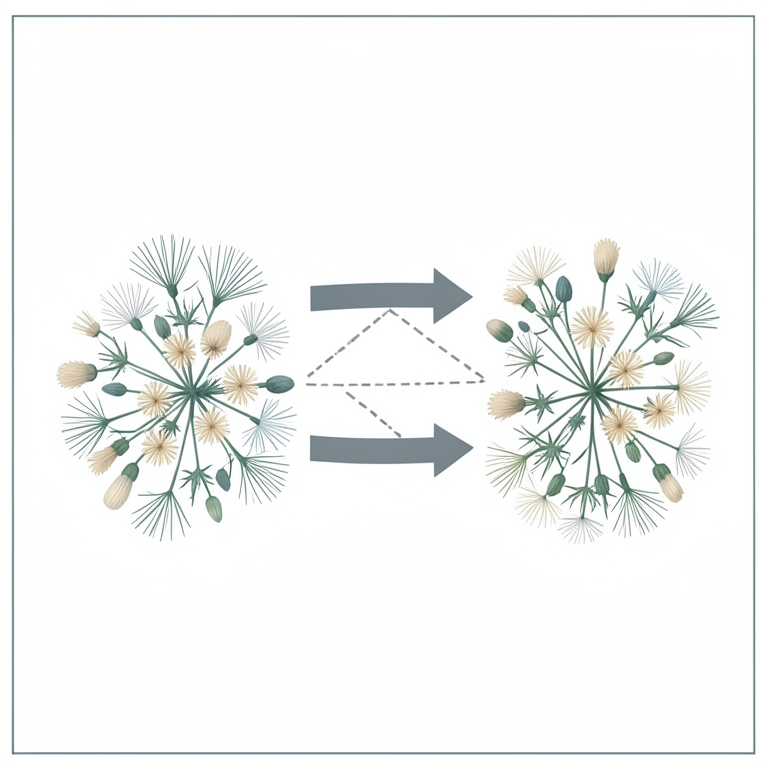
Cross-Reactivity Hierarchy
AI-generated conceptual illustration (Subtropical pollen grains from grass and weed species). It explains the idea and does not show study data.
View source evidence ↗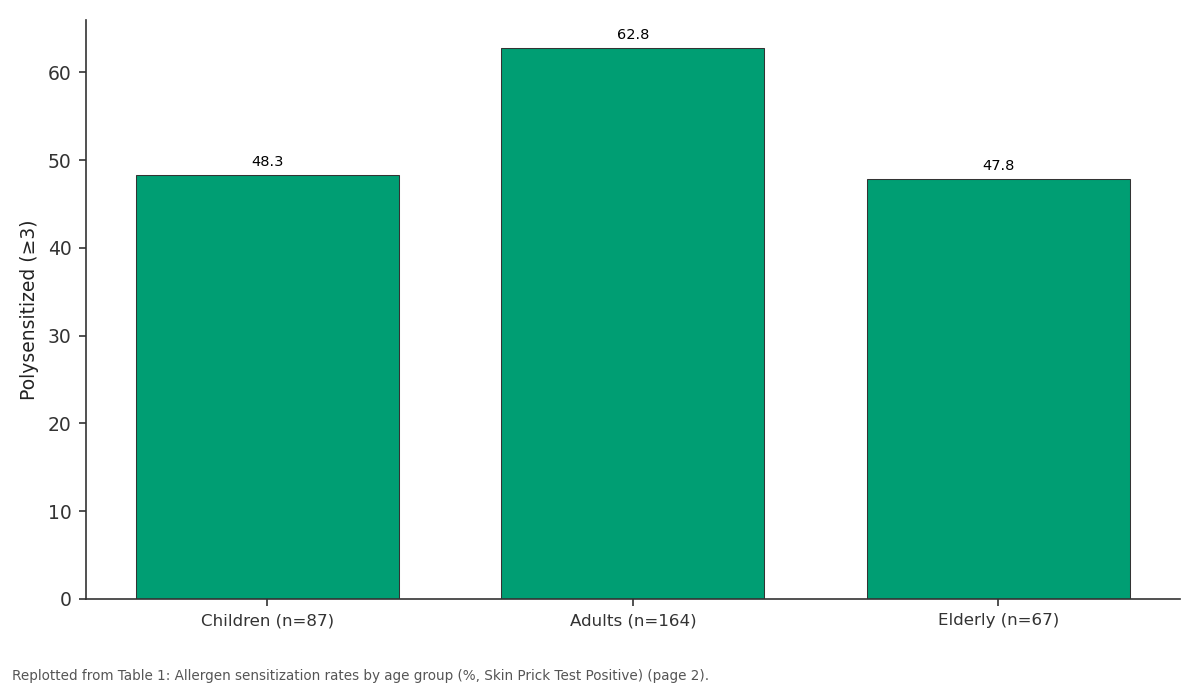
Polysensitized (≥3): Children (n=87) vs Adults (n=164) vs Elderly (n=67)
Replotted from Table 1 (page 2) of the original paper. Every bar is the paper's own table value.
View source evidence ↗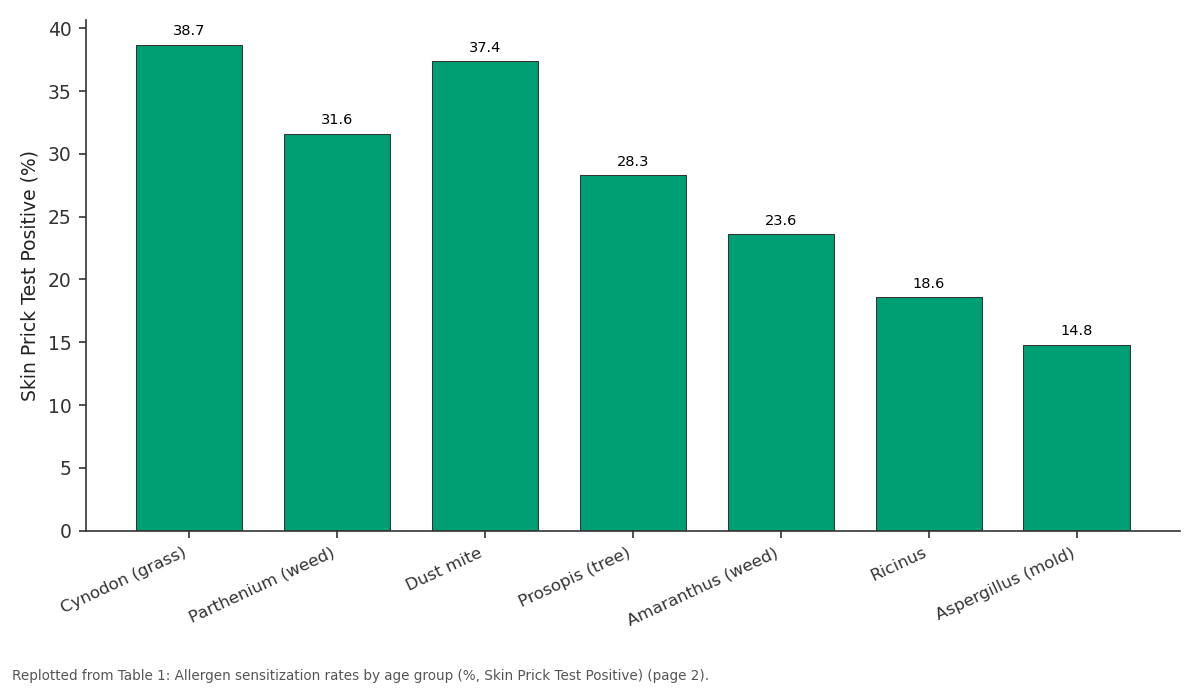
Overall (n=318): Cynodon (grass) vs Parthenium (weed) vs Dust mite vs Prosopis (tree) vs Amaranthus (weed)
Replotted from Table 1 (page 2) of the original paper. Every bar is the paper's own table value.
View source evidence ↗Figures & tables
From the original paper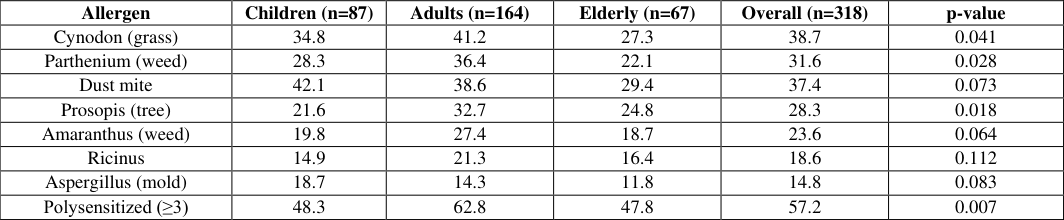 Table 1
 Table 2
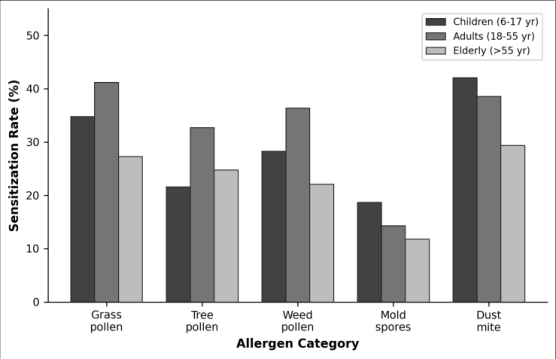 Figure 1
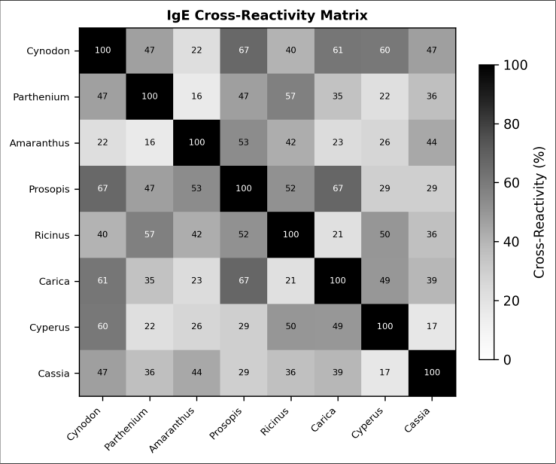 Figure 2
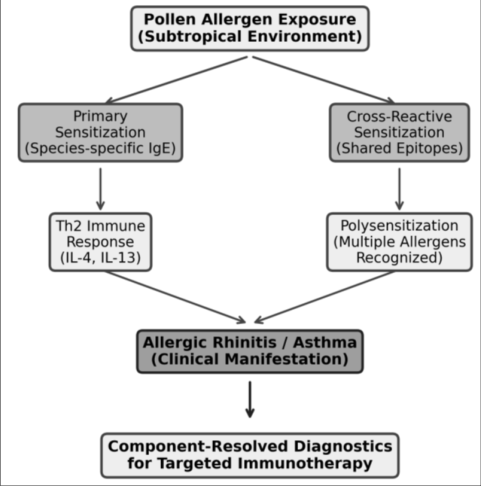 Figure 3
Introduction
According to the World Allergy Organization, allergic rhinitis affects 400 million people globally, and its prevalence in India has been climbing steadily from roughly 20% in the 1990s to over 30% in recent surveys of urban populations [1,2] . Subtropical cities like Hyderabad present a particularly complex allergenic landscape because year-round warm temperatures support continuous pollen production from multiple plant families, unlike temperate regions where pollen seasons are more clearly delineated [3] . When an allergic patient reacts to five or six different pollen extracts on a skin prick test, the clinical question becomes: are these five separate allergies, or is one or two primary sensitizations causing cross-reactive IGE that recognizes structurally similar proteins across species [4] ? This distinction matters enormously for treatment. Allergen-specific immunotherapy targets specific allergen sources, and treating patients for allergens to which they aren't truly primarily sensitized wastes resources and may not improve symptoms [5] . Cross-reactivity occurs when IGE antibodies raised against one allergen bind to homologous proteins from a different source. Panallergens highly conserved proteins found across the plant kingdom like profilins, polcalcins, and lipid transfer proteins are the main drivers of apparent polysensitization [6] . In subtropical regions, where patients encounter diverse pollens year-round, the contribution of cross-reactivity to skin test positivity may be larger than in temperate settings [7] . This research aimed to define age-stratified sensitization patterns to eight locally relevant aeroallergens in Hyderabad, quantify IgE cross-reactivity between major pollen pairs, and determine how much of the observed polysensitization can be attributed to panallergenmediated cross-reactive IgE rather than genuine independent sensitization.
Materials and Methods
Materials and Methods
Materials
A total of 318 patients with physician-diagnosed allergic rhinitis (persistent, moderate-severe by ARIA criteria) were recruited from the allergy outpatient clinic at Deccan College of Biological Sciences, Hyderabad, between March 2022 and February 2023. Inclusion criteria were: age 6-72 years, at least one positive skin prick test to a panel of aeroallergens, no immunotherapy in the past 5 years, and no systemic corticosteroid use within 4 weeks. The cohort was stratified into three age groups: children (6-17 years, n=87), adults (18-55 years, n=164), and elderly (>55 years, n=67). Standardized allergen extracts for skin prick testing (ALK-A bello, through their Indian distributor) covered eight pollen allergens: Cynodon dactylon, Cyperus rotundus (grasses), Parthenium hysterophorus, Amaranthus spinosus (weeds), Prosopis juliflora, Cassia fistula (trees), Ricinus communis, and Carica papaya. Dust mite (Dermatophagoides pteronyssinus) and mold (Aspergillus fumigatus) extracts served as non-pollen controls. The Institutional Ethics Committee approved the protocol (IEC/DCBS/2022-07, February 2022), and all patients or guardians provided informed consent.
Methods
Skin prick tests were performed on the volar forearm following EAACI guidelines. A wheal diameter ≥3 mm larger than the negative control (glycerinated saline) at 15 minutes was considered positive. Histamine dihydrochloride (10 mg/mL) served as positive control. Serum total IGE and allergen-specific IGE levels were measured by Immuno CAP (Thermo Fisher, ≥0.35 kU/L considered positive). IgE cross-reactivity was assessed by inhibition ELISA: patient sera were pre-incubated with increasing concentrations of one allergen extract before testing IgE binding to a second allergen on the solid phase. Cross-inhibition ≥50% was classified as strong cross-reactivity. Component-Resolved Diagnostics (CRD) using recombinant panallergens (rBet v 2 for profilin, rPhl p 7 for polcalcin) were performed on sera from all polysensitized patients (n=182). Data were analyzed using chi-square tests for proportional comparisons and logistic regression for associations between sensitization patterns and clinical variables in SPSS v26.
Quality Control
All skin prick tests were performed by two trained nurses with documented inter-rater reliability (Cohen's kappa = 0.89). Allergen extracts were stored at 2-8 °C and used within 6 months of manufacture date. ImmunoCAP assays included positive and negative quality control sera in each run, with inter-assay CV below 8%. Inhibition ELISA experiments were performed in duplicate, and results were averaged; duplicates differing by more than 15% were repeated. Cynodon grass pollen was the single most common sensitizer overall (38.7%), followed closely by dust mite (37.4%) and Parthenium weed pollen (31.6%; Table 1).
| Allergen | Children (n=87) | Adults (n=164) | Elderly (n=67) | Overall (n=318) | p-value |
|---|---|---|---|---|---|
| Cynodon (grass) | 34.8 | 41.2 | 27.3 | 38.7 | 0.041 |
| Parthenium (weed) | 28.3 | 36.4 | 22.1 | 31.6 | 0.028 |
| Dust mite | 42.1 | 38.6 | 29.4 | 37.4 | 0.073 |
| Prosopis (tree) | 21.6 | 32.7 | 24.8 | 28.3 | 0.018 |
| Amaranthus (weed) | 19.8 | 27.4 | 18.7 | 23.6 | 0.064 |
| Ricinus | 14.9 | 21.3 | 16.4 | 18.6 | 0.112 |
| Aspergillus (mold) | 18.7 | 14.3 | 11.8 | 14.8 | 0.083 |
| Polysensitized (≥3) | 48.3 | 62.8 | 47.8 | 57.2 | 0.007 |
Table text extracted from the original PDF; superscript letters are shown inline. The original table image is below.
View original table image
Results
Polysensitization was more common in adults (62.8%) than in children (48.3%) or elderly (47.8%), consistent with cumulative allergen exposure over time. Cross-reactivity was strongest within plant families: Cynodon-Cyperus (both grasses) showed 67.3% crossinhibition, while Parthenium-Amaranthus (both Asteraceae-related weeds) reached 58.4% (Table 2). Cross-family reactivity was weaker, with grass-weed cross-inhibition averaging only 24.8%. Component-resolved diagnostics revealed that among 182 polysensitized patients, 76 (41.8%) showed IgE reactivity to recombinant profilin (rBet v 2) and/or polcalcin (rPhl p 7). In these patients, an average of 2.4 of their positive skin test results (out of a mean of 4.1 total positives) could be attributed to panallergen cross-reactivity rather than genuine primary sensitization.
| Allergen Pair | % Cross- Inhibition | n Tested | Classification | Shared Epitopes |
|---|---|---|---|---|
| Cynodon ↔ Cyperus | 67.3 | 43 | Strong | Group 1 grass |
| Parthenium ↔ Amaranthus | 58.4 | 38 | Strong | Profilin |
| Prosopis ↔ Cassia | 41.7 | 31 | Moderate | Polcalcin |
| Cynodon ↔ Parthenium | 24.8 | 52 | Weak | Profilin |
| Ricinus ↔ Prosopis | 18.3 | 27 | Minimal | LTP |
| Cynodon ↔ Prosopis | 12.6 | 34 | Minimal | None clear |
Table text extracted from the original PDF; superscript letters are shown inline. The original table image is below.
View original table image
Discussion
The sensitization patterns documented in this Hyderabad cohort reflect the year-round pollen exposure that characterizes subtropical environments. Unlike temperate regions where grass pollen dominates a discrete springsummer season, Hyderabad's warm climate supports continuous Cynodon and Cyperus grass flowering alongside perennial weed growth, creating overlapping exposure windows that favor polysensitization [3,8] . The 57.2% polysensitization rate we observed exceeds rates from northern Indian cities like Delhi (42-48%) where winter temperatures suppress pollen production for several months [9] . The finding that 41.8% of polysensitized patients reacted to panallergens has direct clinical relevance. Profilin-mediated cross-reactivity can cause positive skin tests to unrelated plant allergens, potentially leading clinicians to prescribe immunotherapy against allergen sources that aren't driving the patient's symptoms [5,10] . European allergy guidelines now recommend component-resolved diagnostics before initiating immunotherapy in polysensitized patients, and our data suggest this recommendation applies equally to subtropical Indian settings [11] . The age-stratified patterns make biological sense. Higher dust mite sensitization in children reflects indoor exposure during early immune development, while the increasing pollen sensitization through adulthood reflects cumulative outdoor exposure [12,13] . The slight decline in sensitization rates in the elderly group may reflect immunosenescence, which can dampen IgE-mediated responses [14] .
Conclusion
Pollen sensitization patterns among allergic rhinitis patients in Hyderabad are characterized by high polysensitization rates (57.2%), year-round grass and weed pollen reactivity, and substantial IgE cross-reactivity between botanically related species. Cynodon grass pollen was the single most prevalent sensitizer (38.7%), with sensitization rates peaking in adulthood. IgE cross-reactivity was strongest within plant families (67.3% for grass-grass pairs), while cross-family reactivity was weaker. Panallergen-specific IgE (profilin and polcalcin) accounted for 41.8% of positive skin test results in polysensitized patients, indicating that a large fraction of apparent multi-allergen sensitization reflects cross-reactive rather than independent primary IgE. These findings support the routine use of component-resolved diagnostics before prescribing allergen immunotherapy in subtropical Indian populations, to distinguish genuine primary sensitization from clinically irrelevant crossreactivity.
Acknowledgement
Acknowledgements Funding sourcesThis research was funded through intramural allocations from Deccan College of Biological Sciences. ImmunoCAP reagents were partially supported by a Thermo Fisher academic collaboration grant.
Figures and tables from the paper
References
14 in the original paper- Canonica GW, Holgate ST, Lockey RF. White book on allergy: update 2013. World Allergy Organization. 2013:1-248.
- Goel N, Chopra D. A cross-sectional study of sensitization to common aeroallergens in patients with asthma and rhinitis. Indian Journal of Allergy Asthma and Immunology. 2019;33(1):24-31.
- Kumar P. Aeroallergens in clinical practice of allergy in India: an overview. Annals of Agricultural and Environmental Medicine. 2003;10(2):131-136.
- Ballmer-Weber BK, Vieths S. The oral allergy syndrome: improved diagnostic and treatment methods. Current Opinion in Allergy and Clinical Immunology. 2005;5(3):267-272.
- Landivar ME, Ruiz-Garcia M, et al. How molecular diagnosis can change allergen-specific immunotherapy prescription in a complex pollen area. Allergy. 2012;67(5):709-711.
- Roulias A, Ferreira F, Egger M. Panallergens and their impact on the allergic patient. Allergy Asthma and Clinical Immunology. 2010;6(1):1-11.
- Cecchi L, Bonini S, et al. Allergenic pollen and pollen allergy in Europe. Allergy. 2007;62(9):976-990.
- Nowak M, Szymanska A, et al. Temporal variability in the allergenicity of airborne Alternaria spores. Medical Mycology. 2019;57(4):403-411.
- Dutta BK, Singh AB. Aeropalynology and allergic human diseases in the northeast region of India. Grana. 2009;48(2):145-152.
- Valenta R, Bohle B. Profilin, a potential contributor to IgE-mediated diseases. Annals of Allergy Asthma and Immunology. 2006;33(4):337-347.
- Ansotegui IJ, Pawankar R, et al. A WAO-ARIAGA2LEN consensus document on molecular-based allergy diagnostics. World Allergy Organization Journal. 2013;6(1):17-27.
- Tariq SM, Matthews S, Hakim E. Sensitization to common allergens and its association with allergic disorders at age 4 years. Pediatrics. 2001;108(2):e33e39.
- Macaubas C, Stumbles PA, Sly PD. The role of allergy in the development of asthma. Nature. 1999;402(6760):B12-B17.
- Allergy and asthma in the elderly. Seminars in Respiratory and Critical Care Medicine. 2010;31(5):587-595.