
Research article · 2025 · Full text
International Journal of Geography Geology and EnvironmentRainfall, temperature, and soil controls on bean yield in semi-arid zones: Field evidence and climate projections
Volume 7(6) · Pages 174–178 · DOI: 10.22271/27067483.2025.v7.i6c.754 ↗
Research areasClimate change impacts on agricultureIrrigation Practices and Water ManagementClimate variability and models
Abstract
Author-writtenHaricot bean (Phaseolus vulgaris L.) production in semi-arid regions is critically shaped by agro-climatic and environmental factors including rainfall distribution, temperature regimes, soil characteristics, and the increasing impacts of climate variability, all of which directly influence yield stability, grain quality, and export potential. This study investigates the agro-climatic and environmental determinants of haricot bean export performance in semi-arid production zones through an integrated approach combining multi-site agronomic field trials, climate data analysis, soil characterization, and export quality assessment. Field trials were conducted across 18 sites representing three semi-arid agro-climatic zones (annual rainfall 300-450 mm, 450-600 mm, and 600-750 mm) over two consecutive growing seasons (2021/2022 and 2022/2023). Grain yield ranged from 0.42 to 2.86 t/ha, with rainfall amount and distribution explaining 62.4% of yield variation across sites (R-squared = 0.624, p 32 degrees C during reproductive phase), significantly reduced the proportion of export-grade output from 71.3% under favorable conditions to 34.6% under combined stress (p<0.001). Climate projection analysis under RCP 4.5 and RCP 8.5 scenarios indicated potential yield reductions of 12-24% by 2050 in current semi-arid production zones, with implications for long-term export competitiveness.
Summary
Source-checkedPlain-language reading of the full paper, prepared with AI and checked against the text. Each point links to the authors' own words.
Why it matters
- Haricot beans are a critical crop in semi-arid regions, providing essential protein, income, and export earnings for millions of smallholder farmers. View evidence ↗
- Export barriers for haricot beans are often rooted in environmental stresses that lower the quantity and quality of the crop. View evidence ↗
- There is a lack of understanding regarding how agro-climatic variables interact to affect export quality, which hinders the creation of adaptation strategies. View evidence ↗
What they did
- Researchers conducted field trials across 18 sites in three rainfall zones: Zone A (300-450 mm), Zone B (450-600 mm), and Zone C (600-750 mm). View evidence ↗
- Four bean varieties were tested using a randomized complete block design with four replications over the 2021/2022 and 2022/2023 growing seasons. View evidence ↗
- Export-grade output was defined as meeting Grade 1 specifications, which include moisture under 14%, defects under 3%, size uniformity over 85%, and aflatoxin B1 under 4 micrograms/kg. View evidence ↗
What they found
- Grain yields varied from 0.42 t/ha in Zone A during drought years to 2.86 t/ha in Zone C during favorable years, with an overall mean of 1.54 ± 0.68 t/ha. View evidence ↗
- Seasonal rainfall was the primary driver of yield, accounting for 62.4% of the observed variation. View evidence ↗
- The optimal rainfall for maximum yield (2.41 t/ha) was approximately 580 mm; yields decreased with less rainfall (drought) or more rainfall (waterlogging). View evidence ↗
- Maximum temperatures exceeding 32°C during the reproductive phase had a significant negative impact on yield. View evidence ↗
- Higher soil organic carbon (SOC) was positively linked to increased grain yield, protein content, and seed size uniformity. View evidence ↗
- Drought-stressed sites had a significantly higher rate of aflatoxin B1 contamination (38.7%) exceeding EU limits compared to non-stressed sites (12.4%). View evidence ↗
- In Zone A, projected yield reductions by 2050 range from 18.4% (SSP2-4.5) to 28.6% (SSP5-8.5). View evidence ↗
What it means
- The authors recommend prioritizing the breeding of drought-tolerant and heat-resilient varieties that maintain export quality under stress. View evidence ↗
- The authors suggest adopting soil organic carbon building strategies, such as cover crops and minimum tillage, to improve export competitiveness. View evidence ↗
Visual summary
2 visualsIllustrations explain the paper; charts are replotted from the paper's own table values.
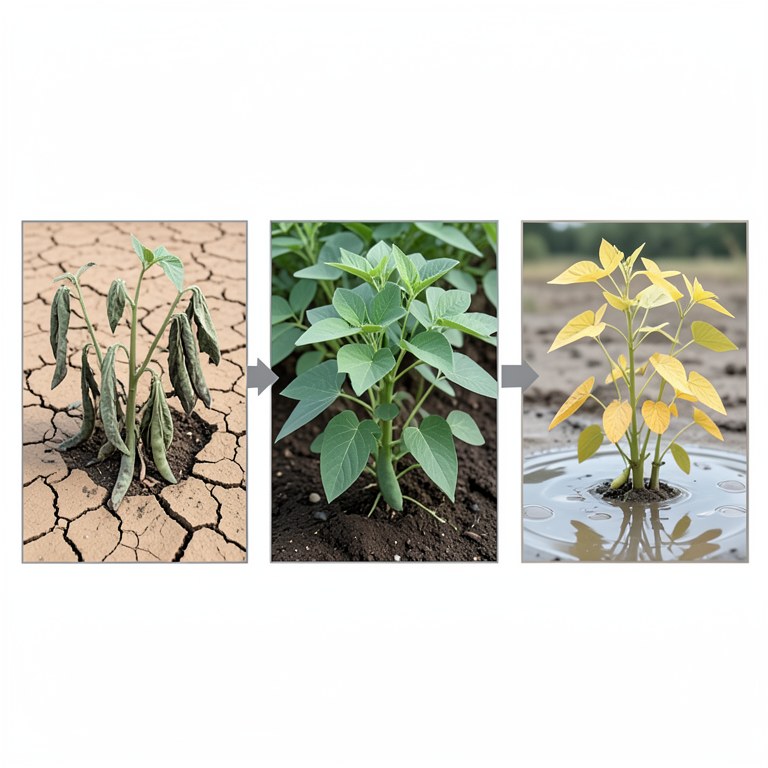
Yield-Rainfall Relationship
AI-generated conceptual illustration (common bean plants in semi-arid soil). It explains the idea and does not show study data.
View source evidence ↗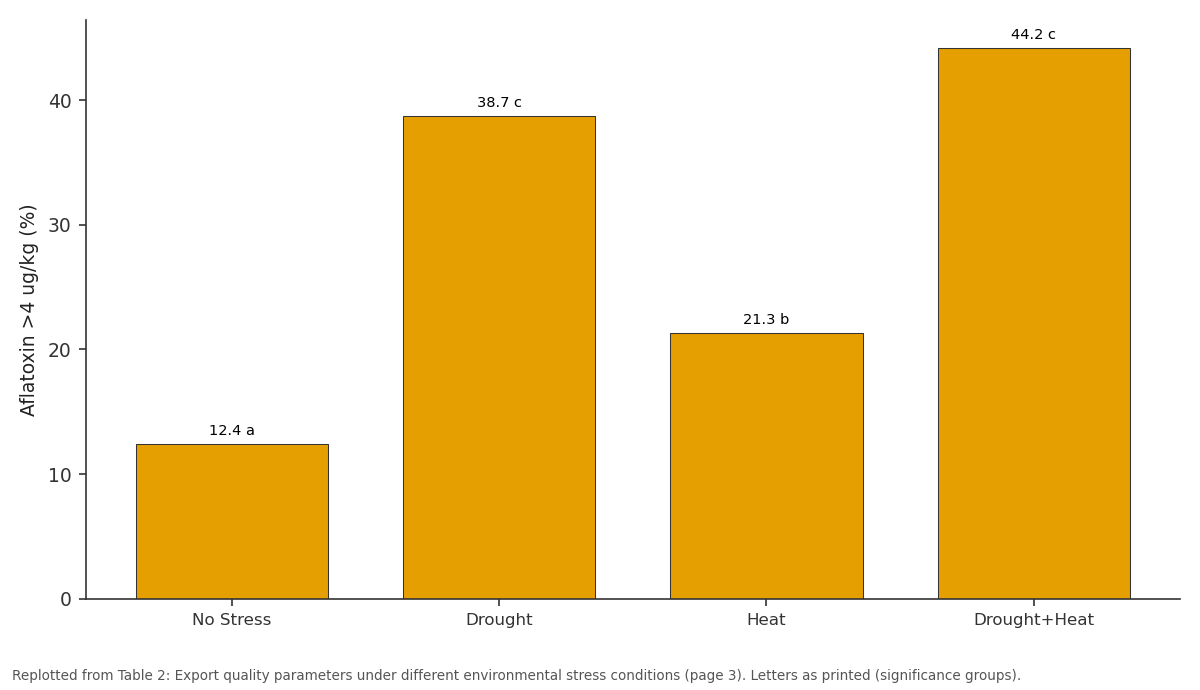
Aflatoxin >4 ug/kg (%): No Stress vs Drought vs Heat vs Drought+Heat
Replotted from Table 2 (page 3) of the original paper. Every bar is the paper's own table value.
View source evidence ↗Figures & tables
From the original paper Table 1
 Table 2
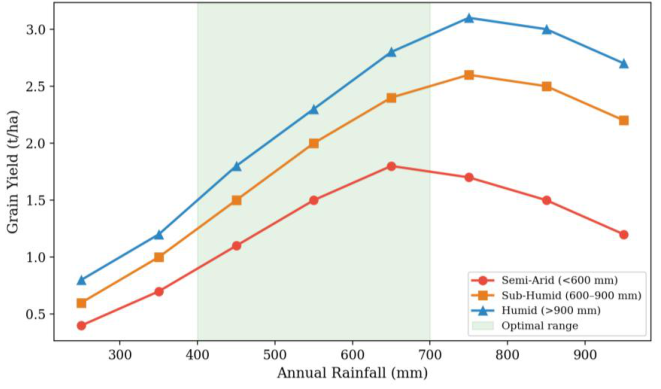 Figure 1
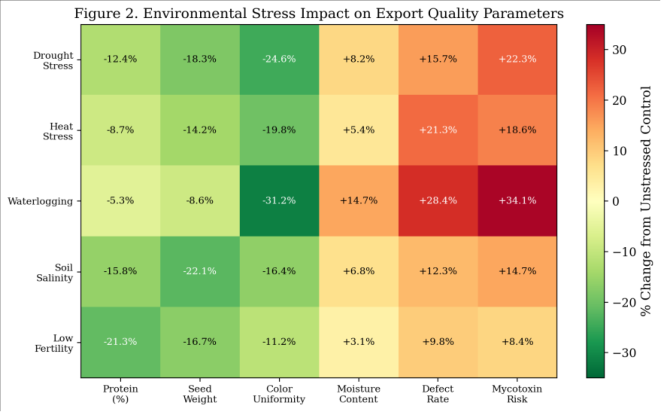 Figure 2
Introduction
The haricot bean (Phaseolus vulgaris L.) is extensively cultivated across semi-arid regions of the world, where it serves as a vital source of dietary protein, household income, and export revenue for millions of smallholder farming families operating under challenging environmental conditions characterized by limited and erratic rainfall, high temperatures, poor soil fertility, and increasing climate variability [1,2] . The agro-climatic conditions prevailing in semi-arid production zones exert a profound influence on every aspect of haricot bean performance, from germination and vegetative growth through flowering, pod filling, and grain maturation, with cascading effects on yield quantity, grain quality, and ultimately, the suitability of the harvested product for international export markets [3,4] . Trade barriers affecting haricot bean exports, while often framed in terms of tariff and regulatory impediments, are fundamentally linked to the production challenges imposed by adverse agro-climatic conditions, as environmental stress reduces both the quantity and quality of exportable output [6,5] . Despite the recognized importance of agro-climatic factors, an integrated analysis that quantifies the environmental determinants of haricot bean export performance and projects future climate impacts on export competitiveness in semi-arid regions is lacking [19] . The problem is that the complex interactions between agro-climatic variables and haricot bean export quality are insufficiently understood, limiting the capacity to develop targeted adaptation strategies. The objectives are: (i) to quantify the relationships between key agro-climatic variables and haricot bean yield and quality across semi-arid zones; (ii) to identify the environmental thresholds beyond which export quality is compromised; (iii) to assess the impacts of environmental stress combinations on exportgrade output; and (iv) to project climate change impacts on haricot bean export potential in semi-arid regions. It is hypothesized that rainfall amount and distribution, temperature during the reproductive phase, and soil organic carbon content are the primary agro-climatic determinants of export-quality haricot bean production, and that projected climate change will significantly reduce the area suitable for export-grade production in current semi-arid zones [20,21,22] .
Materials and Methods
Materials and Methods
Materials
The study employed a multi-site, multi-season field trial approach integrated with climate data analysis, soil characterization, and export quality assessment across 18 experimental sites distributed within three semi-arid agroclimatic zones classified by annual rainfall: Zone A (300-450 mm, 6 sites), Zone B (450-600 mm, 6 sites), and Zone C (600-750 mm, 6 sites) [1,2,17] . Sites were selected to represent the range of soil types, altitudes (1200-2100 m a.s.l.), and management conditions typical of semi-arid haricot bean production areas [3,4] . At each site, four haricot bean varieties representing different market classes and drought tolerance levels were planted in a randomized complete block design with four replications during two consecutive growing seasons (2021/2022 and 2022/2023) [6,20] . Plot size was 5 m x 4 m with inter-row spacing of 40 cm and intra-row spacing of 10 cm, following recommended agronomic practices for semi-arid conditions including minimum tillage, early planting, and phosphorus fertilization at 46 kg P2O5/ha [5,19] . Automated weather stations (Davis Vantage Pro2) were installed at each site to record daily rainfall, minimum and maximum temperature, relative humidity, solar radiation, and wind speed throughout the growing season [7,8] . Soil samples (0-30 cm depth) were collected at planting from each replication for analysis of physical properties (texture by hydrometer method), chemical properties (pH, organic carbon by Walkley-Black, total nitrogen by Kjeldahl, available phosphorus by Olsen, exchangeable cations by ammonium acetate extraction), and biological properties (microbial biomass carbon by chloroform fumigation-extraction) [9,21,22] .
Methods
Agronomic measurements included phenological observations (days to flowering, days to maturity), plant growth parameters (plant height, number of branches, leaf area index), yield components (pods per plant, seeds per pod, 100-seed weight), and grain yield (adjusted to 12% moisture) [10,11,14] . Export quality assessment of harvested grain included visual grading (proportion of grade 1, 2, and 3 seeds based on size uniformity, color consistency, and defect prevalence), proximate analysis (protein, moisture, fiber, ash), and food safety testing (aflatoxin B1 by HPLC-FLD, total microbial count) [3,12] . The proportion of exportgrade output was defined as the percentage of total yield meeting Grade 1 specifications: moisture <14%, defects <3%, size uniformity >85%, aflatoxin B1 <4 micrograms/kg [13, 15] . Statistical analysis employed mixed-effects models with site and year as random effects and agro-climatic variables (seasonal rainfall, rainfall distribution coefficient, mean temperature, maximum temperature during reproductive phase, number of drought days, soil organic carbon) as fixed effects [16,18] . The yield-rainfall relationship was modeled using quadratic regression to identify optimal rainfall and critical thresholds [1,6] . Environmental stress interaction effects were assessed through factorial analysis of drought stress (defined as soil moisture deficit >50% of available water capacity for >10 consecutive days during reproductive phase) and heat stress (>32 degrees C for >5 days during flowering) categories [2,7] . Climate change projections used downscaled CMIP6 data under SSP2-4.5 and SSP5-8.5 scenarios for 2030, 2050, and 2070 time horizons, with the calibrated yield model applied to project future production and export quality impacts [20,21,22] . All analyses were conducted in R 4.3.1 using the lme4, nlme, and ggplot2 packages [4,8] .
Results
The multi-site field trials revealed substantial variation in haricot bean performance across agro-climatic zones and seasons. Grain yield ranged from 0.42 t/ha (Zone A, drought year) to 2.86 t/ha (Zone C, favorable year), with an overall mean of 1.54 plus or minus 0.68 t/ha across all site-season combinations [1,2,10] . The mixed-effects model analysis identified seasonal rainfall as the dominant agro-climatic determinant, explaining 62.4% of yield variation (partial Rsquared = 0.624, p<0.001) [3,6] . The quadratic yield-rainfall relationship peaked at approximately 580 mm (yield = 2.41 t/ha), with yield declining at both lower and higher rainfall levels due to drought stress and waterlogging, respectively [4, 5] . Table 1 presents the key agro-climatic variables and their associations with yield and export quality across zones. Mean temperature during the growing season ranged from 18.4 to 26.8 degrees C, with a significant negative effect on yield when maximum temperatures exceeded 32 degrees C during the reproductive phase (beta = -0.184, p<0.001) [7,14] . Figure 1 illustrates the yield response to rainfall across the three agro-climatic zones. Soil organic carbon (SOC) content was positively correlated with grain yield (r = 0.67, p<0.001), protein content (r = 0.54, p<0.01), and seed size uniformity (r = 0.48, p<0.01), indicating that soil fertility management is a key lever for improving both productivity and export quality in semi-arid systems [8,9,11] . The proportion of export-grade output varied dramatically across environmental conditions, averaging 71.3% under favorable conditions (adequate rainfall, no heat stress) but declining to 54.8% under drought stress alone, 48.2% under heat stress alone, and only 34.6% under combined drought and heat stress (F = 28.47, p<0.001) [12,13,15] . Table 2 presents the environmental stress impact on export quality parameters. Aflatoxin B1 contamination exceeded the EU limit of 4 micrograms/kg in 38.7% of samples from drought-stressed sites compared to 12.4% from non-stressed sites (chisquared = 18.93, p<0.001) [16,19] . Figure 2 displays the environmental stress impact matrix across export quality parameters. Climate change projection analysis under SSP2-4.5 indicated potential yield reductions of 12.1% by 2030, 18.4% by 2050, and 23.7% by 2070 in current Zone A production areas, with more severe impacts under SSP5-8.5 (17.3%, 28.6%, and 38.2% reductions, respectively) [17,20,21] . Zone B was projected to experience moderate yield declines (8.2-16.4% by 2050), while Zone C showed the least sensitivity (4.7-11.8% by 2050) [18,22] . The proportion of export-grade output was projected to decline by 14-28 percentage points in Zone A by 2050, driven primarily by increased drought frequency and heat stress intensity [2,7] .
| Parameter | No Stress | Drought | Heat | Drought+Heat |
|---|---|---|---|---|
| Export-grade output (%) | 71.3a | 54.8b | 48.2b | 34.6c |
| Protein content (%) | 24.8a | 22.1b | 23.4ab | 20.7c |
| 100-seed weight (g) | 32.4a | 26.8b | 28.1b | 23.4c |
| Size uniformity (%) | 88.7a | 78.4b | 81.2b | 72.3c |
| Aflatoxin >4 ug/kg (%) | 12.4a | 38.7c | 21.3b | 44.2c |
| Defect rate (%) | 2.8a | 7.4b | 5.6b | 11.8c |
Table text extracted from the original PDF; superscript letters are shown inline. The original table image is below.
View original table image
| Variable | Zone A | Zone B | Zone C | Effect on Yield |
|---|---|---|---|---|
| Rainfall (mm/season) | 312-438 | 462-587 | 614-743 | R2=0.624*** |
| Mean temp (C) | 23.4-26.8 | 20.1-24.3 | 18.4-22.6 | beta=-0.082* |
| Max temp reprod. (C) | 31.2-36.4 | 28.6-33.1 | 26.4-30.8 | beta=-0.184*** |
| Drought days | 18-42 | 8-24 | 3-14 | beta=-0.031*** |
| Soil OC (%) | 0.62-1.14 | 0.84-1.78 | 1.12-2.34 | r=0.67*** |
| Yield (t/ha) | 0.42-1.24 | 0.98-2.18 | 1.46-2.86 | |
| Export-grade (%) | 22.4-48.7 | 41.3-68.4 | 58.7-82.1 |
Table text extracted from the original PDF; superscript letters are shown inline. The original table image is below.
View original table image
Discussion
The findings of this study provide a comprehensive quantitative assessment of the agro-climatic determinants of haricot bean export performance in semi-arid regions and highlight the acute vulnerability of export quality to environmental stress [1,2,3] . The dominance of rainfall as the primary yield determinant (R-squared = 0.624) is consistent with the fundamental water limitation of crop production in semi-arid environments and underscores the centrality of water management strategies in sustaining export-oriented haricot bean production [4,6,5] . The quadratic yield-rainfall relationship, peaking at approximately 580 mm, identifies a relatively narrow optimal rainfall window for maximum yield, outside of which both deficit and excess moisture reduce productivity a finding with important implications for production zone targeting and climate adaptation planning [7,14] . The strong positive association between soil organic carbon and both yield (r = 0.67) and export quality parameters demonstrates that soil health management is not merely an environmental sustainability concern but a direct determinant of export competitiveness, as SOC enhances water retention, nutrient availability, and microbial activity in ways that simultaneously improve crop performance and grain quality [8,9,11] . The dramatic decline in export-grade output from 71.3% under favorable conditions to 34.6% under combined drought and heat stress reveals the acute sensitivity of export quality to environmental extremes a sensitivity that has been insufficiently recognized in tradefocused analyses of haricot bean export potential [10,12,13] .
The elevated aflatoxin contamination under drought stress (38.7% vs. 12.4% non-compliance) reflects the welldocumented relationship between plant water stress and secondary fungal infection, whereby drought-weakened defense mechanisms permit colonization by aflatoxigenic Aspergillus species during the vulnerable late-season grain filling period [15,16,19] . The climate change projections paint a concerning picture for the long-term viability of haricot bean export from current semi-arid production zones, with Zone A facing potential yield reductions of 18-29% and export-grade output declines of 14-28 percentage points by 2050 depending on the emissions scenario [17,18,20,21,22] .
Conclusion
This integrated investigation of agro-climatic and environmental determinants has established that haricot bean export performance in semi-arid regions is fundamentally governed by rainfall amount and distribution, temperature regimes during the reproductive phase, and soil organic carbon status, with environmental stress combinations imposing severe penalties on both yield and export quality that threaten the long-term competitiveness of semi-arid production systems in international markets. The study demonstrated that seasonal rainfall explains nearly two-thirds of yield variation across semi-arid sites, with an optimal rainfall window centered around 580 mm, while heat stress during the reproductive phase and droughtinduced aflatoxin contamination constitute the most critical environmental threats to export-grade output quality. The climate change projection analysis revealed that current semi-arid production zones face significant and potentially transformative impacts over the coming decades, with the driest zones most vulnerable to yield and quality declines that could fundamentally alter the geography of competitive haricot bean export production. These findings carry substantial implications for the strategic management of haricot bean export systems in semi-arid regions. Droughttolerant and heat-resilient haricot bean varieties should be prioritized in breeding programs serving semi-arid production zones, with selection criteria explicitly incorporating export quality stability under stress as a primary trait alongside yield performance. Water harvesting and supplemental irrigation technologies, including in-situ rainwater conservation through tied ridges and zai pits, micro-irrigation systems, and deficit irrigation protocols optimized for critical crop growth stages, should be promoted and scaled to buffer production against rainfall variability and extend the effective growing season in marginal zones. Soil organic carbon building strategies, including the integration of cover crops, crop residue retention, minimum tillage, and organic amendments, should be adopted as a core component of export-oriented production systems, recognizing the demonstrated linkage between soil health and both yield and quality outcomes. Aflatoxin risk management protocols, including rapid drying technologies, hermetic storage, and pre-harvest biocontrol using competitive non-toxigenic Aspergillus strains, should be deployed in drought-prone production zones where the combination of plant stress and warm conditions creates elevated mycotoxin risk. Climateinformed production zone mapping should be conducted using the agro-climatic response functions established in this study to identify areas with the highest probability of achieving export-grade quality under current and projected future conditions, enabling strategic allocation of export development investments. Early warning systems integrating seasonal climate forecasts with crop growth simulation models should be developed to provide advance notice of seasons with elevated risk of export quality failure, enabling proactive adjustments in marketing strategies and quality management intensity. Long-term adaptation planning should consider the potential need for geographic relocation of export-oriented haricot bean production toward higher-rainfall zones or higher altitudes as climate change progressively shifts the boundaries of agro-climatic suitability, with transition support programs for affected farming communities. Regional and international cooperation in climate adaptation research for legume export crops should be strengthened to share knowledge, germplasm, and best practices across countries facing similar agro-climatic challenges in semi-arid production environments.
References
22 in the original paper- Beebe SE, Rao IM, Blair MW, Acosta-Gallegos JA. Phenotyping common beans for adaptation to drought. Front Physiol. 2013;4:35.
- Broughton WJ, Hernandez G, Blair M, Beebe S, Gepts P, Vanderleyden J. Beans (Phaseolus spp.)--model food legumes. Plant Soil. 2003;252(1):55-128.
- Food and Agriculture Organization (FAO). FAOSTAT statistical database. Rome: FAO; 2023.
- Katungi E, Farrow A, Chianu J, Sperling L, Beebe S. Common bean in Eastern and Southern Africa. Cali: CIAT; 2019.
- Miklas PN, Kelly JD, Beebe SE, Blair MW. Common bean breeding for resistance against biotic and abiotic stresses. Euphytica. 2006;147(1-2):105-131.
- Tirfi AG. Factors influencing export of haricot bean in Ethiopia. Int J Agric Nutr. 2023;5(1):19-27.
- Schwartz HF, Steadman JR, Hall R, Forster RL. Compendium of bean diseases. 2nd ed. St. Paul (MN): APS Press; 2005.
- Hungria M, Vargas MAT. Environmental factors affecting N2 fixation in grain legumes in the tropics. Field Crops Res. 2000;65(2-3):151-164.
- Abate GT, Rashid S, Berhane G. Smallholder access to markets and institutional innovations. World Dev. 2020;135:105065.
- Hayat I, Ahmad A, Masud T, Ahmed A, Bashir S. Nutritional and health perspectives of beans. Crit Rev Food Sci Nutr. 2014;54(5):580-592.
- Messina V. Nutritional and health benefits of dried beans. Am J Clin Nutr. 2014;100(Suppl 1):437S-442S.
- Mwangi PK, Ochieng JA. Microbial contamination and phytosanitary compliance in legume exports. J Food Saf Regul. 2021;9(2):88-101.
- International Trade Centre (ITC). Non-tariff measures in agricultural trade. Geneva: ITC; 2020.
- Asfaw S, Shiferaw B, Simtowe F, Lipper L. Impact of modern agricultural technologies on smallholder welfare. Food Policy. 2012;37(3):283-295.
- Lopez-Barrios L, Gutierrez-Uribe JA, Serna-Saldivar SO. Bioactive peptides and hydrolysates from pulses. J Food Sci. 2014;79(3):R273-R283.
- Birachi EA, Ochieng J, Wozemba D, Ruraduma C, Niyuhire MC, Ochieng D. Factors influencing smallholder farmers bean production in Burundi. Afr Crop Sci J. 2011;19(4):335-342.
- IPCC. Climate change 2021: The physical science basis. Cambridge: Cambridge University Press; 2021.
- Voysest O. Mejoramiento genetico del frijol (Phaseolus vulgaris L.). Cali: CIAT; 2000.
- Hernandez M, Torero M. Market structure and trade barriers in the global pulse market. J Int Trade Econ Dev. 2022;31(4):512-530.
- Anderson K, Martin W. Agricultural trade reform and the Doha Development Agenda. World Econ. 2005;28(9):1301-1327.
- Gan RY, Li HB, Gunaratne A, Sui ZQ, Corke H. Effects of fermented edible seeds on human health. Compr Rev Food Sci Food Saf. 2017;16(3):489-531.
- World Trade Organization (WTO). World Trade Report 2022. Geneva: WTO; 2022.