
Research article · 2026 · Full text
International Journal of Horticulture and Food ScienceImpact of MSME and NDDB initiatives on rural women’s empowerment in India
Volume 8(5) · Pages 11–13 · DOI: 10.33545/26631067.2026.v8.i5a.746 ↗
Research areasMicrofinance and Financial InclusionSocial and Economic Development in IndiaAgricultural Development and Management
Abstract
Author-writtenWomen empowerment in rural India is a key driver of inclusive and sustainable development. Government initiatives, particularly those under Micro, Small and Medium Enterprises (MSME), National Dairy Development Board (NDDB), and rural livelihood missions, have significantly contributed to enhancing women’s economic independence, social status, and participation in decision-making. This review paper examines the role of these schemes in promoting women empowerment through entrepreneurship, dairy cooperatives, and self-help groups (SHGs). Drawing on recent literature and policy reports (2023-2026), the paper highlights achievements, challenges, and future directions. The findings indicate that integrated approaches combining financial support, skill development, and institutional frameworks are essential for long-term empowerment.
Summary
Source-checkedPlain-language reading of the full paper, prepared with AI and checked against the text. Each point links to the authors' own words.
Why it matters
- Empowering women in rural India is considered essential for achieving sustainable and inclusive development. View evidence ↗
- Because rural women make up a large part of the informal and agricultural workforce, their empowerment depends on access to education, resources, and economic opportunities. View evidence ↗
- Empowerment in this context means eliminating discrimination and fostering financial independence by ensuring equal access to healthcare, education, and decision-making. View evidence ↗
The question
- The paper aims to examine how MSME, NDDB, and rural livelihood schemes promote women's empowerment via self-help groups, dairy cooperatives, and entrepreneurship. View evidence ↗
What they did
- The authors conducted a review of policy reports and literature published between 2023 and 2026. View evidence ↗
What they found
- MSME programs such as Stand-Up India, Mudra Yojana, and PMEGP provide collateral-free credit and 25-35% margin money, resulting in over 30% project participation by women. View evidence ↗
- Dairy cooperatives provide technical training, market access, and fair income to a workforce that is nearly 70% female. View evidence ↗
- Initiatives have connected over 90 lakh rural women to Self-Help Groups (SHGs), helping them move from subsistence work to active ownership. View evidence ↗
What it means
- The authors conclude that long-term empowerment requires integrated approaches that combine institutional frameworks, skill development, and financial support. View evidence ↗
- The authors state that investing in rural women entrepreneurs is the most powerful way to build a more equitable, prosperous, and inclusive nation. View evidence ↗
- The authors note that challenges remain regarding the scaling of micro-enterprises and access to formal credit. View evidence ↗
Visual summary
1 visualsIllustrations explain the paper; they do not show study data.
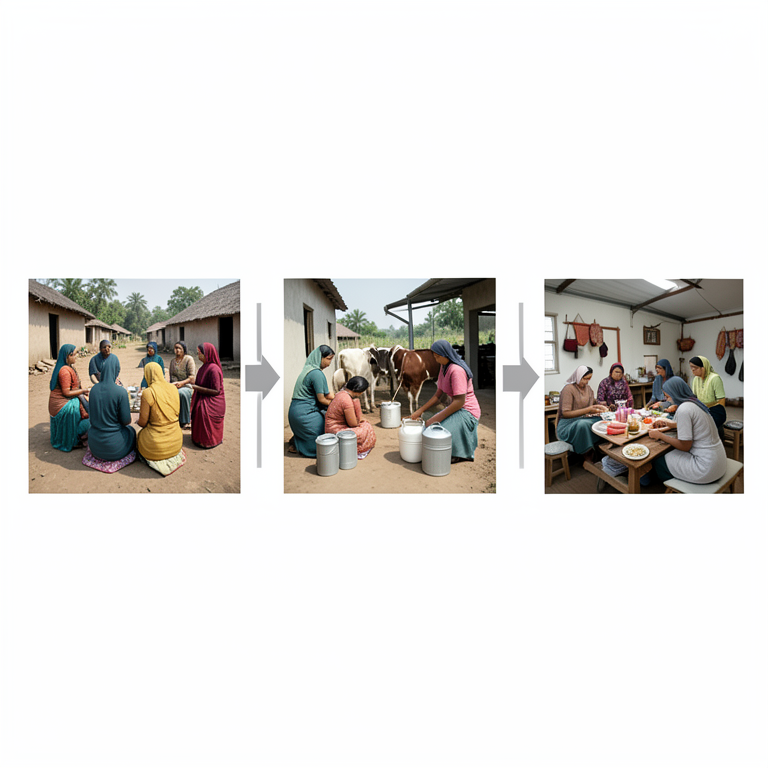
Study overview
AI-generated conceptual illustration (Rural Indian women in a village setting). It explains the idea and does not show study data.
View source evidence ↗Introduction
Women empowerment is central to achieving inclusive economic growth and sustainable development. In rural India, where women constitute a significant portion of the agricultural and informal workforce, empowerment is closely linked to access to resources, education, and economic opportunities. Government initiatives such as MSME schemes, NDDB dairy programs, and rural livelihood missions have transformed women from passive beneficiaries into active economic agents. These programs focus on entrepreneurship, cooperative participation, and financial inclusion, thereby improving livelihoods and social status. MSME schemes empower women by providing financial assistance, lowering entry barriers, and offering training, which fosters economic independence and business ownership. Programs like PMEGP, Mudra Yojana, and Stand-Up India offer subsidized loans, 25-35% margin money for women, and collateral-free credit, facilitating over 30% project participation by women.
Concept of Women Empowerment in Rural India
Women empowerment in rural India involves creating an environment where women have equal access to education, healthcare, and decision-making, aiming to eliminate discrimination and foster financial independence. It enables women to lead in agriculture, entrepreneurship, and local governance, addressing challenges like limited resources and gender-based discrimination to drive sustainable community development. Women empowerment refers to: Economic independence Decision-making power Social and political participation In rural India, empowerment is often achieved through: Self-Help Groups (SHGs) Micro-enterprises Dairy cooperatives
Role of MSME Schemes in Women Empowerment
MSME schemes empower women in India by providing financial assistance, subsidies, and skill training, facilitating their transition from homemakers to entrepreneurs. Key initiatives like PMEGP, Mudra Yojana, and Stand-Up India offer low-interest loans, concessions, and up to 35% subsidies to women, enabling economic independence. These schemes enhance access to capital, encourage business ownership, and promote self-reliance in manufacturing and service sectors.
Overview of MSME Sector
The MSME sector is a major contributor to employment and entrepreneurship.
Dairy Cooperatives as Empowerment Tools
Dairy cooperatives act as powerful empowerment tools for rural women by providing financial independence, enhancing decision-making roles, and improving social status. With nearly 70% of India's dairy workforce being female, these cooperatives ensure fair income, market access, and technical training, transitioning women from informal labor to organized dairy business stakeholders. The dairy sector is one of the most effective means of empowering rural women due to: Low capital requirement Daily income generation Compatibility with household responsibilities
NDDB Initiatives
NDDB actively promotes women's empowerment through dairying by facilitating all-women cooperatives, providing technical training, improving access to credit, and implementing manure management initiatives. Key initiatives include establishing all-women dairy cooperatives (like Shreeja MPO), fostering manure value chains (biogas/slurry) for income, and implementing training under the Women Dairy Cooperative Leadership Programme (WDCLP).
Women Dairy Cooperative Leadership Programme (WDCLP)
Enhances leadership and participation of women in dairy cooperatives Promotes women as decision-makers and board members Recent initiatives have enabled thousands of women to become financially independent through dairy enterprises (e.g., milk producer organizations and cooperatives).
Conclusion
The initiatives spearheaded by MSME development policies and the National Dairy Development Board (NDDB) have not merely provided economic support; they have acted as catalysts for a profound social transformation in rural India. By connecting over 90 lakh rural women to Self-Help Groups (SHGs) and modernizing dairy cooperatives, these initiatives have empowered women to transition from subsistence-level workers to active owners of their futures.
The surge in women-owned MSMEs, particularly in agriculture, handicrafts, and food processing, shows a significant shift towards "Nari Shakti" (women's power) as a driving force of rural prosperity. Looking ahead, this journey from financial inclusion to holistic empowerment is essential for a "Viksit Bharat" (Developed India) by 2047. While challenges related to formal credit access and scaling micro-enterprises persist, the strong foundation laid by NDDB's, Pashu Sakhi programs, and MSME mentorship proves that when women are equipped with skills, digital tools, and institutional support, they become resilient catalysts for poverty reduction and community welfare. Ultimately, supporting rural women entrepreneurs is not just a tool for economic growth; it is the most powerful investment in building a more inclusive, prosperous, and equitable nation.
References
5 in the original paper- Ministry of Micro, Small and Medium Enterprises. Women entrepreneurs. New Delhi: Ministry of Micro, Small and Medium Enterprises. 2024.
- Ministry of MSME. DC MSME schemes. New Delhi: Ministry of MSME. 2024.
- National Dairy Development Board. Enhancing women involvement in cooperation. Anand: National Dairy Development Board. 2024.
- Indifi. MSME schemes for women entrepreneurs. Gurugram: Indifi. 2025.
- MSME Helpdesk. MSME schemes for women empowerment. New Delhi: MSME Helpdesk. 2025.