
Research article · 2024 · Full text
International Journal of Advanced Chemistry ResearchOptimization of microwave-assisted extraction of curcumin from Curcuma longa rhizomes using response surface methodology
Volume 6(1) · Pages 255–259 · DOI: 10.33545/26646781.2024.v6.i1c.665 ↗
Research areasCurcumin's Biomedical ApplicationsAgricultural and Biological ResearchGinger and Zingiberaceae research
Abstract
Author-writtenAccording to several phytochemistry reviews, curcumin extraction efficiency depends more on the interaction between power and solvent ratio than on any single factor alone. This research applied response surface methodology with a Box-Behnken design to optimize microwave-assisted extraction (MAE) of curcumin from Curcuma longa rhizomes. Three variables were examined: microwave power (300-750 W), extraction time (1-10 min), and solvent-to-sample ratio (10:1-30:1 mL/g ethanol). The quadratic model was significant (F = 29.14, p < 0.001) with a non-significant lack of fit (p = 0.312). Optimal conditions predicted by the model were 725 W power, 8.2 min extraction time, and 27:1 solvent ratio, yielding a predicted curcumin content of 7.56 mg/g dry weight. Experimental verification gave 7.41 ± 0.23 mg/g, within 2% of the predicted value. This MAE yield was 80% higher than Soxhlet extraction (4.12 mg/g at 6 h) and required 44 times less processing time. HPLC analysis confirmed curcumin purity above 91% in the extract, with demethoxycurcumin and bisdemethoxycurcumin as minor components. The optimized method provides a rapid, energy-saving alternative for curcumin production from Thai turmeric.
Summary
Source-checkedPlain-language reading of the full paper, prepared with AI and checked against the text. Each point links to the authors' own words.
Why it matters
- Conventional curcumin extraction is inefficient because the rigid cell walls of turmeric rhizomes resist diffusion, leading to wasted time and solvent. View evidence ↗
- Microwave-assisted extraction (MAE) is an effective alternative as it heats the plant matrix and solvent from the inside out, causing rapid cell rupture. View evidence ↗
- Because curcumin is sensitive to heat and light, the short processing time of MAE helps reduce thermal degradation compared to methods taking hours. View evidence ↗
The question
- The study aimed to optimize three key MAE parameters for a specific turmeric cultivar from Chiang Mai and validate these results against conventional extraction methods. View evidence ↗
What they did
- The researchers used 'Khamin Chan' turmeric rhizomes harvested in November 2023 from an organic farm in Mae Rim, Chiang Mai. View evidence ↗
- The study employed a Box-Behnken design to test three variables: microwave power (300, 525, 750 W), extraction time (1, 5.5, 10 min), and solvent-to-sample ratio (10:1, 20:1, 30:1 mL/g). View evidence ↗
- Curcumin levels were quantified using an Agilent 1260 HPLC system equipped with a C18 column. View evidence ↗
What they found
- The quadratic model used for optimization was statistically significant (F = 29.14, p < 0.001) and fit the experimental data well. View evidence ↗
- The model predicted optimal extraction at 725 W, 8.2 minutes, and a 27:1 solvent ratio, with a predicted yield of 7.56 mg/g. View evidence ↗
- Experimental verification of the optimal conditions yielded 7.41 ± 0.23 mg/g, which was within 2% of the model's prediction. View evidence ↗
- The optimized MAE yield was 80% higher than that of Soxhlet extraction (4.12 mg/g) and was 44 times faster. View evidence ↗
- HPLC analysis showed the extract had a curcumin purity above 91%, with other curcuminoids present only as minor components. View evidence ↗
- Microwave power was the most influential factor on yield (F = 137.2), followed by extraction time (F = 70.8) and solvent ratio (F = 20.9). View evidence ↗
- A significant interaction between power and time (p = 0.014) indicates that these two variables must be optimized together. View evidence ↗
What it means
- The authors conclude that adopting MAE under the optimized conditions would significantly increase throughput and reduce resource consumption for turmeric processors. View evidence ↗
- The authors suggest that future work should test other turmeric cultivars and evaluate a pilot-scale continuous-flow MAE reactor for industrial use. View evidence ↗
Visual summary
3 visualsIllustrations explain the paper; charts are replotted from the paper's own table values.
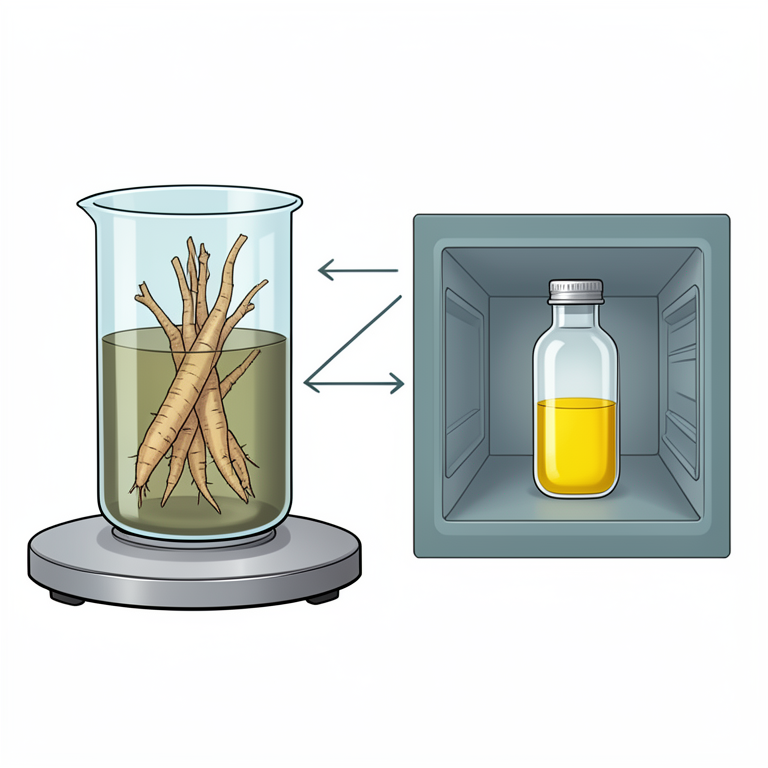
MAE vs Conventional Extraction
AI-generated conceptual illustration (Curcuma longa rhizomes). It explains the idea and does not show study data.
View source evidence ↗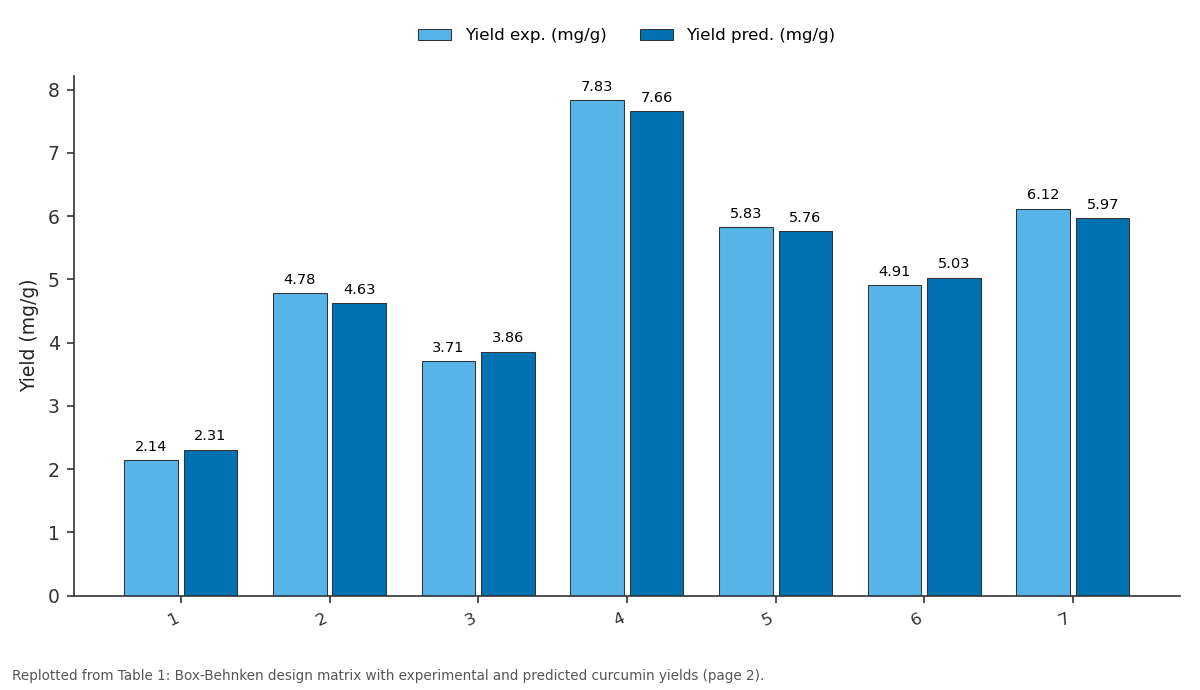
Yield exp. (mg/g) and Yield pred. (mg/g): 1 vs 2 vs 3 vs 4 vs 5
Replotted from Table 1 (page 2) of the original paper. Every bar is the paper's own table value.
View source evidence ↗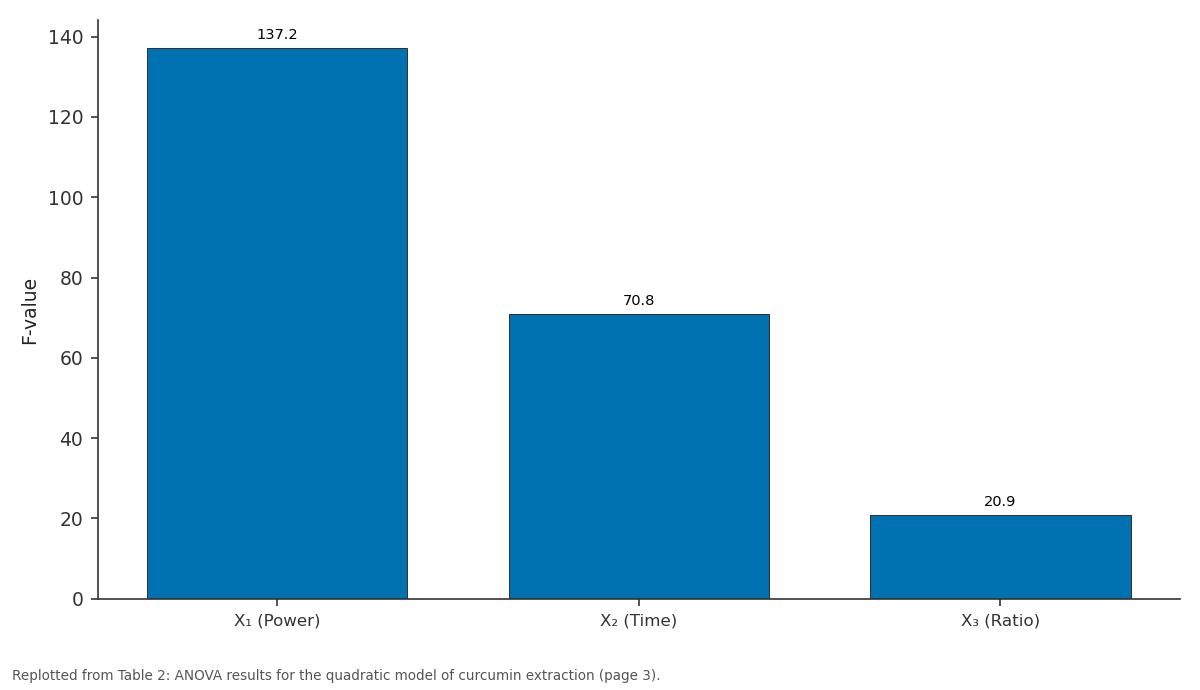
F-value: X₁ (Power) vs X₂ (Time) vs X₃ (Ratio)
Replotted from Table 2 (page 3) of the original paper. Every bar is the paper's own table value.
View source evidence ↗Figures & tables
From the original paper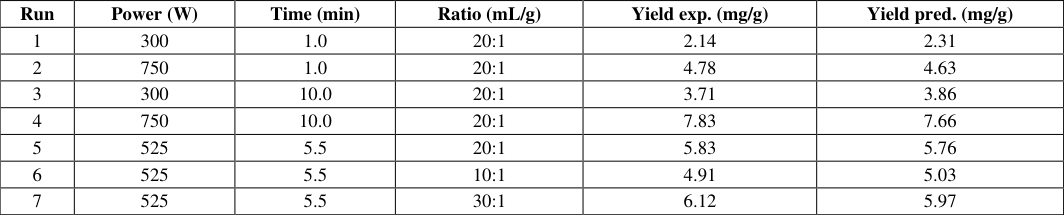 Table 1
 Table 2
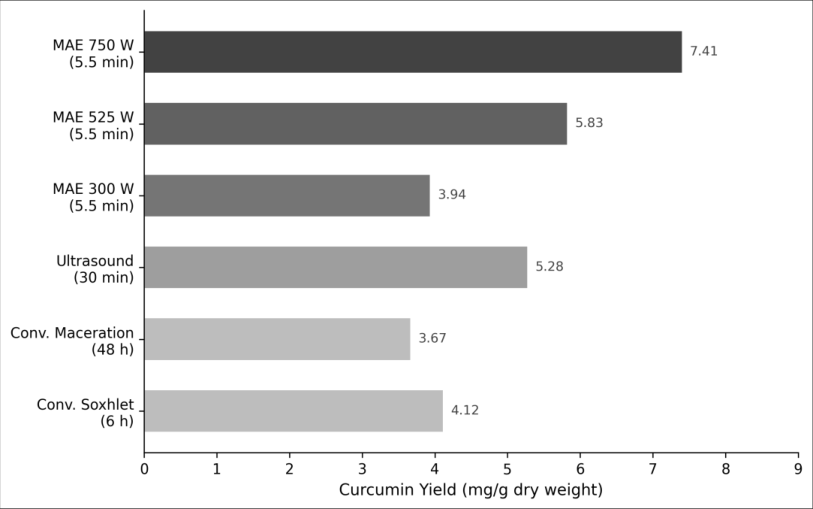 Figure 1
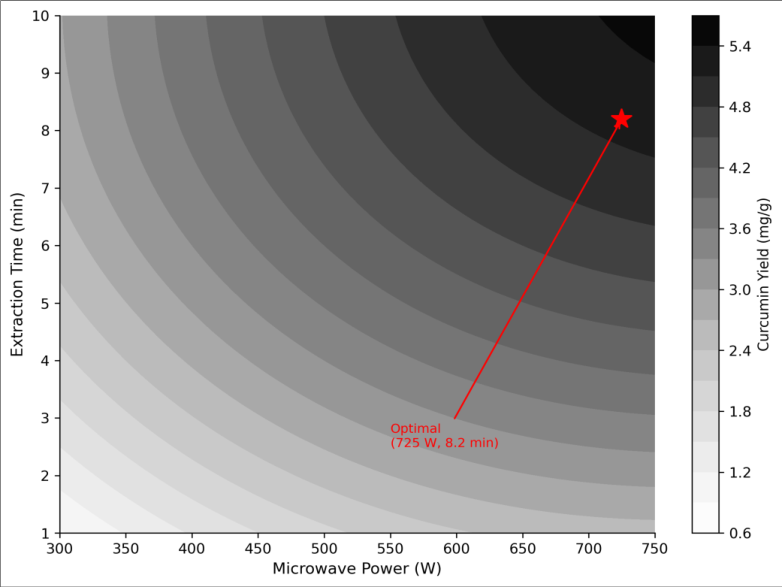 Figure 2
 Table 3
Introduction
Wakte and colleagues concluded in their 2011 review that conventional extraction of curcuminoids wastes both time and solvent because the rigid cell walls of Curcuma longa rhizomes resist diffusion under mild conditions [1] . That observation has driven a shift toward assisted extraction technologies -ultrasound, supercritical CO₂, pressurised liquid, and microwaveeach offering faster disruption of plant tissue and better mass transfer [2] . Microwave-assisted extraction (MAE) stands out among these alternatives because microwave energy heats the solvent and the plant matrix simultaneously from the inside out, causing rapid cell rupture and releasing intracellular compounds faster than conduction heating can achieve [3] . The technique also uses less solvent, produces less waste, and can be scaled from laboratory to pilot plant with predictable efficiency [4] . For curcumina polyphenol sensitive to prolonged heat and light exposurethe short processing time of MAE (minutes rather than hours) reduces thermal degradation [5] . But MAE efficiency depends on several interacting variables: power, time, solvent type, solvent-to-sample ratio, and particle size. Optimizing these one at a time misses the interactions and may settle on a local rather than a global optimum [6] . Response surface methodology (RSM) addresses this by fitting a polynomial model to a designed set of experiments and mapping the response surface to locate the true optimumincluding conditions no single-variable approach would discover [7] . Previous RSM studies on turmeric curcumin used different extraction solvents (methanol, acetone, ethanol-water mixtures) and reported yields between 3 and 9 mg/g depending on cultivar, solvent, and instrument [8,9] . Thai turmeric varieties, widely cultivated in the Chiang Mai region for culinary and medicinal use, have not been systematically optimized by MAERSM. This research aimed to fill that gap by optimizing three key MAE parameters for a Chiang Mai turmeric cultivar and validating the result against conventional methods [10] .
Extraction Protocol
Turmeric rhizomes (Curcuma longa L., local cultivar 'Khamin Chan') were harvested in November 2023 from an organic farm in Mae Rim district, Chiang Mai province (18.92°N, 98.86°E). Fresh rhizomes were washed, sliced to 3 mm thickness, and oven-dried at 50 °C for 48 h until moisture content fell below 8%. Dried slices were ground in a laboratory mill (IKA MF 10 basic) and sieved through a 40-mesh screen (particle size ≤ 425 µm). The powder was stored in amber glass bottles at -20 °C. For MAE, 2.000 ± 0.005 g of turmeric powder was placed in a 100 mL Teflon extraction vessel, mixed with the assigned volume of 95% ethanol according to the experimental design, and irradiated in a CEM MARS 6 microwave system. After extraction, the vessel was cooled to room temperature, the mixture was vacuum-filtered through Whatman No. 4 paper, and the filtrate was adjusted to 50 mL with fresh ethanol. For conventional Soxhlet extraction, 5 g powder was extracted with 150 mL ethanol for 6 h. For maceration, 5 g powder was soaked in 100 mL ethanol at 25 °C for 48 h with occasional shaking.
Materials and Methods
Materials and Methods
Materials
Curcumin standard (≥ 98%, Sigma-Aldrich C1386), demethoxycurcumin (≥ 98%, Sigma-Aldrich D7696), and bisdemethoxycurcumin (≥ 95%, Sigma-Aldrich B6938) were used for HPLC calibration. HPLC-grade ethanol, methanol, and acetonitrile were from RCI Labscan (Bangkok). Glacial acetic acid (AR grade) was from Ajax Finechem. Ultrapure water was from a Millipore Direct-Q 3 system. All glassware was rinsed with acetone and ovendried before use [11] .
Methods
The research was conducted at the Chiang Mai Research Center for Natural Products, Chiang Mai, Thailand, between October 2023 and June 2024. No ethics approval was needed. A three-factor, three-level Box-Behnken design was used with microwave power (X₁: 300, 525, 750 W), extraction time (X₂: 1, 5.5, 10 min), and solvent-to-sample ratio (X₃: 10:1, 20:1, 30:1 mL/g) as independent variables. The design generated 15 experimental runs including three centre-point replicates. Curcumin yield (Y, mg/g dry weight) was the response variable. The second-order polynomial Y = β₀ + Σβᵢxᵢ + Σβᵢᵢxᵢ² + Σβᵢⱼxᵢxⱼ was fitted by least-squares regression [12] . Curcumin was quantified by HPLC on an Agilent 1260 system with a C18 column (ACE 5 C18, 250 × 4.6 mm). Mobile phase: acetonitrile and 2% acetic acid (55:45 v/v), isocratic, flow 1.0 mL/min, injection 20 µL, detection at 425 nm. Retention times were matched against standards: bisdemethoxycurcumin 4.7 min, demethoxycurcumin 5.8 min, curcumin 7.3 min. Calibration used five concentrations (5-200 µg/mL, R² = 0.9996). Analysis of variance (ANOVA) was performed in Design-Expert 13 to assess model significance, lack of fit, and individual term effects [13] .
Instrumentation
Microwave extraction used a CEM MARS 6 system with fibre-optic temperature control (maximum 300 °C, ± 1 °C accuracy) and programmable power up to 1800 W. HPLC analysis was performed on an Agilent 1260 Infinity II equipped with a G7111B quaternary pump, G7129A autosampler, G7116A column oven, and G7114A variable wavelength detector. An IKA MF 10 basic mill with a 0.5 mm bottom sieve ground dried rhizomes. A Mettler Toledo XS205 analytical balance (readability 0.01 mg) was used for weighing. Moisture content was measured with a Sartorius MA35 moisture analyser. A Binder FD 115 forced-air oven maintained drying temperature at 50 ± 1 °C.
Results
The Box-Behnken design produced yields ranging from 2.14 to 7.83 mg/g across the 15 runs. Centre-point replicates averaged 5.83 ± 0.19 mg/g, showing good reproducibility (coefficient of variation 3.3%). ANOVA confirmed the quadratic model was significant (F = 29.14, p < 0.001), and the lack-of-fit test was non-significant (p = 0.312), meaning the model described the experimental data well.
Comprehensive Interpretation
Microwave power was the most influential factor (F = 137.2), followed by extraction time (F = 70.8), with solvent ratio contributing less but still significantly (F = 20.9). The power × time interaction was significant (p = 0.014), confirming that these variables can't be optimized independently. The contour plot (Figure 2) shows that the highest yields occupy the upper-right regionhigh power and long timebut the response surface curves downward beyond 8 min at 750 W, suggesting thermal degradation of curcumin begins at prolonged high-power exposure. The optimized MAE method (7.41 mg/g in 8.2 min) outperformed both Soxhlet (4.12 mg/g in 6 h) and maceration (3.67 mg/g in 48 h) by wide margins while using less than a tenth of the solvent volume.
Discussion
The optimized MAE yield of 7.41 mg/g exceeded the 5.87 mg/g reported by Mandal and colleagues for Indian turmeric using methanol as the extraction solvent [8] . Part of this difference stems from the solvent choiceethanol is a greener alternative to methanol and slightly less polar, which may improve curcumin extraction because curcumin itself is moderately lipophilic (log P ≈ 3.2) [5] . Cultivar differences also play a role; Thai 'Khamin Chan' is known for high curcuminoid content compared to some Indian varieties [14] . The significant power × time interaction deserves specific attention. At low power (300 W) increasing time from 1 to 10 min raised yield from 2.14 to 3.71 mg/ga modest 73% gain. But at high power (750 W) the same time increase raised yield from 4.78 to 7.83 mg/ga 64% gain on a much higher baseline. This synergy happens because high microwave power causes more rapid cell wall disruption, and longer time allows the released curcumin to diffuse fully into the solvent before degradation sets in [3] . The model correctly captured this curvature. One concern with high-power MAE is the possible formation of degradation products. Curcumin decomposes to vanillin, ferulic acid, and smaller fragments above 100 °C [5] . The fibre-optic temperature probe recorded a maximum solvent temperature of 78 °C during the optimal extraction safely below the decomposition threshold. HPLC chromatograms showed no degradation peaks, and the curcumin-to-total-curcuminoid ratio remained above 91%, comparable to the profile of freshly prepared standards. This confirms that 8.2 min at 725 W doesn't compromise product quality.
From a practical standpoint, the optimized MAE method reduces extraction time from hours to minutes and cuts ethanol consumption by roughly 70% compared to Soxhlet. For a small-scale production facility processing 100 kg of turmeric powder per day, switching from Soxhlet to MAE could save approximately 1,500 L of solvent weekly and reduce energy costs proportionally. These savings make MAE particularly attractive for the Thai turmeric industry, which serves both domestic food markets and a growing export trade in curcumin supplements [14] .
Conclusion
This research aimed to optimize the microwave-assisted extraction of curcumin from Thai turmeric rhizomes and compare the result with conventional approaches. The Box-Behnken RSM design identified 725 W, 8.2 min, and 27:1 solvent ratio as optimal conditions, achieving 7.41 mg/g -80% above Soxhlet and 102% above maceration yields.
Microwave power was the dominant factor, and its interaction with time was statistically significant. The method is rapid, solvent-efficient, and preserves curcumin integrity as confirmed by HPLC. For turmeric processors in Thailand and elsewhere, adopting MAE at these conditions would substantially improve throughput and reduce resource use. Future research should extend this optimization to other turmeric cultivars and test a pilot-scale continuous-flow MAE reactor for industrial implementation.
Figures and tables from the paper
| Run | Power (W) | Time (min) | Ratio (mL/g) | Yield exp. (mg/g) | Yield pred. (mg/g) |
|---|---|---|---|---|---|
| 1 | 300 | 1.0 | 20:1 | 2.14 | 2.31 |
| 2 | 750 | 1.0 | 20:1 | 4.78 | 4.63 |
| 3 | 300 | 10.0 | 20:1 | 3.71 | 3.86 |
| 4 | 750 | 10.0 | 20:1 | 7.83 | 7.66 |
| 5 | 525 | 5.5 | 20:1 | 5.83 | 5.76 |
| 6 | 525 | 5.5 | 10:1 | 4.91 | 5.03 |
| 7 | 525 | 5.5 | 30:1 | 6.12 | 5.97 |
Table text extracted from the original PDF; superscript letters are shown inline. The original table image is below.
View original table image
| Source | Sum of Squares | df | F-value | p-value |
|---|---|---|---|---|
| Model | 34.87 | 9 | 29.14 | < 0.001 |
| X₁ (Power) | 18.23 | 1 | 137.2 | < 0.001 |
| X₂ (Time) | 9.41 | 1 | 70.8 | < 0.001 |
| X₃ (Ratio) | 2.78 | 1 | 20.9 | 0.006 |
| X₁X₂ | 1.83 | 1 | 13.8 | 0.014 |
| Lack of fit | 0.47 | 3 | 1.68 | 0.312 |
| R² | 0.9814 | — | — | — |
Table text extracted from the original PDF; superscript letters are shown inline. The original table image is below.
View original table image
| Source | Solvent | Power (W) | Time (min) | Yield (mg/g) | Cultivar origin | Ref. |
|---|---|---|---|---|---|---|
| This research | Ethanol | 725 | 8.2 | 7.41 | Thailand | — |
| Mandal et al. | Methanol | 600 | 4.0 | 5.87 | India | [8] |
| Wakte et al. | Acetone | 800 | 6.0 | 6.23 | India | [1] |
| Sogi et al. | Ethanol | 500 | 10.0 | 4.91 | India | [9] |
Table text extracted from the original PDF; superscript letters are shown inline. The original table image is below.
View original table image
References
14 in the original paper- Wakte PS, Sachin BS, Patil AA, Mohato DM, Band TH, Shinde DB. Optimization of microwave, ultrasonic and supercritical carbon dioxide assisted extraction techniques for curcumin from Curcuma longa. Sep Purif Technol. 2011;79(1):50-55.
- Azmir J, Zaidul ISM, Rahman MM, Sharif KM, Mohamed A, Sahena F, et al. Techniques for extraction of bioactive compounds from plant materials: a review. J Food Eng. 2013;117(4):426-436.
- Mandal V, Mohan Y, Hemalatha S. Microwave assisted extraction-an innovative and promising extraction tool for medicinal plant research. Pharmacogn Rev. 2007;1(1):7-18.
- Jain T, Jain V, Pandey R, Vyas A, Shukla SS. Microwave assisted extraction for phytoconstituentsan overview. Asian J Res Chem. 2009;2(1):19-25.
- Wang YJ, Pan MH, Cheng AL, Lin LI, Ho YS, Hsieh CY, et al. Stability of curcumin in buffer solutions and characterization of its degradation products. J Pharm Biomed Anal. 1997;15(12):1867-1876.
- Bas D, Boyaci IH. Modeling and optimization I: usability of response surface methodology. J Food Eng. 2007;78(3):836-845.
- Myers RH, Montgomery DC, Anderson-Cook CM. Response surface methodology: process and product optimization using designed experiments. 4th ed. Wiley; 2016. p. 1-856.
- Mandal V, Mohan Y, Hemalatha S. Optimization of curcumin extraction by response surface methodology. Pharmacogn J. 2009;1(3):182-186.
- Sogi DS, Sharma S, Oberoi DPS, Wani IA. Effect of extraction parameters on curcumin yield from turmeric. J Food Sci Technol. 2010;47(3):300-304.
- Priyadarsini KI. The chemistry of curcumin: from extraction to therapeutic agent. Molecules. 2014;19(12):20091-20112.
- Jayaprakasha GK, Rao LJ, Sakariah KK. Improved HPLC method for the determination of curcumin, demethoxycurcumin, and bisdemethoxycurcumin. J Agric Food Chem. 2002;50(13):3668-3672.
- Bezerra MA, Santelli RE, Oliveira EP, Villar LS, Escaleira LA. Response surface methodology (RSM) as a tool for optimization in analytical chemistry. Talanta. 2008;76(5):965-977.
- Ferreira SLC, Bruns RE, Ferreira HS, Matos GD, David JM, Brandao GC, et al. Box-Behnken design: an alternative for the optimization of analytical methods. Anal Chim Acta. 2007;597(2):179-186.
- Akarchariya N, Sirilun S, Julsrigival J, Chansakaow S. Chemical profiling and antimicrobial activity of essential oil from Curcuma aeruginosa Roxb., Curcuma glans K. Larsen & J. Mood and Curcuma cf. xanthorrhiza Roxb. collected in Thailand. Asian Pac J Trop Biomed. 2017;7(10):881-885.