
Research article · 2025 · Full text
International Journal of Agriculture and NutritionEffect of pasture renewal and nitrogen fertilization on dry matter yield and feed quality of perennial ryegrass-white clover swards under temperate dairy systems
Volume 7(9) · Pages 162–165 · DOI: 10.33545/26646064.2025.v7.i9c.637 ↗
Research areasPasture and Agricultural SystemsAgricultural Productivity and Crop ImprovementRuminant Nutrition and Digestive Physiology
Abstract
Author-writtenA two-year field experiment was conducted at the Lincoln University Pastoral Research Farm, Canterbury, New Zealand, during 2023-2025 to evaluate the combined effect of pasture renewal and nitrogen fertilization on Dry Matter (DM) yield and feed quality of perennial ryegrass-white clover swards. A split-plot design with two pasture conditions (renewed and unrenewed) as main plots and five nitrogen levels (0, 50, 100, 150 and 200 kg N ha⁻¹ yr⁻¹) as subplots, replicated thrice, was followed. Renewed swards consistently outperformed unrenewed swards, yielding 10.2 to 16.9 t DM ha⁻¹ against 7.8 to 12.7 t ha⁻¹ in unrenewed plots. Crude protein in renewed plots was 2.5 to 2.8 percentage points higher, while metabolisable energy was elevated by 1.0 to 1.2 MJ kg⁻¹ DM. White clover content declined from 28.4% at 0 kg N to 11.6% at 200 kg N ha⁻¹ in renewed swards. Apparent nitrogen use efficiency fell from 48 to 34 kg DM kg⁻¹ N in renewed swards as nitrogen rose from 50 to 200 kg N ha⁻¹. The findings indicate that pasture renewal combined with moderate nitrogen application of 100 to 150 kg N ha⁻¹ yr⁻¹ offers the optimum balance between productivity, forage quality and legume persistence under temperate New Zealand dairy systems.
Summary
Source-checkedPlain-language reading of the full paper, prepared with AI and checked against the text. Each point links to the authors' own words.
Why it matters
- Perennial ryegrass and white clover mixtures are essential for temperate dairy production because they provide most of the crude protein and metabolisable energy for livestock. View evidence ↗
- Pastures often decline in persistence after five to seven years due to factors like weed growth, cultivar deterioration, and insufficient nitrogen replenishment. View evidence ↗
- Pasture renewal is used as a strategy to restore dry matter (DM) production and recover lost legume content in old swards. View evidence ↗
What they did
- A two-year field experiment was conducted from 2023 to 2025 at the Lincoln University Pastoral Research Farm in Canterbury, New Zealand. View evidence ↗
- The study used a split-plot design with three replications, comparing renewed and unrenewed pastures across five nitrogen levels: 0, 50, 100, 150, and 200 kg N ha⁻¹ yr⁻¹. View evidence ↗
- Renewed plots were resown in autumn 2023 with 'Trojan NEA2' ryegrass and 'Tribute' white clover, while unrenewed plots consisted of an existing 8-year-old sward. View evidence ↗
- Feed quality parameters, including crude protein, metabolisable energy, and fiber content (NDF and ADF), were measured using Near-Infrared Spectroscopy (NIRS). View evidence ↗
What they found
- Renewed swards produced 30.6% to 33.1% more dry matter than unrenewed swards, with yields ranging from 10.2 to 16.9 t DM ha⁻¹ compared to 7.8 to 12.7 t ha⁻¹. View evidence ↗
- Increasing nitrogen levels reduced white clover content, dropping from 28.4% to 11.6% in renewed swards and from 18.6% to 7.2% in unrenewed swards. View evidence ↗
- Renewed plots maintained weed content below 6%, whereas unrenewed plots had 11-14% weed content, primarily consisting of yarrow and browntop. View evidence ↗
What it means
- The authors conclude that combining pasture renewal with moderate nitrogen application (100 to 150 kg N ha⁻¹ yr⁻¹) provides the best balance of productivity, feed quality, and clover persistence. View evidence ↗
- The authors state that future research is needed to evaluate the long-term persistence of these benefits and to measure nitrous oxide losses and nitrate leaching. View evidence ↗
Visual summary
3 visualsIllustrations explain the paper; charts are replotted from the paper's own table values.
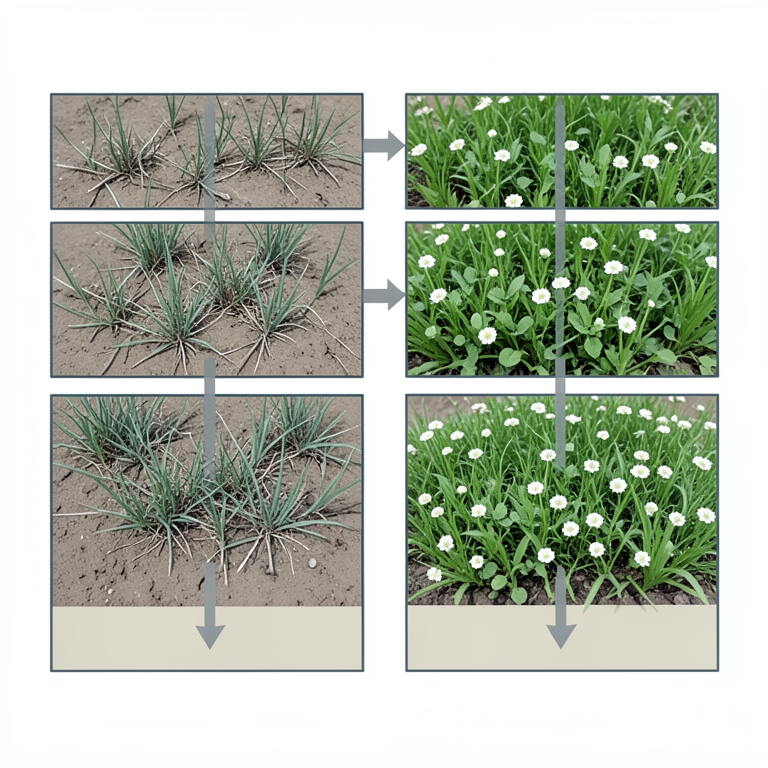
Experimental Design Layout
AI-generated conceptual illustration (perennial ryegrass and white clover swards). It explains the idea and does not show study data.
View source evidence ↗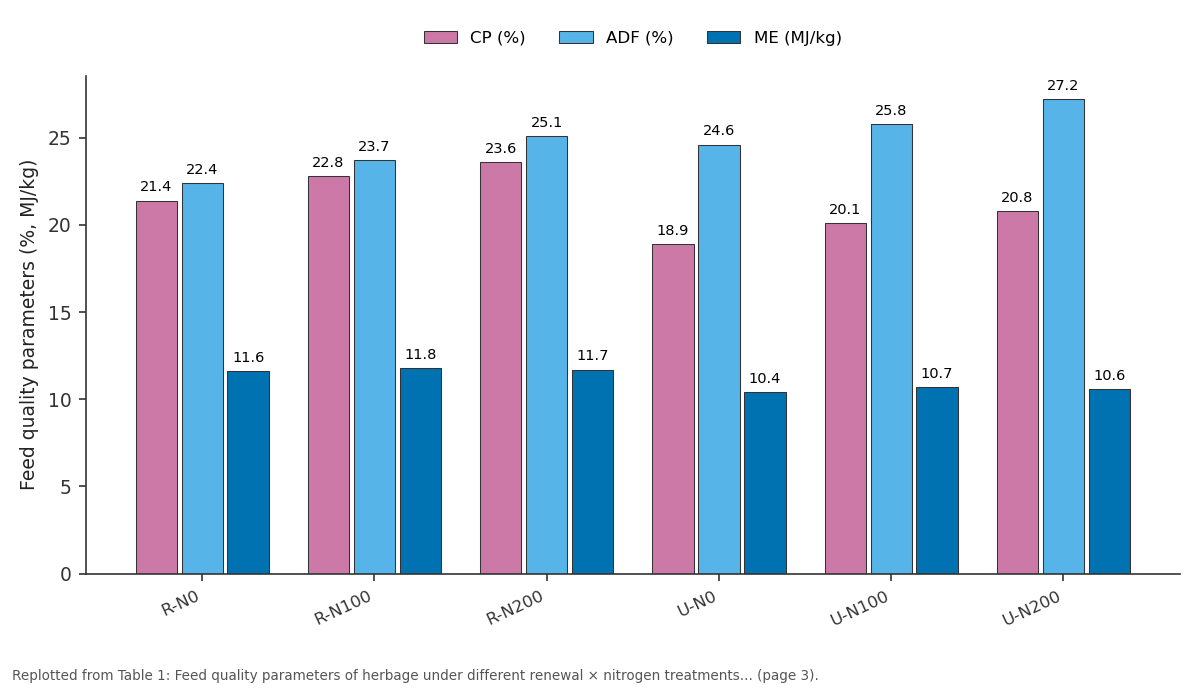
CP (%) and ADF (%) and more: R-N0 vs R-N100 vs R-N200 vs U-N0 vs U-N100
Replotted from Table 1 (page 3) of the original paper. Every bar is the paper's own table value.
View source evidence ↗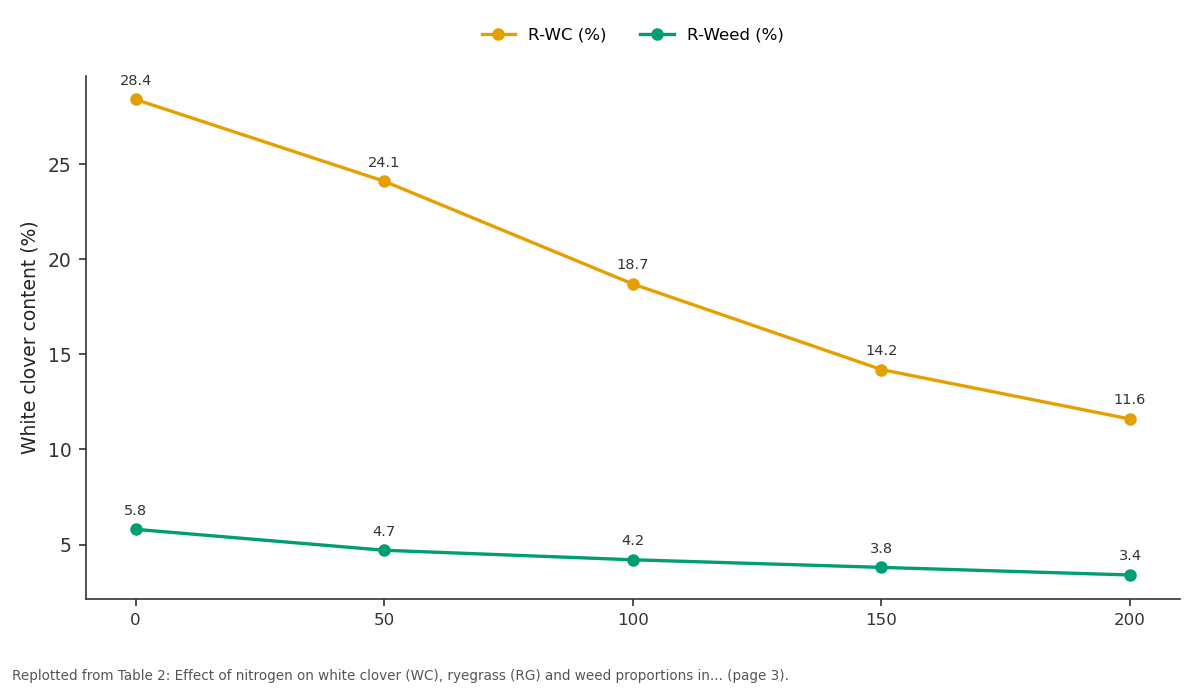
R-WC (%) and R-Weed (%): 0 vs 50 vs 100 vs 150 vs 200
Replotted from Table 2 (page 3) of the original paper. Every bar is the paper's own table value.
View source evidence ↗Figures & tables
From the original paper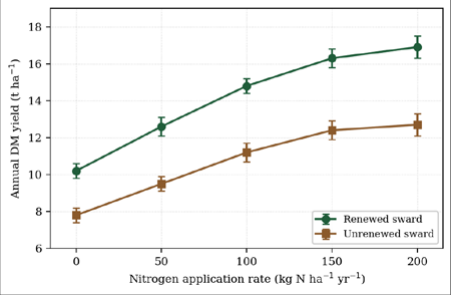 Figure 1
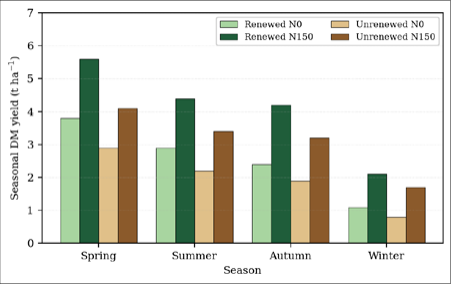 Figure 2
 Table 1
 Table 2
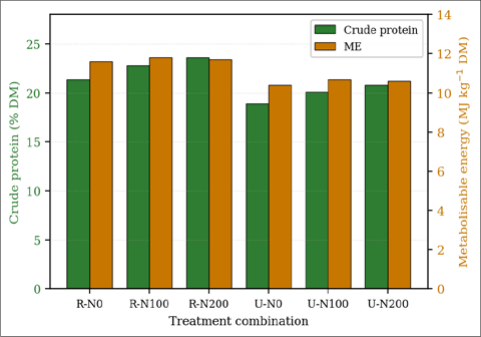 Figure 3
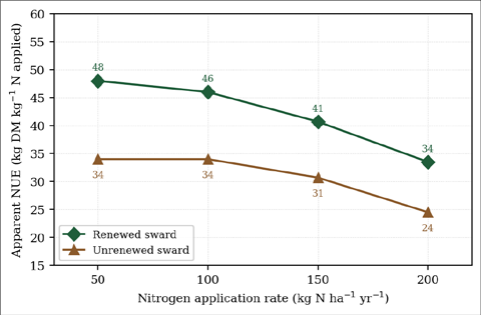 Figure 4
Introduction
Perennial ryegrass (Lolium perenne L.) and white clover (Trifolium repens L.) swards form the cornerstone of pasture-based dairy production across temperate regions, supplying the bulk of metabolisable energy and crude protein required for grazing livestock [1,6] . In New Zealand, where over 90% of dairy farms operate on grazed pasture, the productivity and nutritive value of ryegrass-clover mixtures directly determine farm profitability and the environmental footprint of milk production [2,5] . Recent surveys have documented a marked decline in pasture persistence within five to seven years of establishment, attributed to cultivar deterioration, weed ingress and inadequate replenishment of nitrogen reserves through symbiotic fixation [7,10] . Pasture renewal has emerged as a strategic intervention to restore DM production and reverse the gradual loss of legume content in ageing swards [7,9] . Renewed pastures typically demonstrate higher tiller density and improved seasonal growth distribution [11,13] . Nitrogen fertilization remains the most widely used lever for increasing pasture growth, particularly during periods of low clover activity [3,8] . However, excessive or poorly timed inputs may suppress white clover, elevate nitrate leaching losses and compromise the protein-to-energy ratio of herbage [4,12,14] . Although individual effects have been reported [3,7,11] , integrated assessments of their combined influence on DM accumulation, botanical composition and feed quality under New Zealand dairy conditions remain limited [9,15] . The present investigation was undertaken to (i) quantify the effect of pasture renewal on annual and seasonal DM yield, (ii) evaluate the response of renewed and unrenewed pastures to graded nitrogen levels, (iii) assess the consequent changes in feed quality, and (iv) determine the apparent nitrogen use efficiency under each treatment combination.
Materials and Methods
The field experiment was conducted during 2023-24 and 2024-25 at the Lincoln University Pastoral Research Farm, Canterbury (43°38'S, 172°28'E, 12 m above mean sea level). The site has a temperate maritime climate with mean annual rainfall of 648 mm and mean annual temperature of 11.6 °C. The soil is a Templeton silt loam (Udic Ustochrept) with pH 6.1, organic carbon 3.2%, available N 142 kg ha⁻¹, available P (Olsen) 21 mg kg⁻¹ and available K 168 mg kg⁻¹. The experiment followed a split-plot design with three replications. Main plots comprised pasture renewal status: renewed (R), resown in autumn 2023 with perennial ryegrass cv. 'Trojan NEA2' at 18 kg ha⁻¹ and white clover cv. 'Tribute' at 4 kg ha⁻¹ [1,11] , and unrenewed (U), an existing 8-year-old ryegrass-clover sward. Subplots (6 m × 4 m) received five nitrogen levels (N0, N50, N100, N150 and N200 kg N ha⁻¹ yr⁻¹), applied as urea in four equal splits during August, October, January and March [3,8] . Phosphorus, potassium and sulphur were applied uniformly at maintenance rates. Herbage cuts were taken at approximately 3-week intervals using a Haldrup plot harvester at 5 cm cutting height; subsamples were ovendried at 65 °C for 48 h. Botanical composition was determined by hand separation of three 0.1 m² quadrats per plot [9] . Crude Protein (CP), Neutral Detergent Fibre (NDF), Acid Detergent Fibre (ADF) and Metabolisable Energy (ME) were estimated by NIRS (FOSS DS2500), calibrated against wet chemistry standards [6] . Apparent NUE was computed as additional DM produced per kg N applied, relative to the N0 control [8,15] . Data were subjected to ANOVA using SAS 9.4, with means separated by LSD at P = 0.05.
Results
Results
Annual dry matter yield
Annual DM yield was significantly influenced by both pasture renewal and nitrogen fertilization (p<0.01), with a significant renewal × nitrogen interaction (Figure 1). Renewed swards produced 30.6 to 33.1% higher DM yield than unrenewed swards across all nitrogen levels, attributable to higher tiller density (4,820 vs 3,140 tillers m⁻²) [11,13] . The yield response curve flattened beyond 150 kg N ha⁻¹, with the marginal response declining from 26 to 12 kg DM kg⁻¹ N in renewed swards, indicating diminishing returns [3,8] .
Seasonal yield distribution
Seasonal DM yield distribution (Figure 2) showed that renewed swards captured a larger share of growth in spring and autumn, while winter contributions remained modest [2,11] . At N150, spring DM yield of renewed swards (5.6 t ha⁻¹) was 37% higher than that of unrenewed swards (4.1 t ha⁻¹). The autumn yield advantage of renewed plots (31%) is particularly relevant for autumn-calving herds [5] .
Fig 2:
Seasonal DM yield distribution under contrasting renewal and nitrogen treatments
Feed quality parameters
Crude protein and I were consistently higher in renewed plots across all nitrogen levels (Figure 3). At zero nitrogen, renewed swards recorded CP of 21.4% and ME of 11.6 MJ kg⁻¹ DM, versus 18.9% and 10.4 MJ kg⁻¹ DM in unrenewed swards [1,6] . Increasing nitrogen elevated CP modestly (1.4 to 2.2 percentage points at 200 kg N) but had negligible effect on ME [3,14] . The complete profile, including NDF and ADF, is summarised in Table 1.
| Treatment | CP (%) | NDF (%) | ADF (%) | ME (MJ/kg) | DMD (%) |
|---|---|---|---|---|---|
| R-N0 | 21.4 | 41.8 | 22.4 | 11.6 | 78.2 |
| R-N100 | 22.8 | 43.6 | 23.7 | 11.8 | 78.9 |
| R-N200 | 23.6 | 46.3 | 25.1 | 11.7 | 77.6 |
| U-N0 | 18.9 | 44.5 | 24.6 | 10.4 | 72.4 |
| U-N100 | 20.1 | 46.1 | 25.8 | 10.7 | 73.1 |
| U-N200 | 20.8 | 48.4 | 27.2 | 10.6 | 71.9 |
| LSD (0.05) | 0.6 | 1.1 | 0.8 | 0.2 | 1.2 |
Table text extracted from the original PDF; superscript letters are shown inline. The original table image is below.
View original table image
Botanical composition
White clover content declined sharply with increasing nitrogen (Table 2), falling from 28.4% at N0 to 11.6% at N200 in renewed swards, and from 18.6% to 7.2% in unrenewed plots [1,4] . The shift towards a grass-dominated sward reflects competitive suppression of clover by vigorous ryegrass growth [12,14] . Weed content stayed below 6% in renewed plots but rose to 11-14% in unrenewed plots, dominated by browntop and yarrow [7,10] .
| N rate (kg/ha) | R-WC (%) | R-RG (%) | R-Weed (%) | U-WC (%) | U-RG (%) | U-Weed (%) |
|---|---|---|---|---|---|---|
| 0 | 28.4 | 64.2 | 5.8 | 18.6 | 68.7 | 13.9 |
| 50 | 24.1 | 69.8 | 4.7 | 15.2 | 72.4 | 13.0 |
| 100 | 18.7 | 75.1 | 4.2 | 11.8 | 76.3 | 12.6 |
| 150 | 14.2 | 79.6 | 3.8 | 8.9 | 79.1 | 12.0 |
| 200 | 11.6 | 82.4 | 3.4 | 7.2 | 81.0 | 11.8 |
| LSD (0.05) | 1.3 | 1.9 | 0.6 | 1.1 | 2.0 | 1.4 |
Table text extracted from the original PDF; superscript letters are shown inline. The original table image is below.
View original table image
Nitrogen use efficiency
Apparent NUE declined non-linearly with increasing nitrogen rate in both pasture types (Figure 4). Renewed swards consistently exhibited higher NUE, falling from 48 to 34 kg DM kg⁻¹ N from N50 to N200, while unrenewed swards declined from 34 to 24 kg DM kg⁻¹ N [8,15] . The NUE advantage of renewed swards reflects their greater capacity to capture and partition applied nitrogen into vegetative growth [13] .
Discussion
The 30 to 33% yield advantage of renewed swards is consistent with published estimates for New Zealand dairy systems, where renewal benefits typically range from 25 to 40% during the first three post-establishment years [7,11] . Higher tiller density and superior cultivar vigour of newly sown 'Trojan NEA2' account for most of this gain [13] , with secondary contributions from reduced weed competition [9,10] . The diminishing-returns pattern of nitrogen response mirrors classical curves for temperate ryegrass swards [3,8] and reflects saturation of plant N uptake, intensified competition for light and water, and partial substitution of biologically fixed N by fertilizer-N [12,15] . The agronomic optimum of 100 to 150 kg N ha⁻¹ yr⁻¹ aligns with operational windows currently recommended for Canterbury [2] . The decline of white clover from 28.4% to 11.6% in renewed swards with rising nitrogen is consistent with the competitive disadvantage of legumes under high mineral-N [1, 4] , driven by reduced light penetration and downregulation of nodulation [12,14] . Maintaining clover above 20% [1] was achieved only at nitrogen levels up to 50 kg N ha⁻¹ in renewed swards, representing a critical sustainability tradeoff [4,14] . Renewal benefits extend beyond yield to feed quality: higher CP, ME and DMD in renewed plots reflect a younger leaf population and higher clover content [6,11] . The concurrent rise in NDF and ADF with nitrogen (Table 1) suggests prolonged high inputs encourage stem elongation, partially offsetting the protein gain [3,6] . The renewed N100 treatment offered the most favourable combination of CP (22.8%), ME (11.8 MJ kg⁻¹ DM) and DMD (78.9%), aligning with dairy cow requirements during peak lactation [6] . The lower NUE of unrenewed swards [8,15] indicates that 14 to 28% more nitrogen would be required to match renewed productivity, suggesting renewal should be regarded as a prerequisite rather than alternative to nitrogenintensive management [7,9] , integrated with moderate N rates to optimize farm and catchment outcomes [4,5] .
Conclusion
Pasture renewal substantially improved DM yield, feed quality and nitrogen use efficiency of perennial ryegrasswhite clover swards under temperate dairy conditions in Canterbury, New Zealand. The combination of renewal with moderate nitrogen at 100 to 150 kg N ha⁻¹ yr⁻¹ offered the best compromise between productivity, herbage quality and white clover persistence. Higher rates yielded diminishing returns while accelerating clover decline. Future work should examine the persistence of these benefits over a longer post-renewal horizon and quantify nitrate leaching and nitrous oxide losses across the same treatment matrix.
References
15 in the original paper- Caradus JR, Woodfield DR. Genetic improvement of white clover for New Zealand grazing systems. Grass Forage Sci. 2020;75(3):245-258.
- Chapman DF, Bryant JR, Olayemi ME. Forage production from perennial pasture systems in New Zealand. N Z J Agric Res. 2021;64(2):137-160.
- Edmeades DC, Thorrold BS, Roberts AP. Nitrogen response curves for grazed pastures in temperate environments. Grass Forage Sci. 2019;74(4):621-634.
- Ledgard SF, Schils R, Eriksen J. Environmental impacts of grazed clover/grass pastures. Ir J Agric Food Res. 2022;61(1):44-58.
- Macdonald KA, Penno JW, Lancaster JAS. Effect of stocking rate on pasture production, milk production and reproduction of dairy cows. J Dairy Sci. 2020;103(8):7251-7263.
- Roche JR, Berry DP, Bryant AM. A 100-year review: nutritional management of dairy cattle in pasture-based systems. J Dairy Sci. 2021;104(5):4977-4995.
- Tozer KN, Cameron CA, Thom ER. Pasture renewal in New Zealand dairy systems: agronomic and economic perspectives. N Z J Agric Res. 2023;66(1):28-45.
- Whitehead DC, Bristow AW, Lockyer DR. Nitrogen dynamics in grazed pastures: implications for fertilizer management. Soil Use Manag. 2020;36(2):217-231.
- Kerr GA, Brown HE, Moir JL. Establishment success and species composition of newly sown ryegrass-clover pastures. Agron N Z. 2021;51:73-90.
- Stevens DR, Casey MJ, Cousins GR. Long-term decline in pasture persistence on dairy farms: causes and management responses. Proc N Z Grassland Assoc. 2020;82:135-148.
- Wims CM, McEvoy M, Delaby L, Boland TM, O'Donovan M. Effect of perennial ryegrass cultivar on dry matter yield, nutritive value and animal performance. Anim Prod Sci. 2020;60(11):1432-1444.
- Lambert MG, Clark DA, Mackay AD. Interactions between nitrogen fertilizer and white clover in mixed pastures: a review. Grass Forage Sci. 2021;76(3):412425.
- Parsons AJ, Edwards GR, Newton PCD. Pasture genetics, cultivar performance and sward dynamics under intensive grazing. Crop Pasture Sci. 2022;73(6):615-632.
- Schwenke GD, Beare MH, Cameron KC. Nitrogen losses from intensively managed temperate pastures: pathways and mitigation. Soil Res. 2021;59(4):301-319.
- Smith CJ, Eckard RJ, Chapman DF. Nitrogen use efficiency in pasture-based dairy systems: opportunities for improvement. Anim Prod Sci. 2022;62(8):721-734.