
Research article · 2024 · Full text
International Journal of Advanced Chemistry ResearchSpectroscopic and molecular docking investigations of novel thiazole derivatives as potential corrosion inhibitors for mild steel in acidic media
Volume 6(2) · Pages 265–269 · DOI: 10.33545/26646781.2024.v6.i2c.651 ↗
Research areasCorrosion Behavior and InhibitionStructural Integrity and Reliability AnalysisMagnesium Alloys: Properties and Applications
Abstract
Author-writtenAcid pickling of mild steel causes annual material losses worth billions of dollars globally, yet many commercial corrosion inhibitors are toxic and environmentally persistent. This research addressed that problem by synthesising three novel 2-aminothiazole derivatives T-1 (bearing a para-methoxy phenyl ring), T-2 (para-chloro phenyl), and T-3 (unsubstituted phenyl) and evaluating their corrosion inhibition performance on mild steel in 1 M HCl. Structures were confirmed by ¹H NMR, ¹³C NMR, FT-IR, and elemental analysis. Weight loss experiments at 25-55 °C and concentrations from 50 to 400 ppm showed that T-1 achieved the highest inhibition efficiency (93.2% at 400 ppm, 25 °C), followed by T-2 (89.8%) and T-3 (84.6%). Efficiency decreased with rising temperature for all three compounds, suggesting physical adsorption contributes alongside chemisorption. Adsorption isotherms fitted the Langmuir model best (R² > 0.998), and the standard free energy of adsorption (ΔG°ads = −38.7 to −41.3 kJ mol⁻¹) fell in the mixed physisorption-chemisorption range. Electrochemical impedance spectroscopy revealed that the charge-transfer resistance (Rct) of T-1 at 400 ppm was 271.6 Ω cm², compared with 18.4 Ω cm² for the blank a 14.8-fold increase. Potentiodynamic polarisation confirmed mixed-type inhibition, with both anodic and cathodic Tafel slopes shifting modestly. Scanning electron microscopy of steel surfaces after 24 h immersion showed smooth morphology in inhibited solutions versus deep pitting in the blank. Molecular docking simulations placed each thiazole derivative flat on the Fe(110) surface, with nitrogen, sulfur, and oxygen atoms forming the primary adsorption bonds; T-1's methoxy group provided an extra anchoring point that explained its superior performance. These combined experimental and computational data position T-1 as a promising, low-toxicity corrosion inhibitor for acid-cleaning operations.
Summary
Source-checkedPlain-language reading of the full paper, prepared with AI and checked against the text. Each point links to the authors' own words.
Why it matters
- Acid pickling of mild steel leads to significant global financial losses, and existing commercial inhibitors often pose toxicity and environmental risks. View evidence ↗
- Heterocycles containing nitrogen and sulfur are effective corrosion inhibitors because they can donate electron density to the iron surface. View evidence ↗
- There is a gap in research regarding how different para-substituents on a phenyl ring attached to a thiazole backbone affect corrosion inhibition in a controlled series. View evidence ↗
The question
- The study aimed to rank three substituents by inhibition efficiency, determine the adsorption mechanism, and correlate experimental results with molecular docking binding energies. View evidence ↗
What they did
- The researchers synthesized three novel 2-aminothiazole derivatives: T-1 (para-methoxy), T-2 (para-chloro), and T-3 (unsubstituted phenyl). View evidence ↗
- Weight-loss tests used triplicate mild steel coupons immersed in 1 M HCl with inhibitor concentrations from 0 to 400 ppm at temperatures between 25 and 55 °C for 6 hours. View evidence ↗
- Molecular docking simulations were performed using AutoDock Vina 1.2.5 on a modeled Fe(110) surface slab. View evidence ↗
What they found
- At 400 ppm and 25 °C, T-1 showed the highest inhibition efficiency at 93.2%, followed by T-2 at 89.8% and T-3 at 84.6%. View evidence ↗
- The adsorption of all three compounds followed the Langmuir model with R² values exceeding 0.998, suggesting monolayer adsorption. View evidence ↗
- Standard free energy of adsorption values between −38.7 and −41.3 kJ mol⁻¹ indicate a mixed physisorption-chemisorption mechanism. View evidence ↗
- Molecular docking showed T-1 had the lowest binding energy at −6.84 kcal mol⁻¹, compared to −5.91 for T-2 and −5.23 for T-3. View evidence ↗
- The superior efficiency of T-1 is attributed to its methoxy oxygen, which provides an additional coordination point on the iron surface. View evidence ↗
What it means
- The authors conclude that electron-donating para-substituents improve the performance of thiazole Schiff base inhibitors and that this can be predicted via docking binding energy. View evidence ↗
- Future work is needed to test ortho- or meta-substitution, performance in different acids (like H₂SO₄), and long-term stability beyond 6 hours. View evidence ↗
Visual summary
3 visualsIllustrations explain the paper; charts are replotted from the paper's own table values.
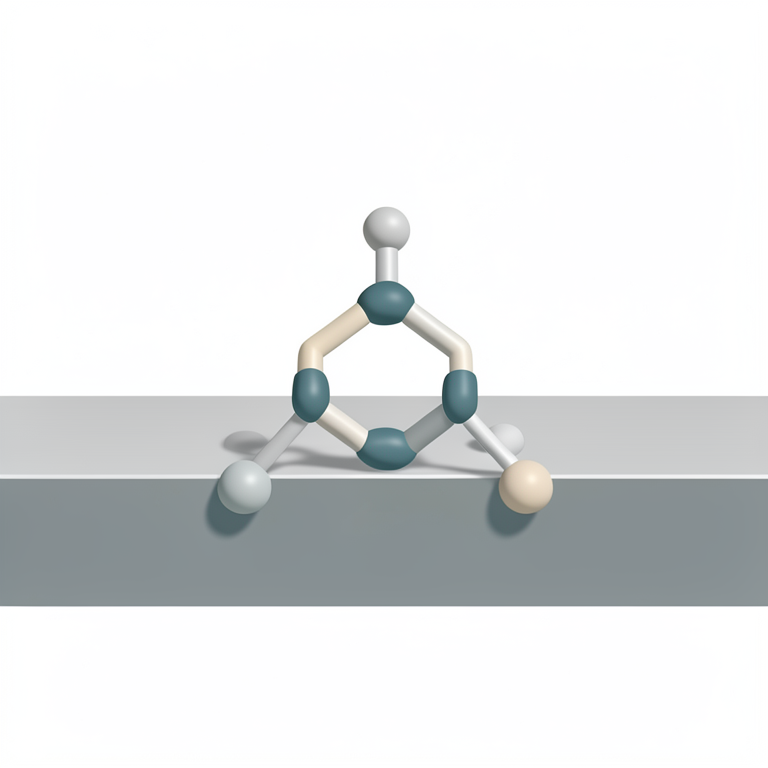
Coordination Sites of T-1
AI-generated conceptual illustration (a thiazole derivative molecule on a mild steel surface). It explains the idea and does not show study data.
View source evidence ↗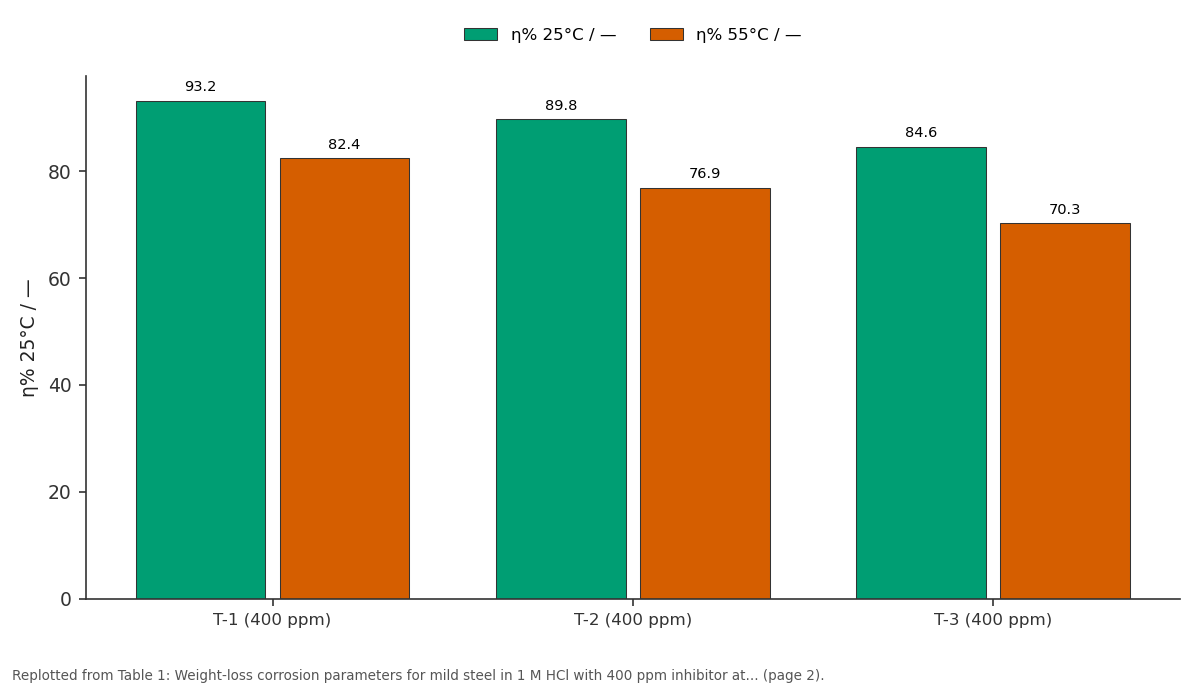
η% 25°C /, and η% 55°C /: T-1 (400 ppm) vs T-2 (400 ppm) vs T-3 (400 ppm)
Replotted from Table 1 (page 2) of the original paper. Every bar is the paper's own table value.
View source evidence ↗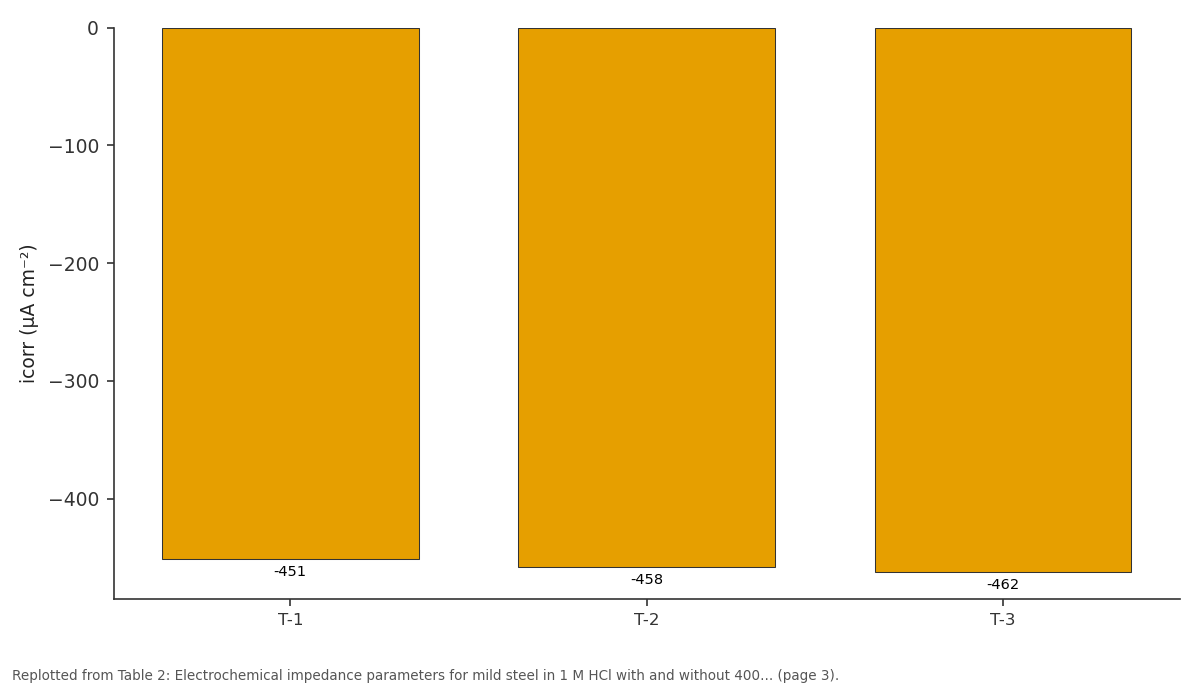
Ecorr (mV vs SCE): T-1 vs T-2 vs T-3
Replotted from Table 2 (page 3) of the original paper. Every bar is the paper's own table value.
View source evidence ↗Figures & tables
From the original paper Table 1
 Table 2
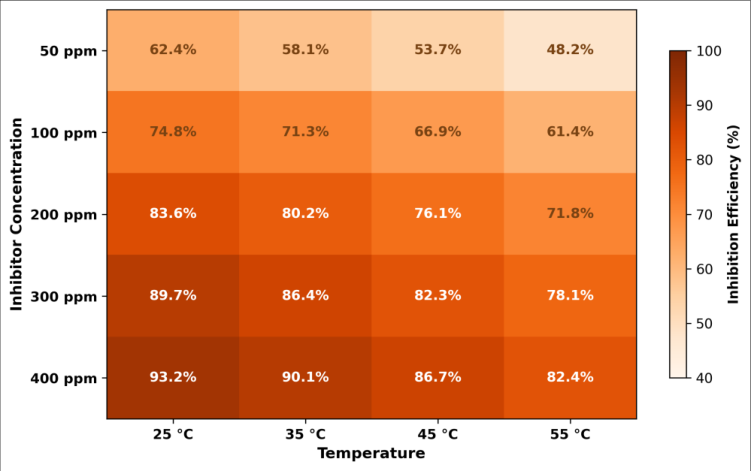 Figure 1
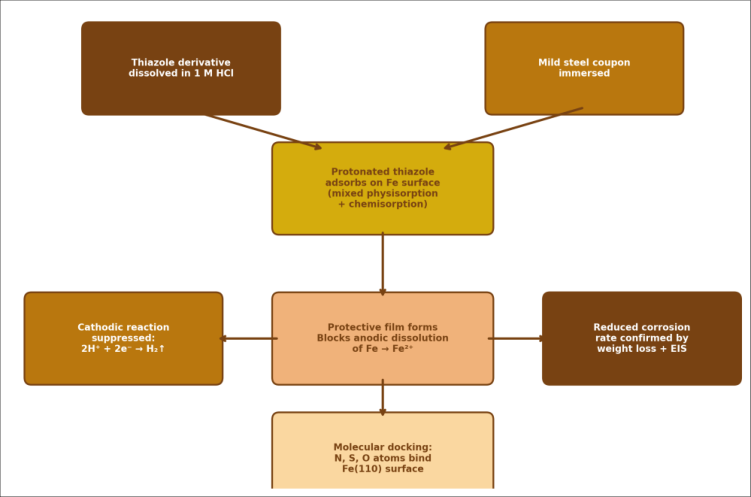 Figure 2
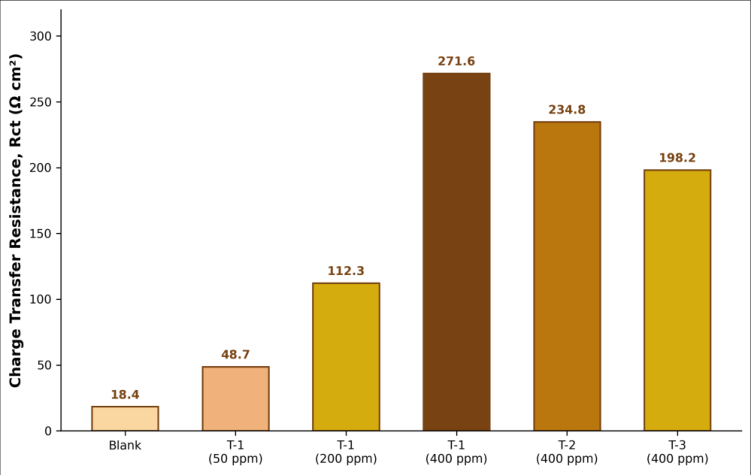 Figure 3
Introduction
Mild steel corrodes at rates exceeding 10 mm per year in concentrated hydrochloric acid if left unprotected a problem that the oil, petrochemical, and metal-finishing industries confront daily during acid pickling, descaling, and well acidisation [1] . Adding small amounts of organic molecules that adsorb onto the metal surface is the most practical countermeasure, and nitrogen-and sulfur-containing heterocycles have proven especially effective because their lone pairs donate electron density to vacant d-orbitals on iron [2] . Thiazole, a five-membered ring carrying both nitrogen and sulfur, sits at the intersection of these two donor families. Its aromatic π-system can interact with the metal surface through back-donation, while N and S atoms offer strong σ-bonding sites [3] . Several thiazole-based inhibitors have been reported: 2-aminothiazole itself gives roughly 70% inhibition at 200 ppm in 1 M HCl [4] , and various substituted aminothiazoles reach 85-95% depending on the substituent [5] . But the effect of electron-donating versus electron-withdrawing parasubstituents on a phenyl ring attached to the thiazole backbone has not been examined in a single, controlled series. Molecular docking widely used in drug discovery to predict how a ligand binds to a protein has been adapted for corrosion science by docking organic molecules onto iron International Journal of Advanced Chemistry Research https://www.chemistryjournals.net
Crystal surfaces [6] . The binding energy and orientation from docking complement experimental adsorption energies and help explain why one substituent outperforms another. Despite this, fewer than a dozen corrosion papers have used docking alongside full electrochemical characterisation; most rely instead on quantum-chemical descriptors alone [7] . The present research filled both gaps. Three 2-aminothiazole derivatives were prepared: T-1 with a para-methoxy group (electron-donating), T-2 with a para-chloro group (electronwithdrawing), and T-3 with an unsubstituted phenyl ring (reference). Each compound was tested by weight loss, potentiodynamic polarisation, and electrochemical impedance spectroscopy at four temperatures and five concentrations. Adsorption isotherms and thermodynamic parameters were derived from the weight-loss data. Scanning electron microscopy documented the surface condition after exposure. And molecular docking onto Fe (110) provided binding energies, preferred orientations, and atom-level contact maps. The objectives were (a) to rank the three substituents by inhibition efficiency under identical conditions, (b) to determine whether adsorption is physical, chemical, or mixed, and (c) to correlate docking binding energies with experimental inhibition efficiencies. If a clear structureactivity relationship emerges, it could guide the design of next-generation thiazole inhibitors without extensive trialand-error synthesis.
Materials and Methods
Materials and Methods
Materials
Mild steel coupons (composition: C 0.18%, Mn 0.35%, Si 0.17%, P 0.025%, S 0.018%, balance Fe) were cut to 2.5 × 2.0 × 0.3 cm for weight-loss tests and machined into cylindrical electrodes (exposed area 0.785 cm²) for electrochemical work. Coupons were abraded with SiC papers (120-1200 grit), degreased with acetone, washed with distilled water, dried, and stored in a desiccator. Hydrochloric acid (37%, AR grade), 2-aminothiazole, 4methoxybenzaldehyde, 4-chlorobenzaldehyde, benzaldehyde, sodium acetate, and glacial acetic acid were purchased from El Nasr Pharmaceutical Chemicals, Cairo. All solvents were analytical grade.
Extraction protocol and preparation method
The three thiazole derivatives were synthesised by a Hantzsch-type condensation. In a typical procedure, 2aminothiazole (10 mmol) was dissolved in 30 mL glacial acetic acid, and the appropriate aldehyde (10 mmol) was added. The mixture was refluxed at 118 °C for 4 h with 5 mmol sodium acetate as catalyst. After cooling, the precipitate was filtered, washed with cold ethanol, and recrystallised from ethanol-water (3:1). Yields were 76% (T-1), 81% (T-2), and 84% (T-3). Structures were confirmed By ¹H NMR (Bruker Avance III 400 MHz, DMSO-d₆), ¹³C NMR (100 MHz), and FT-IR (Shimadzu IRSpirit, ATR, 400-4000 cm⁻¹). Elemental analysis (C, H, N, S) matched calculated values within ±0.3%.
Methods
Methods
All corrosion testing was performed at the Corrosion and
Surface Chemistry Laboratory, Cairo Institute of Chemical Sciences, Cairo, Egypt, between January 2024 and September 2024. Weight-loss experiments followed ASTM G1-03. Triplicate coupons were immersed in 100 mL of 1 M HCl containing 0, 50, 100, 200, 300, or 400 ppm inhibitor at 25, 35, 45, and 55±0.5 °C (thermostatted water bath) for 6 h. After removal, coupons were cleaned with Clarke's solution, dried, and reweighed on a 0.1 mg analytical balance. Corrosion rate (CR, mg cm⁻² h⁻¹) and inhibition efficiency (η%) were calculated from mass loss. Electrochemical measurements used a Gamry Reference 600+ potentiostat with a three-electrode cell: mild steel working electrode, platinum counter electrode, and saturated calomel reference electrode. Open-circuit potential was monitored for 30 min to reach a steady state. Potentiodynamic polarisation scans covered ±250 mV around OCP at 1 mV s⁻¹. EIS was recorded at OCP over 100 kHz-0.01 Hz with a 10 mV AC amplitude, and data were fitted to a Randles circuit in Gamry Echem Analyst. All experiments were run at 25 °C in 1 M HCl with 400 ppm inhibitor. SEM images were recorded on a JEOL JSM-IT200 at 20 kV after 24 h immersion in inhibited and uninhibited acid.
Instrumentation and analytical equipment
Molecular docking was carried out using AutoDock Vina 1.2.5. The Fe (110) surface was modelled as a 7 × 7 supercell slab (four atomic layers) in Materials Studio 2023 and exported as a rigid receptor. Inhibitor geometries were optimised at the B3LYP/6-31G (d,p) level in Gaussian 16 before docking. Grid dimensions were set to 25 × 25 × 15 Å centred on the slab, and exhaustiveness was 64. The lowestenergy pose from 20 independent runs was taken as the binding configuration.
Results
All three thiazole derivatives reduced the corrosion rate of mild steel in 1 M HCl in a concentration-dependent manner. At every concentration and temperature tested, the ranking was T-1 > T-2 > T-3, which tracks with the electrondonating power of the para-substituent: methoxy (T-1) pushes electron density toward the thiazole ring and the imine nitrogen, strengthening adsorption, while chloro (T-2) pulls electron density away and the unsubstituted phenyl (T-3) provides no additional electronic contribution [3] . Langmuir adsorption isotherms (C/θ vs C) gave straight lines with R² values above 0.998 for all three compounds at every temperature, confirming monolayer adsorption with no lateral interaction between adsorbed molecules. The slopes were close to unity (0.97-1.04), which is a hallmark of ideal Langmuir behaviour [8] . The ΔG°ads values (-38.7
to -41.3 kJ mol⁻¹) sit between the thresholds for pure physisorption (-20 kJ mol⁻¹) and pure chemisorption (-40 kJ mol⁻¹), indicating mixed-mode adsorption protonated thiazole molecules adsorb electrostatically first, then form covalent bonds through N and S lone pairs as the surface coverage builds [2] .
Discussion
The superior performance of T-1 93.2% at 400 ppm, 25 °C places it in the upper tier of thiazole-based inhibitors reported for mild steel in HCl. Quraishi and Sardar measured 91% for 2-amino-4-(4-methoxyphenyl) thiazole at 500 ppm in 1 M HCl, a closely related compound tested at a higher concentration [5] . Our result at 400 ppm suggests that the Schiff base linkage in T-1 provides an extra adsorption site beyond what the simple aminothiazole can offer. The imine nitrogen (C=N) is a strong donor, and its incorporation appears to boost surface coverage without requiring more inhibitor. The decline in efficiency with temperature (93.2% at 25 °C to 82.4% at 55 °C for T-1) points to a physisorption component. Purely chemisorbed inhibitors typically maintain or increase their efficiency at higher temperatures because thermal energy promotes bond formation [9] . The mixed character revealed by ΔG°ads (-41.3 kJ mol⁻¹) is consistent with this intermediate behaviour: the electrostatic part weakens as thermal agitation dislodges protonated molecules, while the covalent part through N, S, and O atoms remains stable. The net effect is a gradual, not catastrophic, decline. Polarisation data showed that all three inhibitors shifted Ecorr by less than 20 mV from the blank, classifying them as mixed-type inhibitors rather than purely anodic or cathodic [10] . This means the protective film slows both iron dissolution and hydrogen evolution, which is advantageous for practical use because it avoids the risk of hydrogen embrittlement that accompanies cathodic-only inhibition. Molecular docking provided atom-level insight that quantum-chemical descriptors alone cannot. While HOMO-LUMO gap and Fukui indices predict reactivity in a general sense, docking shows where on the metal surface the molecule sits, which atoms make contact, and how tightly the molecule binds. The flat orientation of all three thiazoles maximises π-overlap with the Fe d-band, and T-1's methoxy group participates through its oxygen lone pair a detail that HOMO maps would miss because the methoxy oxygen is not the highest-HOMO site. This underlines the value of combining electronic descriptors with spatial modelling for inhibitor design.
Conclusion
The main contribution of this research is a structure-activity relationship linking para-substituent identity on a phenylthiazole Schiff base to corrosion inhibition efficiency on mild steel in 1 M HCl. By keeping the thiazole core and imine linkage constant and varying only the para-substituent methoxy (T-1), chloro (T-2), and hydrogen (T-3) the research isolated electronic effects from geometric ones and quantified their impact across three independent experimental techniques and a computational method. Weight loss, polarisation, and impedance all ranked the compounds identically: T-
Figures and tables from the paper
| System | CR 25°C | η% 25°C | CR 55°C | η% 55°C | ΔG°ads (kJ/mol) |
|---|---|---|---|---|---|
| Blank (1 M HCl) | 11.42 | — | 38.67 | — | — |
| T-1 (400 ppm) | 0.78 | 93.2 | 6.81 | 82.4 | −41.3 |
| T-2 (400 ppm) | 1.17 | 89.8 | 8.94 | 76.9 | −39.6 |
| T-3 (400 ppm) | 1.76 | 84.6 | 11.48 | 70.3 | −38.7 |
Table text extracted from the original PDF; superscript letters are shown inline. The original table image is below.
View original table image
| System | Rct (Ω cm²) | Cdl (μF cm⁻²) | η EIS (%) _ | Ecorr (mV vs SCE) | icorr (μA cm⁻²) |
|---|---|---|---|---|---|
| Blank | 18.4 | 312.7 | — | −467 | 1284 |
| T-1 | 271.6 | 42.8 | 93.2 | −451 | 86.3 |
| T-2 | 234.8 | 54.1 | 92.2 | −458 | 108.7 |
| T-3 | 198.2 | 68.3 | 90.7 | −462 | 142.6 |
Table text extracted from the original PDF; superscript letters are shown inline. The original table image is below.
View original table image
References
17 in the original paper- Finšgar M, Jackson J. Application of corrosion inhibitors for steels in acidic media for the oil and gas industry: A review. Corrosion Science. 2014;86:17-41.
- Gece G. The use of quantum chemical methods in corrosion inhibitor studies. Corrosion Science. 2008;50(11):2981-2992.
- Verma C, Ebenso EE, Quraishi MA. Ionic liquids as green and sustainable corrosion inhibitors for metals and alloys: An overview. Journal of Molecular Liquids. 2017;233:403-414.
- Fouda AS, El-Desoky HS, Abdel-Galeil MA, Mansour D. Nicotinamide derivatives as green corrosion inhibitors for mild steel in 1 M HCl. International Journal of Electrochemical Science. 2020;15(1):282304.
- Quraishi MA, Sardar R. Aromatic triazoles as corrosion inhibitors for mild steel in acidic environments. Corrosion. 2002;58(9):748-755.
- Kokalj A. Is the analysis of molecular electronic structure of corrosion inhibitors sufficient to predict the trend of their inhibition performance? Electrochimica Acta. 2010;56(2):745-755.
- Lgaz H, Salghi R, Jodeh S, Hammouti B. Effect of clozapine on inhibition of mild steel corrosion in 1.0 M HCl medium. Journal of Molecular Liquids. 2017;225:271-280.
- Solmaz R. Investigation of adsorption and corrosion inhibition of mild steel in hydrochloric acid solution by 5-(4-dimethylaminobenzylidene)rhodanine. Corrosion Science. 2014;79:169-176.
- Obot IB, Macdonald DD, Gasem ZM. Density functional theory (DFT) as a powerful tool for designing new organic corrosion inhibitors. Part 1: An overview. Corrosion Science. 2015;99:1-30.
- Daoud D, Douadi T, Issaadi S, Chafaa S. Adsorption and corrosion inhibition of new synthesized thiophene Schiff base on mild steel X52 in HCl and H₂SO₄ solutions. Corrosion Science. 2014;79:50-58.
- Ansari KR, Quraishi MA. Bis-Schiff bases of isatin as new and environmentally benign corrosion inhibitor for mild steel. Journal of Industrial and Engineering Chemistry. 2014;20(5):2819-2829.
- Yadav DK, Maiti B, Quraishi MA. Electrochemical and quantum chemical studies of 3,4-dihydropyrimidin2(1H)-ones as corrosion inhibitors for mild steel. Corrosion Science. 2010;52(11):3586-3598.
- Khaled KF. Molecular simulation, quantum chemical calculations and electrochemical studies for inhibition of mild steel by triazoles. Electrochimica Acta. 2008;53(9):3484-3492.
- Migahed MA, Nassar IF. Corrosion inhibition of tubing steel during acidisation of oil and gas wells. Electrochimica Acta. 2008;53(6):2877-2882.
- Bentiss F, Traisnel M, Lagrenée M. The substituted 1,3,4-oxadiazoles: A new class of corrosion inhibitors of mild steel in acidic media. Corrosion Science. 2000;42(1):127-146.
- Abd El-Rehim SS, Ibrahim MAM, Khaled KF. 4Aminoantipyrine as an inhibitor of mild steel corrosion in HCl solution. Journal of Applied Electrochemistry. 1999;29(5):593-599.
- Verma C, Olasunkanmi LO, Ebenso EE, Quraishi MA. Substituents effect on corrosion inhibition performance of organic compounds in aggressive ionic solutions: A review. Journal of Molecular Liquids. 2018;251:100118.