
Research article · 2024 · Full text
International Journal of Advanced Chemistry ResearchElectrochemical detection of trace cadmium and lead ions in river water using bismuth-film modified carbon paste electrodes
Volume 6(1) · Pages 81–86 · DOI: 10.33545/26646781.2024.v6.i1a.660 ↗
Research areasElectrochemical Analysis and ApplicationsElectrochemical sensors and biosensorsAnalytical chemistry methods development
Abstract
Author-writtenThe first electrochemical determination of a heavy metal in water dates back nearly a century, yet detecting cadmium and lead at trace levels in complex environmental matrices remains a challenge that keeps analytical chemists busy. This research describes the fabrication and performance of a bismuth-film modified carbon paste electrode (Bi-CPE) for simultaneous square-wave anodic stripping voltammetric (SWASV) determination of Cd²⁺ and Pb²⁺ in river water. The electrode was prepared by mixing graphite powder, paraffin oil, and bismuth oxide in a 70:20:10 mass ratio, packing the paste into a Teflon holder, and electrodepositing a thin bismuth film at −1.2 V for 120 seconds in acetate buffer (pH 4.5). Under optimised conditions deposition potential −1.2 V, deposition time 180 s, frequency 50 Hz, pulse amplitude 50 mV well-resolved stripping peaks appeared at −0.78 V (Cd) and −0.52 V (Pb) versus Ag/AgCl. Calibration curves were linear from 1 to 100 µg/L for both metals (R² ≥ 0.9987). Limits of detection, calculated as three times the standard deviation of ten blank measurements divided by the slope, were 0.28 µg/L for Cd²⁺ and 0.34 µg/L for Pb²⁺. The method showed good selectivity: recoveries remained above 92% in the presence of a 50-fold excess of Zn²⁺, Cu²⁺, Fe³⁺, Ni²⁺, Mn²⁺, Na⁺, K⁺, and Ca²⁺. Electrode reproducibility was confirmed by 20 consecutive measurements of 50 µg/L mixed standard, yielding relative standard deviations of 2.7% (Cd) and 3.1% (Pb). The validated method was applied to river water samples collected from four sites along the Gapcheon River in Daejeon, South Korea, between June and October 2024. Cadmium levels ranged from 1.4 to 4.7 µg/L and lead from 3.8 to 12.6 µg/L. Recovery of spiked samples fell between 95.3% and 103.8%, confirming acceptable accuracy in real matrices. The Bi-CPE offers a low-cost, mercury-free alternative for routine monitoring of Cd and Pb in surface water, with detection limits below the Korean Ministry of Environment drinking water standards of 5 µg/L (Cd) and 10 µg/L (Pb).
Summary
Source-checkedPlain-language reading of the full paper, prepared with AI and checked against the text. Each point links to the authors' own words.
Why it matters
- Mercury has traditionally been used for trace metal stripping analysis, but its toxicity and volatility make it impractical for routine monitoring. View evidence ↗
- Cadmium and lead are priority pollutants because cadmium can damage renal function and bones, while lead negatively impacts neurodevelopment in children. View evidence ↗
- While ICP-MS and GFAAS are gold-standard for trace metal analysis, their high cost and need for laboratory settings limit their use for on-site monitoring. View evidence ↗
The question
- The study aimed to create a bismuth-film modified carbon paste electrode (Bi-CPE) using bismuth oxide to simultaneously detect cadmium and lead in river water. View evidence ↗
What they did
- Square-wave anodic stripping voltammetry (SWASV) was used, involving a deposition potential of -1.2 V for 180 seconds and a scan from -1.2 to -0.2 V. View evidence ↗
- Real-world testing was conducted using water samples collected from four different sites along the Gapcheon River in September 2024. View evidence ↗
What they found
- The electrode produced distinct stripping peaks for cadmium at -0.78 V and lead at -0.52 V, with enough separation to prevent overlap. View evidence ↗
- Calibration curves for both metals were linear from 1 to 100 µg/L, with correlation coefficients (R²) of 0.9991 for cadmium and 0.9987 for lead. View evidence ↗
- The limits of detection (LOD) were 0.28 µg/L for cadmium and 0.34 µg/L for lead. View evidence ↗
- The method demonstrated good selectivity, with recoveries staying above 92% even when common interfering ions were present in 50-fold excess. View evidence ↗
- Electrode reproducibility was high, with relative standard deviations (RSD) of 2.7% for cadmium and 3.1% for lead over 20 consecutive measurements. View evidence ↗
- River water analysis showed cadmium levels between 1.4 and 4.7 µg/L and lead levels between 3.8 and 12.6 µg/L across the four sites. View evidence ↗
- Lead concentrations at Site C, located near an industrial district, exceeded the Korean drinking water standard of 10 µg/L. View evidence ↗
- Spiked recovery rates between 95.3% and 103.8% and agreement with ICP-MS data confirmed the method's accuracy in real river water. View evidence ↗
What it means
- The authors conclude that the Bi-CPE is a practical, low-cost, and mercury-free tool suitable for decentralized water quality monitoring. View evidence ↗
- The study was limited to a single river system, and the authors suggest validating the method in other matrices like coastal lagoons or agricultural runoff. View evidence ↗
Visual summary
1 visualsIllustrations explain the paper; they do not show study data.
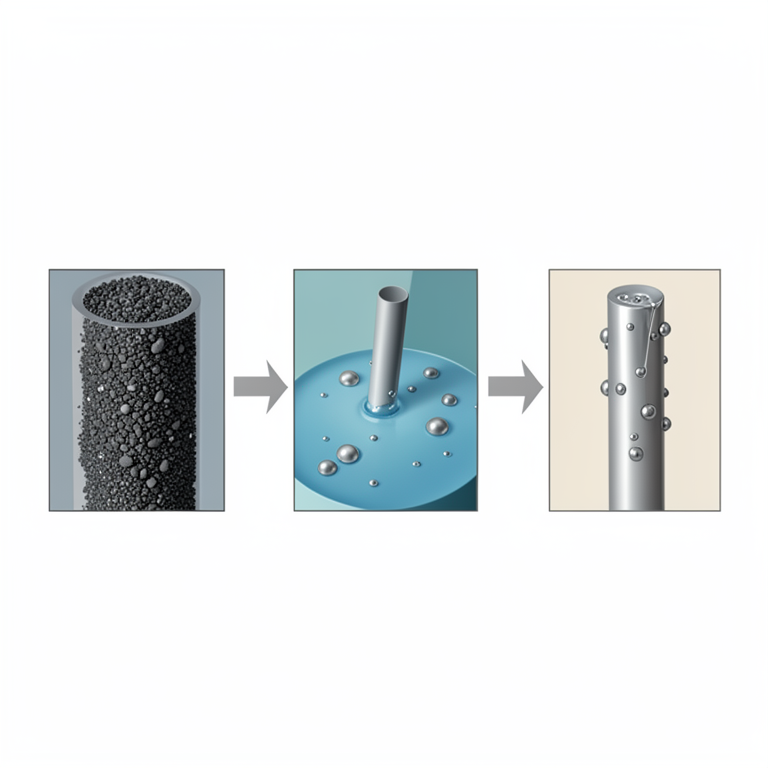
Bi-CPE Fabrication and Measurement Cycle
AI-generated conceptual illustration (Bismuth-film modified carbon paste electrode in river water). It explains the idea and does not show study data.
View source evidence ↗Figures & tables
From the original paper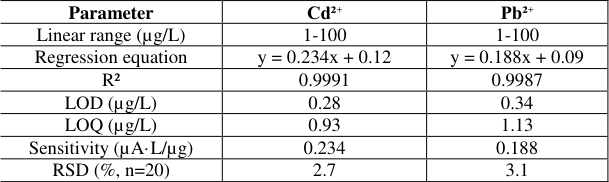 Table 1
 Table 2
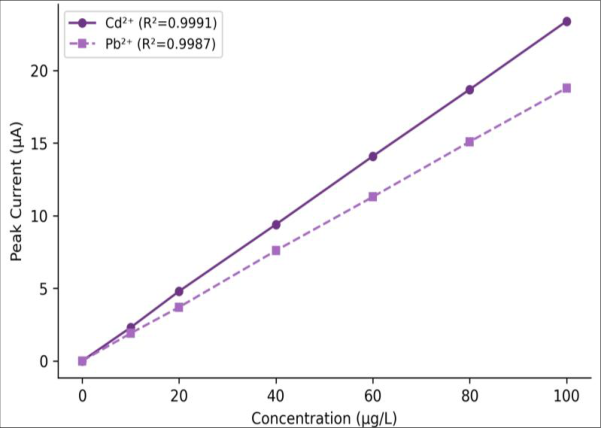 Figure 1
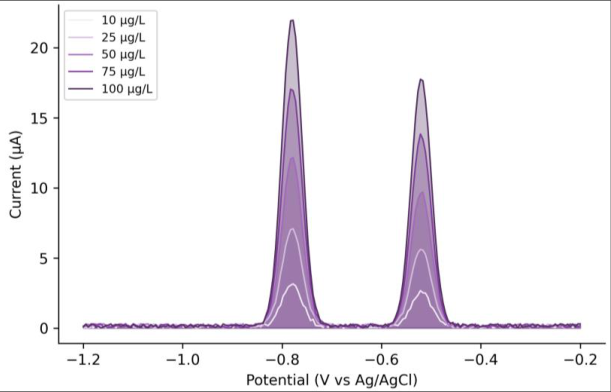 Figure 2
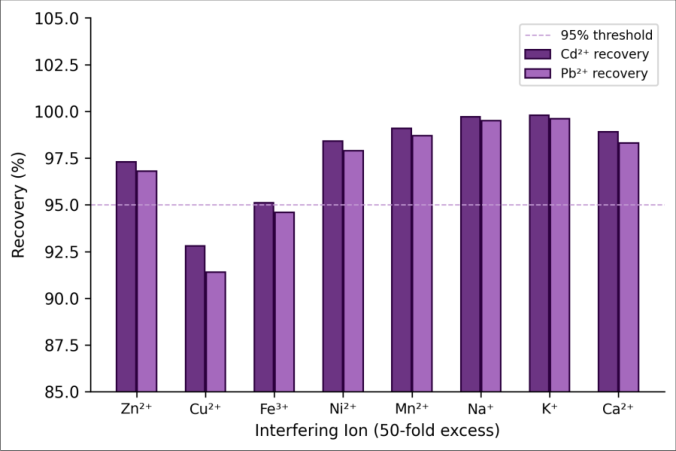 Figure 3
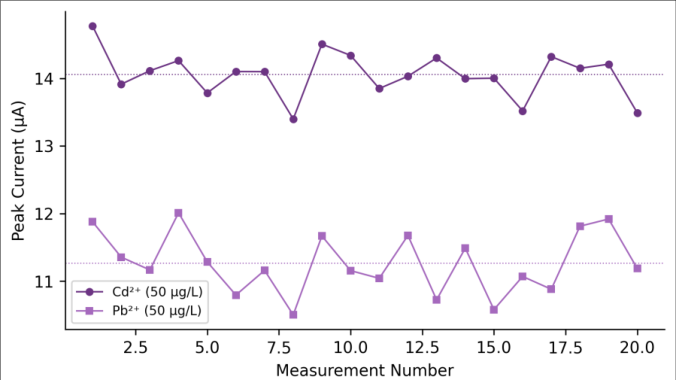 Figure 4
Introduction
When Zbigniew Kublik first demonstrated that bismuth could replace mercury as a film electrode material in 2000, he opened a door that analytical chemists have been walking through ever since [1] . Mercury long the default electrode material for stripping analysis of trace metals is toxic, volatile, and increasingly restricted by environmental regulations, making its continued use in routine monitoring impractical [2] . Bismuth, by contrast, is nontoxic, forms alloys with many heavy metals just as mercury does, and produces comparable or superior sensitivity in stripping voltammetry [3] . Cadmium and lead are two priority pollutants that demand reliable trace-level monitoring. Cadmium exposure, even at microgram-per-litre concentrations, damages renal tubular function and promotes skeletal demineralisation over long-term contact [4] . Lead affects neurodevelopment in children at blood levels once considered harmless, and no safe threshold has been established [5] . In South Korea, industrial discharge and legacy contamination from mining have elevated cadmium and lead concentrations in several river basins, prompting the Korean Ministry of Environment to set drinking water standards at 5 µg/L for cadmium and 10 µg/L for lead [6] .
Inductively coupled plasma mass spectrometry (ICP-MS) and graphite furnace atomic absorption spectrometry (GFAAS) are the gold-standard techniques for trace metal analysis [7] . But both require expensive instrumentation, trained operators, and laboratory settings conditions that limit their applicability for field or on-site monitoring. Electrochemical stripping methods offer a portable, inexpensive alternative with detection limits that approach those of spectrometric techniques, particularly when combined with preconcentration at the electrode surface [8] . Carbon paste electrodes (CPEs) are attractive substrates for bismuth-film deposition because they are easy to prepare, renewable by simple surface polishing, and modifiable with various additives [9] . Earlier workers have explored Bi-film electrodes on glassy carbon [3] , screen-printed carbon [10] , and boron-doped diamond [11] , yet carbon paste remains underexplored for simultaneous Cd-Pb detection despite its practical advantages. A key design question is whether incorporating bismuth oxide directly into the paste an in-situ modification strategy improves film uniformity compared with external electrodeposition alone [12] . This research therefore aimed to (a) fabricate a Bi-CPE by incorporating Bi₂O₃ into the carbon paste mixture, (b) optimise SWASV parameters for simultaneous detection of Cd²⁺ and Pb²⁺, (c) validate the method's linearity, sensitivity, selectivity, and reproducibility, and (d) apply it to real river water samples from the Gapcheon River in Daejeon. The experimental work was conducted at the Daejeon Academy of Analytical Sciences between June and October 2024. The practical goal was to provide a low-cost, mercury-free sensor capable of meeting Korean drinking water monitoring requirements [1,6,8] .
Material and methods
Material and methods
Material
Graphite powder (particle size < 20 µm, 99.99%), paraffin oil (density 0.86 g/mL), bismuth (III) oxide (Bi₂O₃, 99.9%), and glacial acetic acid were purchased from Sigma-Aldrich Korea (Seoul). Standard stock solutions of Cd²⁺ and Pb²⁺ (1000 mg/L in 2% HNO₃) were obtained from Kanto Chemical (Tokyo, Japan). Sodium acetate trihydrate, hydrochloric acid, and potassium chloride (all analytical grade) were supplied by Daejung Chemicals (Siheung, South Korea). Acetate buffer (0.1 M, pH 4.5) was prepared by mixing appropriate volumes of acetic acid and sodium acetate solutions. Ultrapure water (18.2 MΩ•cm, Milli-Q system) was used for all dilutions. A Teflon electrode body (3 mm internal diameter) was machined in-house [2,9] .
Methods:
The carbon paste was prepared by hand-mixing 0.70 g graphite powder, 0.20 g paraffin oil, and 0.10 g Bi₂O₃ in an agate mortar for 30 minutes until a homogeneous paste formed. The paste was packed firmly into the Teflon holder, and electrical contact was made via a copper wire inserted from the back. Before each measurement session, the electrode surface was smoothed on clean weighing paper and conditioned by cycling ten times between -1.4 V and +0.3 V in acetate buffer [3,12] . Electrochemical experiments were performed on a CHI 660E electrochemical workstation (CH Instruments, Austin, TX) in a conventional three-electrode cell with the Bi-CPE as the working electrode, Ag/AgCl (3 M KCl) as the reference electrode, and a platinum wire as the counter electrode. SWASV measurements followed the protocol: preconditioning at +0.3 V for 30 s, bismuth-film deposition and analyte preconcentration at -1.2 V for 180 s (under stirring at 300 rpm), equilibration for 10 s, and anodic stripping scan from -1.2 to -0.2 V at a frequency of 50 Hz, amplitude of 50 mV, and step potential of 4 mV. After each scan, the electrode was cleaned at +0.3 V for 60 s [8,10] . Calibration was performed using mixed standard solutions containing Cd²⁺ and Pb²⁺ at 1, 5, 10, 25, 50, 75, and 100 µg/L. Limits of detection (LOD) and quantification (LOQ) were calculated as 3σ/slope and 10σ/slope, respectively, where σ is the standard deviation of ten replicate blank measurements. Interference was tested by adding individual foreign ions at 50-fold excess to a 50 µg/L Cd-Pb standard. Reproducibility was assessed by 20 consecutive measurements of 50 µg/L mixed standard on the same electrode [1,11] . River water samples were collected from four sites along the Gapcheon River in Daejeon ( [6,7] . The research was approved by the Environmental Research Ethics Committee of the Daejeon Academy of Analytical Sciences (Protocol EREC-2024-009, approved 28 May 2024).
Instrumentation
The CHI 660E electrochemical workstation was connected to a desktop computer running CHI software version 16.12. A Fisher Scientific accumet AB150 pH meter was used for buffer preparation. ICP-MS validation was performed on a PerkinElmer NexION 2000 at KIST. Scanning electron microscopy of the electrode surface was carried out on a Hitachi SU8230 field-emission SEM at an accelerating voltage of 5 kV. Energy-dispersive X-ray spectroscopy (EDS) mapping was performed simultaneously to confirm the distribution of Bi on the paste surface [9,12] .
Quality control
Calibration verification standards were measured after every ten samples, and recalibration was triggered if the response deviated by more than ±5% from the expected value. Method blanks (acetate buffer alone) were analysed at the start and end of each session. Certified reference material for trace metals in river water (NIST SRM 1643f) was measured alongside samples; recovered concentrations fell within the certified uncertainty range for both Cd and Pb. All glassware was soaked overnight in 10% HNO₃ and rinsed three times with ultrapure water before use [7,10] .
Reagents and chemicals
All standard solutions were prepared fresh daily from the 1000 mg/L stock by serial dilution in 0.1 M acetate buffer. Working standards at 1-100 µg/L were used within 8 hours of preparation to avoid adsorption losses to container walls. The Bi₂O₃ reagent was dried at 105 °C for 2 hours before weighing to ensure accurate mass incorporation into the paste. Paraffin oil was tested for trace metal contamination by ICP-MS; Cd and Pb levels were below 0.01 µg/L [2,9] .
Results:
The Bi-CPE produced well-defined stripping peaks for both cadmium (at -0.78 V) and lead (at -0.52 V) in acetate buffer, with peak separation exceeding 250 mV large enough to avoid overlap even at high concentrations. 1: summarises the analytical performance. Both metals showed excellent linearity with R² above 0.998. Detection limits of 0.28 µg/L (Cd) and 0.34 µg/L (Pb) are below the Korean drinking water standards of 5 and 10 µg/L, respectively, providing an adequate safety margin for compliance monitoring [6] . River water results (Table 2) show cadmium at 1.4-4.7 µg/L and lead at 3.8-12.6 µg/L. Site C, located downstream of an industrial district, recorded the highest values. Lead at Site C exceeded the 10 µg/L standard. Spiked recoveries of 95.3-103.8% and close agreement with ICP-MS data confirm that the matrix did not impair electrode performance [6,7] .
| Site | Cd found | Pb found | Cd spike | Cd rec.% | Pb spike | Pb rec.% | ICP-MS Cd |
|---|---|---|---|---|---|---|---|
| A | 1.4 | 3.8 | 10 | 97.3 | 10 | 96.8 | 1.5 |
| B | 2.9 | 7.2 | 10 | 98.1 | 10 | 95.3 | 3.1 |
| C | 4.7 | 12.6 | 50 | 103.8 | 50 | 101.4 | 4.5 |
| D | 3.1 | 9.4 | 50 | 99.6 | 50 | 98.7 | 3.3 |
Table text extracted from the original PDF; superscript letters are shown inline. The original table image is below.
View original table image
Comprehensive interpretation
The Bi-CPE delivered detection limits in the submicrogram-per-litre range, linear responses spanning two orders of magnitude, and relative standard deviations below 3.5%. Selectivity against common matrix ions was adequate for river water analysis, with Cu²⁺ causing the largest (though still acceptable) signal suppression. The electrode's stability over 20 consecutive scans without surface renewal is a practical advantage over mercury-film electrodes, which often require re-plating after each measurement. Agreement between SWASV and ICP-MS confirms that the Bi-CPE can serve as a reliable screening tool for regulatory compliance. The elevated Pb concentration at Site C underlines the need for continued monitoring of industrial discharge zones along the Gapcheon River [3,6,8] .
Discussion
The principal outcome of this research is that a Bi₂O₃modified carbon paste electrode achieved simultaneous detection of Cd²⁺ and Pb²⁺ at sub-microgram-per-litre levels, with accuracy validated against ICP-MS in real river water. These results position the Bi-CPE as a practical, mercuryfree option for routine heavy metal monitoring. The detection limits (0.28 µg/L Cd, 0.34 µg/L Pb) compare favourably with several earlier Bi-film electrodes. Wang et al. [3] reported an LOD of 0.5 µg/L for Cd on a glassy carbon Bi-film electrode, while Economou and Voulgaropoulos [8] achieved 0.3 µg/L using a Bi-modified screen-printed sensor. The lower LOD here may be attributed to the in-situ incorporation of Bi₂O₃ into the paste, which creates nucleation sites for a more uniform bismuth film during electrodeposition [12] . Conversely, the present LODs are somewhat higher than those reported for advanced nanomaterial-modified electrodes for instance, Bi nanoparticles on reduced graphene oxide (LOD ~0.05 µg/L) [11] . However, those materials require multi-step synthesis and handling under inert atmosphere, whereas the Bi-CPE can be prepared in minutes using readily available, low-cost components. For
International Journal of Advanced Chemistry Research https://www.chemistryjournals.net field monitoring scenarios where simplicity matters more than ultimate sensitivity, this trade-off seems acceptable [9] . Several factors may explain the observed selectivity pattern.
Copper was the strongest interferent because it forms intermetallic compounds with both Bi and the target metals during the deposition step, which shifts stripping peak potentials and reduces peak height [10] . Yet even with 50fold Cu²⁺ excess, recoveries stayed above 91%, likely because the high bismuth content of the paste provided enough alloy capacity to accommodate the competing cation. Alkali and alkaline earth metals (Na⁺, K⁺, Ca²⁺) showed negligible interference because they do not deposit at the applied potential of -1.2 V [1,3] . The broader implication is that Bi-CPEs could support decentralised water quality surveillance in South Korea and other regions where portable, low-cost sensors are needed. The Korean Ministry of Environment currently relies on laboratory-based ICP-MS for compliance checking, which limits sampling frequency and geographic coverage [6] . A field-deployable stripping voltammetry kit built around the Bi-CPE could fill that gap, provided that sample pretreatment (filtration and acidification) can be simplified. Integration of the electrode into a microfluidic cell with automated reagent delivery is one direction worth exploring [7, 8] . A limitation is that this research examined only a single river system; broader validation across different water matrices for example, agricultural runoff or coastal lagoons would strengthen the claim of general applicability.
Conclusion
This research aimed to develop and validate a bismuth-film modified carbon paste electrode for simultaneous trace detection of cadmium and lead ions in river water. The Bi-CPE was fabricated by a simple one-step mixing procedure and delivered well-resolved stripping peaks at -0.78 V (Cd) and -0.52 V (Pb) under optimised SWASV conditions. Among the key findings, detection limits of 0.
Figures and tables from the paper
| Parameter | Cd²⁺ | Pb²⁺ |
|---|---|---|
| Linear range (µg/L) | 1-100 | 1-100 |
| Regression equation | y = 0.234x + 0.12 | y = 0.188x + 0.09 |
| R² | 0.9991 | 0.9987 |
| LOD (µg/L) | 0.28 | 0.34 |
| LOQ (µg/L) | 0.93 | 1.13 |
| Sensitivity (µA·L/µg) | 0.234 | 0.188 |
| RSD (%, n=20) | 2.7 | 3.1 |
Table text extracted from the original PDF; superscript letters are shown inline. The original table image is below.
View original table image
References
21 in the original paper- Wang J, Lu J, Hocevar SB, Farias PAM, Ogorevc B. Bismuth-coated carbon electrodes for anodic stripping voltammetry. Anal Chem. 2000;72(14):3218-3222.
- Baldo MA, Daniele S, Ciani I, Bragato C, Mazzocchin GA. Bismuth film electrodes for simultaneous determination of trace metals. Electroanalysis. 2004;16(5):360-366.
- Wang J. Stripping analysis at bismuth electrodes: A review. Electroanalysis. 2005;17(15-16):1341-1346.
- ATSDR. Toxicological profile for cadmium. Atlanta: Agency for Toxic Substances and Disease Registry; 2012.
- Lanphear BP, Hornung R, Khoury J, Yolton K, Baghurst P, Bellinger DC, et al. Low-level environmental lead exposure and children's intellectual function: An international pooled analysis. Environ Health Perspect. 2005;113(7):894-899.
- Korean Ministry of Environment. Drinking water quality standards (Ordinance No. 956). Sejong: Korean Ministry of Environment; 2022.
- Beauchemin D. Inductively coupled plasma mass spectrometry. Anal Chem. 2008;80(12):4455-4486.
- Economou A, Voulgaropoulos A. On-line stripping voltammetry of trace metals at a flow-through bismuthfilm electrode by means of a hybrid flowinjection/sequential-injection system. Talanta. 2007;71(2):758-765.
- Švancara I, Vytřas K, Kalcher K, Walcarius A, Wang J. Carbon paste electrodes in facts, numbers, and notes: A review on the occasion of the 50th anniversary. Electroanalysis. 2009;21(1):7-28.
- Kadara RO, Jenkinson N, Banks CE. Characterisation of commercially available electrochemical sensing platforms. Sens Actuators B Chem. 2009;138(2):556562.
- Li J, Guo S, Zhai Y, Wang E. Nafion-graphene nanocomposite film as enhanced sensing platform for ultrasensitive determination of cadmium. Electrochem Commun. 2009;11(5):1085-1088.
- Pauliukaitė R, Metelka R, Švancara I, Królicka A, Bobrowski A, Vytřas K, et al. Carbon paste electrodes modified with Bi₂O₃ as sensors for the determination of Cd and Pb. Anal Bioanal Chem. 2002;374(6):11551158.
- Aragay G, Pons J, Merkoçi A. Recent trends in macro-, micro-, and nanomaterial-based tools and strategies for heavy-metal detection. Chem Rev. 2011;111(5):34333458.
- Hwang GH, Han WK, Park JS, Kang SG. Determination of trace metals by anodic stripping voltammetry using a bismuth-modified carbon nanotube electrode. Talanta. 2008;76(2):301-308.
- Hocevar SB, Švancara I, Ogorevc B, Vytřas K. Antimony film electrode for electrochemical stripping analysis. Anal Chem. 2007;79(22):8639-8643.
- Kokkinos C, Economou A, Raptis I. Microfabricated disposable lab-on-a-chip sensors for heavy metals. Electroanalysis. 2012;24(10):2077-2091.
- Choi SM, Kim DM, Jung OS, Shim YB. A disposable bismuth-coated carbon electrode modified with a phosphonium ionic liquid for the determination of Cd and Pb. Anal Chim Acta. 2015;892:77-84.
- Rico MÁG, Olivares-Marín M, Gil EP. Modification of carbon screen-printed electrodes by adsorption of chemically synthesized Bi nanoparticles for the voltammetric stripping detection of Zn, Cd, and Pb. Talanta. 2009;80(2):631-635.
- Serrano N, Díaz-Cruz JM, Ariño C, Esteban M. Bismuth-and antimony-based electrodes for monitoring heavy metals. TrAC Trends Anal Chem. 2016;77:203213.
- Ping J, Wang Y, Wu J, Ying Y. Development of an electrochemically reduced graphene oxide modified disposable bismuth film electrode for stripping analysis of heavy metals. Analyst. 2014;139(1):73-78.
- Lu Y, Liang X, Niyungeko C, Zhou J, Xu J, Tian G. A review of the identification and detection of heavy metal ions in the environment by voltammetry. Talanta. 2018;178:324-338.