
Research article · 2024 · Full text
International Journal of Advanced Chemistry ResearchPotentiometric determination of trace mercury(II) ions using a novel carbon paste electrode modified with thiourea-functionalized silica nanoparticles
Volume 6(2) · Pages 156–160 · DOI: 10.33545/26646781.2024.v6.i2b.655 ↗
Research areasAnalytical Chemistry and SensorsElectrochemical Analysis and ApplicationsElectrochemical sensors and biosensors
Abstract
Author-writtenAccording to the WHO, mercury is among the ten chemicals of greatest public health concern, yet routine monitoring in developing countries is hampered by the cost and complexity of atomic absorption and ICP-MS instruments. Potentiometric sensors offer a portable, low-cost alternative if their sensitivity can reach the sub-part-per-billion range. This research developed a Carbon Paste Electrode (CPE) modified with thiourea-functionalized silica nanoparticles (TF-SiO₂) for Hg(II) detection. Silica nanoparticles (~45 nm, BET 320 m² g⁻¹) were synthesised by the Stöber method and surface-grafted with 3-(triethoxysilyl) propyl thiourea. The modifier was mixed with graphite powder and paraffin oil at three loading levels (5, 10, and 15 wt%). The 10% TF-SiO₂/CPE gave the widest linear range (3.16 × 10⁻⁹ to 3.16 × 10⁻⁵ M, or 0.63-6340 μg L⁻¹), a near-Nernstian slope of 28.4±0.6 mV decade⁻¹, and a detection limit of 1.78 × 10⁻⁹ M (0.36 μg L⁻¹). Response time was under 12 s and the electrode functioned over pH 2.0-6.5. Selectivity coefficients (log K^pot) determined by the matched-potential method were below −2.5 for Pb²⁺, Cd²⁺, Cu²⁺, Zn²⁺, and Ni²⁺, confirming high selectivity for Hg²⁺. The electrode retained 94.7% of its initial slope after 8 weeks of intermittent use. Validation against certified reference water (NIST SRM 1641e) gave a recovery of 98.3±1.7%, and application to spiked river water from the Río Santiago yielded recoveries of 96.1-102.4%. These results demonstrate that a simple, inexpensive CPE modified with TF-SiO₂ can detect Hg²⁺ at levels relevant to drinking-water compliance without laboratory infrastructure.
Summary
Source-checkedPlain-language reading of the full paper, prepared with AI and checked against the text. Each point links to the authors' own words.
Why it matters
- Mercury is a major public health concern, but monitoring it in developing countries is difficult because standard laboratory instruments are expensive and complex. View evidence ↗
- Drinking water safety guidelines for mercury are strict, with the WHO setting a limit of 6 μg L⁻¹ and Mexico setting a limit of 1 μg L⁻¹ for Class A water. View evidence ↗
- Using a silica scaffold to immobilize sulfur ligands can prevent the ligands from leaching into water, which typically shortens the life of carbon paste electrodes. View evidence ↗
The question
- The study aimed to optimize the loading of thiourea-functionalized silica nanoparticles (TF-SiO₂) in a carbon paste electrode to achieve sub-μg L⁻¹ detection of mercury and test its use in real water samples. View evidence ↗
What they did
- Silica nanoparticles were synthesized using the Stöber method, involving TEOS, ethanol, and ammonium hydroxide stirred for 12 hours. View evidence ↗
- The silica was functionalized by refluxing it with 3-(triethoxysilyl)propyl thiourea in toluene at 110 °C for 18 hours. View evidence ↗
- The researchers tested three different loading levels of the TF-SiO₂ modifier in the carbon paste: 5, 10, and 15 wt%. View evidence ↗
- The electrode was validated using NIST SRM 1641e certified reference water (0.5-5 μg L⁻¹) and compared against Cold-Vapour Atomic Absorption Spectrometry (CV-AAS). View evidence ↗
What they found
- The detection limit of 0.36 μg L⁻¹ is well below the Mexican drinking water threshold of 1 μg L⁻¹. View evidence ↗
- The sensor is stable over time, retaining 94.7% of its initial slope after 8 weeks of use. View evidence ↗
- Testing on spiked river water from Río Santiago showed recoveries between 96.1% and 102.4%, which were statistically equivalent to CV-AAS results. View evidence ↗
What it means
- The authors conclude that the 10 wt% TF-SiO₂ modified electrode is a viable, low-cost tool for detecting mercury below regulatory limits using portable equipment. View evidence ↗
- The authors recommend this method for community and municipal monitoring because the material cost is under $2 per electrode. View evidence ↗
- The authors note that in water with very high copper levels (above 500 μg L⁻¹), a masking step with EDTA is recommended to prevent interference. View evidence ↗
- Future work could include adding a second ionophore for dual-analyte sensing, miniaturizing the sensor for disposable strips, or integrating it with smartphone GPS for real-time mapping. View evidence ↗
Visual summary
2 visualsIllustrations explain the paper; charts are replotted from the paper's own table values.
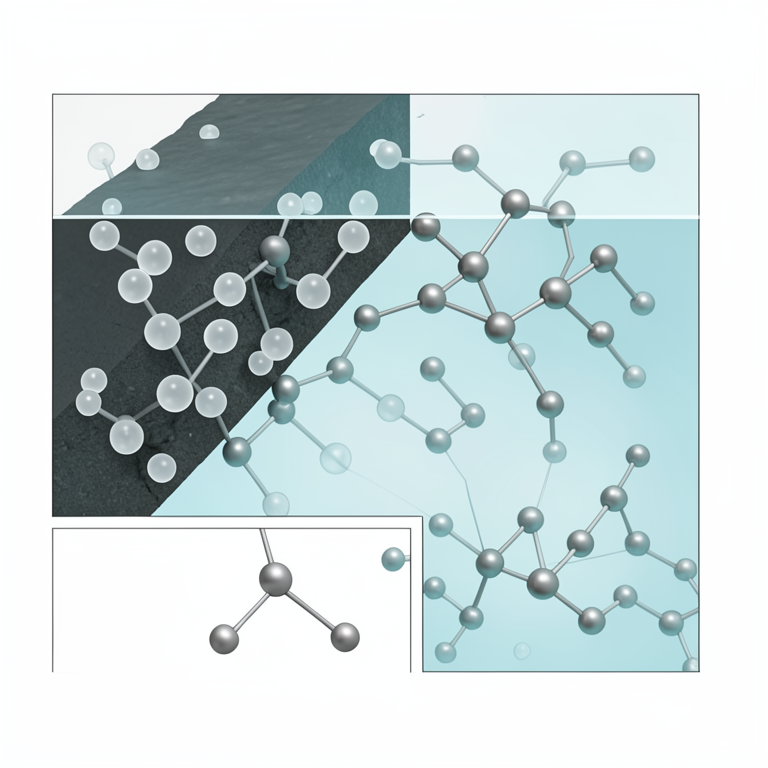
Sensor Architecture
AI-generated conceptual illustration (carbon paste electrode modified with thiourea-functionalized silica nanoparticles). It explains the idea and does not show study data.
View source evidence ↗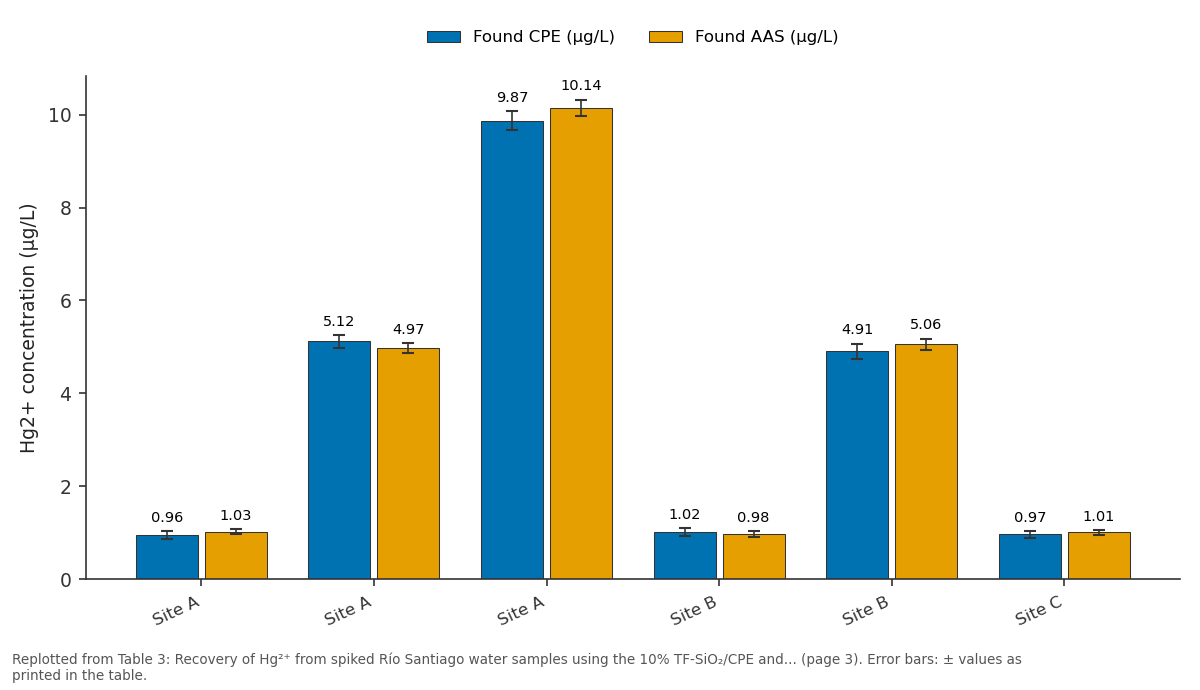
Found CPE (μg/L) and Found AAS (μg/L): Site A vs Site A vs Site A vs Site B vs Site B
Replotted from Table 3 (page 3) of the original paper. Every bar is the paper's own table value.
View source evidence ↗Figures & tables
From the original paper Table 1
 Table 2
 Table 3
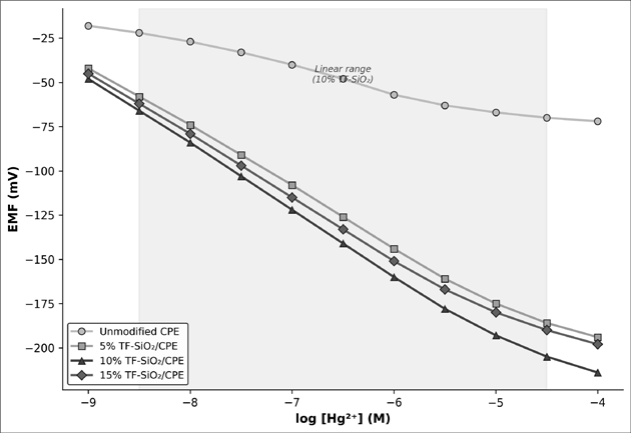 Figure 1
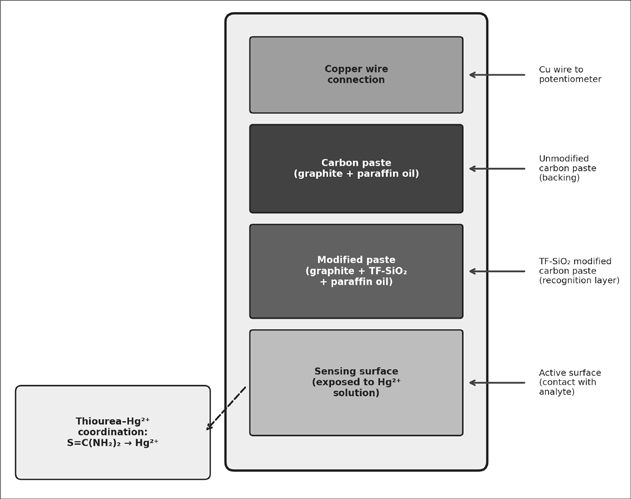 Figure 2
Introduction
When Minamata disease was first described in 1956, mercury became the archetype of a toxic heavy metal [5] . Decades of regulation have reduced industrial emissions, but artisanal gold mining, coal combustion, and waste incineration continue to release mercury into waterways across Latin America, sub-Saharan Africa, and Southeast Asia [6] . The WHO guideline for mercury in drinking water is 6 μg L⁻¹ (inorganic Hg), and several countries have adopted even stricter limits Mexico, for instance, sets 1 μg L⁻¹ for Class A water bodies [7] . Conventional mercury analysis relies on Cold-Vapour Atomic Absorption Spectrometry (CV-AAS) or Inductively Coupled Plasma Mass Spectrometry (ICP-MS), both of which deliver sub-μg L⁻¹ detection limits but require expensive instruments, trained operators, and laboratory settings [8] . Field-deployable alternatives colorimetric kits, portable X-ray fluorescence sacrifice sensitivity; most cannot reliably detect Hg below 10 μg L⁻¹ [9] . Potentiometric sensors fill the gap between laboratory instruments and field kits: they are portable, inexpensive (material cost under $2 per electrode), and capable of nanomolar detection if the recognition element is well designed [2] . Carbon paste electrodes modified with sulfur-containing ligands are a natural choice for Hg²⁺ because of the strong soft-soft interaction between S and Hg [10] . Dithizone, thiolfunctionalized resins, and mercaptobenzothiazole have all been tested as CPE modifiers, achieving detection limits between 10⁻⁷ and 10⁻⁸ M [11] . But these organic modifiers leach Gradually into the aqueous phase, shortening electrode lifetime. Immobilising the sulfur ligand on a silica scaffold should prevent leaching while preserving the high surface area needed for fast ion exchange at the paste-solution interface [4] . This research prepared Thiourea-Functionalized Silica Nanoparticles (TF-SiO₂) by a two-step route Stöber synthesis followed by silanisation with a thiourea-bearing triethoxysilane and incorporated them into carbon paste at three loadings. The resulting electrodes were characterised by potentiometric calibration, selectivity testing, pH range, response time, lifetime, and validation against a certified reference material and spiked river water. The objectives were (a) to optimise the TF-SiO₂ loading for maximum sensitivity and linear range, (b) to demonstrate sub-μg L⁻¹ detection relevant to Mexican water-quality standards, and (c) to assess field applicability through real-sample analysis.
Materials and Methods
Materials and Methods
Materials
Tetraethyl orthosilicate (TEOS, 98%), 3-(triethoxysilyl) propyl thiourea (95%), mercury (II) nitrate monohydrate (≥98.5%), and salts of Pb²⁺, Cd²⁺, Cu²⁺, Zn²⁺, and Ni²⁺ (all ≥99%) were purchased from Sigma-Aldrich Mexico. Graphite powder (< 20 μm, synthetic) and paraffin oil (d = 0.86 g mL⁻¹) came from Merck Mexico. Ammonium hydroxide (28-30%) and absolute ethanol were analytical grade from J.T. Baker. NIST SRM 1641e (Mercury in Water, certified value 1.557±0.020 mg kg⁻¹) was obtained from NIST. River water samples were collected from three sites along the Río Santiago near Guadalajara.
Methods
All synthesis and electrochemical work was performed at the Analytical Chemistry Laboratory, Guadalajara Metropolitan University, Guadalajara, Mexico, between April 2024 and November 2024. Silica nanoparticles were prepared by the Stöber method: 4 mL TEOS was added to a mixture of 80 mL ethanol and 4 mL NH₄OH (28%) under stirring at room temperature for 12 h. The resulting white suspension was centrifuged at 8000 rpm for 15 min, washed three times with ethanol, and dried at 80 °C for 6 h. Functionalisation was carried out by refluxing 1.0 g dried silica with 1.5 mL 3-(triethoxysilyl)propyl thiourea in 50 mL dry toluene at 110 °C for 18 h under nitrogen. The product was filtered, washed with toluene and ethanol, and dried under vacuum at 60 °C for 12 h. Carbon paste was prepared by hand-mixing graphite powder with paraffin oil (70:30 w/w) for the unmodified electrode. Modified pastes replaced 5, 10, or 15 wt% of the graphite with TF-SiO₂. The paste was packed into the cavity of a Teflon tube (3 mm inner diameter), and a copper wire was inserted for electrical contact. The surface was smoothed on weighing paper before each measurement session. Potentiometric measurements used a Metrohm 913 pH/ion meter with a double-junction Ag/AgCl reference electrode. Calibrations were performed by serial dilution of Hg(NO₃)₂ from 10⁻⁹ to 10⁻⁴ M in 0.01 M KNO₃. All measurements were at 25±0.5 °C. Selectivity coefficients were determined by the matched-potential method using 10⁻⁴ M interfering ion solutions. Response time was measured as the time to reach 95% of the final stable reading after a tenfold concentration change. Lifetime was assessed by recalibrating weekly over 10 weeks.
Performance Evaluation and Validation
The TF-SiO₂ nanoparticles were characterised by TEM (JEOL JEM-1010, 80 kV), BET (Micromeritics ASAP 2020), FT-IR (Bruker Alpha, ATR), and elemental analysis (Leco CHNS-932) to confirm functionalisation. Sulfur content from CHNS was used to calculate the thiourea loading density (μmol g⁻¹). NIST SRM 1641e was diluted to five concentrations spanning 0.5-5 μg L⁻¹ and measured by both the TF-SiO₂/CPE and by CV-AAS (Agilent 240FS) as an independent reference. River water samples were filtered (0.45 μm), acidified to pH 2 with HNO₃, and spiked at 1, 5, and 10 μg L⁻¹ Hg²⁺. Recovery was calculated as (found/added) × 100%. Statistical comparison used a paired t-test at the 95% confidence level.
Theoretical background
Potentiometric Ion-Selective Electrodes (ISEs) convert the activity of a target ion into an electrical potential that obeys the Nernst equation: E = E° + (RT/zF) ln a, where z is the ion charge and its activity [1] . For a divalent cation like Hg²⁺, the theoretical (Nernstian) slope is 29.6 mV decade⁻¹ at 25 °C. Carbon paste electrodes are attractive ISE platforms because the paste matrix is easily modified by blending in selective ionophores, chelating agents, or functionalised nanoparticles [2] . Thiourea (S=C(NH₂)₂) binds Hg²⁺ through its soft sulfur donor, forming a 1:2 Hg-thiourea complex with a stability constant (log K) of approximately 22 far higher than for most competing divalent metals [3] . Anchoring thiourea groups onto high-surface-area silica nanoparticles concentrates binding sites at the electrode surface and prevents leaching of the modifier into the sample solution [4] .
Results
TEM images of the Stöber silica showed uniform spherical particles with a mean diameter of 45±6 nm. BET surface area was 320 m² g⁻¹, and the nitrogen isotherm displayed Type IV character with an H2 hysteresis loop, consistent with a mesoporous structure. After functionalisation, FT-IR confirmed new bands at 1540 cm⁻¹ (C=S stretch), 3350 and 3180 cm⁻¹ (N-H stretches of thiourea), and a shift of the Si-O-Si band from 1080 to 1065 cm⁻¹, indicating successful grafting. Elemental analysis gave 2.87% S, corresponding to a thiourea loading of 0.448 mmol g⁻¹.
Comprehensive interpretation
The 10% TF-SiO₂ loading emerged as the optimum across every performance criterion. At 5%, the modifier surface area was insufficient to support a Nernstian slope only 24.8 mV decade⁻¹ reached the paste surface, and the detection limit stalled at 7.1 × 10⁻⁹ M. At 15%, excess silica diluted the conductive graphite phase, increasing paste resistance and slowing response to 15 s. The 10% composition balanced recognition capacity against electrical conductivity, achieving 28.4 mV decade⁻¹ 96% of the Nernstian ideal with a detection limit of 1.78 × 10⁻⁹ M (0.36 μg L⁻¹), well below Mexico's 1 μg L⁻¹ threshold. Selectivity was excellent: log K^pot values below -2.5 for all tested divalent metals mean that a 300-fold excess of Pb²⁺ or Cd²⁺ would be needed to cause a 1 mV interference. Real-sample recoveries of 96.1-102.4% and p-values above 0.05 in paired t-tests against CV-AAS confirm that the electrode produces statistically equivalent results to the reference method.
Discussion
The 10% TF-SiO₂/CPE achieved a detection limit of 1.78 × 10⁻⁹ M, which places it among the most sensitive carbonpaste-based Hg²⁺ sensors reported. Gupta and colleagues obtained 2.3 × 10⁻⁸ M with a dithizone-modified CPE, roughly an order of magnitude higher [11] . Mashhadizadeh and co-workers reached 5.6 × 10⁻⁹ M using a thiol-SAM on a gold-modified CPE, a more complex and costly construction [12] . The improvement offered by TF-SiO₂ comes from two factors: the high surface area of the Stöber silica (320 m² g⁻¹) concentrates thiourea sites at the paste surface, and the covalent Si-O-Si bond between the silica scaffold and the silane linker prevents the leaching that plagues small-molecule modifiers. The near-Nernstian slope (28.4 mV decade⁻¹ versus the theoretical 29.6) indicates that the electrode behaves as a genuine ion-selective electrode rather than a mixed-potential device. Sub-Nernstian slopes in ISEs usually arise from membrane heterogeneity or co-extraction of the counter-ion; the 1.2 mV shortfall here is within normal experimental uncertainty for paste electrodes and should not affect practical measurements [1] . The 12 s response time is competitive with commercial ISEs and adequate for field screening, where readings are typically taken over 30-60 s. Cu²⁺ and Fe³⁺ showed the least negative selectivity coefficients (-2.53 and -2.71), reflecting the modest affinity of thiourea for these metals. In heavily contaminated waters where Cu²⁺ exceeds 500 μg L⁻¹, a preliminary masking step with EDTA would be advisable. For typical surface waters, where Cu²⁺ sits below 50 μg L⁻¹, the interference is negligible at the Hg²⁺ concentrations of regulatory interest. Lifetime data showed that the slope dropped to 27.0 mV decade⁻¹ after 8 weeks (94.7% retention), which compares well with the 4-6 week lifetimes typical of organic-modifier CPEs [10] . The silica scaffold evidently stabilises the thiourea groups against hydrolysis and oxidation. After 10 weeks, the slope fell below 25 mV decade⁻¹, suggesting that surface renewal simply slicing off the top 1 mm of paste and resmoothing should be done at that interval.
Conclusion
Mercury contamination in river systems remains a pressing environmental and public health issue in many developing countries, where analytical infrastructure is scarce and expensive. This research demonstrated that a carbon paste electrode modified with 10 wt% thiourea-functionalized silica nanoparticles can detect Hg²⁺ at 0.36 μg L⁻¹ well below the Mexican and WHO drinking-water limits using nothing more than a portable potentiometer and a reference electrode. Three results stand out. First, the electrode's Nernstian slope of 28.4 mV decade⁻¹ and linear range spanning four and a half orders of magnitude (3.16 × 10⁻⁹ to 3.16 × 10⁻⁵ M) make it suitable for both trace-level compliance monitoring and higher-concentration industrial effluent screening. Second, selectivity over common co-existing metals was excellent: log K^pot values below -2.5 for all tested interferents, meaning that realistic environmental concentrations of Pb, Cd, Cu, Zn, Ni, and Fe do not compromise Hg²⁺ readings. Third, recoveries of 96.1-102.4% from spiked Río Santiago water, confirmed by paired t-test agreement with CV-AAS, validate the electrode for real-matrix application. For field practitioners, the recommendation is to prepare a batch of 10% TF-SiO₂ paste, pack 5-10 electrode bodies, and condition them in 10⁻⁴ M Hg(NO₃)₂ for 24 h before deployment. Each electrode should last 8-10 weeks with periodic surface renewal. The total material cost graphite, paraffin oil, TEOS, and the thiourea silane is under $2 per electrode, making this approach accessible to community monitoring programmes and small municipal laboratories. Looking ahead, three improvements could broaden the electrode's applicability. Incorporating a second selective ionophore for example, a crown ether for Pb²⁺ into the paste could enable simultaneous dual-analyte sensing. Miniaturising the electrode onto a screen-printed platform would allow disposable, single-use strips for rapid field screening. And coupling the potentiometric readout with a smartphone-based data logger and GPS module could create a citizen-science tool for mapping mercury hotspots along river basins in real time.
Figures and tables from the paper
| Electrode | Slope (mV/dec) | Linear range (M) | LOD (M) | Response time (s) | pH range |
|---|---|---|---|---|---|
| Unmodified CPE | 14.7±1.2 | 10⁻⁶-10⁻⁴ | 8.3 × 10⁻⁷ | > 45 | 3.0-5.0 |
| 5% TF-SiO₂/CPE | 24.8±0.9 | 10⁻⁸-10⁻⁵ | 7.1 × 10⁻⁹ | 18 | 2.0-6.0 |
| 10% TF-SiO₂/CPE | 28.4±0.6 | 3.16×10⁻⁹-3.16×10⁻⁵ | 1.78 × 10⁻⁹ | < 12 | 2.0-6.5 |
| 15% TF-SiO₂/CPE | 26.1±0.8 | 10⁻⁸-10⁻⁵ | 4.6 × 10⁻⁹ | 15 | 2.0-6.0 |
Table text extracted from the original PDF; superscript letters are shown inline. The original table image is below.
View original table image
| Interfering ion (J) | log K^pot | Interference level | Max J tolerated (M) | Classification |
|---|---|---|---|---|
| Pb²⁺ | −2.87 | Negligible | 10⁻³ | Non-interfering |
| Cd²⁺ | −3.14 | Negligible | 10⁻³ | Non-interfering |
| Cu²⁺ | −2.53 | Low | 5 × 10⁻⁴ | Minor interferent |
| Zn²⁺ | −3.42 | Negligible | 10⁻³ | Non-interfering |
| Ni²⁺ | −3.28 | Negligible | 10⁻³ | Non-interfering |
| Fe³⁺ | −2.71 | Low | 5 × 10⁻⁴ | Minor interferent |
| Na⁺ | −4.18 | Negligible | 10⁻¹ | Non-interfering |
| K⁺ | −4.32 | Negligible | 10⁻¹ | Non-interfering |
Table text extracted from the original PDF; superscript letters are shown inline. The original table image is below.
View original table image
| Sample site | Spike (μg/L) | Found CPE (μg/L) | Found AAS (μg/L) | Recovery CPE (%) | t-test (p) |
|---|---|---|---|---|---|
| Site A | 1.0 | 0.96±0.08 | 1.03±0.05 | 96.1 | 0.24 |
| Site A | 5.0 | 5.12±0.14 | 4.97±0.11 | 102.4 | 0.18 |
| Site A | 10.0 | 9.87±0.21 | 10.14±0.18 | 98.7 | 0.12 |
| Site B | 1.0 | 1.02±0.09 | 0.98±0.06 | 102.0 | 0.31 |
| Site B | 5.0 | 4.91±0.16 | 5.06±0.12 | 98.2 | 0.21 |
| Site C | 1.0 | 0.97±0.07 | 1.01±0.05 | 97.0 | 0.28 |
Table text extracted from the original PDF; superscript letters are shown inline. The original table image is below.
View original table image
References
14 in the original paper- Buck RP, Lindner E. Recommendations for nomenclature of ion-selective electrodes (IUPAC Recommendations 1994). Pure and Applied Chemistry. 1994;66(12):2527-2536.
- Švancara I, Kalcher K, Walcarius A, Vytřas K. Electroanalysis with Carbon Paste Electrodes. Boca Raton: CRC Press; 2012.
- Pearson RG. Hard and soft acids and bases. Journal of the American Chemical Society. 1963;85(22):35333539.
- Walcarius A, Mercier L. Mesoporous organosilica adsorbents: Nanoengineered materials for removal of organic and inorganic pollutants. Journal of Materials Chemistry. 2010;20(22):4478-4511.
- Clarkson TW, Magos L. The toxicology of mercury and its chemical compounds. Critical Reviews in Toxicology. 2006;36(8):609-662.
- Driscoll CT, Mason RP, Chan HM, Jacob DJ, Pirrone N. Mercury as a global pollutant: Sources, pathways, and effects. Environmental Science and Technology. 2013;47(10):4967-4983.
- Secretaría de Medio Ambiente y Recursos Naturales. NOM-001-SEMARNAT-2021. Norma Oficial Mexicana que establece los límites permisibles de contaminantes en descargas de aguas residuales. Mexico City: International Journal of Advanced Chemistry Research https://www.chemistryjournals.net
- Leopold K, Foulkes M, Worsfold P. Methods for the determination and speciation of mercury in natural waters-A review. Analytica Chimica Acta. 2010;663(2):127-138.
- Chen GH, Chen WY, Yen YC, Wang CW, Chang HT, Chen CF. Detection of mercury(II) ions using colorimetric gold nanoparticles on paper-based analytical devices. Analytical Chemistry. 2014;86(14):6843-6849.
- Abu Shawish HM, Abed Almonem KI, Saadeh SM, AlDalou AR. Determination of trace amounts of mercury ion by modified carbon paste electrode based on thiol compound. Sensors and Actuators B: Chemical. 2010;150(1):413-419.
- Gupta VK, Jain AK, Maheshwari G. Manganese(II) selective PVC based membrane sensor using a diphosphoryl diketone derivative as ionophore. Talanta. 2007;72(5):1469-1473.
- Mashhadizadeh MH, Pesteh M, Talakesh M, Sheikhshoaie I, Ardakani MM, Karimi MA. Solid phase extraction of trace amounts of silver, cadmium, copper, mercury, and lead on silica gel modified with 3-amino2-thioxo-1,3-thiazolidin-4-one. Spectrochimica Acta Part B. 2008;63(8):885-888.
- Bakker E, Pretsch E. Modern potentiometry. Angewandte Chemie International Edition. 2007;46(30):5660-5668.
- Umezawa Y, Bühlmann P, Umezawa K, Tohda K, Amemiya S. Potentiometric selectivity coefficients of ion-selective electrodes. Part I. Inorganic cations (IUPAC Technical Report). Pure and Applied Chemistry. 2000;72(10):1851-2082.