
Research article · 2026 · Full text
International Journal of Biology SciencesEvaluation of a Nano-Herbal Acaricide to Mitigate Acaricidal Resistance in Dairy Cattle under Field Conditions in Tamil Nadu, India
Volume 8(5) · Pages 92–94 · DOI: 10.33545/26649926.2026.v8.i5b.833 ↗
Research areasVector-borne infectious diseasesInsect Pest Control StrategiesDermatological diseases and infestations
Abstract
Author-writtenTick infestation is one of the major constraints affecting dairy productivity in tropical regions. Continuous use of synthetic acaricides has resulted in resistance among tick populations, necessitating the development of eco-friendly alternatives. The present field study evaluated the efficacy of TANUVAS‑VIC Tix Killer, a nano-herbal acaricide, in comparison with a polyherbal spray and farmers’ conventional practice for controlling ticks in dairy cattle. The trial was conducted from September to December 2025 in Thalinji village of Karur District. Results showed a significant reduction in tick load within 28 days when treated with the nano-herbal formulation. Milk yield increased from 8.0 to 8.3 L/animal/day in animals treated with Tix Killer. Re-infestation was lowest (5%) in the nano-herbal treatment compared to the polyherbal spray (10%) and farmers’ practice (20%). Economic analysis indicated a higher benefit-cost ratio (1.57) for the nano-herbal treatment. The study suggests that nano-herbal acaricides can be an effective and sustainable approach for managing tick infestation and improving dairy productivity.
Summary
Source-checkedPlain-language reading of the full paper, prepared with AI and checked against the text. Each point links to the authors' own words.
Why it matters
- Tick infestations are a primary factor limiting the productivity of dairy cattle in tropical areas. View evidence ↗
- The ongoing use of synthetic acaricides has led to tick resistance, creating a need for environmentally friendly alternatives. View evidence ↗
- Ticks negatively impact cattle by reducing feed intake, causing blood loss, and transmitting diseases like anaplasmosis and babesiosis. View evidence ↗
The question
- The study aimed to compare the field effectiveness of the nano-herbal application 'TANUVAS-VIC Tix Killer' against a polyherbal spray and traditional farmer practices. View evidence ↗
What they did
- The field trial took place in Thalinji village, Karur District, between September and December (dates reported as both 2023 and 2025 in the text). View evidence ↗
- Three treatments were evaluated: a nano-herbal acaricide (Tix Killer), a polyherbal spray made from neem and notchi leaves, and conventional chemical applications used by farmers. View evidence ↗
- The researchers measured milk yield per animal per day, the load of ticks larger than 4 mm, the percentage of re-infestation, and the benefit-cost ratio. View evidence ↗
- Tick populations were monitored at five specific intervals: Day 0, 7, 14, 21, and 28. View evidence ↗
What they found
- Animals treated with the nano-herbal formulation saw an increase in milk yield from 8.0 to 8.3 L/animal/day. View evidence ↗
- The nano-herbal treatment provided the highest economic return with a benefit-cost ratio of 1.57, compared to 1.55 for the polyherbal spray and 1.20 for farmers' practices. View evidence ↗
What it means
- The authors recommend the nano-herbal acaricide as an economically viable and eco-friendly strategy for managing ticks on dairy farms. View evidence ↗
- The study was limited by a small sample size and short duration; the authors state that larger populations and seasonal variations must be studied to validate long-term efficacy. View evidence ↗
Visual summary
3 visualsIllustrations explain the paper; charts are replotted from the paper's own table values.
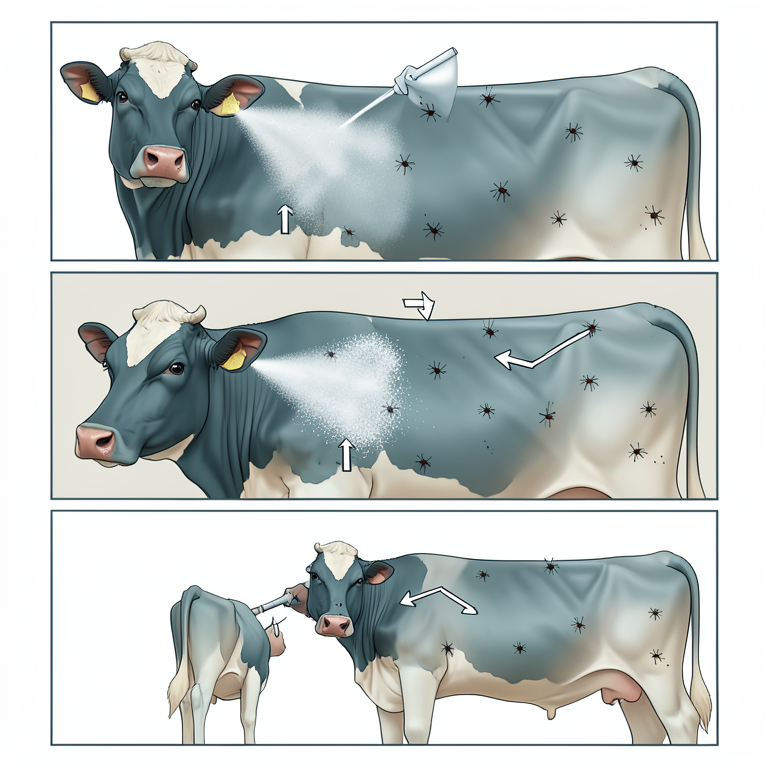
Comparison of Acaricide Treatments
AI-generated conceptual illustration (dairy cattle and ticks). It explains the idea and does not show study data.
View source evidence ↗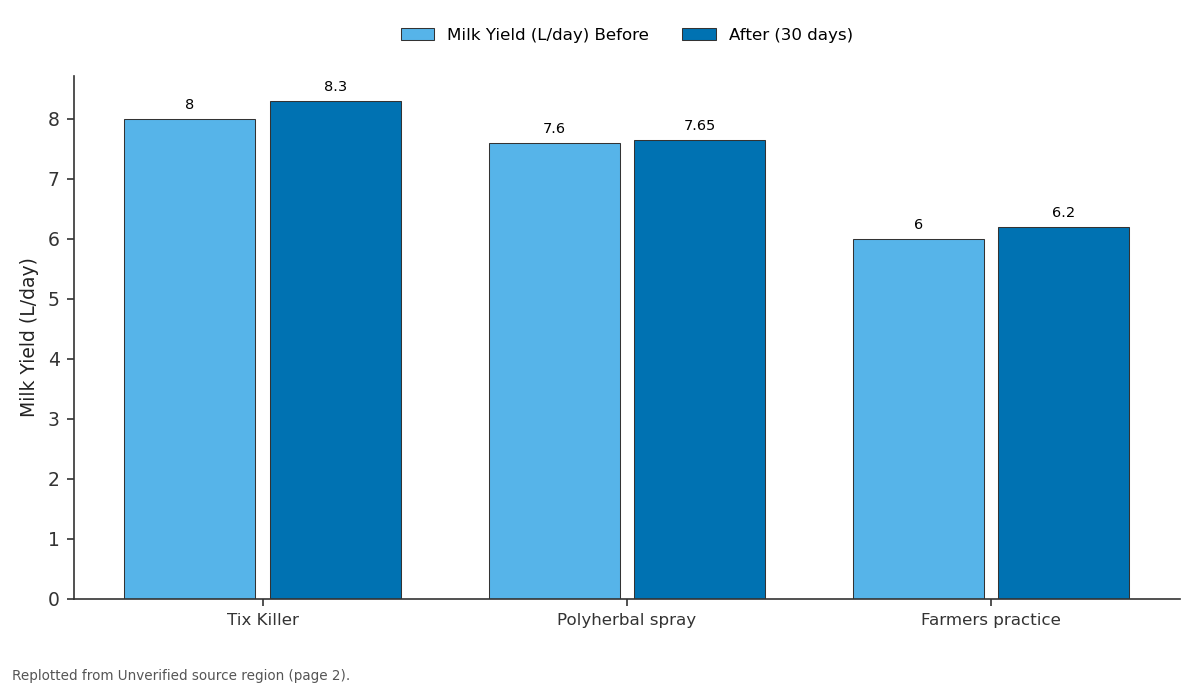
Milk Yield (L/day) Before and After (30 days): Tix Killer vs Polyherbal spray vs Farmers practice
Replotted from a table (page 2) of the original paper. Every bar is the paper's own table value.
View source evidence ↗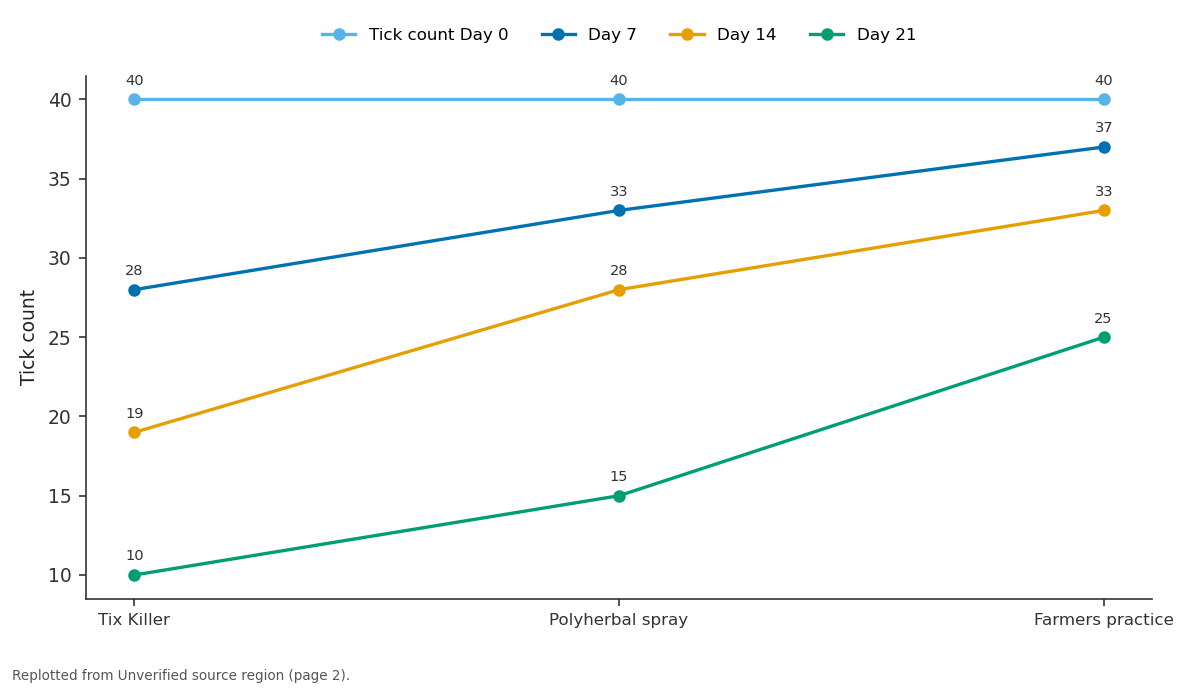
Tick count Day 0 and Day 7 and more: Tix Killer vs Polyherbal spray vs Farmers practice
Replotted from a table (page 2) of the original paper. Every bar is the paper's own table value.
View source evidence ↗Introduction
Ticks are among the most important ecto-parasites affecting livestock worldwide and are responsible for significant economic losses due to reduced productivity, transmission of tickborne diseases, and increased treatment costs. These parasites reduce feed intake, cause blood loss, and transmit haemoprotozoan diseases such as babesiosis and anaplasmosis in cattle (Benavides et al., 2001) [1] . Chemical acaricides are widely used for tick control; however, their indiscriminate use has led to acaricidal resistance, environmental contamination, and residues in milk and meat products. Hence, there is growing interest in plant-based acaricides as sustainable alternatives. Herbal extracts such as neem (Azadirachta indica) and notchi (Vitex negundo) have been reported to possess acaricidal and repellent properties against cattle ticks (Thaware et al, 20230 [8] . Plant-derived acaricides are ecofriendly and may reduce dependence on synthetic chemicals while effectively controlling tick populations. The present study aimed to evaluate the field performance of TANUVAS-VIC Tix Killer, a nano-herbal external application developed by Tamil Nadu Veterinary and Animal Sciences University, in comparison with a polyherbal spray formulation promoted by National Innovation Foundation -India and farmers' traditional practices.
Materials and Methods
Materials and Methods
Study Area
The study was conducted from September to December 2023 in Thalinji located in Thogamalai Block of Karur District. The region is predominantly rain-fed, and livestock farming plays a major role in rural livelihoods. Dairy cattle are reared mainly for milk production and regular calf production.
Problem Identification
Field surveys indicated a high prevalence of tick infestation in dairy cattle. Repeated use of conventional acaricides resulted in poor efficacy due to resistance. Farmers commonly used chemical acaricides, which provided only temporary relief. The Nano-herbal acaricide significantly reduced tick load within 28 days compared to the polyherbal spray and farmers' practice.
Technologies Evaluated
Technologies Evaluated
Economic Analysis
Economic Analysis
Discussion
The present study demonstrated that nano-herbal acaricides can effectively control tick infestation in dairy cattle. The reduction in tick population observed in this study agrees with earlier reports that plant-based extracts such as neem and Vitex negundo possess acaricidal activity against ticks (Singh et al., 2014) [3] . Tick infestation leads to reduced milk yield, loss of appetite, and transmission of tick-borne diseases in cattle (Sadhu et al., 2024) [4] . Herbal formulations provide an environmentally safe alternative to synthetic acaricides and reduce the risk of chemical residues (George et al., 2004) [2] . The improvement in milk yield and economic returns observed in this study suggests that nanoherbal formulations may be a viable solution for managing acaricidal resistance in dairy farms. The superior efficacy of the nano-herbal formulation observed in the present study may be attributed to improved penetration and prolonged residual activity of nano-sized particles on the skin surface. Nano-formulations enhance bioavailability and stability of active phytochemicals, thereby improving acaricidal efficiency even at lower concentrations (Kumar et al., 2020) [7] . Similar findings were reported by Patil et al. (2021) [10] , who observed significant reduction in tick burden in cattle treated with herbal nano-emulsions. The gradual reduction in tick count from Day 7 to Day 28 indicates sustained acaricidal action of the nano-herbal formulation. Lower re-infestation percentages observed in the Tix Killer-treated group suggest possible repellent effects of herbal constituents such as azadirachtin and essential oils present in medicinal plants. Neem-based compounds are known to interfere with feeding, molting, and reproductive cycles of ticks (Benavides et al., 2001) [1] . Improvement in milk yield recorded in treated animals could be associated with reduced stress and blood loss following tick control. Tick infestation adversely affects animal comfort and feed utilization efficiency, ultimately lowering milk production (Jonsson, 2006) [9] . Effective tick management therefore contributes directly to enhanced productivity and farm profitability. The higher benefit-cost ratio obtained in the nano-herbal treatment indicates its economic feasibility under field conditions. Farmers also reported ease of application and absence of adverse skin reactions in treated animals. Adoption of herbal acaricides may therefore support sustainable dairy farming by minimizing dependence on synthetic chemicals and delaying development of acaricidal resistance. However, the present study was conducted under field conditions with limited sample size and duration. Further studies involving larger populations, seasonal variations, and molecular assessment of acaricidal resistance are required to validate long-term efficacy of nano-herbal formulations.
Conclusion
The field evaluation showed that TANUVAS-VIC Tix Killer, a nano-herbal acaricide, effectively reduced tick infestation and improved milk yield in dairy cattle. The treatment resulted in lower re-infestation rates and higher economic returns compared with polyherbal spray and farmers' conventional practice. The technology can therefore be recommended as an eco-friendly and economically viable strategy for tick control in dairy farms.
References
10 in the original paper- Benavides EO, Hernández GM, Romero AN, Castro HA, Rodríguez JL. Preliminary evaluation of neem extracts as alternative for cattle tick control. Rev Colomb Entomol. 2001.
- George JE, Pound JM, Davey RB. Chemical control of ticks on cattle and the resistance problem. Vet Parasitol. 2004.
- Singh N, Jyoti B, Nandi A. Laboratory assessment of acaricidal activity of plant extracts against deltamethrin-resistant ticks. Exp Appl Acarol. 2014.
- Sadhu DB, Patel OS, Sadariya KA. Evaluation of plantbased acaricides for tick control in cattle. Indian J Vet Sci Biotechnol. 2024.
- National Innovation Foundation -India. Polyherbal ecofriendly technology for tick control in dairy animals. 2022.
- Gopalakrishnan A, Veena AG, Jyothi UY, Sravanthi S, Vihari AM, Raju SS, Dhurua S. Evaluation of poly herbal extract from Azadirachta indica (Neem) and Vitex negundo leaves for the control of ectoparasitic International Journal of Biology Sciences https://www.biologyjournal.net infestation in bovine. Int J Vet Sci Anim Husb. 2026;11(2):432-434.
- Kumar S, Sharma AK, Ray DD, Ghosh S. Nanoformulations in veterinary ectoparasite management: emerging opportunities and challenges. Vet Parasitol. 2020.
- Thaware VH, Mane AM. Integrated pest management: An eco-friendly approach to control and manage ticks in cattle. Acta Entomol Zool 2023;4(1):33-36. DOI: 10.33545/27080013.2023.v4.i1a.93
- Jonsson NN. The productivity effects of cattle tick (Boophilus microplus) infestation on cattle. Vet Parasitol. 2006;137:1-10.
- Patil SS, Kale MK, Deshmukh PV. Evaluation of herbal nano-emulsion against cattle tick infestation under field conditions. Indian J Anim Res. 2021.