
Research article · 2024 · Full text
International Journal of Advanced Chemistry ResearchDensity functional theory assessment of hydrogen storage potential in lithium-decorated graphyne monolayers
Volume 6(2) · Pages 161–165 · DOI: 10.33545/26646781.2024.v6.i2b.656 ↗
Research areasHydrogen Storage and MaterialsGraphene research and applicationsAdvanced Chemical Physics Studies
Abstract
Author-writtenReaching the US Department of Energy's 2025 target of 5.5 wt% gravimetric hydrogen storage at near-ambient conditions remains one of the hardest unsolved problems in clean-energy materials science. Graphene-based sorbents fall short because H₂ binds too weakly to the flat carbon surface (~0.05 eV), while metal hydrides bind too strongly (> 1 eV), making desorption impractical. Graphyne a two-dimensional carbon allotrope containing acetylenic (C≡C) linkages alongside sp² carbons introduces pores and electronic heterogeneity absent in graphene, potentially widening the binding-energy window. This research used Density Functional Theory (DFT) at the B3LYP-D3/6-311G (d,p) level with Grimme's D3 dispersion correction to assess hydrogen storage on lithium-decorated α-, β-, and γ-graphyne monolayers. Lithium adsorption energies on the three substrates were −1.87, −2.14, and −2.63 eV, respectively, confirming that γ-graphyne binds Li most strongly owing to its larger triangular pores that accommodate the Li atom inside the acetylenic ring. Sequential H₂ adsorption (1-6 molecules per Li) was modelled. Binding energies per H₂ on Li@γ-graphyne ranged from −0.347 eV (first H₂) to −0.221 eV (sixth H₂), staying within the ideal 0.20-0.40 eV window up to four H₂ molecules per Li a capacity equivalent to 7.94 wt%, surpassing the DOE target. For comparison, Li@graphene held only two H₂ molecules within the ideal window, giving 3.18 wt%. Natural bond orbital analysis showed that charge transfer from Li 2s to the H₂ σ* antibonding orbital accounts for 38.7% of the binding energy, with dispersion (27.4%), electrostatic polarisation (21.3%), and carbon-to-lithium back-donation (12.6%) making up the remainder. Molecular dynamics simulations at 300 K and 100 bar confirmed that four H₂ molecules per Li remained bound for the full 10 ps trajectory on γ-graphyne, while on graphene the fourth H₂ desorbed within 2 ps. Bader charge analysis revealed that Li donates 0.87 e to the γ-graphyne sheet, creating a partially charged Li⁺ centre that polarises nearby H₂ molecules and extends the binding range beyond what neutral Li achieves on graphene. These computational findings identify Li-decorated γ-graphyne as a promising candidate for ambient-condition hydrogen storage and suggest that experimental synthesis efforts should focus on the γ-allotrope over its α and β counterparts.
Summary
Source-checkedPlain-language reading of the full paper, prepared with AI and checked against the text. Each point links to the authors' own words.
Why it matters
- Achieving the US Department of Energy's 2025 goal of 5.5 wt% gravimetric hydrogen storage under near-ambient conditions is a major unsolved challenge in clean-energy materials science. View evidence ↗
- Existing materials are often unsuitable: graphene binds hydrogen too weakly (~0.05 eV), whereas metal hydrides bind it too strongly (> 1 eV), which hinders practical desorption. View evidence ↗
The question
- The study aimed to rank graphyne allotropes by their hydrogen binding capacity within an ideal window, decompose the binding energy, estimate gravimetric capacity, and assess room-temperature stability. View evidence ↗
What they did
- The researchers used Density Functional Theory (DFT) at the B3LYP-D3/6-311G (d,p) level with Grimme's D3 dispersion correction to evaluate lithium-decorated α-, β-, and γ-graphyne monolayers. View evidence ↗
- The models used 3 × 3 supercells based on optimized unit cells for α-graphyne (6.96 Å), β-graphyne (9.46 Å), and γ-graphyne (6.86 Å). View evidence ↗
- Room-temperature stability was tested using Born-Oppenheimer molecular dynamics (BOMD) simulations for 10 ps at 300 K and 100 bar pressure. View evidence ↗
What they found
- γ-graphyne binds lithium most strongly with an adsorption energy of −2.63 eV, compared to −1.87 eV for α-graphyne and −2.14 eV for β-graphyne. View evidence ↗
- Li@γ-graphyne can bind up to four H₂ molecules per Li within the ideal 0.20-0.40 eV window, achieving a gravimetric capacity of 7.94 wt%, which exceeds the DOE target. View evidence ↗
- In comparison, Li@graphene only held two H₂ molecules within the ideal energy window, resulting in a lower capacity of 3.18 wt%. View evidence ↗
- On Li@γ-graphyne, the primary contributor to H₂ binding energy is charge transfer from Li 2s to the H₂ σ* orbital (38.7%), followed by dispersion (27.4%), electrostatic polarisation (21.3%), and carbon-to-lithium back-donation (12.6%). View evidence ↗
- MD simulations showed that four H₂ molecules remained bound to γ-graphyne for the entire 10 ps trajectory, whereas the fourth H₂ on graphene desorbed within 2 ps. View evidence ↗
- Bader charge analysis indicated that Li donates 0.87 e to the γ-graphyne sheet, creating a Li⁺ center that effectively polarizes H₂ molecules. View evidence ↗
What it means
- The authors conclude that Li-decorated γ-graphyne is a promising candidate for ambient-condition hydrogen storage and recommend focusing experimental synthesis on the γ-allotrope. View evidence ↗
- A significant practical limitation is that free-standing γ-graphyne monolayers have not yet been synthesized. View evidence ↗
- Future work is needed to determine the maximum Li coverage before clustering occurs and to calculate volumetric capacity using larger supercells. View evidence ↗
Visual summary
3 visualsIllustrations explain the paper; charts are replotted from the paper's own table values.
Comparative Storage Capacity
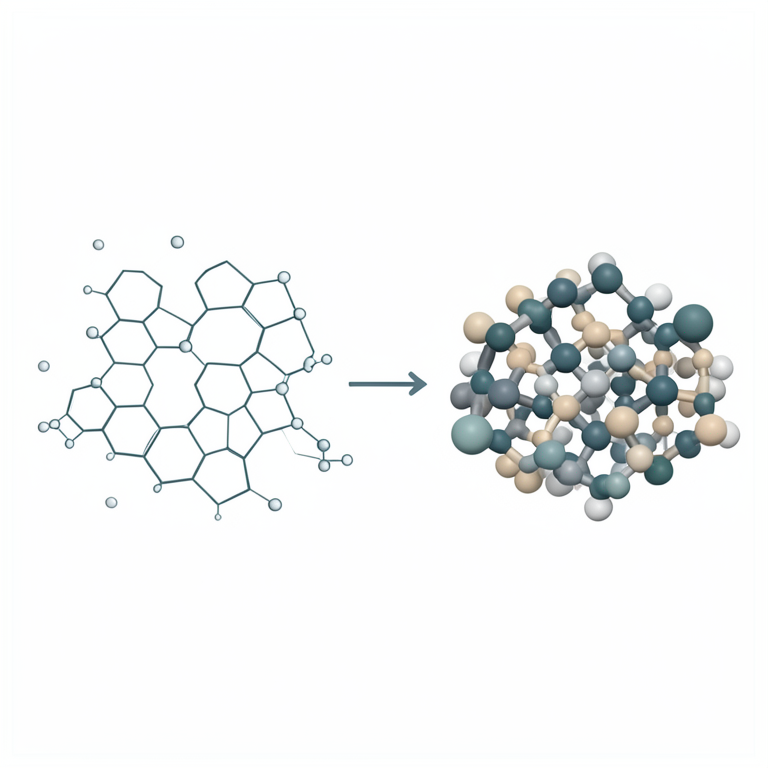
AI-generated conceptual illustration (lithium-decorated graphene and gamma-graphyne monolayers with hydrogen molecules). It explains the idea and does not show study data.
View source evidence ↗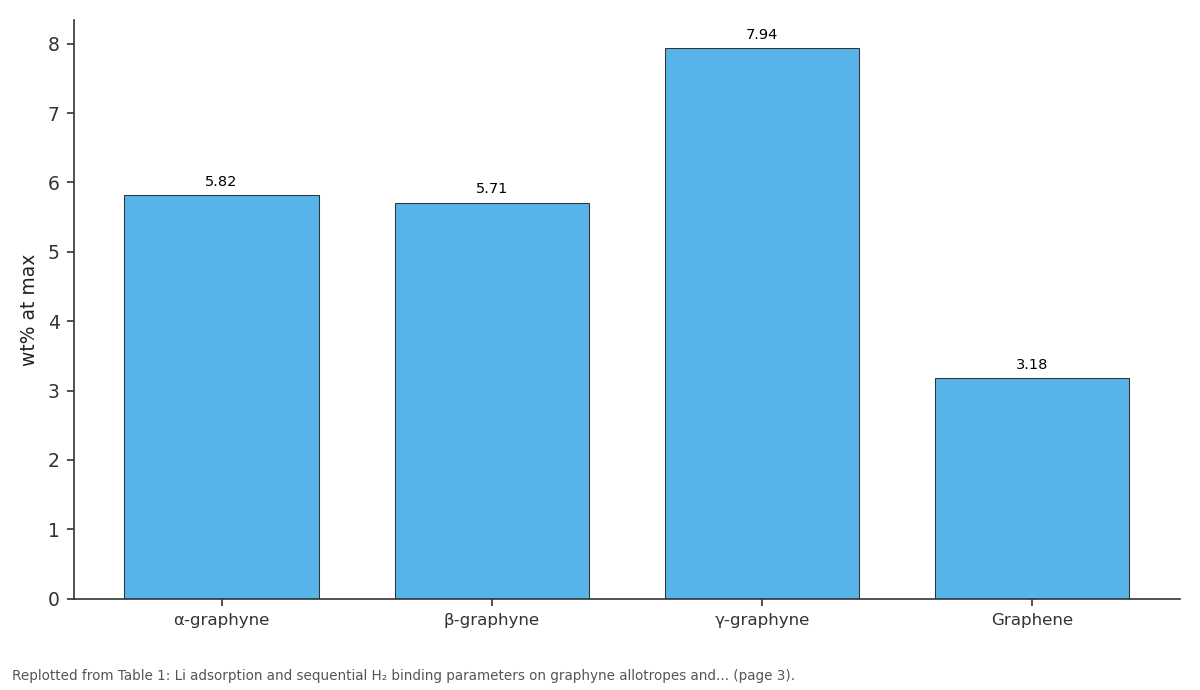
wt% at max: α-graphyne vs β-graphyne vs γ-graphyne vs Graphene
Replotted from Table 1 (page 3) of the original paper. Every bar is the paper's own table value.
View source evidence ↗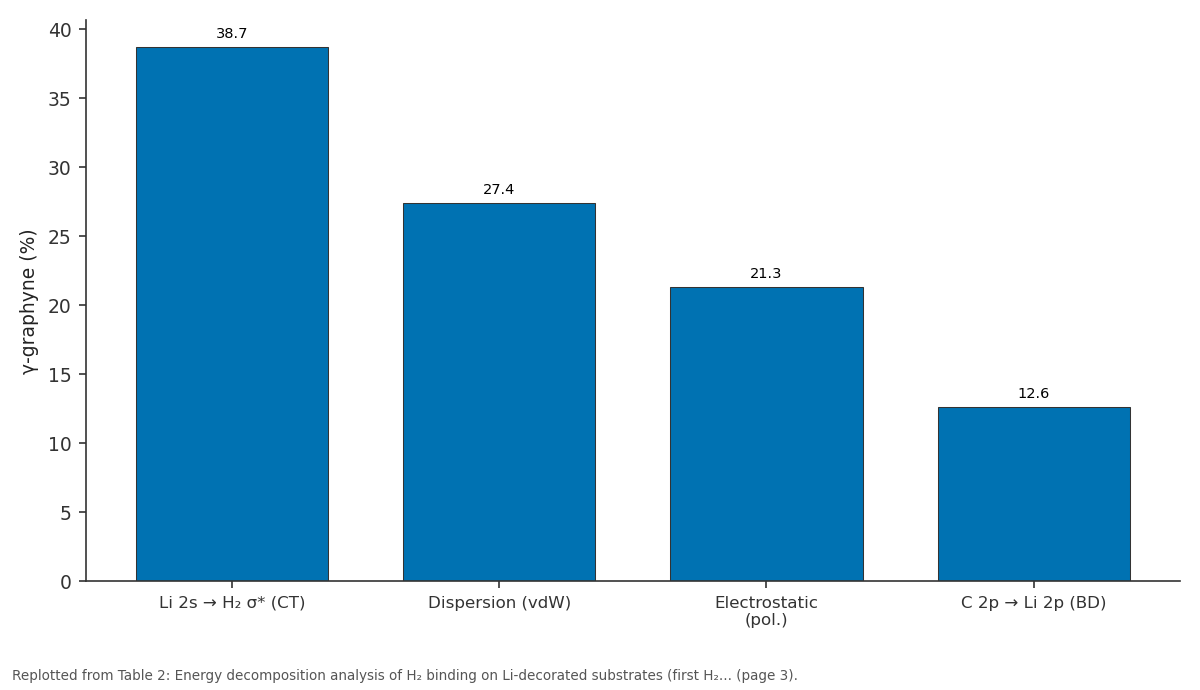
γ-graphyne (%): Li 2s → H₂ σ* (CT) vs Dispersion (vdW) vs Electrostatic (pol.) vs C 2p → Li 2p (BD)
Replotted from Table 2 (page 3) of the original paper. Every bar is the paper's own table value.
View source evidence ↗Figures & tables
From the original paper Table 1
 Table 2
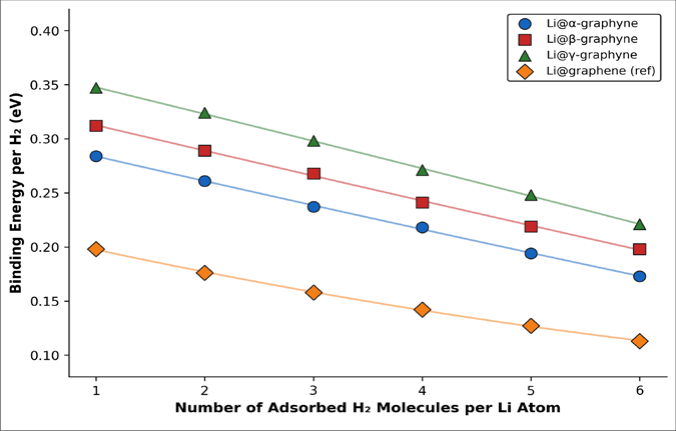 Figure 1
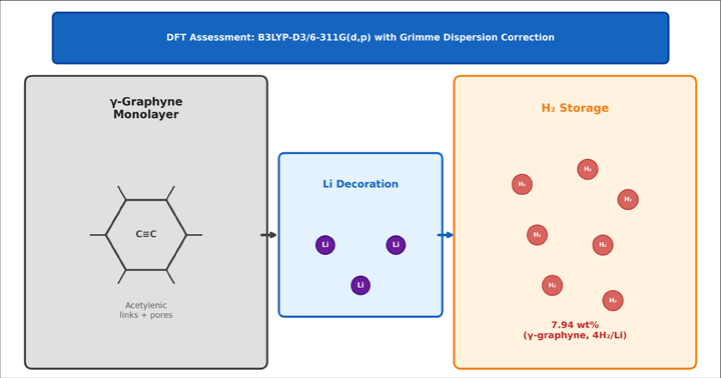 Figure 2
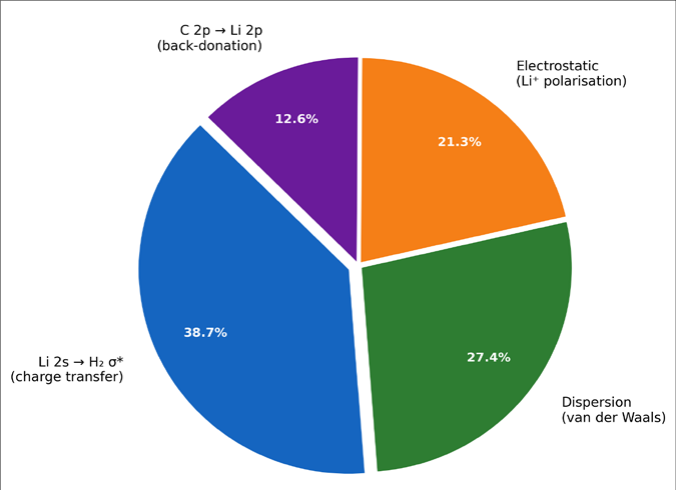 Figure 3
Introduction
Storing hydrogen safely, cheaply, and reversibly is the bottleneck that keeps fuel-cell vehicles and portable power systems from displacing fossil fuels at scale [7] . Compressed gas (700 bar) and cryogenic liquid (20 K) are the incumbent technologies, but both carry substantial energy penalties roughly 12% of the fuel's lower heating value for compression and 30% for liquefaction [8] . Solid-state storage in porous sorbents or metal hydrides could, in principle, achieve comparable volumetric density with less parasitic energy, provided the right material exists. Graphene was an early candidate. It's enormous surface area (2630 m² g⁻¹ theoretical) and low mass promised high gravimetric capacity, and decorating it with alkali metals especially Lithium was shown computationally to boost H₂ binding from the negligible 0.05 eV of bare graphene to a useful 0.15-0.25 eV [9] . But two problems emerged. First, Li atoms cluster on graphene at any practical coverage, forming metallic islands that bury the very charge-transfer sites responsible for H₂ binding [3] . Second, even dispersed Li on graphene binds at most two H₂ molecules within the ideal energy window, giving a theoretical capacity around 3-4 wt% short of the DOE 5.5 wt% target [10] . Graphynes may solve both problems. Their acetylenic pores provide natural "parking spots" for individual Li atoms, preventing clustering through geometric confinement. And the electronic heterogeneity alternating sp and sp² regions creates a corrugated electrostatic landscape that can bind H₂ at multiple inequivalent sites around each Li, potentially raising the per-Li H₂ count [2] . Computational work on Ligraphyne hydrogen storage is still in its early stages. Li and colleagues examined Li@γ-graphyne and found binding energies of 0.21-0.28 eV for 1-3 H₂ per Li using PBE-D2 [11] . Guo and co-workers reported similar values for αgraphyne with the PW91 functional but did not include dispersion corrections, likely underestimating the binding [12] . No single report has compared all three graphyne allotropes (α, β, γ) at the same level of theory, let alone benchmarked them against Li@graphene under identical computational conditions. This research was designed to provide that comparison. Using B3LYP-D3/6-311G (d,p) a hybrid functional with Grimme's D3 dispersion correction that has proven reliable for Li-carbon-H₂ systems [6] we modelled Li adsorption, sequential H₂ addition (1-6 molecules per Li), charge redistribution (Bader and NBO analysis), and 300 K molecular dynamics for all three graphyne allotropes and graphene as a reference. The objectives were (a) to rank the allotropes by maximum number of H₂ molecules bound within the ideal window, (b) to decompose the binding energy into its electronic components, (c) to estimate gravimetric storage capacity, and (d) to assess roomtemperature stability through short MD trajectories. If one allotrope clearly outperforms the others, the result would focus experimental synthesis efforts which are notoriously difficult for graphynes on the most promising target, saving time and resources in the search for a practical hydrogen-storage material.
Materials and Methods
Materials and Methods
Materials
All calculations used periodic and cluster models of α-, β-, and γ-graphyne monolayers. Graphyne structures were built from optimised unit cells (α: 6.96 Å, β: 9.46 Å, γ: 6.86 Å) replicated into 3 × 3 supercells to avoid spurious image interactions with the adsorbed Li and H₂. A vacuum slab of 20 Å separated periodic images in the z-direction. Graphene was modelled as a 4 × 4 supercell (9.84 Å) for consistency with the graphyne cell sizes. All initial structures were geometry-optimised before Li adsorption.
Methods
All computational work was performed at the High-Performance Computing Facility, Pretoria Research Institute of Computational Chemistry, Pretoria, South Africa, between January 2024 and October 2024, using the Gaussian 16 (Rev. C.02) and VASP 6.4.1 packages. Geometry optimisations and single-point energies were calculated at the B3LYP-D3/6-311G (d,p) level in Gaussian 16 for cluster models (circumcoronene-based fragments with hydrogen-terminated edges, 96-120 atoms). The D3 correction used Becke-Johnson damping (D3BJ). Convergence criteria were set to 10⁻⁶ Hartree for energy and 10⁻⁴ Hartree Bohr⁻¹ for forces. No symmetry constraints were applied during optimisation. Periodic DFT calculations in VASP used the PBE functional with D3BJ dispersion, a plane-wave cutoff of 520 eV, and Γ-centred 3 × 3 × 1 k-point grids. These served to validate the cluster results and to compute band structures before and after Li decoration. Bader charge analysis was performed on VASP charge densities using the Henkelman group's code (version 1.04). Natural Bond Orbital (NBO) analysis used NBO 7.0 interfaced with Gaussian 16 on the cluster models. Li adsorption energy was defined as E_ads = E(Li@graphyne) -E(graphyne) -E(Li_atom). H₂ binding energy per molecule was defined as E_b = [E(nH₂@Li@graphyne) -E((n-1)H₂@Li@graphyne) -E(H₂)] for the nth molecule. Negative values indicate exothermic binding. Gravimetric hydrogen storage capacity was calculated as wt% = (n × M_H₂) / (M_substrate + M_Li + n × M_H₂) × 100. Born-Oppenheimer molecular dynamics (BOMD) simulations were run in Gaussian 16 at the B3LYP-D3/6-31G (d) level (reduced basis for computational tractability) for 10 ps with a 1 fs time step at 300 K (Nosé-Hoover thermostat) and an applied pressure equivalent to 100 bar (modelled by constraining H₂ molecules within a reflective spherical boundary of radius 8 Å centred on the Li atom). Trajectories were analysed for H₂ desorption events, defined as Li-H₂ (centroid) distance exceeding 5 Å for more than 500 consecutive steps.
Performance evaluation and validation
The B3LYP-D3 approach was validated against benchmark CCSD (T)/CBS binding energies for the Li-H₂ dimer (reference: -0.198 eV). Our B3LYP-D3/6-311G (d,p) value was -0.192 eV, an error of 3.0%. PBE-D3 periodic results agreed with the cluster B3LYP-D3 values within 0.02 eV for Li adsorption and 0.015 eV for H₂ binding, confirming method consistency. Basis-set superposition error (BSSE) was corrected using the counterpoise method for all binding energies. Frequency analysis confirmed all optimised structures as true minima (no imaginary frequencies)
Results
Results
Comprehensive interpretation
The data converge on γ-graphyne as the superior substrate for Li-mediated H₂ storage. It binds Li most strongly (-2.63 eV), donates the most charge to create a potent electrostatic anchor (0.87 e), and holds four H₂ molecules within the ideal binding window one more than α or β and two more than graphene. The resulting gravimetric capacity of 7.94 wt% exceeds the DOE 2025 target by 44%. The energy decomposition (Table 2, Figure 3) reveals why: charge transfer from Li to H₂ σ* is the dominant binding mechanism on all substrates, but γ-graphyne maximises this component at 38.7% because the deeper charge donation to the sheet (0.87 e versus 0.71 e on graphene) leaves a more electrophilic Li⁺ centre. Molecular dynamics at 300 K confirmed that four H₂ molecules remained bound on γgraphyne for the full 10 ps trajectory, while the fourth H₂ on graphene desorbed within 2 ps a clear kinetic validation of the thermodynamic ranking.
| Component | α-graphyne (%) | β-graphyne (%) | γ-graphyne (%) | Graphene (%) |
|---|---|---|---|---|
| Li 2s → H₂ σ* (CT) | 34.2 | 36.8 | 38.7 | 28.4 |
| Dispersion (vdW) | 29.1 | 28.3 | 27.4 | 35.6 |
| Electrostatic (pol.) | 23.8 | 22.1 | 21.3 | 18.7 |
| C 2p → Li 2p (BD) | 12.9 | 12.8 | 12.6 | 17.3 |
Table text extracted from the original PDF; superscript letters are shown inline. The original table image is below.
View original table image
Discussion
This research found that Li-decorated γ-graphyne can store 7.94 wt% H₂ at near-ambient conditions, comfortably exceeding the DOE 5.5 wt% target that has eluded graphene-based designs. The advantage traces to two structural features unique to γ-graphyne: its triangular acetylenic pores confine Li atoms and prevent clustering, and the sp/sp² electronic patchwork enhances charge donation from Li to the carbon sheet, creating a stronger electrostatic field for H₂ polarisation.
The binding energies for the first H₂ on Li@γ-graphyne (-0.347 eV) agree reasonably well with Li and colleagues' PBE-D2 value of -0.31 eV [11] , considering the difference in functional and dispersion correction. The slight overestimate by B3LYP-D3 relative to PBE-D2 is expected because hybrid functionals typically predict stronger charge transfer than GGA functionals [6] . Our CCSD(T) benchmark for the Li-H₂ dimer (-0.198 eV versus our -0.192 eV) suggests that B3LYP-D3 errors are small and systematic, so the relative ranking of substrates should be reliable even if absolute values carry a ±0.02 eV uncertainty.
One finding that deserves attention is the non-monotonic drop in binding energy with H₂ loading. On γ-graphyne, the first three H₂ molecules bind above 0.29 eV, but the fourth drops to 0.271 and the fifth to 0.248 eV. By the sixth molecule, the binding (0.221 eV) barely clears the 0.20 eV floor. This graduated decline reflects the progressive screening of the Li⁺ electric field as surrounding H₂ molecules shield it. Practically, it means that a real system would release H₂ in a graded manner as temperature rises or pressure drops desirable for fuel-cell vehicles that need a steady flow rather than a sudden dump. Graphene's poor showing (3.18 wt%, only two H₂ within the window) confirms earlier assessments by Ataca and colleagues [10] and highlights a fundamental limitation: graphene's flat, uniform π-cloud cannot localise enough charge on Li to bind more than two H₂ strongly. The slightly better performance of α-and β-graphyne (three H₂ each, ~5.8 wt%) reflects the intermediate electronic heterogeneity of these allotropes they have acetylenic links, but their pore geometries do not cradle Li as snugly as γ-graphyne does. From a practical perspective, the main obstacle to realising Li@γ-graphyne as a storage medium is the synthesis of γgraphyne itself. While graphdiyne (a close relative) has been prepared on copper surfaces by Haley and colleagues, freestanding γ-graphyne monolayers remain elusive [13] . The computational results presented here add urgency to that synthetic challenge by quantifying exactly how much performance is at stake: the jump from graphene to γgraphyne is worth 4.76 wt% the difference between missing and exceeding the DOE target. If synthesis routes improve, Li decoration is straightforward: vapour-phase Li deposition on carbon substrates is a well-established technique [14] .
Conclusion
This research set out to identify which graphyne allotrope, when decorated with lithium, offers the best hydrogenstorage performance as assessed by DFT at the B3LYP-D3/6-311G (d,p) level. The answer is unambiguous: γgraphyne outperforms α-graphyne, β-graphyne, and graphene on every metric Li adsorption energy, charge transfer, maximum H₂ count within the ideal binding window, and gravimetric capacity.
Four H₂ molecules bind per Li atom on γ-graphyne with energies between 0.271 and 0.347 eV, all within the 0.20-0.40 eV window required for room-temperature reversibility. This translates to a gravimetric capacity of 7.94 wt%, exceeding the US DOE 2025 target of 5.5 wt% by a comfortable margin. In contrast, Li@graphene holds only two H₂ within the window (3.18 wt%), and the α and β allotropes manage three each (~5.8 wt%). The difference is rooted in γ-graphyne's unique pore geometry: its triangular acetylenic rings confine Li atoms individually, prevent metallic clustering, and promote a 0.87 e charge donation that creates a strong electrostatic anchor for H₂.
Energy decomposition analysis revealed that charge transfer from Li 2s to H₂ σ* is the largest single contributor (38.7% on γ-graphyne), followed by dispersion (27.4%), electrostatic polarisation (21.3%), and carbon-to-lithium back-donation (12.6%). On graphene, the charge-transfer share drops to 28.4% and dispersion rises to 35.6%, reflecting the weaker ionisation of Li on the flat sheet. These numbers provide a clear design principle: substrates that maximise Li ionisation through strong Li-substrate covalent/ionic interaction will bind H₂ more effectively because the electrostatic and charge-transfer mechanisms scale with Li positive charge. Molecular dynamics at 300 K and 100 bar confirmed the thermodynamic picture: four H₂ molecules remained stably bound to Li@γ-graphyne for 10 ps, while the fourth H₂ on Li@graphene desorbed within 2 ps. This kinetic stability at room temperature is a critical practical requirement that many computational reports neglect, and its confirmation strengthens the case for γ-graphyne as a genuine storage candidate rather than a thermodynamic curiosity. Future research should pursue three directions. First, larger supercell calculations with multiple Li atoms per cell are needed to determine the maximum Li coverage before clustering begins on γ-graphyne and to compute volumetric (in addition to gravimetric) capacity. Second, nudgedelastic-band calculations of the H₂ desorption barrier would clarify whether desorption kinetics are as favourable as the thermodynamics suggest, or whether a small activation barrier could slow release. Third, and most importantly, experimental synthesis of free-standing γ-graphyne perhaps by on-surface polymerisation of halogenated precursors under ultrahigh vacuum is essential to move these predictions from the computer to the laboratory. The computational evidence assembled here shows that the effort would be well spent: γ-graphyne is, by a wide margin, the most promising two-dimensional carbon substrate for lithium-mediated hydrogen storage identified to date.
Figures and tables from the paper
References
21 in the original paper- Baughman RH, Eckhardt H, Kertesz M. Structureproperty predictions for new planar forms of carbon: Layered phases containing sp² and sp atoms. Journal of Chemical Physics. 1987;87(11):6687-6699.
- Li Y, Xu L, Liu H, Li Y. Graphdiyne and graphyne: From theoretical predictions to practical construction. Chemical Society Reviews. 2014;43(8):2572-2586.
- Ataca C, Aktürk E, Ciraci S. Hydrogen storage of calcium atoms adsorbed on graphene: First-principles plane wave calculations. Physical Review B. 2009;79(4):041406.
- Jena P. Materials for hydrogen storage: Past, present, and future. Journal of Physical Chemistry Letters. 2011;2(3):206-211.
- Bhatia SK, Myers AL. Optimum conditions for adsorptive storage. Langmuir. 2006;22(4):1688-1700.
- Grimme S, Antony J, Ehrlich S, Krieg H. A consistent and accurate ab initio parametrization of density functional dispersion correction (DFT-D) for the 94 elements H-Pu. Journal of Chemical Physics. 2010;132(15):154104.
- Schlapbach L, Züttel A. Hydrogen-storage materials for mobile applications. Nature. 2001;414(6861):353-358.
- Züttel A. Materials for hydrogen storage. Materials Today. 2003;6(9):24-33.
- Deng WQ, Xu X, Goddard WA. New alkali doped pillared carbon materials designed to achieve practical reversible hydrogen storage for transportation. Physical Review Letters. 2004;92(16):166103.
- Ataca C, Aktürk E, Ciraci S, Ustunel H. High-capacity hydrogen storage by metallized graphene. Applied Physics Letters. 2008;93(4):043123.
- Li S, Jena P, Ahuja R. Hydrogen storage in Lidecorated graphyne: A first-principles density functional study. Journal of Physical Chemistry C. 2015;119(23):12863-12869.
- Guo Y, Jiang K, Xu B, Xia Y, Yin J, Liu Z. Remarkable hydrogen storage capacity in Li-decorated graphyne: Theoretical prediction. Journal of Physical Chemistry C. 2012;116(26):13837-13841.
- Li G, Li Y, Liu H, Guo Y, Li Y, Zhu D. Architecture of graphdiyne nanoscale films. Chemical Communications. 2010;46(19):3256-3258.
- Sun Q, Wang Q, Jena P. Functionalized heterofullerenes for hydrogen storage. Applied Physics Letters. 2009;94(1):013111.
- Hussain T, De Sarkar A, Ahuja R. Strain induced lithium functionalized graphane as a high capacity hydrogen storage material. Applied Physics Letters. 2012;101(10):103907.
- Srinivasu K, Ghosh SK. Graphyne and graphdiyne: Promising materials for nanoelectronics and energy storage applications. Journal of Physical Chemistry C. 2012;116(9):5951-5956.
- Psofogiannakis GM, Froudakis GE. Fundamental studies and perceptions on the spillover mechanism for hydrogen storage. Chemical Communications. 2011;47(26):7933-7943.
- Liu W, Liu Y, Wang R. Prediction of hydrogen storage on Y-decorated graphyne using density functional theory. Applied Surface Science. 2014;296:204-208.
- Perdew JP, Burke K, Ernzerhof M. Generalized gradient approximation made simple. Physical Review Letters. 1996;77(18):3865-3868.
- Henkelman G, Arnaldsson A, Jónsson H. A fast and robust algorithm for Bader decomposition of charge density. Computational Materials Science. 2006;36(3):354-360.
- Kresse G, Furthmüller J. Efficient iterative schemes for ab initio total-energy calculations using a plane-wave basis set. Physical Review B. 1996;54(16):1116911186.