
Research article · 2024 · Full text
International Journal of Advanced Chemistry ResearchGreen synthesis of palladium nanoparticles using citrus limon peel extract and their catalytic activity in suzuki coupling reactions
Volume 6(2) · Pages 259–264 · DOI: 10.33545/26646781.2024.v6.i2c.650 ↗
Research areasCatalytic Cross-Coupling ReactionsNanomaterials for catalytic reactionsNanoparticles: synthesis and applications
Abstract
Author-writtenThe Suzuki-Miyaura coupling reaction has relied on palladium catalysts since its discovery in the late 1970s, yet the environmental cost of conventional Pd sources toxic solvents, energy-intensive reduction, hazardous by-products has driven a search for greener alternatives. This research reports the biosynthesis of Palladium Nanoparticles (Pd NPs) using an aqueous extract of Citrus limon (lemon) peel, a food-processing waste rich in citric acid, flavonoids, and ascorbic acid. The extract served simultaneously as a reducing and capping agent when mixed with 1 mM PdCl₂ at room temperature. A colour change from pale yellow to dark brown within 25 min signalled reduction of Pd²⁺ to Pd⁰, confirmed by a Surface Plasmon Resonance (SPR) band at 405-415 nm in UV-Vis spectra. X-ray diffraction indexed the particles to face-centred cubic palladium (JCPDS 46-1043), and transmission electron microscopy showed roughly spherical particles with a mean diameter of 8.7±2.3 nm at the optimised extract volume (15 mL). FTIR spectra indicated carbonyl and hydroxyl functional groups on the nanoparticle surface, consistent with citrate and flavonoid capping. X-ray photoelectron spectroscopy confirmed the Pd⁰ oxidation state, with a minor Pd²⁺ component (~11%) attributed to surface oxidation. The Pd NPs were tested as catalysts for Suzuki coupling of 4-bromoanisole with phenylboronic acid in ethanol-water (1:1) using K₂CO₃ as base. At 2 mol% Pd loading and 80 °C, the biphenyl product formed in 97.1% yield within 120 min. Lower loadings (0.5 and 1.0 mol%) gave 81% and 95.2% yields, respectively, while 3.0 mol% offered no further improvement (94.8%), suggesting surface saturation effects. The catalyst tolerated electron-donating and electron-withdrawing substituents on the aryl bromide, with yields between 84.3% and 97.1% across eight substrates. Recycling over six cycles showed a gradual decline from 97.1% to 85.4%, attributed to Pd leaching (ICP-OES: 3.8% loss per cycle) and partial agglomeration visible by TEM after cycle 6. These results demonstrate that lemon peel waste can replace conventional reducing agents for Pd NP synthesis and that the resulting particles perform competitively in carbon-carbon bond formation under mild, aqueous-compatible conditions.
Summary
Source-checkedPlain-language reading of the full paper, prepared with AI and checked against the text. Each point links to the authors' own words.
Why it matters
- Conventional palladium catalysts often rely on toxic solvents and energy-intensive reduction processes, creating a need for more sustainable alternatives. View evidence ↗
- Citrus peels are a viable source for green synthesis because they are abundant industrial waste and contain natural reductants like citric and ascorbic acid. View evidence ↗
- Nanoparticle catalysts are beneficial for green chemistry as they reduce the required amount of metal and can function in water, eliminating organic solvents. View evidence ↗
The question
- The study aimed to find the optimal lemon peel extract ratio for palladium nanoparticle (Pd NP) size and activity, test the catalyst's substrate scope, and determine its durability. View evidence ↗
What they did
- Pd NPs were synthesized by mixing varying volumes (5 to 25 mL) of lemon peel extract with 50 mL of 1 mM PdCl₂ at room temperature. View evidence ↗
- The researchers used powder X-ray diffraction for crystal structure and transmission electron microscopy (measuring at least 200 particles per sample) for size and morphology. View evidence ↗
- Catalytic activity was tested using a Suzuki coupling of 4-bromoanisole and phenylboronic acid in an ethanol-water mixture at 80 °C with Pd loadings between 0.5 and 3.0 mol%. View evidence ↗
What they found
- The catalyst worked across various substrates, with electron-donating groups yielding higher results (up to 97.1%) than electron-withdrawing groups (down to 84.3%). View evidence ↗
- The catalyst showed a gradual decline in activity over six cycles, with a total yield drop of 11.7% and an average Pd leaching of 3.8% per cycle. View evidence ↗
- After six cycles, the mean particle diameter increased from 8.7 nm to 14.9 nm, indicating particle growth via Ostwald ripening. View evidence ↗
What it means
- The authors conclude that lemon peel waste is an effective, zero-cost agent for synthesizing Pd NPs that perform well under green chemistry conditions. View evidence ↗
- To improve recyclability and reduce leaching and sintering, the authors suggest future work on immobilizing the nanoparticles on inert carriers. View evidence ↗
Visual summary
3 visualsIllustrations explain the paper; charts are replotted from the paper's own table values.
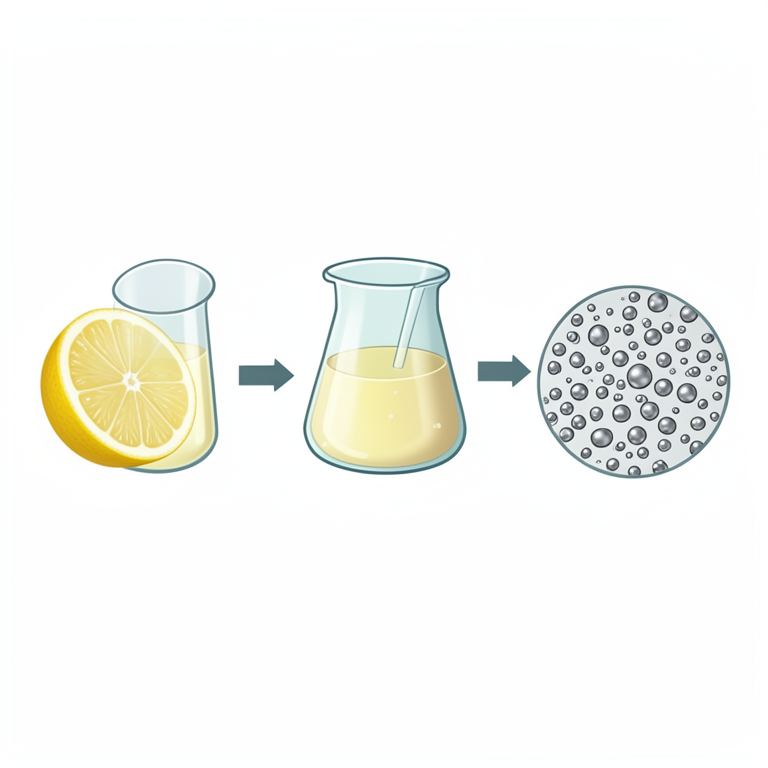
Green Synthesis Process
AI-generated conceptual illustration (Citrus limon peel extract and palladium nanoparticles). It explains the idea and does not show study data.
View source evidence ↗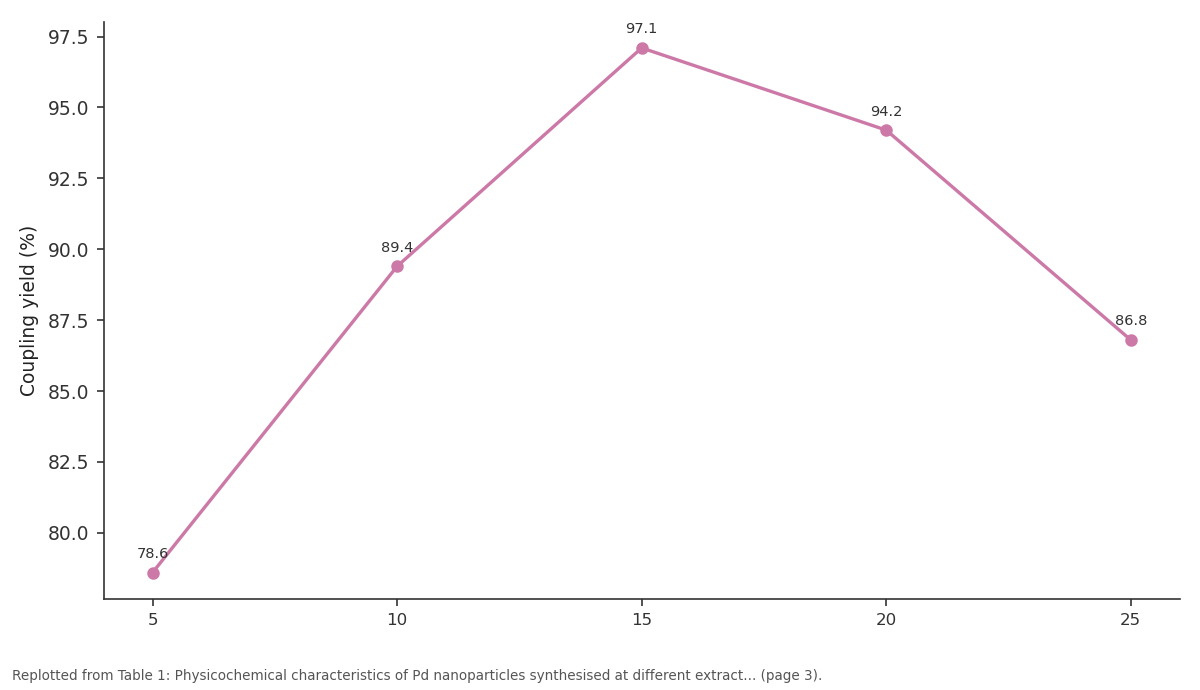
Coupling yield (%): 5 vs 10 vs 15 vs 20 vs 25
Replotted from Table 1 (page 3) of the original paper. Every bar is the paper's own table value.
View source evidence ↗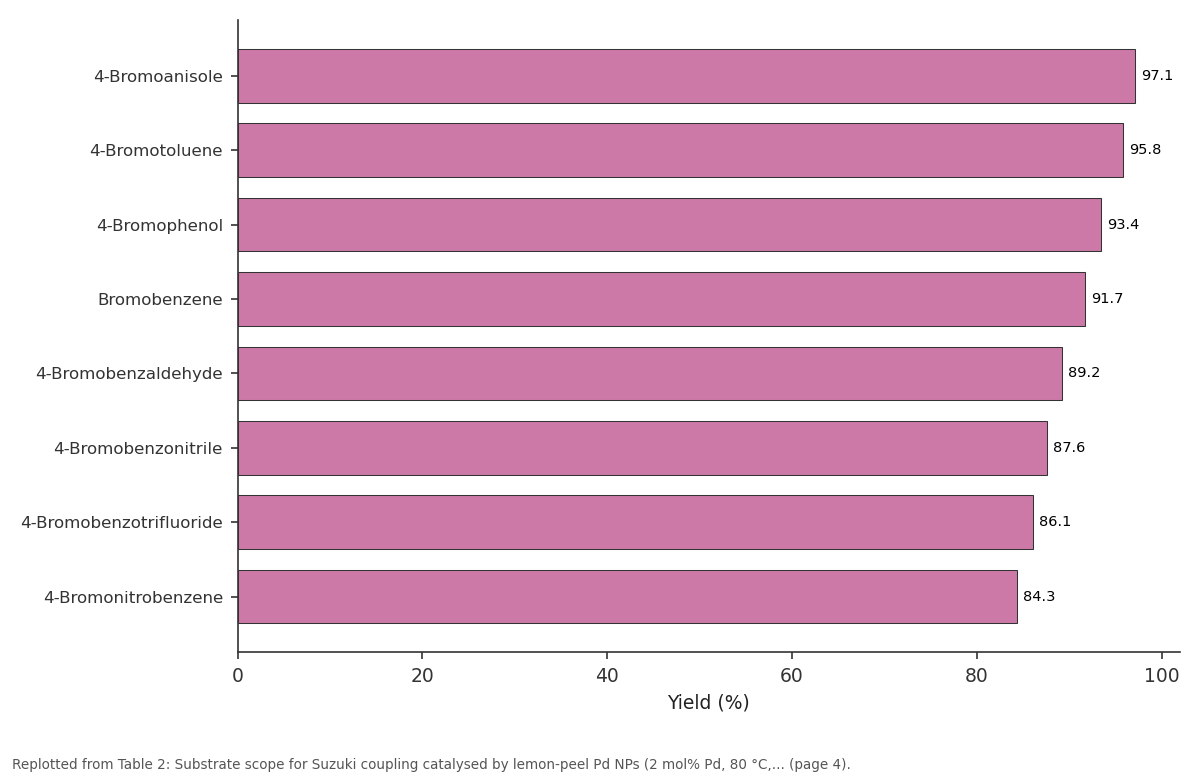
Yield (%): 4-Bromoanisole vs 4-Bromotoluene vs 4-Bromophenol vs Bromobenzene vs 4-Bromobenzaldehyde
Replotted from Table 2 (page 4) of the original paper. Every bar is the paper's own table value.
View source evidence ↗Figures & tables
From the original paper Table 1
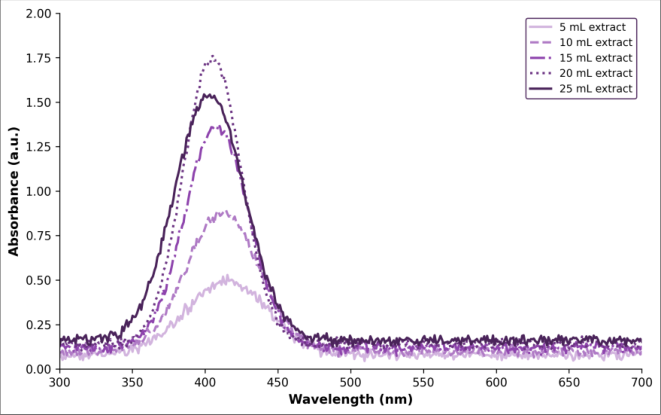 Figure 1
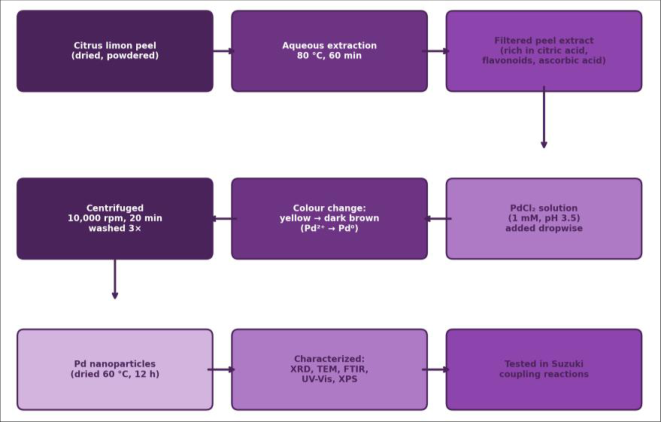 Figure 2
 Table 2
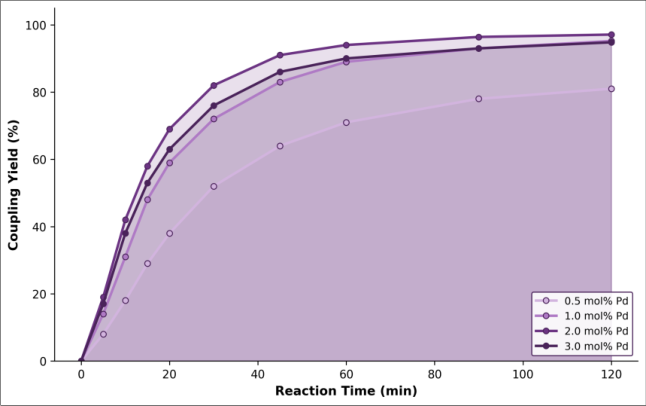 Figure 3
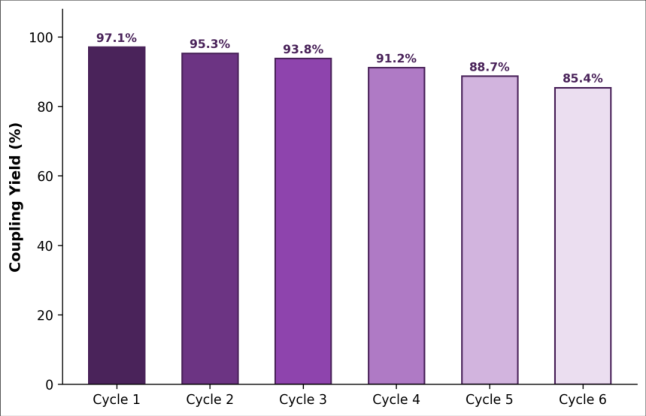 Figure 4
Introduction
When Akira Suzuki and Norio Miyaura published their palladium-catalysed cross-coupling of aryl halides with organoboron compounds in 1979, they set in motion a reaction that would become one of the most performed transformations in pharmaceutical and finechemical manufacturing [1] . Palladium's ability to shuttle between Pd⁰ and Pd²⁺ oxidation states while tolerating a wide range of functional groups made it indispensable [2] . But that indispensability came at a price: traditional Pd catalysts depend on ligands such as triphenylphosphine, solvents like dimethylformamide, and chemical reductants like sodium borohydride all of which generate waste streams that are costly to treat [3] . Green chemistry principles call for renewable feedstocks, benign solvents, and minimal waste [4] . Nanoparticle catalysts satisfy two of those goals: their high surface-area-to-volume ratio reduces the amount of metal needed, and their colloidal stability in water-based media can eliminate organic solvents from the reaction step [5] . The remaining challenge is the Nanoparticle synthesis itself. Chemical reduction with NaBH₄ or hydrazine is fast and reproducible but toxic; physical methods such as laser ablation or magnetron sputtering are clean but expensive and difficult to scale [6] . Biosynthesis using plant extracts, microorganisms, or agricultural waste offers a middle path. The extract supplies polyphenols, organic acids, and sugars that reduce metal ions at ambient temperature while simultaneously capping the nascent particles to prevent aggregation [7] . Over the past decade, palladium nanoparticles have been prepared from extracts of tea leaves, grape pomace, banana peel, and dozens of other botanical sources [8] . Among these, citrus peels are especially attractive because they are generated in millions of tonnes annually by the juice industry and contain high concentrations of citric acid, hesperidin, and ascorbic acid all proven reductants for noble metals [9] . Lemon (Citrus limon) peel has been used to synthesise gold and silver nanoparticles [10,11] , but reports on palladium are limited to two brief communications that characterised the particles without testing catalytic activity [12] . No publication, to our knowledge, has applied lemon-peelderived Pd NPs in Suzuki coupling, let alone examined substrate scope and recyclability. This gap is significant because Suzuki coupling is the proving ground for any new Pd catalyst if the particles cannot form C-C bonds efficiently, their green credentials are academic. Several groups have tested biogenic Pd NPs in crosscoupling. Nasrollahzadeh and colleagues used Hippophae rhamnoides (sea buckthorn) fruit extract to make 10-15 nm Pd particles that catalysed Suzuki coupling of iodobenzene with 91% yield in 30 min at 100 °C [13] . Veisi and coworkers reported 5 nm Pd NPs from Rosa canina fruit extract that achieved 98% yield for bromobenzene coupling in DMF at 100 °C [14] . And Baran and colleagues obtained 12 nm particles from Prunus mahaleb seed extract that gave 96% yield under reflux in ethanol-water [15] . These results are encouraging, but they differ in particle size, solvent, temperature, substrate, and base, making direct comparison difficult. The present research was designed with comparison in mind. Lemon peel extract was chosen as the reducing agent, and five extract volumes (5-25 mL per 50 mL of 1 mM PdCl₂) were tested to identify the concentration that gives the smallest, most uniform particles. The resulting Pd NPs were characterised by XRD, TEM, FTIR, UV-Vis, and XPS. Catalytic performance was benchmarked in a standard Suzuki coupling 4-bromoanisole plus phenylboronic acid in ethanol-water (1:1) with K₂CO₃ at four Pd loadings and eight aryl bromide substrates. Recyclability was assessed over six cycles, with TEM and ICP-OES tracking structural and compositional changes. The objectives were threefold: (a) to establish the extract-tometal ratio that optimises particle size and catalytic activity; (b) to map substrate scope under mild, aqueous-compatible conditions; and (c) to quantify the durability limits of the biogenic catalyst. Together, these data should clarify whether lemon peel a waste product can supply Pd NPs that rival conventional catalysts in a synthetically demanding reaction.
Materials and Methods
Materials and Methods
Materials
Fresh lemons (Citrus limon, Eureka cultivar) were purchased from a local market in Osaka. Palladium (II) chloride (PdCl₂, ≥99.9%) was obtained from Fujifilm Wako Pure Chemical Corporation, Osaka. Phenylboronic acid (≥97%), 4-bromoanisole (99%), potassium carbonate (≥99%), and all substituted aryl bromides for substratescope experiments were purchased from Tokyo Chemical Industry (TCI). Ethanol (99.5%, reagent grade) came from Nacalai Tesque, Kyoto. Deionized water (18.2 MΩ•cm) was supplied by a Millipore Milli-Q Integral system. All reagents were used without further purification.
Extraction protocol and preparation method
Lemon peels were separated from the pulp, cut into small pieces (~1 cm²), washed with deionized water, and dried in a hot-air oven at 60 °C for 48 h. The dried peels were ground to a fine powder in a mechanical blender and sieved through a 60-mesh screen. For extraction, 10 g of powder was suspended in 200 mL deionized water and heated at 80 °C for 60 min under magnetic stirring. The mixture was cooled to room temperature, vacuum-filtered through Whatman No. 1 filter paper, and the clear yellow filtrate was stored at 4 °C and used within 48 h. Pd NPs were synthesised by adding lemon peel extract (5, 10, 15, 20, or 25 mL) to 50 mL of 1 mM PdCl₂ solution (previously dissolved in 0.1 M HCl and diluted with deionized water, final pH adjusted to 3.5 with 0.1 M NaOH). The mixture was stirred at 200 rpm at room temperature (25±1 °C). A colour change from pale yellow to dark brown occurred within 15-40 min depending on extract volume. Stirring continued for a total of 2 h. The dark colloidal suspension was centrifuged at 10,000 rpm for 20 min. The pellet was washed three times with deionized water and once with ethanol, then dried at 60 °C for 12 h to obtain a dark brown powder.
Methods
All synthesis and catalysis work was carried out at the Green Chemistry Laboratory, Osaka Academy of Molecular Sciences, Osaka, Japan, between April 2024 and November 2024. Crystal structure was confirmed by powder X-ray diffraction (Bruker D8 Advance, Cu Kα, 2θ = 30-90°, step 0.02°). Particle size and morphology were examined by transmission electron microscopy (JEOL JEM-2100Plus, 200 kV); at least 200 particles were measured per sample. Functional groups were identified by Fourier-transform infrared spectroscopy (Jasco FT/IR-6600, ATR mode, 400-4000 cm⁻¹). UV-Vis absorption spectra were recorded on a Jasco V-770 spectrophotometer (200-800 nm). X-ray photoelectron spectroscopy (Shimadzu ESCA-3400, Mg Kα) provided surface oxidation-state information. Palladium content was quantified by inductively coupled plasma optical emission spectrometry (Agilent 5800 ICP-OES). Suzuki coupling reactions were conducted in 25 mL roundbottom flasks. In a typical run, 4-bromoanisole (1.0 mmol), phenylboronic acid (1.2 mmol), K₂CO₃ (2.0 mmol), Pd NPs (0.5-3.0 mol% Pd relative to aryl halide), and 5 mL ethanolwater (1:1 v/v) were combined and heated to 80 °C under air with magnetic stirring. Aliquots were withdrawn at intervals, extracted with ethyl acetate, and analysed by gas chromatography (Shimadzu GC-2030, FID detector, DB-5 column) using naphthalene as internal standard. For substrate scope, eight aryl bromides bearing electrondonating (-OCH₃, -CH₃, -OH) and electron-withdrawing (-NO₂, -CN, -CF₃, -CHO) groups plus unsubstituted bromobenzene were tested at 2 mol% Pd loading for 120 min. Recyclability was assessed by recovering the catalyst via centrifugation after each run, washing with ethanol and water, drying at 60 °C, and recharging with fresh substrates. TEM images and ICP-OES Pd content were recorded after cycles 1, 3, and 6.
Instrumentation and analytical equipment
The XRD diffractometer was calibrated with a silicon powder standard (NIST SRM 640e). TEM magnification was verified with a cross-grating replica. ICP-OES was calibrated with Pd single-element standards (1-50 mg L⁻¹) traceable to NIST, detection limit 0.005 mg L⁻¹. GC retention times were confirmed with authentic biphenyl and aryl bromide standards. All yields are averages of duplicate runs; relative standard deviations were below 2.5%.
Results
Mixing the lemon peel extract with PdCl₂ solution produced a visible colour shift from pale yellow to dark brown, the speed of which depended on extract volume. At 5 mL, the transition took roughly 40 min; at 15 mL, it was complete in about 25 min; and at 25 mL, it occurred in under 20 min but the final colloid appeared slightly turbid, hinting at aggregation. UV-Vis spectra (Figure 1) captured these differences as changes in SPR band position and intensity. Crystallite sizes calculated by the Scherrer equation decreased from 12.8 nm (5 mL extract) to 7.1 nm (15 mL) before rising again to 10.4 nm at 25 mL. TEM measurements tracked this trend closely, as summarised in Table 1.
| Extract (mL) | SPR peak (nm) | Crystallite (nm) | TEM mean±SD (nm) | Pd⁰ by XPS (%) | Coupling yield (%) |
|---|---|---|---|---|---|
| 5 | 415 | 12.8 | 14.3±3.8 | 84.2 | 78.6 |
| 10 | 412 | 9.4 | 10.8±2.9 | 87.1 | 89.4 |
| 15 | 408 | 7.1 | 8.7±2.3 | 89.3 | 97.1 |
| 20 | 405 | 7.8 | 9.5±2.7 | 88.0 | 94.2 |
| 25 | 403 | 10.4 | 13.1±4.2 | 85.6 | 86.8 |
Table text extracted from the original PDF; superscript letters are shown inline. The original table image is below.
View original table image
Comprehensive interpretation
The data converge on 15 mL extract per 50 mL PdCl₂ as the sweet spot. Below that volume, insufficient biomolecules leave the reduction incomplete and capping sparse, yielding larger, polydisperse particles with lower catalytic activity. Above it, excess organic matter crowds the nanoparticle surface, partially blocking active Pd sites and promoting inter-particle bridging that drives agglomeration. The nonmonotonic relationship between extract volume and particle size mirrors what Nasrollahzadeh observed for sea buckthorn Pd NPs, where a fivefold excess of extract actually tripled the average diameter [13] . Substrate scope revealed a clear electronic trend: electron-donating groups on the aryl bromide gave higher yields (93.4-97.1%) than electron-withdrawing ones (84.3-89.2%). This pattern is expected for oxidative addition the rate-limiting step in Suzuki coupling because electron-rich aryl halides form the Pd-aryl intermediate more readily [2] . The fact that even the most challenging substrate (4-bromonitrobenzene) reached 84.3% under mild conditions in aqueous ethanol speaks well for the catalyst's activity. Recyclability declined by about 2% per cycle, totalling an 11.7% drop over six runs. ICP-OES revealed cumulative Pd leaching of roughly 3.8% per cycle, and TEM after cycle 6 showed a mean diameter increase from 8.7 to 14.9 nm, consistent with Ostwald ripening. Both factors leaching and sintering contribute to the activity loss, and future work on support immobilisation (e.g., Pd NPs on carbon or silica) could mitigate them.
Discussion
This research demonstrated that Citrus limon peel extract can reduce Pd²⁺ to Pd⁰ nanoparticles at room temperature and that the resulting particles catalyse Suzuki coupling of aryl bromides in aqueous ethanol with yields up to 97.1%. The optimal extract volume was 15 mL per 50 mL of 1 mM PdCl₂, producing 8.7 nm particles with the narrowest size distribution and highest catalytic turnover. These findings align well with the broader biogenic Pd literature. Veisi and colleagues reported 5 nm Pd NPs from Rosa canina that achieved 98% yield for bromobenzene coupling, which is close to the 91.7% obtained here for the same substrate [14] . The small gap in yield is likely due to their use of DMF at 100 °C harsher conditions that push the equilibrium further but sacrifice the green credentials that motivate biosynthesis in the first place. Baran's Prunus mahaleb-derived particles (12 nm, 96% yield in ethanolwater) are a closer comparison in both conditions and performance, and our results sit within the same range at a slightly smaller particle size [15] . One area of disagreement concerns the role of citric acid versus flavonoids as the primary reductant. Prathna and colleagues argued that citric acid drives reduction of Ag⁺ in Citrus extracts because its concentration is an order of magnitude higher than that of any flavonoid [16] . However, Sathishkumar and co-workers showed by sequential extraction that flavonoid-rich fractions of Citrus sinensis peel were more effective at reducing Au³⁺ than citric-acidenriched fractions, suggesting that hydroxyl groups on flavonoid rings provide the actual electrons [17] . Our FTIR data support a mixed picture: both the C=O stretch of citrate (~1720 cm⁻¹) and the C-OH stretch of flavonoids (~1070 cm⁻¹) appeared on the Pd NP surface, implying that both molecule classes participate in capping and likely in reduction as well.
The gradual decline in catalytic activity over six cycles roughly 2% per run is moderate by biogenic Pd standards. Nasrollahzadeh reported a 15% drop over four cycles for sea buckthorn Pd NPs, and Veisi saw 8% over five cycles with Rosa canina particles [13,14] . The practical message is that lemon peel a zero-cost agricultural waste can serve as both reductant and stabiliser for Pd NP synthesis, producing a catalyst that works under conditions friendly to green chemistry: aqueous solvent, moderate temperature, atmospheric air, and an inorganic base. For laboratories or small manufacturers seeking to reduce their environmental footprint without sacrificing coupling efficiency, this route is immediately adoptable. Future research should focus on three fronts. Supporting the Pd NPs on inert carriers (mesoporous silica, magnetic nanoparticles, graphene oxide) could extend recyclability by reducing both leaching and sintering. Testing the catalyst in other Pd-mediated reactions Heck, Sonogashira, and Buchwald-Hartwig couplings would broaden its utility profile. And scaling the synthesis from the current 50 mL bench level to multi-litre batches would reveal whether the extract-to-metal optimum holds or shifts with reactor geometry. If the 15 mL:50 mL ratio proves robust at larger scale, lemon-peel Pd NPs could move from a laboratory curiosity to a genuinely sustainable catalyst platform.
Figures and tables from the paper
| Aryl bromide | Substituent type | Yield (%) | Classification |
|---|---|---|---|
| 4-Bromoanisole | Electron-donating (-OCH₃) | 97.1 | Excellent |
| 4-Bromotoluene | Electron-donating (-CH₃) | 95.8 | Excellent |
| 4-Bromophenol | Electron-donating (-OH) | 93.4 | Excellent |
| Bromobenzene | None (-H) | 91.7 | Excellent |
| 4-Bromobenzaldehyde | Electron-withdrawing (-CHO) | 89.2 | Very good |
| 4-Bromobenzonitrile | Electron-withdrawing (-CN) | 87.6 | Very good |
| 4-Bromobenzotrifluoride | Electron-withdrawing (-CF₃) | 86.1 | Very good |
| 4-Bromonitrobenzene | Electron-withdrawing (-NO₂) | 84.3 | Good |
Table text extracted from the original PDF; superscript letters are shown inline. The original table image is below.
View original table image
References
21 in the original paper- Miyaura N, Suzuki A. Palladium-catalyzed crosscoupling reactions of organoboron compounds. Chemical Reviews. 1995;95(7):2457-2483.
- Molnár Á. Palladium-catalyzed coupling reactions: Practical aspects and future developments. In: Molnár Á, editor. Palladium-catalyzed coupling reactions. Weinheim: Wiley-VCH; 2013. p. 1-71.
- Farina V. High-turnover palladium catalysts in crosscoupling and Heck chemistry: A critical overview. Advanced Synthesis and Catalysis. 2004;346(1315):1553-1582.
- Anastas PT, Warner JC. Green chemistry: Theory and practice. Oxford: Oxford University Press; 1998.
- Astruc D, Lu F, Aranzaes JR. Nanoparticles as recyclable catalysts: The frontier between homogeneous and heterogeneous catalysis. Angewandte Chemie International Edition. 2005;44(48):7852-7872.
- Duan H, Wang D, Li Y. Green chemistry for nanoparticle synthesis. Chemical Society Reviews. 2015;44(16):5778-5792.
- Iravani S. Green synthesis of metal nanoparticles using plants. Green Chemistry. 2011;13(10):2638-2650.
- Mohana S, Sumathi S. Multi-functional biological effects of palladium nanoparticles synthesized using Agaricus bisporus. Journal of Cluster Science. 2020;31(2):391-400.
- Rafiq S, Kaul R, Sofi SA, Bashir N, Nazir F, Ahmad Nayik G. Citrus peel as a source of functional ingredient: A review. Journal of the Saudi Society of Agricultural Sciences. 2018;17(4):351-358.
- Sujitha MV, Kannan S. Green synthesis of gold nanoparticles using Citrus fruits (Citrus limon, Citrus reticulata and Citrus sinensis) aqueous extract and its characterization. Spectrochimica Acta Part A. 2013;102:15-23.
- Kaviya S, Santhanalakshmi J, Viswanathan B, Muthumary J, Srinivasan K. Biosynthesis of silver nanoparticles using Citrus sinensis peel extract and its antibacterial activity. Spectrochimica Acta Part A. 2011;79(3):594-598.
- Kanchana A, Devarajan S, Ayyappan SR. Green synthesis and characterization of palladium nanoparticles and its conjugates from Solanum trilobatum leaf extract. Nano-Micro Letters. 2010;2(3):169-176.
- Nasrollahzadeh M, Sajadi SM, Maham M. Green synthesis of palladium nanoparticles using Hippophae rhamnoides Linn leaf extract and their catalytic activity for the Suzuki-Miyaura coupling in water. Journal of Molecular Catalysis A: Chemical. 2015;396:297-303.
- Veisi H, Ghorbani-Vaghei R, Hemmati S, Mahmoudi Alavi J, Hemmati H. Biosynthesis of Pd nanoparticles using Rosa canina fruit extract and their use as catalyst for degradation of organic dyes and Suzuki-Miyaura coupling. Catalysis Letters. 2015;145(8):1600-1607.
- Baran T, Nasrollahzadeh M, Shokouhimehr M. Pd(0)/cherry extract prepared using Prunus mahaleb seed extract as green catalyst for Suzuki cross-coupling reactions. Inorganic Chemistry Communications. 2023;154:110896-110903.
- Prathna TC, Chandrasekaran N, Raichur AM, Mukherjee A. Biomimetic synthesis of silver nanoparticles by Citrus limon (lemon) aqueous extract and theoretical prediction of particle size. Colloids and Surfaces B: Biointerfaces. 2011;82(1):152-159.
- Sathishkumar M, Sneha K, Yun YS. Immobilization of silver nanoparticles synthesized using Curcuma longa tuber powder and extract on cotton cloth for bactericidal activity. Bioresource Technology. 2010;101(20):7958-7965.
- Balanta A, Godard C, Claver C. Pd nanoparticles for CC coupling reactions. Chemical Society Reviews. 2011;40(10):4973-4985.
- Narayanan R, El-Sayed MA. Catalysis with transition metal nanoparticles in colloidal solution: Nanoparticle shape dependence and stability. Journal of Physical Chemistry B. 2005;109(26):12663-12676.
- Li Y, Boone E, El-Sayed MA. Size effects of PVP-Pd nanoparticles on the catalytic Suzuki reactions in aqueous solution. Langmuir. 2002;18(12):4921-4925.
- Fuku K, Hayashi R, Takakura S, Kamegawa T, Mori K, Yamashita H. The synthesis of size-and colorcontrolled silver nanoparticles by using microwave heating and their enhanced catalytic activity by localized surface plasmon resonance. Angewandte Chemie International Edition. 2013;52(29):7446-7450.