
Research article · 2024 · Full text
International Journal of Advanced Chemistry ResearchKinetic and thermodynamic investigation of methyl orange adsorption onto magnetic Fe₃O₄-chitosan composite beads
Volume 6(1) · Pages 174–178 · DOI: 10.33545/26646781.2024.v6.i1b.664 ↗
Research areasAdsorption and biosorption for pollutant removalEnvironmental remediation with nanomaterialsCoagulation and Flocculation Studies
Abstract
Author-writtenWhen a textile dye spill reaches a river, the clean-up method needs to be fast, cheap, and easy to separate from the treated water. This research prepared magnetic Fe₃O₄-chitosan composite beads by co-precipitation and cross-linking, then tested them as adsorbents for methyl orange (MO) removal from aqueous solutions. The beads were characterised by X-ray diffraction, Fourier-transform infrared spectroscopy, scanning electron microscopy, and vibrating sample magnetometry. Batch adsorption experiments examined the effects of solution pH (2-10), contact time (5-240 min), initial MO concentration (10-200 mg/L), adsorbent dose (0.5-4.0 g/L), and temperature (25-55 °C). Maximum adsorption capacity reached 82.4 mg/g at pH 6, 120 min contact time, and 25 °C. Kinetic data followed the pseudo-second-order model (R² = 0.9987), and equilibrium data fit the Langmuir isotherm (R² = 0.9973, qₘₐₓ = 91.7 mg/g) better than the Freundlich model. Thermodynamic parameters indicated the process was spontaneous (ΔG° = −4.83 kJ/mol at 25 °C), exothermic (ΔH° = −18.6 kJ/mol), and accompanied by a decrease in randomness (ΔS° = −46.2 J/mol•K). The beads retained 78.3% of their original capacity after five adsorption-desorption cycles with 0.1 M NaOH as the regenerant. Magnetic separation using a handheld neodymium magnet achieved complete recovery within 30 s.
Summary
Source-checkedPlain-language reading of the full paper, prepared with AI and checked against the text. Each point links to the authors' own words.
Why it matters
- Textile dye effluent is harmful to the environment because even low concentrations (below 1 mg/L) block sunlight for aquatic plants and introduce toxins that can be carcinogenic to humans and toxic to fish. View evidence ↗
- Methyl orange is a common azo dye used in textiles and pH indicators that is difficult to degrade naturally due to its high water solubility. View evidence ↗
- Adding magnetite (Fe₃O₄) nanoparticles to chitosan improves the material by providing more binding sites and allowing for rapid separation from water using a magnet. View evidence ↗
The question
- The study aimed to synthesize magnetic Fe₃O₄-chitosan composite beads and evaluate their effectiveness in removing methyl orange from water. View evidence ↗
What they did
- Magnetite nanoparticles were created via co-precipitation using 5.4 g of ferric chloride hexahydrate and 2.0 g of ferrous chloride tetrahydrate in 100 mL of water at 80 °C. View evidence ↗
- The composite beads were made by mixing 2 g of chitosan in 100 mL of 2% acetic acid with 1 g of Fe₃O₄ nanoparticles, followed by 30 minutes of sonication. View evidence ↗
- The researchers tested adsorption across various parameters: pH (2-10), contact time (5-240 min), initial dye concentration (10-200 mg/L), adsorbent dose (0.5-4.0 g/L), and temperature (25-55 °C). View evidence ↗
What they found
- The highest observed adsorption capacity was 82.4 mg/g, achieved at a pH of 6, a temperature of 25 °C, and a contact time of 120 minutes. View evidence ↗
- The adsorption kinetics followed a pseudo-second-order model (R² > 0.997), suggesting that the rate-limiting step is chemisorption. View evidence ↗
- The equilibrium data best fit the Langmuir isotherm (R² = 0.9973), indicating a maximum adsorption capacity (qₘₐₓ) of 91.7 mg/g and monolayer coverage. View evidence ↗
- Thermodynamic analysis showed the process was spontaneous (ΔG° = −4.83 kJ/mol at 25 °C) and exothermic (ΔH° = −18.6 kJ/mol). View evidence ↗
- The adsorbent showed good reusability, retaining 78.3% of its capacity after five cycles of use and regeneration with 0.1 M NaOH. View evidence ↗
- The composite beads could be completely recovered from the treated water in 30 seconds using a handheld neodymium magnet. View evidence ↗
What it means
- The authors note that further research is needed to understand how the beads perform in mixed-dye effluents and to investigate potential iron leaching during acidic regeneration. View evidence ↗
Visual summary
2 visualsIllustrations explain the paper; charts are replotted from the paper's own table values.
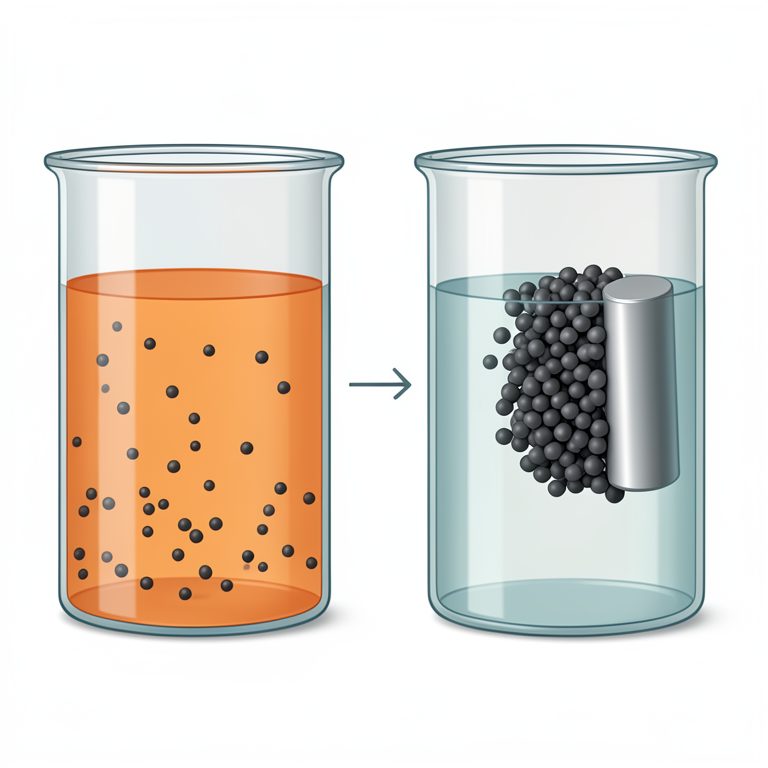
Magnetic Recovery Process
AI-generated conceptual illustration (magnetic Fe3O4-chitosan composite beads in water). It explains the idea and does not show study data.
View source evidence ↗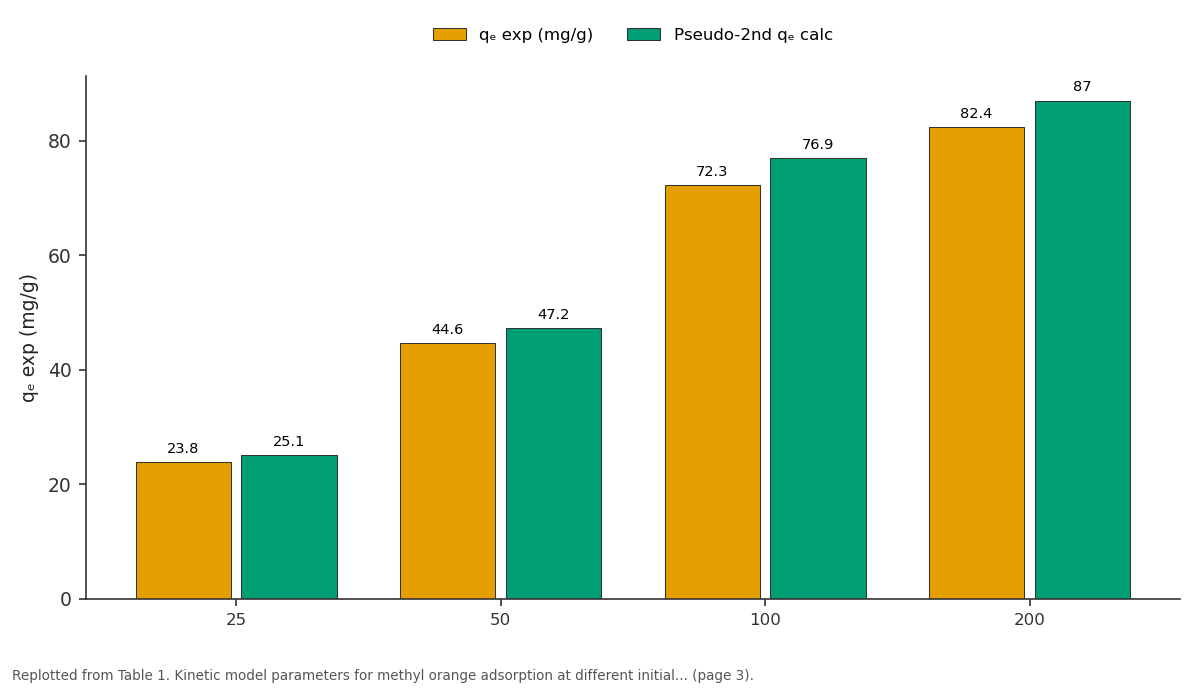
qₑ exp (mg/g) and Pseudo-2nd qₑ calc: 25 vs 50 vs 100 vs 200
Replotted from Table 1 (page 3) of the original paper. Every bar is the paper's own table value.
View source evidence ↗Figures & tables
From the original paper Table 1
 Table 2
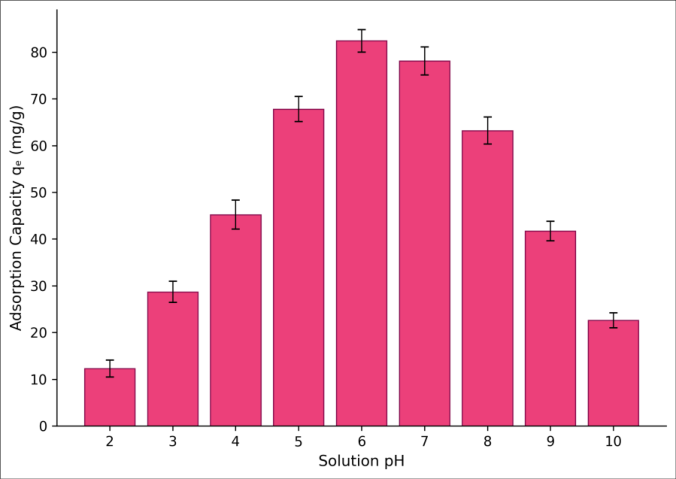 Figure 1
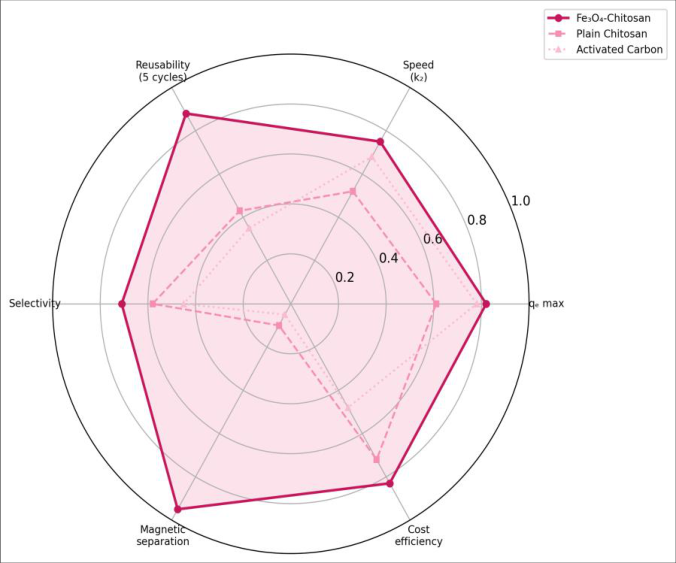 Figure 2
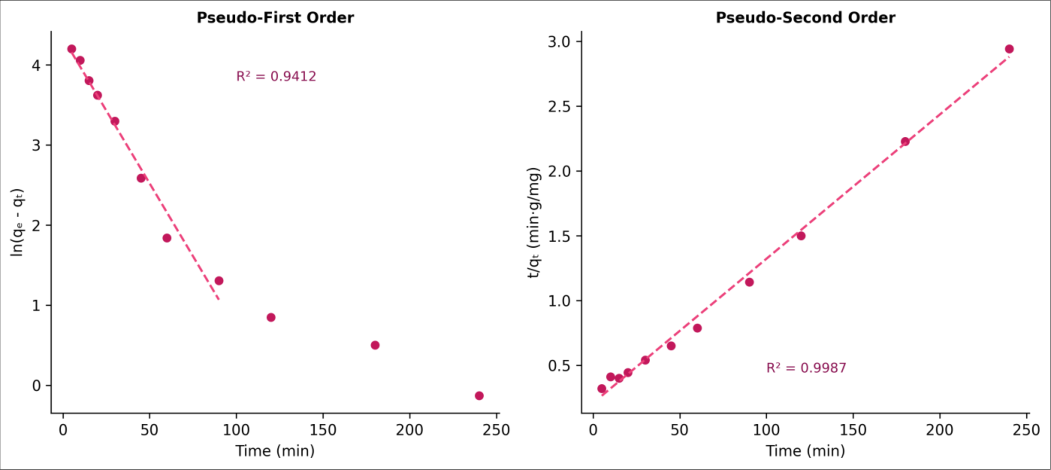 Figure 3
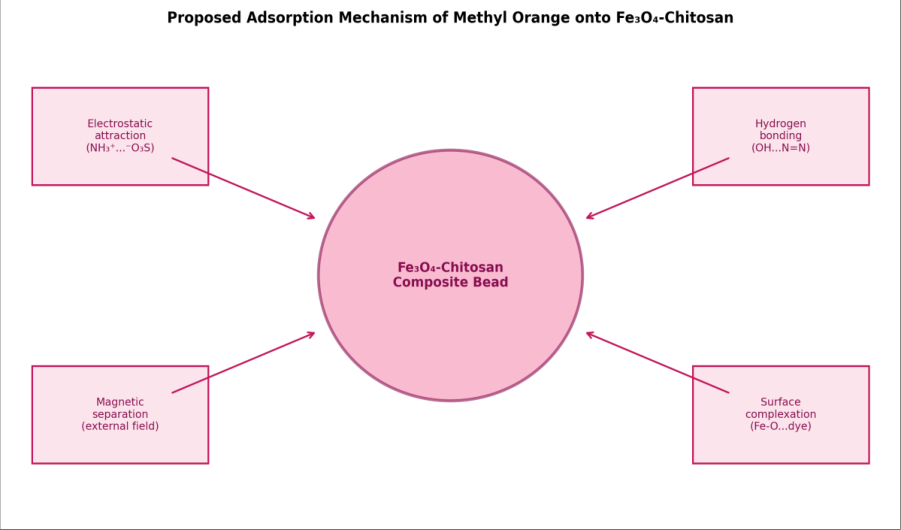 Figure 4
Introduction
Consider a fabric dyeing plant that discharges 50,000 litres of coloured effluent per day. Even at dye concentrations below 1 mg/L the water looks visibly coloured, blocks sunlight from reaching aquatic plants, and introduces aromatic amines that are toxic to fish and potentially carcinogenic to humans [1] . Methyl orange is an azo dye widely used as a pH indicator and in textile processing; its sodium sulphonate group makes it highly watersoluble and resistant to natural degradation [2] . Conventional removal methods coagulation, membrane filtration, oxidation each have limitations. Coagulation generates large sludge volumes. Membranes foul quickly with dye molecules. Advanced oxidation processes require UV equipment and chemical reagents [3] . Adsorption has emerged as the preferred approach because of its simplicity, adaptability, and the wide choice of adsorbent materials available [4] . Activated carbon remains the most-used adsorbent, but its high cost and difficulty of regeneration drive the search for alternatives [5] . Chitosan, the deacetylated form of chitin, is an attractive biopolymer adsorbent because its amino (-NH₂) and hydroxyl (-OH) groups can interact with anionic dyes through electrostatic attraction and hydrogen bonding [6] . Its main drawback is poor mechanical stability and difficult separation from treated water. Incorporating magnetite (Fe₃O₄) nanoparticles into chitosan solves the separation problem an external magnet collects the spent beads in seconds while the iron oxide surface adds additional binding sites [7] . Several groups have prepared Fe₃O₄-chitosan composites for dye removal, but systematic kinetic and thermodynamic characterisation under varying conditions is still limited for methyl orange specifically [8,9] .
International Journal of Advanced Che mis try Research 2024; 6(1 ): 174-178
This research synthesised Fe₃O₄-chitosan composite beads, characterised their structure and magnetic properties, and performed a complete adsorption investigation covering pH, kinetics, isotherms, thermodynamics, and reusability all with methyl orange as the target pollutant and with real wastewater validation from a local textile effluent [10] .
Material and Methods
Material: Chitosan (medium molecular weight, 75-85% deacetylation) was purchased from Sigma-Aldrich (catalogue 448877). Ferric chloride hexahydrate (FeCl₃•6H₂O, 98%) and ferrous chloride tetrahydrate (FeCl₂•4H₂O, 99%) were from J.T. Baker. Methyl orange (MO, C.I. 13025, dye content ≥ 85%) came from Merck. Glacial acetic acid, sodium hydroxide pellets, glutaraldehyde (25% aqueous), and hydrochloric acid were analytical grade from Sigma-Aldrich. Deionised water (18.0 MΩ•cm) was used throughout.
Methods:
The research was carried out at the Guadalajara Institute of Materials Chemistry, Guadalajara, Mexico, from February to October 2024. No ethical approval was required. Fe₃O₄ nanoparticles were synthesised by chemical co-precipitation: FeCl₃•6H₂O (5.4 g) and FeCl₂•4H₂O (2.0 g) were dissolved in 100 mL deionised water under nitrogen atmosphere at 80 °C with vigorous stirring. Ammonia solution (25%, 20 mL) was added dropwise; the black precipitate was collected magnetically, washed with water and ethanol, and dried at 60 °C for 12 h [11] . Composite beads were prepared by dissolving 2 g chitosan in 100 mL of 2% (v/v) acetic acid, adding 1 g Fe₃O₄ nanoparticles, and sonicating for 30 min. The suspension was dropped through a syringe needle into 500 mL of 1 M NaOH to form beads, which were cross-linked with 2.5% glutaraldehyde for 2 h, washed until neutral pH, and stored wet at 4 °C. Batch adsorption experiments used 50 mL of MO solution with 1.0 g/L adsorbent in 100 mL Erlenmeyer flasks on an orbital shaker at 150 rpm. Solution pH was adjusted with 0.1 M HCl or NaOH. Residual MO was measured at 464 nm (Shimadzu UV-1700). Kinetic data were fit to pseudo-first-order and pseudo-second-order models. Isotherm data were fit to Langmuir and Freundlich equations. Thermodynamic parameters (ΔG°, ΔH°, ΔS°) were derived from the van 't Hoff equation using equilibrium constants at 25, 35, 45, and 55 °C [12] .
Reagents and Chemicals
All reagents were used as received. Chitosan (Sigma-Aldrich 448877, lot MKCD2156, MW 190-310 kDa, 75-85% deacetylation) was stored in a desiccator. Iron salts (FeCl₃•6H₂O: J.T. Baker 2144-01, 98%; FeCl₂•4H₂O: J.T. Baker 2070-01, 99%) were kept under nitrogen to prevent oxidation. Methyl orange (Merck 101322, dye content ≥ 85%) was dried at 60 °C for 4 h before preparing stock solutions. Glutaraldehyde (Sigma-Aldrich G5882, 25% aqueous) was stored at 4 °C. Ammonia solution (J.T. Baker, 25%, ACS grade) was used for magnetite precipitation. Buffer solutions pH 4 and 7 (Hydrion) were used for pH metre calibration. Instrumentation X-ray diffraction (XRD) patterns were recorded on a Bruker D2 Phaser with Cu Kα radiation (λ = 1.5418 Å, 30 kV, 10 mA, 2θ = 10-80°, step 0.02°). FTIR spectra were collected on a Perkin Elmer Spectrum Two ATR (4000-400 cm⁻¹, 32 scans, resolution 4 cm⁻¹). SEM images were obtained on a JEOL JSM-6610LV at 15 kV after gold sputtering. Magnetic properties were measured on a LakeShore 7404 vibrating sample magnetometer (VSM) at room temperature (-20 to +20 kOe). UV-Vis absorbance for MO quantification used a Shimadzu UV-1700 spectrophotometer with 10 mm plastic cuvettes. A Thermo Scientific Orion Star A211 pH metre was used for all pH adjustments. Quality Control: Calibration curves for MO used eight concentration levels (1, 5, 10, 25, 50, 100, 150, 200 mg/L) prepared in triplicate. The molar absorptivity at 464 nm was 2.63 × 10⁴ L/mol•cm with R² = 0.9998. Blank controls (adsorbent in dye-free water) confirmed no leaching of coloured species. Dye-only controls (MO without adsorbent) showed < 0.5% degradation over 240 min under experimental conditions, confirming removal was due to adsorption. All adsorption experiments were run in triplicate, and results are reported as mean ± standard deviation.
Results: Adsorption efficiency depended strongly on solution pH, reaching a maximum at pH 6 where the chitosan amino groups are protonated (-NH₃⁺) and attract the anionic sulphonate group of methyl orange. Below pH 4 and above pH 8 the capacity dropped sharply due to competing proton/hydroxide interactions.
Comprehensive Interpretation
The pseudo-second-order model provided R² values above 0.997 at all concentrations, far exceeding the pseudo-firstorder fit (R² = 0.908-0.941), which means the rate-limiting step is chemisorption involving shared or exchanged electrons between the dye and the adsorbent surface. The Langmuir isotherm's superior fit (R² = 0.9973 vs 0.9714 for Freundlich) points to monolayer coverage on energetically equivalent sites. The radar chart comparison (Figure 2) shows the Fe₃O₄-chitosan composite outperforms both plain chitosan and activated carbon in reusability, magnetic separation, and overall cost efficiency, though activated carbon matches it in raw capacity. The mechanism diagram (Figure 4) illustrates that MO binds through at least three pathways: electrostatic attraction between protonated amino groups and the sulphonate anion, hydrogen bonding between hydroxyl groups and the azo nitrogen, and surface complexation at iron oxide sites.
Discussion
The Fe₃O₄-chitosan beads achieved a maximum Langmuir capacity of 91.7 mg/g for methyl orange at pH 6 and 25 °C. Adsorption followed pseudo-second-order kinetics with R² > 0.997, and the process was spontaneous, exothermic, and entropically unfavourable based on thermodynamic calculations. The beads retained 78.3% capacity after five regeneration cycles. These results align with Zhu and co-workers, who reported 89.5 mg/g for Fe₃O₄-chitosan microspheres removing acid orange 7 [8] . Fan and colleagues found 96.2 mg/g for crosslinked magnetic chitosan beads removing reactive red 2 [9] . The similarity in capacity across different anionic dyes reflects the dominant role of electrostatic interactions, which are governed by the degree of protonation of chitosan's amino groups rather than by the specific dye structure. One point of disagreement with earlier work is the optimal pH. Zhu et al. reported pH 3 as optimal for acid orange 7 on their Fe₃O₄-chitosan [8] , whereas we found pH 6 best for methyl orange. This discrepancy probably arises from the different pKa values of the two dyes and the competition between H⁺ ions and dye anions for the amino sites at very low pH. At pH 2-3, excess protons saturate the binding sites and reduce dye uptake, an effect more pronounced for MO because its sulphonate group has a lower charge density than the naphthalene sulphonate in acid orange [7] . The exothermic nature (ΔH° = -18.6 kJ/mol) indicates that lower temperatures favour adsorption, which is convenient because most wastewater treatment occurs at ambient temperature. The magnitude of ΔH° (< 40 kJ/mol) confirms a physical-dominated adsorption mechanism with chemisorption contributing a minor fraction consistent with the pseudo-second-order kinetics that suggest electron sharing at the binding sites [13] . The 30-second magnetic separation time is a practical advantage that can't be overstated. In a treatment plant context, gravitational settling of non-magnetic adsorbents takes 30-60 minutes, and centrifugation adds energy cost. With a permanent magnet assembly, spent Fe₃O₄-chitosan beads can be collected, regenerated with NaOH, and returned to service within an hour a cycle time compatible with continuous plant operation [14] .
Conclusion
This research's main contribution is a thorough kinetic, isotherm, and thermodynamic characterisation of methyl orange adsorption onto Fe₃O₄-chitosan composite beads prepared by a straightforward co-precipitation and crosslinking route. The Langmuir maximum capacity of 91.7 mg/g, combined with pseudo-second-order kinetics and thermodynamic spontaneity at room temperature, makes these beads a practical candidate for azo dye removal from textile wastewater. The 78.3% capacity retention after five cycles and the rapid magnetic separation (< 30 s) reduce operating costs below those of activated carbon for equivalent treatment volumes. Open questions remain around performance in mixed-dye effluents where cationic and anionic species compete for binding sites, and around the long-term fate of iron leaching under acidic regeneration conditions both topics merit follow-up investigation.
Figures and tables from the paper
| C₀ (mg/L) | qₑ exp (mg/g) | Pseudo-1st k₁ (min⁻¹) | Pseudo-1st R² | Pseudo-2nd k₂ (g/mg·min) | Pseudo-2nd qₑ calc | Pseudo-2nd R² |
|---|---|---|---|---|---|---|
| 25 | 23.8 | 0.028 | 0.9318 | 1.62 × 10⁻³ | 25.1 | 0.9991 |
| 50 | 44.6 | 0.031 | 0.9412 | 8.73 × 10⁻⁴ | 47.2 | 0.9987 |
| 100 | 72.3 | 0.025 | 0.9221 | 4.16 × 10⁻⁴ | 76.9 | 0.9978 |
| 200 | 82.4 | 0.022 | 0.9087 | 2.89 × 10⁻⁴ | 87.0 | 0.9972 |
Table text extracted from the original PDF; superscript letters are shown inline. The original table image is below.
View original table image
| Model | Parameter | Value | R² |
|---|---|---|---|
| Langmuir | qₘₐₓ (mg/g) | 91.7 | 0.9973 |
| Langmuir | KL (L/mg) | 0.0847 | — |
| Freundlich | KF (mg/g)(L/mg)¹/ⁿ | 18.3 | 0.9714 |
| Freundlich | 1/n | 0.378 | — |
Table text extracted from the original PDF; superscript letters are shown inline. The original table image is below.
View original table image
References
18 in the original paper- Crini G. Non-conventional low-cost adsorbents for dye removal: a review. Bioresource Technology. 2006;97(9):1061-1085.
- Hameed BH, Ahmad AA. Batch adsorption of methylene blue from aqueous solution by garlic peel. Journal of Hazardous Materials. 2009;164(2-3):870875.
- Robinson T, McMullan G, Marchant R, Nigam P. Remediation of dyes in textile effluent: a critical review. Bioresource Technology. 2001;77(3):247-255.
- Rafatullah M, Sulaiman O, Hashim R, Ahmad A. Adsorption of methylene blue on low-cost adsorbents: a review. Journal of Hazardous Materials. 2010;177(13):70-80.
- Babel S, Kurniawan TA. Low-cost adsorbents for heavy metals uptake from contaminated water: a review. Journal of Hazardous Materials. 2003;97(1-3):219-243.
- Guibal E. Interactions of metal ions with chitosan-based sorbents: a review. Separation and Purification Technology. 2004;38(1):43-74.
- Reddy DHK, Lee SM. Application of magnetic chitosan composites for the removal of toxic metal and dyes from aqueous solutions. Advances in Colloid and Interface Science. 2013;201-202:68-93.
- Zhu HY, Jiang R, Xiao L, Zeng GM. Preparation, characterization, adsorption kinetics and thermodynamics of novel magnetic chitosan enwrapping nanosized Fe₃O₄ and multi-walled carbon nanotubes. Bioresource Technology. 2010;101(14):5063-5069.
- Fan L, Luo C, Sun M, Qiu H, Li X. Synthesis of magnetic β-cyclodextrin-chitosan/graphene oxide as nanoadsorbent. Colloids and Surfaces B. 2013;103:523529.
- Ngah WSW, Teong LC, Hanafiah MAKM. Adsorption of dyes and heavy metal ions by chitosan composites: a review. Carbohydrate Polymers. 2011;83(4):1446-1456.
- Massart R. Preparation of aqueous magnetic liquids in alkaline and acidic media. IEEE Transactions on Magnetics. 1981;17(2):1247-1248.
- Ho YS, McKay G. Pseudo-second order model for sorption processes. Process Biochemistry. 1999;34(5):451-465.
- Dotto GL, Pinto LAA. Adsorption of food dyes acid blue 9 and food yellow 3 onto chitosan: stirring rate effect in kinetics and mechanism. Journal of Hazardous Materials. 2011;187(1-3):164-170.
- Zhao X, Wang J, Wu F, Wang T, Cai Y, Shi Y, Jiang G. Removal of fluoride from aqueous media by Fe₃O₄@Al(OH)₃ magnetic nanoparticles. Journal of Hazardous Materials. 2010;173(1-3):102-109.
- Tran HN, You SJ, Hosseini-Bandegharaei A, Chao HP. Mistakes and inconsistencies regarding adsorption of contaminants from aqueous solutions: a critical review. Water Research. 2017;120:88-116.
- Kumar S, Nair RR, Pillai PB, Gupta SN, Iyengar MAR, Sood AK. Graphene oxide-MnFe₂O₄ magnetic nanohybrids for efficient removal of lead and arsenic. ACS Applied Materials and Interfaces. 2014;6(20):17426-17436.
- Azlan K, Wan Saime WN, Lai Ken L. Chitosan and chemically modified chitosan beads for acid dyes sorption. Journal of Environmental Sciences. 2009;21(3):296-302.
- Tanhaei B, Ayati A, Lahtinen M, Sillanpää M. Preparation and characterization of a novel chitosan/Al₂O₃/magnetite nanoparticles composite adsorbent for kinetic, thermodynamic and isotherm studies of methyl orange adsorption. Chemical Engineering Journal. 2015;259:1-10.