
Research article · 2026 · Full text
International Journal of Horticulture and Food ScienceAn analytical review of White Revolution 2.0\\\\\\\'s contribution for strengthening dairy farmers towards Viksit Bharat @2047
Volume 8(5S) · Pages 01–03 · DOI: 10.33545/26631067.2026.v8.i5sa.744 ↗
Research areasAgricultural Economics and PracticesAgricultural Development and ManagementLivestock Management and Performance Improvement
Abstract
Author-writtenThe cooperative dairy movement, spearheaded by the White Revolution (Operation Flood), has played a transformative role in India’s rural economy by enhancing farmer incomes, ensuring food security, and promoting inclusive growth. This review paper examines the evolution, impact, and future prospects of dairy cooperatives in India, with a special focus on their contribution towards achieving the vision of Viksit Bharat @2047. Drawing upon recent literature, policy documents, and empirical data, the study highlights the role of cooperatives in strengthening rural livelihoods, empowering women, and fostering sustainable dairy development. It also discusses emerging initiatives such as White Revolution 2.0 and outlines policy recommendations.
Summary
Source-checkedPlain-language reading of the full paper, prepared with AI and checked against the text. Each point links to the authors' own words.
Why it matters
- The original White Revolution (Operation Flood) significantly improved India's rural economy by increasing farmer income and food security. View evidence ↗
- India became the world's largest milk producer, with production surpassing 230 million tonnes in 2022-23. View evidence ↗
- The dairy sector is a critical source of employment and income for more than 8 crore people. View evidence ↗
What they did
- The authors conducted an analytical review using empirical data, policy documents, and recent literature. View evidence ↗
What they found
- White Revolution 2.0 targets a 50% increase in milk procurement, rising from 660 to 1,007 LKgPD by 2029, through the creation of 75,000 new village cooperatives. View evidence ↗
- The initiative plans to establish 75,000 new Dairy Cooperative Societies in remote areas and strengthen 46,422 existing ones. View evidence ↗
- Productivity is being targeted via the Rashtriya Gokul Mission using Embryo Transfer Technology, sex-sorted semen, and crossbreeding. View evidence ↗
- Women make up approximately 70% of the dairy workforce, and the new initiative aims to integrate them into formal cooperatives to improve their income and decision-making. View evidence ↗
- Farmers are encouraged to shift to high-margin products like yogurt and cheese, which offer 20% margins compared to 3-5% for raw milk. View evidence ↗
- The strategy aims to increase per capita milk availability, which is currently at 471g/day, to fight malnutrition. View evidence ↗
- Financial inclusion is being promoted through the use of micro-ATMs in cooperatives and RuPay Kisan Credit Cards. View evidence ↗
- Key challenges identified include rising cattle feed costs, the need for better cold chain logistics to prevent spoilage, and regional productivity gaps. View evidence ↗
What it means
- The authors conclude that White Revolution 2.0 is a necessary, technology-driven strategy to make the dairy sector a sustainable pillar for achieving the Viksit Bharat 2047 goal. View evidence ↗
- The authors state that future success depends on providing policy support, infrastructure, and innovation to dairy cooperatives. View evidence ↗
Figures & tables
From the original paper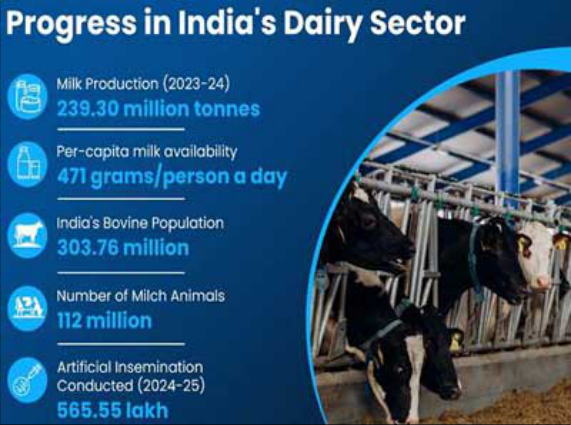 Figure 1
Introduction
India’s dairy sector is one of the largest in the world, contributing significantly to agricultural GDP and rural livelihoods. The success of this sector is largely attributed to the cooperative movement initiated during the White Revolution, led by Dr. Verghese Kurien. The White Revolution transformed India from a milk-deficient country into the largest milk producer globally, with production exceeding 230 million tonnes in 2022-23.
This transformation was achieved through a decentralized, farmer-centric cooperative model that eliminated intermediaries and ensured fair pricing (Sharma, 2023) [10]. Today, the dairy sector supports over 8 crore people and contributes substantially to rural income and employment. With the vision of Viksit Bharat @2047, the dairy cooperative model is being reimagined to achieve sustainable and inclusive growth (Malik et al., 2024) [6]. Gulati and Juneja, 2023 [4] concluded that White Revolution 2.0 strengthens dairy farmers towards Viksit Bharat @2047 by targeting a 50% increase in milk procurement (660 to 1,007 LKgPD by 2029) via 75,000 new village cooperatives, boosting income for 8 crore farmers.
It focuses on productivity via genetic improvement (IVF/ET) and formalizing women-led (70% workforce) dairy value chains. 2. Key Contributions to Strengthening Dairy Farmers Institutional Strengthening & Expansion The initiative aims to set up 75,000 new Dairy Cooperative Societies (DCS) in uncovered, particularly in rural and remote areas, strengthening 46,422 existing societies. This increases formal, structured procurement, reducing dependence on middlemen and ensuring fairer prices for producers. Technological & Genetic Advancement: Focus on increasing per- animal productivity through crossbreeding, sex-sorted semen, and Embryo Transfer Technology (ET) under the Rashtriya Gokul Mission.
This reduces input costs (feed/fodder) while improving yield, crucial for farmer profitability. NAAS Rating (2026): 4.74 IJHFS 2026; SP-8(5): 01-03 Kumar P Executive Assistant, Haryana Dairy Development Co- operative Federation Limited, Haryana, India Somveer Assistant Manager, Haryana Dairy Development Co- operative Federation Limited, Haryana, India Anita Master of Arts, Swami Vivekanand Subharti University, Uttar Pradesh, India Jyoti Trained Graduate Teacher (Science), the Sanskar Plateau School, Haryana, India Kumar P Executive Assistant, Haryana Dairy Development Co- operative Federation Limited, Haryana, India https://www.hortijournal.com Fig 1: Key Indicators of Progress in India's Dairy Sector (2023–25) (2024) to: • Increase milk procurement by 50% • Expand cooperative coverage • Improve infrastructure 5.2 Key targets • Increase procurement from 660 lakh kg/day to 1007 lakh kg/day by 2028-29 • Establish 75,000 new dairy cooperatives • Strengthen existing cooperative societies 5.3 Focus areas • Digital dairy systems • Genetic improvement of livestock • Women-led cooperatives • Sustainability and circular economy 6. Role in achieving Viksit Bharat @2047 The cooperative dairy model aligns strongly with India’s long-term development goals: 6.1 Inclusive growth • Integrates small and marginal farmers • Reduces rural inequality 6.2 Atmanirbhar Bharat (Self-Reliance) • Strengthens domestic production • Reduces import dependency 6.3 Sustainable development • Promotes organic manure and biogas production • Encourages climate-resilient practices 6.4 Digital transformation • Adoption of automation and data-driven systems • Improved efficiency and transparency
Conclusion
The White Revolution and cooperative dairy movement Empowerment of Women farmers: With women constituting approx. 70% of the dairy workforce, White Revolution 2.0 integrates them into formal cooperatives, improving their decision-making power and income security (Scholten, 2015) [9]. Financial inclusion: Implementation of RuPay Kisan Credit Cards for dairy farmers and installation of micro- ATMs in cooperative societies enhances direct financial access and digital literacy. Value addition: Focus on encouraging farmers to produce high-margin products like cheese and yogurt (20% margins vs. 3-5% for raw milk) to diversify income streams. 3. Strategic alignment with Viksit Bharat @2047 Nutritional security: Elevating per capita milk availability (already at 471g/day) to combat malnutrition, enhancing human capital for a developed India.
Sustainability: Promoting climate-smart dairy farming to create a resilient rural economy. Inclusive growth: By targeting small and marginal farmers and women, it ensures growth is equitable, strengthening the economic backbone of rural India. 4. Challenges and Focus areas Productivity gaps: Addressing low productivity in certain regions through better fodder management and health services. Infrastructure: Strengthening cold chain logistics to reduce spoilage and improve quality.
Input Costs: Managing rising costs of cattle feed to ensure competitive pricing. White Revolution 2.0 acts as a comprehensive, technology- driven, and inclusive strategy designed to turn the dairy sector into a high-productivity, sustainable pillar of the rural economy, essential for achieving Viksit Bharat by 2047. 5. White Revolution 2.0: A Step towards Viksit Bharat @2047 5.1 Objectives The Government of India launched White Revolution 2.0 https://www.hortijournal.com have transformed India’s rural economy by empowering farmers, enhancing food security, and promoting inclusive growth. As India moves towards Viksit Bharat @2047, strengthening dairy cooperatives through innovation, infrastructure, and policy support will be crucial.
The success of White Revolution 2.0 will determine the future trajectory of India’s dairy sector.
References
12 in the original paper- Sustainable dairy sector of an emerging economy: An empirical quest based on India. Agricultural Systems. 2024;218:103970-103970.
- Will White Revolution 2.0 propel India’s dairy sector to new heights? Business Standard. 2024.
- Digital transformation of India’s dairy sector. Drishti IAS. 2024.
- Gulati A, Juneja R. White Revolution in India: What smallholders can do given the right ecosystem. ZEF Working Paper Series. 2023;(224):1-28.
- White Revolution 2.0: Rejuvenating the Indian dairy sector. IMPRI. 2024.
- Malik M, Gahlawat VK, Mor RS, Hosseinian-Far A. Towards white revolution 2.0: challenges and opportunities for industry 4.0 technologies in Indian dairy industry. Operations Management Research. 2024;17(3):811-832.
- White Revolution 2.0 policy framework. Ministry of Cooperation. 2024.
- Launch of White Revolution 2.0. Press Information Bureau. 2024.
- Scholten BA. The ‘White Revolution’ and dual dairy economy structures. In: Handbook on the Globalisation of Agriculture. Edward Elgar Publishing; 2015. p. 461- 482.
- Sharma VP. Transforming Indian agriculture: Emerging trends, challenges and policy options. Indian Journal of Agricultural Marketing. 2023;37:1-29.
- A new White Revolution: Where India stands and aims to be. The Indian Express. 2024.
- India’s dairy cooperative sector. Vision IAS. 2024.