
Research article · 2026 · Full text
International Journal of Advanced Chemistry ResearchEffect of growth regulating chemicals and green pesticides as wheat seed treatment on grain damage caused by lesser grain borer, Rhyzopertha dominica (Fab.)
Volume 8(4) · Pages 38–45 · DOI: 10.33545/26646781.2026.v8.i4a.646 ↗
Research areasInsect Pest Control StrategiesInsect-Plant Interactions and ControlInsect Pheromone Research and Control
Abstract
Author-writtenInsect growth regulating chemicals and green pesticides are biorational insecticides that mimic or inhibit natural insect hormone to disrupt molting, development and reproduction, stopping pests from reaching adulthood or delayed development. They are highly selective, having long lasting persistence, low in toxicity to humans and non-target organisms. These chemicals are used in Integrated Pest Management (IPM) to provide long term population control at low concentrations. In the present study, an effort was made to manage the most destructive and obnoxious pest lesser grain borer, Rhyzoperta dominica (Fab.) (Family-Bostrichidae, Order-Coleoptera) infesting wheat grain. The Insect growth regulating chemicals, lufenuron (C17H8C2F8N2O3), novaluron (C17H9ClF8N2O4), diflubenzuron (C14H9ClF2N2O2), pyriproxyfen (C20H19NO3) and buprofezin (C16H23N3OS) were used as seed treatment in four concentration levels, viz., 1,5,10 and 15 ppm; green pesticides, neem oil at 0.1, 0.5 and 1.0 per cent and NSKE at 1.0, 2.5 and 5.0 per cent concentration levels. The deltamethrin (C22H19Br2NO3) was used as a standard check (2 and 4 ppm) and untreated control was maintained for comparison. The experiment was conducted under laboratory conditions in CRD (Completely Randomized Block Design) with three replications. Data on grain damage due to F1 R. dominica adult emergence after 24 hours, 30 days, 60 days, 90 days, 120 days and 150 days after wheat seed treatment was recorded. The data were statistically analyzed and compared at 1 per cent level of significance. As evident in Table-2, the treatments, neem oil 1.0 per cent and NSKE (Neem Seed Kernel Extract) 5.0 per cent provided complete protection of wheat seed (nil damaged grains) from the infestation of lesser grain borer, R. dominica. The novaluron 15 ppm and pyriproxyfen 15 ppm also provided complete protection of wheat seed but upto 60 days of storage. These treatments were followed by diflubenzuron, lufenuron and buprofezin at 15 ppm each. The novaluron and diflubenzuron 1 ppm each ranked at lower order. The remaining treatments ranked in the middle order. The untreated check differed significantly (grain damage 66.17%) over the treatments. No adverse effect of insect growth regulating chemicals and green pesticides on seed germination (Viability) of wheat seed was recorded after 150 days of treatment.
Summary
Source-checkedPlain-language reading of the full paper, prepared with AI and checked against the text. Each point links to the authors' own words.
Why it matters
- Wheat is a primary stored commodity in India, with a production volume of 117.94 million tonnes. View evidence ↗
- The lesser grain borer, Rhyzopertha dominica, is a significant pest that causes substantial damage to stored wheat and other grains. View evidence ↗
- Conventional insecticides are being phased out due to issues with persistence, resistance development, and toxicity to non-target organisms. View evidence ↗
The question
- The study aimed to evaluate the effectiveness of insect growth regulators (IGRs) and green pesticides in managing the lesser grain borer in wheat. View evidence ↗
What they did
- The research was conducted in laboratory settings in Rajasthan, India, between 2024 and 2025. View evidence ↗
- Deltamethrin at 2 and 4 ppm served as the standard check, while an untreated group served as the control. View evidence ↗
- Grain damage was measured by recording the emergence of F1 adult progeny at intervals of 24 hours, 30, 60, 90, 120, and 150 days. View evidence ↗
What they found
- Novaluron and pyriproxyfen at 15 ppm provided complete protection, but only for up to 60 days of storage. View evidence ↗
- The untreated control group experienced significantly higher grain damage, reaching 66.17%. View evidence ↗
- At the 24-hour mark, several treatments including 15 ppm of most IGRs, 1% neem oil, and 5% NSKE showed the minimum grain damage and were statistically similar. View evidence ↗
- Seed germination rates across all treatments ranged from 82.00% to 85.67%, showing no statistically significant difference between them. View evidence ↗
- The used IGRs and green pesticides did not adversely affect the germination of the wheat seeds. View evidence ↗
What it means
- The authors conclude that 1.0% neem oil and 5.0% NSKE are the most effective treatments, offering full protection for up to 150 days. View evidence ↗
Visual summary
2 visualsIllustrations explain the paper; charts are replotted from the paper's own table values.
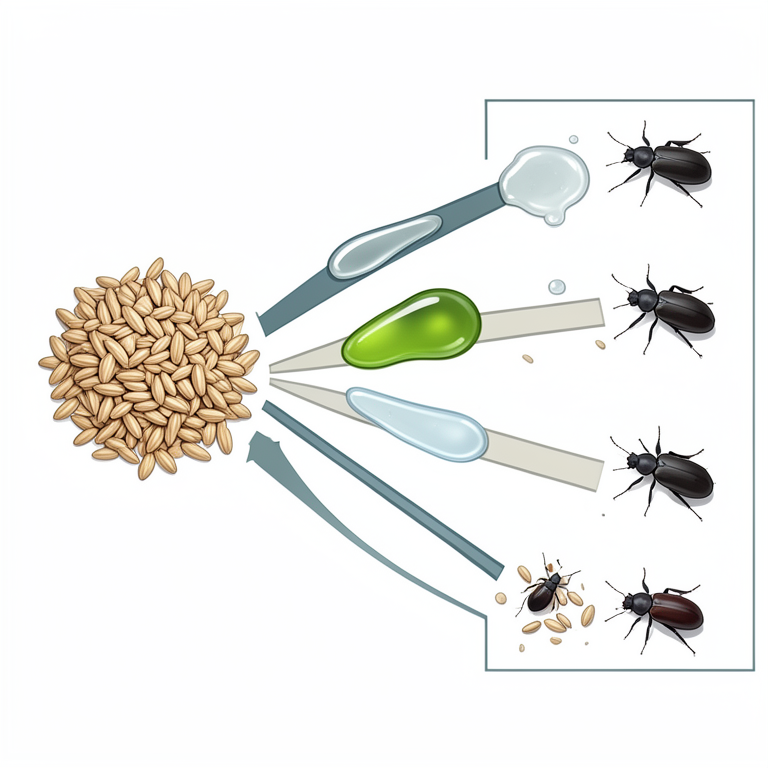
Experimental Design Overview
AI-generated conceptual illustration (wheat seeds and Rhyzopertha dominica beetles). It explains the idea and does not show study data.
View source evidence ↗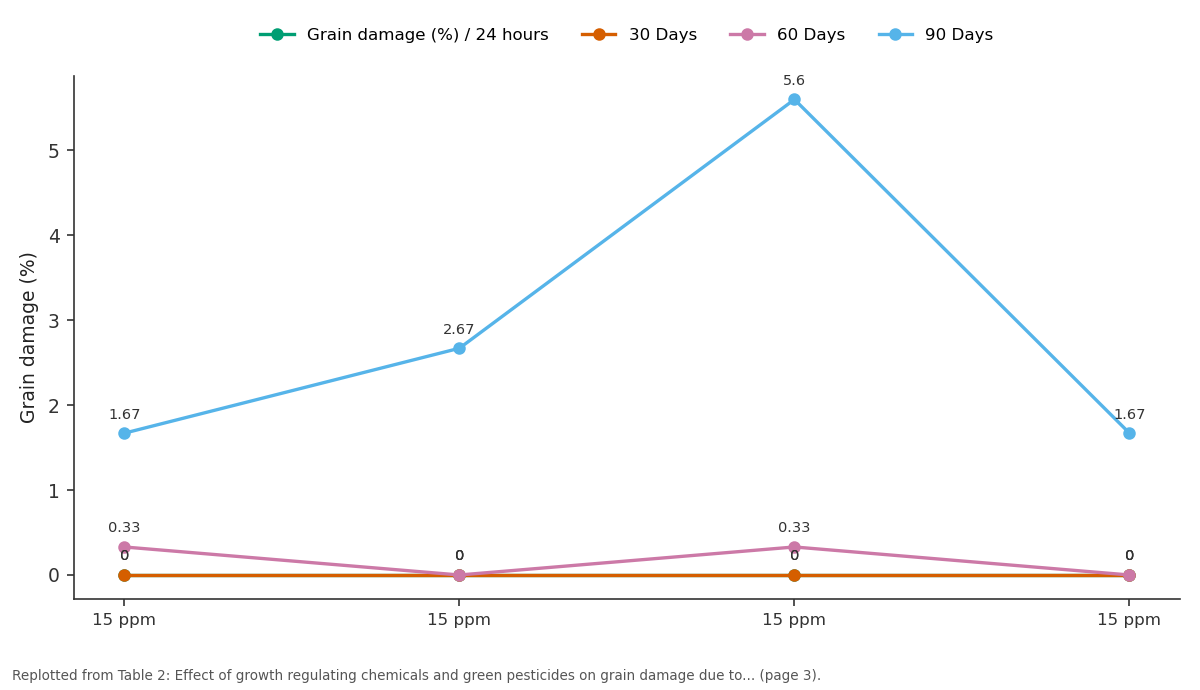
Grain damage (%) / 24 hours and 30 Days and more: 15 ppm vs 15 ppm vs 15 ppm vs 15 ppm
Replotted from Table 2 (page 3) of the original paper. Every bar is the paper's own table value.
View source evidence ↗Figures & tables
From the original paper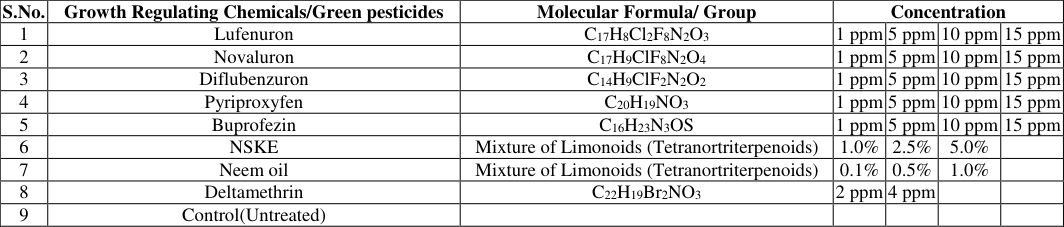 Table 1
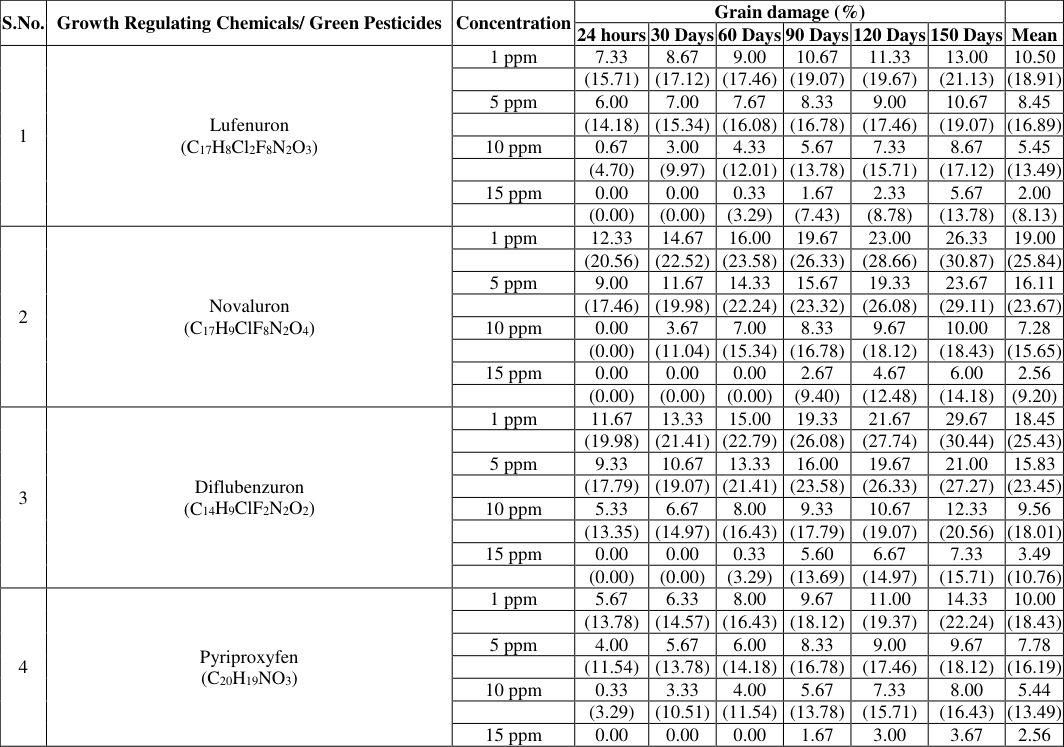 Table 2
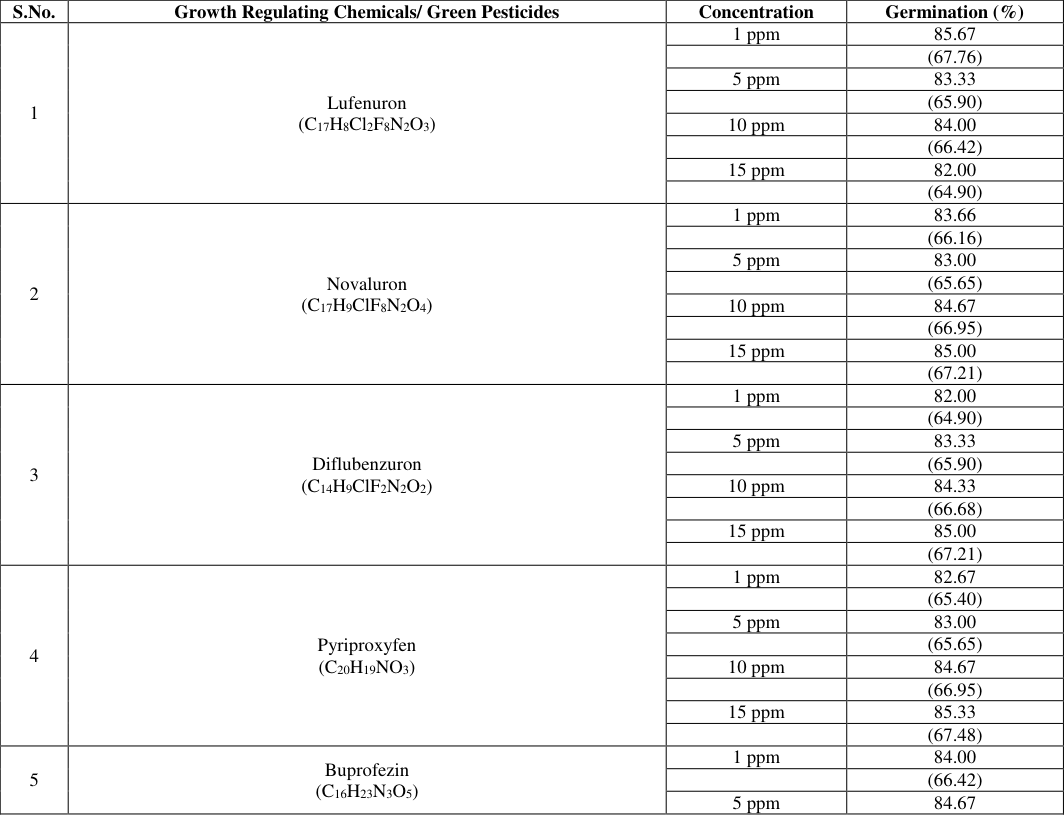 Table 3
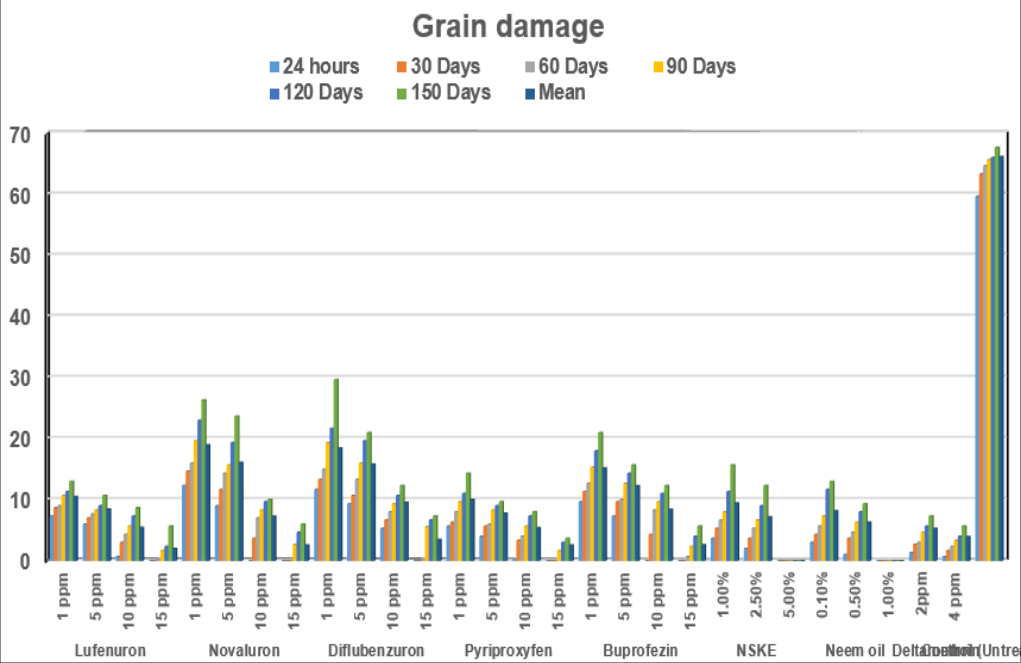 Figure 1
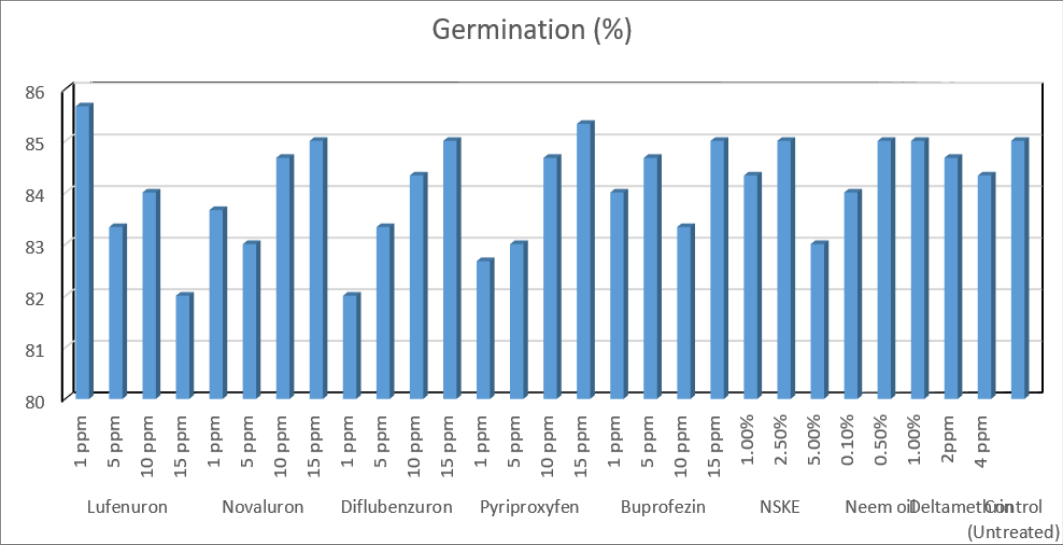 Figure 2
Introduction
Wheat grain is a chief commodity stored in warehouses, farmers' and traders' godowns as a huge amount of the same is produced (117.94 million tonnes) in india. The total area accrued under cultivation of this crop is estimated to be 32.80 million hectares with an average yield of 3,595 kg per hectare [1] . One of the important menaces heavily infesting the wheat grain is reported to be the lesser grain borer, Rhyzopertha dominica (Fab.) (Family-Bostrichidae, Order-Coleoptera) which causes considerable damage in wheat and other sored grains [7] . The original home of this borer is considered to be india [19] . The pest not only inflicts postharvest losses in terms of quantity but also deteriorates the quality of the grain by depleting specific nutrients and contaminating it with uric acid, excreta and insect carcasses. The pest is responsible to cause drastic losses by reducing the grain weight and seed viability. The pest can readily be distinguished from other grain pests by its cylindrical form, small size, polished with dark brown hue with roughened surface. The head of the beetle (Adult stage) turned down under thorax and armed with powerful jaws with which they can make direct cuts into wood and other rough vegetable material. Both beetles and grubs (immature stage) cause a serious damage in tropical and subtropical climates. The females lay eggs on exterior surface of wheat kernel, upon hatching the first instar larvae bore into the kernel, feed and develop inside the kernel, pupate inside the kernel and upon reaching the adult stage come out creating a large exit hole. Two or three grubs are generally observed to be feeding inside the grain. The grub underwent hibernation during winter months and regain activity as soon as the season warms up. The high non target toxicity, persistence and development of resistance are the major bottlenecks which led to discontinue the use of conventional insecticides in the recent years. The aluminium phosphide (𝐴𝐴𝐴𝐴𝐴𝐴) and Ethylene Dibromide (EDB) fumigation is typically used to manage stored grain pests. The majority of synthetic pesticides are persistent in the environment, they kill non-target organisms and make target pests resistant. There have been reports of carcinogenic effects from residual toxicity brought on by organophosphorus insecticides including dichlorvos, malathion, and synthetic pyrethroids [11] . Besides these, the conventional insecticides accumulate in food chains affecting wide range of wild life. There is a need to introduce alternative chemicals which are less persistent, more pest specific, and effective in low concentration and have novel mode of action [2] . Among insect growth regulating chemicals, the lufenuron, novaluron and diflubenzuron belongs to Benzoyl Phenyl Urea (BPU) group. These chemicals react by inhibition of chitin synthesis, disruption of ecdysis, larvicidal action and ovicidal action [20] . Pyriproxyfen belongs to Juvenile Hormone Analogue (JHA) group that disrupt normal growth by hormonal imbalance, disruption of metamorphosis and inhibition of adult emergence [8] . Buprofezin belongs to Chitin Synthesis Inhibitor (CSI) group. The insect growth regulating chemicals and natural organic compounds were found to be effective replacement of the conventional insecticides. These compounds may be compatible with the Integrated Pest Management (IPM) strategy. The insect growth regulating chemicals and natural organic compounds are specific to target species, do not adversely affect or minimally affect the non-target organisms including the beneficial ones. These chemicals have drawn a lot of attention in the hunt for novel control strategies for stored grain and grain products. IGRs have a unique method of action, influencing insects' molting and metamorphosis processes. Looking into the significance of botanicals and IGRs in stored commodities, their efficacy be examined and evaluated as these maintain quality of grain [21] . As such there has been a meagre amount of work available on the efficacy of insect growth regulating chemicals and natural organic compounds against stored grain pests in india. In that direction, the present investigation was carried out to evaluate some IGRs and natural organic compounds/green pesticides for management of lesser grain borer, R. dominica in wheat.
Material and methods 1. General details of the experiment: The experiment was conducted under laboratory conditions at the Department of Chemistry, Singhania University, Pacheri Badi, Jhunjhunu (Rajasthan) and Department of Chemistry, Government Polytechnic College, Jhunjhunu (Rajasthan) during 2024-2025. In order to maintain the stock culture of lesser grain borer, R. dominica, the pure culture was procured from the culture maintained in the Department of Entomology, SKNAU, Jobner (Rajasthan). The healthy seeds were used for the study and were fumigated with aluminum phosphide (powdered) to get rid of any hidden infestation [4] . The seed samples were then placed at 29±1.5 °C temperature and 70±5 per cent relative humidity for 48 hours for conditioning at which the cultures were maintained. The Relative Humidity (RH) and required temperature were maintained using a humidity chamber. The seed samples were weighed with the help of an automatic electronic balance. The moisture content of seed samples was determined by the digital moisture meter and oven method. The culture of insect was developed on sterilized and conditioned grain of wheat (variety, Raj 3077). For maintaining insect culture, 20 pairs of 0 to 24 hours old adult insects were released for oviposition in glass jar (size 18 x 6.5 cm) containing 200 g wheat grain. Further, newly emerged adults were transferred in a matka bin containing sterilized and conditioned grain in order to maintain a stock culture for continuous fresh supply of large number of insects required for the experimentation. The sex of adults emerged was determined by examining the 5 th segment as this is light yellow in female; while in male, it is brown in colour. The 3 rd and 4 th sernites are light doted in female; whereas in male they are greenish in colour [15] . A Completely Randomized Design (CRD) was used to study different insect growth regulating chemicals and green pesticides/natural organics as seed protectants against lesser grain borer, R. dominica [18] .
Treatments:
Sterilized and conditioned wheat grains (100g) was treated with different concentrations of insect growth regulating chemicals and natural organic compounds/green pesticides (lufenuron, novaluron, diflubenzuron, pyriproxyfen, buprofezin, NSKE, neem oil, deltamethrin) at different concentrations as shown in the Control(Untreated)
Table -1 Growth regulating chemicals and green pesticides used as wheat seed treatment against lesser grain borer, Rhyzopertha dominica (Fab.)
Release of insects in treated grain samples:
After 24 hours, 5g grains from treated lot of each growth regulator and natural organic compounds/green pesticides was taken in glass vials (10 x 2.5 cm). Two pairs of newly emerged beetles (equal sex, 0 to 24 hours old) released in each glass vial. Three replications of each treatment were maintained. The wheat grain samples for the experiment infested with R.
dominica were kept at a temperature of 29 ± 1.5 °C and relative humidity (RH) of 70 ± 5% for the study period.
These aliquots were critically examined every alternate day for changes in population of R. dominica. For handling the insect and infested grain a forceps and a camel hair brush was used. The experiment was repeated after 30, 60, 90, 120 and 150 days after treatment.
Method for recording observations:
Before counting the damaged grains, these were thoroughly mixed and samples of 100 grains were drawn from each treatment. The damaged grains in 100 grains were counted from each sample to work out the per cent grain damage. The germination test of treated grain samples after 150 days of treatment was carried out to know the adverse effect of growth regulators and natural organic compounds/green pesticides as grain protectants on germination of seed. One hundred seeds of each treatment were put between the wet blotting papers in petri dishes and three replications of each treatment was maintained. The germinated seeds were counted after 4-5 days.
Statistical analysis:
The per cent data on grain damage and seed germination were transformed into angular values (arc sine ) for analysis of variance [6,9] .
Results and Discussion
In the present investigation, the effectiveness of insect growth regulating chemicals and green pesticides/natural organic compounds were assessed by treating the wheat seed or grain. Subsequently, the data generated thereof after releasing R. dominica on grain or seed damage and seed viability were registered after certain period of grain or seed treatment. The data were statistically analyzed and compared at 1 per cent level of significance.
In order to register the grain damage caused by lesser grain borer, R. dominica, the samples were drawn from the treated grain samples from the insects released after 24 hours of grain treatment, 60 days, 90 days, 120 days and 150 days of treatment. Thus the grain damage caused by F1 R. dominica adult progeny was recorded to evaluate the efficacy of insect growth regulating chemicals and natural organics/green pesticides after different intervals of grain treatment (Table-2, Fig. 1). After 24 hours of adult release and F1 R. dominica progeny developed therein, the minimum grain damage was observed in diflubenzuron 15 ppm, novaluron 10 and 15 ppm, lufenuron 15 ppm, pyriproxyfen 15 ppm, buprofezin 10 and 15 ppm, neem oil 1 per cent and NSKE 5 per cent; these treatments were found statistically at far with each other. These treatments were followed by pyriproxyfen 10 ppm (0.33%), lufenuron 10 ppm (0.67%), and deltamethrin 4 ppm (0.67%); the former treatment resulted as significantly superior over the latter duo. The maximum grain damage was recorded in the untreated control (59.67%), which differed significantly over the treated grains. The treatment diflubenzuron 1 ppm and novaluron 5 ppm ranked as the inferior ones though significantly superior over the untreated control. The other treatments ranked in middle order but with varying degree of grain damage. The grain damage was found nil in the F1 generation developed from the adults released after 30 days of treatment with diflubenzuron, novaluron, lufenuron, pyriproxyfen, buprofezin (15 ppm each), neem oil 1 per cent, and NSKE 5 per cent. These treatments were found significantly superior over other treatments. The treatment of deltamethrin 4 ppm (1.67% grain damage) was next effective treatment and differed significantly over rest of the treatments. The grain damage observed in the diflubenzuron and novaluron (1 ppm each) fell in the least effective category but differed significantly over the untreated control (63.33% grain damage). The diflubenzuron, novaluron, lufenuron, pyriproxyfen, buprofezin (5 ppm each), neem oil 0.5 per cent, NSKE 2.5 per cent and deltamethrin 2 ppm ranked in the middle order with varying degree of grain damage.
After 60 days of treatment, the grain damage due to F1 adult emergence was found nil in the treatments of novaluron, pyriproxyfen (15 ppm each), neem oil 1 per cent and NSKE 5 per cent. These treatments were closely followed by diflubenzuron 15 ppm and lufenuron 15 ppm (0.33% grain damage each). The least effective treatments comprised of novaluron (1 and 5 ppm), diflubenzuron (1 ppm), though differed significantly over the untreated control where 64.67 per cent grain damage was registered. The other treatments ranked in the middle order, more or less a variation in degree of effectiveness in terms of grain damage was registered.
After 90 days of treatment, the grain damage observed due to F1 generation was found nil in neem oil (1%) and NSKE (5%). These treatments were followed by the lufenuron and pyriproxyfen 15 ppm each where the grain damage of 1.67 per cent in each was recorded. Again, the diflubenzuron and novaluron 1 ppm each fell in the least effective group exhibiting grain damage of 5.67 per cent and 2.67 per cent, respectively; both treatments were found significantly superior over the untreated control (65.67% grain damage). The data were consistent with regards to the most effective treatments and the least effective treatments after 120 days of treatment. The untreated control revealed a grain damage as high as 66.00%. After 150 days of treatment, the order of grain damage due to F1 generation was also found consistent with that of the observations recorded after 90 days and 120 days of seed treatment. The grain damage in this observation ranged from 0 to 29.67 per cent in different treatments which differed significantly over the untreated control (67.67% grain damage).
Based on the mean of all the observations, it was inferred that the treatments neem oil 1 per cent and NSKE 5 per cent emerged as the best treatments providing a full protection of wheat seed revealing no grain damage. The lufenuron, novaluron, pyriproxyfen and buprofezin 15 ppm each revealed grain damage of 2.0, 2.56, 2.56 and 2.61 per cent, respectively; the latter treatment was found at par with diflubenzuron 15 ppm (3.49% grain damage). The diflubenzuron and novaluron (1 ppm each) revealed grain damage of 18.45 per cent and 19.00 percent forming a least effective group but differed significantly over the untreated control (66.17% grain damage). The remaining treatments stood in the middle order but with varying degree of effectiveness in terms of grain damage. The present results have been found in accordance with Kteo and Mohammed (2019) [16] who carried out a study to evaluate the lethal and the sublethal three concentrations of neem oil on Khapra beetle, Trogoderma granarium (Everts).
The results demonstrated that treating of wheat grains with 5 per cent neem caused the highest mortality of T. granarium (82.3%). The results were also shown that application of neem oil decreased the percentage of weight loss of wheat grains and the percentage of egg hatching. This might be due to the entry of oil into the micropile that leads to the death of fetus. Kavallieratos et al. (2012) [14] concluded that all IGRs were very effective (>88.5% suppression of progeny) against the tested species at doses of ≥ 5 ppm, while diflubenzuron at 25 °C in the case of Prostephanus truncates (Horn), lufenuron and pyriproxyfen in the case of R. dominica completely suppressed (100%) progeny production. At all tested doses, the highest values of R. dominica parental mortality were observed in wheat treated with lufenuron.
The pyriproxyfen gave effective residual control of primary stored product insect species, R. dominica, which got full support from the results obtained by Arthur et al. (2009) [3] . The same IGR was also reported as the most effective compound inhibiting the F1 adult occurrence of R. dominica [10] . Jangir et al. (2018) [12] studied the efficacy of IGRs and natural organics/green pesticides and pointed out that the neem oil 1 per cent and NSKE 5 per cent exhibited nil adult emergence, grain damage and weight loss of wheat grain upto 150 days of storage; these were followed by pyriproxyfen 15 ppm, lufenuron 15 ppm. Mahmoud et al.
2023 [17] reported that IGRs, i.e. buprofezin, lufenuron and hexaflumuron in reduced fecundity, hatchability, adult emergence, and weight loss in treated wheat grains and increased the developmental period of R. dominica compared with the control which is in full agreement with the present result.
Seed germination:
As evident in table-3 and fig2, the seed germination in different treatments ranged from 82.00 to 85.67 per cent. These data were found statistically at par at 1 per cent level of significance. Therefore, it could be inferred that the seed treatment with different insect growth regulating chemicals and natural organic compounds/ green pesticides at varying degree of concentrations did not cause harmful effect in terms of seed germination. The results were confirmed by Kadam et al. (2013) [13] who pointed out that deltamethrin 2.8 EC @ 0.04 ml/kg and lufenuron 5 EC @ 0.1 ml/kg were found equally effective for control of stored grain pest of chickpea and germination above minimum seed certification standards (85%) upto nine months of storage. Babu et al. (1991) [5] studied the efficacy of pre-storage treatment of seed of Vigna radiata with diflubenzuron and buprofezin at 0.02g a.i./kg in cloth bag storage under ambient conditions. None of the seed treatments used had any adverse effect on seed germination upto ten months of storage, the findings were in full agreement with the present one.
Conclusion
The treatment of wheat seed with neem oil 1.0 per cent and NSKE 5.0 per cent resulted as the most effective, providing a full protection upto 150 days of storage (with no grain damage). The lufenuron, novaluron, pyriproxyfen and buprofezin 15 ppm each were followed by the neem oil and NSKE revealing grain damage of 2.0, 2.56, 2.56 and 2.61 per cent, respectively. As high as 66.17 per cent grain damage was registered in the untreated control.
Acknowledgement
AcknowledgementsThe author is very grateful to Department of Chemistry, Singhania University, Pacheri Badi, Jhunjhunu and Department of Chemistry, Government Polytechnic College, Jhunjhunu for providing facilities required for completing the research work. I also express deep gratitude to Professor K.C. Kumawat and Dr. Yogesh Kumar for critically going through and editing the present manuscript.
Figures and tables from the paper
| S.No. | Growth Regulating Chemicals/Green pesticides | Molecular Formula/ Group | Concentration | — | — | — |
|---|---|---|---|---|---|---|
| 1 | Lufenuron | C17H8Cl2F8N2O3 | 1 ppm | 5 ppm | 10 ppm | 15 ppm |
| 2 | Novaluron | C17H9ClF8N2O4 | 1 ppm | 5 ppm | 10 ppm | 15 ppm |
| 3 | Diflubenzuron | C14H9ClF2N2O2 | 1 ppm | 5 ppm | 10 ppm | 15 ppm |
| 4 | Pyriproxyfen | C20H19NO3 | 1 ppm | 5 ppm | 10 ppm | 15 ppm |
| 5 | Buprofezin | C16H23N3OS | 1 ppm | 5 ppm | 10 ppm | 15 ppm |
| 6 | NSKE | Mixture of Limonoids (Tetranortriterpenoids) | 1.0% | 2.5% | 5.0% | |
| 7 | Neem oil | Mixture of Limonoids (Tetranortriterpenoids) | 0.1% | 0.5% | 1.0% | |
| 8 | Deltamethrin | C22H19Br2NO3 | 2 ppm | 4 ppm | ||
| 9 | Control(Untreated) |
Table text extracted from the original PDF; superscript letters are shown inline. The original table image is below.
View original table image
| S.No. | Growth Regulating Chemicals/ Green Pesticides | Concentration | Grain damage (%) | — | — | — | — | — | — |
|---|---|---|---|---|---|---|---|---|---|
| 24 hours | 30 Days | 60 Days | 90 Days | 120 Days | 150 Days | Mean | |||
| 1 | Lufenuron (C17H8Cl2F8N2O3) | 1 ppm | 7.33 | 8.67 | 9.00 | 10.67 | 11.33 | 13.00 | 10.50 |
| (15.71) | (17.12) | (17.46) | (19.07) | (19.67) | (21.13) | (18.91) | |||
| 5 ppm | 6.00 | 7.00 | 7.67 | 8.33 | 9.00 | 10.67 | 8.45 | ||
| (14.18) | (15.34) | (16.08) | (16.78) | (17.46) | (19.07) | (16.89) | |||
| 10 ppm | 0.67 | 3.00 | 4.33 | 5.67 | 7.33 | 8.67 | 5.45 | ||
| (4.70) | (9.97) | (12.01) | (13.78) | (15.71) | (17.12) | (13.49) | |||
| 15 ppm | 0.00 | 0.00 | 0.33 | 1.67 | 2.33 | 5.67 | 2.00 | ||
| (0.00) | (0.00) | (3.29) | (7.43) | (8.78) | (13.78) | (8.13) | |||
| 2 | Novaluron (C17H9ClF8N2O4) | 1 ppm | 12.33 | 14.67 | 16.00 | 19.67 | 23.00 | 26.33 | 19.00 |
| (20.56) | (22.52) | (23.58) | (26.33) | (28.66) | (30.87) | (25.84) | |||
| 5 ppm | 9.00 | 11.67 | 14.33 | 15.67 | 19.33 | 23.67 | 16.11 | ||
| (17.46) | (19.98) | (22.24) | (23.32) | (26.08) | (29.11) | (23.67) | |||
| 10 ppm | 0.00 | 3.67 | 7.00 | 8.33 | 9.67 | 10.00 | 7.28 | ||
| (0.00) | (11.04) | (15.34) | (16.78) | (18.12) | (18.43) | (15.65) | |||
| 15 ppm | 0.00 | 0.00 | 0.00 | 2.67 | 4.67 | 6.00 | 2.56 | ||
| (0.00) | (0.00) | (0.00) | (9.40) | (12.48) | (14.18) | (9.20) | |||
| 3 | Diflubenzuron (C14H9ClF2N2O2) | 1 ppm | 11.67 | 13.33 | 15.00 | 19.33 | 21.67 | 29.67 | 18.45 |
| (19.98) | (21.41) | (22.79) | (26.08) | (27.74) | (30.44) | (25.43) | |||
| 5 ppm | 9.33 | 10.67 | 13.33 | 16.00 | 19.67 | 21.00 | 15.83 | ||
| (17.79) | (19.07) | (21.41) | (23.58) | (26.33) | (27.27) | (23.45) | |||
| 10 ppm | 5.33 | 6.67 | 8.00 | 9.33 | 10.67 | 12.33 | 9.56 | ||
| (13.35) | (14.97) | (16.43) | (17.79) | (19.07) | (20.56) | (18.01) | |||
| 15 ppm | 0.00 | 0.00 | 0.33 | 5.60 | 6.67 | 7.33 | 3.49 | ||
| (0.00) | (0.00) | (3.29) | (13.69) | (14.97) | (15.71) | (10.76) | |||
| 4 | Pyriproxyfen (C20H19NO3) | 1 ppm | 5.67 | 6.33 | 8.00 | 9.67 | 11.00 | 14.33 | 10.00 |
| (13.78) | (14.57) | (16.43) | (18.12) | (19.37) | (22.24) | (18.43) | |||
| 5 ppm | 4.00 | 5.67 | 6.00 | 8.33 | 9.00 | 9.67 | 7.78 | ||
| (11.54) | (13.78) | (14.18) | (16.78) | (17.46) | (18.12) | (16.19) | |||
| 10 ppm | 0.33 | 3.33 | 4.00 | 5.67 | 7.33 | 8.00 | 5.44 | ||
| (3.29) | (10.51) | (11.54) | (13.78) | (15.71) | (16.43) | (13.49) | |||
| 15 ppm | 0.00 | 0.00 | 0.00 | 1.67 | 3.00 | 3.67 | 2.56 |
Table text extracted from the original PDF; superscript letters are shown inline. The original table image is below.
View original table image
| S.No. | Growth Regulating Chemicals/ Green Pesticides | Concentration | Germination (%) |
|---|---|---|---|
| 1 | Lufenuron (C17H8Cl2F8N2O3) | 1 ppm | 85.67 |
| (67.76) | |||
| 5 ppm | 83.33 | ||
| (65.90) | |||
| 10 ppm | 84.00 | ||
| (66.42) | |||
| 15 ppm | 82.00 | ||
| (64.90) | |||
| 2 | Novaluron (C17H9ClF8N2O4) | 1 ppm | 83.66 |
| (66.16) | |||
| 5 ppm | 83.00 | ||
| (65.65) | |||
| 10 ppm | 84.67 | ||
| (66.95) | |||
| 15 ppm | 85.00 | ||
| (67.21) | |||
| 3 | Diflubenzuron (C14H9ClF2N2O2) | 1 ppm | 82.00 |
| (64.90) | |||
| 5 ppm | 83.33 | ||
| (65.90) | |||
| 10 ppm | 84.33 | ||
| (66.68) | |||
| 15 ppm | 85.00 | ||
| (67.21) | |||
| 4 | Pyriproxyfen (C20H19NO3) | 1 ppm | 82.67 |
| (65.40) | |||
| 5 ppm | 83.00 | ||
| (65.65) | |||
| 10 ppm | 84.67 | ||
| (66.95) | |||
| 15 ppm | 85.33 | ||
| (67.48) | |||
| 5 | Buprofezin (C16H23N3O5) | 1 ppm | 84.00 |
| (66.42) | |||
| 5 ppm | 84.67 |
Table text extracted from the original PDF; superscript letters are shown inline. The original table image is below.
View original table image
References
20 in the original paper- Anonymous. http://apeda.gov.in. 2024-25.
- Ali Q, Mason LJ, Sagheer M, Javed N. Biological activity of insect growth regulators, pyriproxyfen, lufenuron and methoxyfenozide against Tribolium castaneum (Herbst). Pak J Zool. 2016;48(5):526-530.
- Arthur FH, Liu SW, Zhao BG, Phillips TW. Residual efficacy of pyriproxyfen and hydroprene applied to wood, metal and concrete for control of stored product insects. Pest Manag Sci. 2009;65(7):791-797.
- Arul G, Kumawat KC. Efficacy of insect growth regulators as grain protectants of stored chickpea against Callosobruchus chinensis (L.). Prog Res: Int J. 2022;17(2):104-107.
- Bliss CI. Plant Protection. 1937; No. 12. Leningrad.
- Campbell A, Sinha RN. Damage of wheat by feeding of some stored beetles. J Econ Entomol. 1976;69:11-13.
- Dhadialla TS, Carlson GR, Le DP. New insecticides with ecdysteroidal and juvenile hormone activity. Annu Rev Entomol. 1998;43(1):545-569.
- Gomez KA, Gomez AA. Problem data, Statistical Procedures for Agricultural Research. John Wiley and Sons, New York; 1976. p. 272-315.
- Granger NA. Biological activity of two juvenoids and two ecdysteroids against three stored product insects. Seventh International Conference on the juvenile hormones, Kostyakovsky, Insect Biochem Mol Biol. 1999;30(8-9):891-897.
- Islam T, Biswas MJH. Bioassay of Beauveria bassiana, three plant oils and five biorational molecules against Callosobruchus chinensis (L.) in chickpea. J Entomol Zool Stud. 2017;5(3):516-519.
- Jangir H, Kumawat KC, Sharma P, Yadav D, Ranawat YS. Bioefficacy of insect growth regulators (IGRs) as seed protectants against lesser grain borer, Rhyzopertha dominica (Fab.) on wheat. J Entomol Zool Stud. 2018;6:1641-1646.
- Kadam UK, Palande PR, Shelar V, Bansode GM. Effect of newer insecticidal seed treatment on viability of chickpea seed during storage. Int J Plant Sci. 2013;8(1):134-136.
- Kavallieratos NG, Athanassiou CG, Vayias BJ, Tomanović Ž. Efficacy of insect growth regulators as grain protectants against two stored-product pests in wheat and maize. J Food Prot. 2012;75(5):942-950.
- Khare BP. Stored Grain Pests and Their Management. Kalyani Publishers, Ludhiana-141008; 1993.
- Kteo BQ, Mohammed AA. The effect of Neem oil in controlling Khapra beetle Trogoderma granarium (Dermestidae: Coleoptera) and reducing its associated fungal isolates in wheat grains. In IOP Conf Ser: Earth Environ Sci. 2019;388(1):012015.
- Mahmoud MA, Abd Elrahman IE, Zedan OA, AbdelRahman YA, Saba RM, Laban GF, Ibrahim IS. Effect International Journal of Advanced Chemistry Research https://www.chemistryjournals.net of three insect growth regulators on certain biological aspects of the lesser grain borer, Rhyzopertha dominica (Coleoptera: Bostrichidae). Braz J Biol. 2023;82:e267629.
- Panse VG, Sukhatme PV. Statistical Methods for Agricultural Workers. Published by Indian Council of Agricultural Research, New Delhi; 1954.
- Pruthi HS, Singh M. Pests of stored grain and their control. Indian J Agric Sci. 1950;18(4):52-58.
- Tunaz H, Uygun N. Insect growth regulators for insect pest control. Turk J Agric For. 2004;28(6):377-387.
- Umesh Babu BS, Tembhurne BV, Sreenivas AG. Assessment of fruit borer resistance for quality chilli production. Front Crop Improv. 2021;9(1):22-26.