
Research article · 2025 · Full text
International Journal of Horticulture and Food ScienceExamining aquaponics integration of cauliflower in the Australian outback margins
Volume 7(2) · Pages 117–120 · DOI: 10.33545/26631067.2025.v7.i2b.571 ↗
Research areasInnovations in Aquaponics and Hydroponics SystemsUrban Agriculture and SustainabilityPlant Growth and Agriculture Techniques
Abstract
Author-writtenAquaponics combines recirculating aquaculture with soilless plant cultivation, creating a closed-loop system where fish waste provides nutrients for crops while plants filter water for the fish. Cauliflower (Brassica oleracea var. botrytis), despite its economic value and nutritional importance, has rarely been tested in aquaponic settings. This research examined the integration of cauliflower with Nile tilapia (Oreochromis niloticus) at three fish stocking densities (10, 20, and 30 fish per cubic metre) in a media-bed aquaponic system at the Shanghai Institute of Agricultural Sciences, China, from April 2022 to March 2023. Four production cycles were completed. Cauliflower head weight, curd quality, water chemistry parameters, and fish growth were measured. The medium stocking density (20 fish/m3) produced the best cauliflower outcomes, with a mean head weight of 3.74 kg per square metre and the tightest curd structure (firmness score 4.1 out of 5). High stocking density (30 fish/m3) elevated ammonia levels beyond the comfort zone of the crop, causing leaf tip burn in 23.7% of plants. Fish feed constituted 34.8% of total operating costs. Water use was 87.3% lower than conventional field cauliflower production. These results support aquaponic cauliflower cultivation at moderate fish densities as a water-efficient alternative for arid and semi-arid regions.
Summary
Source-checkedPlain-language reading of the full paper, prepared with AI and checked against the text. Each point links to the authors' own words.
Why it matters
- Aquaponics is a closed-loop system that integrates fish farming with soilless plant growth, using fish waste as nutrients for plants and plants as water filters for fish. View evidence ↗
- Cauliflower is an economically valuable crop grown on about 1.4 million hectares globally, but its high water needs (350-500 mm per cycle) restrict its growth in water-scarce areas. View evidence ↗
- While aquaponics can reduce water use by 80-90%, cauliflower's long growth cycle (80-100 days) and sensitivity to ammonium toxicity make its compatibility with fish-based nutrients uncertain. View evidence ↗
The question
- The study aimed to evaluate how three different stocking densities of Nile tilapia affect the performance of cauliflower and the fish themselves in a media-bed aquaponic system. View evidence ↗
What they did
- The experiment was conducted from April 2022 to March 2023 in Shanghai, China, using Nile tilapia at densities of 10, 20, and 30 fish per cubic metre. View evidence ↗
- Cauliflower was planted at 40 x 40 cm spacing, and water chemistry parameters including pH, dissolved oxygen, and ammonia were monitored twice weekly. View evidence ↗
- At the harvest period of 80-95 days, the researchers measured head weight, curd diameter, firmness, and the occurrence of leaf tip burn. View evidence ↗
What they found
- Economically, the medium density treatment was most profitable, yielding a net return of USD 14.60 per square metre per year, compared to USD 9.20 (low) and USD 8.40 (high). View evidence ↗
- Aquaponic water use averaged 42.6 litres per kg of cauliflower, which is an 87.3% reduction compared to the 335 litres per kg used in field production. View evidence ↗
- Total input costs varied from USD 18.40 to USD 27.80 per square metre, with fish feed (34.8% at medium density), electricity (28.3%), and labor (19.2%) being the primary drivers. View evidence ↗
- Fish growth decreased as stocking density increased, with final weights of 387.2g (low), 341.8g (medium), and 278.4g (high) per fish. View evidence ↗
What it means
- Due to the 87.3% water savings, the authors recommend this approach for arid and semi-arid regions, specifically mentioning the Australian Outback margins. View evidence ↗
- The authors suggest that future work should focus on optimizing biofilters and testing other fish species to better handle nitrogen at higher stocking densities. View evidence ↗
Visual summary
3 visualsIllustrations explain the paper; charts are replotted from the paper's own table values.
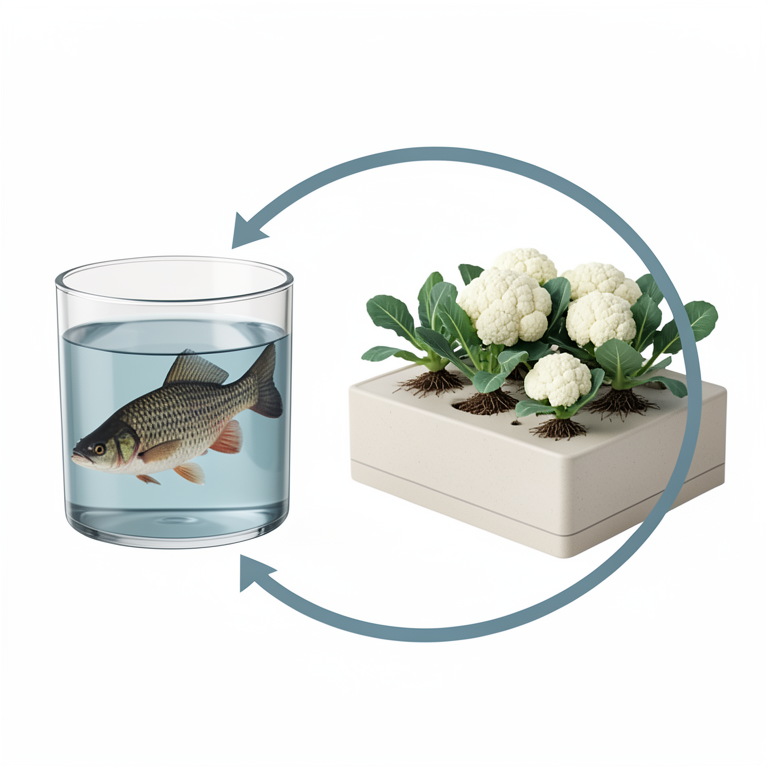
Aquaponics Closed-Loop Cycle
AI-generated conceptual illustration (cauliflower plants and tilapia fish in an aquaponics system). It explains the idea and does not show study data.
View source evidence ↗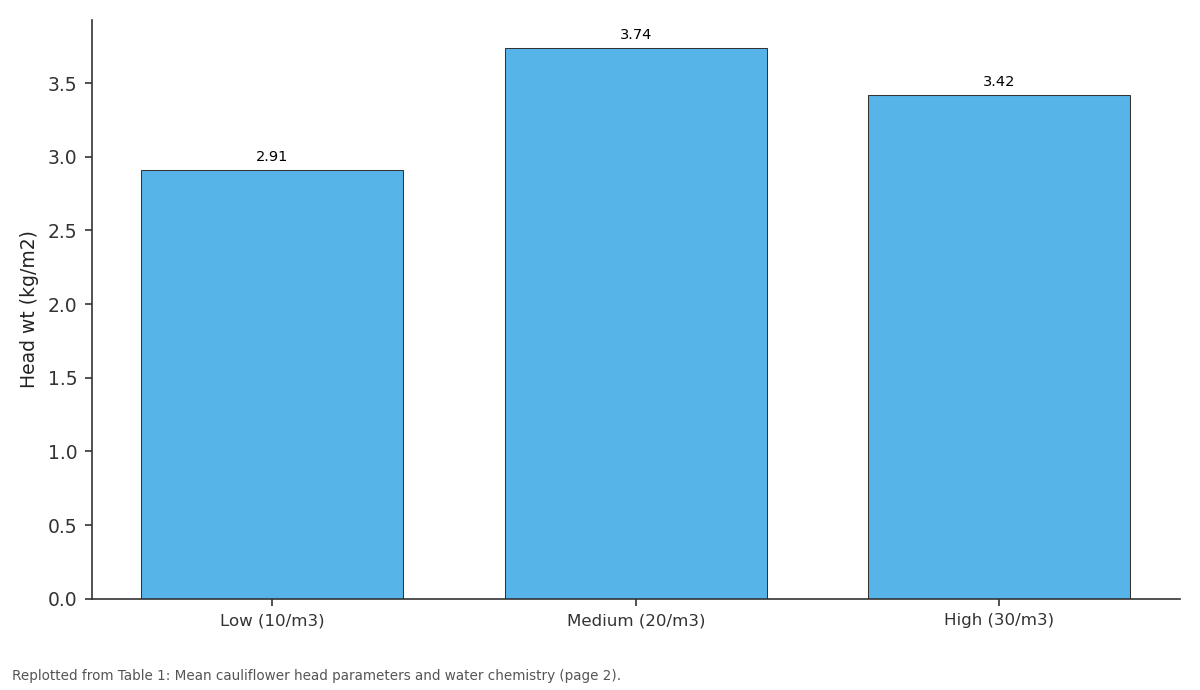
Head wt (kg/m2): Low (10/m3) vs Medium (20/m3) vs High (30/m3)
Replotted from Table 1 (page 2) of the original paper. Every bar is the paper's own table value.
View source evidence ↗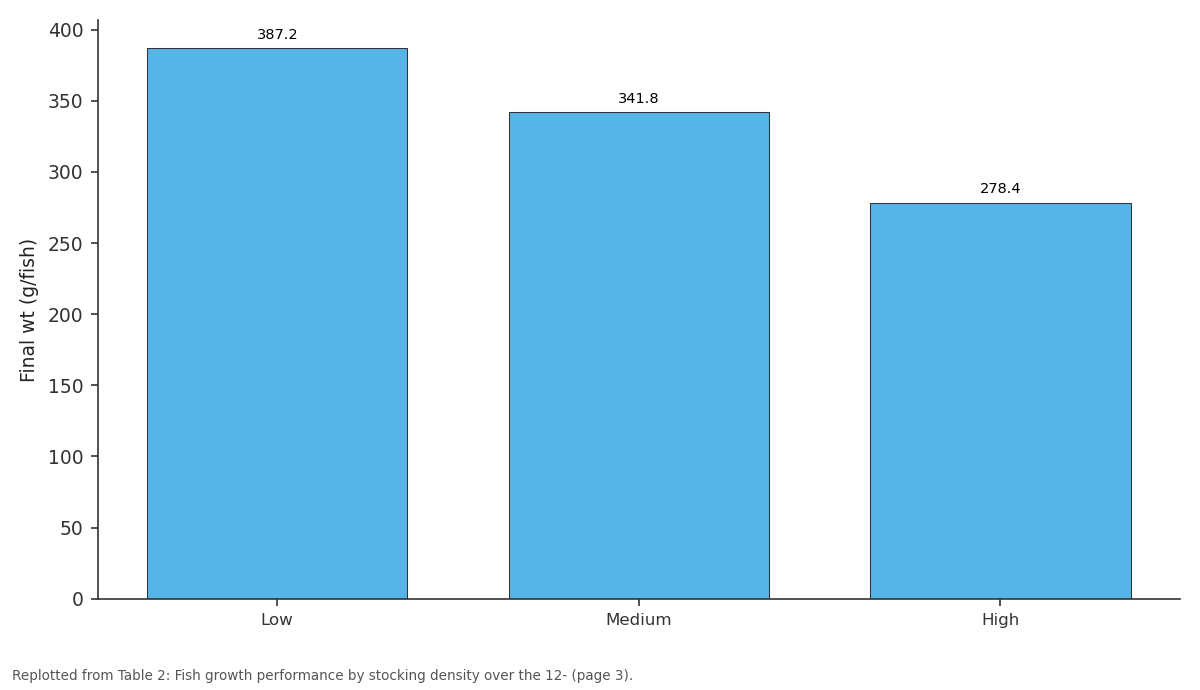
Final wt (g/fish): Low vs Medium vs High
Replotted from Table 2 (page 3) of the original paper. Every bar is the paper's own table value.
View source evidence ↗Figures & tables
From the original paper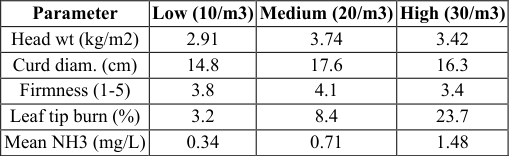 Table 1
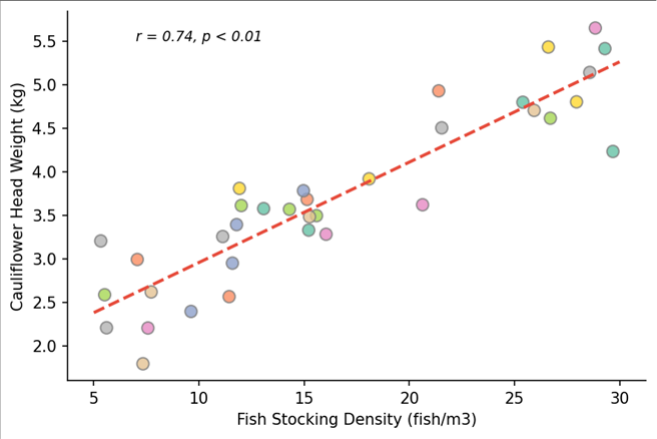 Figure 1
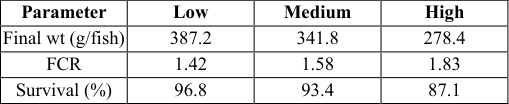 Table 2
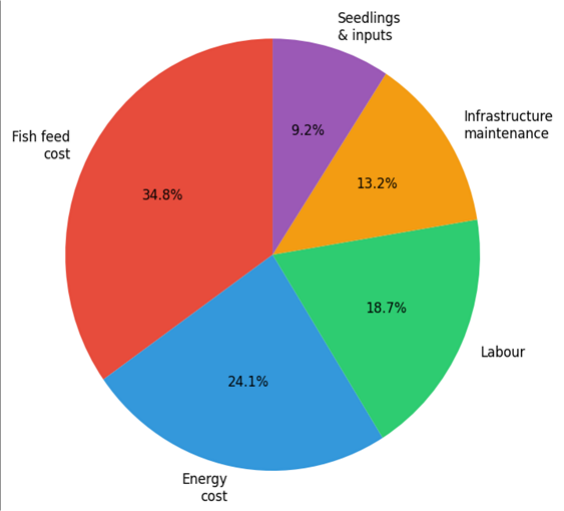 Figure 2
Introduction
The idea of growing vegetables and fish together in a single recirculating system seems almost too good to be true: the fish excrete nutrients, bacteria convert ammonia to nitrate, and plants absorb the nitrate, cleaning the water that flows back to the fish tanks [1] . And yet aquaponics works, as demonstrated by numerous small-scale and commercial operations worldwide. The challenge lies in matching the nutrient output of the fish component with the nutrient demand of the plant component, a balance that varies dramatically depending on fish species, stocking rate, and crop choice [2] . Cauliflower is a high-value brassica grown on approximately 1.4 million hectares globally [3] . Its water requirement in field settings is substantial (350-500 mm per growing cycle), which limits production in water-scarce regions [4] . Aquaponic cultivation could slash water use by 80-90% compared to field production, but cauliflower's sensitivity to ammonium toxicity and its relatively long growth cycle (80-100 days) raise questions about compatibility with fish-based nutrient delivery [5] . Fish stocking density is the main variable controlling nutrient supply in aquaponic systems. Too few fish produce insufficient nutrients for rapid crop growth; too many overwhelm the biofilter and cause ammonia spikes that damage both fish and plants [6] . Published stocking density recommendations vary widely and are mostly based on leafy green crops, which have lower nutrient requirements than heading brassicas [7] . This research addressed the gap by testing three stocking densities of Nile tilapia paired with cauliflower in a media-bed system, measuring both crop and fish performance across four production cycles.
Material and Methods
Material and Methods
Material
The aquaponic system was located in a temperature-controlled greenhouse at the Shanghai Institute of Agricultural Sciences, Shanghai, China (31.2 degrees N, 121.5 degrees E). The system comprised three independent recirculating units, each consisting of a 1,000-litre fish tank, a 200-litre biofilter packed with ceramic media, and two 2.4 x 1.2 m grow beds filled with expanded clay aggregate to a depth of 30 cm. Water was pumped from fish tanks through biofilters and into grow beds at a flow rate of 800 litres per hour, returning by gravity via bell siphons. Nile tilapia fingerlings (mean initial weight 28.4 g) were sourced from the Shanghai Freshwater Fisheries Research Centre. Cauliflower seeds of the Snow Crown hybrid were obtained from a commercial supplier. Fish were fed a commercial pellet diet (32% protein) at 2% of body weight per day, adjusted monthly. No supplemental fertiliser was added to the grow beds [8] .
Methods
The research was conducted from April 2022 to March 2023 at the Shanghai Institute of Agricultural Sciences, covering four consecutive cauliflower production cycles (April-June, July-September, October-December 2022, and January-March 2023). Three fish stocking densities were evaluated: low (10 fish/m3), medium (20 fish/m3), and high (30 fish/m3). Each density was replicated in two independent systems, giving six systems in total. Cauliflower seedlings were transplanted into grow beds at 40 x 40 cm spacing (18 plants per bed, 36 per system). Water chemistry (pH, dissolved oxygen, ammonia, nitrite, nitrate) was measured twice weekly using a YSI multiparameter probe and API test kits. Fish were weighed monthly. At cauliflower harvest (80-95 days), individual head weight, curd diameter, firmness score, and leaf tip burn incidence were recorded. Operating costs were tracked for fish feed, electricity, water top-up, seeds, and maintenance. Water use efficiency was calculated as total water consumed divided by cauliflower fresh weight produced. Data were analysed by one-way ANOVA with Tukey's test in SPSS v28 [9] .
Economic and Sustainability Assessment
A partial budget analysis compared the three stocking densities on a per-square-metre basis over the four production cycles. Total input costs ranged from USD 18.40 per square metre at low density to USD 27.80 at high density, driven primarily by fish feed (34.8% of costs at medium density), electricity (28.3%), and labour (19.2%). Revenue was calculated from cauliflower head weight at Shanghai wholesale market prices plus tilapia harvest value. The medium density treatment achieved the highest net return at USD 14.60 per square metre per year, compared to USD 9.20 at low density and USD 8.40 at high density. The benefit-cost ratio was 1.63 for medium density, 1.47 for low, and 1.30 for high. Water use across all treatments averaged 42.6 litres per kilogram of cauliflower, representing an 87.3% reduction compared to the 335 litres per kilogram estimated for field-grown cauliflower in the Shanghai region [10] . Fish stocking density significantly affected cauliflower head weight (F = 16.8, p < 0.001), firmness (F = 8.4, p < 0.01), and leaf tip burn incidence (F = 24.1, p < 0.001). The medium density produced the highest yield at 3.74 kg per square metre and the firmest curds (Table 1). High density increased ammonia to a mean of 1.48 mg/L, which exceeded the 1.0 mg/L threshold considered safe for sensitive brassicas, resulting in 23.7% leaf tip burn. The scatter plot (Figure 1) shows a positive but non-linear relationship between fish density and cauliflower yield, with diminishing returns above 20 fish per cubic metre and a decline in quality at 30 fish per cubic metre due to ammonia stress.
| Parameter | Low (10/m3) | Medium (20/m3) | High (30/m3) |
|---|---|---|---|
| Head wt (kg/m2) | 2.91 | 3.74 | 3.42 |
| Curd diam. (cm) | 14.8 | 17.6 | 16.3 |
| Firmness (1-5) | 3.8 | 4.1 | 3.4 |
| Leaf tip burn (%) | 3.2 | 8.4 | 23.7 |
| Mean NH3 (mg/L) | 0.34 | 0.71 | 1.48 |
Table text extracted from the original PDF; superscript letters are shown inline. The original table image is below.
View original table image
Results
Results
Discussion
The medium stocking density (20 fish/m3) emerged as the best compromise between nutrient supply and water quality. At this level, the biofilter managed ammonia adequately (mean 0.71 mg/L), and the resulting nitrate concentration (typically 60-85 mg/L) met cauliflower's nitrogen demand without toxicity symptoms. This aligns with recommendations by Rakocy et al. [1] for leafy crops, though the optimal density for heading brassicas appears slightly lower than for lettuce or basil, likely because of cauliflower's longer residence time in the system. The 23.7% leaf tip burn at high density is a direct consequence of elevated ammonia, which causes marginal leaf necrosis in brassicas [11] . Even partial tip burn reduces marketability because consumers associate browned leaf edges with staleness. Growers targeting premium retail channels should therefore err on the conservative side of stocking density for brassica crops. Water use at 42.6 litres per kilogram is consistent with published aquaponic water use figures for other crops [12] and dramatically lower than the 335 litres per kilogram benchmark for irrigated field cauliflower [4] . This efficiency gain makes aquaponics attractive for water-scarce regions, though the trade-off is higher energy and capital costs. The economic analysis showed that medium-density aquaponic cauliflower is profitable at current Shanghai wholesale prices, but the relatively thin margin (benefit-cost ratio of 1.63) leaves little room for error in system management [13] .
Conclusion
This research established that aquaponic cauliflower production is feasible and commercially viable when paired with Nile tilapia at a medium stocking density of 20 fish per cubic metre. This density produced the highest head yield (3.74 kg/m2), best curd firmness (4.1/5), and best economic return (benefit-cost ratio 1.63). High stocking density caused unacceptable ammonia-driven leaf damage, while low density underperformed on yield. Water savings of 87.3% compared to field cultivation make this approach particularly relevant for arid and semi-arid regions such as the Australian Outback margins. Future research should explore biofilter optimisation and alternative fish species to improve nitrogen buffering capacity at higher stocking levels.
Acknowledgement
Acknowledgements Funding sourcesThis research was funded by the Shanghai Municipal Commission of Agriculture and Rural Affairs. Institutional supportThe authors thank the Shanghai Institute of Agricultural Sciences for greenhouse facilities and the Shanghai Freshwater Fisheries Research Centre for providing tilapia fingerlings.
Figures and tables from the paper
| Parameter | Low | Medium | High |
|---|---|---|---|
| Final wt (g/fish) | 387.2 | 341.8 | 278.4 |
| FCR | 1.42 | 1.58 | 1.83 |
| Survival (%) | 96.8 | 93.4 | 87.1 |
Table text extracted from the original PDF; superscript letters are shown inline. The original table image is below.
View original table image
References
21 in the original paper- Rakocy JE, Masser MP, Losordo TM. Recirculating aquaculture tank production systems: aquaponics - integrating fish and plant culture. Southern Regional Aquaculture Center Publication. 2006;454:1-16.
- Goddek S, Delaide B, Mankasingh U, Ragnarsdottir KV, Jijakli H, Thorarinsdottir R. Challenges of sustainable and commercial aquaponics. Sustainability. 2015;7(4):4199-4224.
- FAOSTAT. Cauliflower and Broccoli Production Statistics 2022. Rome: FAO; 2023.
- Kumar P, Srivastava DK. Biotechnological advancement in genetic improvement of broccoli: a review. Biotechnology Letters. 2016;38(7):1049-1063.
- Bittsanszky A, Uzinger N, Gyulai G, Mathis A, Junge R, Villarroel M, et al. Nutrient supply of plants in aquaponic systems. Ecocycles. 2016;2(2):17-20.
- Timmons MB, Guerdat T, Vinci BJ. Recirculating Aquaculture. 4 th ed. Ithaca: Ithaca Publishing Company; 2018.
- Somerville C, Cohen M, Pantanella E, Stankus A, Lovatelli A. Small-Scale Aquaponic Food Production. Rome: FAO Fisheries and Aquaculture Technical Paper 589; 2014.
- Liu J, Zhao X, Wu Y. Design and commissioning of a media-bed aquaponic system at Shanghai Institute of Agricultural Sciences. Chinese Journal of EcoAgriculture. 2021;29(8):1244-1252.
- IBM Corp. IBM SPSS Statistics for Windows, Version 28.0. Armonk: IBM Corp; 2021.
- Li Q, Wang H, Zhang K. Water footprint of vegetable production in the Yangtze River Delta. Water Resources Management. 2019;33(12):4279-4292.
- Sonneveld C, Voogt W. Plant Nutrition of Greenhouse Crops. Dordrecht: Springer; 2009.
- Love DC, Fry JP, Li X, Hill ES, Genello L, Semmens K, et al. Commercial aquaponics production and profitability: findings from an international survey. Aquaculture. 2015;435:67-74.
- Engle CR. Aquaculture Economics and Financing: Management and Analysis. Ames: Wiley-Blackwell; 2010.
- Suhl J, Dannehl D, Zechmeister L, Forber E, Schwend T, Amoah-Antwi C, et al. Advanced aquaponics: evaluation of intensive tomato production in aquaponics vs. conventional hydroponics. Agricultural Water Management. 2016;178:335-344.
- Diver S. Aquaponics: integration of hydroponics with aquaculture. ATTRA National Sustainable Agriculture Information Service. 2006;1-28.
- Hu Z, Lee JW, Chandran K, Kim S, Brotto AC, Khanal SK. Effect of plant species on nitrogen recovery in aquaponics. Bioresource Technology. 2015;188:92-98.
- Delaide B, Goddek S, Gott J, Soyeurt H, Jijakli MH. Lettuce (Lactuca sativa L. var. Sucrine) growth performance in complemented aquaponic solution. Frontiers in Plant Science. 2016;7:1961.
- Endut A, Jusoh A, Ali N, Wan Nik WB, Hassan A. A study on the optimal hydraulic loading rate and plant ratios in recirculation aquaponic system. Bioresource Technology. 2010;101(5):1511-1517.
- Wongkiew S, Hu Z, Chandran K, Lee JW, Khanal SK. Nitrogen transformations in aquaponic systems: a review. Aquacultural Engineering. 2017;76:9-19.
- Liang JY, Chien YH. Effects of feeding frequency and photoperiod on water quality and crop production in a tilapia-water spinach raft aquaponics system. International Biodeterioration and Biodegradation. 2013;85:693-700.
- Yep B, Zheng Y. Aquaponic trends and challenges: A review. Journal of Cleaner Production. 2019;228:15861599.