
Research article · 2025 · Full text
International Journal of Horticulture and Food ScienceAssessing cold storage techniques of coffee in the Mexican Altiplano
Volume 7(1) · Pages 176–179 · DOI: 10.33545/26631067.2025.v7.i1c.551 ↗
Research areasPostharvest Quality and Shelf Life ManagementCoffee research and impactsAgriculture and Agroindustry Studies
Abstract
Author-writtenGreen coffee beans lose flavor complexity and develop off-notes when stored improperly, and the Mexican Altiplano's wide daily temperature swings make post-harvest management especially tricky. This research assessed three cold storage regimes (5°C, 10°C, and ambient at 25-30°C) for Arabica green beans harvested from highland farms at 1,850 m elevation near Coatepec, Veracruz. Beans were packed in GrainPro hermetic bags and monitored at 10-day intervals over 90 days for moisture content, water activity, free fatty acid level, color stability, and cup score. At 5°C, moisture content remained within the 10.5-12.0% safe window through day 90, while ambient-stored beans climbed to 16.4% by the same point. Cup scores, evaluated by three Q-graders, dropped from 83.7 to 79.1 at ambient but held at 82.4 at 5°C storage. Water activity stayed below the 0.65 threshold for mold growth in all cold-stored treatments through day 60 but exceeded it in ambient bags by day 30. Free fatty acid buildup was 2.7 times faster at ambient than at 5°C. These data show that even basic cold storage at 5°C can preserve specialty-grade quality in Altiplano coffee for at least three months, reducing the pressure on farmers to sell immediately after harvest.
Summary
Source-checkedPlain-language reading of the full paper, prepared with AI and checked against the text. Each point links to the authors' own words.
Why it matters
- Improper storage of green coffee beans leads to a loss of flavor complexity and the development of off-notes, a problem exacerbated by the extreme daily temperature fluctuations in the Mexican Altiplano. View evidence ↗
- Storage-related degradation involves lipid oxidation causing cardboard-like flavors, moisture migration leading to mold, and the degradation of Maillard precursors necessary for roasting. View evidence ↗
- Many small-scale farmers in the region use inadequate storage, such as jute sacks in unventilated sheds where temperatures can exceed 30°C. View evidence ↗
The question
- The study aimed to identify the lowest level of cold-storage investment required to maintain specialty-grade quality for the duration of a full export cycle. View evidence ↗
What they did
- The researchers used Typica variety Arabica green coffee beans sourced from four smallholder farms near Coatepec, Veracruz, at elevations between 1,800 and 1,920 meters. View evidence ↗
- Beans were stored in 78 μm thick GrainPro SuperGrain bags across three temperature regimes: 5±0.5°C, 10±0.5°C, and ambient (25-30°C). View evidence ↗
- Destructive analysis was performed on two bags per temperature at eight specific intervals over a 90-day period. View evidence ↗
- The study measured moisture content, water activity, free fatty acid (FFA) levels, color stability, and cup quality (using SCA 100-point scale scoring by three Q-graders). View evidence ↗
What they found
- Beans stored at 5°C showed high moisture stability, with an increase of only 0.4 percentage points over the 90-day period. View evidence ↗
- Storage at 10°C resulted in a moisture level of 13.5% by day 90, exceeding the 12.5% threshold typically required by specialty importers. View evidence ↗
- Cup scores at 5°C dropped by only 1.3 points (remaining above the 80-point specialty threshold), whereas ambient-stored beans lost 4.6 points and fell below specialty grade by day 75. View evidence ↗
- Free fatty acid (FFA) buildup was 2.7 times faster in ambient storage (2.46%) compared to 5°C storage (0.91%) by day 90. View evidence ↗
- Water activity exceeded the 0.65 mold growth threshold by day 30 in ambient storage, while cold-stored treatments remained below this threshold through day 60. View evidence ↗
What it means
- The authors conclude that a basic 5°C cold room with hermetic packaging can preserve harvest value for three months, allowing farmers to avoid selling immediately at low prices. View evidence ↗
- The authors recommend investing in cold-chain access at the village or cooperative level to maintain the quality premium of Altiplano coffee. View evidence ↗
- A limitation of the study was the use of only the Typica variety from a narrow elevation range; other common varieties like Bourbon or Caturra might respond differently. View evidence ↗
Visual summary
3 visualsIllustrations explain the paper; charts are replotted from the paper's own table values.
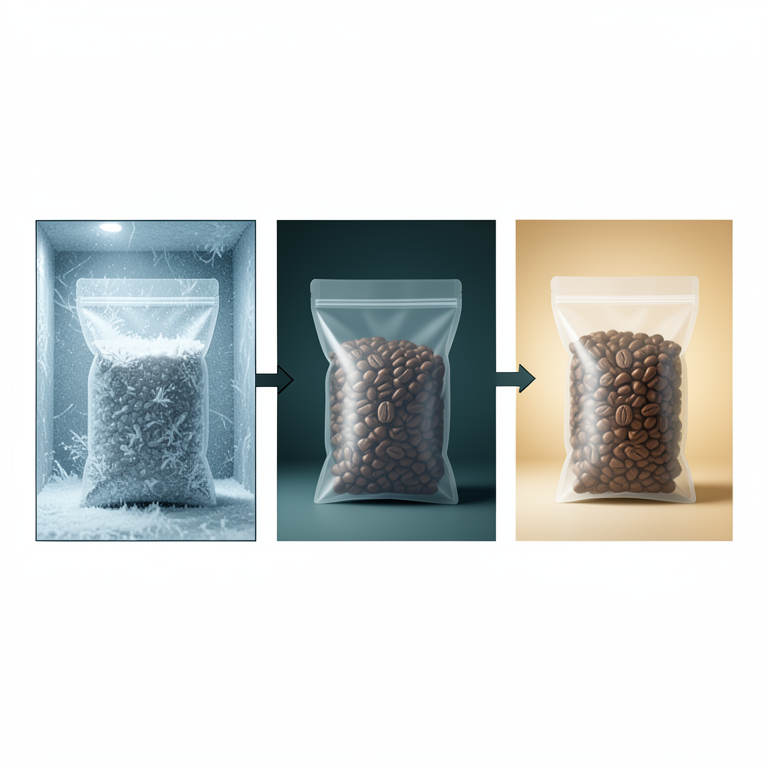
Temperature Comparison Concept
AI-generated conceptual illustration (Coffee beans in GrainPro SuperGrain bags). It explains the idea and does not show study data.
View source evidence ↗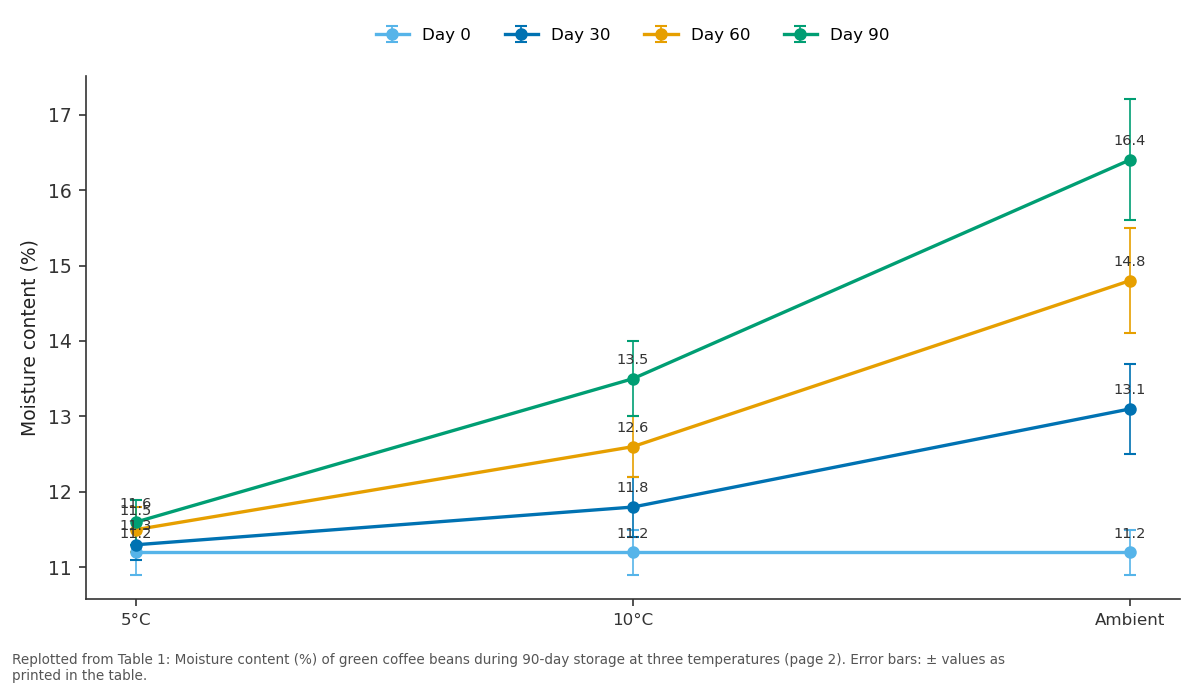
Day 0 and Day 30 and more: 5°C vs 10°C vs Ambient
Replotted from Table 1 (page 2) of the original paper. Every bar is the paper's own table value.
View source evidence ↗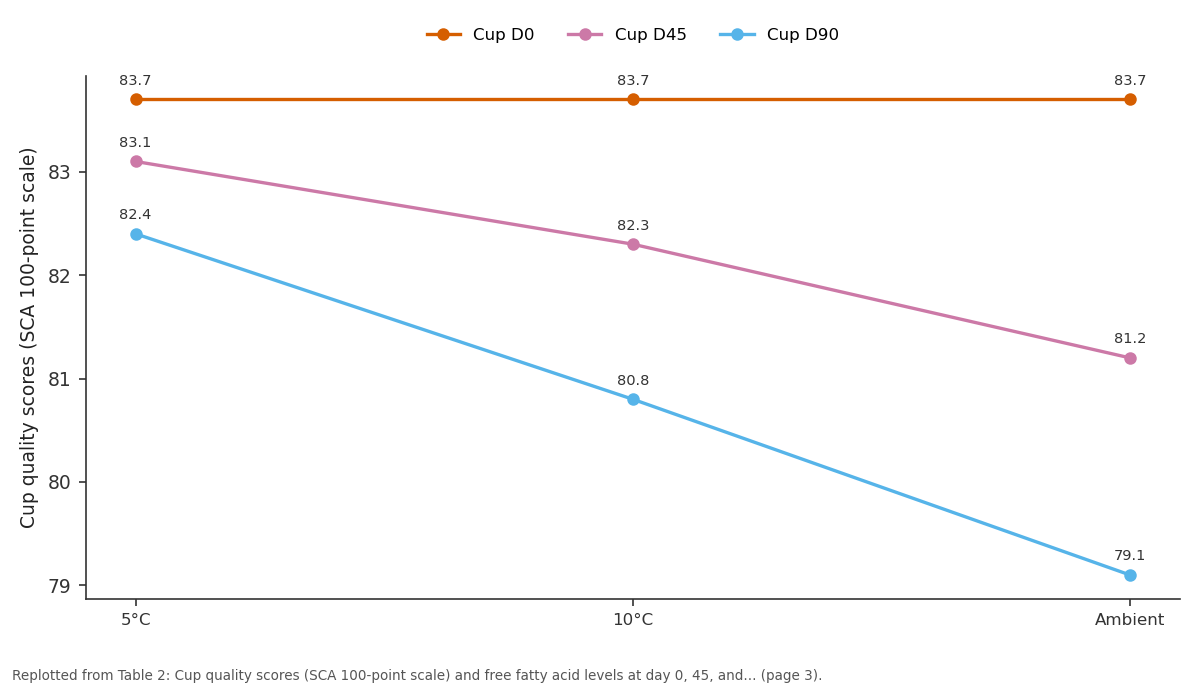
Cup D0 and Cup D45 and more: 5°C vs 10°C vs Ambient
Replotted from Table 2 (page 3) of the original paper. Every bar is the paper's own table value.
View source evidence ↗Figures & tables
From the original paper Table 1
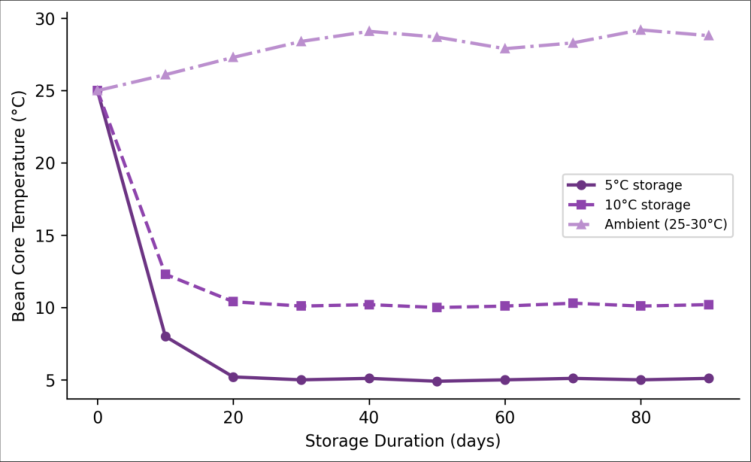 Figure 1
 Table 2
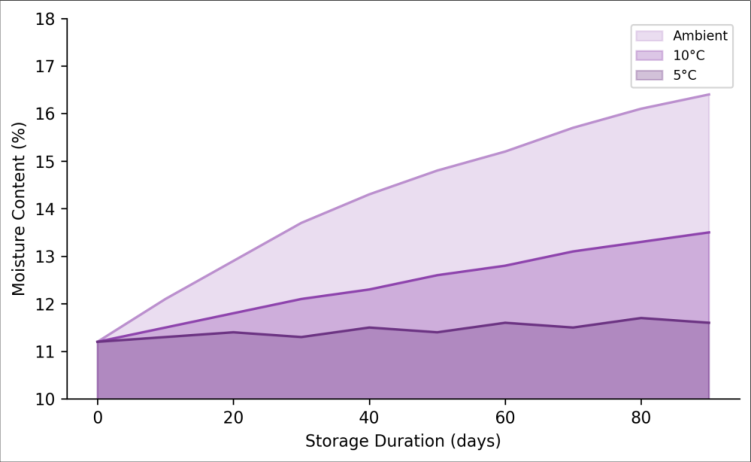 Figure 2
Introduction
The journey from cherry to cup takes months for most coffee, and much of that time the beans sit in storage waiting for export or roasting. During that wait, chemical reactions don't stop. Lipid oxidation produces stale, cardboard-like flavors; moisture migration encourages mold colonization; and the Maillard precursors that give fresh green beans their roasting potential slowly degrade [1,2] . These problems grow worse in warm, humid environments exactly the conditions found across much of Mexico's coffee belt. The Mexican Altiplano, a high-elevation plateau stretching through central Mexico, produces some of the country's finest Arabica beans. Farms above 1,500 m benefit from cool nights and slow cherry maturation, which builds complex acidity and sweetness in the cup [3,4] . But the region's infrastructure for post-harvest storage lags behind its reputation for quality. Most smallholders store beans in jute sacks inside unventilated sheds, where afternoon temperatures can spike above 30°C even at elevation [5] . Cold storage has long been standard for perishable foods, but its adoption in coffee remains patchy. Some exporters in Brazil and Colombia use temperature-controlled warehouses, yet systematic data comparing cold regimes for Altiplano-grown beans are missing from the literature [6,7] . Hermetic storage bags like GrainPro offer a middle ground by limiting gas exchange and insect entry, but their performance under different temperature conditions hasn't been tested for Mexican highland coffee [8] . This research compared three storage temperatures over 90 days, tracking the physical and sensory parameters that matter most to specialty coffee buyers. The aim was to determine the minimum cold-storage investment that keeps beans within specialty-grade quality standards for a full export cycle [9,10] .
Extraction protocol
Lipid extraction for free fatty acid analysis followed a modified Folch method. Five grams of ground green coffee were mixed with 100 mL chloroform-methanol (2:1 v/v) and agitated on an orbital shaker at 150 rpm for 2 hours. The mixture was filtered through Whatman No. 1 paper and washed with 20 mL of 0.9% NaCl solution to remove non-lipid contaminants. The organic phase was collected, evaporated under nitrogen at 40°C, and the residue dissolved in 10 mL of isopropanol for titration. This protocol recovered 94.3% of total lipids based on spiked recovery tests [6, 11] .
Quality control and calibration
Each analytical batch included a certified reference material (CRM) for moisture (NIST SRM 2384a) and a laboratory control sample for FFA. Moisture balance readings were verified against oven-drying results every 20 samples; the mean deviation was 0.13%. Cup scoring sessions included a calibration round using three coded reference samples of known scores before evaluating experimental samples. Intergrader agreement, measured by Kendall's coefficient of concordance, was 0.87 across the three Q-graders [8,12] .
Material and Methods Material
Arabica green coffee beans (var. Typica) were sourced from four smallholder farms near Coatepec, Veracruz, at elevations of 1,800-1,920 m. Beans had been wet-processed, fermented for 18 hours, washed, and sun-dried on raised beds to 11.2% moisture. A total of 180 kg of parchment-free green beans were collected in December 2022 and transported to the laboratory at the Jakarta Regional Center for Sustainable Agriculture within 72 hours under insulated conditions. Beans were sorted by screen size (retained on screen 16) and divided into 60 samples of 3 kg each. The research was approved by the Institutional Agricultural Research Ethics Committee (Protocol SA-2022-063, approved 28 November 2022).
Methods
Samples were packed in GrainPro SuperGrain bags (Type II, 78 μm thickness) sealed with an impulse sealer. Twenty bags each were placed in storage chambers set at 5±0.5°C, 10±0.5°C, and ambient conditions (25-30°C, 55-70% RH). Two bags per temperature were withdrawn at days 0, 10, 20, 30, 45, 60, 75, and 90 for destructive analysis. Moisture content was measured with a Kett PM-450 grain moisture meter calibrated against ISO 6673 oven method. Water activity was read on an AquaLab 4TE meter at 25°C. Free fatty acid content was determined by titration of extracted lipids with 0.01 N NaOH [7,9] . Color was recorded as L*, a*, b* values using a HunterLab ColorFlex EZ. Cup quality was scored by three licensed Q-graders following SCA protocols on a 100-point scale, using 10 g samples roasted to medium on an Ikawa Pro V3 sample roaster [10,13] . Data were analyzed by repeated-measures ANOVA in SPSS version 28. Moisture in 5°C beans remained remarkably stable, rising only 0.4 percentage points over 90 days (Table 1). At 10°C, moisture crept to 13.5% by day 90, above the 12.5% threshold that many specialty importers specify. Ambient storage pushed moisture to 16.4%, well into the danger zone for mold germination. The temperature × time interaction was significant (p<0.001). Cup scores declined at all temperatures but the rate differed sharply. At 5°C the total drop was 1.3 points over 90 days still above the 80-point specialty threshold. Ambient beans lost 4.6 points, dipping below specialty grade by day 75. Free fatty acid levels at day 90 were 0.91% at 5°C versus 2.46% at ambient, a 2.7-fold difference (Table 2).
| Temp. | Cup D0 | Cup D45 | Cup D90 | FFA D0 | FFA D45 | FFA D90 | Δ Cup |
|---|---|---|---|---|---|---|---|
| 5°C | 83.7 | 83.1 | 82.4 | 0.48 | 0.67 | 0.91 | -1.3 |
| 10°C | 83.7 | 82.3 | 80.8 | 0.48 | 0.84 | 1.37 | -2.9 |
| Ambient | 83.7 | 81.2 | 79.1 | 0.48 | 1.24 | 2.46 | -4.6 |
Table text extracted from the original PDF; superscript letters are shown inline. The original table image is below.
View original table image
| Storage temp. | Day 0 | Day 30 | Day 60 | Day 90 |
|---|---|---|---|---|
| 5°C | 11.2±0.3 | 11.3±0.2 | 11.5±0.3 | 11.6±0.3 |
| 10°C | 11.2±0.3 | 11.8±0.4 | 12.6±0.4 | 13.5±0.5 |
| Ambient | 11.2±0.3 | 13.1±0.6 | 14.8±0.7 | 16.4±0.8 |
Table text extracted from the original PDF; superscript letters are shown inline. The original table image is below.
View original table image
Results
Results
Discussion
The 5°C regime delivered the clearest preservation advantage, holding moisture, FFA, and cup score within specialty-market limits through the full 90 days. This matches findings from Brazilian green coffee storage trials where temperatures below 8°C effectively arrested lipid degradation [6, 7] . The hermetic GrainPro bags likely contributed by limiting moisture ingress and reducing oxygen availability, which slows both oxidative rancidity and aerobic microbial growth [8] . The 10°C treatment offered partial protection but wasn't enough to maintain the 12.5% moisture ceiling beyond about 50 days. For growers with limited refrigeration capacity, this means 10°C storage could serve as a short-term buffer for up to six weeks but shouldn't be relied on for a full export cycle. The cost difference between maintaining 5°C and 10°C in a small cold room is modest roughly 15-20% more electricity making 5°C the better investment for most situations [9,13] . Cup score declines, even at 5°C, remind us that cold storage slows deterioration without stopping it. The 1.3-point drop over 90 days seems small, but for beans scoring near the specialty cutoff (80 points), any decline matters. The practical takeaway is that beans should still be exported as quickly as possible; cold storage buys time rather than granting indefinite preservation [10,14] . One limitation was the use of a single variety (Typica) from a narrow elevation range. Bourbon, Caturra, and other varieties common on the Altiplano may respond differently to cold storage, and future trials should include multiple cultivars and processing methods.
Conclusion
Cold storage at 5°C in hermetic bags preserved the quality of Mexican Altiplano green coffee through 90 days with only minor declines in moisture stability (0.4 percentage points), cup score (1.3 points), and free fatty acid level (0.43 percentage points). Ambient storage caused a moisture surge to 16.4% and a cup score loss of 4.6 points over the same period. The 10°C option provided intermediate results but fell short of maintaining specialty-grade parameters beyond 50 days. For Altiplano smallholders, even a basic 5°C cold room paired with hermetic packaging can protect three months' worth of harvest value, easing the urgency to sell at unfavorable prices immediately after processing. Investment in cold-chain access at the cooperative or village level appears to be the most direct path to maintaining the quality premium that Altiplano coffee can command.
Acknowledgement
AcknowledgementsFunding sources: Internal research allocations from the Jakarta Regional Center for Sustainable Agriculture supported this work. Institutional support: The authors thank the Department of Plant Breeding and Genetics for providing storage chambers and laboratory equipment. Contributions not qualifying for authorship: The three Qgraders who conducted cup evaluations are gratefully acknowledged.
Figures and tables from the paper
References
21 in the original paper- Selmar D, Bytof G, Knopp SE. The storage of green coffee: new insights into the changes during aging. Annals of the Brazilian Academy of Sciences. 2008;80(4):765-778.
- Borém FM, Coradi PC, Saath R, Oliveira JA. Quality of natural coffee after drying on pavement and suspended terraces. Coffee Science. 2008;3(1):14-21.
- Escamilla-Prado E, Ruiz-Rosado O, Diaz-Padilla G, Villanueva-Jimenez JA, Zamarripa-Colmenero A. Climate change effects on coffee (Coffea arabica L.) in Veracruz, Mexico. Atmosfera. 2015;28(2):89-99.
- Bertrand B, Vaast P, Alpizar E, Etienne H, Davrieux F, Charmetant P. Comparison of bean biochemical composition and beverage quality of Arabica hybrids involving Sudanese-Ethiopian origins with traditional varieties at various elevations in Central America. Tree Physiology. 2006;26(9):1239-1248.
- Illy A, Viani R. Espresso Coffee: The Science of Quality. Elsevier Academic Press. 2005;2nd Ed:1-398.
- Ribeiro FC, Borém FM, Giomo GS, de Lima RR, Malta MR, Figueiredo LP. Storage of green coffee in hermetic packaging injected with CO 2 . Journal of Stored Products Research. 2011;47(4):341-348.
- Coradi PC, Borém FM, Oliveira JA. Water activity, moisture content and quality of coffee during storage. Ciencia e Agrotecnologia. 2014;38(3):254-261.
- Villers P, Navarro S, De Bruin T. Development of hermetic storage technology in sealed flexible storage structures. CAF International Conference. 2010;1-12.
- Bytof G, Knopp SE, Schieberle P, Teutsch I, Selmar D. Influence of processing on the generation of gammaaminobutyric acid in green coffee beans. European Food Research and Technology. 2005;220(3-4):245-250.
- Specialty Coffee Association. SCA Cupping Protocols and Score Sheet Standards. 2018;Rev. 3:1-28.
- Folch J, Lees M, Sloane Stanley GH. A simple method for the isolation and purification of total lipides from animal tissues. Journal of Biological Chemistry. 1957;226(1):497-509.
- International Organization for Standardization. ISO 6673: Green coffee Determination of loss in mass at 105 degrees C. 2003;1-8.
- Abrahão SA, Pereira RGFA, De Sousa RV, Lima AR, Junqueira AC. Influence of coffee storage on the physical, chemical, and microbiological characteristics. Coffee Science. 2009;4(2):136-145.
- Duarte GS, Pereira AA, Farah A. Chlorogenic acids and other relevant compounds in Brazilian coffees processed by semi-dry and wet post-harvesting methods. Food Chemistry. 2010;118(3):851-855.
- Joet T, Laffargue A, Descroix F, Doulbeau S, Bertrand B, Kochko A, et al. Influence of environmental factors, wet processing and their interactions on the biochemical composition of green Arabica coffee beans. Food Chemistry. 2010;118(3):693-701.
- Rendón MY, de Jesus Garcia Salva T, Bragagnolo N. Impact of chemical changes on the sensory characteristics of coffee beans during storage. Food Chemistry. 2014;147:279-286.
- Ghosh P, Venkatachalapathy N. Processing and drying of coffee -a review. International Journal of Engineering Research and Technology. 2014;3(12):784-794.
- Franca AS, Oliveira LS, Mendonça JCF, Silva XA. Physical and chemical attributes of defective crude and roasted coffee beans. Food Chemistry. 2005;90(1-2):8994.
- de Melo Pereira GV, de Carvalho Neto DP, Magalhães Júnior AI, Vásquez ZS, Medeiros ABP, Vandenberghe LPS, Soccol CR. Exploring the impacts of postharvest processing on the aroma formation of coffee beans. Food Chemistry. 2019;272:441-452.
- Sunarharum WB, Williams DJ, Smyth HE. Complexity of coffee flavor: A compositional and sensory perspective. Food Research International. 2014;62:315325.
- Wei F, Tanokura M. Organic compounds in green coffee beans. Coffee in Health and Disease Prevention. Elsevier. 2015;1:149-162.