
Research article · 2025 · Full text
International Journal of Horticulture and Food ScienceDocumenting mulching techniques of clove in the Thai central plain
Volume 7(1) · Pages 233–236 · DOI: 10.33545/26631067.2025.v7.i1d.559 ↗
Research areasIrrigation Practices and Water ManagementPlant Growth and Agriculture TechniquesPlant Physiology and Cultivation Studies
Abstract
Author-writtenA layer of organic matter between a clove tree's roots and the tropical sun can mean the difference between a thriving plantation and one that struggles through every dry spell. This research documented the effects of four mulching techniques on soil temperature, moisture retention, weed suppression, and clove bud yield in the Thai Central Plain. Treatments included rice straw mulch (10 cm depth), coconut husk mulch (8 cm), black polyethylene plastic mulch, a living mulch of Arachis pintoi, and an unmulched control. The trial ran for 18 months at a 12-year-old clove plantation near Nakhon Pathom. Rice straw reduced peak soil temperature at 10 cm depth by 3.4°C compared with bare soil and maintained dry-season soil moisture 6.7 percentage points higher than the control. Black plastic achieved the strongest weed suppression (89.3%) but raised soil temperature by 1.2°C above bare ground during hot months. Clove bud yield was highest under rice straw mulch (4.87 kg/tree) and coconut husk (4.62 kg/tree), both significantly above the control (3.71 kg/tree). Living mulch offered moderate benefits across all parameters. These data confirm that organic mulching, especially rice straw, is a practical and low-cost method for improving clove performance on the Central Plain.
Summary
Source-checkedPlain-language reading of the full paper, prepared with AI and checked against the text. Each point links to the authors' own words.
Why it matters
- In the Thai Central Plain, bare soil surface temperatures can reach 48°C, which damages shallow feeder roots and accelerates the loss of soil moisture and organic matter. View evidence ↗
- The region's annual rainfall of approximately 1,200 mm includes a severe five-month dry season, making soil management a critical limiting factor for clove growth. View evidence ↗
- While mulching is well-studied for annual crops, there is a lack of comparative data regarding its effects on perennial spice trees in the Thai Central Plain. View evidence ↗
The question
- The study aimed to document how four different mulching techniques affect soil temperature, moisture retention, weed suppression, and the yield of clove buds. View evidence ↗
What they did
- The experiment used 60 12-year-old Zanzibar clone clove trees in a randomized complete block design at a plantation near Nakhon Pathom, Thailand. View evidence ↗
- The treatments compared an unmulched control against rice straw (10 cm), coconut husk (8 cm), black polyethylene plastic, and a living mulch of Arachis pintoi. View evidence ↗
- Researchers measured hourly soil temperature at 10 cm, biweekly moisture at 20 cm, quarterly weed biomass, and the weight of sun-dried clove buds per tree. View evidence ↗
What they found
- Rice straw mulch was the most effective at moderating the environment, reducing mean soil temperature to 27.8°C (compared to 30.2°C for the control) and increasing moisture by 6.7 percentage points. View evidence ↗
- Black plastic mulch provided the highest weed suppression at 89.3%, but it increased soil temperature by 1.2°C relative to bare soil during hot periods. View evidence ↗
- Rice straw mulch produced the highest bud yield at 4.87 kg/tree (31% higher than the 3.71 kg/tree control), followed by coconut husk at 4.62 kg/tree. View evidence ↗
- The yield benefit of rice straw was most significant during the minor harvest in January 2023, where it produced 51% more buds than the control. View evidence ↗
- Rice straw mulch increased soil organic carbon by 0.18% over 18 months, which represents a 12% increase over the baseline for these alluvial soils. View evidence ↗
- The living mulch (Arachis pintoi) had reduced moisture-retention benefits because the cover crop competed with the clove trees for water during the dry season. View evidence ↗
What it means
- The authors recommend organic mulching as a standard practice for clove plantations in the Central Plain, specifically preferring rice straw. View evidence ↗
Visual summary
3 visualsIllustrations explain the paper; charts are replotted from the paper's own table values.
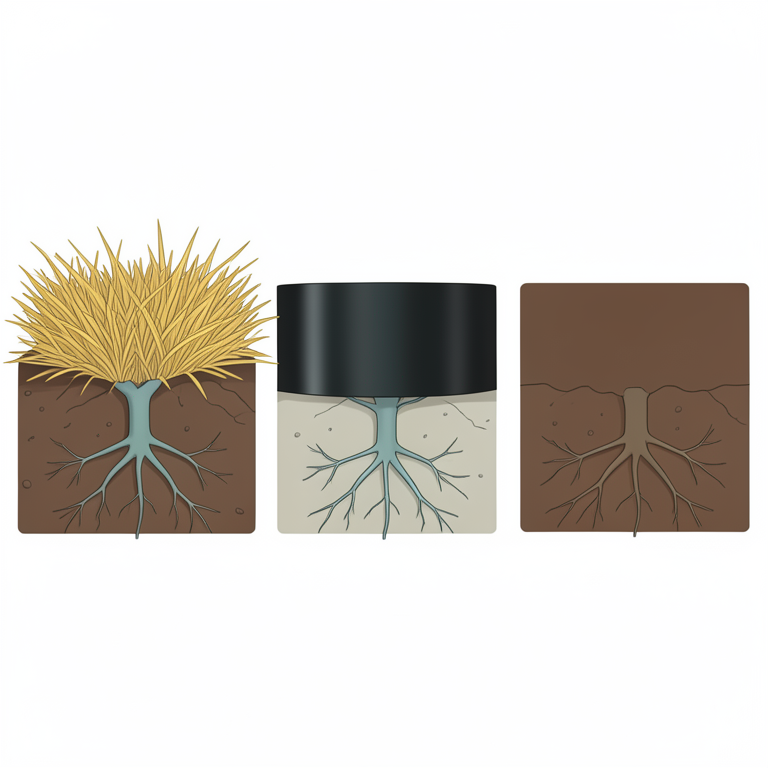
Soil Temperature Comparison
AI-generated conceptual illustration (clove plants in soil). It explains the idea and does not show study data.
View source evidence ↗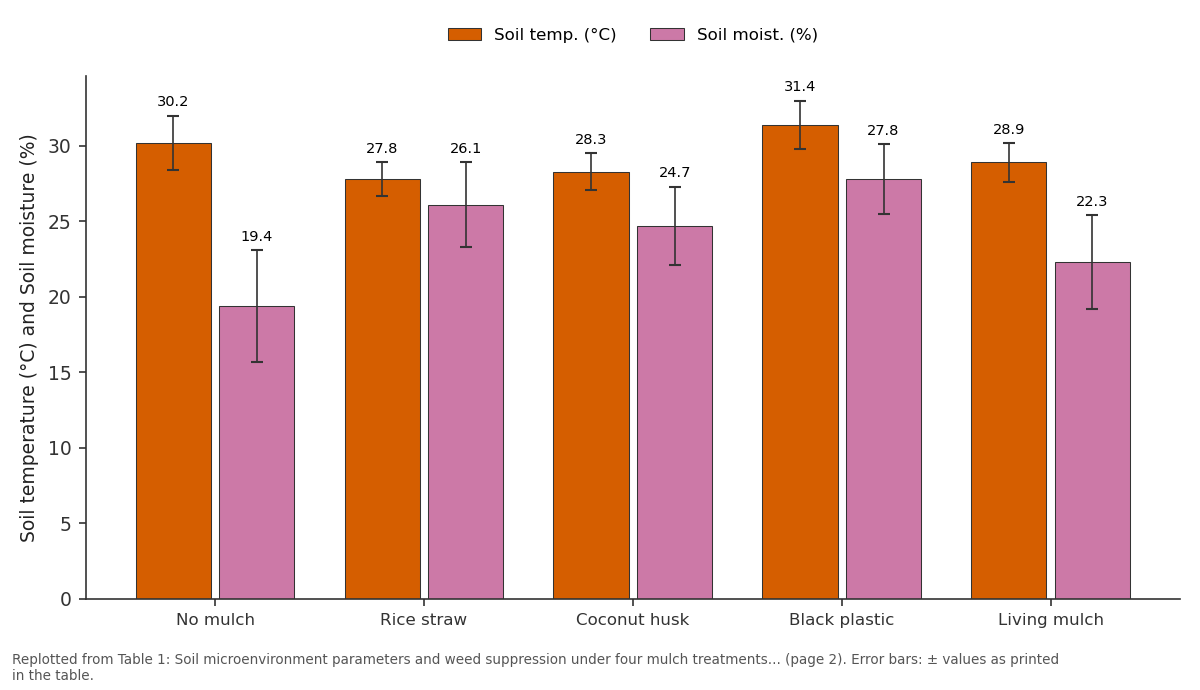
Soil temp. (°C) and Soil moist. (%): No mulch vs Rice straw vs Coconut husk vs Black plastic vs Living mulch
Replotted from Table 1 (page 2) of the original paper. Every bar is the paper's own table value.
View source evidence ↗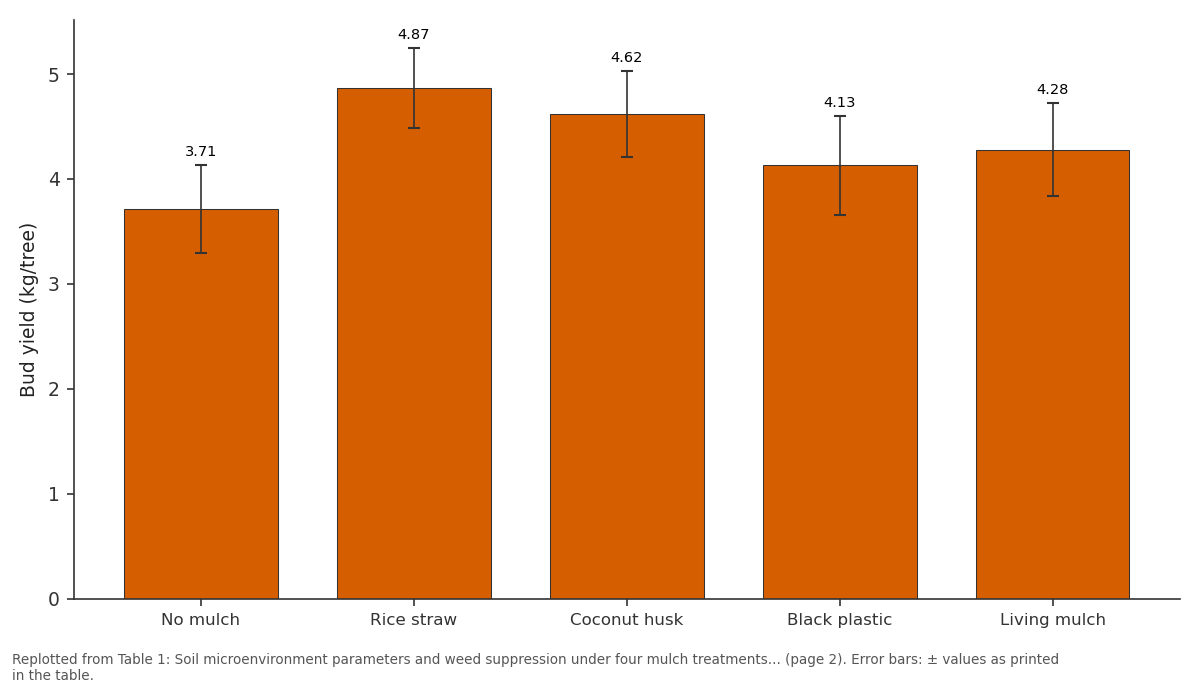
Bud yield (kg/tree): No mulch vs Rice straw vs Coconut husk vs Black plastic vs Living mulch
Replotted from Table 1 (page 2) of the original paper. Every bar is the paper's own table value.
View source evidence ↗Figures & tables
From the original paper Table 1
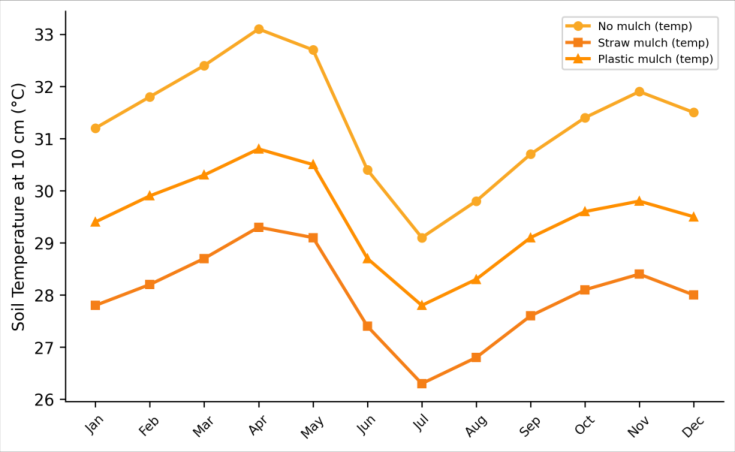 Figure 1
 Table 2
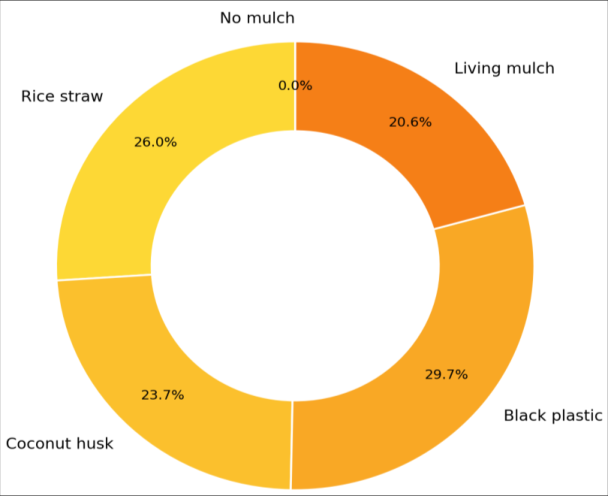 Figure 2
Introduction
Walk through a clove plantation on the Thai Central Plain in March and you'll feel the heat radiating off bare soil surface temperatures can reach 48°C on cloudless afternoons. Those temperatures don't just bake the topsoil; they accelerate organic matter decomposition, kill shallow feeder roots, and drive moisture from the root zone faster than irrigation can replace it [1,2] . Mulching is one of the oldest and cheapest interventions available, yet its use in Thai clove plantations remains inconsistent. The Central Plain of Thailand, a flat alluvial lowland stretching from Bangkok northward through Nakhon Pathom and Ayutthaya, isn't traditional clove country. Clove (Syzygium aromaticum) originates from the Moluccas and grows best where rainfall exceeds 1,500 mm with a brief dry season [3,4] . The Central Plain receives about 1,200 mm annually with a pronounced five-month dry period from November to March, during which irrigation becomes necessary and soil management becomes a limiting factor [5] . Organic mulches like rice straw and coconut husk moderate soil temperature extremes, reduce evaporation, suppress weeds, and add organic matter as they decompose [6,7] . Plastic mulch blocks weeds more effectively but doesn't contribute to soil biology and can trap heat. Living mulches perennial ground covers planted beneath the main crop offer a self-renewing alternative but compete for water and nutrients [8] . Despite a wealth of mulching research on vegetables and annual crops, comparative data for perennial spice trees in the Central Plain are sparse [9] . This research tested four mulch types against a bare control over 18 months, focusing on the soil microenvironment and its connection to bud yield [10,11] .
Crop growth stage documentation
Clove trees at the trial site followed the biannual flowering pattern common in tropical Southeast Asia, with major flushing in April-May and minor flushing in September-October. Buds were harvested at the mature unopened stage (BBCH 59), when they had turned from green to pink but before the petals separated. Two harvests were recorded during the trial: July 2022 and January 2023 for the major and minor flush respectively, plus July 2023 for the second major flush. Vegetative growth, measured as terminal shoot extension, averaged 14.7 cm per flush in mulched plots versus 11.2 cm in control plots [3,4] .
Seasonal variations
The monitoring period (January 2022 to June 2023) covered one and a half annual cycles. Dry season (November-March) rainfall averaged 47 mm per month while wet season (May-October) brought 156 mm per month. Soil temperature at 10 cm depth in bare plots swung from 26.3°C in December to 33.1°C in April. Mulched plots showed a compressed range: rice straw plots stayed between 26.8°C and 29.3°C, a moderation of 3.4°C at the hot extreme. The temperaturebuffering effect was most pronounced during the transition from dry to wet season (April-May), when bare soil heated rapidly before the monsoon rains arrived [2,5] .
Material and Methods Material
The trial was conducted at a 12-year-old Syzygium aromaticum (clone Zanzibar) plantation near Nakhon Pathom, Thailand (13.82°N, 100.04°E, elevation 8 m). Trees were spaced at 8 m × 8 m on a silty clay alluvial soil with pH 6.4 and organic carbon of 1.47%. Five treatments were applied to the 2 m radius basin around each tree: T1 = no mulch (control); T2 = rice straw at 10 cm depth; T3 = shredded coconut husk at 8 cm; T4 = black polyethylene mulch (100 μm thickness); T5 = living mulch of Arachis pintoi established by stolon planting. Mulch was applied in January 2022 and replenished every six months for organic treatments. The research was done in collaboration with the Addis Ababa School of Plant Sciences. Ethics clearance was obtained (Protocol PS-2022-024, approved 12 January 2022).
Methods
Soil temperature was recorded hourly using iButton DS1922L loggers buried at 10 cm depth in each plot. Soil moisture at 20 cm was measured biweekly with a Delta-T SM150 probe. Weed biomass was harvested quarterly from a 1 m² quadrat per plot, oven-dried at 70°C, and weighed; weed suppression was calculated as percentage reduction relative to the control. Clove buds were harvested at the mature pink stage, sun-dried to 12-14% moisture, and weighed per tree. Soil organic carbon was measured at baseline and at 18 months by Walkley-Black method [6,7,10] . The trial used a randomized complete block design with four blocks and three trees per treatment per block (60 trees total). Data were analyzed by ANOVA with Tukey's HSD at p<0.05. 1). Black plastic achieved the highest weed suppression (89.3%) but actually raised soil temperature above the control during hot months. Bud yield under rice straw was 31% higher than the unmulched control and 18% higher than plastic mulch. The yield advantage of rice straw mulch was consistent across all three harvests (Table 2). The minor harvest (January 2023) showed the largest proportional gap: strawmulched trees produced 51% more buds than control trees in this flush, likely because the minor flush falls in the dry season when soil moisture differences between treatments are greatest.
| Treatment | Jul 2022 (major) | Jan 2023 (minor) | Jul 2023 (major) |
|---|---|---|---|
| No mulch | 1.62±0.21 | 0.74±0.12 | 1.35±0.19 |
| Rice straw | 1.94±0.18 | 1.12±0.14 | 1.81±0.16 |
| Coconut husk | 1.87±0.20 | 0.98±0.13 | 1.77±0.18 |
| Black plastic | 1.71±0.22 | 0.83±0.15 | 1.59±0.20 |
| Living mulch | 1.78±0.19 | 0.89±0.14 | 1.61±0.21 |
Table text extracted from the original PDF; superscript letters are shown inline. The original table image is below.
View original table image
Results
Results
Discussion
Rice straw's superiority stems from its combination of low thermal conductivity, high moisture-trapping capacity, and steady nutrient release as it decomposes [6,7] . The +0.18% increase in soil organic carbon over 18 months, while modest in absolute terms, represents a 12% gain over baseline a meaningful improvement for the naturally low-carbon alluvial soils of the Central Plain. And the rice straw is essentially free for farmers in Thailand's rice bowl, where post-harvest burning of straw creates air quality problems that the government actively tries to discourage [1,9] . Black plastic's thermal penalty is a genuine concern. By trapping longwave radiation beneath an opaque barrier, plastic mulch raised soil temperature by 1.2°C above bare ground. For heat-sensitive feeder roots of clove, which concentrate in the top 15 cm, this extra heat may offset the moisture-conservation benefit and explain why plasticmulched trees yielded 15% less than straw-mulched trees despite better weed control [2,10] . The living mulch (Arachis pintoi) occupied an intermediate position on most parameters. Its nitrogen-fixing capacity should, over time, improve soil fertility more than straw, but its water demand during the dry season competed with clove trees for the limited available moisture, reducing its moistureretention benefit [8,11] . A practical note: rice straw requires biannual replenishment as it decomposes, adding a labor cost that coconut husk (slower decomposition) partially avoids. For growers choosing between straw and husk, the marginal yield gain from straw (5.4%) may or may not justify the extra labor depending on local wage rates.
Conclusion
Rice straw mulch at 10 cm depth was the most effective mulching technique for clove on the Thai Central Plain, reducing soil temperature by 3.4°C, raising dry-season moisture by 6.7 percentage points, suppressing 78% of weeds, and increasing bud yield by 31% over unmulched trees. Coconut husk performed nearly as well with slower decomposition. Black plastic mulch excelled at weed control (89%) but penalized yield through soil heating. Living mulch of Arachis pintoi offered moderate improvements across all parameters. These findings support a recommendation for organic mulching as a standard practice in Central Plain clove plantations, with rice straw as the preferred material where availability is not a limitation.
Figures and tables from the paper
| Treatment | Soil temp. (°C) | Soil moist. (%) | Weed supp. (%) | SOC change | Bud yield (kg/tree) |
|---|---|---|---|---|---|
| No mulch | 30.2±1.8 | 19.4±3.7 | — | -0.04% | 3.71±0.42 |
| Rice straw | 27.8±1.1 | 26.1±2.8 | 78.4 | +0.18% | 4.87±0.38 |
| Coconut husk | 28.3±1.2 | 24.7±2.6 | 71.2 | +0.14% | 4.62±0.41 |
| Black plastic | 31.4±1.6 | 27.8±2.3 | 89.3 | -0.02% | 4.13±0.47 |
| Living mulch | 28.9±1.3 | 22.3±3.1 | 62.1 | +0.11% | 4.28±0.44 |
Table text extracted from the original PDF; superscript letters are shown inline. The original table image is below.
View original table image
References
18 in the original paper- Vityakon P, Meepech S, Cadisch G, Toomsan B. Soil organic matter and nitrogen transformation mediated by plant residues of different qualities in sandy acid upland and paddy soils. Netherlands Journal of Agricultural Science. 2000;48(1):75-90.
- Lal R. Soil carbon sequestration impacts on global climate change and food security. Science. 2004;304(5677):1623-1627.
- Purseglove JW, Brown EG, Green CL, Robbins SRJ. Spices Volume 2. Longman Group. 1981;1-608.
- Razak MA, Afandi A, Kadir RA, Hisham MN. Floral biology and phenology of clove. Journal of Tropical Agriculture. 2007;45(1-2):81-84.
- Thai Meteorological Department. Climate data of central Thailand 2015-2023. 2023;Annual Report:1-124.
- Chalker-Scott L. Impact of mulches on landscape plants and the environment: a review. Journal of Environmental Horticulture. 2007;25(4):239-249.
- Kader MA, Senge M, Mojid MA, Ito K. Recent advances in mulching materials and methods for modifying soil environment. Soil and Tillage Research. 2017;168:154166.
- Hartwig NL, Ammon HU. Cover crops and living mulches. Weed Science. 2002;50(6):688-699.
- Ngoc Lan TT, Preston TR, Leng RA. Use of rice straw for feeding and as mulch in Vietnam. Livestock Research for Rural Development. 2006;18(12):Article 176.
- Steinmetz Z, Wollmann C, Schaefer M, Buchmann C, David J, Troger J, et al. Plastic mulching in agriculture: trading short-term agronomic benefits for long-term soil degradation. Science of the Total Environment. 2016;550:690-705.
- Anikwe MAN, Mbah CN, Ezeaku PI, Onyia VN. Tillage and plastic mulch effects on soil properties and growth and yield of cocoyam on an ultisol in southeastern Nigeria. Soil and Tillage Research. 2007;93(2):264-272.
- Kasim WA, Gaafar RM, Abou-Ali RM, Omar MN, Hewait HM. Effect of biofilm forming plant growth promoting rhizobacteria on salinity tolerance in barley. Annals of Agricultural Sciences. 2016;61(2):217-227.
- Tilander Y, Bonzi M. Water and nutrient conservation through the use of agroforestry mulches, and sorghum yield response. Plant and Soil. 1997;197(2):219-232.
- Wuest SB, Caesar-TonThat TC, Wright SF, Williams JD. Organic matter addition, N, and residue burning effects on infiltration, biological, and physical properties of an intensively tilled silt-loam soil. Soil and Tillage Research. 2005;84(2):154-167.
- Bu LD, Liu JL, Zhu L, Luo SS, Chen XP, Li SQ, et al. The effects of mulching on maize growth, yield and water use in a semi-arid region. Agricultural Water Management. 2013;123:71-78.
- Jimenez MN, Pinto JR, Ripoll MA, Sanchez-Miranda A, Navarro FB. Impact of straw and rock-fragment mulches on soil moisture and early growth of holm oaks in a semiarid area. Catena. 2017;152:198-206.
- Pramanik P, Ghosh GK, Ghosal PK, Banik P. Changes in organic carbon, nitrogen, phosphorus and potassium content under rice-wheat cropping system in West Bengal. Journal of Crop and Weed. 2007;3(1):51-54.
- Kumar S, Dey P. Effects of different mulches and irrigation methods on root growth, nutrient uptake, water-use efficiency and yield of strawberry. Scientia Horticulturae. 2011;127(3):318-324.