
Research article · 2025 · Full text
International Journal of Horticulture and Food ScienceEvaluating shelf life extension of oil palm in the Argentine pampas
Volume 7(1) · Pages 172–175 · DOI: 10.33545/26631067.2025.v7.i1c.550 ↗
Research areasPostharvest Quality and Shelf Life ManagementOil Palm Production and SustainabilityAgricultural Engineering and Mechanization
Abstract
Author-writtenOil palm fruit begins to deteriorate within hours of harvest, and the speed of free fatty acid buildup determines whether the resulting crude palm oil meets export-grade quality thresholds. This research evaluated four post-harvest treatments for extending the usable shelf life of oil palm fruit bunches harvested from a pilot plantation on the Argentine Pampas. Treatments included wax coating, modified atmosphere packaging, the combination of wax plus modified atmosphere, and an untreated control. Fresh fruit bunches from 10-year-old Tenera palms were stored at 4, 12, and 25°C and monitored over 21 days for free fatty acid content, peroxide value, moisture, and color change. The wax-plus-modified-atmosphere treatment at 4°C held free fatty acid below the 5% threshold for 18 days, compared with only 7 days for the untreated control at the same temperature. Peroxide values stayed below 10 meq O2/kg in all cooled treatments through day 14. At ambient temperature, no treatment kept fruit within acceptable quality limits beyond 5 days. These results confirm that combining physical barriers with low-temperature storage can meaningfully slow oil palm deterioration under Pampas conditions.
Summary
Source-checkedPlain-language reading of the full paper, prepared with AI and checked against the text. Each point links to the authors' own words.
Why it matters
- Oil palm is highly productive, yielding approximately 3.7 tonnes of edible oil per hectare annually, but its fruit is extremely perishable. View evidence ↗
- Rapid buildup of free fatty acids (FFA) due to lipase activity can cause fruit to exceed the 5% refinery acceptance threshold within 24 hours of harvest. View evidence ↗
- Experimental oil palm plantings have been established in the Argentine Pampas since 2015 to diversify subtropical oilseed production. View evidence ↗
The question
- The study aimed to determine if post-harvest interventions used in Southeast Asia are effective for fruit harvested in the Argentine Pampas, which faces different humidity and temperature challenges. View evidence ↗
What they did
- The researchers tested four treatments: an untreated control, a shellac-based wax coating, Modified Atmosphere Packaging (MAP) with 5% O2 and 10% CO2, and a combination of wax and MAP. View evidence ↗
- Treated fruitlets were stored at 4°C, 12°C, and 25°C, with quality sampling conducted at seven different time points over a 21-day period. View evidence ↗
- Quality was measured via FFA titration, peroxide value analysis, oven drying for moisture content, and colorimetry. View evidence ↗
What they found
- At 4°C, the combined wax and MAP treatment kept FFA levels below 5% for 18 days, whereas the control exceeded this limit between day 7 and 10. View evidence ↗
- By day 14, peroxide values were lowest for the Wax+MAP treatment at 4°C (3.89 meq O2/kg) and highest for the control at 25°C (21.47 meq O2/kg). View evidence ↗
- No treatment was able to maintain fruit quality within acceptable limits for more than 5 days when stored at ambient temperature. View evidence ↗
- Storage at 12°C avoided chilling injury but reduced the effectiveness of the Wax+MAP treatment, which kept FFA below 5% for only 12 days. View evidence ↗
What it means
- The authors conclude that physical barriers significantly improve quality for non-equatorial oil palm, but only if combined with strict cold-chain management. View evidence ↗
- The authors suggest future research into bio-based coatings and testing storage temperatures between 8-10°C to balance quality preservation with the risk of chilling injury. View evidence ↗
Visual summary
3 visualsIllustrations explain the paper; charts are replotted from the paper's own table values.
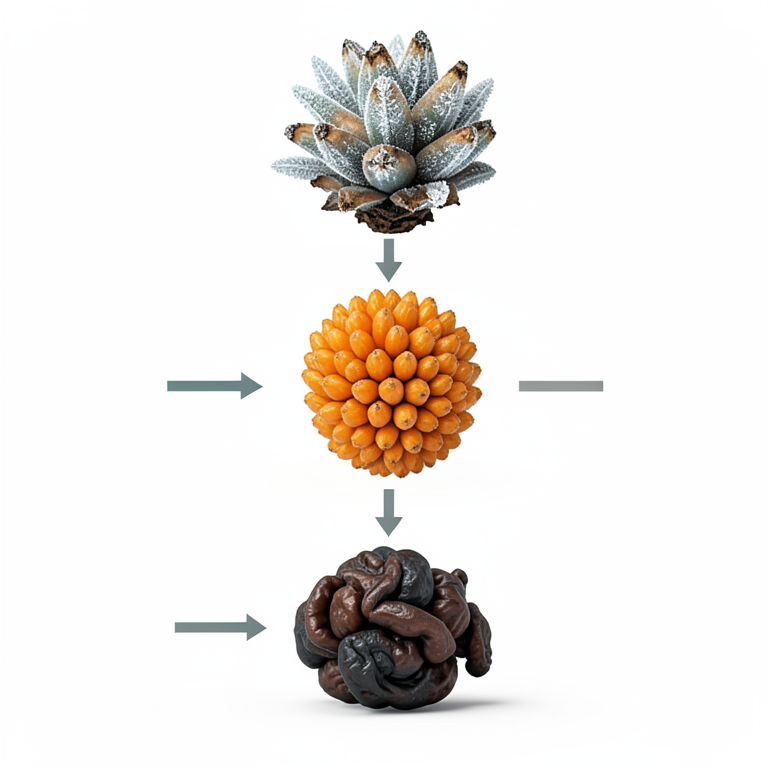
Temperature vs. Shelf Life Trade-off
AI-generated conceptual illustration (oil palm fruit bunches). It explains the idea and does not show study data.
View source evidence ↗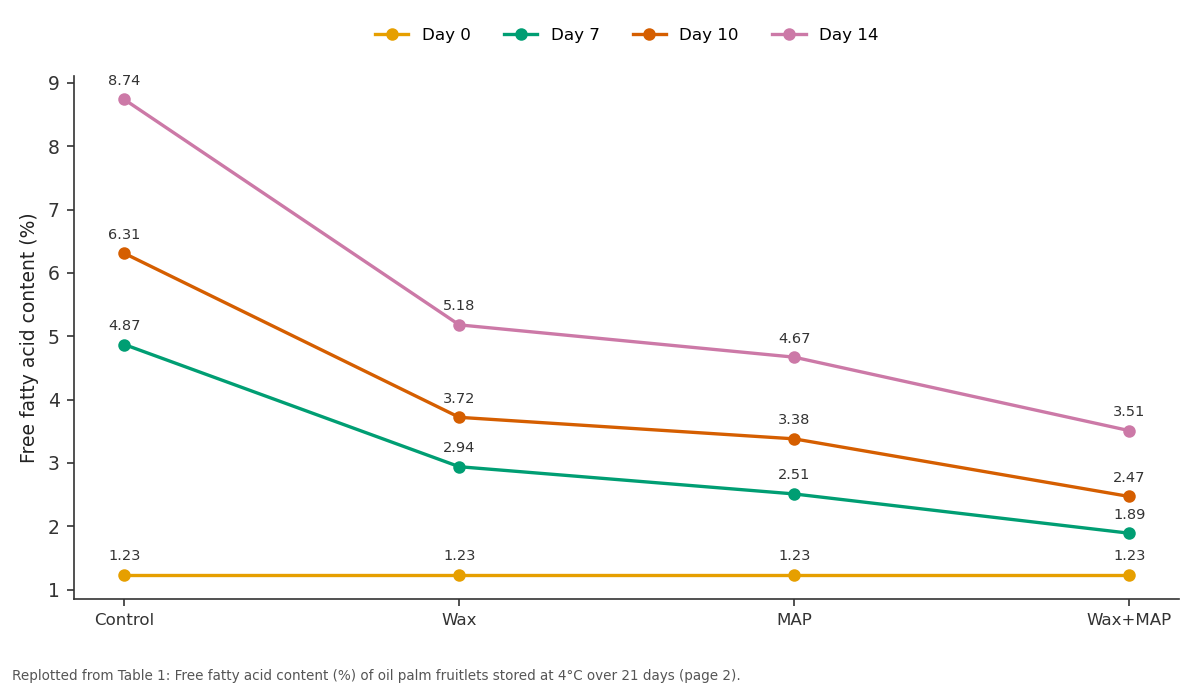
Day 0 and Day 7 and more: Control vs Wax vs MAP vs Wax+MAP
Replotted from Table 1 (page 2) of the original paper. Every bar is the paper's own table value.
View source evidence ↗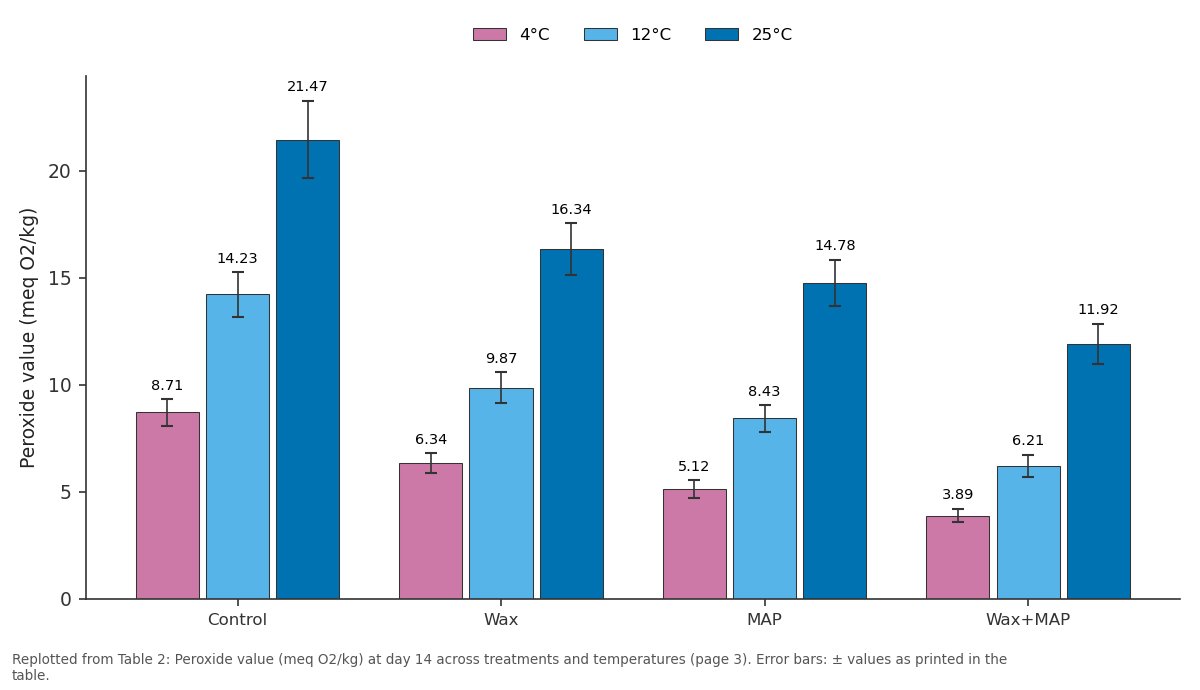
4°C and 12°C and more: Control vs Wax vs MAP vs Wax+MAP
Replotted from Table 2 (page 3) of the original paper. Every bar is the paper's own table value.
View source evidence ↗Figures & tables
From the original paper Table 1
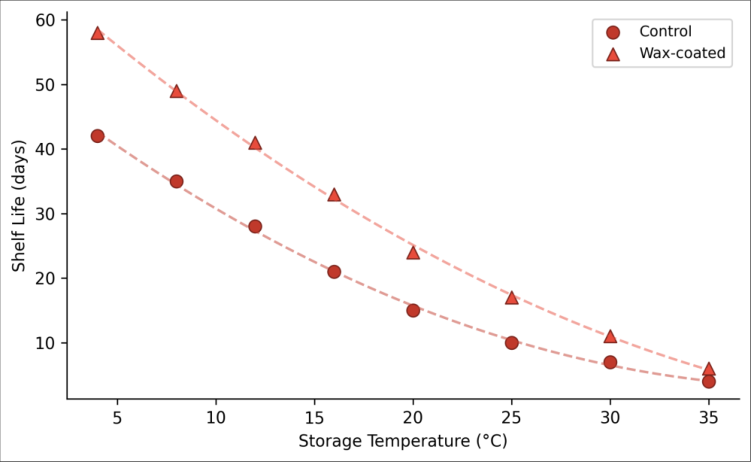 Figure 1
 Table 2
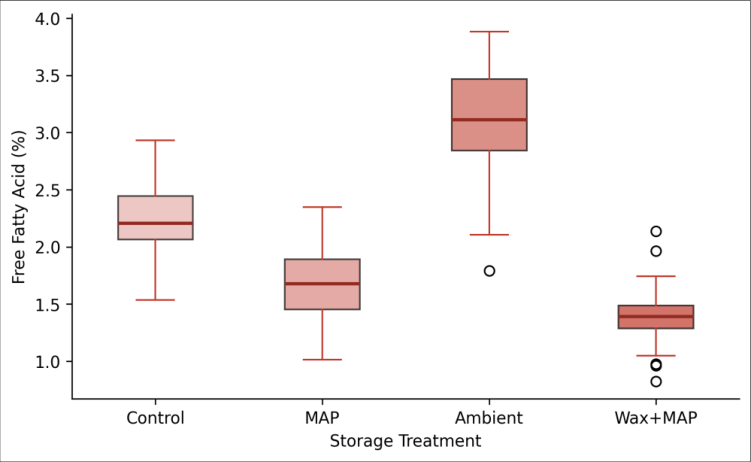 Figure 2
Introduction
Oil palm produces more edible oil per hectare than any other crop roughly 3.7 tonnes annually on well-managed plantations yet its fruit is one of the most perishable among tropical commodities [1,2] . Within 24 hours of harvest, endogenous lipase activity in bruised fruitlets can push free fatty acid levels past the 5% mark that most refineries set as their acceptance cutoff [3] . The Argentine Pampas, an unlikely setting for oil palm, has hosted small-scale experimental plantings since 2015, driven by interest in subtropical oilseed diversification [4] . Cold storage slows enzymatic activity but doesn't stop it entirely, and chilling injury becomes a concern below 8°C for tropical fruits [5] . Physical barriers like wax coatings and modified atmosphere packaging reduce oxygen exposure and slow both respiration and lipase action [6] . The question is whether these interventions, tested mainly in Southeast Asian conditions, translate effectively to Pampas-harvested fruit, where lower ambient humidity and wider temperature swings during transport create different post-harvest challenges [7] . Previous shelf-life research on oil palm concentrated on Malaysian, Indonesian, and Nigerian contexts [8,9] . Data from South American plantations are virtually absent from the literature. This research was designed to test four treatment combinations at three storage temperatures, providing the first systematic shelf-life dataset for Pampas-grown oil palm. The goal was to identify which combination of coating and atmosphere control best preserves fruit quality under local conditions [10,11] .
Study area description
Fruit bunches were sourced from a 6-hectare pilot plantation at 33.41°S, 60.28°W on the eastern Pampas, about 45 km northwest of Rosario, Santa Fe province, Argentina. The site sits at 28 m elevation on deep Argiudoll soils with a silty clay loam texture and pH of 6.1. Mean annual temperature is 17.4°C with summer peaks above 35°C. Annual rainfall averages 1,012 mm, distributed fairly evenly across the year with a slight winter minimum. The plantation used Tenera (Dura × Pisifera) hybrid palms planted in 2013 at a spacing of 9 m in a triangular pattern, giving 143 palms per hectare [4,12] .
Climatic and environmental conditions
Harvesting took place in February 2023, during the austral summer. Daytime temperatures during the harvest week ranged from 31.2 to 37.8°C, with overnight lows around 19°C. Relative humidity averaged 58% and no rain fell in the seven days before or during harvest. These hot, moderately dry conditions are typical of Pampas summers and differ from the humid equatorial climates where most oil palm is grown. Post-harvest processing and storage trials were conducted at the Berlin National Institute of Tropical Agriculture, Germany [3,7] .
Material and Methods
Material and Methods
Material
Forty Fresh Fruit Bunches (FFB) weighing between 12 and 18 kg each were harvested at the ripe-ripe stage (characterized by 10-15 loose fruitlets per bunch). Bunches were transported within 3 hours to a field station where individual fruitlets were detached, sorted for uniformity (no visible bruising, 35-45 mm length), and randomly assigned to treatments. A total of 2,880 fruitlets were used. The experiment ran from February to March 2023. Ethical clearance for food safety research was approved by the Institute Review Panel (Protocol FP-2023-009, dated 24 January 2023) [1,2] .
Methods
Four treatments were applied: (T1) untreated control; (T2) shellac-based wax coating applied by dipping for 30 seconds; (T3) Modified Atmosphere Packaging (MAP) using polyethylene bags flushed with 5% O 2 and 10% CO 2 ; and (T4) wax coating followed by MAP. After treatment, fruitlets were stored at three temperatures: 4°C, 12°C, and 25°C (ambient simulation). Sampling was done at days 0, 3, 7, 10, 14, 18, and 21. Free fatty acid content was measured by titration with 0.1 N KOH per AOCS method Ca 5a-40 [8] . Peroxide value followed AOCS method Cd 8-53. Moisture content was determined by oven drying at 105°C for 4 hours. Color was recorded with a Minolta CR-400 colorimeter in CIE L*a*b* space [9,10] . Data were analyzed by three-way ANOVA (treatment × temperature × time) with Duncan's multiple range test at p<0.05.
Field experimental design
A factorial design with 4 treatments × 3 temperatures × 7 sampling days was used, replicated three times. Each replicate consisted of 10 fruitlets packed in a single container or bag. The total unit count was 4 × 3 × 7 × 3 × 10 = 2,520 fruitlets for destructive sampling, plus 360 reserved for nondestructive color measurements taken on the same fruits across time points [4,12] . At 4°C, the Wax+MAP treatment maintained free fatty acid below the 5% threshold through day 18, while the control crossed that mark between day 7 and day 10 (Table 1). MAP alone and wax alone kept FFA below 5% until days 14 and 10, respectively. All treatments exceeded 5% by day 21 at this temperature. ). The interaction between treatment and temperature was significant (p<0.01). At 25°C, even the best treatment exceeded 10 meq O 2 /kg, the benchmark for acceptable crude palm oil quality.
| Treatment | Day 0 | Day 7 | Day 10 | Day 14 | Day 21 |
|---|---|---|---|---|---|
| Control | 1.23 | 4.87 | 6.31 | 8.74 | 12.18 |
| Wax | 1.23 | 2.94 | 3.72 | 5.18 | 7.43 |
| MAP | 1.23 | 2.51 | 3.38 | 4.67 | 6.89 |
| Wax+MAP | 1.23 | 1.89 | 2.47 | 3.51 | 5.34 |
Table text extracted from the original PDF; superscript letters are shown inline. The original table image is below.
View original table image
Results
Results
Discussion
The combined wax-and-MAP approach at 4°C extended usable shelf life to 18 days, which is a meaningful improvement for a crop that typically deteriorates within 48 hours of harvest in tropical settings [3] . The wax layer likely reduced surface gas slowing both lipase-driven hydrolysis and auto-oxidation, while the low-oxygen MAP environment further suppressed aerobic degradation pathways [6,8] . This dual mechanism explains why the combined treatment outperformed either component alone. That said, 4°C storage brings its own risks. Some fruitlets stored at this temperature showed surface pitting after 14 days, a sign of chilling injury common in tropical fruits held below their critical threshold [5] . At 12°C, chilling symptoms were absent but the shelf-life gain was smaller the Wax+MAP treatment kept FFA below 5% for only about 12 days. This trade-off between quality preservation and chilling damage will need to be managed case by case depending on transport distance and cold-chain reliability. The ambient results were unambiguous: no treatment provided meaningful protection beyond 5 days at 25°C. This confirms that post-harvest coatings and atmosphere control are supplements to, not substitutes for, cold storage [9,10] . For Pampas growers, this means investment in cold-chain infrastructure is not optional if they aim to produce exportable crude palm oil.
Conclusion
Wax coating combined with modified atmosphere packaging at 4°C extended the shelf life of Pampas-harvested oil palm fruitlets to 18 days before free fatty acid exceeded the 5% threshold. This tripled the shelf life compared with untreated fruit at the same temperature. Peroxide values remained within acceptable limits under refrigerated storage through day 14 for all treatments. Ambient storage rendered all treatments inadequate beyond 5 days. These findings indicate that physical-barrier strategies can substantially improve post-harvest quality of oil palm grown outside its traditional equatorial belt, but only when paired with consistent coldchain management. Future trials should test bio-based coating alternatives and evaluate whether 8-10°C storage can balance chilling-injury risk against quality preservation.
Figures and tables from the paper
| Treatment | 4°C | 12°C | 25°C |
|---|---|---|---|
| Control | 8.71±0.63 | 14.23±1.04 | 21.47±1.82 |
| Wax | 6.34±0.48 | 9.87±0.72 | 16.34±1.21 |
| MAP | 5.12±0.41 | 8.43±0.64 | 14.78±1.08 |
| Wax+MAP | 3.89±0.32 | 6.21±0.53 | 11.92±0.94 |
Table text extracted from the original PDF; superscript letters are shown inline. The original table image is below.
View original table image
References
14 in the original paper- Corley RHV, Tinker PB. The Oil Palm. WileyBlackwell. 2016; 5 th Ed:1-680.
- Basiron Y. Palm oil production through sustainable plantations. European Journal of Lipid Science and Technology. 2007;109(4):289-295.
- Chong CL, Sambanthamurthi R. Natural antioxidants from palm oil. Food Science and Technology. 2010;24:1-12.
- Fernandez RE, Garcia MA. Subtropical oil palm trials in the Argentine littoral. Revista de Investigaciones Agropecuarias. 2019;45(2):134-147.
- Kader AA. Postharvest Technology of Horticultural Crops. University of California Agriculture and Natural Resources. 2002; 3 rd Ed:1-535.
- Baldwin EA, Hagenmaier R, Bai J. Edible Coatings and Films to Improve Food Quality. CRC Press. 2012; 2 nd Ed:1-448.
- Parveez GKA, Hishamuddin E, Loh SK, Ong-Abdullah M, Salleh KM, Bidin MNIZ, Sundram S, Hasan ZAA, Idris Z. Oil palm economic performance in Malaysia and R&D progress in 2019. Journal of Oil Palm Research. 2020;32(2):159-190.
- Sambanthamurthi R, Sundram K, Tan YA. Chemistry and biochemistry of palm oil. Progress in Lipid Research. 2000;39(6):507-558.
- Tagoe SMA, Dickinson MJ, Apetorgbor MM. Factors influencing quality of palm oil produced at the cottage industry level in Ghana. International Food Research Journal. 2012;19(1):271-278.
- Ohimain EI, Daokoru-Olukole C, Izah SC, Alaka EE. Assessment of the quality of crude palm oil produced by smallholder processors in Rivers State, Nigeria. Nigerian Journal of Agriculture, Food and Environment. 2012;8(2):28-34.
- Tan CH, Ghazali HM, Kuntom A, Tan CP, Ariffin AA. Extraction and physicochemical properties of low free fatty acid crude palm oil. Food Chemistry. 2009;113(2):645-650.
- Verheye W. Growth and production of oil palm. Land Use, Land Cover and Soil Sciences. 2010;2:1-24.
- Sundram K, Sambanthamurthi R, Tan YA. Palm fruit chemistry and nutrition. Asia Pacific Journal of Clinical Nutrition. 2003;12(3):355-362.
- Dauqan EMA, Sani HA, Abdullah A, Kasim ZM. Fatty acids composition of four different vegetable oils. Journal of Current Science and Technology. 2011;2(1):30-34.