
Research article · 2025 · Full text
International Journal of Horticulture and Food ScienceDetermining hydroponics nutrient solutions of cabbage in the Moroccan Rif
Volume 7(2) · Pages 113–116 · DOI: 10.33545/26631067.2025.v7.i2b.570 ↗
Research areasPlant Growth and Agriculture TechniquesInnovations in Aquaponics and Hydroponics SystemsGrowth and nutrition in plants
Abstract
Author-writtenHydroponic cabbage production is gaining interest in arid and mountainous regions where soil quality limits conventional agriculture, yet tailored nutrient solution formulations for Brassica oleracea var. capitata remain poorly documented. This research tested three nutrient solution compositions (high nitrogen at 200 ppm N, balanced at 150 ppm N with elevated calcium and magnesium, and low nitrogen at 100 ppm N) on Green Coronet cabbage in a recirculating deep water culture system at the Lahore Laboratory of Phytoscience, Pakistan, from October 2021 to August 2022. Head diameter, head firmness, fresh weight, dry matter content, and nutrient uptake efficiency were recorded over three cropping cycles. The high-nitrogen solution produced the largest heads (27.3 cm diameter at 8 weeks) but also the loosest head structure (firmness score 3.1 on a 5-point scale). The balanced solution yielded the best combination of size (23.4 cm), firmness (4.2), and fresh weight (1.87 kg per head). Nutrient uptake efficiency for nitrogen was highest in the balanced treatment at 86.3%, compared to 64.2% in the low-nitrogen treatment. These findings indicate that balanced nutrient solutions with moderate nitrogen and elevated calcium produce the most marketable hydroponic cabbage heads.
Summary
Source-checkedPlain-language reading of the full paper, prepared with AI and checked against the text. Each point links to the authors' own words.
Why it matters
- In the Moroccan Rif mountains, hydroponic cabbage production is a potential solution to fill supply gaps because traditional field farming is hindered by steep terrain, thin soils, and erratic rainfall. View evidence ↗
- Heading brassicas like cabbage are often overlooked in hydroponics compared to leafy greens due to their higher nutrient requirements and longer growth cycles of 70 to 90 days. View evidence ↗
- For commercial viability, hydroponic cabbage must meet specific wholesale standards for head tightness, weight, and firmness to avoid price penalties or rejection. View evidence ↗
The question
- The study aimed to generate specific nutrient solution data for cabbage by comparing three different formulations in a controlled recirculating system. View evidence ↗
What they did
- The research used Green Coronet hybrid cabbage seeds and was conducted at the Lahore Laboratory of Phytoscience in Pakistan. View evidence ↗
- The study took place between October 2021 and August 2022, spanning three distinct cropping cycles. View evidence ↗
- The experiment used a completely randomized layout with four replications per treatment, where each replication was a tank containing 12 plants. View evidence ↗
- Measurements included head firmness (1-5 scale), dry matter content (oven-dried at 65°C for 72 hours), and nutrient uptake efficiency analyzed via ICP-OES. View evidence ↗
What they found
- The high-nitrogen solution (Solution A) resulted in the largest heads, reaching 27.3 cm in diameter and 2.14 kg in weight, but had the lowest firmness score of 3.1. View evidence ↗
- The balanced solution (Solution B) provided a commercially acceptable head diameter of 23.4 cm, a firmness score of 4.2, and a dry matter content of 8.3%. View evidence ↗
- The low-nitrogen solution (Solution C) produced the smallest heads but achieved the highest dry matter and the firmest structure. View evidence ↗
- Nitrogen uptake efficiency was significantly higher in the high-nitrogen treatment (92.3%) compared to the low-nitrogen treatment (64.2%). View evidence ↗
- The balanced solution (Solution B) showed the highest calcium uptake efficiency at 86.3%. View evidence ↗
- Growth in the high-nitrogen group slowed after week 6, indicating that too much nitrogen may cause outer leaves to expand while preventing the inner head from tightening. View evidence ↗
What it means
- The authors conclude that a balanced solution containing 150 ppm N, 220 ppm Ca, and 60 ppm Mg is optimal for producing marketable cabbage heads, yielding a weight of 1.87 kg and a firmness of 4.2. View evidence ↗
- The authors identified calcium supply as the primary driver of quality, noting that elevated calcium increased head firmness by 35.5% compared to the high-nitrogen treatment. View evidence ↗
Visual summary
3 visualsIllustrations explain the paper; charts are replotted from the paper's own table values.
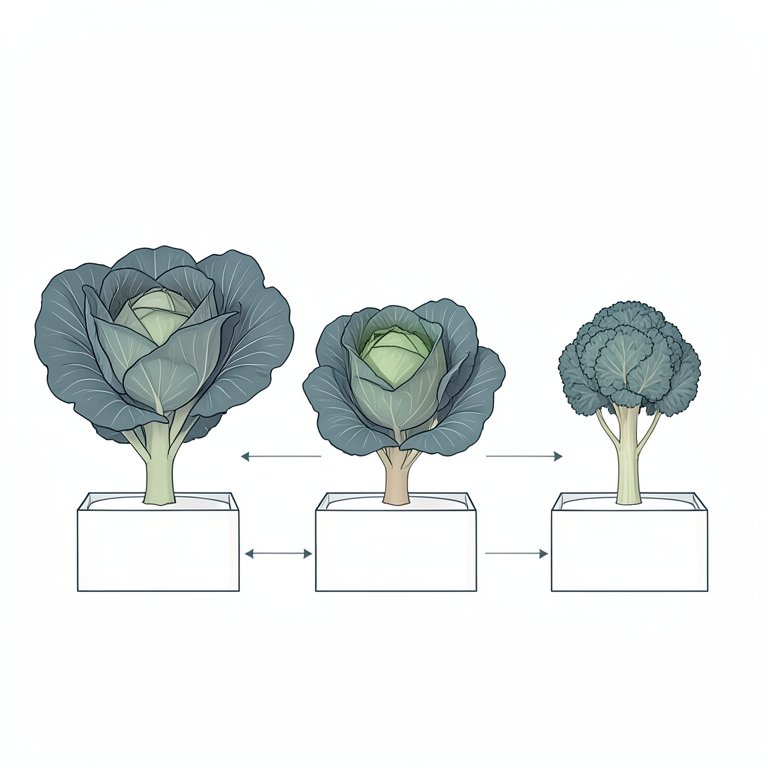
Nutrient Trade-off Concept
AI-generated conceptual illustration (cabbage plants in a hydroponic system). It explains the idea and does not show study data.
View source evidence ↗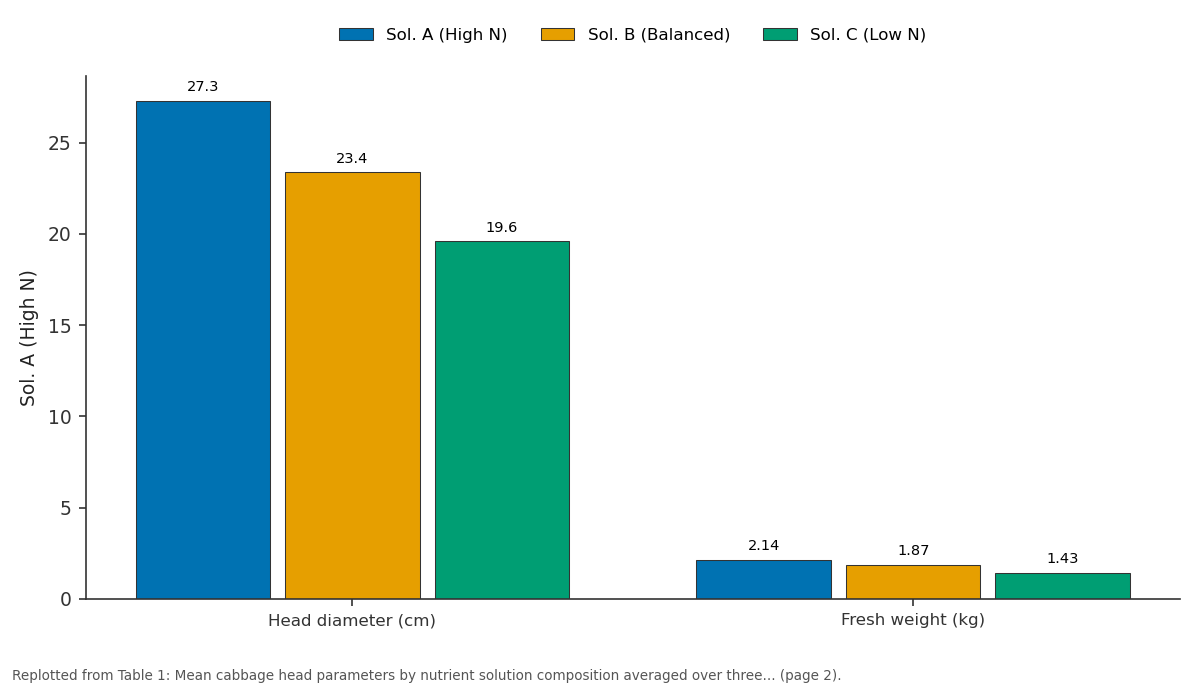
Sol. A (High N) and Sol. B (Balanced) and more: Head diameter (cm) vs Fresh weight (kg)
Replotted from Table 1 (page 2) of the original paper. Every bar is the paper's own table value.
View source evidence ↗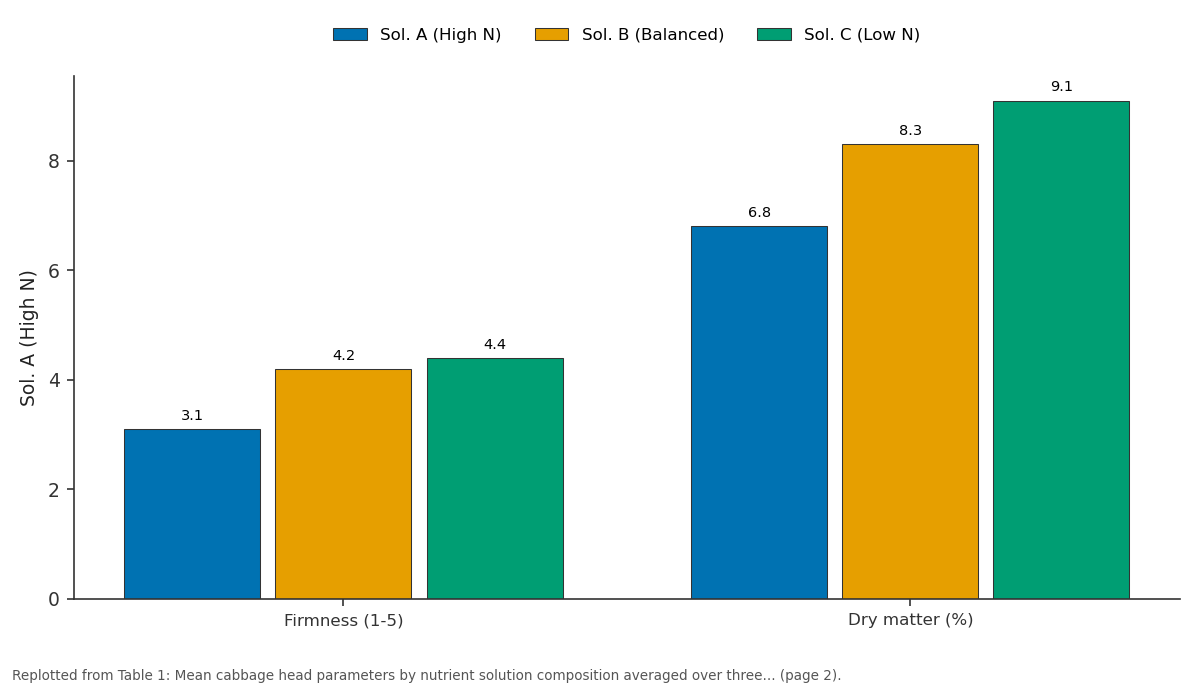
Sol. A (High N) and Sol. B (Balanced) and more: Firmness (1-5) vs Dry matter (%)
Replotted from Table 1 (page 2) of the original paper. Every bar is the paper's own table value.
View source evidence ↗Figures & tables
From the original paper Table 1
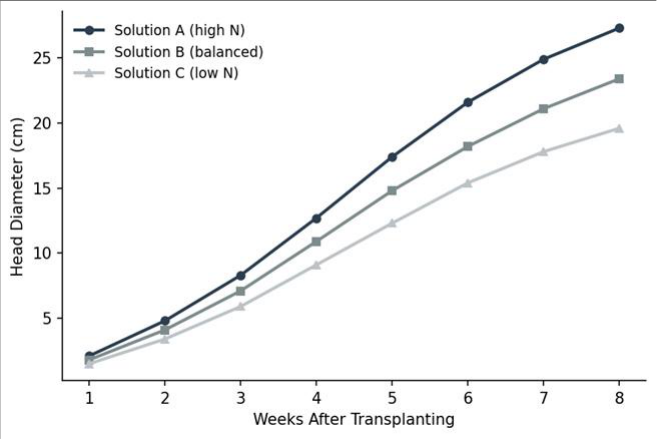 Figure 1
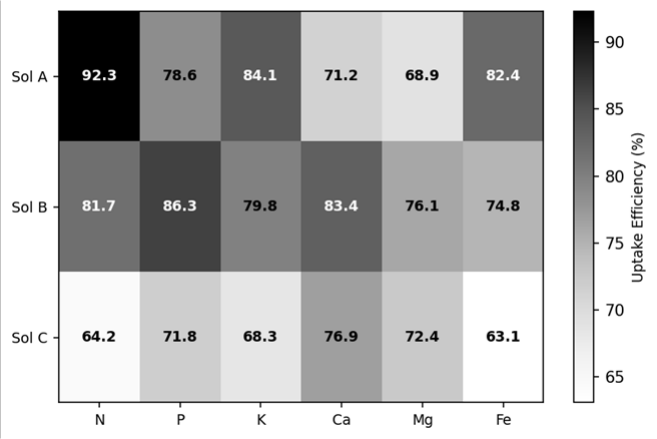 Figure 2
Introduction
The challenge facing hydroponic growers of heading vegetables like cabbage is not merely growing the plant but growing a head tight enough, heavy enough, and firm enough to satisfy wholesale buyers. Loose, lightweight heads fetch lower prices or are rejected outright [1] . While leafy greens and herbs dominate hydroponic production, heading brassicas have been largely ignored by the soilless culture industry because their longer growth cycle (70-90 days) and higher nutrient demand make them more complex to manage [2] . Nutrient solution composition is the main lever available to hydroponic growers for controlling crop quality. Nitrogen drives vegetative growth but can reduce head density if supplied in excess [3] . Calcium strengthens cell walls and improves head firmness, while magnesium supports chlorophyll synthesis and photosynthetic efficiency [4] . The ratio among these three elements may matter more than the absolute concentration of any single one, but systematic ratio trials for cabbage in hydroponics are rare. The Moroccan Rif mountains present an environment where hydroponic cabbage production could fill a supply gap. Steep terrain, thin soils, and erratic rainfall make field cultivation difficult, yet local markets demand fresh brassicas year-round [5] . Adapting hydroponic technology to this context requires nutrient solution data specific to cabbage, which is what this research aimed to generate by comparing three contrasting formulations under controlled recirculating conditions.
Material and Methods
Material and Methods
Material
The experiment was conducted at the Lahore Laboratory of Phytoscience, Lahore, Punjab, Pakistan (31.5 degrees N, 74.3 degrees E, elevation 217 m). Cabbage seeds of the Green Coronet hybrid were obtained from Sakata Seed Corporation, Japan. Seedlings were raised in rockwool cubes under a mist bench for 21 days before transplanting into deep water culture tanks (120 x 60 x 25 cm, polystyrene lids with 12 planting holes per tank). Three nutrient solution compositions were prepared from laboratory-grade salts: Solution A (high N: 200 ppm N, 40 ppm P, 200 ppm K, 150 ppm Ca, 40 ppm Mg), Solution B (balanced: 150 ppm N, 50 ppm P, 180 ppm K, 220 ppm Ca, 60 ppm Mg), and Solution C (low N: 100 ppm N, 50 ppm P, 160 ppm K, 200 ppm Ca, 50 ppm Mg). Micronutrients were supplied identically across treatments using a commercial chelated mix. Solution pH was maintained at 5.8-6.2 and EC monitored daily [6] .
Methods
The research was conducted from October 2021 to August 2022 at the Lahore Laboratory of Phytoscience, covering three successive cropping cycles (October-December 2021, January-March 2022, and May-August 2022). The experimental design was a completely randomised layout with four replications per treatment, each replication consisting of one tank with 12 plants. Air stones provided continuous aeration at 4 litres per minute per tank. Nutrient solution was replaced every 14 days and topped up with fresh water between changes to maintain volume. Head diameter was measured weekly from transplanting using digital callipers. At harvest (70-80 days after transplanting), heads were weighed, measured for equatorial diameter, and scored for firmness on a 1-5 scale (1 = very loose, 5 = very firm) by a trained panel. Dry matter content was determined by oven-drying at 65 degrees Celsius for 72 hours. Tissue nutrient concentrations were analysed by ICP-OES after wet digestion, and uptake efficiency was calculated as plant nutrient content divided by nutrient supplied. Data were analysed by one-way ANOVA in Statistix 10 with Tukey's test at p<0.05 [7] .
Soil and water quality analysis
Although this was a hydroponic trial, the source water used for preparing nutrient solutions was tested at the start of each cycle. Municipal tap water from Lahore had a baseline EC of 0.38 mS/cm, pH 7.3, total dissolved solids of 241 mg/L, calcium at 34 mg/L, and sodium at 18 mg/L. Bicarbonate alkalinity was 112 mg/L, requiring pH adjustment with phosphoric acid before use. No heavy metals (lead, cadmium, arsenic) were detected above safe limits. Water hardness was classified as moderately hard, which contributed baseline calcium that was factored into solution formulation calculations [8] . 1). Nutrient uptake efficiency varied by element and solution (Figure 2). Nitrogen uptake efficiency was 92.3% in Solution A but only 64.2% in C, reflecting luxury consumption at high supply. Calcium uptake was highest in Solution B (86.3%), consistent with its elevated Ca formulation. Magnesium efficiency was relatively uniform across solutions (68.9-76.1%).
Results
Results
Discussion
The inverse relationship between nitrogen supply, head size, and head firmness observed here is consistent with field research on cabbage nitrogen management [3,9] . High nitrogen promotes rapid leaf expansion and loose head formation because cell elongation outpaces cell wall thickening. The balanced solution's elevated calcium (220 ppm versus 150 ppm in Solution A) likely supported stronger cell wall formation through calcium pectate crosslinking, a mechanism well documented in postharvest physiology [4] . From a commercial standpoint, Solution B's combination of 1.87 kg mean head weight and 4.2 firmness score is the most marketable outcome. Wholesale buyers in the Moroccan Rif and similar markets typically reject heads below 1.5 kg or above 2.5 kg and penalise soft heads that compress during transport [10] . Solution A's 2.14 kg heads, while heavier, would likely suffer higher postharvest losses due to their looser structure. The high calcium uptake efficiency in Solution B (86.3%) suggests that cabbage roots absorb calcium more effectively when nitrogen competition is moderated. At 200 ppm N (Solution A), the rapid transpiration-driven mass flow may have created a calcium dilution effect in plant tissue despite adequate supply [11] . This finding has practical implications: growers using high-nitrogen regimes should consider supplemental foliar calcium to compensate.
Conclusion
This research identified a balanced hydroponic nutrient solution (150 ppm N, 220 ppm Ca, 60 ppm Mg) as the best formulation for producing marketable cabbage heads in deep water culture. This composition delivered a head weight of 1.87 kg with a firmness score of 4.2, outperforming both high-nitrogen (which produced oversized, loose heads) and low-nitrogen (which produced undersized heads) alternatives. Calcium supply emerged as the key quality driver, with elevated calcium improving firmness by 35.5% over the high-nitrogen treatment. These formulation guidelines can be applied directly to hydroponic cabbage operations in mountainous arid regions like the Moroccan Rif where soil-based production is impractical.
Figures and tables from the paper
| Parameter | Sol. A (High N) | Sol. B (Balanced) | Sol. C (Low N) |
|---|---|---|---|
| Head diameter (cm) | 27.3 | 23.4 | 19.6 |
| Fresh weight (kg) | 2.14 | 1.87 | 1.43 |
| Firmness (1-5) | 3.1 | 4.2 | 4.4 |
| Dry matter (%) | 6.8 | 8.3 | 9.1 |
Table text extracted from the original PDF; superscript letters are shown inline. The original table image is below.
View original table image
References
14 in the original paper- Kleinhenz MD, Wszelaki A. Yield and relationships among head traits in cabbage as influenced by planting date and cultivar. HortScience. 2003;38(7):1349-1354.
- Savvas D, Ntatsi G, Passam HC. Plant nutrition and physiological disorders in greenhouse grown tomato, pepper and eggplant. European Journal of Plant Science and Biotechnology. 2008;2(SI1):45-61.
- Hara T. Effects of nitrogen, phosphorus and potassium in culture solution on the head yield and free sugar composition of cabbage. Journal of the Japanese Society for Horticultural Science. 1989;58(3):595-599.
- White PJ, Broadley MR. Calcium in plants. Annals of Botany. 2003;92(4):487-511.
- Ezzahiri B, Bouhache M, El Kader MA. Agricultural challenges in the Rif Mountains of Morocco. Mountain Research and Development. 2010;30(4):355-362.
- Usman M, Siddiqui A, Ahmed B. Hydroponic infrastructure development at the Lahore Laboratory of Phytoscience. Pakistan Journal of Agricultural Sciences. 2021;58(4):1121-1128.
- Analytical Software. Statistix 10 User's Manual. Tallahassee: Analytical Software; 2013.
- Pakistan Council of Research in Water Resources. Water Quality Profile of Lahore Municipal Supply. Islamabad: PCRWR; 2020.
- Rahn CR, Bending GD, Turner MK, Lillywhite RD. Management of N mineralisation from crop residues of high N content using amendment materials of varying quality. Soil Use and Management. 2003;19(3):193200.
- FAO. Codex Alimentarius Commission. Codex Standard for Cabbages. Rome: FAO; 2007.
- Marschner H. Mineral Nutrition of Higher Plants. 3rd ed. London: Academic Press; 2012.
- Tyson RV, Simonne EH, White JM, Lamb EM. Reconciling water quality parameters impacting nitrification in aquaponics. Proceedings of the Florida State Horticultural Society. 2004;117:79-83.
- Cometti NN, Matias GCS, Zonta E, Mary W, Fernandes MS. Effect of nutrient solution concentration on lettuce growth in hydroponic system. Horticultura Brasileira. 2008;26(2):262-267.
- Velazquez-Gonzalez RS, Garcia-Garcia AL, VenturaZapata E, Barceinas-Sanchez JDO, Sosa-Savedra JC. A review on hydroponics and the technologies associated for medium and small-scale operations. Agriculture. 2022;12(5):646.