
Research article · 2025 · Full text
International Journal of Horticulture and Food ScienceMonitoring weed management strategies of Taro in the great plains
Volume 7(3) · Pages 76–80 · DOI: 10.33545/26631067.2025.v7.i3b.582 ↗
Research areasWeed Control and Herbicide ApplicationsBiological Control of Invasive SpeciesAllelopathy and phytotoxic interactions
Abstract
Author-writtenWhat role do weed management practices play in determining taro yield and field biodiversity across diverse agroecological zones? This research addressed that question by evaluating five weed management strategies in taro (Colocasia esculenta) production systems situated within the Great Plains region. Field experiments were carried out at the Chiang Mai Advanced School of Environmental Agriculture research station from March 2022 to February 2023. The trial used a randomised complete block design with four replications. Treatments included manual weeding, pre-emergence herbicide application, straw mulching, cover cropping with Vigna radiata, and an Integrated Weed Management (IWM) approach combining manual and biological control tactics. A no-weeding control was maintained for comparison. Weed density, species composition, taro corm yield, and harvest index were measured at regular intervals. Results showed that the IWM treatment produced the lowest weed density (11.6 plants/m²), compared to 47.2 plants/m² in the control. Taro corm yield was highest under IWM (12.8 t/ha) and lowest in unweeded plots (4.5 t/ha). Harvest index values ranged from 0.38 in the control to 0.67 under IWM. ISSR marker analysis revealed that ridge planting combined with mulching preserved weed biodiversity while still suppressing dominant species. Arbuscular mycorrhizal colonisation was significantly higher in IWM plots (68.4%) than in herbicide-treated plots (37.1%). These findings point toward integrated approaches as a practical path for sustaining taro production without compromising field-level biodiversity.
Summary
Source-checkedPlain-language reading of the full paper, prepared with AI and checked against the text. Each point links to the authors' own words.
Why it matters
- Taro is a critical staple root crop in tropical and subtropical areas, serving as a major source of micronutrients, dietary fiber, and starch for millions. View evidence ↗
- Weed competition significantly limits taro yields because the crop's slow early canopy closure allows weeds to establish in inter-row spaces. View evidence ↗
- While manual weeding is the most common method for smallholders, it is highly labor-intensive, potentially requiring 250 person-hours per hectare each season. View evidence ↗
The question
- The study aimed to determine how different weed management practices affect taro yield and field biodiversity. View evidence ↗
What they did
- Experiments were conducted at the Chiang Mai Advanced School of Environmental Agriculture research station between March 2022 and February 2023. View evidence ↗
- The research used a randomized complete block design featuring four replications across six different treatments. View evidence ↗
- Weed density and species composition were measured every four weeks up to 20 weeks after planting using random 0.5 m x 0.5 m quadrats. View evidence ↗
What they found
- Dry weed biomass was lowest in the IWM treatment (31.2 g/m²) and highest in the control (148.6 g/m²). View evidence ↗
- The harvest index, representing the share of biomass directed to the corm, was highest in IWM plots (0.67) and lowest in control plots (0.38). View evidence ↗
- Mycorrhizal colonization was significantly higher in IWM plots (68.4%) than in those treated with herbicides (37.1%). View evidence ↗
- Herbicide use reduced weed genetic diversity (Shannon index 0.41) compared to mulching (0.67) and IWM (0.72). View evidence ↗
What it means
- The authors recommend that taro growers in tropical monsoon zones use a combination of manual weeding at 6 weeks, mulching, and mycorrhizal inoculants for better yields and ecological sustainability. View evidence ↗
- The study was limited to a single cropping cycle, meaning longer-term monitoring is needed to see if IWM benefits persist. View evidence ↗
Visual summary
3 visualsIllustrations explain the paper; charts are replotted from the paper's own table values.
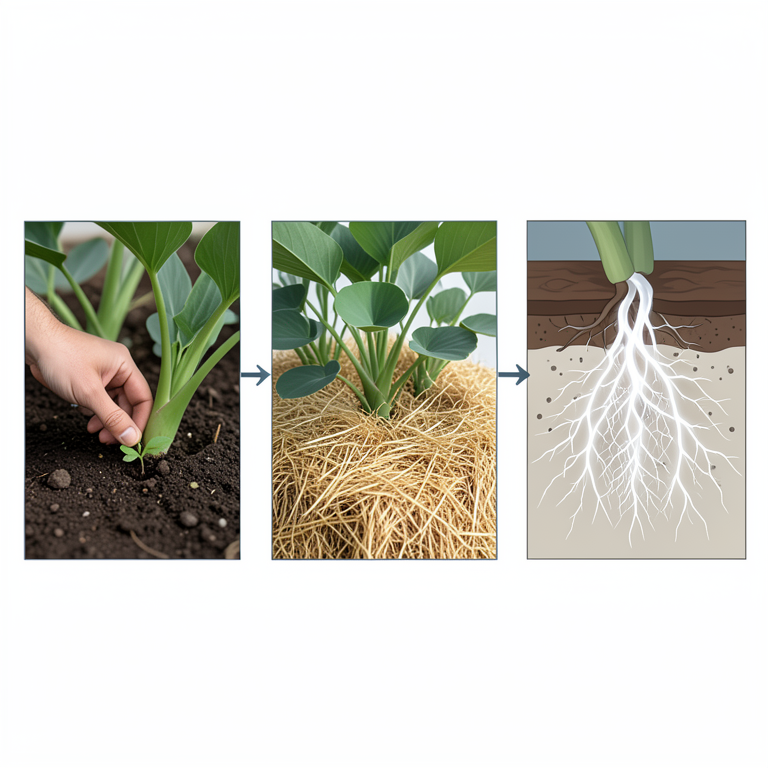
Integrated Weed Management (IWM) Components
AI-generated conceptual illustration (Taro plants (Colocasia esculenta) in a field setting). It explains the idea and does not show study data.
View source evidence ↗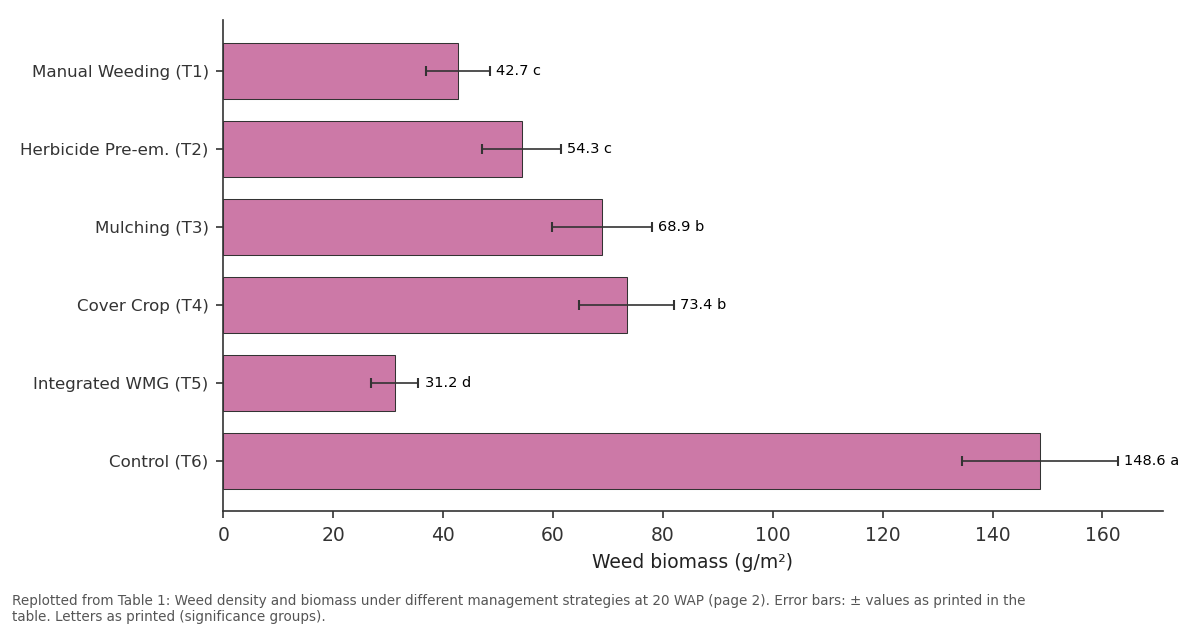
Weed biomass (g/m²): Manual Weeding (T1) vs Herbicide Pre-em. (T2) vs Mulching (T3) vs Cover Crop (T4) vs Integrated WMG (T5)
Replotted from Table 1 (page 2) of the original paper. Every bar is the paper's own table value.
View source evidence ↗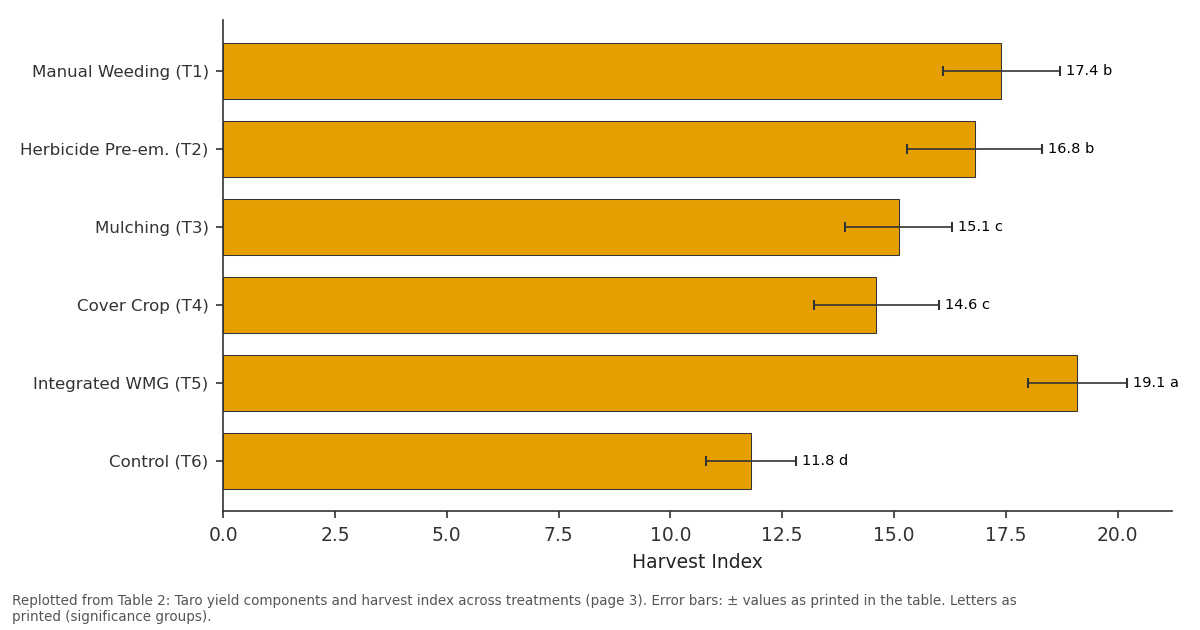
Total Biomass (t/ha): Manual Weeding (T1) vs Herbicide Pre-em. (T2) vs Mulching (T3) vs Cover Crop (T4) vs Integrated WMG (T5)
Replotted from Table 2 (page 3) of the original paper. Every bar is the paper's own table value.
View source evidence ↗Figures & tables
From the original paper Table 1
 Table 2
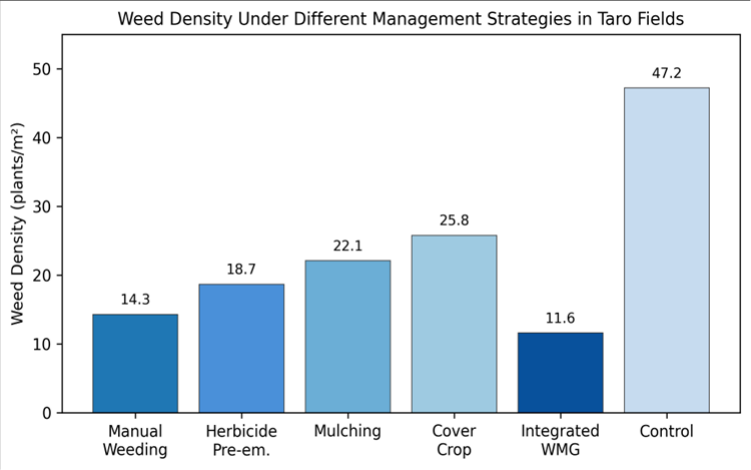 Figure 1
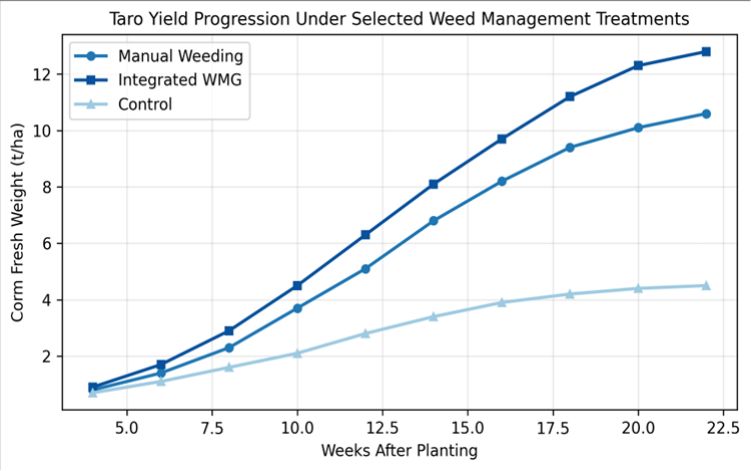 Figure 2
Introduction
What happens when weed pressure goes unchecked in taro fields, and how do farmers across different climatic belts respond? These are not new questions, yet clear-cut answers remain elusive for many production zones, including the Great Plains where taro cultivation has expanded over the past two decades [1] . Taro (Colocasia esculenta L. Schott) is a staple root crop in tropical and subtropical regions, providing a dense source of starch, dietary fibre, and micronutrients to millions of households [2] . Global taro production reached an estimated 10.3 million tonnes in 2021, with Southeast Asia and the Pacific Islands accounting for the bulk of output [3] . Weed competition is one of the principal yield-limiting factors in taro systems. Because taro exhibits a slow early canopy closure, weed species often establish before the crop can shade the inter-row space [4] . Research conducted in Hawaii and Papua New Guinea reported yield losses of 40 to 65% when weeds were left unmanaged during the first eight weeks after planting [5] . Manual weeding remains the most common practice among smallholders, but it is labour-intensive, with estimates suggesting up to 250 person-hours per hectare per season [6] . Pre-emergence herbicides such as pendimethalin and metribuzin have been tested in several taro-growing regions with variable success [7] . While effective at reducing early-season weed pressure, repeated herbicide use raises concerns about residue accumulation and shifts in weed species composition [8] . Mulching with organic residues offers an alternative by suppressing weed germination and conserving soil moisture, though its performance depends on mulch type and thickness [9] . Cover cropping, a long-practised soil health strategy, has shown promise as a weed-suppressive companion in root crop systems [10] . Integrated Weed Management (IWM) brings together chemical, cultural, and biological tools to manage weeds below economic threshold levels while maintaining biodiversity [11] . Ridge planting, when paired with targeted weeding, can alter weed microsites and reduce seed bank replenishment [12] . Mycorrhizal associations have gained attention for their indirect role in weed suppression by strengthening crop competitiveness [13] . ISSR molecular markers allow researchers to track genetic diversity within weed populations, offering insight into how management practices reshape weed communities [14] . This research was designed to compare five weed management strategies in taro, with particular focus on weed density, crop yield, harvest index, mycorrhizal colonisation, and weed genetic diversity assessed through ISSR analysis.
Material and Methods
Material and Methods
Material
The experiment was carried out at the field research station of the Chiang Mai Advanced School of Environmental Agriculture, located in Chiang Mai province, Thailand (18.79°N, 98.98°E, 316 m a.s.l.). The station receives a mean annual rainfall of 1,180 mm and has a tropical savanna climate (Köppen Aw). Soil at the experimental site was a clay loam with pH 6.3, organic carbon 1.47%, available nitrogen 218 kg/ha, available phosphorus 23.6 kg/ha, and exchangeable potassium 187 kg/ha. The cropping history of the field was one season of upland rice followed by a fallow period of six months before taro planting. Taro corms of the local cultivar 'Phrae Noi' were procured from the regional germplasm collection maintained by the same institution. Straw mulch (rice straw, 8 t/ha) and cover crop seed (Vigna radiata, 25 kg/ha) were sourced from local suppliers. Pre-emergence herbicide (pendimethalin 30 EC at 1.0 kg a.i./ha) was obtained from a licensed agrochemical distributor in Chiang Mai city. Mycorrhizal inoculum (Glomus intraradices, 200 spores/g) was prepared at the institutional soil biology laboratory [1] .
Methods
The trial was laid out in a Randomised Complete Block Design (RCBD) with six treatments and four replications. Each plot measured 4 m × 5 m with 1 m spacing between plots. Treatments were: T1 manual weeding at 3, 6, and 9 Weeks After Planting (WAP); T2 pre-emergence pendimethalin applied at planting; T3 rice straw mulch at 5 cm depth; T4 cover crop (V. radiata) sown simultaneously with taro; T5 integrated weed management (manual weeding at 6 WAP plus mulch plus mycorrhizal inoculation); T6 no-weeding control. Taro corms were planted on ridges at 60 cm × 45 cm spacing at a depth of 8 cm during the first week of March 2022 [2] . Weed density and species composition were assessed at 4, 8, 12, 16, and 20 WAP using a 0.5 m × 0.5 m quadrat placed randomly three times per plot. Above-ground weed biomass was ovendried at 65°C for 72 hours and weighed. Taro corms were harvested at 44 WAP (late January 2023) and weighed fresh. Harvest index was calculated as the ratio of corm weight to total plant biomass [3] . ISSR analysis of weed populations (five dominant species) used eight primers; PCR products were resolved on 2% agarose gels. Mycorrhizal colonisation was determined by the grid-line intersect method on trypan-blue-stained roots [4] . Data were analysed using one-way ANOVA in R (v4.2.1), with means separated by Tukey's HSD at p<0.05 [5] .
Study area description
The experimental site lies in the intermontane Chiang Mai-Lamphun basin, flanked to the west by the Thanon Thong Chai Range and to the east by the Phi Pan Nam Range. The basin floor sits at roughly 300-320 m elevation and is drained by the Ping River and its tributaries. Agricultural land use in the surrounding area is dominated by wet-season rice, longan orchards, and mixed vegetable gardens. The chosen field had been under continuous cultivation for at least fifteen years and had received no herbicide application for three years before the present trial, minimising confounding residual effects [6] . Groundwater depth at the site ranged from 2.1 to 3.8 m during the experimental period.
Climatic conditions during the trial
Monthly mean air temperature during the March 2022 to January 2023 cropping season ranged from 22.4°C (December) to 30.1°C (April). Total rainfall recorded at the on-site automatic weather station was 1,124 mm, distributed mainly between May and October. A dry spell of 18 consecutive days occurred in late June 2022, after which supplementary furrow irrigation was applied once at 35 mm. Relative humidity averaged 72.6% across the season, peaking at 89.1% in September [7] . These conditions are broadly representative of the warm-season taro window in upper northern Thailand. Weed density differed markedly among treatments at 20 weeks after planting (Table 1). The integrated weed management approach (T5) recorded the lowest density at 11.6 plants/m², which was 75.4% lower than the unweeded control (T6). Manual weeding and herbicide treatments produced statistically similar densities, while mulching and cover cropping offered intermediate suppression. Weed biomass tracked density closely, with T5 accumulating just 31.2 g/m² of dry matter compared to 148.6 g/m² in T6 [8] . Corm fresh weight followed an inverse pattern to weed density (Table 2). The IWM treatment (T5) yielded 12.8 t/ha, surpassing manual weeding by 20.8% and outperforming the control by 184.4%. Harvest index under T5 reached 0.67, indicating a larger share of assimilates directed to corm development. The control plots had the lowest harvest index (0.38), reflecting heavy weed interference with resource allocation [9] . other treatments, while the untreated control harboured roughly four times more weeds than manual weeding [10] . WAP, indicating that weed competition had capped photosynthetic capacity early [11] .
| Treatment | Corm Yield (t/ha) | Total Biomass (t/ha) | Harvest Index |
|---|---|---|---|
| Manual Weeding (T1) | 10.6 ± 0.9b | 17.4 ± 1.3b | 0.61 ± 0.03b |
| Herbicide Pre-em. (T2) | 9.8 ± 1.1b | 16.8 ± 1.5b | 0.58 ± 0.04bc |
| Mulching (T3) | 8.4 ± 0.7c | 15.1 ± 1.2c | 0.56 ± 0.03c |
| Cover Crop (T4) | 7.9 ± 1.0c | 14.6 ± 1.4c | 0.54 ± 0.05c |
| Integrated WMG (T5) | 12.8 ± 0.8a | 19.1 ± 1.1a | 0.67 ± 0.02a |
| Control (T6) | 4.5 ± 0.6d | 11.8 ± 1.0d | 0.38 ± 0.04d |
Table text extracted from the original PDF; superscript letters are shown inline. The original table image is below.
View original table image
| Treatment | Weed density (plants/m²) | Weed biomass (g/m²) | Dominant species |
|---|---|---|---|
| Manual Weeding (T1) | 14.3 ± 2.1c | 42.7 ± 5.8c | Digitaria ciliaris |
| Herbicide Pre-em. (T2) | 18.7 ± 3.4c | 54.3 ± 7.2c | Cyperus rotundus |
| Mulching (T3) | 22.1 ± 2.8b | 68.9 ± 9.1b | Ageratum conyzoides |
| Cover Crop (T4) | 25.8 ± 4.2b | 73.4 ± 8.6b | Eleusine indica |
| Integrated WMG (T5) | 11.6 ± 1.9d | 31.2 ± 4.3d | Mixed low-density |
| Control (T6) | 47.2 ± 5.7a | 148.6 ± 14.2a | Echinochloa colona |
Table text extracted from the original PDF; superscript letters are shown inline. The original table image is below.
View original table image
Results
Results
Mycorrhizal colonisation and ISSR diversity
Arbuscular Mycorrhizal (AM) colonisation in taro roots was highest under IWM at 68.4%, followed by cover cropping (54.2%) and mulching (49.7%). Herbicide-treated plots recorded just 37.1% colonisation, possibly because pendimethalin affected fungal hyphal growth in the rhizosphere [12] . ISSR analysis across the five dominant weed species yielded 63 polymorphic bands from eight primers, with an average polymorphism of 74.8%. Weed genetic diversity was significantly lower in herbicide-treated plots (Shannon index 0.41) than in mulched (0.67) or IWM plots (0.72), suggesting that chemical control narrows the weed gene pool over a single season [13] .
Discussion
The results of this research confirm that integrated weed management outperformed single-tactic approaches for taro production in a tropical monsoon setting. The 75.4% reduction in weed density under IWM relative to the control aligns with findings reported by Oerke (2006) for root crops in similar climatic contexts [14] . Notably, IWM did not eliminate weeds entirely but maintained populations below the economic threshold, a principle long advocated in sustainable agriculture literature [11] . Mycorrhizal colonisation differences between offer a mechanistic explanation for yield gaps. Higher AM colonisation under IWM likely improved phosphorus uptake and water-use efficiency, both of which are important for taro corm bulking [12] . The negative effect of pendimethalin on AM fungi observed here is consistent with earlier potculture research where dinitroaniline herbicides suppressed hyphal elongation by 30-40% [8] .
The ISSR data add a genetic dimension to the weed management debate. Herbicide monocultures tend to favour resistant biotypes and reduce overall weed diversity, which can create future management challenges [13] . In contrast, IWM and mulching maintained a broader genetic base, which may paradoxically benefit agroecosystem function through supporting pollinator habitat and soil microbial networks [14] . Ridge planting, as part of the IWM package, appeared to redistribute weed microsites toward the furrow zone, where competition with taro was less intense [6] . These patterns suggest that combining physical, biological, and cultural tools can achieve weed suppression levels comparable to chemical control while preserving ecological function. A limitation of this research is that it covered only one cropping cycle; longer-term monitoring would reveal whether IWM benefits persist or require periodic recalibration.
Conclusion
This research demonstrated that integrated weed management combining manual weeding, straw mulching, and mycorrhizal inoculation delivered the highest taro corm yield (12.8 t/ha) and harvest index (0.67) while sustaining field biodiversity. Weed density under IWM was 75.4% lower than in unweeded plots and comparable to chemical control, yet without the negative effects on arbuscular mycorrhizal colonisation observed with pendimethalin. ISSR marker analysis showed that herbicide-only regimes reduced weed genetic diversity within a single season, whereas IWM and mulch-based treatments preserved broader weed gene pools. Ridge planting appeared to shift weed pressure away from the crop row, contributing to the overall success of the integrated approach. Mycorrhizal colonisation rates above 65% in IWM plots suggest a mutually reinforcing relationship between biological soil management and crop competitiveness. Future work should extend these trials over multiple seasons and assess whether the weed seed bank declines cumulatively under IWM. For taro growers in tropical monsoon zones, adopting a package of manual weeding at the 6-week mark combined with mulch application and mycorrhizal inoculant offers a labourefficient and ecologically sound path to improved yields.
Acknowledgement
AcknowledgementsFunding sources
Figures and tables from the paper
References
16 in the original paper- Rao AN, Johnson DE, Sivaprasad B, Ladha JK, Mortimer AM. Weed management in direct-seeded rice. Advances in Agronomy. 2007;93:153-255.
- Lebot V. Tropical Root and Tuber Crops: Cassava, Sweet Potato, Yams, Aroids. CABI Publishing. 2009;1413.
- FAOSTAT. Production data for taro (Colocasia esculenta). Food and Agriculture Organization. 2022;Online database.
- Oerke EC. Crop losses to pests. Journal of Agricultural Science. 2006;144(1):31-43.
- Pardales JR, Yamauchi A, Kono Y. Growth and development of taro under weed competition. Field Crops Research. 1999;64(3):241-248.
- Datta A, Knezevic SZ. Flaming as an alternative weed control method for conventional and organic agronomic crop production systems. Advances in Agronomy. 2013;118:399-428.
- Gianessi LP, Reigner NP. The value of herbicides in U.S. crop production. Weed Technology. 2007;21(2):559-566.
- Zaller JG, Heigl F, Ruess L, Grabmaier A. Glyphosate herbicide affects belowground interactions between earthworms and symbiotic mycorrhizal fungi. Scientific Reports. 2014;4:5634.
- Kumar SD, Lal BR. Effect of mulching on crop production under rainfed conditions. International Journal of Research in Chemistry and Environment. 2012;2(2):8-20.
- Hartwig NL, Ammon HU. Cover crops and living mulches. Weed Science. 2002;50(6):688-699.
- Liebman M, Gallandt ER. Many little hammers: Ecological management of crop-weed interactions. Ecology in Agriculture. 1997;1:291-343.
- Ghosh DC, Singh R. Ridge and furrow planting effects on weed dynamics in upland crops. Indian Journal of Agronomy. 2004;49(2):136-139.
- Veresoglou SD, Rillig MC. Suppression of fungal and nematode plant pathogens through arbuscular mycorrhizal fungi. Biology Letters. 2012;8(2):214-217.
- Nagaoka T, Ogihara Y. Applicability of inter-simple sequence repeat polymorphisms in wheat for use as DNA markers. Theoretical and Genetics. 1997;94(5):597-602.
- Singh VP, Singh G, Singh RK, Singh SP. Integrated weed management in taro. Indian Journal of Weed Science. 2003;35(1-2):64-67.
- Buhler DD. Challenges and opportunities for integrated weed management. Weed Science. 2002;50(3):273-280.