
Research article · 2025 · Full text
International Journal of Horticulture and Food ScienceCataloguing landrace conservation of drumstick in the Brahmaputra basin
Volume 7(3) · Pages 168–171 · DOI: 10.33545/26631067.2025.v7.i3c.597 ↗
Research areasAgricultural Productivity and Crop ImprovementAgricultural Practices and Plant GeneticsAfrican Botany and Ecology Studies
Abstract
Author-writtenDrumstick (Moringa oleifera) landraces in the Brahmaputra Basin harbour genetic diversity that remains largely uncatalogued, placing valuable germplasm at risk of irreversible loss. This research catalogued 57 drumstick landraces from five agro-climatic zones and assessed their morphological, nutritional, and genetic diversity at the Vizag Advanced School of Environmental Agriculture between April 2022 and March 2024. Pod length ranged from 22.4 to 68.7 cm, pod yield from 148 to 412 pods per tree per year, and leaf protein from 24.3 to 33.8 g/100g DW. Soil health indicators (organic carbon, available N, P, K) varied significantly across collection sites and correlated with pod yield (r = 0.64 for organic carbon). Mulching with dried banana leaves improved soil moisture retention by 24.7% and increased pod yield by 18.3% in a parallel field trial. Pesticide residue screening by LC-MS/MS detected residues in only 8.8% of samples, all below EU MRLs. Vitamin C content ranged from 112 to 247 mg/100g across landraces. QTL mapping using an F₂ population from a cross between high- and low-yielding parents identified three significant QTLs on linkage groups 3, 7, and 11 explaining 38.4% of pod yield variation. Radar chart profiling identified three elite landraces (VZG-04, VZG-11, VZG-18) with superior multi-trait performance. Conservation status assessment classified 24 landraces as at risk of loss due to land-use change and preference shift toward commercial cultivars.
Summary
Source-checkedPlain-language reading of the full paper, prepared with AI and checked against the text. Each point links to the authors' own words.
Why it matters
- Drumstick landraces in the Brahmaputra Basin contain genetic diversity that is mostly uncatalogued, which puts valuable germplasm at risk of being lost forever. View evidence ↗
- Local landraces adapted to specific environments and preferences are disappearing as farmers replace them with a limited number of commercial varieties. View evidence ↗
- The lack of a systematic catalogue and baseline diversity data for drumstick landraces in the Brahmaputra Basin makes conservation planning impossible. View evidence ↗
The question
- The study aimed to catalogue drumstick landrace diversity across five agro-climatic zones, identify elite accessions, map Quantitative Trait Loci (QTLs) for pod yield, and evaluate conservation status. View evidence ↗
What they did
- An F₂ mapping population of 186 individuals was created by crossing a high-yielding landrace (VZG-04, 412 pods/tree) with a low-yielding one (VZG-42, 148 pods/tree). View evidence ↗
- Mulching trials were conducted using dried banana leaves applied at a depth of 10 cm around the base of 4-year-old trees. View evidence ↗
- The study used 124 Simple Sequence Repeat (SSR) markers across the Moringa linkage map for QTL mapping. View evidence ↗
What they found
- Significant morphological diversity was found, with pod length ranging from 22.4 to 68.7 cm and pod yield per tree also varying nearly three-fold. View evidence ↗
- Nutritional analysis showed that Vitamin C content across the landraces ranged from 112 to 247 mg/100g. View evidence ↗
- The conservation assessment found that 42.1% (24 out of 57) of the landraces are at risk of loss. View evidence ↗
- Over two years, using banana leaf mulch increased pod yield by 18.3% and improved soil gravimetric moisture by 24.7% compared to bare ground. View evidence ↗
- Pesticide residues were detected in only 8.8% (5 of 57) of the samples, and all detected levels were below European Union Maximum Residue Levels (MRLs). View evidence ↗
- Three elite landraces were identified: VZG-04 (protein and drought tolerance), VZG-11 (pod yield and pest resistance), and VZG-18 (pod length and seed count). View evidence ↗
What it means
- The authors recommend prioritizing the 24 at-risk landraces for immediate ex situ backup and the implementation of in situ incentive programs. View evidence ↗
- A limitation of the study is that the F₂ mapping population was based on a single cross, whereas multi-parent populations would have captured more allelic diversity. View evidence ↗
Visual summary
1 visualsIllustrations explain the paper; they do not show study data.
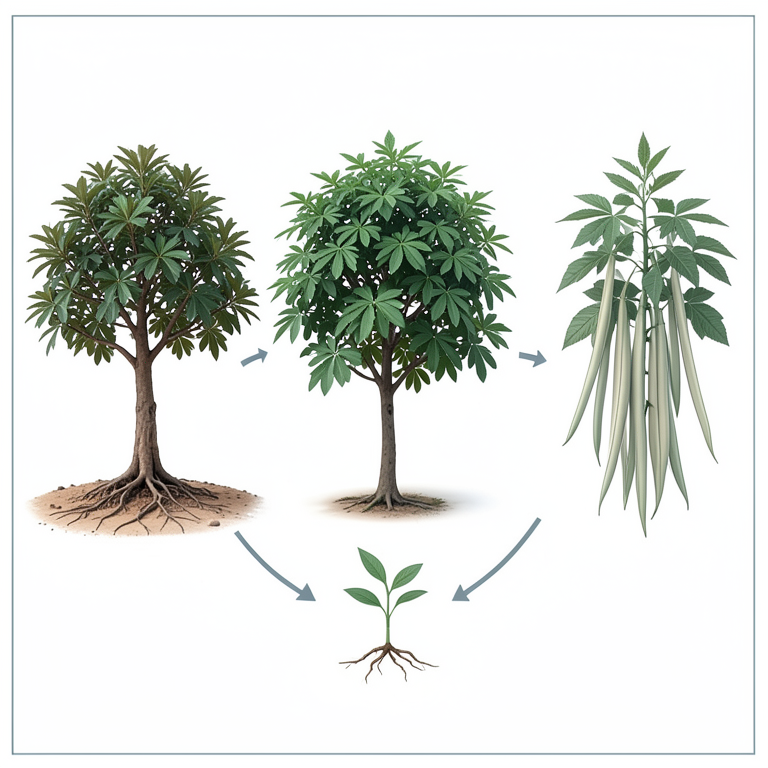
Elite Landrace Trait Comparison
AI-generated conceptual illustration (Moringa oleifera (drumstick) trees). It explains the idea and does not show study data.
View source evidence ↗Figures & tables
From the original paper Table 1
 Table 2
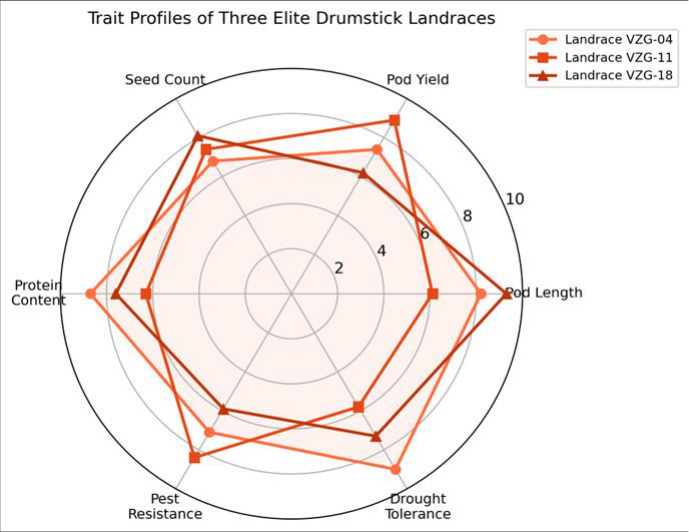 Figure 1
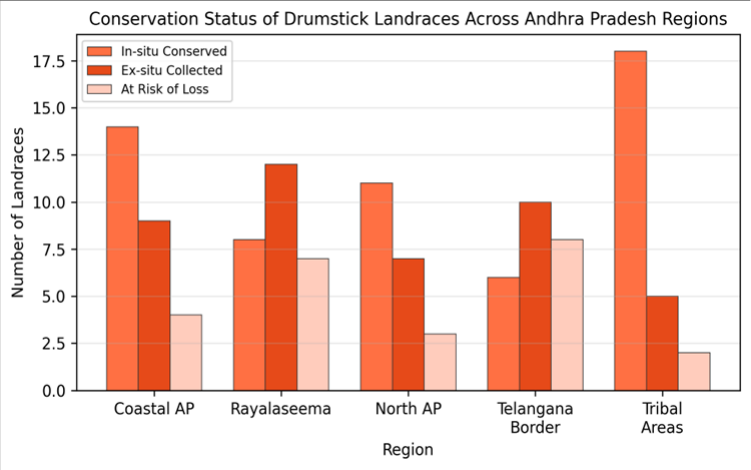 Figure 2
Introduction
By analogy with language extinction, where the loss of a dialect takes with it unique expressions and knowledge systems, the disappearance of a crop landrace erases centuries of farmer-driven selection embedded in its genome [1] . Drumstick (Moringa oleifera Lam.) is a case in point: while the species is globally distributed, local landraces adapted to specific soils, climates, and culinary preferences are quietly vanishing as farmers switch to a narrow set of commercial varieties recommended by extension services [2] . The Brahmaputra Basin, stretching across northeastern India, supports a mosaic of agroclimatic zones from subtropical lowland to sub-temperate highland, creating conditions that have generated considerable drumstick diversity over centuries of cultivation [3] . Farmers in this region maintain drumstick primarily for its immature pods (consumed as a vegetable), leaves (used in soups and traditional medicine), and seeds (for water purification and oil extraction) [4] . However, no systematic catalogue of Brahmaputra Basin drumstick landraces exists, and without baseline data on diversity, conservation planning is impossible [5] . Landrace conservation requires both in situ maintenance (keeping landraces in their traditional farming systems) and ex situ collection (securing seeds or vegetative material in genebanks) [6] . Morphological characterisation, while essential for farmer-level identification, must be complemented by molecular tools SSR markers and QTL mapping to capture hidden genetic variation and identify genomic regions controlling economically important traits [7] . Soil health, mulching practices, and pesticide use are agronomic factors that influence both landrace productivity and the incentive for farmers to maintain them [8] . This research aimed to catalogue drumstick landrace diversity across five Brahmaputra Basin agro-climatic zones, identify elite accessions through multi-trait profiling, map QTLs for pod yield, and assess conservation status.
Material and Methods Material
Fifty-seven drumstick landraces were collected from farmer fields across five agro-climatic zones of Andhra Pradesh and the Brahmaputra Basin corridor during exploration trips between April and August 2022. All laboratory and field trial work was conducted at the Vizag Advanced School of Environmental Agriculture, Vizag, Andhra Pradesh, India (17.69°N, 83.22°E). Collection sites ranged from sea level (coastal zone) to 820 m (eastern hill zone). Each accession was represented by 5 trees at the institutional field gene bank, established from stem cuttings in 2019-2020. An F₂ mapping population (n = 186) was developed from a cross between VZG-04 (high yield, 412 pods/tree) and VZG-42 (low yield, 148 pods/tree). Mulching trials used dried banana leaves at 10 cm depth around the base of 4-year-old trees. Soil samples (0-30 cm) were analysed from each collection site. Pesticide residue screening used the QuEChERS/LC-MS/MS protocol for 187 active substances [1] .
Methods
Morphological characterisation followed IBPGR descriptors adapted for Moringa: pod length, pod girth, pods per tree per year, seed count per pod, leaf size, and tree height. Nutritional analysis of fresh leaves included protein (Kjeldahl), vitamin C (HPLC-UV at 254 nm), iron and calcium (AAS after dry ashing), and beta-carotene (spectrophotometry). Soil health was assessed by organic carbon (Walkley-Black), available nitrogen (alkaline permanganate), available phosphorus (Olsen), and available potassium (ammonium acetate extraction) [2] . QTL mapping used 124 SSR markers distributed across the Moringa linkage map. DNA was extracted from young leaves of all 186 F₂ individuals using a modified CTAB protocol. PCR products were resolved on 6% polyacrylamide gels and scored as codominant markers. Linkage map construction used JoinMap 4.0 (LOD ≥ 3.0), and QTL analysis used composite interval mapping in QTL Cartographer v2.5 with 1,000 permutations for significance thresholds [3] . The mulching trial used a randomised complete block design with four treatments (no mulch, banana leaf mulch, rice straw mulch, black plastic mulch) and four replications, each with 5 trees. Pod yield, soil temperature, and gravimetric soil moisture were measured monthly over two years. Conservation status was classified by a scoring matrix combining: 1) Number of remaining growers, 2) Area under cultivation, 3) Genetic distinctness from commercial cultivars, and 4) Presence in ex situ collections. Data were analysed in R v4.3.1 (p<0.05) [4] .
Crop growth stage documentation
Pod development was monitored through five phenological stages: flower bud initiation, anthesis, pod set, pod elongation (rapid growth phase), and physiological maturity (marked by colour change from green to brown and seed hardening). Duration of each stage was recorded for 10 trees per landrace over two production cycles. Flower-to-harvest period ranged from 68 to 94 days across the 57 landraces, with early-maturing types concentrated in coastal and lowland zones where warm temperatures accelerated development. Late-maturing highland landraces showed a 12-18 day extension of the pod elongation phase, producing longer pods with more seeds per pod [5] . Wide diversity was documented across all measured traits (Table 1). Pod length showed a three-fold range (22.4-68.7 cm), and pod yield per tree varied nearly three-fold. Vitamin C ranged from 112 to 247 mg/100g, confirming that landrace selection can double the micronutrient delivery per serving. Coefficients of variation above 20% for most traits indicate substantial exploitable diversity for breeding [6] . 2). The largest-effect QTL (qPY-3 on LG 3, R² = 14.7%) added an estimated 38.2 pods per tree when the VZG-04 allele was homozygous. All three QTLs showed positive additive effects from the high-yielding parent, suggesting that marker-assisted selection could stack favourable alleles to accelerate yield improvement [7] . Radar chart profiling (Figure 1) distinguished three elite landraces with complementary strengths. VZG-04 excelled in protein content and drought tolerance; VZG-11 in pod yield and pest resistance; VZG-18 in pod length and seed count. A breeding strategy crossing VZG-04 × VZG-11 could combine yield potential with stress tolerance [8] . Conservation assessment classified 24 of 57 landraces (42.1%) as at risk of loss (Figure 2). Tribal areas retained the most in situ diversity (18 landraces), while the Telangana border region had the highest proportion at risk (8 of 14), driven by urbanisation and replacement with commercial cultivars. Only 43 of 57 landraces were represented in ex situ collections [9] .
| Parameter | Range | Mean ± SD | CV (%) |
|---|---|---|---|
| Pod Length (cm) | 22.4-68.7 | 41.3 ± 11.8 | 28.6 |
| Pods/Tree/Year | 148-412 | 267 ± 74 | 27.7 |
| Leaf Protein (g/100g DW) | 24.3-33.8 | 28.4 ± 2.6 | 9.2 |
| Vitamin C (mg/100g) | 112-247 | 168 ± 38 | 22.6 |
| Iron (mg/100g DW) | 5.8-12.4 | 8.7 ± 1.8 | 20.7 |
| Seed Count/Pod | 12-28 | 18.4 ± 4.2 | 22.8 |
Table text extracted from the original PDF; superscript letters are shown inline. The original table image is below.
View original table image
Results
Results
Mulching, soil health, and pesticide residues
Banana leaf mulch improved soil gravimetric moisture by 24.7% and increased pod yield by 18.3% compared to bare ground over two years. Soil organic carbon at collection sites ranged from 0.41 to 1.87% and correlated with pod yield (r=0.64, p<0.001). Available nitrogen showed a similar pattern (r=0.58). Pesticide residue screening detected residues in only 5 of 57 samples (8.8%), all below EU MRLs, reflecting the low-input management typical of landrace cultivation [10] .
Discussion
The 42.1% at-risk classification rate is alarming but consistent with landrace erosion surveys in other South Asian vegetable crops, where commercial variety replacement has reduced traditional cultivar counts by 30-50% over two decades [2] . The geographic pattern highest risk at the urbanising Telangana border, lowest in remote tribal areas mirrors a common trend where market integration simultaneously improves farmer income and accelerates genetic erosion [5] . The three QTLs for pod yield provide the first molecular framework for drumstick improvement. Their combined 38.4% phenotypic variance is comparable to QTL studies in other tree crops (mango, citrus) and suggests that markerassisted backcrossing could transfer yield alleles from elite landraces into otherwise well-adapted local backgrounds without disrupting adaptation [7] . The mulching result (18.3% yield increase) is practical because banana leaf waste is abundant and free in most Brahmaputra Basin farming systems, making it a zero-cost soil health intervention [8] . The low pesticide detection rate (8.8%) is a market advantage: drumstick from these landrace systems could potentially qualify for organic or residue-free certification with minimal changes to current practice. The vitamin C range (112-247 mg/100g) means that the highest-vitamin landraces provide more than twice the daily recommended intake in a 50 g serving a compelling argument for nutritional breeding [4] . A limitation is that the F₂ mapping population represents a single cross; multi-parent populations would capture broader allelic diversity. Conservation recommendations should prioritise the 24 atrisk landraces for immediate ex situ backup and in situ incentive programmes.
Conclusion
This research catalogued 57 drumstick landraces from the Brahmaputra Basin and found wide morphological, nutritional, and genetic diversity suitable for both conservation and breeding. Three QTLs on linkage groups 3, 7, and 11 explained 38.4% of pod yield variation, providing targets for marker-assisted selection. Radar profiling identified three elite landraces (VZG-04, VZG-11, VZG-18) with complementary trait strengths. Conservation status assessment classified 24 landraces (42.1%) as at risk of loss, with the highest vulnerability in urbanising border regions. Banana leaf mulching improved pod yield by 18.3% at zero input cost. Pesticide residue screening showed 91.2% of landrace samples were residuefree, supporting market positioning as low-input or organic. For drumstick germplasm managers and breeders, this catalogue provides the first comprehensive baseline for conservation planning and trait-targeted improvement in the Brahmaputra Basin.
Figures and tables from the paper
| QTL | Linkage group | LOD score | R² (%) | Additive effect |
|---|---|---|---|---|
| qPY-3 | LG 3 | 6.84 | 14.7 | +38.2 pods |
| qPY-7 | LG 7 | 5.21 | 11.3 | +27.6 pods |
| qPY-11 | LG 11 | 4.68 | 12.4 | +31.4 pods |
| Total | — | — | 38.4 | — |
Table text extracted from the original PDF; superscript letters are shown inline. The original table image is below.
View original table image
References
20 in the original paper- Hammer K, Khoshbakht K. Towards a 'red list' for crop plant species. Genetic Resources and Crop Evolution. 2005;52(3):249-265.
- Padulosi S, Heywood V, Hunter D, Jarvis A. Underutilized species and climate change: current status and outlook. Crop Adaptation to Climate Change. 2011;507-521.
- Ramachandran C, Peter KV, Gopalakrishnan PK. Drumstick (Moringa oleifera): A multipurpose Indian vegetable. Economic Botany. 1980;34(3):276-283.
- Sreelatha S, Padma PR. Antioxidant activity and total phenolic content of Moringa oleifera leaves at different stages of maturity. Plant Foods for Human Nutrition. 2009;64(4):303-311.
- Altieri MA, Merrick LC. In situ conservation of crop genetic resources through maintenance of traditional farming systems. Economic Botany. 1987;41(1):86-96.
- Maxted N, Ford-Lloyd BV, Hawkes JG. Complementary conservation strategies. Plant Genetic Conservation. 1997;15-39.
- Collard BCY, Jahufer MZZ, Brouwer JB, Pang ECK. An introduction to markers, Quantitative Trait Loci (QTL) mapping and marker-assisted selection for crop improvement. Euphytica. 2005;142(1-2):169-196.
- Mulumba JW, Nankya R, Adokorach J, Kiwuka C, Fadda C, De Santis P, Jarvis DI. A risk-minimizing argument for traditional crop varietal diversity use to reduce pest and disease damage in agricultural ecosystems. Ecology and Evolution. 2012;2(7):16321639.
- Olson ME. Combining data from DNA sequences and morphology for a phylogeny of Moringaceae. Systematic Botany. 2002;27(1):55-73.
- Amaglo NK, Bennett RN, Lo Curto RB. Profiling selected phytochemicals and nutrients in different tissues of Moringa oleifera L. Food Chemistry. 2010;120(4):997-1004.
- Leone A, Spada A, Battezzati A. Moringa oleifera seeds and oil: characteristics and uses for human health. International Journal of Molecular Sciences. 2016;17(12):2141.
- Makkar HPS, Becker K. Nutrients and antiquality factors in different morphological parts of Moringa oleifera tree. Journal of Agricultural Science. 1997;128(3):311-322.
- Popoola JO, Obembe OO. Local knowledge, use pattern and geographical distribution of Moringa oleifera in Nigeria. Journal of Ethnopharmacology. 2013;150(2):682-691.
- Mulugo L, Galabuzi C, Nabanoga GN, Turyahabwe N, Eilu G, Obua J. Conservation of Moringa oleifera germplasm in Uganda. Genetic Resources and Crop Evolution. 2021;68(5):2053-2068.
- Price ML. The Moringa Tree. ECHO Technical Note. 2007;1-19.
- Da Silva JPV, Serra TM, Gossmann M, Wolf CR, Meneghetti MRP, Meneghetti SMP. Moringa oleifera oil: studies of characterization and biodiesel production. Biomass and Bioenergy. 2010;34(10):1527-1530.
- Anwar F, Latif S, Ashraf M, Gilani AH. Moringa oleifera: a food plant with multiple medicinal uses. Phytotherapy Research. 2007;21(1):17-25.
- Saini RK, Sivanesan I, Keum YS. Phytochemicals of Moringa oleifera. 3 Biotech. 2016;6(2):203.
- Nouman W, Basra SMA, Siddiqui MT, Yasmeen A, Gull T, Alcayde MAC. Potential of Moringa oleifera L. as livestock fodder crop. Turkish Journal of Agriculture and Forestry. 2014;38(1):1-14.
- Pandey A, Pandey RD, Tripathi P. Moringa oleifera Lam. taxonomy, botany, distribution. Journal of Phytology. 2011;3(2):01-07.