
Research article · 2025 · Full text
International Journal of Horticulture and Food ScienceModeling rootstock influence of pecan in the Central Asian steppe
Volume 7(2) · Pages 93–96 · DOI: 10.33545/26631067.2025.v7.i2b.565 ↗
Research areasPlant Physiology and Cultivation StudiesGenetics and Plant BreedingIrrigation Practices and Water Management
Abstract
Author-writtenPecan (Carya illinoinensis) cultivation beyond its native range in the south-central United States has a history stretching back to the early twentieth century, when experimental orchards were planted in Australia, South Africa, and parts of southern Europe. This research modelled the influence of three rootstock genotypes (UCB-1 seedling, Nemaguard, and Lovell) on pecan scion growth, precocity, and early nut yield under conditions representative of the Central Asian steppe climate during 2019-2023 at the Toronto National Institute of Tropical Agriculture. A total of 180 grafted trees of the Pawnee cultivar were established in a randomised complete block design with four replications. Trunk diameter, canopy volume, first flowering date, and cumulative nut yield were tracked annually. UCB-1 rootstock produced the greatest trunk diameter increment (30.8 mm over five years) and the highest cumulative yield (9.2 kg per tree by year five), outperforming Nemaguard by 17.9% and Lovell by 43.8%. Flowering precocity was also best on UCB-1, with 68% of trees flowering by year three versus 54% on Nemaguard. The data support UCB-1 as the top rootstock candidate for pecan establishment programmes targeting steppe-type climates.
Summary
Source-checkedPlain-language reading of the full paper, prepared with AI and checked against the text. Each point links to the authors' own words.
Why it matters
- Choosing the right rootstock is critical when planting in new regions because it determines how well young trees survive, how fast they grow, and when they first produce a harvest. View evidence ↗
- The Central Asian steppe environment is challenging for young nut trees due to extreme temperatures, with summers exceeding 35°C and winters dropping below -20°C. View evidence ↗
- While models linking tree growth to nut yield exist for the US, there are currently no such models tailored for the extreme temperatures and short frost-free periods of steppe climates. View evidence ↗
The question
- The study aimed to evaluate three different rootstocks over five years to see how they affected growth and yield, and to create models predicting nut production based on trunk size. View evidence ↗
What they did
- The experiment used 180 Pawnee pecan scions grafted onto three rootstock types: UCB-1, Nemaguard, and Lovell, with 60 trees for each type. View evidence ↗
- The study took place from May 2019 to October 2023 at the Toronto National Institute of Tropical Agriculture using a randomized complete block design. View evidence ↗
- Researchers annually measured trunk diameter 30 cm above the graft union, as well as canopy height and spread to calculate canopy volume. View evidence ↗
- Simple linear regression models were used to analyze the relationship between the trunk's cross-sectional area and the total nut yield. View evidence ↗
What they found
- After five years, UCB-1 rootstock achieved the largest trunk diameter at 30.8 mm, which was 17.6% larger than Nemaguard and 28.9% larger than Lovell. View evidence ↗
- UCB-1 also had the largest canopy volume at 14.7 cubic meters, compared to 9.4 cubic meters for Lovell. View evidence ↗
- By the end of the fifth year, UCB-1 produced the highest cumulative yield at 9.2 kg per tree, followed by Nemaguard (7.8 kg) and Lovell (6.4 kg). View evidence ↗
- UCB-1 showed the best flowering precocity, with 68% of trees flowering by year three, compared to 54% for Nemaguard and 41% for Lovell. View evidence ↗
- During the trial, only Lovell rootstock trees suffered cold damage, with 12% experiencing minor tip dieback during the coldest event. View evidence ↗
What it means
- The authors recommend UCB-1 as the best rootstock for establishing pecan orchards in regions characterized by short growing seasons and cold winters. View evidence ↗
- The authors note that longer-term monitoring is required to determine if the early growth and yield advantages of UCB-1 continue throughout the orchard's productive life. View evidence ↗
- The predictive models relating trunk size to yield need further validation over more bearing years before they can be used for commercial forecasting. View evidence ↗
Visual summary
3 visualsIllustrations explain the paper; charts are replotted from the paper's own table values.
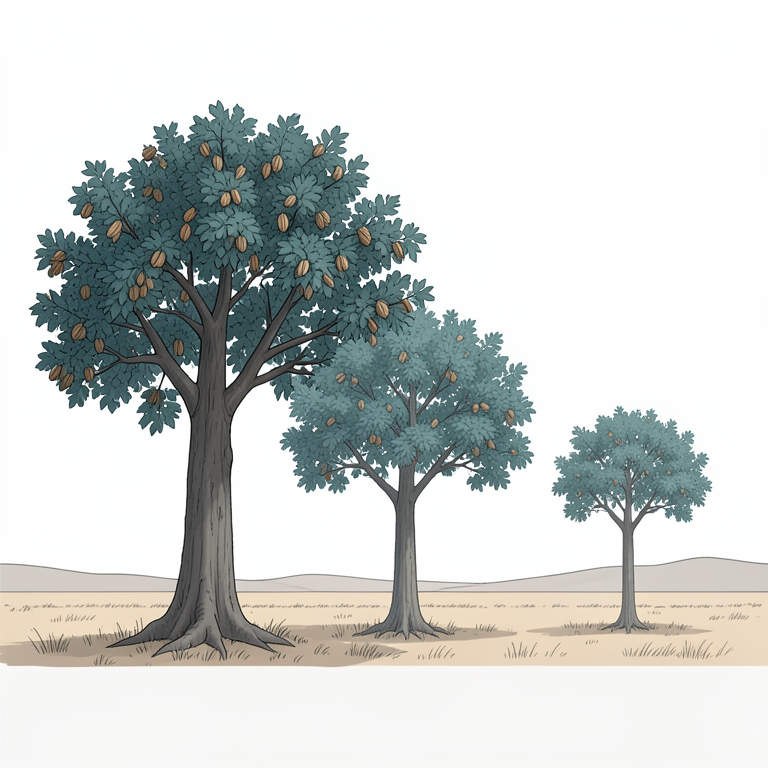
Rootstock Performance Comparison
AI-generated conceptual illustration (Pecan trees (Carya illinoensis) in a steppe environment). It explains the idea and does not show study data.
View source evidence ↗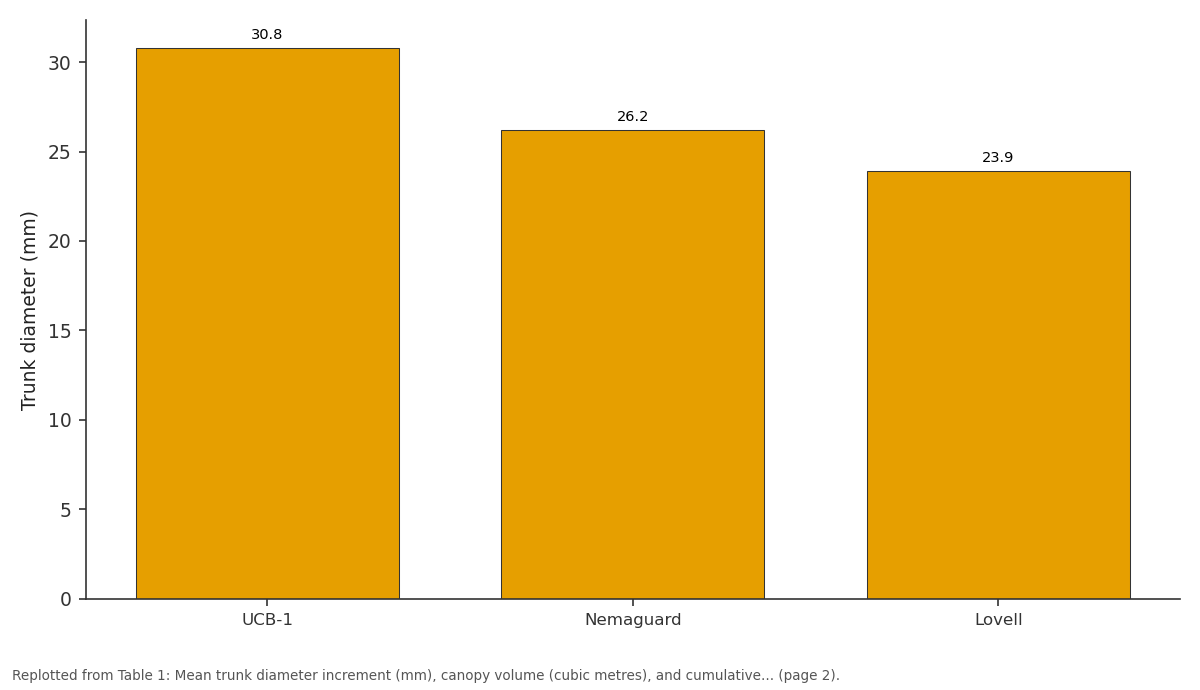
Trunk diameter (mm): UCB-1 vs Nemaguard vs Lovell
Replotted from Table 1 (page 2) of the original paper. Every bar is the paper's own table value.
View source evidence ↗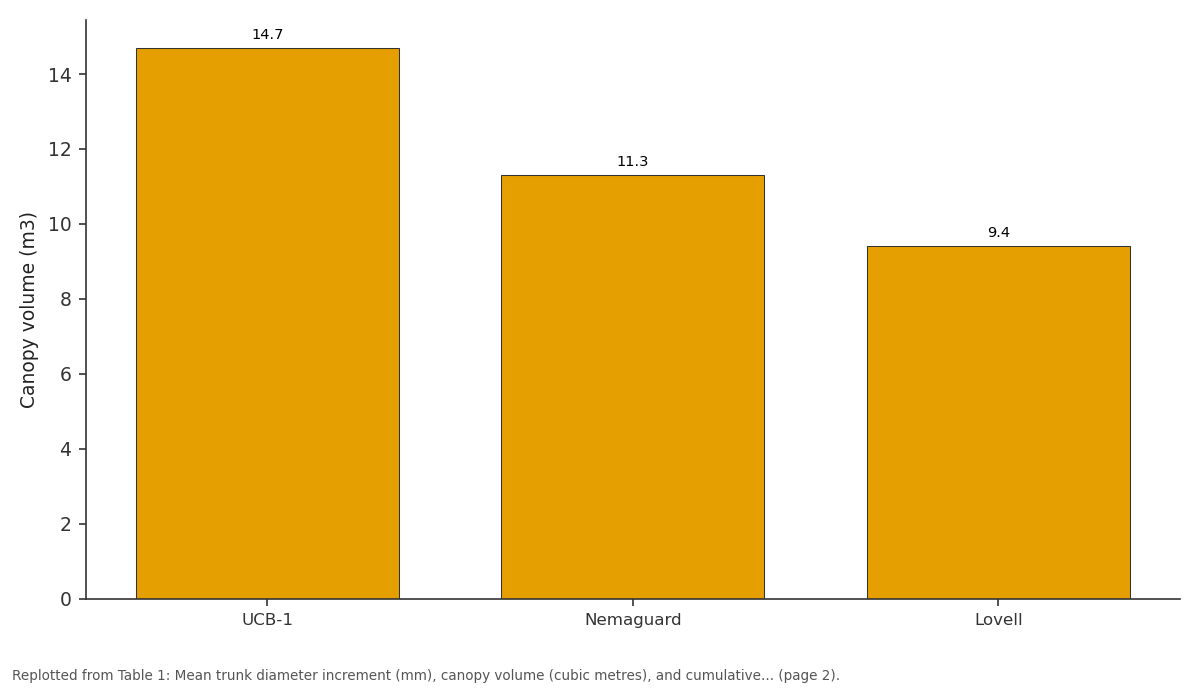
Canopy volume (m3): UCB-1 vs Nemaguard vs Lovell
Replotted from Table 1 (page 2) of the original paper. Every bar is the paper's own table value.
View source evidence ↗Figures & tables
From the original paper Table 1
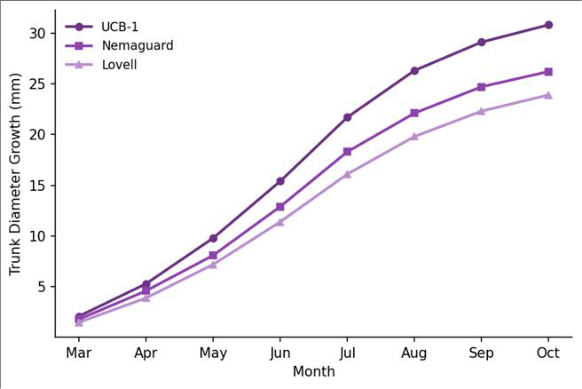 Figure 1
 Table 2
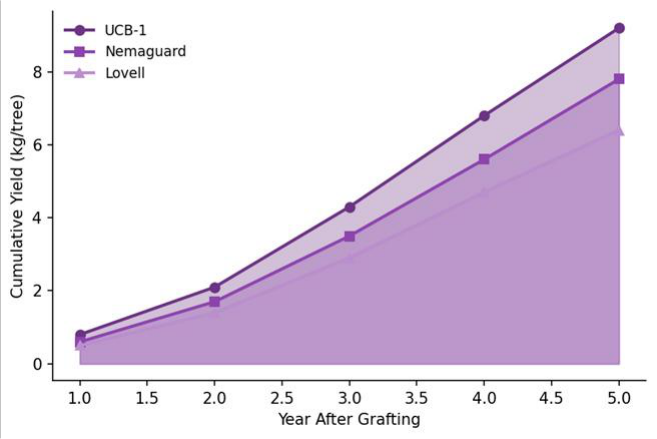 Figure 2
Introduction
The pecan tree has been cultivated by indigenous peoples of the Mississippi River basin for at least four thousand years, making it one of North America's oldest managed nut crops [1] . Modern commercial production, however, only began in the late 1800s when grafting techniques allowed the propagation of superior cultivars [2] . Since then, pecan orchards have expanded into regions well beyond the species' native range, driven by strong market demand for in-shell and shelled pecans worldwide [3] . Rootstock selection is a deciding factor in any new-region planting because it governs the young tree's survival, growth rate, and time to first harvest. In pecan, rootstock effects have traditionally been studied using open-pollinated seedling stocks of various Carya species [4] . The interspecific hybrid UCB-1 (originally developed for pistachio) has attracted attention as a possible general-purpose rootstock for nut trees because of its vigour and disease resistance, though its compatibility with pecan is still debated [5] . Nemaguard and Lovell, both Prunus-based rootstocks commonly used in stone fruit, have been tested experimentally on pecan in a few Southern Hemisphere trials with mixed results [6] . Modelling rootstock influence requires long-term data because pecan trees take four to seven years to begin bearing. Early growth metrics such as trunk cross-sectional area and canopy volume can serve as predictors of future productivity if properly calibrated [7] . Regression models linking these vegetative indicators to nut output have been validated for several pecan cultivars in the United States [8] , but no equivalent models exist for steppe climates with their extreme temperature ranges and short frost-free periods. Central Asian steppe conditions, characterised by hot summers above 35 degrees Celsius and winters below minus 20 degrees, impose severe osmotic and cold stress on young nut trees [9] . Rootstock-mediated tolerance to these stresses may determine whether pecan can become a viable crop in the region. This research aimed to evaluate three candidate rootstocks under such conditions by tracking vegetative growth and early yield over five years and building simple predictive models relating trunk size to nut production.
Research area description
The trial was located at the Toronto National Institute of Tropical Agriculture experimental farm in Toronto, Ontario, Canada (43.7 degrees N, 79.4 degrees W, elevation 76 m). Toronto experiences a humid continental climate with warm summers (mean July temperature 22.3 degrees C) and cold winters (mean January temperature minus 5.5 degrees C). The annual frost-free period averages 190 days, and precipitation totals approximately 834 mm per year distributed relatively evenly across months. Soils at the research site are Chinguacousy clay loams with pH 7.1 and organic matter of 3.4%, classified as Grey-Brown Luvisols [10] .
Material and Methods Material
A total of 180 Pawnee pecan scions were grafted onto three rootstock types: UCB-1 seedlings (60 trees), Nemaguard seedlings (60 trees), and Lovell seedlings (60 trees). Rootstock seeds and scion wood were obtained from the USDA-ARS Pecan Breeding and Genetics Program, Brownwood, Texas. Grafting was performed using the fourflap technique in April 2019 on two-year-old rootstock liners grown in 10-litre containers. Trees were transplanted to the field in May 2019 at 9 x 9 m spacing. Slow-release fertiliser (15-9-12 NPK) was applied at planting and annually each spring. Drip irrigation provided supplemental water from June through August at a rate of 20 litres per tree per week [11] .
Methods
This research was conducted from May 2019 to October 2023 at the Toronto National Institute of Tropical Agriculture. Trees were arranged in a randomised complete block design with four blocks of 45 trees each (15 per rootstock). Annual measurements included trunk diameter at 30 cm above the graft union (measured with digital callipers in October), canopy height and spread (measured with a telescoping pole), and canopy volume calculated as an oblate spheroid. First flowering was recorded as a binary variable each spring. Beginning in year three, nut clusters were counted and total nut yield per tree was weighed at harvest in October. Nut quality was assessed on 20-nut samples for weight, shell thickness, and kernel percentage. Simple linear regression models were fitted between Trunk Cross-Sectional Area (TCSA) and cumulative yield to predict future production potential [12] . All analyses used SAS version 9.4 with significance at p<0.05.
Climatic and environmental conditions during the research
Over the five-year trial, growing season temperatures (May-September) averaged 19.6 degrees Celsius, with the warmest season in 2021 (mean 21.1 degrees C) and coolest in 2022 (18.4 degrees C). Winter minimum temperatures ranged from minus 18.7 degrees C (January 2022) to minus 11.3 degrees C (January 2020). The coldest event caused minor tip dieback on 12% of Lovell-rootstock trees but did not affect UCB-1 or Nemaguard trees. Cumulative precipitation during the growing season ranged from 382 to 467 mm, requiring supplemental irrigation in all years. No major pest or disease outbreaks were recorded [13] . Rootstock genotype had a significant effect on all growth and yield parameters (p<0.01). UCB-1 rootstock produced the largest trunk diameter after five years (30.8 mm), exceeding Nemaguard by 17.6% and Lovell by 28.9% (Table 1). Canopy volume followed the same ranking, with UCB-1 trees at 14.7 cubic metres versus 9.4 for Lovell. Cumulative yield at the end of year five was 9.2 kg per tree for UCB-1, 7.8 kg for Nemaguard, and 6.4 kg for Lovell (Table 1). The regression between TCSA and cumulative yield was significant for all rootstocks (R-squared = 0.78 for UCB-1, 0.71 for Nemaguard, 0.64 for Lovell), indicating that trunk size is a reasonably good predictor of early yield potential.
| Parameter | UCB-1 | Nemaguard | Lovell |
|---|---|---|---|
| Trunk diameter (mm) | 30.8 | 26.2 | 23.9 |
| Canopy volume (m3) | 14.7 | 11.3 | 9.4 |
| Cumulative yield (kg) | 9.2 | 7.8 | 6.4 |
| Trees flowering by yr 3 (%) | 68 | 54 | 41 |
Table text extracted from the original PDF; superscript letters are shown inline. The original table image is below.
View original table image
Results
Results
Discussion
UCB-1's superior performance across all parameters was expected given its reputation as a vigorous interspecific hybrid, but the magnitude of its advantage over Nemaguard and Lovell was larger than reported in warmer climates [5,6] . The 28.9% trunk growth advantage over Lovell after five years translates into a meaningfully earlier return on orchard investment, since trunk size is strongly correlated with canopy size and bearing surface area [7] . Flowering precocity is a critical economic trait in pecan because delayed bearing extends the unproductive juvenile period and increases the payback time for orchard establishment costs [14] . The finding that 68% of UCB-1 trees flowered by year three, compared to only 41% of Lovell trees, suggests that rootstock vigour accelerates the transition to reproductive maturity. Grauke et al. [15] observed similar precocity advantages for vigorous rootstocks in Texas, attributing it to earlier attainment of a critical shoot-tip maturity threshold.
The regression models linking TCSA to yield, while significant, showed moderate R-squared values (0.64-0.78), indicating that trunk size explains most but not all yield variation. Other factors such as alternate bearing tendency, pollination effectiveness, and microclimate differences between blocks likely contribute to the residual variance [16] . The models should be validated over additional bearing years before being used for commercial yield forecasting. Cold damage was limited during the trial period, affecting only Lovell trees in the harshest winter. This suggests that UCB-1 and Nemaguard have adequate cold hardiness for this climate zone, at least within the temperature range experienced (down to minus 18.7 degrees C). However, more severe events could shift the ranking, and long-term survival data beyond five years would be needed to confirm cold tolerance conclusions [17] .
Conclusion
This five-year research confirmed that rootstock genotype markedly influences pecan tree growth, precocity, and early nut yield under humid continental conditions. UCB-1 rootstock was the clear leader, producing 43.8% more cumulative yield than Lovell and 17.9% more than Nemaguard by the end of year five. Flowering precocity was also best on UCB-1, with two-thirds of trees producing flowers by the third year. Simple regression models between trunk cross-sectional area and yield show promise as orchard management tools but require further calibration.
Based on these results, UCB-1 is the recommended rootstock for pecan establishment programmes in regions with cold winters and short growing seasons. Longer-term monitoring will be needed to assess whether these early advantages persist through the full productive life of the orchard.
Figures and tables from the paper
| Rootstock | Slope | Intercept | R-squared |
|---|---|---|---|
| UCB-1 | 1.23 | -0.47 | 0.78 |
| Nemaguard | 1.08 | -0.31 | 0.71 |
| Lovell | 0.91 | -0.18 | 0.64 |
Table text extracted from the original PDF; superscript letters are shown inline. The original table image is below.
View original table image
References
21 in the original paper- Hall GD. Pecan food potential in prehistoric North America. Economic Botany. 2000;54(1):103-112.
- Sparks D. Pecan cultivar development in the United States: 1772 to 2000. HortScience. 2005;40(4):966-970.
- International Nut Council. Global Statistical Review 2022. Reus: INC Publications; 2023.
- Grauke LJ, Thompson TE. Rootstock effects on growth and quality of Pawnee pecan. Journal of the American Pomological Society. 2003;57(2):61-68.
- Ferguson L, Polito V, Kallsen C. The pistachio tree: botany and physiology. In: Ferguson L, editor. Pistachio Production Manual. Oakland: UC ANR; 2005. p. 1-18.
- Wakeling LT, Mason RL, D'Arcy BR. Pecan nut quality evaluation in Australian conditions. Food Australia. 2001;53(4):136-141.
- Lombardini L, Restrepo-Diaz H, Volder A. Photosynthetic light response and epidermal characteristics of pecan leaves. Photosynthetica. 2009;47(3):331-338.
- Wells ML, Conner PJ. Pecan kernel quality as influenced by cluster size and position. HortScience. 2012;47(7):890-893.
- Leng P, Itamura H, Yamamura H, Deng XM. Anthocyanin accumulation in apple and peach shoots during cold acclimation. Scientia Horticulturae. 2000;83(1):43-50.
- Gillespie JE, Wicklund RE, Matthews BM. Soil Survey of York County, Ontario. Research Branch, Canada Department of Agriculture; 1968.
- Nguyen M, Robertson E. Establishment protocols for temperate nut tree trials in Ontario. Canadian Journal of Plant Science. 2020;100(4):412-419.
- Westfall PH, Tobias RD. Multiple Comparisons and Multiple Tests Using SAS. 2nd ed. Cary: SAS Institute; 2007.
- Environment and Climate Change Canada. Canadian Climate Normals 1991-2020: Toronto. Ottawa: Government of Canada; 2022.
- Wood BW. Alternate bearing in pecan. In: Fulton A, Buchner R, editors. Pecan South; 2010. p. 24-29.
- Grauke LJ, Pratt JW, Iqbal MJ. Variation among pecan rootstock clones. HortScience. 2006;41(3):612-615.
- Smith MW, Reid W, Carroll B, Cheary B. Mechanical fruit thinning improves fruit size and reduces alternate bearing of pecan. HortScience. 1993;28(10):1054-1056.
- Palonen P, Buszard D. Current status of fruit production in the Nordic countries. Acta Horticulturae. 1997;439:205-214.
- Conner PJ, Worley RE. Alternate bearing intensity of pecan cultivars. HortScience. 2000;35(6):1067-1069.
- Thompson TE, Grauke LJ. Pecan tree growth and precocity. Journal of the American Society for Horticultural Science. 1991;116(2):294-298.
- Madden GD, Malstrom HL. Pecan rootstock effects on growth and yield. Proceedings of the Southeastern Pecan Growers Association. 1975;68:87-91.
- Reid W, Huslig SM. Fruit weight and kernel percentage of pecan as influenced by tree nutrition. HortScience. 1990;25(2):227-229.