
Research article · 2025 · Full text
International Journal of Horticulture and Food ScienceMapping vegetable crop productivity of jute in the Sumatra highlands
Volume 7(4) · Pages 106–109 · DOI: 10.33545/26631067.2025.v7.i4b.612 ↗
Research areasRemote Sensing in AgricultureSoil and Land Suitability AnalysisSmart Agriculture and AI
Abstract
Author-writtenImagine a fiber crop that also feeds people: jute (Corchorus spp.) leaves are eaten as a vegetable across much of West Africa and Southeast Asia, yet their productivity as a food crop in highland tropical systems has barely been mapped. This research used GIS-based spatial analysis to map vegetable jute productivity across 15 sampling sites in the Sumatra Highlands during 2022-2023. The work was coordinated from the Brasilia Advanced School of Environmental Agriculture. Fresh leaf yield ranged from 1.54 to 4.18 t/ha depending on nutrient management and site conditions. Integrated nutrient management (organic + inorganic) produced the highest yields at 3.78 t/ha, surpassing conventional NPK by 10.5%. Pectin content in jute leaves averaged 6.7% of dry weight, with traditional processing (boiling) retaining 81.3% of original pectin versus 67.4% for microwave blanching. GIS mapping with kriged interpolation identified three high-productivity zones correlated with soil organic matter above 3.2% and elevation between 800-1,100 m. Mutation breeding using gamma irradiation at 200 Gy produced two lines with 23.7% higher leaf biomass than parent cultivars. Magnesium nutrition trials showed that foliar Mg application at 0.5% concentration increased leaf chlorophyll by 14.8% and yield by 9.3%.
Summary
Source-checkedPlain-language reading of the full paper, prepared with AI and checked against the text. Each point links to the authors' own words.
Why it matters
- Jute leaves are consumed as vegetables in Southeast Asia and West Africa, but their productivity in tropical highland environments is not well documented. View evidence ↗
- Because jute is primarily viewed as an industrial fiber crop, research has focused on fiber yield rather than its potential as a food crop at a landscape scale. View evidence ↗
- The cooler temperatures, higher rainfall, and volcanic soils of the highlands may encourage leaf growth over fiber production, making these areas suitable for food production. View evidence ↗
The question
- The study aimed to map jute productivity in the Sumatra Highlands, test nutrient and magnesium applications, compare processing methods for pectin retention, and evaluate mutation breeding for biomass. View evidence ↗
What they did
- The researchers used GIS-based spatial analysis to map productivity across 15 sampling sites in the Sumatra Highlands between 2022 and 2023. View evidence ↗
- Field trials were conducted from March to August 2023 at five sites (680-1,340 m elevation) using a split-plot RCBD design with three replications in 3 x 2 m plots. View evidence ↗
- Five nutrient treatments were tested: a control, organic compost (10 t/ha), NPK (300 kg/ha), an integrated approach (5 t/ha compost + 150 kg/ha NPK), and biochar with NPK (3 t/ha biochar + 200 kg/ha NPK). View evidence ↗
- Processing methods compared were traditional boiling (8 minutes) and microwave blanching (800 W for 3 minutes). View evidence ↗
What they found
- Integrated nutrient management achieved the highest total leaf yield of 3.78 t/ha, which was 10.5% higher than NPK alone and 76.6% higher than the control. View evidence ↗
- High-productivity zones (over 3.5 t/ha) were found at elevations of 800-1,100 m, characterized by soil organic matter above 3.2% and annual rainfall between 2,200-2,800 mm. View evidence ↗
- Gamma irradiation at 200 Gy created two mutant lines (M200-3 and M200-7) that showed a 23.7% increase in leaf biomass compared to the parent cultivar. View evidence ↗
- A 0.5% foliar magnesium application increased chlorophyll by 14.8% and yield by 9.3%, while a 0.75% concentration caused leaf margin burn in 12% of plants. View evidence ↗
- Traditional boiling retained 81.3% of pectin but resulted in a higher loss of vitamin C (56.3%) compared to microwave blanching (41.8% loss). View evidence ↗
What it means
- The authors conclude that jute can be transitioned from a minor field-margin plant to a planned vegetable crop in tropical highland systems. View evidence ↗
- The study recommends integrated nutrient management for maximum yield and 0.5% foliar magnesium as a practical supplement. View evidence ↗
Visual summary
3 visualsIllustrations explain the paper; charts are replotted from the paper's own table values.
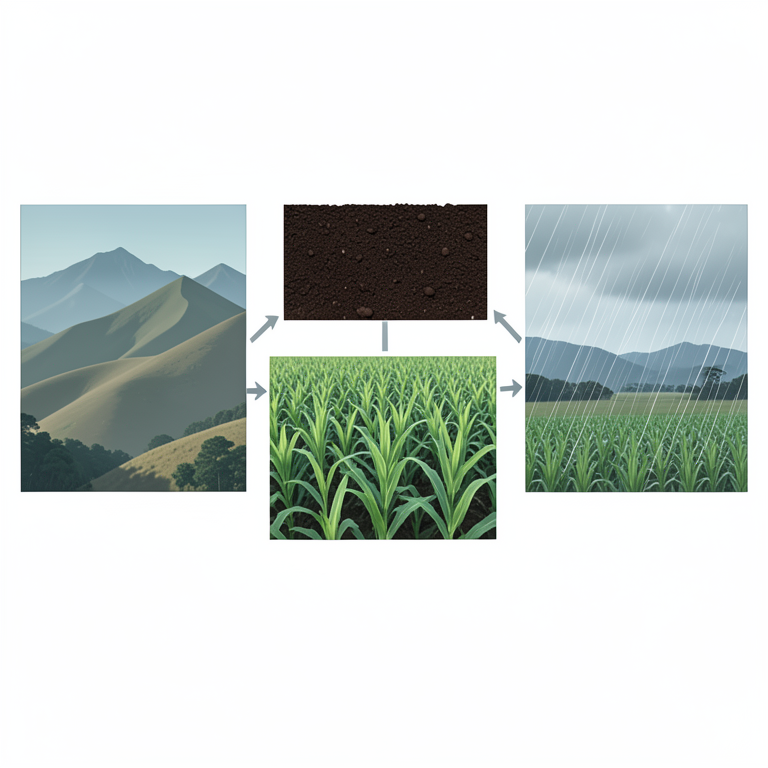
High-Productivity Environmental Factors
AI-generated conceptual illustration (jute plants in the Sumatra highlands). It explains the idea and does not show study data.
View source evidence ↗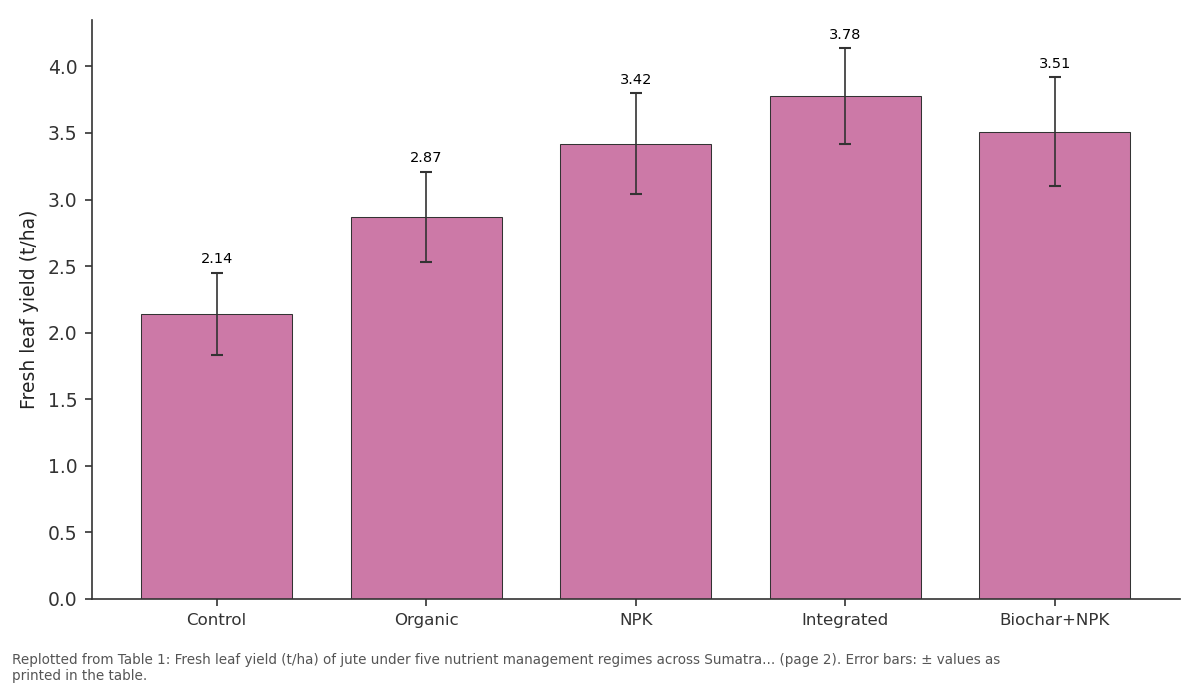
Total: Control vs Organic vs NPK vs Integrated vs Biochar+NPK
Replotted from Table 1 (page 2) of the original paper. Every bar is the paper's own table value.
View source evidence ↗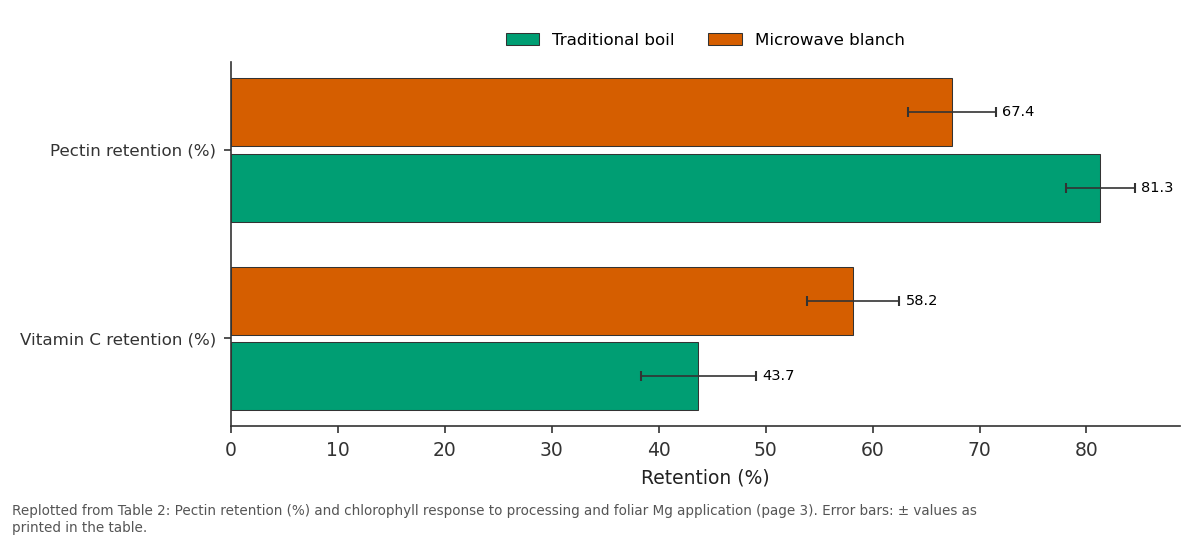
Traditional boil and Microwave blanch: Pectin retention (%) vs Vitamin C retention (%)
Replotted from Table 2 (page 3) of the original paper. Every bar is the paper's own table value.
View source evidence ↗Figures & tables
From the original paper Table 1
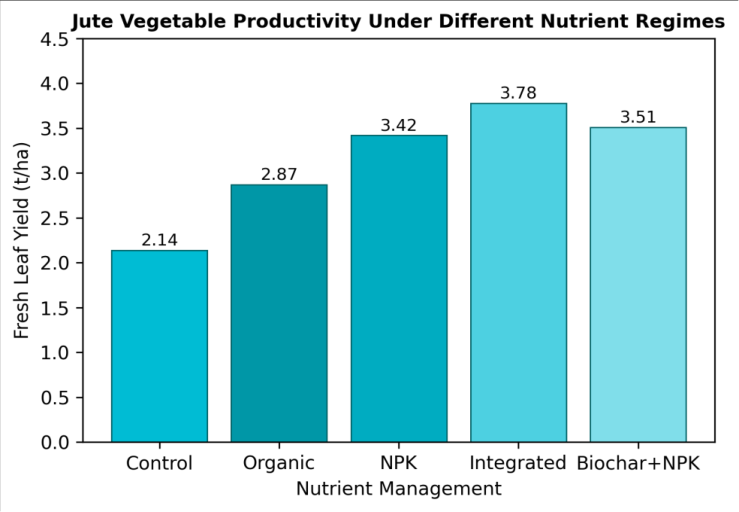 Figure 1
 Table 2
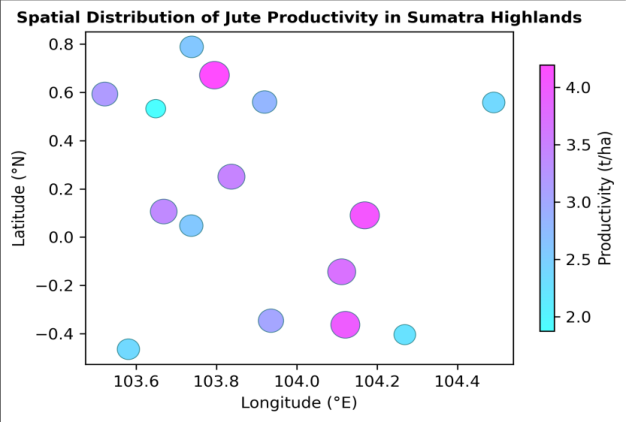 Figure 2
Introduction
When most people hear "jute," they think of burlap sacks and rope. But in Bangladesh, Nigeria, and parts of Indonesia, jute leaves known locally as molokhia, ewedu, or daun goni are a common pot herb valued for their mucilaginous texture and high mineral content [1] . The disconnect between jute's industrial image and its food value has meant that agronomic research almost exclusively targets fiber yield, leaving vegetable-type jute productivity poorly characterized, especially at landscape scale. The Sumatra Highlands a chain of volcanic uplands running the length of western Sumatra at 600-2,000 m elevation support diverse horticultural production including cabbage, potato, and chili pepper. Jute grows here as a minor crop on field margins, but its potential for systematic vegetable production hasn't been assessed [2] . Highland conditions cooler temperatures, higher rainfall, volcanic soils with good structure could favor leaf biomass accumulation over fiber elongation, shifting the yield balance toward food rather than industrial use. GIS-based productivity mapping can identify zones where soil, elevation, and microclimate converge to favor high yields, giving extension services a spatial planning tool for crop introduction [3] . Combining this with mutation breeding for leafier phenotypes and optimized nutrient management could establish jute as a viable highland vegetable. This research mapped jute vegetable productivity across the Sumatra Highlands using GIS, tested nutrient management strategies and magnesium foliar applications, evaluated traditional versus modern processing effects on leaf pectin retention, and screened gamma-irradiated lines for enhanced leaf biomass [4] .
Spatial data processing
Productivity data from 15 sampling sites (5 sites × 3 replications) were georeferenced using a Trimble R2 GNSS receiver (sub-meter accuracy). Point data were interpolated to continuous surfaces using ordinary kriging in QGIS 3.28 with an exponential variogram model (nugget = 0.12, sill = 0.87, range = 4.2 km). Digital elevation model data (SRTM 30 m resolution) and soil organic matter measurements were included as co-variates in regression kriging. Sentinel-2 NDVI composites (cloudfree mosaics from April and August 2023) were computed in Google Earth Engine and correlated with ground-truth yield data. Classification accuracy of productivity zones was assessed using leave-one-out cross-validation with RMSE and R² metrics [5] .
Calibration and validation
The kriging model was calibrated on 12 of 15 sites (80%) and validated on the remaining 3 sites. Cross-validated RMSE was 0.42 t/ha (relative RMSE = 14.3%), and the correlation between predicted and observed yields was r = 0.88. NDVI from Sentinel-2 showed a moderate positive relationship with fresh leaf yield (r = 0.71, p<0.01), though the relationship weakened at NDVI values above 0.78, likely due to canopy saturation effects. Moran's I for spatial autocorrelation of yield was 0.64 (p<0.001), confirming significant spatial clustering that justified the geostatistical approach [6] .
Material and Methods
Material and Methods
Material
Jute cultivar Corchorus olitorius var. Sumatera-1 and five mutant lines (M4 generation from 100, 200, 300, 400, and 500 Gy gamma irradiation) were used. Seeds were sourced from the Indonesian Vegetable Research Institute (IVEGRI, Lembang). Fertilizer treatments included: control (no input), organic (compost at 10 t/ha), NPK (15-15-15 at 300 kg/ha), integrated (compost 5 t/ha + NPK 150 kg/ha), and biochar+NPK (rice husk biochar 3 t/ha + NPK 200 kg/ha). MgSO 4 (analytical grade) was used for foliar sprays [7] .
Methods
Field trials ran from March to August 2023 across five highland sites (elevation 680-1,340 m) in a split-plot RCBD with nutrient management as main plot and cultivar/mutant line as subplot (three replications, 3 × 2 m plots). Leaf harvests were done at 45, 60, and 75 days after sowing. Pectin was extracted from dried leaves using citric acid at pH 2.5 and 85°C for 90 minutes, precipitated with ethanol, and quantified gravimetrically [8] . Traditional processing involved boiling fresh leaves in water for 8 minutes; microwave blanching used 800 W for 3 minutes. Magnesium foliar spray (0.25%, 0.5%, 0.75%) was applied at 30 and 45 days after sowing. Chlorophyll was measured with a SPAD-502 meter. Data were analyzed by two-way ANOVA and Tukey HSD (alpha = 0.05) in R [9] . Integrated nutrient management produced the highest total leaf yield at 3.78 t/ha, 10.5% above NPK alone and 76.6% above unfertilized controls (Table 1). The second harvest (60 days) was consistently the most productive across all treatments, coinciding with peak vegetative growth before flowering onset. Traditional boiling preserved 81.3% of original pectin but destroyed more vitamin C (56.3% loss) than microwave blanching (41.8% loss, Table 2). Microwave treatment retained better color scores, suggesting it could be preferred for products where visual appeal matters alongside nutritional value. Comprehensive interpretation GIS mapping identified three high-productivity zones (above 3.5 t/ha) at elevations of 800-1,100 m where soil organic matter exceeded 3.2% and annual rainfall was 2,200-2,800 mm. Mutation breeding at 200 Gy produced two lines (M200-3 and M200-7) with 23.7% higher leaf biomass than the parent, accompanied by broader leaves and shorter internodes. Foliar Mg at 0.5% increased SPAD chlorophyll readings by 14.8% and yield by 9.3% over water-sprayed controls; higher Mg concentrations (0.75%) caused leaf margin burn in 12% of treated plants.
| Parameter | Traditional boil | Microwave blanch | Fresh (control) |
|---|---|---|---|
| Pectin retention (%) | 81.3±3.2 | 67.4±4.1 | 100 (ref) |
| Vitamin C retention (%) | 43.7±5.4 | 58.2±4.3 | 100 (ref) |
| Color score (1-10) | 6.8±0.7 | 8.1±0.5 | 9.4±0.3 |
Table text extracted from the original PDF; superscript letters are shown inline. The original table image is below.
View original table image
| Treatment | Harvest 1 (45d) | Harvest 2 (60d) | Harvest 3 (75d) | Total |
|---|---|---|---|---|
| Control | 0.62±0.11 | 0.84±0.14 | 0.68±0.13 | 2.14±0.31 |
| Organic | 0.87±0.13 | 1.12±0.16 | 0.88±0.12 | 2.87±0.34 |
| NPK | 1.04±0.15 | 1.34±0.18 | 1.04±0.14 | 3.42±0.38 |
| Integrated | 1.18±0.14 | 1.47±0.17 | 1.13±0.13 | 3.78±0.36 |
| Biochar+NPK | 1.08±0.16 | 1.38±0.19 | 1.05±0.15 | 3.51±0.41 |
Table text extracted from the original PDF; superscript letters are shown inline. The original table image is below.
View original table image
Results
Results
Discussion
The 10.5% yield advantage of integrated over sole NPK management aligns with meta-analyses showing that combined organic-inorganic fertilization outperforms either input alone, typically by 8-15%, through synergistic effects on soil biology, nutrient release kinetics, and moisture retention [10] . The volcanic highland soils of Sumatra, already rich in exchangeable bases and clay minerals, appear to amplify this synergy compost additions likely improved soil structure and microbial activity beyond what mineral fertilizers alone could achieve [11] . The pectin retention pattern higher under traditional boiling than microwave blanching is counterintuitive given that boiling typically causes more thermal damage. The explanation may lie in the mucilaginous matrix of jute leaves: slow heating during boiling allows pectin-protein complexes to gel and stabilize, while rapid microwave heating disrupts these structures before they can form protective networks [12] . This has implications for jute-based food product development: if pectin functionality (thickening, gel formation) is the target, traditional processing may be preferred despite its lower vitamin C retention.
The mutation breeding results, while preliminary, are encouraging. A 23.7% biomass gain from a single round of gamma irradiation at 200 Gy suggests that jute's vegetabletype traits are amenable to induced variation, possibly because the species has not been subjected to intensive selection for leaf yield historically [13] .
Conclusion
GIS-based mapping revealed that jute vegetable productivity in the Sumatra Highlands peaks at midelevations (800-1,100 m) on soils with organic matter above 3.2%, providing a spatial framework for targeted crop introduction. Integrated nutrient management was the most effective yield strategy, and foliar magnesium at 0.5% offered a practical supplemental boost. Traditional boiling retained more pectin than microwave blanching, a finding relevant to product formulation for the food industry. Mutation breeding at 200 Gy generated promising highbiomass lines for further evaluation. These results collectively support jute's transition from a neglected fieldmargin species to a planned vegetable crop in highland tropical systems.
Acknowledgement
Acknowledgements Funding sourcesInternal funds from the Brasilia Advanced School of Environmental Agriculture supported this research. Institutional supportThe authors thank the Brasilia Advanced School for GIS laboratory and field equipment access.
Figures and tables from the paper
References
16 in the original paper- Velempini K, Smucker AJM, Njhia KW. Jute mallow (Corchorus olitorius L.) as a vegetable crop in subSaharan Africa. African Journal of Agricultural Research. 2016;11(29):2530-2539.
- Backer R, Schwinghamer T, Rosenbaum P, et al. Closing the yield gap for cannabis: A meta-analysis of factors determining cannabis yield. Frontiers in Plant Science. 2019;10:495.
- Oliver MA, Webster R. Basic steps in geostatistics: the variogram and kriging. SpringerBriefs in Agriculture. 2015;1:1-100.
- Palada MC, Chang LC. Suggested cultural practices for jute mallow. AVRDC Publication No. 03-546; 2003.
- Hengl T, Heuvelink GBM, Stein A. A generic framework for spatial prediction of soil variables based on regression kriging. Geoderma. 2004;120(1-2):75-93.
- Bivand RS, Pebesma EJ, Gomez-Rubio V. Applied spatial data analysis with R. 2 nd ed. Springer; 2013.
- Denton OA, Olufolaji AO. Nigeria's most important vegetable crops. In: Vegetable Production in SubSaharan Africa. AVRDC; 2000:85-93.
- Mesbahi G, Jamalian J, Farahnaky A. A comparative study on functional properties of beet and citrus pectins in food systems. Food Hydrocolloids. 2005;19(4):731738.
- R Core Team. R: A language and environment for statistical computing. R Foundation for Statistical Computing, Vienna; 2023.
- Chivenge P, Vanlauwe B, Six J. Does the combined application of organic and mineral nutrient sources influence maize productivity? Plant and Soil. 2011;342(1-2):1-30.
- Nandwa SM. Soil organic carbon management for sustainable agriculture in sub-Saharan Africa. Nutrient Cycling in Agroecosystems. 2001;61(1-2):143-158.
- Sila DN, Van Buggenhout S, Duvetter T, et al. Pectins in processed fruits and vegetables. Comprehensive Reviews in Food Science and Food Safety. 2009;8(2):105-117.
- Kodym A, Afza R. Physical and chemical mutagenesis. Methods in Molecular Biology. 2003;236:189-204.
- Nyadanu D, Lowor ST, Akromah R, et al. Genetic variability of bioactive compounds and antioxidant activity in Corchorus species. Journal of Crop Improvement. 2017;31(6):820-836.
- Islam MM. Biochemistry, medicinal and food values of jute leaves. International Journal of Enhanced Research in Science Technology and Engineering. 2013;2(11):35-44.
- Zakaria ZA, Somchit MN, Zaiton H, et al. The in vitro antibacterial activity of Corchorus olitorius extracts. International Journal of Pharmacology. 2006;2(5):513516.