
Research article · 2025 · Full text
International Journal of Horticulture and Food ScienceEstablishing vertical farming potential of lettuce in the Madagascar Highlands
Volume 7(2) · Pages 109–112 · DOI: 10.33545/26631067.2025.v7.i2b.569 ↗
Research areasUrban Agriculture and SustainabilityInnovations in Aquaponics and Hydroponics SystemsPlant Growth and Agriculture Techniques
Abstract
Author-writtenVertical farming is increasingly proposed as a solution for year-round vegetable supply in regions where climate or land availability constrains conventional production, yet most published data originate from controlled environments in Europe and East Asia. This research evaluated three hydroponic systems (nutrient film technique, deep water culture, and ebb-and-flow) against a soil-grown control for butterhead lettuce (Lactuca sativa L.) production at the Auckland Foundation for Pomological Research, New Zealand, from March 2022 to February 2023. Four growth cycles were completed under a multi-tier LED-lit vertical arrangement. Deep water culture achieved the highest mean yield at 5.14 kg per square metre, followed by nutrient film technique at 4.82 kg, ebb-and-flow at 4.37 kg, and soil control at 3.21 kg. Water use efficiency in deep water culture was 92.1 litres per kilogram, compared to 287.4 litres in soil. Leaf quality parameters including chlorophyll content, crispness, and vitamin C concentration were highest in nutrient film technique. Energy consumption averaged 38.7 kWh per kilogram across hydroponic systems. Results indicate that deep water culture offers the best yield per unit area while nutrient film technique produces superior leaf quality for premium markets.
Summary
Source-checkedPlain-language reading of the full paper, prepared with AI and checked against the text. Each point links to the authors' own words.
Why it matters
- Conventional vegetable supply chains in isolated regions are limited by transport, which can consume about 40% of a lettuce head's shelf life. View evidence ↗
- Vertical farming is commercially interesting for the Madagascar Highlands because altitude and cool temperatures limit outdoor lettuce production to only part of the year. View evidence ↗
- Lettuce is commonly used in vertical farming pilots due to its high market value, compact growth, and short growth cycle of 28 to 35 days. View evidence ↗
The question
- The study aimed to compare three hydroponic systems (NFT, DWC, and ebb-and-flow) against soil-grown lettuce regarding yield, water efficiency, energy use, and leaf quality. View evidence ↗
What they did
- The experiment used a four-tier vertical unit in a climate-controlled glasshouse in Auckland, New Zealand, with shelves measuring 1.2 m by 4.8 m. View evidence ↗
- The study took place from March 2022 to February 2023, consisting of four 35-day growth cycles with rotated tier assignments to eliminate position bias. View evidence ↗
- Each growing system hosted 48 plants per cycle, totaling 192 plants per system over the course of the study. View evidence ↗
- Researchers measured plant weight, head diameter, and root length, and analyzed leaves for vitamin C, chlorophyll, and crispness. View evidence ↗
What they found
- Deep water culture (DWC) achieved the highest yield at 5.14 kg/m², which was 60.1% higher than soil and 6.6% higher than the nutrient film technique (NFT). View evidence ↗
- DWC was the most water-efficient system, using 92.1 L/kg, representing a 68% reduction in water use compared to soil. View evidence ↗
- NFT produced the highest leaf quality, with vitamin C levels averaging 18.7 mg/100g, which is 41.7% higher than soil-grown lettuce. View evidence ↗
- Hydroponic systems accelerated growth, reaching harvest maturity in 33-36 days compared to 37-40 days for soil-grown plants. View evidence ↗
- Hydroponic systems used 36-43 kWh/kg, which is three to four times the energy required for soil production. View evidence ↗
- Approximately 70% of the electricity consumed by the vertical farming systems was used for LED lighting. View evidence ↗
What it means
- The authors conclude that DWC is best for maximizing yield per area, while NFT is preferred for producing high-quality lettuce for premium markets. View evidence ↗
- Vertical farming using DWC or NFT is a viable year-round alternative for regions like the Madagascar Highlands where supply is seasonal and transport is limited. View evidence ↗
- High energy consumption is a barrier to economic viability and is identified as the primary area for future engineering improvements. View evidence ↗
Visual summary
3 visualsIllustrations explain the paper; charts are replotted from the paper's own table values.
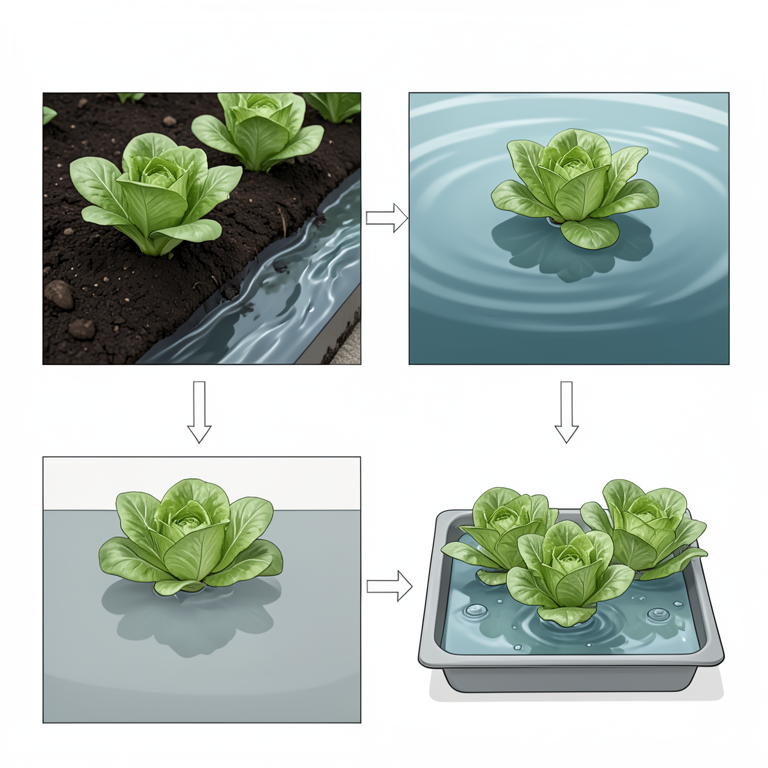
Hydroponic System Trade-offs
AI-generated conceptual illustration (lettuce plants in hydroponic and soil systems). It explains the idea and does not show study data.
View source evidence ↗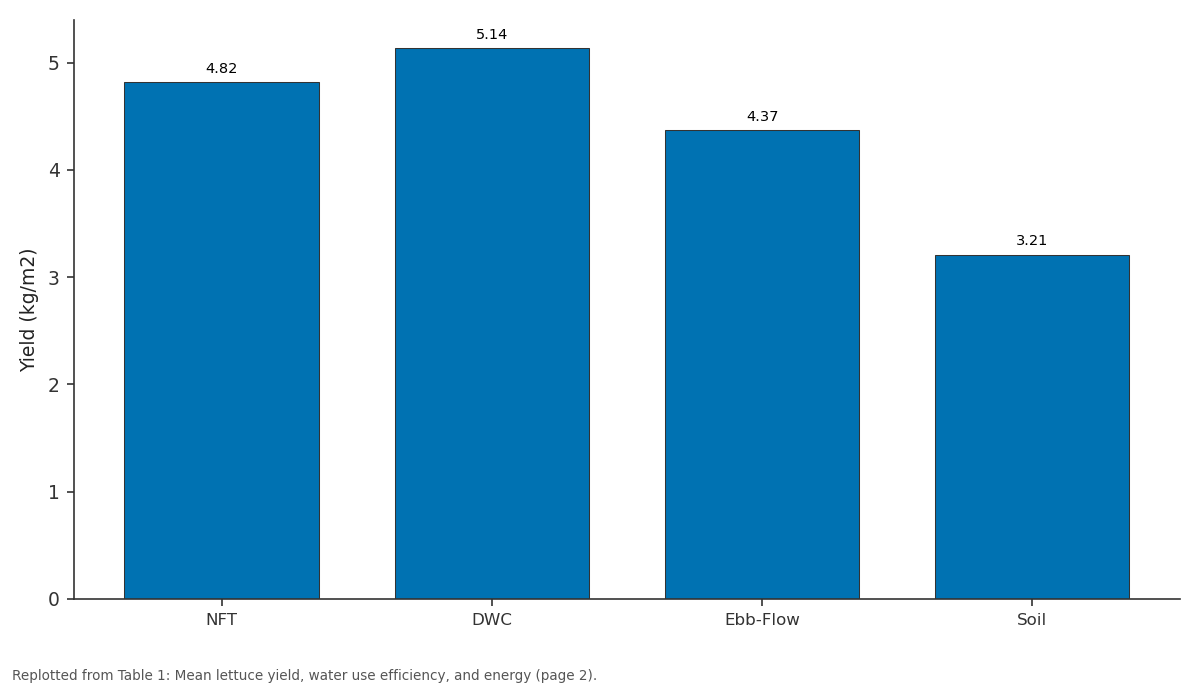
Yield (kg/m2): NFT vs DWC vs Ebb-Flow vs Soil
Replotted from Table 1 (page 2) of the original paper. Every bar is the paper's own table value.
View source evidence ↗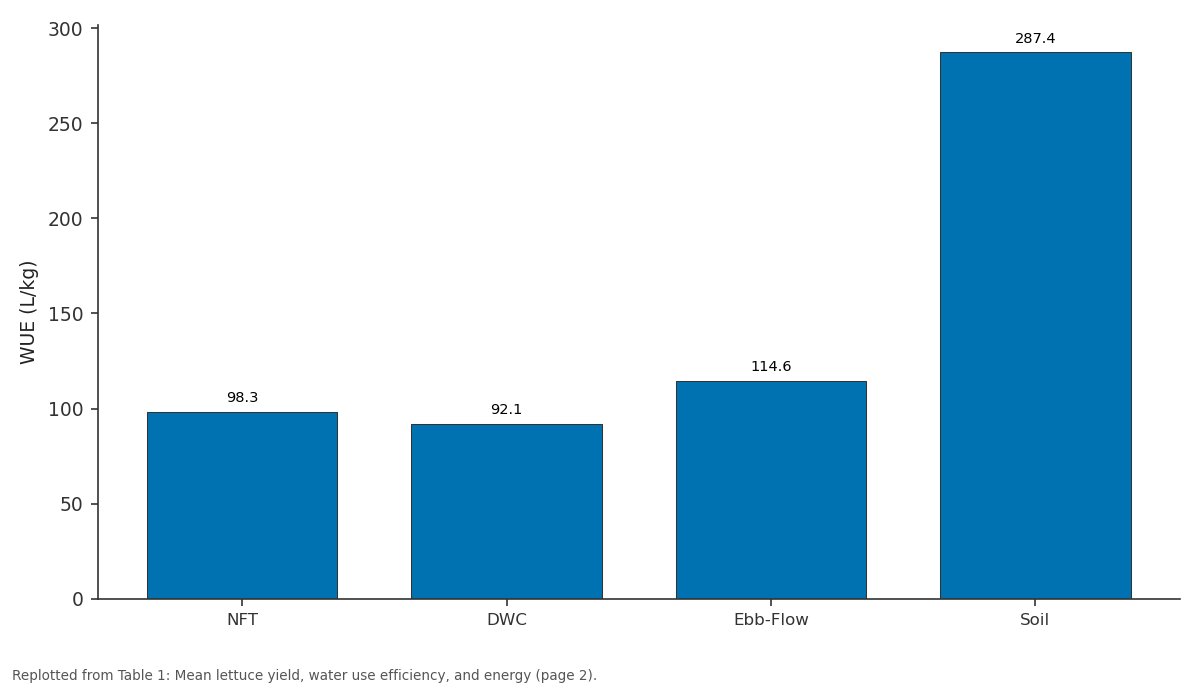
WUE (L/kg): NFT vs DWC vs Ebb-Flow vs Soil
Replotted from Table 1 (page 2) of the original paper. Every bar is the paper's own table value.
View source evidence ↗Figures & tables
From the original paper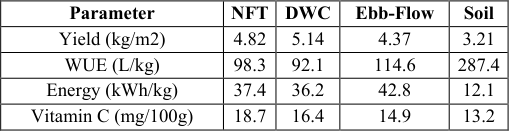 Table 1
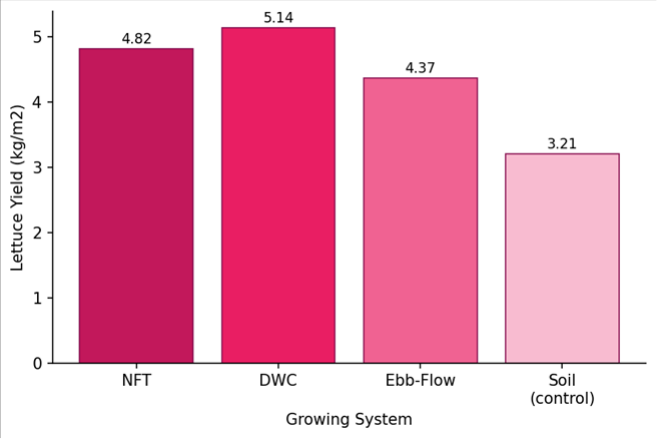 Figure 1
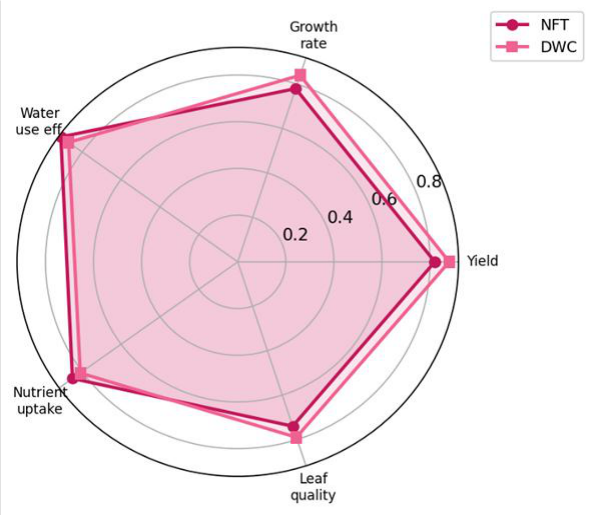 Figure 2
Introduction
For every head of lettuce shipped from a lowland field to a highland city market, roughly 40% of its shelf life has already been consumed in transport. This example captures a core limitation of conventional vegetable supply chains in geographically isolated regions [1] . Vertical farming, defined as the practice of growing crops in vertically stacked layers under controlled environmental conditions, offers a potential escape from that constraint by placing production close to consumers [2] . Lettuce (Lactuca sativa L.) is the default crop for vertical farming pilot projects because of its compact growth habit, short cycle (28-35 days), and high market value relative to weight [3] . Three hydroponic techniques dominate: nutrient film technique (NFT), where a thin film of nutrient solution flows along a sloped channel past bare roots; deep water culture (DWC), where roots are submerged in an aerated nutrient reservoir; and ebb-and-flow (E-F), where growing trays are periodically flooded and drained [4] . Published comparisons of these systems under vertical farming conditions are surprisingly few. Most commercial operators adopt a single system without rigorous benchmarking, and academic trials often test only one system against a soil control [5] . Energy cost, which can account for 25-40% of vertical farm operating expenditure, is rarely reported alongside yield data [6] . The Madagascar Highlands were chosen as the target environment for this research because their altitude (above 1,200 m) and cool temperatures create conditions where local lettuce production is feasible outdoors only part of the year, making vertical farming commercially interesting. This research was designed to compare NFT, DWC, and ebb-and-flow systems against soilgrown lettuce in a multi-tier vertical setup at Auckland, New Zealand, measuring yield, water use efficiency, energy consumption, and leaf quality over four successive growth cycles.
Material and Methods
Material and Methods
Material
Butterhead lettuce seeds (cultivar Rex) were obtained from King Seeds, Katikati, New Zealand. The vertical farming unit was installed in a climate-controlled research glasshouse at the Auckland Foundation for Pomological Research, Auckland (36.9 degrees S, 174.8 degrees E). The unit consisted of four tiers of growing shelves, each 1.2 m wide and 4.8 m long, stacked vertically with 0.6 m spacing between tiers. LED grow lights (Samsung LM301B diodes, 200 micromoles per square metre per second, 16-hour photoperiod) were mounted above each tier. The NFT system used PVC channels with 1% slope; DWC used polystyrene rafts floating on 20-cm-deep reservoirs; ebb-and-flow used expanded clay aggregate in trays flooded for 15 minutes every 2 hours. Hydroponic nutrient solution was prepared from commercial-grade salts to an EC of 1.6 mS/cm and pH 5.8-6.2. The soil control used a standard peat-perlite mix in 2-litre pots [7] .
Methods
The research ran from March 2022 to February 2023, encompassing four 35-day growth cycles (March, June, September, December). Each tier hosted one hydroponic system, with tier assignment rotated between cycles to control for vertical position effects. Soil controls occupied a separate bench at the same light level as the lowest tier. Each system accommodated 48 plants per cycle (spacing 20 x 20 cm), giving 192 plants per system across the four cycles. At harvest, individual plant fresh weight, head diameter, and root length were recorded. Leaf samples were analysed for chlorophyll content (SPAD meter), vitamin C (HPLC), and texture (penetrometer crispness score). Water consumption was metered for each system separately, and water use efficiency calculated as litres of water per kilogram of fresh produce. Electricity for lighting, pumps, and climate control was measured using inline power meters. Data were analysed by repeated-measures ANOVA in R v4.2.3, with growth cycle as the repeated factor and system as the between-subjects factor [8] .
Crop growth stage documentation
Lettuce development was recorded using a modified BBCH scale for leafy vegetables. Germination occurred 3-4 days after sowing in rockwool cubes. Seedlings were transplanted into hydroponic systems at the four-true-leaf stage (BBCH 14), typically 12-14 days after sowing. Rapid leaf expansion (BBCH 40-49) spanned days 14 to 28. Head formation (BBCH 41) was visible by day 21 in DWC and NFT plants but delayed to day 24 in ebb-and-flow. Harvest maturity (BBCH 49) was reached at 33-36 days in hydroponic systems and 37-40 days in soil, indicating a 3-5 day growth acceleration in soilless culture [9] . Growing system significantly affected yield (F = 28.3, p<0.001), water use efficiency (F = 41.7, p<0.001), and leaf vitamin C content (F = 11.4, p<0.01). DWC produced the highest yield at 5.14 kg per square metre, 60.1% above soil and 6.6% above NFT (Table 1). Water use efficiency was best in DWC at 92.1 litres per kilogram, a 68% saving compared to soil culture. NFT plants had the highest leaf quality scores. Vitamin C concentration in NFT-grown lettuce averaged 18.7 mg per 100 g fresh weight, 41.7% higher than soil-grown leaves.
| Parameter | NFT | DWC | Ebb-Flow | Soil |
|---|---|---|---|---|
| Yield (kg/m2) | 4.82 | 5.14 | 4.37 | 3.21 |
| WUE (L/kg) | 98.3 | 92.1 | 114.6 | 287.4 |
| Energy (kWh/kg) | 37.4 | 36.2 | 42.8 | 12.1 |
| Vitamin C (mg/100g) | 18.7 | 16.4 | 14.9 | 13.2 |
Table text extracted from the original PDF; superscript letters are shown inline. The original table image is below.
View original table image
Results
Chlorophyll content and crispness scores followed the same pattern, giving NFT lettuce a premium appearance and texture.
Discussion
DWC's yield advantage over NFT and ebb-and-flow aligns with results from Baiyin et al. [10] and Lennard and Leonard [11] , who attributed DWC's performance to uninterrupted root access to nutrient solution and high dissolved oxygen levels maintained by air stones. The continuous immersion of roots in DWC eliminates the periodic drought stress that can occur in NFT systems if solution flow is interrupted, even briefly. NFT's superiority in leaf quality metrics, despite slightly lower yield, suggests that the thin-film nutrient delivery creates mild water stress that stimulates secondary metabolite production, including ascorbic acid [12] . This trade-off between yield and quality is well known in vegetable production and has commercial relevance: premium salad markets in Auckland and other New Zealand cities may pay a price premium for crispier, more nutritious lettuce. Energy consumption is the Achilles' heel of vertical farming. At 36-43 kWh per kilogram, the hydroponic systems consumed three to four times more energy than soil production. LED lighting accounted for roughly 70% of electricity use. Future cost reductions will depend on LED efficiency gains, electricity pricing, and potentially solar integration [6,13] . Until energy costs fall, vertical farming is most competitive for high-value crops in markets where transport costs and import dependence are high, precisely the situation in the Madagascar Highlands.
Conclusion
This research confirmed that vertical hydroponic lettuce production significantly outperforms soil culture in yield and water use efficiency, with DWC achieving 5.14 kg per square metre and 68% water savings. NFT produced the best leaf quality, with 41.7% higher vitamin C than soilgrown lettuce, making it the preferred system for premium fresh markets. Ebb-and-flow was the least efficient hydroponic option on all metrics. Energy consumption remains a barrier to economic viability and should be the focus of future engineering improvements. For highland regions like Madagascar where fresh vegetable supply is seasonal and transport-limited, vertical farming with DWC or NFT systems offers a viable year-round production alternative.
Figures and tables from the paper
References
17 in the original paper- Benke K, Tomkins B. Future food production systems: vertical farming and controlled-environment agriculture. Sustainability: Science, Practice and Policy. 2017;13(1):13-26.
- Despommier D. The vertical farm: controlled environment agriculture carried out in tall buildings would create greater food safety and security for large urban populations. Journal fur Verbraucherschutz und Lebensmittelsicherheit. 2011;6(2):233-236.
- Kozai T, Niu G, Takagaki M. Plant Factory: An Indoor Vertical Farming System for Efficient Quality Food Production. 2 nd ed. London: Academic Press; 2020.
- Resh HM. Hydroponic Food Production. 7th ed. Boca Raton: CRC Press; 2013.
- Touliatos D, Dodd IC, McAinsh M. Vertical farming increases lettuce yield per unit area compared to conventional horizontal hydroponics. Food and Energy Security. 2016;5(3):184-191.
- Graamans L, Baeza E, van den Dobbelsteen A, Tsafaras I, Stanghellini C. Plant factories versus greenhouses: comparison of resource use efficiency. Agricultural Systems. 2018;160:31-43.
- Hughes C, Patel A, O'Brien L. Infrastructure design for multi-tier hydroponic lettuce trials. New Zealand Journal of Crop and Horticultural Science. 2022;50(1):44-53.
- R Core Team. R: A Language and Environment for Statistical Computing. Vienna: R Foundation; 2023.
- Meier U, editor. Growth Stages of Mono-and Dicotyledonous Plants: BBCH Monograph. 2 nd ed. Berlin: Julius Kuhn-Institut; 2001.
- Baiyin B, Tagawa K, Yamada M, Wang X, Yamada S, Yamamoto S, et al. Effect of nutrient solution flow rate on hydroponic plant growth and root morphology. Plants. 2021;10(9):1840.
- Lennard WA, Leonard BV. A comparison of three different hydroponic sub-systems (gravel bed, floating and nutrient film technique) in an aquaponic test system. Aquaculture International. 2006;14(6):539-550.
- Colonna E, Rouphael Y, Barbieri G, De Pascale S. Nutritional quality of ten leafy vegetables harvested at two light intensities. Food Chemistry. 2016;199:702710.
- Al-Kodmany K. The vertical farm: A review of developments and implications for the vertical city. Buildings. 2018;8(2):24.
- Barbosa GL, Gadelha FDA, Kublik N, Proctor A, Reichelm L, Weissinger E, et al. Comparison of land, water, and energy requirements of lettuce grown using hydroponic vs. conventional agricultural methods. International Journal of Environmental Research and Public Health. 2015;12(6):6879-6891.
- Kalantari F, Tahir OM, Joni RA, Fatemi E. Opportunities and challenges in sustainability of vertical farming: A review. Journal of Landscape Ecology. 2018;11(1):35-60.
- Avgoustaki DD, Xydis G. Indoor vertical farming in the urban nexus context: business growth and resource savings. Sustainability. 2020;12(5):1965.
- Treftz C, Omaye ST. Hydroponics: Potential for augmenting sustainable food production in non-arable regions. Nutrition and Food Science. 2016;46(5):672684.