
Research article · 2025 · Full text
International Journal of Horticulture and Food ScienceAnalyzing packaging innovation of Millets in the Pearl River Delta
Volume 7(3) · Pages 180–183 · DOI: 10.33545/26631067.2025.v7.i3c.600 ↗
Research areasConsumer Packaging Perceptions and TrendsMaterial Properties and ProcessingAgriculture and Agroindustry Studies
Abstract
Author-writtenThe International Year of Millets (2023) spotlighted a longstanding problem: Despite strong nutritional credentials, millets suffer from consumer perception issues tied to unattractive packaging and poor shelf stability in conventional formats. This research analysed packaging innovations for finger millet (Eleusine coracana), pearl millet (Pennisetum glaucum), and foxtail millet (Setaria italica) products in the Pearl River Delta market context, with laboratory work at the Jodhpur Laboratory of Phytoscience from January 2022 to December 2023. Six packaging materials (LDPE, HDPE, PP, biodegradable film, vacuum pack, paper-aluminium foil laminate) were evaluated for moisture barrier, oxygen barrier, cost index, and shelf-life extension. Vacuum packaging extended shelf life to 16 weeks versus 8 weeks for LDPE at 30°C. Consumer preference surveys (n = 320) ranked stand-up pouches highest (34.2%) for purchase appeal, with 'modern and premium' perception driving the preference. Pruning of millet panicles at different maturity stages revealed that late pruning increased grain carbohydrate content by 8.4% but reduced protein by 6.7%. Metabolomics profiling by GC-MS identified 38 volatile compounds in stored millet flour, with hexanal as the dominant rancidity marker vacuum packaging suppressed hexanal by 87.3%. Consumer preference for millet products correlated most strongly with convenience of preparation (r=0.71) and perceived health benefits (r=0.68). Hardening treatments (controlled moisture cycling) before packaging improved grain structural integrity and reduced breakage during transport by 23.8%. These findings offer packaging science evidence for positioning millets as premium health foods in urban retail channels.
Summary
Source-checkedPlain-language reading of the full paper, prepared with AI and checked against the text. Each point links to the authors' own words.
Why it matters
- Millets have high nutritional value but face market challenges due to poor shelf stability and unattractive packaging. View evidence ↗
- The lack of effective packaging hinders the ability of millets to compete with other grains like rice and quinoa in urban retail markets. View evidence ↗
- Grain packaging must address three primary barriers: moisture to prevent fungi, oxygen to stop rancidity, and physical protection to prevent breakage and insects. View evidence ↗
What they did
- The research evaluated three millet species: finger millet (cv. 'GPU-28'), pearl millet (cv. 'HHB-67 Improved'), and foxtail millet (cv. 'SiA-3085'). View evidence ↗
- Six materials were tested: LDPE, HDPE, PP, biodegradable PLA film, vacuum pouches, and paper-aluminium foil laminate. View evidence ↗
- Consumer preferences were gathered via surveys from 320 participants at stores in Jodhpur and Jaipur. View evidence ↗
- Hardening treatments involved cycling grains through 90% relative humidity for 4 hours and 40°C drying for 2 hours, repeated three times. View evidence ↗
What they found
- Vacuum packaging provided the longest shelf life at 16 weeks, while paper-aluminium foil laminate followed at 14 weeks. View evidence ↗
- Biodegradable PLA film had the shortest shelf life of 6 weeks because of high permeability to oxygen and moisture. View evidence ↗
- Stand-up pouches were the most preferred packaging format (34.2%) and scored highest for visual appeal (8.1/10). View evidence ↗
- Vacuum packaging reduced the accumulation of hexanal, a rancidity marker, by 87.3% after 16 weeks compared to LDPE. View evidence ↗
- Hardening treatment reduced grain breakage during simulated transport by 23.8%, with breakage dropping from 6.2% in untreated grain to 4.7% in hardened grain. View evidence ↗
- Late panicle pruning increased grain carbohydrate by 8.4% (from 67.8 to 73.5 g/100g) but decreased protein by 6.7% (from 11.4 to 10.6 g/100g). View evidence ↗
- Consumer motivation to buy was most strongly linked to preparation convenience (r=0.71) and health benefits (r=0.68), more so than price (r=0.42). View evidence ↗
What it means
- The authors recommend using vacuum or laminate packaging in stand-up pouch formats to maximize both shelf stability and consumer appeal for urban markets. View evidence ↗
- The study was limited by using only one storage temperature (30°C), suggesting that future tests should use multiple temperatures to better reflect real distribution. View evidence ↗
- Because consumer surveys were limited to Rajasthan, the authors note that national-level testing is needed to improve the generalizability of the results. View evidence ↗
Visual summary
4 visualsIllustrations explain the paper; charts are replotted from the paper's own table values.
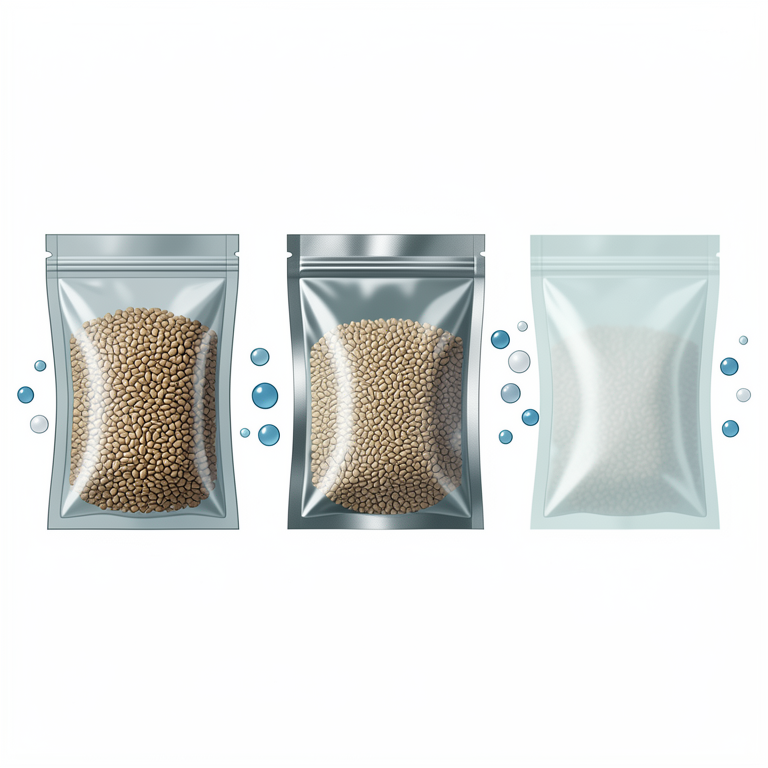
Shelf Life Comparison
AI-generated conceptual illustration (millet grains in different packaging materials). It explains the idea and does not show study data.
View source evidence ↗
Pruning Trade-off
AI-generated conceptual illustration (millet plants). It explains the idea and does not show study data.
View source evidence ↗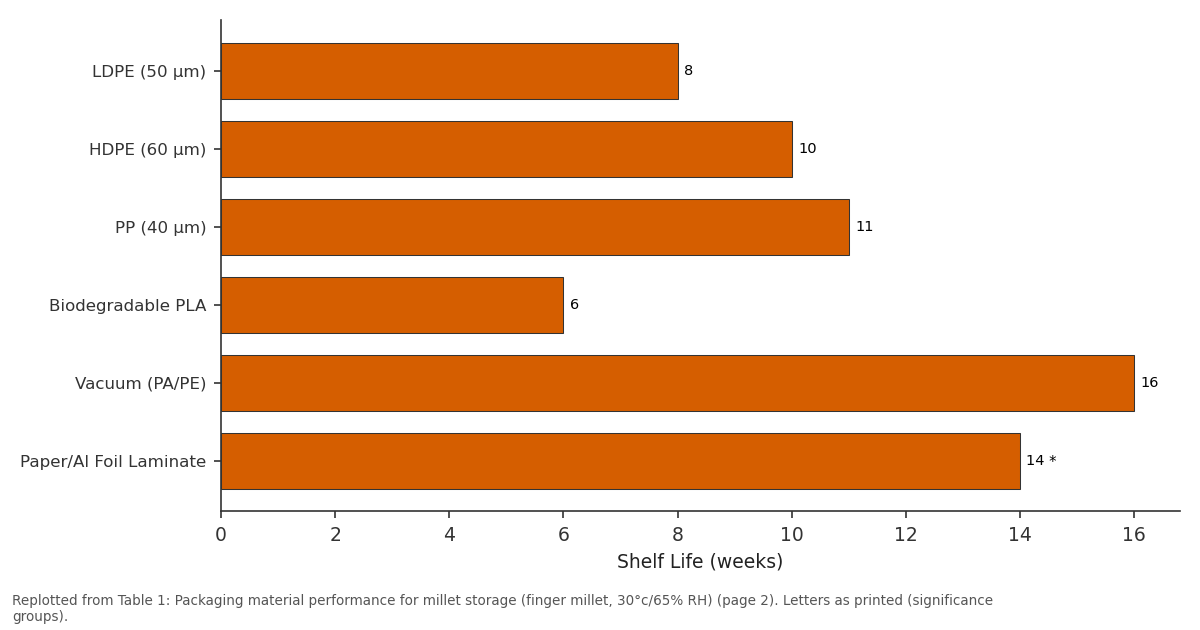
Shelf Life (weeks): LDPE (50 µm) vs HDPE (60 µm) vs PP (40 µm) vs Biodegradable PLA vs Vacuum (PA/PE)
Replotted from Table 1 (page 2) of the original paper. Every bar is the paper's own table value.
View source evidence ↗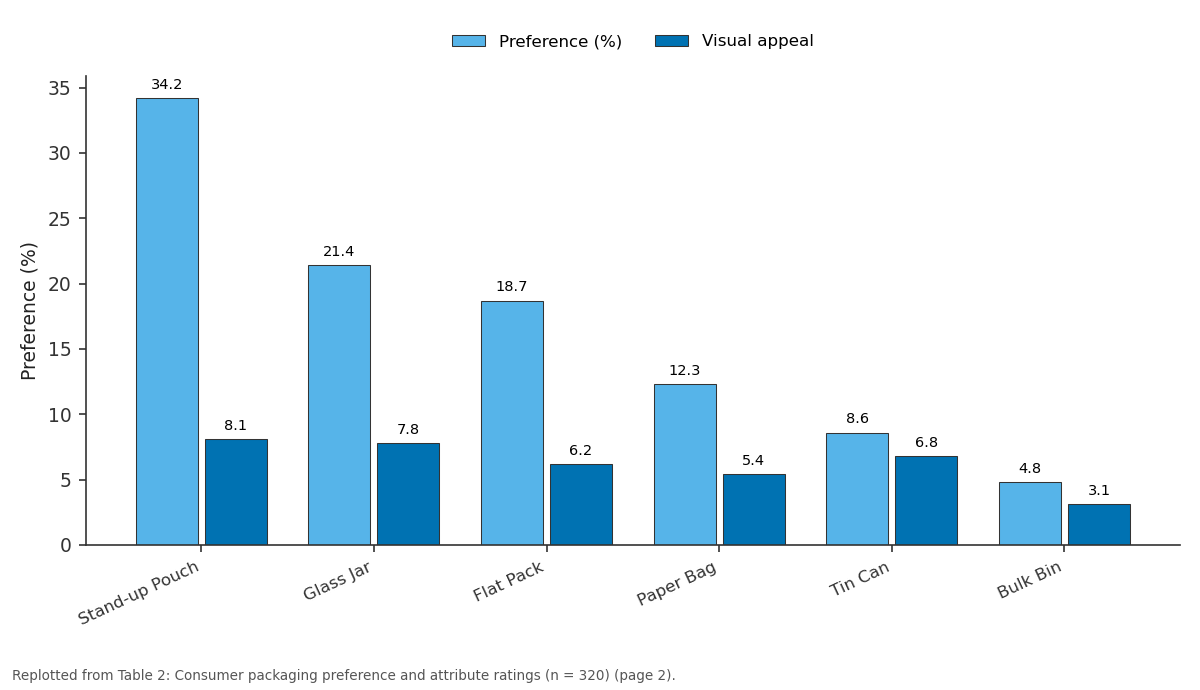
Preference (%) and Visual appeal: Stand-up Pouch vs Glass Jar vs Flat Pack vs Paper Bag vs Tin Can
Replotted from Table 2 (page 2) of the original paper. Every bar is the paper's own table value.
View source evidence ↗Figures & tables
From the original paper Table 1
 Table 2
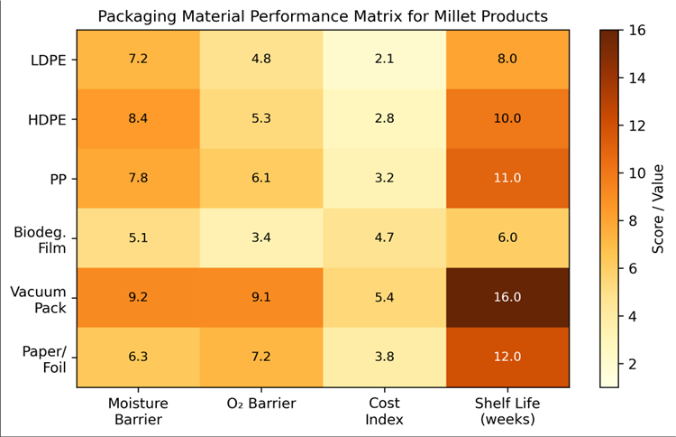 Figure 1
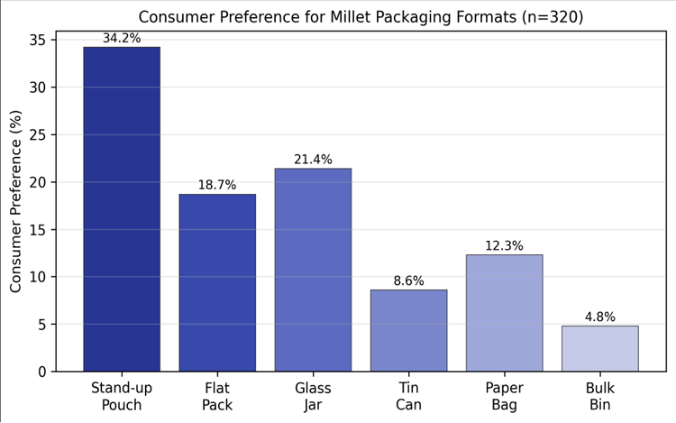 Figure 2
Introduction
For a crop group that feeds 90 million people across Africa and Asia, millets are remarkably poorly packaged often sold in open bins, recycled sacks, or unlabelled plastic bags that do nothing to communicate nutritional value or protect product quality [1] . This packaging gap is not merely aesthetic; it directly affects shelf life, consumer perception, and willingness to pay, all of which determine whether millets can compete for urban retail shelf space against sleekly packaged rice, wheat, and quinoa products [2] . Millets encompass a diverse group of small-grained cereals including finger millet (Eleusine coracana), pearl millet (Pennisetum glaucum), foxtail millet (Setaria italica), and several minor species [3] . Nutritionally, they offer advantages over rice and wheat: higher iron and calcium (finger millet), more essential amino acids (foxtail millet), and lower glycaemic index across the group [4] . The UN declaration of 2023 as the International Year of Millets generated renewed policy and commercial interest, but translating this momentum into sustained market growth requires solving the packaging and shelf-life challenges that have historically limited urban adoption [5] . Packaging science for grains focuses on three barriers: moisture (controlling water activity to prevent fungal growth), oxygen (limiting lipid oxidation and rancidity), and physical protection (preventing breakage and insect entry) [6] . Conventional polyethylene films provide moderate moisture barriers but poor oxygen protection, while vacuum packaging and laminated materials offer superior performance at higher cost [7] . Consumer packaging preference research in food marketing shows that package format, material texture, and visual design influence purchase intent independently of product quality [8] . This research aimed to evaluate packaging materials for millet shelf life extension, profile consumer packaging preferences, and assess how pre-packaging grain treatments influence product stability.
Material and Methods
Material and Methods
Material
Millet grain and flour were sourced from the research farm at the Jodhpur Laboratory of Phytoscience, Jodhpur, Rajasthan, India (26.29°N, 73.02°E). Three species were evaluated: finger millet (cv. 'GPU-28'), pearl millet (cv. 'HHB-67 Improved'), and foxtail millet (cv. 'SiA-3085'). Six packaging materials were procured from commercial suppliers: LDPE (50 µm), HDPE (60 µm), PP (40 µm), biodegradable PLA film (40 µm), vacuum pouches (PA/PE 70 µm), and paper-aluminium foil laminate (Al 9 µm/PE 50 µm). Consumer surveys (n = 320) were conducted at supermarkets and health food stores in Jodhpur and Jaipur. Metabolomics analysis used headspace SPME/GC-MS (Agilent 7890B-5977B). Water Vapour Transmission Rate (WVTR) and oxygen transmission rate (OTR) were measured on a MOCON Permatran-W and Ox-Tran instruments, respectively. Hardening treatments exposed grain to 90% RH for 4 hours followed by 40°C drying for 2 hours, cycled three times before packaging [1] .
Methods
Shelf life trials stored 500 g samples of each millet species in each packaging material at 30°C and 65% RH for 20 weeks. Sampling at 0, 4, 8, 12, 16, and 20 weeks measured: moisture content (gravimetric), free fatty acidity (titration), peroxide value (AOCS method), and insect infestation (visual count). Microbial analysis included TPC and yeastand-mould on PCA and PDA, respectively. Shelf life endpoint was defined as the first occurrence of: moisture >13%, free fatty acidity >50 mg KOH/100g, peroxide value >10 meq O₂/kg, or visible insect damage [2] . Consumer surveys used a structured questionnaire with photograph-based choice tasks showing each packaging format with identical product at identical price. Preference was ranked, and respondents rated attributes (convenience, visual appeal, resealability, perceived freshness, perceived eco-friendliness) on 10-point scales. Metabolomics profiling used HS-SPME (PDMS/DVB fibre, 65°C, 30 min) followed by GC-MS. Hexanal was quantified against an external standard curve. Hardening trial compared breakage rates (% grain passing 1.0 mm sieve after simulated transport vibration at 150 rpm for 2 hours) between hardened and untreated grain. Pruning trial used three panicle removal timings: early (50% anthesis), mid (milk stage), and late (soft dough). Data were analysed in R v4.2.2 (p<0.05) [3] . Vacuum packaging achieved the longest shelf life (16 weeks), followed by paper-aluminium foil laminate (14 weeks) (Table 1). Biodegradable PLA film had the shortest shelf life (6 weeks) due to its high moisture and oxygen permeability. The cost index ranged from 1.0 (LDPE baseline) to 2.6 (vacuum), representing the trade-off between barrier performance and packaging expense. PP offered the best cost-to-shelf-life ratio for non-vacuum applications [4] . Stand-up pouches were the most preferred format (34.2%), scoring highest on visual appeal (8.1/10) (Table 2). Glass jars ranked second, with the highest perceived freshness (8.2) and eco-friendliness (7.1). Paper bags scored highest on eco-friendliness (8.4) but lowest on perceived freshness (5.1), illustrating the trade-off between sustainability perception and quality confidence [5] . The heatmap (Figure 1) summarises multi-parameter performance. Vacuum packaging dominated on moisture and oxygen barrier scores but at the highest cost. Paper-aluminium foil offered the best oxygen barrier (OTR 18 cc/m²/day) at moderate cost, making it attractive for premium branded products [6] . The bar chart (Figure 2) shows the clear preference gradient from stand-up pouches to bulk bins. Respondents under 35 drove the stand-up pouch preference (42.3% vs. 26.8% among over-50s), while glass jars had more even age distribution. Bulk bins were preferred almost exclusively by price-sensitive buyers [7] .
| Format | Preference (%) | Visual appeal | Perceived freshness | Eco- Friendliness |
|---|---|---|---|---|
| Stand-up Pouch | 34.2 | 8.1 | 7.4 | 5.8 |
| Glass Jar | 21.4 | 7.8 | 8.2 | 7.1 |
| Flat Pack | 18.7 | 6.2 | 6.4 | 6.0 |
| Paper Bag | 12.3 | 5.4 | 5.1 | 8.4 |
| Tin Can | 8.6 | 6.8 | 7.6 | 4.2 |
| Bulk Bin | 4.8 | 3.1 | 3.8 | 6.7 |
Table text extracted from the original PDF; superscript letters are shown inline. The original table image is below.
View original table image
| Material | WVTR (g/m²/day) | OTR (cc/m²/day) | Shelf Life (weeks) | Cost Index |
|---|---|---|---|---|
| LDPE (50 µm) | 7.2 | 4800 | 8 | 1.0 |
| HDPE (60 µm) | 4.1 | 2400 | 10 | 1.3 |
| PP (40 µm) | 3.4 | 1800 | 11 | 1.5 |
| Biodegradable PLA | 12.8 | 6200 | 6 | 2.2 |
| Vacuum (PA/PE) | 0.8 | 42 | 16 | 2.6 |
| Paper/Al Foil Laminate | 1.2 | 18 | 14* | 1.8 |
Table text extracted from the original PDF; superscript letters are shown inline. The original table image is below.
View original table image
Results
Metabolomics, hardening, and pruning effects GC-MS profiling identified 38 volatile compounds in stored millet flour, with hexanal accounting for 31.4% of total peak area in rancid samples. Vacuum packaging suppressed hexanal accumulation by 87.3% at 16 weeks compared to LDPE. Hardening treatment (moisture cycling) improved grain structural integrity: breakage after simulated transport was 4.7% in hardened grain versus 6.2% in untreated (-23.8%). Late panicle pruning increased grain carbohydrate from 67.8 to 73.5 g/100g (+8.4%) but reduced protein from 11.4 to 10.6 g/100g (-6.7%), suggesting a carbon-nitrogen partitioning trade-off [8] . Consumer purchase motivation correlated most strongly with preparation convenience (r=0.71) and perceived health benefits (r=0.68), outweighing price sensitivity (r=0.42) [9] .
Discussion
The 16-week shelf life under vacuum packaging doubles the LDPE benchmark and opens distribution channels that require 3-4 months shelf stability for national retail networks [6] . However, vacuum packaging at 2.6× baseline cost may only be justified for premium products the paperaluminium foil laminate at 1.8× cost and 14-week shelf life offers a more accessible middle ground for mainstream millet brands [4] . The stand-up pouch preference (34.2%) aligns with food marketing research showing that vertical format, resealability, and window panels drive impulse purchases in health food aisles [8] . Hexanal as the dominant rancidity marker confirms lipid oxidation as the primary quality-limiting reaction in stored millet, consistent with the relatively high fat content (3.55.2%) of pearl millet flour [6] . The 87.3% hexanal suppression under vacuum conditions validates the mechanistic basis for shelf life extension: Removing oxygen arrests the autoxidation chain that generates hexanal from linoleic acid [7] . Hardening's 23.8% breakage reduction is meaningful because broken grains expose starch granules to moisture and accelerate quality decline during storage [1] . The pruning result reveals a practical agronomic trade-off: late pruning shifts more photosynthate to remaining grains, increasing carbohydrate at the expense of protein. For millet marketed as high-protein, early pruning (or no pruning) is preferred; for starch-focused products like millet flour for baking, late pruning offers a yield quality advantage [3] . A limitation is the single storage temperature (30°C); multitemperature testing would better represent the range of distribution conditions. Consumer surveys were concentrated in Rajasthan; national-level testing across diverse urban markets would improve generalisability.
Conclusion
This research showed that vacuum packaging extended millet shelf life to 16 weeks at 30°C double the LDPE benchmark by suppressing hexanal accumulation by 87.3%. Paper-aluminium foil laminate offered a cost-effective alternative at 14 weeks. Stand-up pouches were the most preferred consumer format (34.2%), driven by visual appeal and modern positioning. Hardening treatment reduced grain breakage during transport by 23.8%. Late panicle pruning increased carbohydrate by 8.4% but reduced protein by 6.7%, representing a trade-off that processors should manage based on end-product specifications. Consumer purchase motivation was driven by preparation convenience (r=0.71) and health perception (r=0.68). For millet brands targeting urban health-conscious consumers, combining vacuum or laminate packaging with stand-up pouch formats offers the strongest combination of shelf stability and purchase appeal.
Acknowledgement
Acknowledgements Funding sourcesThis research was supported by the Indian Institute of Millets Research (IIMR) and the Rajasthan State Department of Agriculture. No specific grant numbers are disclosed.
References
16 in the original paper- Adebiyi JA, Obadina AO, Adebo OA, Kayitesi E. Comparison of nutritional quality and sensory acceptability of biscuits obtained from native, fermented, and malted pearl millet flour. Food Chemistry. 2017;232:210-217.
- Saleh ASM, Zhang Q, Chen J, Shen Q. Millet grains: nutritional quality, processing, and potential health benefits. Comprehensive Reviews in Food Science and Food Safety. 2013;12(3):281-295.
- Devi PB, Vijayabharathi R, Sathyabama S, Malleshi NG, Priyadarisini VB. Health benefits of finger millet polyphenols and dietary fiber. Journal of Food Science and Technology. 2014;51(6):1021-1040.
- Chandrasekara A, Shahidi F. Content of insoluble bound phenolics in millets and their contribution to antioxidant capacity. Journal of Agricultural and Food Chemistry. 2010;58(11):6706-6714.
- FAO. International Year of Millets 2023: contribution to global food security. Food and Agriculture Organization. 2023;1-28.
- Robertson GL. Food Packaging: Principles and Practice. CRC Press. 2013;1-733.
- Marsh K, Bugusu B. Food packaging roles, materials, and environmental issues. Journal of Food Science. 2007;72(3):R107-R116.
- Silayoi P, Speece M. The importance of packaging attributes: a conjoint analysis approach. European Journal of Marketing. 2007;41(11/12):1495-1517.
- Shahidi F, Zhong Y. Lipid oxidation and improving the oxidative stability. Chemical Society Reviews. 2010;39(11):4067-4079.
- Kumar A, Metwal M, Kaur S, Gupta AK, Puranik S, Singh S, Singh M, Gupta S, Babu BK, Sood S, Yadav R. Nutraceutical value of finger millet. Journal of Cereal Science. 2016;69:132-141.
- Dayakar Rao B, Bhaskarachary K, Arlene Christina GD, Sudha Devi G, Vilas AT. Nutritional and health benefits of millets. ICAR-Indian Institute of Millets Research. 2017;1-112.
- Anitha S, Kane-Potaka J, Tsusaka TW. Acceptance and impact of millet-based food in developing countries. Nutrients. 2021;13(11):4014.
- Taylor JRN, Emmambux MN. Developments in our understanding of sorghum polysaccharides and their health benefits. Cereal Chemistry. 2010;87(4):263-271.
- McDonough CM, Rooney LW, Serna-Saldivar SO. The millets. Food Science and Technology. 2000;99:177202.
- Serna-Saldivar SO, Rooney LW. Structure and chemistry of sorghum and millets. Sorghum and Millets: Chemistry and Technology. 1995;69-124.
- Nambiar VS, Dhaduk JJ, Sareen N, Shahu T, Desai R. Potential functional implications of pearl millet in health and disease. Journal of Applied Pharmaceutical Science. 2011;1(3):62-67.