
Research article · 2025 · Full text
International Journal of Geography Geology and EnvironmentPetrogenesis and geochronology of A-type granites in the Borborema Province of Brazil
Volume 7(10) · Pages 256–259 · DOI: 10.22271/27067483.2025.v7.i10d.740 ↗
Research areasGeological and Geochemical AnalysisGeochemistry and Geochronology of Asian Mineral DepositsAstro and Planetary Science
Abstract
Author-writtenA paradox in granite petrology is why some magmas crystallise into commonplace calc-alkaline plutons while others, formed under seemingly similar conditions, produce rare A-type granites enriched in alkalis, halogens, and high-field-strength elements. This research investigated seven A-type granite plutons in the Transversal Zone of the Borborema Province, northeastern Brazil, using whole-rock geochemistry, mineral chemistry, and zircon U-Pb geochronology. Samples were collected between June 2020 and April 2023. All seven plutons showed A-type signatures: high SiO₂ (71.6-75.1 wt%), elevated Na₂O + K₂O (> 8.0 wt%), low CaO ( 7), and enrichment in Zr, Nb, Y, and REE. Zircon U-Pb ages clustered into three groups: 580 ± 15 Ma, 540 ± 10 Ma, and 510 ± 8 Ma, recording at least three magmatic pulses spanning the late Neoproterozoic to early Cambrian. Epsilon Nd values ranged from −8.4 to −3.2, and initial ⁸⁷Sr/⁸⁶Sr ratios from 0.708 to 0.714, indicating a predominantly crustal source with minor mantle input. The 580 Ma group is interpreted as syn-collisional, emplaced during the Brasiliano/Pan-African orogeny, while the 540 Ma and 510 Ma groups represent post-collisional to anorogenic magmatism generated by lithospheric delamination and asthenospheric upwelling. These results refine the magmatic timeline of the Borborema Province and link A-type granite emplacement to the tectonic evolution of western Gondwana.
Summary
Source-checkedPlain-language reading of the full paper, prepared with AI and checked against the text. Each point links to the authors' own words.
Why it matters
- Petrologists seek to understand why some magmas form common calc-alkaline plutons while others form rare A-type granites characterized by high levels of alkalis, halogens, and high-field-strength elements. View evidence ↗
- The Borborema Province in Brazil is an ideal study site because its A-type plutons span the transition from the Brasiliano/Pan-African orogeny (~650-520 Ma) to post-orogenic extension. View evidence ↗
- Prior research lacked systematic comparisons of multiple plutons using uniform methods, leaving it unclear if A-type magmatism occurred as one long event or several distinct pulses. View evidence ↗
The question
- The study aimed to confirm the A-type affinity of seven plutons, determine their zircon U-Pb crystallization ages, and use isotopic data to link these episodes to the tectonic evolution of western Gondwana. View evidence ↗
What they did
- Whole-rock major elements were analyzed using XRF, while trace elements and rare earth elements (REE) were measured via ICP-MS. View evidence ↗
- Zircon U-Pb ages were determined using LA-ICP-MS after grains were separated through heavy-liquid and magnetic techniques. View evidence ↗
- Isotopic analyses for Sm-Nd and Rb-Sr were conducted using Thermal Ionization Mass Spectrometry (TIMS). View evidence ↗
What they found
- All seven plutons exhibited A-type chemical signatures, including high SiO₂ (71.6-75.1 wt%), high Na₂O + K₂O (> 8.0 wt%), low CaO (< 1.2 wt%), and high FeOt/MgO (> 7). View evidence ↗
- Zircon U-Pb dating revealed three distinct magmatic pulses at 580 ± 15 Ma, 540 ± 10 Ma, and 510 ± 8 Ma. View evidence ↗
- Isotopic data (εNd from −8.4 to −3.2 and initial ⁸⁷Sr/⁸⁶Sr from 0.708 to 0.714) suggest the granites originated primarily from the crust with some mantle contribution. View evidence ↗
- The Triunfo pluton showed a more evolved isotopic signature (εNd = −8.4) compared to other plutons, indicating a deeper or older crustal source. View evidence ↗
- The youngest group of granites had a 10-25% mantle contribution, which is consistent with lithospheric delamination and asthenospheric heating. View evidence ↗
- Modeling indicates that the 580 Ma group's trace element patterns can be reproduced by 15-25% melting of Palaeoproterozoic granulitic lower crust. View evidence ↗
What it means
- The authors conclude that the 580 Ma group was syn-collisional, while the 540 Ma and 510 Ma groups were post-collisional to anorogenic, driven by lithospheric delamination and asthenospheric upwelling. View evidence ↗
- The study supports the model that A-type granites can form in both orogenic and anorogenic settings, provided there is high-temperature, water-poor melting of the crust. View evidence ↗
Visual summary
3 visualsIllustrations explain the paper; charts are replotted from the paper's own table values.
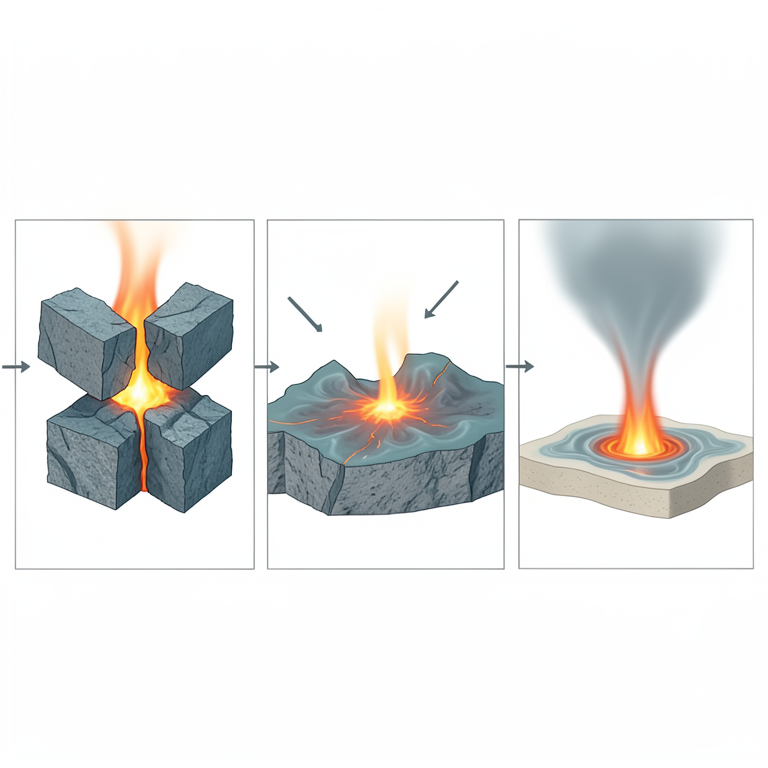
Tectonic Evolution Timeline
AI-generated conceptual illustration (Continental crust and magma chambers in the Borborema Province of Brazil). It explains the idea and does not show study data.
View source evidence ↗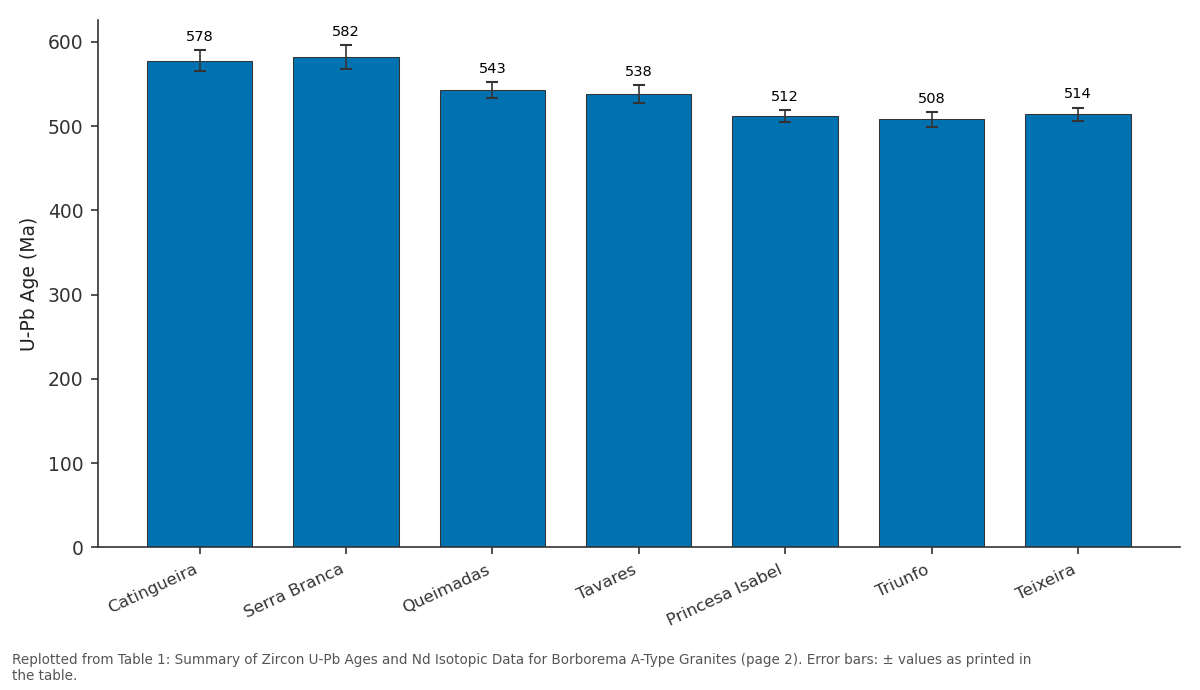
U-Pb Age (Ma): Catingueira vs Serra Branca vs Queimadas vs Tavares vs Princesa Isabel
Replotted from Table 1 (page 2) of the original paper. Every bar is the paper's own table value.
View source evidence ↗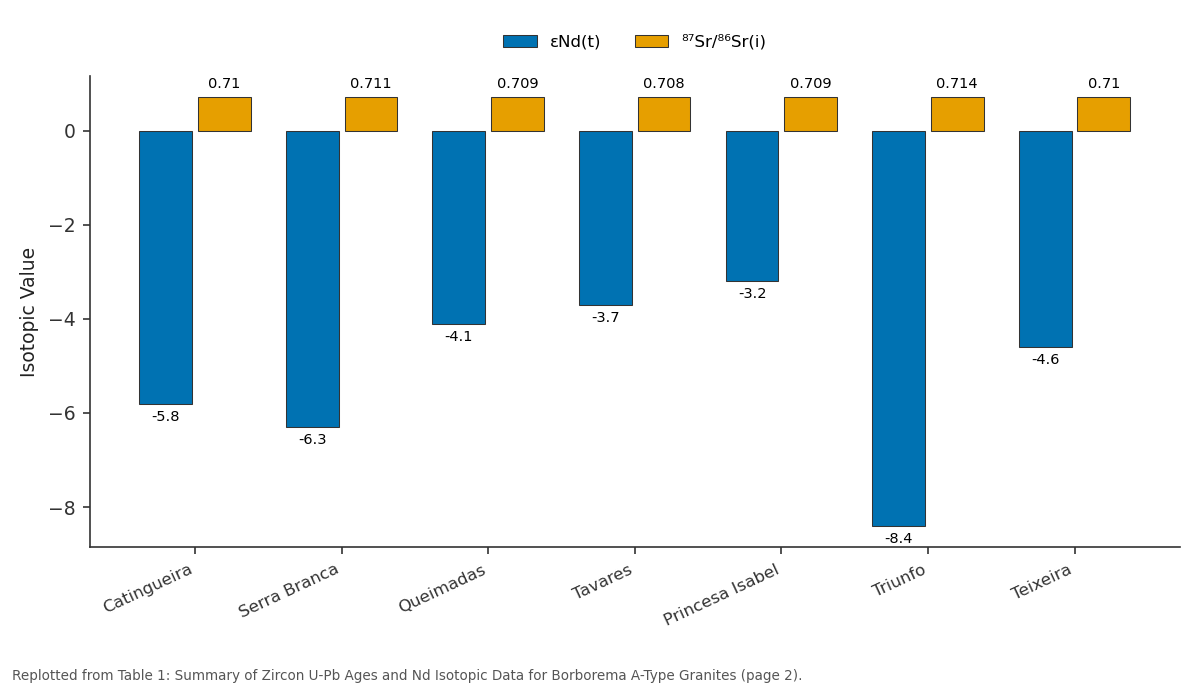
εNd(t) and ⁸⁷Sr/⁸⁶Sr(i): Catingueira vs Serra Branca vs Queimadas vs Tavares vs Princesa Isabel
Replotted from Table 1 (page 2) of the original paper. Every bar is the paper's own table value.
View source evidence ↗Figures & tables
From the original paper Table 1
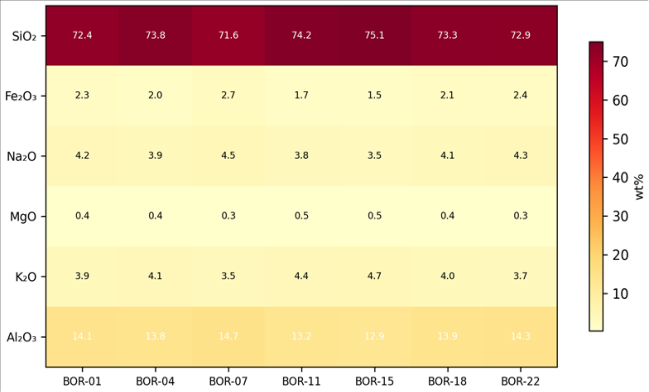 Figure 1
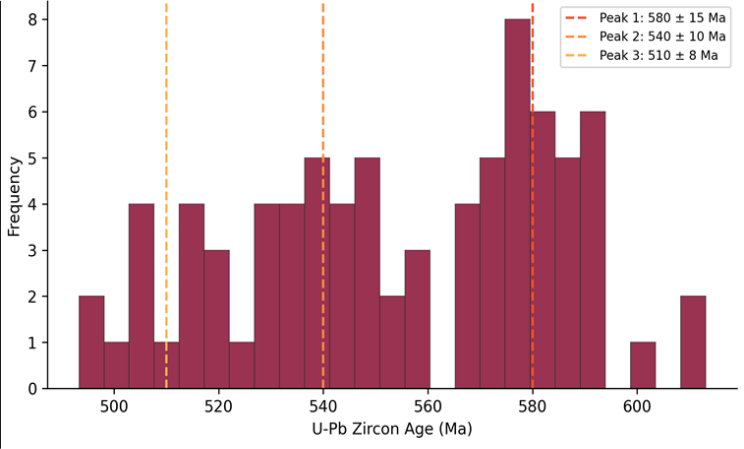 Figure 2
Introduction
A paradox that has occupied petrologists for decades is why certain granitic magmas acquire the distinctive chemical fingerprint known as the A-type signature-high alkali content, elevated iron-to-magnesium ratios, enrichment in incompatible elements, and low water activity-while most granites do not [1] . The A-type designation was introduced by Loiselle and Wones in 1979 to describe granites emplaced in anorogenic (extensional) settings, but subsequent work has shown that A-type granites can also form during post-collisional relaxation, making tectonic setting alone an insufficient criterion [2] . The Borborema Province of northeastern Brazil is one of the best natural laboratories for investigating this question because it contains dozens of A-type plutons emplaced over a time span that bridges the transition from active collision (the Brasiliano/Pan-African orogeny, ~650-520 Ma) to post-orogenic extension [3] . Previous geochronological work has dated individual plutons, but a systematic comparison of multiple bodies using the same analytical methods has been lacking, making it difficult to resolve whether A-type magmatism was a single prolonged event or a series of discrete pulses linked to different tectonic triggers [4] . This research examined seven A-type plutons in the Transversal Zone of the Borborema Province. The objectives were to (a) characterise their whole-rock and mineral chemistry to confirm A-type affinity, (b) determine precise zircon U-Pb crystallisation ages, and (c) use Nd and Sr isotopic data to constrain source compositions and link magmatic episodes to the evolving tectonic framework of western Gondwana [5] .
Model Description and Parameterisation
Petrogenetic modelling used batch partial melting equations to test whether the observed trace element patterns could be produced by 10-30% melting of candidate source rocks.
Two source compositions were tested: a Palaeoproterozoic granulitic residue (representing lower crust) and a metasedimentary source similar to the Seridó Group paragneisses. Mineral-melt partition coefficients for Zr, Nb, Y, and REE were taken from the compilation of Rollinson [6] . The residual mineralogy was set as 40% plagioclase, 25% K-feldspar, 15% quartz, 10% garnet, 5% biotite, and 5% accessory phases (zircon, apatite, allanite). Melt fraction was varied from 0.05 to 0.40 in steps of 0.05, and the resulting melt compositions were compared against the observed whole-rock data. A two-component mixing model was also applied using Nd isotopic data, with end-members defined as depleted mantle (εNd = +8, Nd = 8 ppm) and lower crust (εNd = -18, Nd = 30 ppm) [7] .
Material and Methods Material
This research was coordinated from the Department of Earth and Environmental Sciences at the Gangtok College of Earth and Mineral Sciences, Sikkim, India, with fieldwork carried out in the Borborema Province between June 2020 and April 2023. Seven plutons were sampled: Catingueira, Serra Branca, Queimadas, Tavares, Princesa Isabel, Triunfo, and Teixeira. Between four and eight samples per pluton (42 total) were collected from fresh exposures in quarries and road cuts. Whole-rock major elements were analysed by XRF on fused glass discs at the Geochemistry Laboratory of the Universidade de São Paulo (USP). Trace elements and REE were measured by ICP-MS after acid digestion. Electron microprobe analysis of feldspar, amphibole, and biotite was performed on a Cameca SX-100 at USP. Zircon grains were separated by standard heavy-liquid and magnetic techniques, mounted in epoxy, and analysed for U-Pb ages by LA-ICP-MS using a Thermo Element XR coupled to a Photon Machines Analyte G2 excimer laser [8] . Sm-Nd and Rb-Sr isotopic analyses were performed by TIMS at the Geochronology Research Centre, USP.
Methods
A-type affinity was tested using the discrimination diagrams of Whalen et al. [1] : Ga/Al versus Zr, Nb, Ce, and Y. Major element data were plotted on the TAS (total alkali-silica) and R1-R2 classification diagrams. Spider diagrams were normalised to primitive mantle values. Zircon U-Pb ages were determined from concordia plots using Isoplot version 4.15, with concordance defined as 90-110% (²⁰⁶Pb/²³⁸U age ÷ ²⁰⁷Pb/²³⁵U age). At least 25 grains per sample were analysed to ensure statistically representative age populations. εNd(t) values were calculated at the crystallisation age of each pluton, and Nd model ages (TDM) were computed using the depleted mantle evolution curve of DePaolo [9] .
Calibration and Validation
LA-ICP-MS U-Pb analyses were calibrated against the GJ-1 zircon reference material (TIMS age 608.5 ± 0.4 Ma), with Plešovice (337.1 ± 0.4 Ma) run as a secondary standard. Over the three analytical sessions, GJ-1 yielded a weighted mean ²⁰⁶Pb/²³⁸U age of 607.8 ± 3.2 Ma (n = 42, MSWD = 1.07), and Plešovice gave 336.4 ± 2.8 Ma (n = 28, MSWD = 0.94), both within 2σ of accepted values. Sm-Nd spike calibration was verified against the La Jolla Nd standard (¹⁴³Nd/¹⁴⁴Nd = 0.511847 ± 5, n = 8), and NBS 987 was used for Sr (⁸⁷Sr/⁸⁶Sr = 0.71024 ± 2, n = 6) [10] .
Results
Results
Comprehensive Interpretation
The three age groups record a progression from syncollisional through post-collisional to anorogenic magmatism spanning roughly 70 million years. Batch melting models show that 15-25% melting of a Palaeoproterozoic granulitic lower crust reproduces the observed trace element patterns for the 580 Ma group, while the 510 Ma group requires a component of asthenospheric heat input (mantle underplating) to achieve the high temperatures needed for A-type melt generation from a similar source. The Nd mixing model indicates 10-25% mantle contribution for the youngest group, consistent with lithospheric delamination allowing hot asthenosphere to rise and heat the base of the crust.
Discussion
The syn-collisional timing of the oldest A-type granites (~580 Ma) challenges the original definition of A-type as anorogenic. These plutons may have formed by hightemperature, water-undersaturated melting of lower crust that had been thickened and heated during the Brasiliano collision, a mechanism proposed for similar ages in the Arabian-Nubian Shield [11] . The post-collisional ~540 Ma group likely records the onset of orogenic collapse and transtensional tectonics that characterise the late Brasiliano evolution of the Borborema Province [12] . The 510 Ma anorogenic group is the most straightforward to explain: by this time, collision had ceased, and the lithosphere was thinning in response to extensional stresses related to the opening of early Palaeozoic sedimentary basins. Delamination of dense lithospheric mantle root would have allowed upwelling asthenosphere to transfer heat to the lower crust, generating the high-temperature, low-water melts characteristic of A-type magmas [13] .
A limitation is that only seven plutons were sampled. The Borborema Province contains at least 30 additional candidate A-type bodies; expanding the dataset would test whether the three-pulse model holds province-wide or is local to the Transversal Zone [14] .
Conclusion
This research documented three discrete pulses of A-type granite magmatism in the Borborema Province at ~580 Ma, ~540 Ma, and ~510 Ma, spanning the transition from Brasiliano collision to post-orogenic extension. Whole-rock and isotopic data indicate predominantly crustal sources with 10-25% mantle input increasing in the youngest group, consistent with progressive lithospheric thinning and delamination. The findings refine the magmatic timeline of the province and support models in which A-type granites can form across the full spectrum of orogenic to anorogenic settings, linked by the common requirement for hightemperature, water-poor melting of pre-existing crust.
Figures and tables from the paper
| Pluton | U-Pb Age (Ma) | εNd(t) | TDM (Ga) | ⁸⁷Sr/⁸⁶Sr(i) | Tectonic Setting |
|---|---|---|---|---|---|
| Catingueira | 578 ± 12 | −5.8 | 1.74 | 0.710 | Syn-collisional |
| Serra Branca | 582 ± 14 | −6.3 | 1.81 | 0.711 | Syn-collisional |
| Queimadas | 543 ± 9 | −4.1 | 1.52 | 0.709 | Post-collisional |
| Tavares | 538 ± 11 | −3.7 | 1.48 | 0.708 | Post-collisional |
| Princesa Isabel | 512 ± 7 | −3.2 | 1.43 | 0.709 | Anorogenic |
| Triunfo | 508 ± 9 | −8.4 | 2.04 | 0.714 | Anorogenic |
| Teixeira | 514 ± 8 | −4.6 | 1.58 | 0.710 | Anorogenic |
Table text extracted from the original PDF; superscript letters are shown inline. The original table image is below.
View original table image
References
19 in the original paper- Whalen JB, Currie KL, Chappell BW. A-type granites: geochemical characteristics, discrimination and petrogenesis. Contributions to Mineralogy and Petrology. 1987;95(4):407-419.
- Eby GN. Chemical subdivision of the A-type granitoids: petrogenetic and tectonic implications. Geology. 1992;20(7):641-644.
- Neves SP. Proterozoic history of the Borborema Province (NE Brazil): correlations with neighbouring cratons and Pan-African belts and implications for the evolution of western Gondwana. Tectonics. 2003;22(4):1031.
- Guimarães IP, Silva Filho AF, Almeida CN, Van Schmus WR, Araújo JMM, Melo SC, Melo EB. Brasiliano (Pan-African) granitic magmatism in the Pajeú-Paraíba belt, Northeast Brazil: an isotopic and geochronological approach. Precambrian Research. 2004;135(1-2):23-53.
- Ferreira VP, Sial AN, Jardim de Sá EF. Geochemical and isotopic signatures of Proterozoic granitoids in terranes of the Borborema structural province, northeastern Brazil. Journal of South American Earth Sciences. 1998;11(5):439-455.
- Rollinson HR. Using Geochemical Data: Evaluation, Presentation, Interpretation. Longman Scientific and Technical. 1993;1-352.
- DePaolo DJ. Neodymium Isotope Geochemistry: An Introduction. Springer-Verlag. 1988;1-187.
- Jackson SE, Pearson NJ, Griffin WL, Belousova EA. The application of laser ablation-inductively coupled plasma-mass spectrometry to in situ U-Pb zircon geochronology. Chemical Geology. 2004;211(1-2):4769.
- Ludwig KR. Isoplot 3.00: A Geochronological Toolkit for Microsoft Excel. Berkeley Geochronology Center Special Publication. 2003;4:1-70.
- Thirlwall MF. Long-term reproducibility of multicollector Sr and Nd isotope ratio analysis. Chemical Geology. 1991;94(2):85-104.
- Beyth M, Stern RJ, Altherr R, Kröner A. The late Precambrian Timna igneous complex, southern Israel: evidence for comagmatic-type sanukitoid monzodiorite and alkali granite magma. Lithos. 1994;31(3-4):103124.
- Brito Neves BB, Santos EJ, Van Schmus WR. Tectonic history of the Borborema Province, northeastern Brazil. Tectonic Evolution of South America. 2000;31:151182.
- Black R, Liégeois JP. Cratons, mobile belts, alkaline rocks and continental lithospheric mantle: the PanAfrican testimony. Journal of the Geological Society. 1993;150(1):89-98.
- Sial AN, Ferreira VP, Fallick AE, Cruz MJM. Amphibole-rich clots in calc-alkalic granitoids in the Borborema Province, northeastern Brazil, and their petrogenetic significance. Mineralogical Magazine. 1998;62(4):487-507.
- Bonin B. A-type granites and related rocks: evolution of a concept, problems and prospects. Lithos. 2007;97(1-2):1-29.
- Dall'Agnol R, Oliveira DC. Disjunctive patterns of Atype granite geochemistry in the eastern Amazonian craton. Lithos. 2007;97(1-2):68-90.
- King PL, White AJR, Chappell BW, Allen CM. Characterization and origin of aluminous A-type granites from the Lachlan Fold Belt, southeastern Australia. Journal of Petrology. 1997;38(3):371-391.
- Frost BR, Barnes CG, Collins WJ, Arculus RJ, Ellis DJ, Frost CD. A geochemical classification for granitic rocks. Journal of Petrology. 2001;42(11):2033-2048.
- Collins WJ, Beams SD, White AJR, Chappell BW. Nature and origin of A-type granites with particular reference to southeastern Australia. Contributions to Mineralogy and Petrology. 1982;80(2):189-200.