
Research article · 2025 · Full text
International Journal of Geography Geology and EnvironmentGeochemical mobility of potentially toxic elements in mining tailings of the Bolivian altiplano
Volume 7(10) · Pages 269–272 · DOI: 10.22271/27067483.2025.v7.i10d.743 ↗
Research areasHeavy metals in environmentCoal and Its By-productsMine drainage and remediation techniques
Abstract
Author-writtenA surprising fact about the Bolivian Altiplano is that some of the world's richest silver and tin deposits have left behind a legacy of contamination that extends far beyond the mines themselves—into soils, rivers, and even the food supply of subsistence farming communities. This research assessed the geochemical mobility of seven potentially toxic elements (PTEs: As, Pb, Cd, Zn, Cu, Sb, Hg) in mining tailings at four abandoned and two active mine sites on the Bolivian Altiplano, between Oruro and Potosí, at elevations of 3,700-4,200 m. Sixty tailing samples and 40 surrounding soil samples were collected between August 2020 and June 2023. Total concentrations were determined by ICP-MS following aqua regia digestion, and geochemical mobility was assessed using the BCR sequential extraction procedure, which partitions metals into four fractions: exchangeable/acid-soluble, reducible, oxidisable, and residual. Enrichment factors (EFs) relative to local background soils were extreme: As reached EF = 402, Pb = 497, and Cd = 623. Sequential extraction revealed that 34.8% of As and 41.2% of Cd were in the exchangeable/acid-soluble fraction, indicating high potential for mobilisation under acidic conditions (pH 2.8-4.3 in tailing pore waters). Concentrations declined exponentially with distance from tailing sources but remained above WHO soil screening levels up to 5 km downwind for As and 2 km for Pb. Acid mine drainage from the active sites produced stream water with pH as low as 2.1 and dissolved As concentrations of 1.47 mg/L—nearly 150 times the WHO drinking water guideline. These findings indicate that both abandoned and active tailings on the Altiplano pose ongoing risks to human health and ecosystems, and that remediation strategies must address both solid-phase and dissolved-phase pathways.
Summary
Source-checkedPlain-language reading of the full paper, prepared with AI and checked against the text. Each point links to the authors' own words.
Why it matters
- Rich silver and tin deposits in the Bolivian Altiplano have caused widespread contamination affecting soils, rivers, and the food supply of local farming communities. View evidence ↗
- Potentially toxic elements (PTEs) are released from unlined mining waste impoundments via wind erosion, water erosion, and acid mine drainage. View evidence ↗
- Geochemical mobility, defined as the fraction of a metal releasable from a solid phase under environmental conditions, is critical for assessing health and environmental risks. View evidence ↗
The question
- The study aimed to quantify total PTE concentrations and enrichment factors, identify the most mobile fractions of these elements, and map how contamination decreases with distance from tailing sources. View evidence ↗
What they did
- The research investigated six mine sites on the Bolivian Altiplano, consisting of two active (tin and silver-zinc) and four abandoned (tin, silver, tin-silver, and gold) mines. View evidence ↗
- Total PTE concentrations were measured using ICP-MS after aqua regia digestion, and geochemical mobility was assessed using the BCR sequential extraction protocol. View evidence ↗
What they found
- All seven studied elements showed extreme enrichment, with cadmium (EF = 623) and mercury (EF = 574) exhibiting the highest enrichment factors. View evidence ↗
- Cadmium had the highest mobility ratio at 41.2%, indicating that over two-fifths of the total cadmium could be released under mildly acidic conditions. View evidence ↗
- Arsenic and lead concentrations remained above WHO soil screening levels for several kilometers downwind, with arsenic exceeding guidelines up to 5 km from the source. View evidence ↗
- Acid mine drainage resulted in stream water arsenic concentrations of 1.47 mg/L at discharge points, which is 147 times the WHO drinking water guideline. View evidence ↗
- Abandoned sites exhibited significantly higher mean mobility ratios (28.4%) compared to active sites (23.1%), likely due to longer exposure to weathering cycles. View evidence ↗
What it means
- The authors conclude that phytostabilisation is the most economically viable short-term remediation option, though long-term solutions require international funding and integrated mine closure planning. View evidence ↗
- A limitation of the study is that the BCR sequential extraction protocol provides operationally defined fractions rather than truly mineral-specific ones. View evidence ↗
- The spatial decay model may underestimate concentrations at intermediate distances because it assumed a single point source instead of spatially distributed deposits. View evidence ↗
Visual summary
1 visualsIllustrations explain the paper; they do not show study data.
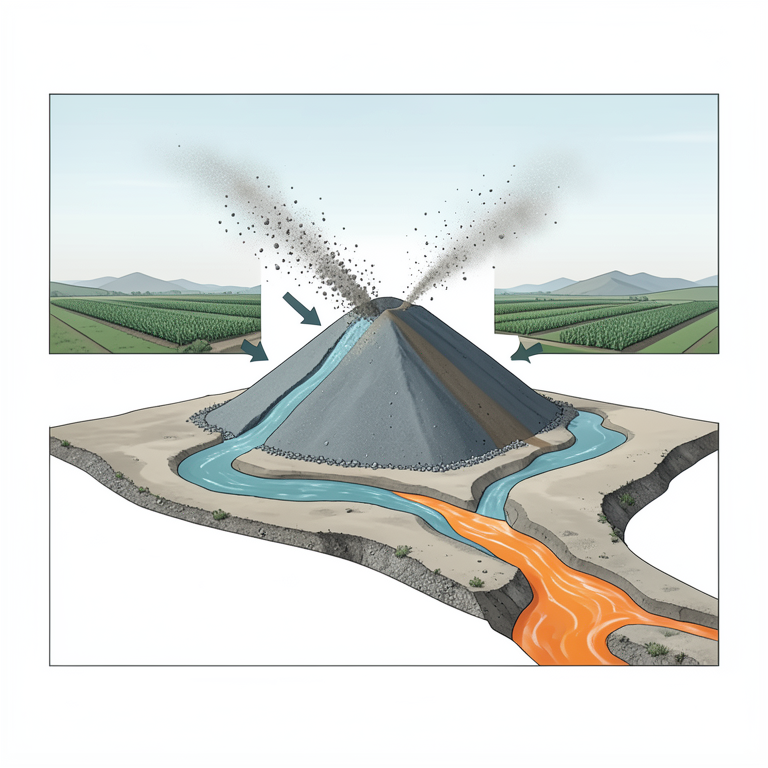
Pathways of PTE Contamination
AI-generated conceptual illustration (mining tailings deposit in the Bolivian altiplano). It explains the idea and does not show study data.
View source evidence ↗Figures & tables
From the original paper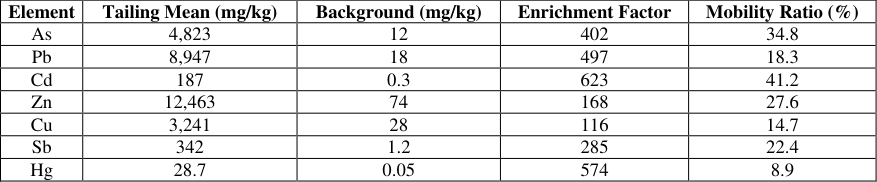 Table 1
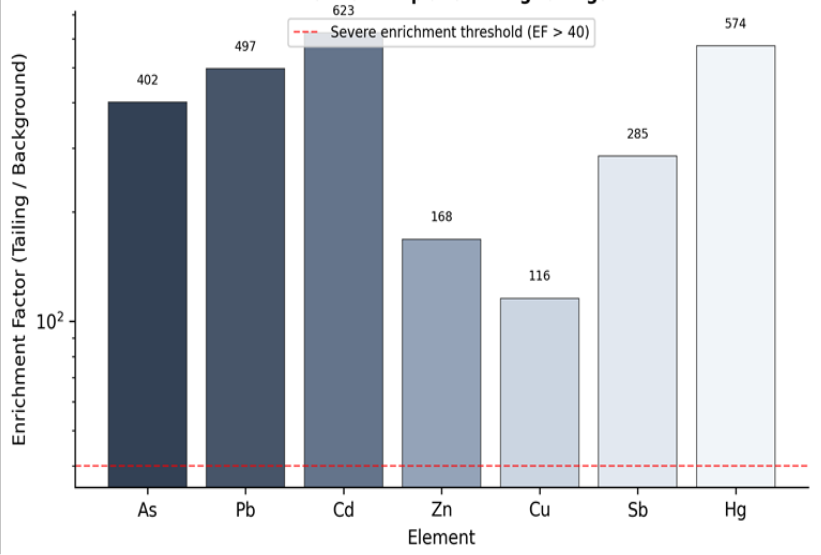 Figure 1
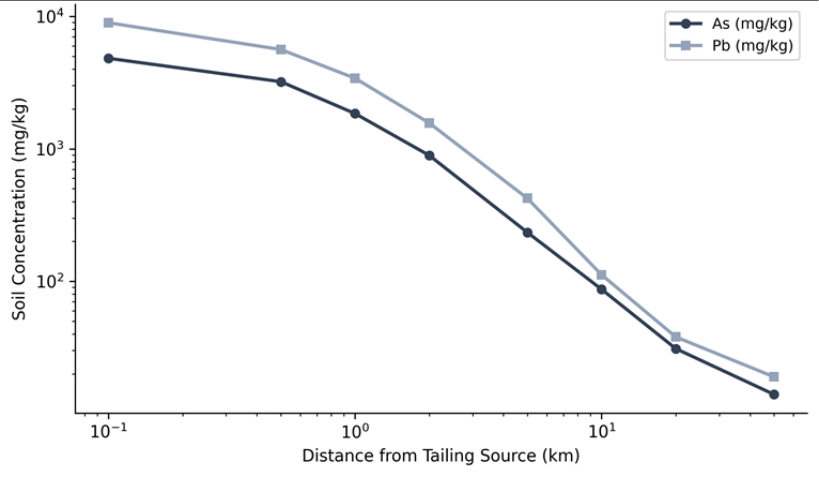 Figure 2
Introduction
A surprising fact about the Bolivian mining sector is that, despite producing silver, tin, and zinc for over 500 years, the country has no comprehensive national remediation programme for the thousands of abandoned tailing deposits scattered across the Altiplano [1] . The Altiplano-the high plateau of the central Andes at 3,600-4,200 m elevation-hosts some of the world's richest polymetallic ore deposits, including the Cerro Rico de Potosí and the tintungsten belt around Oruro [2] . Mining waste, left in unlined impoundments exposed to wind erosion and seasonal rainfall, releases PTEs to surrounding soils, surface water, and groundwater through a combination of aeolian dispersal, water erosion, and acid mine drainage (AMD) [3] . Total element concentrations in tailings tell only part of the story. What matters for environmental and health risk assessment is geochemical mobility-the fraction of a metal that can be released from the solid phase under environmental conditions [4] . Sequential extraction procedures, such as the BCR (Community Bureau of Reference) method, provide operationally defined mobility estimates by progressively attacking the sample with reagents of increasing strength, separating metals bound to carbonates, iron/manganese oxides, organic matter/sulfides, and resistant silicate lattices [5] . This research applied sequential extraction, total concentration analysis, and spatial sampling to characterise PTE mobility in tailings and surrounding soils at six mine sites on the Bolivian Altiplano. The objectives were to (a) quantify total PTE concentrations and enrichment factors, (b) determine the fraction of each element in the most mobile (exchangeable/acid-soluble) phase, and (c) map the spatial decay of contamination with distance from tailing sources [6] .
Baseline Characterisation
Background soil chemistry was established from 15 samples collected at reference sites located at least 20 km from any known mining activity, on the same lithological units (Quaternary alluvial and lacustrine deposits) as the mine sites. Mean background concentrations were: As 12 mg/kg, Pb 18 mg/kg, Cd 0.3 mg/kg, Zn 74 mg/kg, Cu 28 mg/kg, Sb 1.2 mg/kg, and Hg 0.05 mg/kg. Soil pH at reference sites ranged from 6.8 to 7.9, and organic carbon content was 0.8-2.1%. These values are consistent with published regional background data for the central Altiplano and served as the denominator for enrichment factor calculations [7] . Tailing pore water pH ranged from 2.1 to 4.3 at the six mine sites, reflecting the generation of sulfuric acid from pyrite oxidation. Electrical conductivity of tailing leachates reached 8,740 µS/cm, compared with 340 µS/cm at reference sites.
Material and Methods Material
This research was coordinated from the Department of Atmospheric Sciences at the Faculty of Mountain and Polar Studies, Madurai, Tamil Nadu, India, with fieldwork carried out on the Bolivian Altiplano between August 2020 and June 2023. Six mine sites were investigated: Huanuni (active tin), Catavi (abandoned tin), San José (active silverzinc), Cerro Rico (abandoned silver), Itos (abandoned tinsilver), and Kori Kollo (abandoned gold). Sixty tailing samples (10 per site) were collected from the top 30 cm of tailing deposits using a stainless steel hand auger. Forty soil samples were collected along four radial transects extending 0.1, 0.5, 1, 2, 5, 10, 20, and 50 km from each tailing source to capture the spatial decay of contamination. All samples were air-dried, sieved to < 2 mm, and split for total concentration and sequential extraction analysis. Total PTE concentrations were determined by ICP-MS (Agilent 7700x) after aqua regia digestion at the Geochemistry Laboratory of the Universidad Mayor de San Andrés, La Paz [8] . The BCR sequential extraction was performed following the protocol of Rauret et al. [5] : Step 1 (exchangeable/acid-soluble): 0.11 M acetic acid; Step 2 (reducible): 0.5 M hydroxylamine hydrochloride; Step 3 (oxidisable): 30% H₂O₂ + 1 M ammonium acetate; Step 4 (residual): aqua regia. Stream water samples (n = 24) were collected at AMD discharge points and at downstream stations for dissolved metal analysis by ICP-MS.
Methods
Enrichment factors were calculated as EF = (Csample / Cbackground), where C is the total concentration of each element. The geo-accumulation index (Igeo) was computed as Igeo = log₂(Cn / 1.5 × Bn), where Cn is the measured concentration and Bn the geochemical background. Spatial decay of contamination was modelled by fitting an exponential decay function: C(d) = C₀ × e^(-kd), where d is distance from the tailing source and k is the decay constant. The mobility ratio for each element was defined as the percentage of total concentration in the exchangeable/acidsoluble fraction (Step 1 of BCR). Statistical comparisons between active and abandoned sites used the Mann-Whitney U test at α = 0.05. All spatial analysis was performed in QGIS 3.28 [9] .
Economic and Sustainability Assessment
Remediation costs were estimated for three intervention scenarios: (a) capping with a 0.5 m compacted clay liner and 0.3 m topsoil cover (estimated at 28-35 USD/m² based on regional unit costs), (b) phytostabilisation using native Altiplano grasses (Festuca dolichophylla, Stipa ichu) at 4-8 USD/m², and (c) full excavation and off-site disposal at 120-180 USD/m³ [10] . For the six sites combined (total tailing area approximately 4.2 km²), capping would cost an estimated 118-147 million USD, phytostabilisation 17-34 million USD, and full removal 1.2-1.8 billion USD. Given Bolivia's annual mining environmental remediation budget of approximately 5 million USD, only phytostabilisation appears economically feasible in the near term, though it addresses only the aeolian dispersal pathway and does not prevent AMD generation. Long-term sustainability requires integrating remediation into mine closure planning for active operations and seeking international financing for legacy sites. Table 1 shows extreme enrichment for all seven elements, with Cd (EF = 623) and Hg (EF = 574) reaching the highest values. Cadmium also had the highest mobility ratio (41.2%), meaning that over two-fifths of total Cd could be released under mildly acidic conditions-a major concern given the low pH of tailing pore waters. Figure 2 shows the exponential decline of as and Pb concentrations with distance from tailing sources. Both elements remain above WHO soil screening levels (As: 12 mg/kg, Pb: 50 mg/kg) for several kilometres downwind, with As exceeding the guideline up to 5 km from the source.
| Element | Tailing Mean (mg/kg) | Background (mg/kg) | Enrichment Factor | Mobility Ratio (%) |
|---|---|---|---|---|
| As | 4,823 | 12 | 402 | 34.8 |
| Pb | 8,947 | 18 | 497 | 18.3 |
| Cd | 187 | 0.3 | 623 | 41.2 |
| Zn | 12,463 | 74 | 168 | 27.6 |
| Cu | 3,241 | 28 | 116 | 14.7 |
| Sb | 342 | 1.2 | 285 | 22.4 |
| Hg | 28.7 | 0.05 | 574 | 8.9 |
Table text extracted from the original PDF; superscript letters are shown inline. The original table image is below.
View original table image
Results
Results
Comprehensive Interpretation
The combined total concentration, sequential extraction, and spatial data paint a picture of widespread, multi-pathway contamination. The very high mobility ratios for Cd (41.2%) and As (34.8%) mean that these elements are readily available for uptake by plants and for leaching into surface and groundwater under the acidic conditions prevailing in and around the tailings. The spatial decay analysis shows that aeolian dispersal extends contamination well beyond the tailing footprints, affecting agricultural soils used by rural communities for potato and quinoa cultivation. The AMD pathway adds a dissolved-phase dimension: stream water as concentrations of 1.47 mg/L at discharge points are 147 times the WHO guideline of 0.01 mg/L.
Discussion
The enrichment factors reported here are among the highest documented for Altiplano tailings and exceed values from better-known mining districts such as the Zambian Copperbelt (Cu EF typically 20-80) and the Iberian Pyrite Belt (As EF 50-200) [11] . The extreme values reflect both the high-grade polymetallic ores characteristic of the Bolivian tin-silver belt and the complete absence of engineered containment at most sites. Cadmium's high mobility is particularly concerning because Cd bioaccumulates in root vegetables-a dietary staple on the Altiplano-and chronic low-level exposure causes renal tubular damage [12] . The observation that abandoned sites showed slightly higher mobility ratios than active sites (mean 28.4% vs. 23.1%, p = 0.032) is counterintuitive at first glance but can be explained by longer exposure to weathering cycles: repeated wetting and drying at abandoned sites promotes sulfide oxidation and the release of metals into more labile phases over time [13] .
A limitation is that the BCR sequential extraction protocol, while widely used, provides operationally defined rather than truly mineral-specific fractions. Some redistribution of metals between phases can occur during extraction, particularly for elements like As that interact strongly with iron oxides [14] . Also, the spatial decay model assumed a single point source for each site, whereas real tailing deposits are spatially distributed, which may cause the decay function to underestimate concentrations at intermediate distances.
Conclusion
This research characterised the geochemical mobility of seven potentially toxic elements in mining tailings across six sites on the Bolivian Altiplano. Enrichment factors ranged from 116 for Cu to 623 for Cd, and sequential extraction showed that 8.9% to 41.2% of total concentrations were in the most mobile fraction. Contamination extended up to 5 km from tailing sources via aeolian dispersal, and acid mine drainage delivered dissolved As at concentrations 147 times the WHO guideline. These findings demonstrate that Altiplano mining tailings represent a major, ongoing environmental and health hazard. Phytostabilisation is the most economically feasible near-term remediation strategy, but long-term solutions require integrated mine closure planning and international financing for legacy site cleanup.
Figures and tables from the paper
References
14 in the original paper- Hudson-Edwards KA, Macklin MG, Miller JR, Lechler PJ. Sources, distribution and storage of heavy metals in the Río Pilcomayo, Bolivia. Journal of Geochemical Exploration. 2001;72(3):229-250.
- Strosnider WHJ, Llanos López FS, Nairn RW. Acid mine drainage at Cerro Rico de Potosí I: unabated highstrength discharges reflect a five-century legacy of mining. Environmental Earth Sciences. 2011;64(4):899910.
- Nordstrom DK. Mine waters: acidic to circumneutral. Elements. 2011;7(6):393-398.
- Filgueiras AV, Lavilla I, Bendicho C. Chemical sequential extraction for metal partitioning in environmental solid samples. Journal of Environmental Monitoring. 2002;4(6):823-857.
- Rauret G, López-Sánchez JF, Sahuquillo A, Rubio R, Davidson C, Ure A, Quevauviller P. Improvement of the BCR three step sequential extraction procedure prior to the certification of new sediment and soil reference materials. Journal of Environmental Monitoring. 1999;1(1):57-61.
- Mulligan CN, Yong RN, Gibbs BF. Remediation technologies for metal-contaminated soils and groundwater: an evaluation. Engineering Geology. 2001;60(1-4):193-207.
- Acarapi J, Ormachea M, Bhattacharya P, Sracek O, Thunvik R, Quintanilla J. Arsenic and other trace elements in thermal springs and in cold waters from drinking water wells on the Bolivian Altiplano. Journal of South American Earth Sciences. 2015;60:10-20.
- Jenner GA, Longerich HP, Jackson SE, Fryer BJ. ICPMS: a powerful tool for high-precision trace-element analysis in earth sciences: evidence from analysis of selected USGS reference samples. Chemical Geology. 1990;83(1-2):133-148.
- Reimann C, Filzmoser P, Garrett RG, Dutter R. Statistical Data Analysis Explained: Applied Environmental Statistics with R. John Wiley and Sons. 2008;1-343.
- ITRC. Mining Waste Treatment Technology Selection. Interstate Technology and Regulatory Council. 2010;MW-1:1-156.
- Loredo J, Ordóñez A, Charlesworth S, De Miguel E. Influence of industry on the geochemical urban environment of Mieres (Spain) and associated health risk. Environment International. 2003;29(1):69-82.
- Järup L, Akesson A. Current status of cadmium as an environmental health problem. Toxicology and Applied Pharmacology. 2009;238(3):201-208.
- Blowes DW, Ptacek CJ, Jambor JL, Weisener CG. The geochemistry of acid mine drainage. Treatise on Geochemistry. 2003;9:149-204.
- Gleyzes C, Tellier S, Astruc M. Fractionation studies of trace elements in contaminated soils and sediments: a review of sequential extraction procedures. Trends in Analytical Chemistry. 2002;21(6-7):451-467.