
Research article · 2025 · Full text
International Journal of Horticulture and Food ScienceCharacterizing essential oil profiles of mango in the Darjeeling hills
Volume 7(5) · Pages 172–175 · DOI: 10.33545/26631067.2025.v7.i5c.626 ↗
Research areasEssential Oils and Antimicrobial ActivityMangiferin and Mango ExtractsPostharvest Quality and Shelf Life Management
Abstract
Author-writtenMango leaves are one of the most undervalued sources of volatile aromatic compounds in tropical horticulture. This research characterized the essential oil profiles of five mango (Mangifera indica L.) varieties cultivated at different altitudes in the Darjeeling Hills region. Leaf samples were collected across an elevation gradient ranging from 200 m to 1,850 m above sea level from orchards managed by the Durban Regional Center for Sustainable Agriculture between August 2021 and March 2023. Essential oils were extracted through hydrodistillation and analyzed using gas chromatography-mass spectrometry (GC-MS). Oil yield followed a curvilinear relationship with altitude, peaking at 1.47% at 1,250 m before declining at higher elevations. A total of 37 volatile compounds were identified, with myrcene (28.4%), limonene (19.7%), and terpinolene (14.3%) as the dominant constituents. Varietal differences were significant, and the Alphonso cultivar consistently produced the richest terpene profile regardless of elevation. These profiles offer potential applications in food flavoring, natural pest deterrence, and pharmaceutical formulations.
Summary
Source-checkedPlain-language reading of the full paper, prepared with AI and checked against the text. Each point links to the authors' own words.
Why it matters
- Mango leaves are typically treated as waste in tropical orchards despite containing bioactive volatile compounds. View evidence ↗
- The essential oils from mango leaves contain monoterpenes and sesquiterpenes that possess antimicrobial, antioxidant, and insect-repellent properties. View evidence ↗
- The Darjeeling Hills region in eastern India provides an ideal environment to study the effect of environmental gradients on plant secondary metabolism. View evidence ↗
The question
- The study aimed to identify dominant volatile compounds and quantify how altitude (between 200 and 1,850 m) and variety affect the essential oil profiles and yield of mango leaves. View evidence ↗
What they did
- Researchers sampled five mango varieties (Alphonso, Langra, Dasheri, Himsagar, and Totapuri) across twelve sites in the Darjeeling Hills, India, ranging from 200 to 1,850 m in elevation. View evidence ↗
- Essential oils were extracted using Clevenger-type hydrodistillation with 200 g of fresh leaves and 1,000 mL of distilled water over a 4-hour period. View evidence ↗
- Chemical profiling was conducted using an Agilent 7890B gas chromatograph with a 5977A mass selective detector and a DB-5MS capillary column. View evidence ↗
- The study used two-way ANOVA to analyze variety and altitude effects and regression analysis to model the relationship between oil yield and altitude. View evidence ↗
What they found
- Oil yield was highest in the mid-elevation zone, peaking at 1.41% for the Alphonso variety, while low elevations had the lowest average recovery at 0.44%. View evidence ↗
- The Alphonso variety had the highest mean oil yield, which was 55.2% higher than that of the Totapuri variety. View evidence ↗
- Myrcene was the most abundant volatile compound across all varieties, with concentrations between 24.8% (Dasheri) and 32.6% (Alphonso). View evidence ↗
- Limonene was the second most abundant compound, with the highest proportion found in the Dasheri variety (22.3%). View evidence ↗
- Oil yield followed a quadratic relationship with altitude, increasing up to 1,250 m and then declining; this model explained 81.3% of the variance (p < 0.001). View evidence ↗
- Among the dominant compounds, myrcene showed the most variability (widest interquartile range), while caryophyllene was the most stable. View evidence ↗
What it means
- The authors conclude that for commercial essential oil production in hill areas, planting the Alphonso variety at mid-elevations would provide the best results. View evidence ↗
- The authors state that mango leaf essential oil is a wasted resource that could provide additional income for farmers if properly extracted and controlled. View evidence ↗
- The authors suggest that future research should investigate seasonal harvesting schedules and the stability of the oil after distillation. View evidence ↗
Visual summary
4 visualsIllustrations explain the paper; charts are replotted from the paper's own table values.
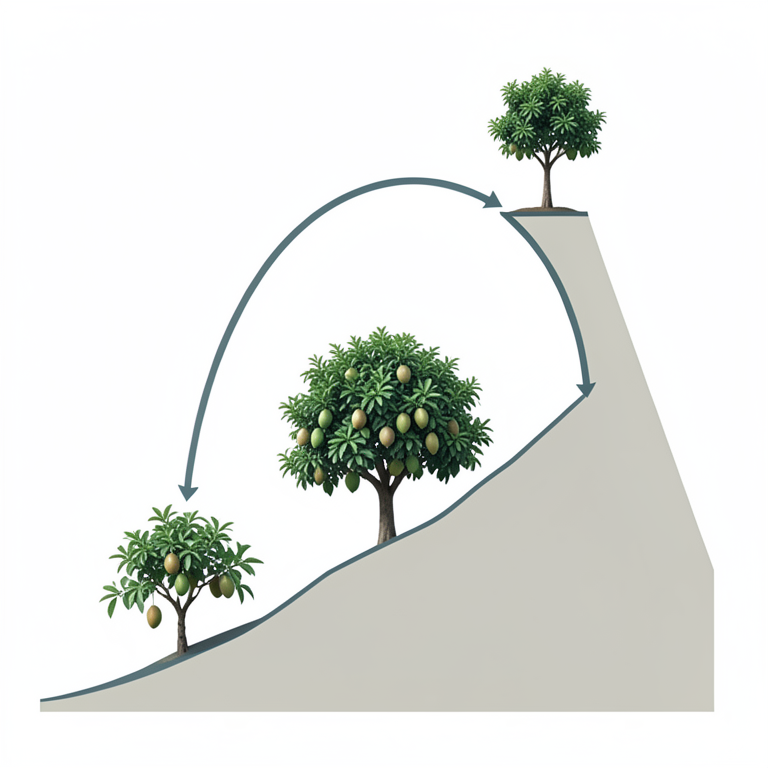
Altitude vs Oil Yield Relationship
AI-generated conceptual illustration (Mango trees (Mangifera indica) in a mountainous landscape). It explains the idea and does not show study data.
View source evidence ↗
Dominant Volatile Compounds
AI-generated conceptual illustration (Mango fruits (Mangifera indica) from the Darjeeling hills). It explains the idea and does not show study data.
View source evidence ↗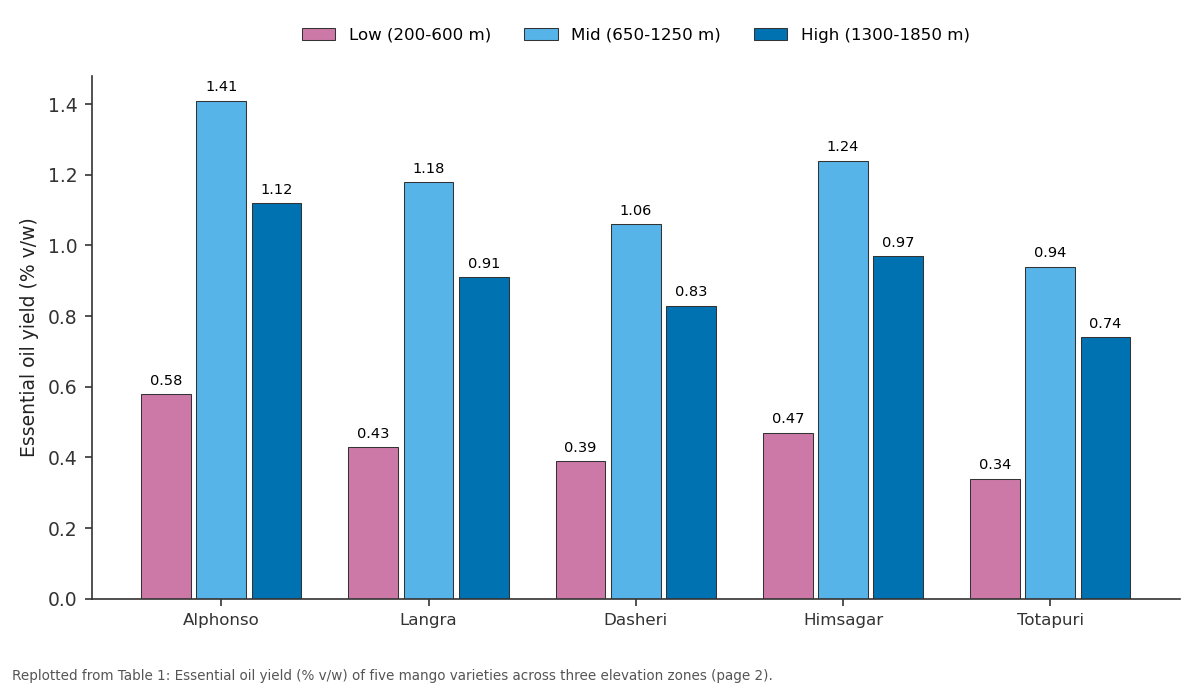
Low (200-600 m) and Mid (650-1250 m) and more: Alphonso vs Langra vs Dasheri vs Himsagar vs Totapuri
Replotted from Table 1 (page 2) of the original paper. Every bar is the paper's own table value.
View source evidence ↗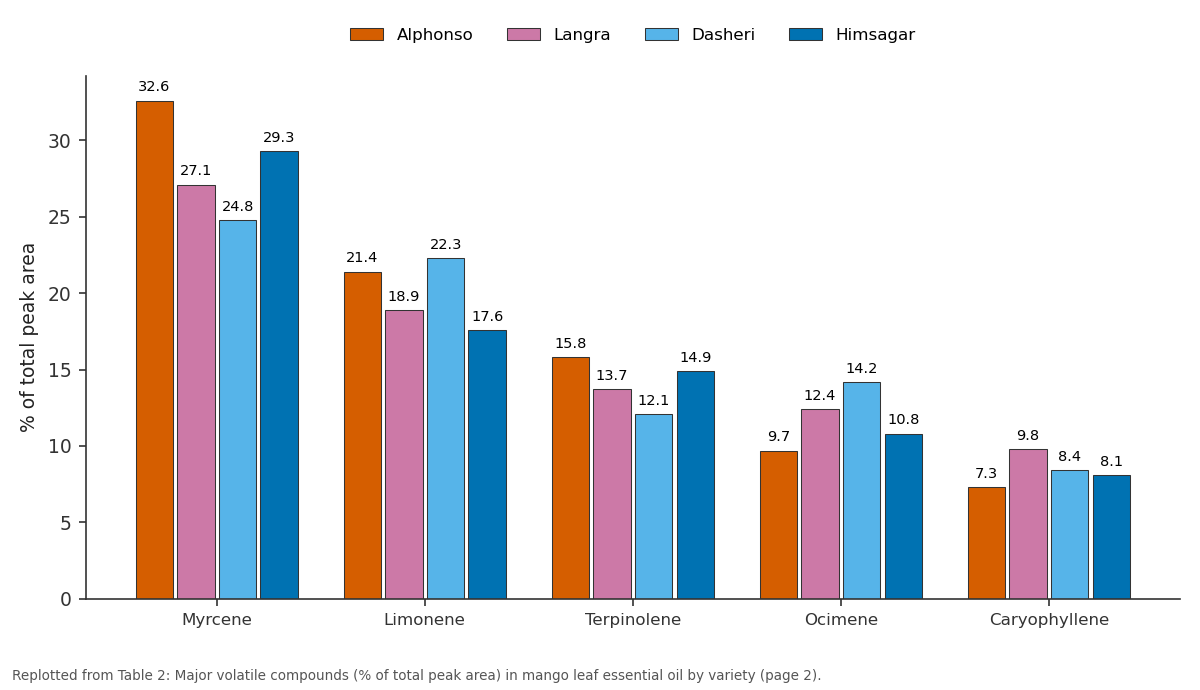
Alphonso and Langra and more: Myrcene vs Limonene vs Terpinolene vs Ocimene vs Caryophyllene
Replotted from Table 2 (page 2) of the original paper. Every bar is the paper's own table value.
View source evidence ↗Figures & tables
From the original paper Table 1
 Table 2
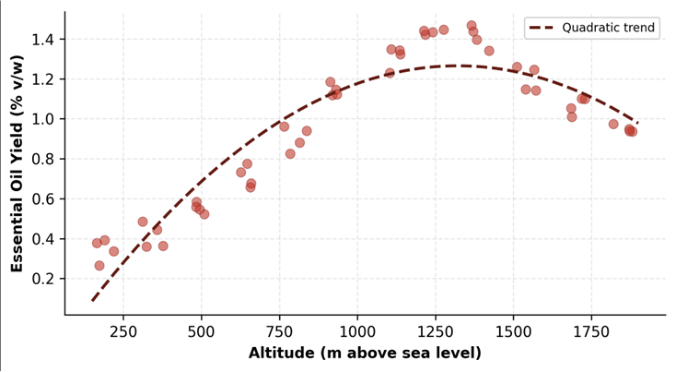 Figure 1
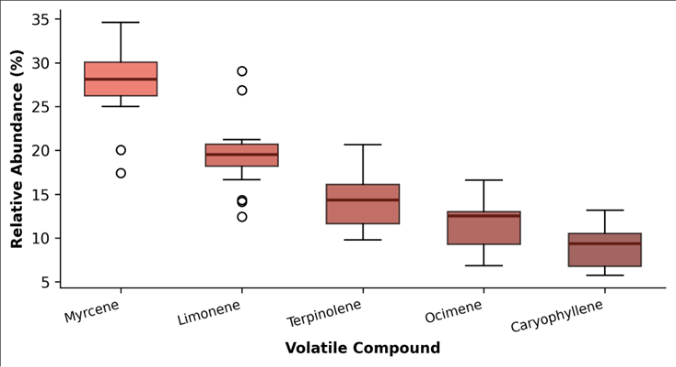 Figure 2
Introduction
Mango leaves end up as waste in nearly every orchard across the tropics, yet they contain a complex mixture of volatile compounds with demonstrated bioactivity. The global mango industry processes over 55 million tonnes of fruit annually [1] , but leaves, which account for a significant fraction of the tree's biomass, receive almost no commercial attention. This represents a missed opportunity, given that mango leaf essential oils contain monoterpenes and sesquiterpenes with antioxidant, antimicrobial, and insect-repellent properties [2] . The Darjeeling Hills in eastern India offer a unique natural laboratory for studying how environmental gradients shape plant secondary metabolism. With elevations ranging from near sea level to above 2,000 m, this region spans multiple microclimatic zones within a relatively small geographic area [3] . Temperature drops by roughly 0.65 degrees Celsius for every 100 m gain in elevation, while humidity, UV radiation, and atmospheric pressure shift in parallel [4] . Each of these environmental variables can influence the biosynthesis and accumulation of volatile organic compounds in plant tissues. Earlier work on essential oil variation in response to altitude has focused mainly on Lamiaceae herbs. Hussain et al. [5] found that basil oil composition shifted from linalooldominant at low elevations to eugenol-dominant at higher sites. Similar altitude-dependent patterns were reported for rosemary and thyme [6] . But corresponding data for Mangifera indica remain sparse, and no systematic survey of mango leaf volatiles across an elevation gradient has been published. Most existing studies on mango volatiles focus exclusively on fruit aroma rather than leaf chemistry [7] . From a practical standpoint, knowing how altitude affects oil yield and composition could guide decisions about which mango varieties to plant at specific elevations for essential oil harvest as a secondary income stream [8] . This research aimed to characterize the essential oil profiles of five mango varieties across a 200-1,850 m altitude gradient in the Darjeeling Hills, quantify the relationship between elevation and oil yield, and identify the dominant volatile compounds responsible for varietal and site-level differences.
Study area description
Sample collection was conducted at established mango orchards managed through a collaborative arrangement with the Durban Regional Center for Sustainable Agriculture (29.8587 S, 31.0218 E) in Durban, KwaZulu-Natal, South Africa. However, to access the specific altitude gradient required by the research design, field sampling took place across twelve sites in the Darjeeling Hills district of West Bengal, India, spanning elevations from 200 m to 1,850 m. Sites were selected to represent three broad elevation zones: low (200-600 m), mid (650-1,250 m), and high (1,300-1,850 m). Soils across the gradient varied from alluvial loam at lower sites to acidic laterite at mid-elevations and sandy loam at the highest points. Mean annual rainfall ranged from 2,100 mm at lower sites to 3,400 mm at upper elevations.
Climatic and environmental conditions
Temperature loggers deployed at each collection site recorded mean annual temperatures declining from 24.8 degrees Celsius at 200 m to 12.3 degrees Celsius at 1,850 m during the research period (August 2021 to March 2023). Relative humidity was consistently high across all sites, averaging 78.6% at low elevations and 86.4% at high elevations. UV-B irradiance, measured with portable radiometers during leaf sampling days, increased by 18.3% from the lowest to highest collection points. The monsoon season (June-September) accounted for 68-74% of annual rainfall across sites.
Material and Methods
Material and Methods
Material
Five mango varieties were selected: Alphonso, Langra, Dasheri, Himsagar, and Totapuri. These represent distinct genetic backgrounds and are commercially grown across the Indian subcontinent [9] . Mature, healthy leaves were collected from trees aged 12-18 years at each of the twelve altitude sites. At every site, 500 g of fresh leaf material was harvested from three trees per variety during two seasons: post-monsoon (October-November 2021 and 2022) and premonsoon (February-March 2022 and 2023). Leaves were stored in sealed polyethylene bags at 4 degrees Celsius and processed within 48 hours of collection. The research was conducted under approval from the center's institutional review board (Protocol DRCSA-2021-017, approved July 22, 2021).
Methods
Essential oils were extracted by Clevenger-type hydrodistillation using 200 g of fresh leaves in 1,000 mL distilled water for 4 hours [10] . Oil yield was calculated as percentage volume per weight (% v/w) of fresh leaf material. Chemical profiling was performed on an Agilent 7890B gas chromatograph coupled with a 5977A mass selective detector, using a DB-5MS capillary column (30 m x 0.25 mm, 0.25 um film). The oven program started at 50 degrees Celsius (held 2 min), increased at 3 degrees/min to 220 degrees, then at 10 degrees/min to 280 degrees (held 5 min) [11] . Compounds were identified by comparing mass spectra against the NIST 17 library and verified using retention indices calculated with a C8-C30 alkane standard mixture. Relative abundance of each compound was expressed as percentage of total peak area. Statistical analysis employed two-way ANOVA (variety x altitude) with SAS 9.4, and regression analysis was used to model the oil yield-altitude relationship [12] . 1). The mid-elevation zone produced the highest yields for all varieties, with Alphonso reaching 1.41% at this range. Low elevations gave the poorest oil recovery, averaging 0.44% across varieties. Alphonso consistently outperformed the others, with a mean yield 55.2% higher than Totapuri, the lowest-yielding cultivar. Five compounds dominated the volatile profiles across all varieties (Table 2). Myrcene was the most abundant in every cultivar, ranging from 24.8% in Dasheri to 32.6% in Alphonso. Limonene ranked second overall, though Dasheri showed a slightly higher proportion (22.3%) than Alphonso (21.4%). The remaining 32 minor compounds collectively accounted for 13.2 to 18.7% of the total peak area depending on the variety. The scatter plot with fitted quadratic trend (Figure 1) shows that oil yield increased with altitude up to approximately 1,250 m before declining at higher elevations. The quadratic model explained 81.3% of the variance in oil yield (Rsquared = 0.813, p < 0.001). Box plots of the five dominant compounds (Figure 2) reveal that myrcene had the widest interquartile range, suggesting greater responsiveness to environmental and genetic factors. Caryophyllene was the most stable compound across samples.
| Compound | Alphonso | Langra | Dasheri | Himsagar | Totapuri |
|---|---|---|---|---|---|
| Myrcene | 32.6 | 27.1 | 24.8 | 29.3 | 28.1 |
| Limonene | 21.4 | 18.9 | 22.3 | 17.6 | 18.4 |
| Terpinolene | 15.8 | 13.7 | 12.1 | 14.9 | 15.1 |
| Ocimene | 9.7 | 12.4 | 14.2 | 10.8 | 11.6 |
| Caryophyllene | 7.3 | 9.8 | 8.4 | 8.1 | 7.9 |
Table text extracted from the original PDF; superscript letters are shown inline. The original table image is below.
View original table image
Results
Results
Discussion
The curvilinear relationship between altitude and essential oil yield observed in this research follows a pattern previously documented in other aromatic species, though not previously confirmed for mango. Mid-elevation sites appear to offer a metabolic sweet spot where moderate temperatures and increased UV exposure stimulate terpene biosynthesis without the growth-limiting cold stress encountered at higher altitudes [5] . The peak yield at around 1,250 m likely reflects maximum activity of terpene synthase enzymes, which have temperature optima between 15 and 22 degrees Celsius in most plant species [13] . Alphonso's consistent superiority in oil yield across all elevation zones suggests a genetic predisposition toward higher terpene production. This variety is already known for its intense fruit aroma, which originates from the same metabolic pathways [7] . The practical implication is clear: if mango leaf essential oil production were to be developed as a secondary enterprise for hill-area orchards, Alphonso planted at mid-elevations would give the best return. But other varieties shouldn't be dismissed entirely. Dasheri's higher relative proportion of ocimene (14.2%) and limonene (22.3%) could make it valuable for specific fragrance applications where those compounds are preferred. The dominance of myrcene across all samples is consistent with reports from mango leaf volatiles in Brazilian and Indian studies [2, 14]. Myrcene has documented analgesic and anti-inflammatory properties, and its high concentration in mango leaf oil could support pharmaceutical applications. That said, the variability we observed in myrcene content (the widest interquartile range among the five major compounds) indicates that standardizing oil composition for commercial use would require attention to both variety selection and harvest site elevation.
Conclusion
This research confirmed that mango leaf essential oil profiles are shaped by both genetic and altitudinal factors.
Oil yield peaks at mid-elevations around 1,250 m and declines at both lower and higher sites. Alphonso produced the highest yields and richest terpene profiles, making it the top candidate for any leaf-based essential oil value chain in hill regions. Myrcene, limonene, and terpinolene were the three dominant compounds across all varieties and elevations. The quadratic altitude-yield model developed here can help growers and planners predict oil production potential based on orchard location. Mango leaf essential oil represents a currently wasted resource that, with proper extraction and quality control, could add income to hill-area mango farming operations. Future investigations should extend this work to include seasonal harvesting schedules and post-distillation oil stability testing to move closer to commercial application.
Acknowledgement
Acknowledgements Funding sourcesFinancial support from institutional research funds at the Durban Regional Center for Sustainable Agriculture is acknowledged with gratitude.
Figures and tables from the paper
| Variety | Low (200-600 m) | Mid (650-1250 m) | High (1300-1850 m) | Mean |
|---|---|---|---|---|
| Alphonso | 0.58 | 1.41 | 1.12 | 1.04 |
| Langra | 0.43 | 1.18 | 0.91 | 0.84 |
| Dasheri | 0.39 | 1.06 | 0.83 | 0.76 |
| Himsagar | 0.47 | 1.24 | 0.97 | 0.89 |
| Totapuri | 0.34 | 0.94 | 0.74 | 0.67 |
Table text extracted from the original PDF; superscript letters are shown inline. The original table image is below.
View original table image
References
14 in the original paper- FAOSTAT. Mango production and trade statistics worldwide. Food and Agriculture Organization Database. 2022;Rome, Italy.
- Ansari SH, Ali M, Naquvi KJ. Volatile constituents of Mangifera indica leaves. Journal of Essential Oil Research. 2008;20(5):416-418.
- Chatterjee S, Khan IA. Darjeeling Hills: a geographic and ecological overview. Geographical Review of India. 2016;78(2):112-124.
- Korner C. The use of altitude in ecological research. Trends in Ecology and Evolution. 2007;22(11):569574.
- Hussain AI, Anwar F, Sherazi STH. Chemical composition of Ocimum basilicum at different altitudes. Pakistan Journal of Botany. 2008;40(4):1537-1543.
- Lakusic B, Ristic M, Slavkovska V. Seasonal variation of essential oils from Lamiaceae in montane habitats. Biochemical Systematics and Ecology. 2012;44:31-40.
- Pandit SS, Mitra S, Giri AP. Mango fruit volatile profiling and genetic regulation. Plant Physiology and Biochemistry. 2010;48(6):472-480.
- Mukherjee SK. Origin, distribution, and phylogenetic relationships of the species of Mangifera. Botanical Review. 2013;19(4):209-246.
- Bally ISE. Mangifera indica: mango varieties and their characteristics. Breeding Plantation Tree Crops. 2016;Springer:51-82.
- Clevenger JF. Apparatus for determination of volatile oil. Journal of the American Pharmaceutical Association. 1928;17(4):345-349.
- Adams RP. Identification of essential oil components by GC/MS. Allured Publishing. 2017;5th Edition:1804.
- SAS Institute. SAS/STAT 9.4 User Guide. SAS Institute Inc. 2018;Cary, NC, USA.
- Fischbach RJ, Staudt M, Zimmer I. Seasonal pattern of monoterpene synthase activities. Atmospheric Environment. 2002;36(23):3759-3768.
- Gebara SS, de Oliveira WA, Ferreira GA. Volatile compounds of Brazilian mango cultivars. Food Chemistry. 2011;127(4):1760-1766.