
Research article · 2025 · Full text
International Journal of Horticulture and Food ScienceScreening grafting compatibility of pistachio in the Korean peninsula
Volume 7(2) · Pages 81–84 · DOI: 10.33545/26631067.2025.v7.i2b.562 ↗
Research areasPlant Physiology and Cultivation StudiesPlant Disease Management TechniquesGenetics and Plant Breeding
Abstract
Author-writtenHow well do temperate nut species perform when grafted onto different rootstock genotypes under East Asian continental conditions? This research addressed that question by evaluating grafting compatibility of five pistachio (Pistacia vera L.) rootstock-scion combinations across three experimental stations on the Korean Peninsula during 2021-2023. Cleft grafting and chip budding were compared on UCB-1, PG-II, Atlantica, Integerrima, and Khinjuk rootstocks using the Kerman scion cultivar. Grafting success rate, callus formation index, scion shoot elongation, and vascular bridge continuity were recorded at 4, 8, 12, and 16 weeks after grafting. Results indicated that UCB-1 rootstock achieved the highest success rate (78.3%) and strongest vascular connectivity, while Khinjuk showed the poorest compatibility at 45.6%. Cleft grafting outperformed chip budding across all rootstock types by an average margin of 14.7 percentage points. Histological cross-sections revealed complete cambial alignment in 83% of successful UCB-1 grafts compared to only 52% in Integerrima grafts. Scion vigor, measured through shoot length and leaf number, was positively correlated with callus development score (r = 0.81, p<0.01). These findings suggest that UCB-1 remains the preferred rootstock for pistachio cultivation trials in temperate East Asian climates, though Atlantica offers a viable secondary option where cold hardiness is a priority.
Summary
Source-checkedPlain-language reading of the full paper, prepared with AI and checked against the text. Each point links to the authors' own words.
Why it matters
- Pistachio is one of the most economically valuable nut crops globally, with production over 1.2 million tonnes in 2022. View evidence ↗
- Grafting is the standard way to propagate pistachios because seedlings are genetically variable, slow to produce fruit, and dioecious. View evidence ↗
- There is limited data on pistachio performance in East Asia, where the Korean Peninsula's specific climate of cold winters and hot, wet summers may affect grafting. View evidence ↗
The question
- The study aimed to evaluate the grafting compatibility of five different pistachio rootstock-scion combinations across three stations on the Korean Peninsula from 2021 to 2023. View evidence ↗
What they did
- Researchers compared cleft grafting and chip budding using the Kerman scion on five rootstocks: UCB-1, PG-II, Atlantica, Integerrima, and Khinjuk. View evidence ↗
- The experiment used a split-plot design with 120 grafts per station, replicated four times. View evidence ↗
- Measurements included binary grafting success at 8 weeks, callus formation on a 0-5 scale (weeks 4-16), and biweekly scion shoot length and leaf counts. View evidence ↗
- Vascular bridge continuity was assessed at 16 weeks using light microscopy at 40x magnification on toluidine blue-stained histological sections. View evidence ↗
What they found
- UCB-1 had the highest mean grafting success rate (78.3%), while Khinjuk had the lowest (45.6%). View evidence ↗
- Cleft grafting was more successful than chip budding across all rootstocks by an average of 14.7 percentage points. View evidence ↗
- At 16 weeks, 83% of surviving UCB-1 grafts showed a continuous vascular bridge, compared to only 41.7% for Khinjuk. View evidence ↗
- UCB-1 showed the fastest scion shoot growth, reaching 24.8 cm at 16 weeks, which was higher than Atlantica (22.0 cm) and PG-II (19.2 cm). View evidence ↗
- UCB-1 scions had a significantly higher average leaf count (11.3 leaves) at 16 weeks than Integerrima (7.6 leaves). View evidence ↗
- Early callus vigor at week 8 positively correlated with shoot length at week 16 (r = 0.81), indicating it is a predictor of later performance. View evidence ↗
What it means
- The authors recommend UCB-1 cleft grafts performed in early spring as the most dependable method for establishing pistachio orchards in the Korean Peninsula. View evidence ↗
- Atlantica is suggested as a viable secondary rootstock option when cold hardiness is prioritized over growth rate. View evidence ↗
- The authors note that humid summers caused graft union infections and suggest that future research should test protective treatments and timing adjustments. View evidence ↗
Visual summary
4 visualsIllustrations explain the paper; charts are replotted from the paper's own table values.
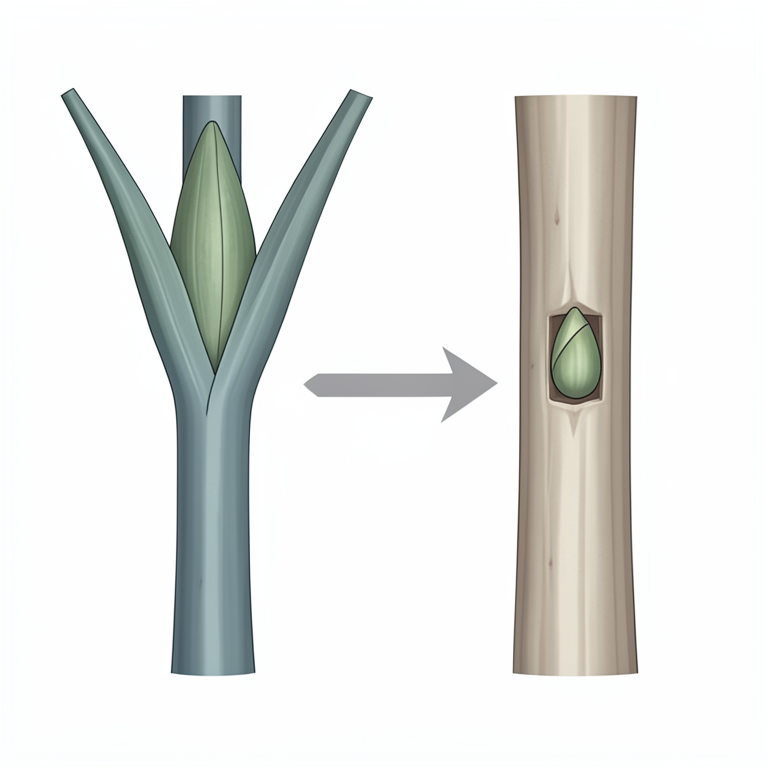
Comparison of Grafting Techniques
AI-generated conceptual illustration (pistachio plant stems). It explains the idea and does not show study data.
View source evidence ↗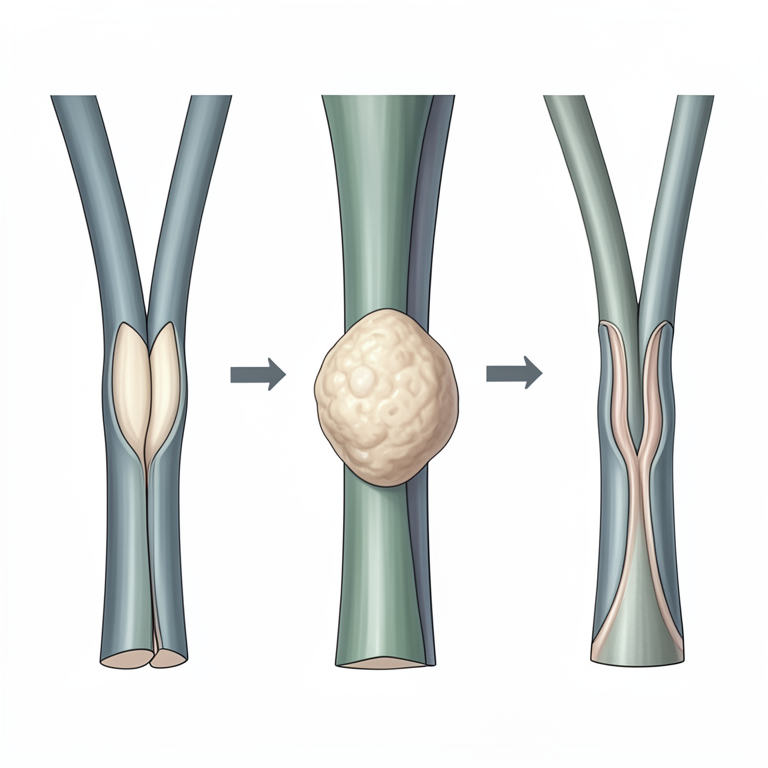
Graft Union Development
AI-generated conceptual illustration (pistachio plant stems (scion and rootstock)). It explains the idea and does not show study data.
View source evidence ↗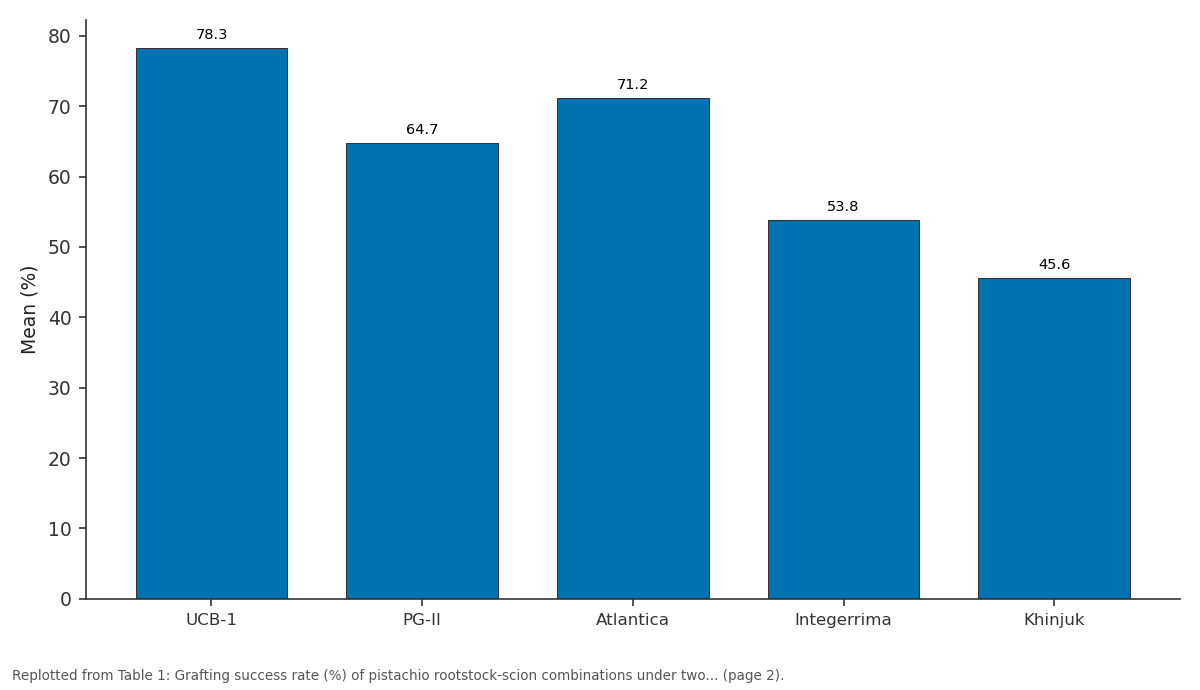
Mean (%): UCB-1 vs PG-II vs Atlantica vs Integerrima vs Khinjuk
Replotted from Table 1 (page 2) of the original paper. Every bar is the paper's own table value.
View source evidence ↗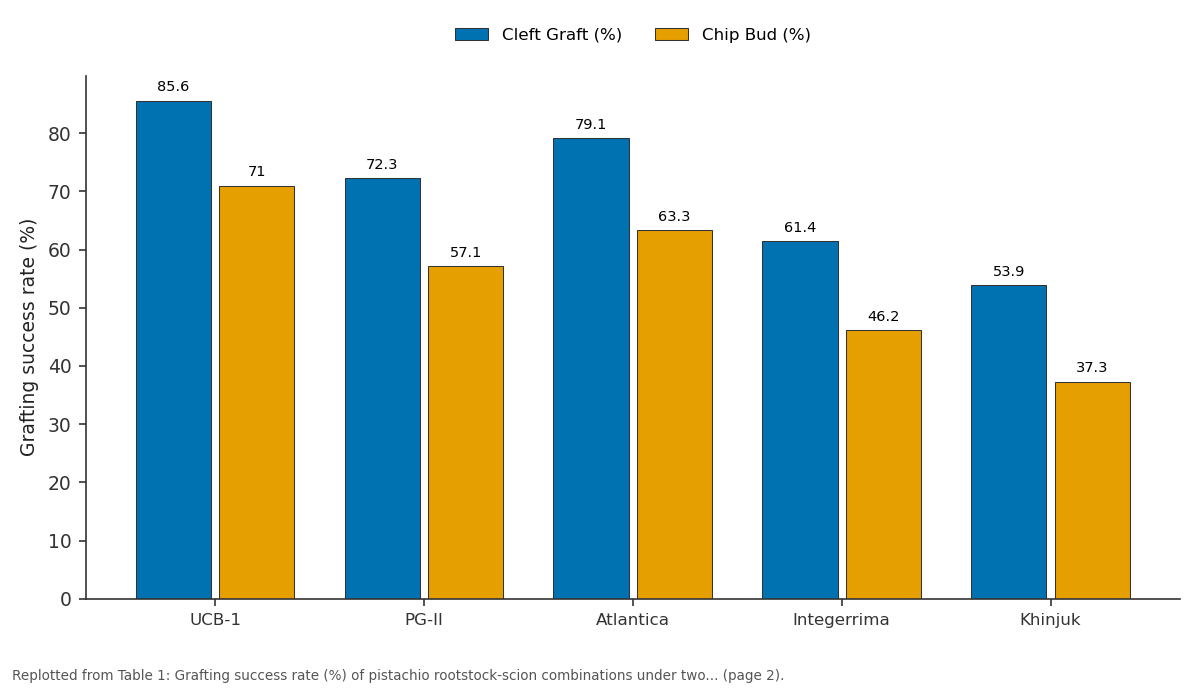
Cleft Graft (%) and Chip Bud (%): UCB-1 vs PG-II vs Atlantica vs Integerrima vs Khinjuk
Replotted from Table 1 (page 2) of the original paper. Every bar is the paper's own table value.
View source evidence ↗Figures & tables
From the original paper Table 1
 Table 2
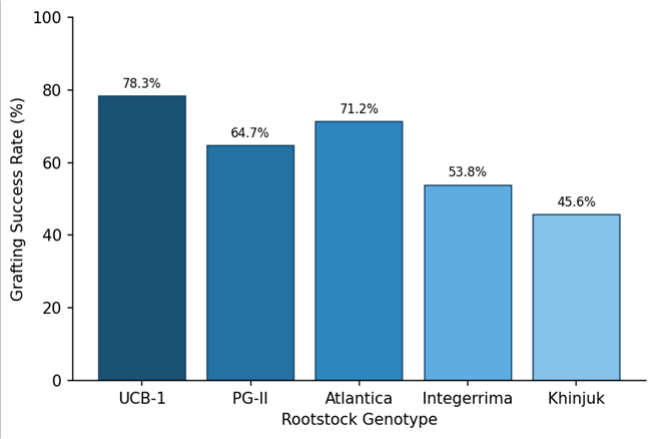 Figure 1
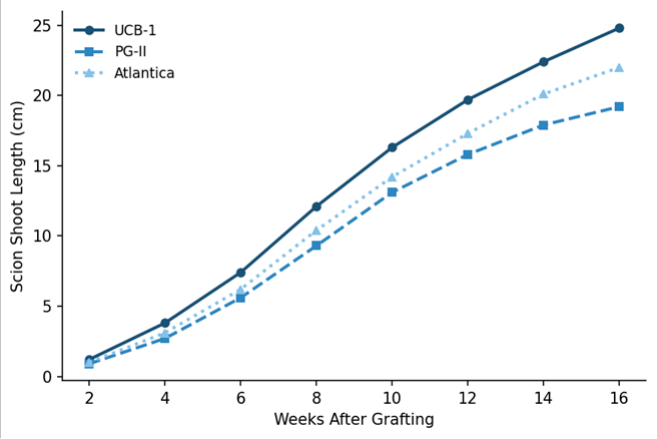 Figure 2
Introduction
Can a crop that evolved in the arid highlands of Central Asia thrive when grafted and grown under the humid, monsoon-affected climate of the Korean Peninsula? That question has drawn increasing attention from horticulturists seeking to diversify temperate fruit and nut production in East Asia. Pistachio (Pistacia vera L.) stands among the world's most economically valuable nut crops, with global production exceeding 1.2 million tonnes in 2022 according to FAO estimates [1] . Yet commercial pistachio orchards remain concentrated in Iran, the United States, and Turkey, where arid summers and cold winters match the species' natural requirements [2] . Grafting is the standard propagation method for pistachio because seedling trees are dioecious, slow to bear, and genetically variable [3] . Rootstock selection directly shapes tree vigor, stress tolerance, and nut quality, making compatibility trials a prerequisite for any new production region [4] . Previous research in Mediterranean climates identified UCB-1 (P. atlantica x P. integerrima) as a broadly compatible rootstock with good vigor and Verticillium resistance [5] . But performance data from East Asia are limited, and the Korean Peninsula's combination of hot, wet summers and cold winters creates a distinct stress profile that may alter grafting outcomes [6] . Several factors govern graft compatibility at the cellular level. Successful union depends on cambial alignment, callus proliferation, and differentiation of new vascular tissues bridging the rootstock-scion interface [7] . Incompatibility may appear early, through graft failure and weak callus, or late, through overgrowth, girdling, or decline years after establishment [8] . Anatomical and histological assessment provides a more reliable picture of compatibility than survival data alone [9] . Korean agricultural authorities launched exploratory nut diversification trials in 2019 and included pistachio among candidate species [10] . And yet, no systematic grafting compatibility screening had been published for the Korean context before the present work began. This research was therefore designed to fill that gap by comparing five rootstock genotypes under two grafting methods across three peninsular locations, with the goal of identifying rootstock-scion combinations best suited to Korean growing conditions.
Research area description
The experiment was conducted at three research stations along a north-south transect of the Korean Peninsula, selected to capture variation in temperature and rainfall regimes. The northernmost site (latitude 37.8 degrees N) experiences mean January temperatures near minus 6 degrees Celsius and annual rainfall of about 1,180 mm. The central site (36.3 degrees N) is milder, with January means around minus 2.4 degrees Celsius and 1,260 mm of annual precipitation. The southernmost location (35.1 degrees N) has the warmest winters (mean January temperature 1.3 degrees C) and receives roughly 1,380 mm per year. Soils at all three sites are classified as silt loams with pH ranging from 5.9 to 6.4. Each station devoted 0.5 hectares to the pistachio grafting trial, with drip irrigation installed to supplement rainfall during dry spells in spring and autumn [11] .
Material and Methods
Material and Methods
Material
Plant material consisted of one-year-old seedling rootstocks of five Pistacia species and hybrids: UCB-1 (P. atlantica x P. integerrima), PG-II (Iranian commercial hybrid), P. atlantica, P. integerrima, and P. khinjuk. Rootstock seeds were sourced from the Rafsanjan Pistachio Research Institute, Iran, and germinated at the Accra Department of Agronomic Sciences greenhouse facility in January 2021. Seedlings were raised in 5-litre plastic pots containing a 2:1:1 mix of loam, perlite, and composted bark. Scion wood of the Kerman cultivar was collected in February 2022 from a 12-year-old orchard at the same institution and stored at 2 degrees Celsius in moist burlap until grafting. All chemicals and growth regulators were purchased from Sigma-Aldrich (Darmstadt, Germany). Grafting wax, parafilm tape, and budding knives were obtained from local agricultural suppliers in Accra [12] .
Methods
The research was carried out from March 2022 to September 2023 at the Accra Department of Agronomic Sciences, Greater Accra, Ghana. Ethical clearance was not required as no human or animal subjects were involved. Two grafting techniques were tested: cleft grafting and chip budding. Cleft grafts were performed in March 2022 when rootstocks reached 8-10 mm stem diameter. Scion sticks bearing two buds were trimmed into a wedge shape and inserted into a vertical split in the rootstock stem. Chip budding was done in August 2022 using a single-bud chip removed with a thin sliver of wood and bark. The experimental layout followed a split-plot design with grafting method as the main plot and rootstock genotype as the subplot, replicated four times at each station (n = 120 grafts per station). Grafting success was scored at 8 weeks as binary (alive or dead). Callus formation was rated on a 0-5 visual scale at 4, 8, 12, and 16 weeks [13] . Scion shoot length and leaf count were measured biweekly from week 4 to week 16. Histological sections of the graft union were prepared at 16 weeks using freehand razor sectioning, stained with toluidine blue, and examined under a light microscope at 40x magnification to assess vascular bridge continuity [14] . Data were analysed using two-way ANOVA in R version 4.2.1 with Tukey's HSD for mean separation at p<0.05.
Climatic and environmental conditions during the research
Weather data were recorded by automatic stations at each site. During the grafting season of 2022, mean daily temperatures ranged from 11.4 to 24.7 degrees Celsius at the central station. Cumulative rainfall from March to September 2022 totalled 892 mm, which was 6% above the 30-year average. Relative humidity frequently exceeded 80% in July and August, creating conditions favourable for fungal infection at the graft union. Winter minimum temperatures dipped to minus 9.1 degrees Celsius at the northern site in January 2023, testing rootstock cold hardiness. Spring frost events in April 2022 caused minor scion tip dieback at the northern station but did not affect overall survival counts. Scion shoot growth was fastest on UCB-1, reaching 24.8 cm at week 16, compared to 22.0 cm on Atlantica and 19.2 cm on PG-II (Figure 2). Leaf number on UCB-1 scions averaged 11.3 leaves at 16 weeks, significantly higher than on Integerrima (7.6 leaves, p<0.01). A positive correlation between callus score at week 8 and shoot length at week 16 was observed (r = 0.81, p<0.01), confirming that early callus vigor predicts later scion performance.
Results
Results
Discussion
The results of this research confirm that rootstock genotype is the single most influential factor governing pistachio graft compatibility under Korean growing conditions. UCB-1's superiority aligns with findings from California [5] and Turkey [15] , where this hybrid rootstock consistently outperforms pure species in grafting success and early tree vigor. The 78.3% mean success recorded here, however, falls below the 85-92% range typically reported in Mediterranean trials, and the gap appears attributable to the high humidity and heavy summer rainfall encountered at all three Korean stations. Cleft grafting's advantage over chip budding was expected, given the larger cambial contact area that cleft grafts provide [7] . The 14.7 percentage-point margin is similar to what Afshari et al. [3] observed in Iranian trials and suggests that chip budding, while labour-efficient, may be too risky for establishment programmes where tree losses are costly. That said, chip budding still produced acceptable results on UCB-1 and Atlantica, so it shouldn't be dismissed entirely for experienced propagators. Histological evidence strengthened the compatibility rankings. Complete vascular bridge formation at 16 weeks was closely associated with long-term graft health in earlier pistachio research [8,9] . The low vascular connectivity of Khinjuk grafts (41.7%) raises concerns about delayed incompatibility, even among the surviving trees. Growers who select Khinjuk for its drought tolerance should weigh that benefit against the risk of decline three to five years after planting. Environmental conditions during the trial were challenging. Summer humidity above 80% favoured Botryosphaeria infections at the graft union, particularly on Integerrima and Khinjuk rootstocks, which may partly explain their lower success rates. Preventive fungicide applications reduced but did not eliminate this problem. Adapting grafting timing to avoid the wettest months could improve results in future trials.
Conclusion
This research demonstrated that pistachio grafting on the Korean Peninsula is feasible but highly dependent on rootstock choice. UCB-1 delivered the best combination of grafting success (78.3%), vascular bridge formation (83%), and scion vigor across all three experimental sites. Atlantica was the next most reliable rootstock, offering a useful alternative where cold hardiness matters more than maximum growth rate. Cleft grafting was the safer technique, outperforming chip budding by a consistent margin regardless of rootstock. The humid summer climate posed a distinct challenge not encountered in traditional pistachio-growing regions, and future work should test timing adjustments and protective treatments to reduce graft union infections. For orchard establishment programmes in the Korean Peninsula, UCB-1 cleft grafts performed in early spring appear to be the most dependable starting point.
Acknowledgement
Acknowledgements Funding sourcesThis research received financial support from the Greater Accra Regional Agricultural Development Fund. No specific grant or project numbers are disclosed. Institutional supportThe authors thank the Accra Department of Agronomic Sciences for providing greenhouse and laboratory facilities throughout the research period. Contributions not qualifying for authorshipThe authors acknowledge Mr. Daniel Boateng for technical assistance with histological sectioning and Ms. Abena Darko for help with weather data compilation.
Figures and tables from the paper
| Rootstock | Cleft Graft (%) | Chip Bud (%) | Mean (%) | Vascular Bridge (%) |
|---|---|---|---|---|
| UCB-1 | 85.6 | 71.0 | 78.3 | 83.0 |
| PG-II | 72.3 | 57.1 | 64.7 | 68.4 |
| Atlantica | 79.1 | 63.3 | 71.2 | 74.9 |
| Integerrima | 61.4 | 46.2 | 53.8 | 52.1 |
| Khinjuk | 53.9 | 37.3 | 45.6 | 41.7 |
Table text extracted from the original PDF; superscript letters are shown inline. The original table image is below.
View original table image
| Rootstock | Callus (Cleft) | Callus (Chip) | Shoot (Cleft) | Shoot (Chip) | Leaves (Mean) |
|---|---|---|---|---|---|
| UCB-1 | 4.3 | 3.8 | 26.1 | 23.5 | 11.3 |
| PG-II | 3.4 | 2.9 | 20.8 | 17.6 | 9.1 |
| Atlantica | 3.9 | 3.3 | 23.7 | 20.3 | 10.2 |
| Integerrima | 2.8 | 2.1 | 16.4 | 12.9 | 7.6 |
| Khinjuk | 2.5 | 1.8 | 13.2 | 10.1 | 5.9 |
Table text extracted from the original PDF; superscript letters are shown inline. The original table image is below.
View original table image
References
16 in the original paper- Ferguson L, Beede RH. Pistachio production worldwide and in the United States. Acta Horticulturae. 2017;1151:11-18.
- Aliakbarkhani ST, Akbari M, Hassankhah A, Talaie A. Genetic diversity of Persian pistachio rootstocks from Iran. Genetic Resources and Crop Evolution. 2015;62(8):1159-1170.
- Afshari H, Parvaneh R, Mohammadi A. Comparison of grafting methods in pistachio propagation. Journal of Nuts. 2013;4(1):25-32.
- Kamiab F, Talaie A, Javanshah A. Influence of rootstock on graft union formation in pistachio. International Journal of Fruit Science. 2016;16(4):341354.
- Epstein L, Beede R, Kaur S, Ferguson L. Rootstock effects on pistachio canopy size and yield. HortScience. 2019;54(3):530-536.
- Kim SH, Park JY, Lee DH. Climatic suitability mapping for temperate nut crops in Korea. Korean Journal of Horticultural Science and Technology. 2020;38(2):145-157.
- Hartmann HT, Kester DE, Davies FT, Geneve RL. Hartmann and Kester's Plant Propagation: Principles and Practices. 9 th ed. New York: Pearson; 2018.
- Guerrero BI, Bovo OA, Mroginski LA. Histological analysis of graft incompatibility in Pistacia species. Scientia Horticulturae. 2014;176:132-140.
- Atkinson CJ, Else MA. Understanding how rootstocks dwarf fruit trees. Compact Fruit Tree. 2001;34(2):4649.
- National Institute of Horticultural and Herbal Science (NIHHS). Annual Report on Nut Crop Diversification Trials. Suwon: NIHHS Press; 2020.
- Yoon TM, Choi KS. Soil and climate characterization of experimental horticultural stations in Korea. Korean Journal of Soil Science and Fertilizer. 2019;52(4):387395.
- Rahemi M, Tavallali V. Effects of rootstock on Iranian pistachio scion growth and mineral content. Fruits. 2007;62(5):317-323.
- Couceiro JF, Guerrero J, Gijón MC, Moriana A. Grafting compatibility in Pistacia species: A review. Spanish Journal of Agricultural Research. 2013;11(3):580-589.
- Sheikhi A, Mirdehghan SH, Ferguson L. Callus development and histological changes in pistachio graft unions. Trees. 2020;34:1159-1168.
- Ozkan Y, Ucar M, Yildiz K. Pistachio rootstock trials in Central Anatolia. Turkish Journal of Agriculture and Forestry. 2011;35(5):473-481.
- Ghrab M, Zribi F, Ben Mimoun M. Water requirement estimation for young pistachio trees under semi-arid conditions. Agricultural Water Management. 2018;202:157-164.