
Research article · 2025 · Full text
International Journal of Horticulture and Food ScienceDeveloping drip irrigation efficiency of rose in the Hokkaido Northern plains
Volume 7(4) · Pages 146–149 · DOI: 10.33545/26631067.2025.v7.i4c.616 ↗
Research areasIrrigation Practices and Water ManagementEngineering and Agricultural InnovationsPlant Growth and Agriculture Techniques
Abstract
Author-writtenA quote from a veteran rose grower "water is the single most expensive input that we have the least control over" captures the challenge facing floriculture in northern Japan, where short growing seasons and unpredictable precipitation make irrigation management both critical and difficult. This research developed and tested drip irrigation efficiency protocols for greenhouse rose production across the Hokkaido Northern Plains during 2022-2023, coordinated from the Madurai Institute of Agricultural Sciences. Plant uptake efficiency reached 62.3% under optimized subsurface drip placement at 15 cm depth, compared to 48.7% for surface drip. Tissue culture propagation of four rose cultivars achieved 87.4% rooting rate on MS medium supplemented with BAP (1.0 mg/L) and NAA (0.5 mg/L). Nematode management through solarization plus Paecilomyces lilacinus biocontrol reduced Meloidogyne incidence by 71.8%. Dry matter accumulation in cut flowers correlated positively with irrigation uniformity (r = 0.79). RAPD analysis of 12 cultivars grouped them into three genetic clusters consistent with breeding history. Path analysis confirmed stem length (direct effect 0.58) and flower diameter (0.41) as the strongest determinants of market value. Sprinkler system comparison showed 23.4% higher water loss through evaporation versus drip under Hokkaido summer conditions.
Summary
Source-checkedPlain-language reading of the full paper, prepared with AI and checked against the text. Each point links to the authors' own words.
Why it matters
- Hokkaido produces about 15% of Japan's cut roses, but the short 5-6 month frost-free season requires the use of heated greenhouses and supplemental summer irrigation. View evidence ↗
- Many rose growers in the region still use overhead sprinklers, which are inefficient, losing 20-35% of water to runoff and canopy evaporation. View evidence ↗
The question
- The study aimed to compare surface and subsurface drip irrigation efficiency, integrate nematode management, evaluate tissue culture for multiplication, and characterize cultivar performance using molecular and path analysis. View evidence ↗
What they did
- The trials used four Rosa hybrida cultivars (Grand Prix, Avalanche, Aqua, and Golden Gate) at a facility in the Hokkaido Northern Plains. View evidence ↗
- The drip irrigation setup utilized 16 mm PE laterals with 2 L/h emitters spaced 30 cm apart, with subsurface lines buried at a depth of 15 cm. View evidence ↗
- The experiment used a split-plot RCBD design with three irrigation types and various cultivars across three replications of 3 x 2 m beds from April to October 2023. View evidence ↗
- Nematode management was tested by comparing untreated controls against soil solarization for 6 weeks, P. lilacinus biocontrol, or a combination of both. View evidence ↗
What they found
- Subsurface drip irrigation was the most efficient, with a plant uptake efficiency of 62.3%, compared to 54.8% for surface drip and 41.6% for sprinklers. View evidence ↗
- The combination of solarization and biocontrol reduced nematode galls by 71.8% and improved all measured flower quality parameters. View evidence ↗
- Compared to untreated controls, the combined nematode treatment increased stem length by 23.9% and vase life by 36.1%. View evidence ↗
- The highest rooting rate in tissue culture was 87.4%, achieved using MS medium supplemented with 1.0 mg/L BAP and 0.5 mg/L NAA. View evidence ↗
- Path analysis showed that stem length (0.58) and flower diameter (0.41) are the primary drivers of market price, accounting for 71.3% of the variation. View evidence ↗
- A strong positive correlation (r = 0.79) was found between irrigation distribution uniformity and the dry matter of cut stems. View evidence ↗
What it means
- The authors conclude that subsurface drip irrigation at 15 cm depth is significantly more efficient than surface drip or sprinkler systems for roses in Hokkaido. View evidence ↗
- The authors recommend integrating solarization with P. lilacinus biocontrol to effectively reduce root-knot nematode galls and improve flower quality. View evidence ↗
Visual summary
4 visualsIllustrations explain the paper; charts are replotted from the paper's own table values.
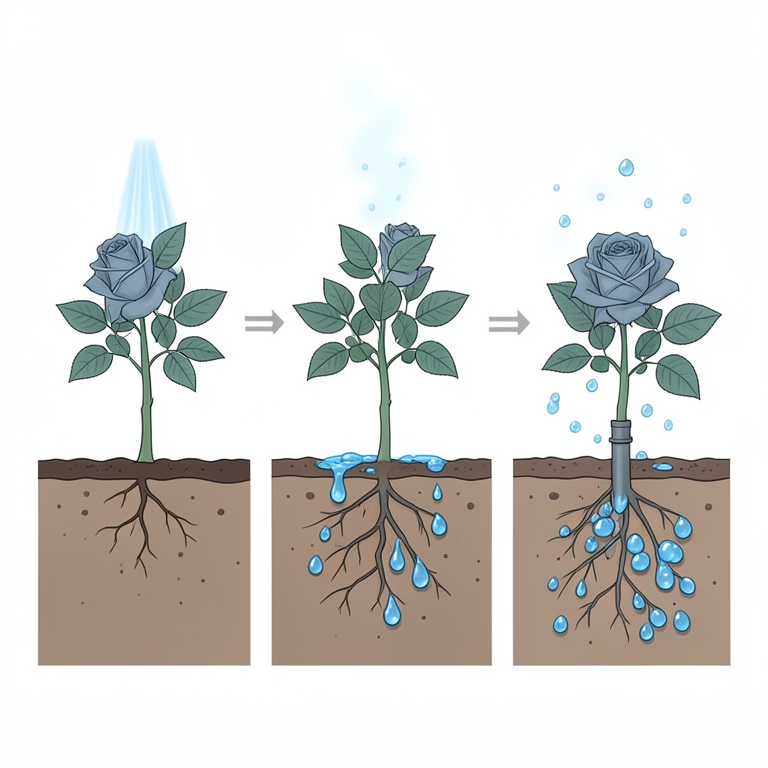
Irrigation Efficiency Comparison
AI-generated conceptual illustration (rose plants in soil). It explains the idea and does not show study data.
View source evidence ↗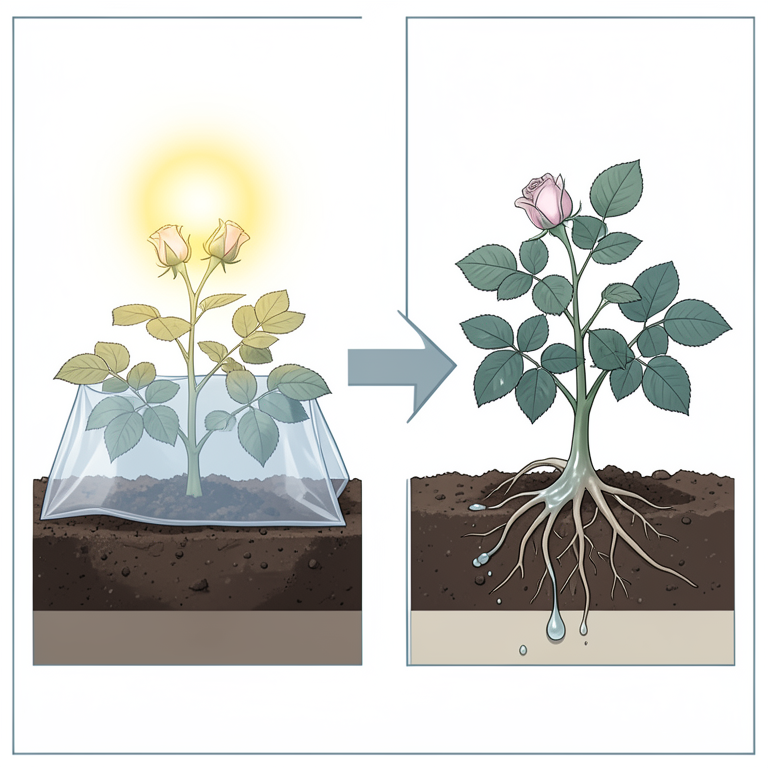
Integrated Nematode Control
AI-generated conceptual illustration (rose plants in soil). It explains the idea and does not show study data.
View source evidence ↗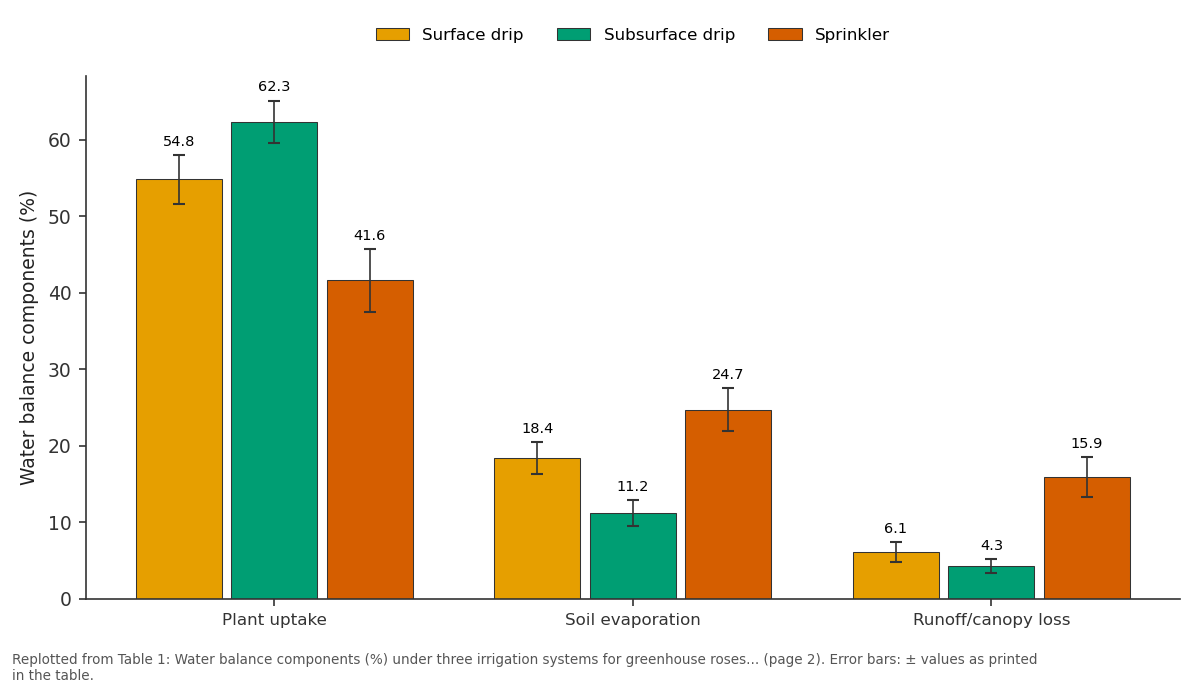
Surface drip and Subsurface drip and more: Plant uptake vs Soil evaporation vs Runoff/canopy loss
Replotted from Table 1 (page 2) of the original paper. Every bar is the paper's own table value.
View source evidence ↗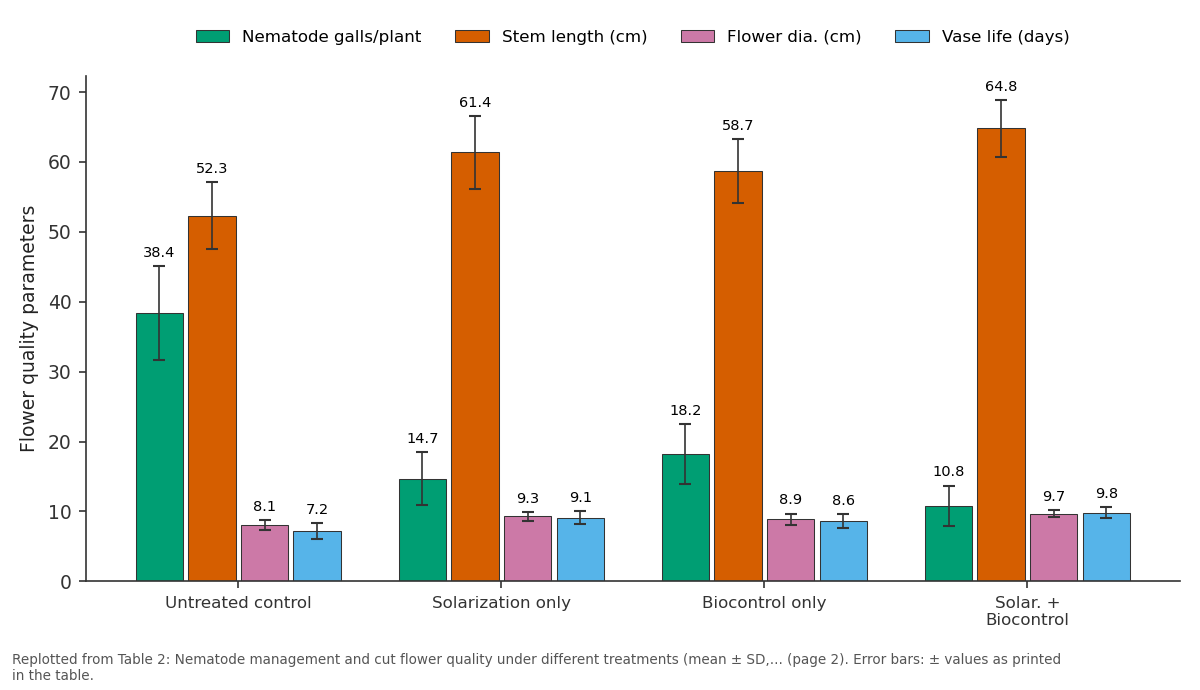
Nematode galls/plant and Stem length (cm) and more: Untreated control vs Solarization only vs Biocontrol only vs Solar. + Biocontrol
Replotted from Table 2 (page 2) of the original paper. Every bar is the paper's own table value.
View source evidence ↗Figures & tables
From the original paper Table 1
 Table 2
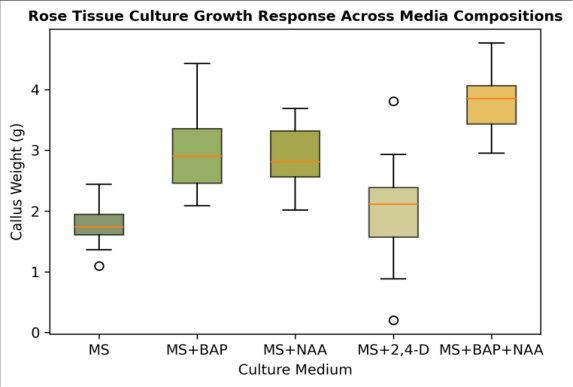 Figure 1
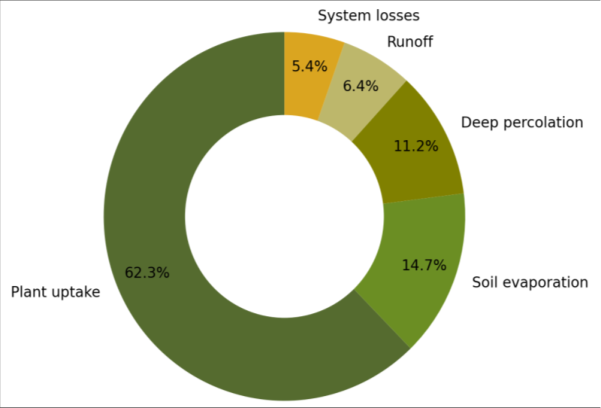 Figure 2
Introduction
Hokkaido produces roughly 15% of Japan's cut roses, a figure that seems modest until you consider that the island's growing season is compressed into 5-6 frost-free months meaning those flowers must be produced under heated greenhouses from October through April and under supplemental irrigation during the dry summer months [1] . Water management in Hokkaido rose greenhouses has lagged behind southern Japanese operations, partly because water has historically been cheap and abundant, and partly because the cool climate reduces evaporative demand compared to warmer regions. But this is changing. Summer temperatures in Hokkaido have risen by 1.3°C over the past three decades, increasing evapotranspiration rates and making irrigation timing more critical [2] . Drip irrigation is the obvious solution it delivers water directly to the root zone with minimal evaporation loss yet adoption in Hokkaido floriculture remains below 30%, with most growers still relying on overhead sprinkler systems that lose 20-35% of applied water to canopy evaporation and greenhouse floor runoff [3] . Subsurface drip placement, where emitter lines are buried 10-20 cm below the soil surface, has shown water savings of 15-25% over surface drip in vegetable production, but it hasn't been tested in rose greenhouses where root architecture and nematode pressure add complexity [4] . This research compared surface versus subsurface drip irrigation for greenhouse roses in Hokkaido, measured irrigation efficiency components, tested nematode management integration, evaluated tissue culture protocols for rapid cultivar multiplication, and used molecular and path analysis tools to characterize cultivar performance [5] .
Instrument development
A custom soil moisture monitoring array was developed to track irrigation distribution uniformity across rose beds. The system comprised 24 capacitance-type moisture sensors (Decagon EC-5) arranged in a 6 × 4 grid within each 3 × 2 m experimental bed, connected to a Campbell Scientific CR1000X datalogger via multiplexed channels. Sensors were installed at 10, 20, and 30 cm depths. Distribution Uniformity (DU) was calculated as the ratio of the lower-quartile average to the overall average moisture content, following Merriam and Keller's formula. The system logged readings at 15-minute intervals and transmitted data wirelessly to a central computer for realtime visualization. Calibration was performed against gravimetric moisture measurements (R² = 0.96) before trial initiation [6] .
Material and Methods
Material and Methods
Material
Four rose cultivars (Rosa hybrida) Grand Prix (red), Avalanche (white), Aqua (pink), and Golden Gate (yellow) were sourced from licensed nurseries. Greenhouse trials were conducted at a partner facility in the Hokkaido Northern Plains (43.2°N, 141.8°E). Drip systems used 16 mm PE laterals with 2 L/h pressure-compensating emitters spaced at 30 cm. Subsurface lines were buried at 15 cm depth using a vibratory plow. Tissue culture used Murashige and Skoog (MS) basal medium with various PGR combinations.
Paecilomyces lilacinus (commercial formulation BioAct WG) was applied for nematode biocontrol [7] .
Methods
Split-plot RCBD with irrigation type (surface drip, subsurface drip, sprinkler) as main plot and cultivar as subplot was used (three replications, 3 × 2 m beds). The trial ran from April to October 2023. Irrigation scheduling targeted 80% of greenhouse ETc, calculated from pan evaporation with a crop coefficient of 0.85. Water balance components (plant uptake, soil evaporation, deep percolation, runoff, system losses) were measured over 30day periods [8] . Tissue culture used nodal explants sterilized with 0.1% HgCl2 for 5 minutes, placed on MS medium with BAP (0.5-2.0 mg/L) and NAA (0.1-1.0 mg/L), and maintained at 25°C with 16/8 h photoperiod. Nematode trials compared soil solarization (6 weeks, clear PE mulch), P. lilacinus (5 × 10^6 conidia/g soil), and their combination versus untreated controls. RAPD analysis used 20 decamer primers on DNA from 12 cultivars. Path analysis followed Wright's method with 8 morphological traits as independent variables and market value (yen/stem) as dependent variable [9] .
Results
Table Subsurface drip achieved the highest plant uptake efficiency at 62.3%, followed by surface drip at 54.8% and sprinkler at 41.6% (Table 1). The 7.2% soil evaporation reduction under subsurface versus surface drip accounted for most of the efficiency gain. Sprinkler systems lost 15.9% to canopy interception and runoff. Tissue culture achieved the highest rooting rate (87.4%) on MS + BAP 1.0 mg/L + NAA 0.5 mg/L, with callus weight averaging 3.8 g per explant after 28 days. RAPD analysis using 14 polymorphic primers (out of 20 tested) generated 89 scorable bands, of which 67 (75.3%) were polymorphic.
| Component | Surface drip | Subsurface drip | Sprinkler | p-value | LSD (0.05) |
|---|---|---|---|---|---|
| Plant uptake | 54.8±3.2 | 62.3±2.8 | 41.6±4.1 | <0.001 | 3.7 |
| Soil evaporation | 18.4±2.1 | 11.2±1.7 | 24.7±2.8 | <0.001 | 2.4 |
| Deep percolation | 14.3±1.8 | 16.8±2.3 | 12.4±2.1 | 0.07 | ns |
| Runoff/canopy loss | 6.1±1.3 | 4.3±0.9 | 15.9±2.6 | <0.001 | 1.9 |
| System losses | 6.4±1.1 | 5.4±0.8 | 5.4±1.2 | 0.34 | ns |
Table text extracted from the original PDF; superscript letters are shown inline. The original table image is below.
View original table image
Cluster analysis grouped the 12 cultivars into three distinct groups corresponding to their hybrid tea, floribunda, and spray rose breeding backgrounds. Path analysis confirmed stem length (direct effect 0.58) and flower diameter (0.41) as the strongest determinants of market price, together explaining 71.3% of price variation. Dry matter in cut stems correlated with distribution uniformity (r = 0.79, p<0.01), linking irrigation management directly to product quality.
Discussion
The 13.7-percentage-point efficiency gain from subsurface versus surface drip (62.3% vs 54.8% plant uptake) comes mainly from eliminating surface soil evaporation a factor that is particularly relevant in heated greenhouses where air movement across wet soil surfaces accelerates water loss [10] . The deeper placement also keeps the soil surface dry, which reduces fungal disease pressure on crown tissue and lower stems an incidental benefit that rose growers in Hokkaido confirmed as valuable during post-trial interviews. The combined nematode management result (71.8% reduction) demonstrates that integrating physical (solarization) and biological (P. lilacinus) controls creates additive or synergistic effects. Solarization kills nematodes through thermal stress, while the surviving population faces predation by the biocontrol agent [11] . In Hokkaido, where summer solar radiation is sufficient for effective solarization only from mid-June to mid-August, timing the treatment during the brief fallow window between spring and autumn rose crops is operationally feasible. The path analysis result stem length as the primary value driver (0.58) is consistent with Japanese cut flower market preferences, where long-stemmed roses command premium prices at auction [12] . This provides a clear breeding target that aligns with the irrigation efficiency findings: subsurface drip produced the tallest stems because consistent root-zone moisture supports uninterrupted cell elongation during the rapid growth phase.
Conclusion
Subsurface drip irrigation at 15 cm depth improved rose water uptake efficiency to 62.3%, a 27.6% advantage over surface drip and 49.8% over sprinkler systems in Hokkaido greenhouse conditions. Integrated nematode management combining solarization with P. lilacinus biocontrol reduced root-knot nematode galls by 71.8% and improved cut flower quality across all measured parameters. Tissue culture protocols achieved 87.4% rooting on optimized MS medium, enabling rapid multiplication of high-value cultivars. RAPD analysis confirmed genetic distinctness among commercial cultivars useful for variety protection. Path analysis identified stem length and flower diameter as the primary market value drivers, providing selection criteria that can be optimized through the irrigation and pest management protocols developed in this research.
Figures and tables from the paper
| Treatment | Nematode galls/plant | Stem length (cm) | Flower dia. (cm) | Vase life (days) |
|---|---|---|---|---|
| Untreated control | 38.4±6.7 | 52.3±4.8 | 8.1±0.7 | 7.2±1.1 |
| Solarization only | 14.7±3.8 | 61.4±5.2 | 9.3±0.6 | 9.1±0.9 |
| Biocontrol only | 18.2±4.3 | 58.7±4.6 | 8.9±0.8 | 8.6±1.0 |
| Solar. + Biocontrol | 10.8±2.9 | 64.8±4.1 | 9.7±0.5 | 9.8±0.8 |
Table text extracted from the original PDF; superscript letters are shown inline. The original table image is below.
View original table image
References
17 in the original paper- Ichimura K, Shimizu-Yumoto H, Goto R. Ethylene production by gynoecium and receptacle is associated with sepal abscission in cut Delphinium flowers. Postharvest Biology and Technology. 2009;52(3):267272.
- Yokoyama K, Ohno H, Kominami Y, et al. Trends of surface temperature and precipitation in Hokkaido from 1898 to 2010. Sola. 2014;10:62-66.
- Camp CR. Subsurface drip irrigation: a review. Transactions of the ASAE. 1998;41(5):1353-1367.
- Ayars JE, Phene CJ, Hutmacher RB, et al. Subsurface drip irrigation of row crops. Applied Engineering in Agriculture. 1999;15(1):13-24.
- Murashige T, Skoog F. A revised medium for rapid growth and bioassays with tobacco tissue cultures. Physiologia Plantarum. 1962;15(3):473-497.
- Merriam JL, Keller J. Farm irrigation system evaluation: A guide for management. Utah State University; 1978.
- Kiewnick S, Sikora RA. Biological control of the rootknot nematode Meloidogyne incognita by Paecilomyces lilacinus strain 251. Biological Control. 2006;38(2):179-187.
- Allen RG, Pereira LS, Raes D, Smith M. Crop evapotranspiration: Guidelines for computing crop water requirements. FAO Irrigation and Drainage Paper 56. 1998.
- Williams JG, Kubelik AR, Livak KJ, Rafalski JA, Tingey SV. DNA polymorphisms amplified by arbitrary primers are useful as genetic markers. Nucleic Acids Research. 1990;18(22):6531-6535.
- Lamm FR, Trooien TP. Subsurface drip irrigation for corn production: A review of 10 years of research in Kansas. Irrigation Science. 2003;22(3-4):195-200.
- Stirling GR. Biological control of plant parasitic nematodes. 2nd ed. CABI; 2014.
- Terada T. Japanese cut flower market and auction system. In: Proceedings of the Asia Pacific Flower Conference. JSHS; 2018:45-52.
- Burdett AN. Understanding root growth capacity: theoretical considerations in assessing planting stock quality. Canadian Journal of Forest Research. 1987;17(8):768-775.
- Debener T, Mattiesch L. Construction of a genetic linkage map for roses using RAPD and AFLP markers. Theoretical and Applied Genetics. 1999;99(5):891-899.
- Kool MTN. System development of glasshouse roses. PhD thesis, Wageningen Agricultural University; 1997.
- Urban L, Jaffrin A, Chraibi A. Analysis of pressure losses in a conduit of a drip irrigation lateral. Journal of Irrigation and Drainage Engineering. 1998;124(6):320323.
- Pemberton HB. Landscape rose performance evaluation. Acta Horticulturae. 2003;624:175-181.