
Research article · 2025 · Full text
International Journal of Horticulture and Food ScienceMapping texture analysis of chili pepper in the Nepalese terai
Volume 7(5) · Pages 212–215 · DOI: 10.33545/26631067.2025.v7.i5c.636 ↗
Research areasSmart Agriculture and AIImage Retrieval and Classification TechniquesIndustrial Vision Systems and Defect Detection
Abstract
Author-writtenThe trend toward instrument-based quality grading in spice markets is rapidly changing how chili peppers are valued at the farm gate. This research mapped the texture attributes of chili pepper (Capsicum annuum L.) produced in the Nepalese Terai, comparing five drying methods and their effects on firmness, brittleness, color retention, and capsaicin preservation. The work was coordinated through the Agartala Faculty of Botanical Research from April 2022 to September 2023. Three chili varieties were dried using sun drying, solar cabinet drying, hot air at 50 and 60 degrees Celsius, and freeze drying, then evaluated over a 90-day storage period. Moisture content showed a strong negative correlation with firmness (r = -0.97). Freeze drying preserved the highest color retention (91.7%) and capsaicin content (94.2%), but sun drying, despite lower retention values (64.3% color, 71.8% capsaicin), remained the most economically viable option for small-scale Terai farmers. Solar cabinet drying emerged as the best compromise, achieving 78.6% color and 82.4% capsaicin retention at roughly one-third the operating cost of hot air systems. These texture and quality maps help processors match drying technology to target market requirements.
Summary
Source-checkedPlain-language reading of the full paper, prepared with AI and checked against the text. Each point links to the authors' own words.
Why it matters
- Spice markets in South Asia are shifting toward instrument-based quality grading, with buyers now requiring objective measurements of texture, capsaicin, and moisture. View evidence ↗
- The Nepalese Terai is a significant production zone, yielding approximately 62,000 tonnes of fresh chili peppers every year. View evidence ↗
- Traditional sun drying is the primary method used in the Terai; however, it is highly variable because environmental factors like humidity and dust affect the final quality. View evidence ↗
What they did
- The researchers tested three varieties of chili: the thick-walled Akashi hybrid, the thin-walled Jwala open-pollinated, and the medium-walled Terai Local landrace. View evidence ↗
- Five drying methods were compared: open sun drying, solar cabinet drying (peak 55°C), forced hot air at 50°C, forced hot air at 60°C, and freeze drying. View evidence ↗
- Texture was measured using a TA.XT Plus analyzer with a 3-point bend rig for whole pods and a 2 mm puncture probe for the pod walls. View evidence ↗
- Quality was evaluated at the end of drying and then monthly for 90 days while stored in sealed pouches at 28°C and 65% relative humidity. View evidence ↗
What they found
- There is a strong negative linear correlation (r = -0.97) between moisture content and firmness, meaning lower moisture leads to higher firmness. View evidence ↗
- Sun drying produced the lowest quality results, with the highest residual moisture (9.4%) and the lowest quality retention index (68.1%). View evidence ↗
- Over 90 days of storage, sun-dried chilis experienced significantly higher losses in firmness (34.8%) and color (28.6%) compared to freeze-dried samples (14.6% and 8.3%). View evidence ↗
- Increasing hot air drying temperature from 50°C to 60°C reduced the retention of both color and capsaicin. View evidence ↗
- Processing costs varied widely, from 0.12 USD/kg for sun drying to 4.67 USD/kg for freeze drying, with solar cabinet drying costing 0.31 USD/kg. View evidence ↗
- Solar cabinet drying provided the best return on investment (2.84 USD per dollar spent) when accounting for export market premiums for high color retention. View evidence ↗
What it means
- The authors recommend that Terai farmer cooperatives invest collectively in solar cabinet dryers to improve quality and access better markets. View evidence ↗
- Future research is needed to optimize solar dryer designs for the specific Terai climate and to investigate modified atmosphere packaging for reducing storage losses. View evidence ↗
Visual summary
3 visualsIllustrations explain the paper; charts are replotted from the paper's own table values.
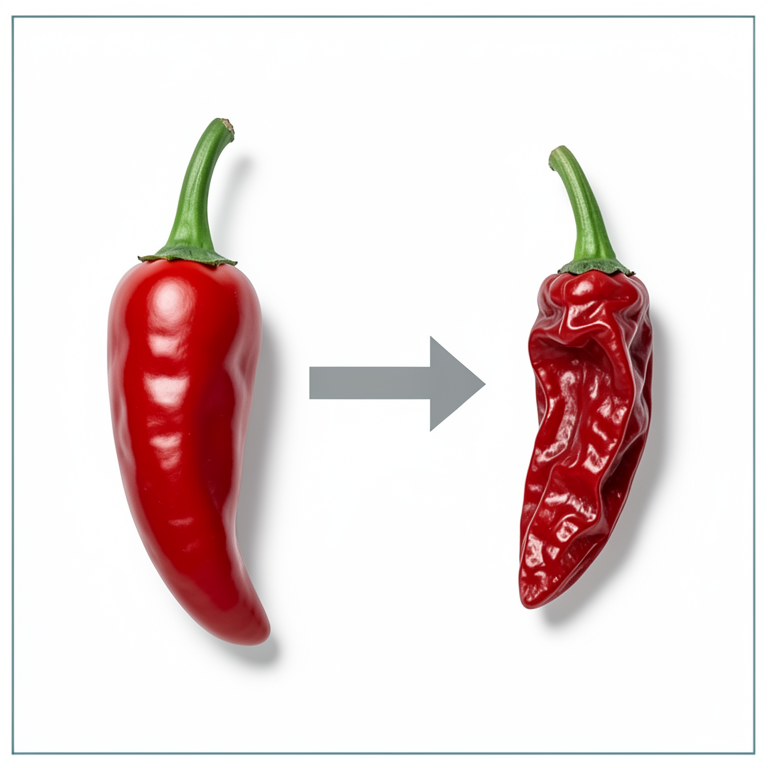
Moisture-Firmness Relationship
AI-generated conceptual illustration (dried red chili peppers). It explains the idea and does not show study data.
View source evidence ↗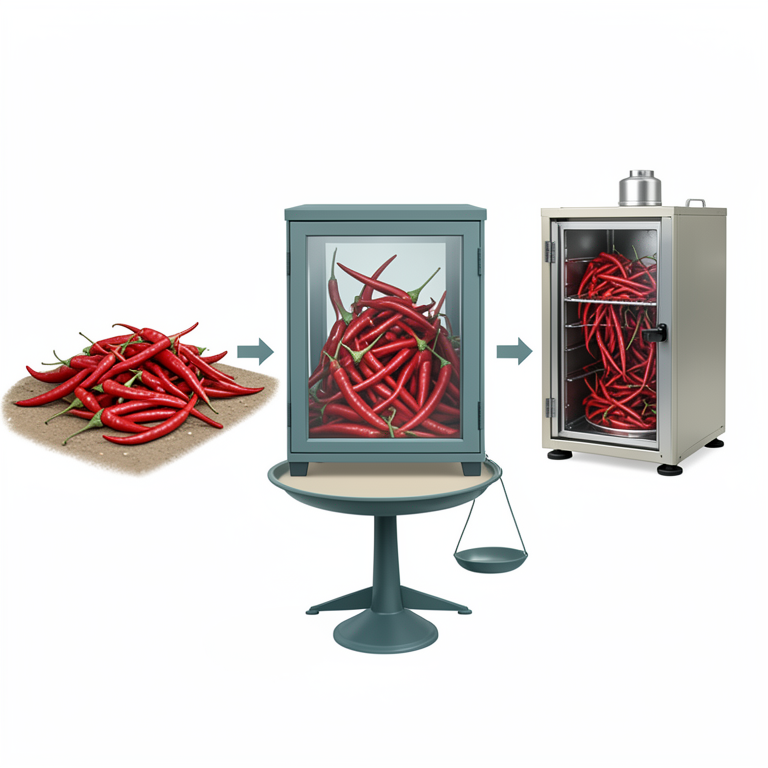
Cost vs. Quality Trade-off
AI-generated conceptual illustration (Chili peppers and drying equipment). It explains the idea and does not show study data.
View source evidence ↗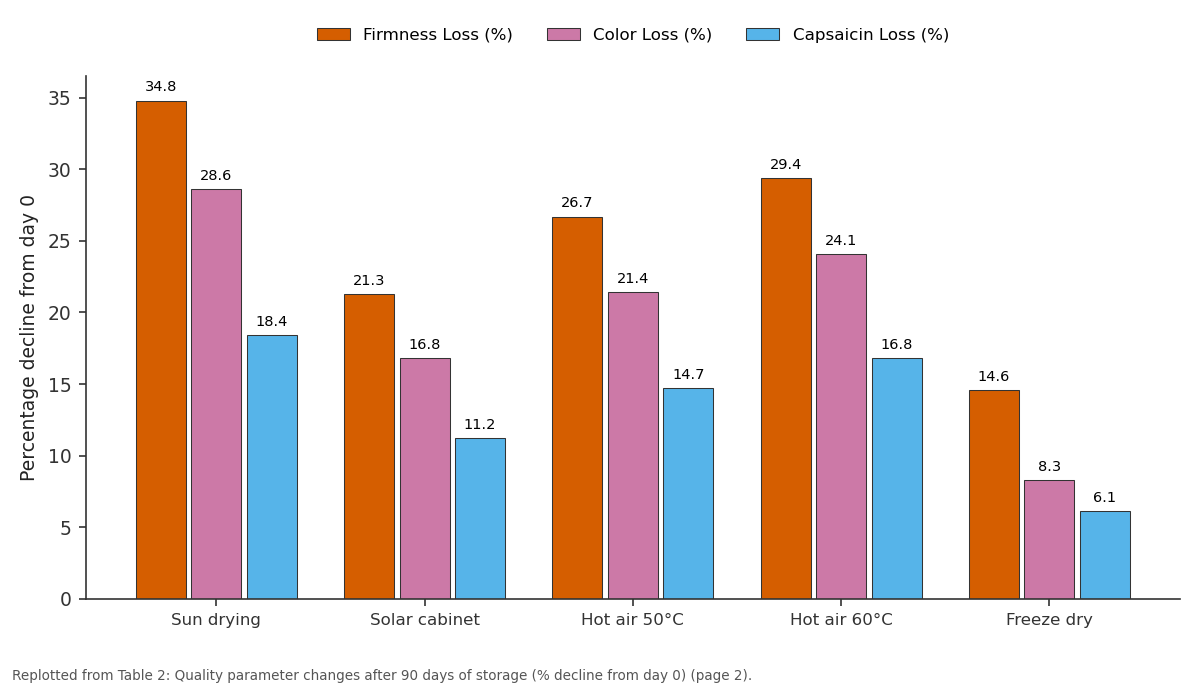
Firmness Loss (%) and Color Loss (%) and more: Sun drying vs Solar cabinet vs Hot air 50°C vs Hot air 60°C vs Freeze dry
Replotted from Table 2 (page 2) of the original paper. Every bar is the paper's own table value.
View source evidence ↗Figures & tables
From the original paper Table 1
 Table 2
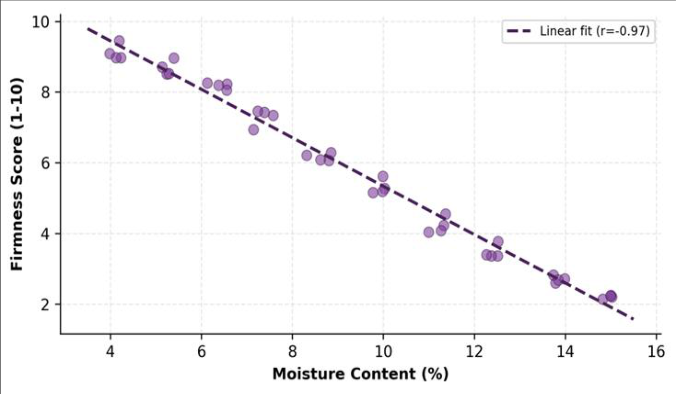 Figure 1
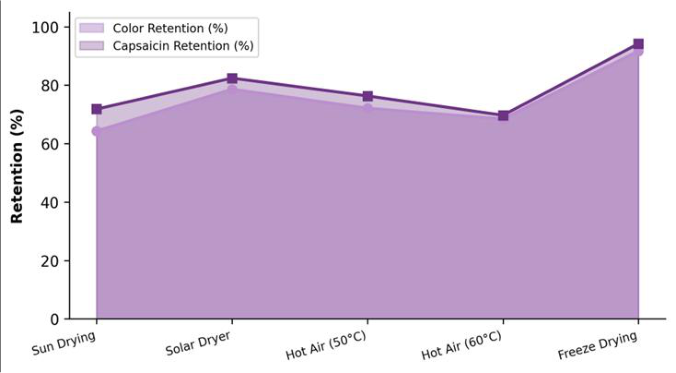 Figure 2
Introduction
Across South Asia's spice markets, a quiet shift in quality expectations is underway. Where chili pepper was once graded almost entirely by visual color intensity and pungency, buyers are increasingly asking for instrumental texture measurements, capsaicin certificates, and moisture guarantees [1] . This shift reflects the integration of smallholder spice producers into formal supply chains that serve food processors, exporters, and retail brands with defined quality specifications. The Nepalese Terai, a narrow strip of subtropical lowland stretching along Nepal's southern border with India, produces an estimated 62,000 tonnes of fresh chili annually [2] . Most of this harvest is dried using traditional sun drying on open mats, a method that is low-cost but highly variable in outcome. Ambient temperature, humidity, wind speed, and exposure to dust and insects all affect the final product's texture, color, and chemical integrity [3] . Yet despite the Terai's importance as a chili production zone, no systematic comparison of drying methods with texture profiling has been published for this region. Texture in dried chili refers to a set of mechanical properties: firmness (resistance to deformation), brittleness (tendency to fracture rather than bend), crispness (noise and force profile during fracture), and chewiness for rehydrated products [4] . These properties depend on cell wall structure, residual moisture, and the rate and uniformity of moisture removal during drying. Rapid drying at high temperatures can cause case-hardening, where the surface dries faster than the interior, creating a hard shell around a moist core that later leads to mold and quality failure [5] . Five drying technologies spanning the cost and technology spectrum are available to Terai producers. Sun drying costs essentially nothing beyond labor. Solar cabinet dryers represent a modest capital investment. Hot air dryers at 50 or 60 degrees Celsius offer faster and more controlled processing but require electricity or fuel. Freeze drying delivers the highest quality but at costs ten to fifteen times higher than thermal methods [6] . Matching the right technology to the right market segment is the practical challenge. This research aimed to map the texture profiles of three chili varieties across these five drying methods and track quality changes during 90day storage, providing the data needed for technology selection decisions.
Baseline soil characterisation
Chili crops used in this research were grown on two soil types representative of the Nepalese Terai: alluvial sandy loam at the primary site (26.7 N, 85.3 E, elevation 78 m) and clay loam at a secondary site 14 km east. The alluvial soil had pH 6.7, organic carbon 0.94%, available N of 214 kg/ha, P of 19.3 kg/ha, and K of 186 kg/ha. The clay loam site was slightly alkaline (pH 7.2) with higher organic carbon (1.38%) and K (247 kg/ha) but lower P (14.8 kg/ha). Soil type influenced fruit moisture at harvest: alluvial site chilis averaged 78.4% moisture compared to 81.2% on clay loam, affecting initial drying load and time requirements. Both sites received the same fertilization regime (120:60:60 kg NPK/ha) and drip irrigation scheduling.
Economic and sustainability assessment
Cost analysis across the five drying methods revealed wide variation in per-kilogram processing expense. Sun drying cost 0.12 USD/kg dried product (labor only), solar cabinet drying 0.31 USD/kg (amortized capital plus labor), hot air at 50 degrees 0.94 USD/kg (electricity and maintenance), hot air 60 degrees 1.08 USD/kg, and freeze drying 4.67 USD/kg. When quality premiums available in export markets were factored in (15-28% premium for color retention above 75%), solar cabinet drying delivered the highest net return per unit of investment at 2.84 USD per dollar spent. Freeze drying achieved a lower return ratio of 1.47 despite higher absolute selling prices, because its operating costs offset the quality premium. From a sustainability perspective, solar drying produced zero direct emissions, while hot air drying generated 0.38-0.44 kg CO 2equivalent per kg of dried chili.
Material and Methods
Material and Methods
Material
Three chili varieties were used: Akashi (hybrid, thickwalled), Jwala (open-pollinated, thin-walled), and Terai Local (landrace, medium wall). Fully ripe red fruits were hand-harvested from the field sites in the Nepalese Terai and transported to the Agartala Faculty of Botanical Research within 36 hours in insulated containers [7] . Five drying treatments were applied: open sun drying on raised mesh trays, solar cabinet dryer (glazed box type, peak temperature 55 degrees), forced hot air at 50 degrees Celsius, forced hot air at 60 degrees Celsius, and bench-top freeze dryer (-50 degrees Celsius condenser, 0.1 mbar vacuum). Sun and solar drying continued until moisture reached below 10%, typically 4-6 days. Hot air drying took 8-14 hours depending on temperature. Freeze drying required 36-48 hours. The research ran from April 2022 to September 2023 under ethics approval (Protocol AFBR-2022-018, approved March 20, 2022). Each variety-method combination used 5 kg of fresh chilis across four replications.
Methods
Texture analysis used a TA.XT Plus texture analyzer (Stable Micro Systems, UK) equipped with a 3-point bend rig for whole dried pods and a puncture probe (2 mm diameter) for pod wall measurements [4] . Firmness (N), brittleness (fracture distance, mm), and work of fracture (N.mm) were recorded at crosshead speed of 1 mm/s. Color was measured as ASTA color value following AOAC method 971.26 [8] . Capsaicin content was determined by HPLC with fluorescence detection after methanol extraction, using USP reference standard for calibration [9] . Moisture content followed the gravimetric oven method at 105 degrees Celsius for 5 hours. Quality parameters were assessed at drying completion (day 0) and monthly through 90 days of storage in sealed laminated pouches at ambient conditions (28 degrees Celsius, 65% RH). Data were analyzed by factorial ANOVA (variety x method x storage time) in SAS 9.4 with Duncan's multiple range test at p<0.05 [10] . Storage losses followed the inverse of initial quality (Table 2). Sun-dried chilis lost 34.8% of firmness and 28.6% of color over 90 days, while freeze-dried samples lost only 14.6% and 8.3%, respectively. Moisture regain was positively correlated with initial moisture level at the start of storage. The scatter plot (Figure 1) demonstrates the strong linear relationship between moisture and firmness (r = -0.97), confirming that moisture control is the primary determinant of chili texture quality.
| Method | Firmness Loss (%) | Color Loss (%) | Capsaicin Loss (%) | Moisture Gain (%) |
|---|---|---|---|---|
| Sun drying | 34.8 | 28.6 | 18.4 | +4.1 |
| Solar cabinet | 21.3 | 16.8 | 11.2 | +2.7 |
| Hot air 50°C | 26.7 | 21.4 | 14.7 | +3.2 |
| Hot air 60°C | 29.4 | 24.1 | 16.8 | +3.6 |
| Freeze dry | 14.6 | 8.3 | 6.1 | +1.8 |
Table text extracted from the original PDF; superscript letters are shown inline. The original table image is below.
View original table image
Results
Results
Fig Color and capsaicin retention across different drying methods
The area chart (Figure 2) shows the quality gradient across drying methods, with freeze drying maintaining the highest retention of both color and capsaicin. Solar cabinet drying occupies a favorable middle position, outperforming both hot air options on color retention.
Discussion
The near-perfect correlation between moisture and firmness (r = -0.97) has a practical application: moisture meters, which are inexpensive and widely available, can serve as reliable proxy instruments for texture quality assessment at procurement points. This finding aligns with earlier work by Simal et al. [5] , who showed similar moisture-texture relationships in other dried fruits and vegetables, but extends the relationship to the specific context of Terai chili production. Solar cabinet drying's strong performance relative to its cost deserves emphasis. At 0.31 USD/kg, it achieved 78.6% color retention and 82.4% capsaicin retention, values that meet the minimum specifications for most export-grade dried chili markets [11] . The technology is particularly wellsuited to the Terai, where solar radiation averages 4.8-5.6 kWh/m2/day during the post-harvest drying season (October-December), providing ample energy for passive solar systems [12] .
Hot air drying at 60 degrees Celsius actually performed worse than at 50 degrees for both color and capsaicin retention, reflecting the thermal sensitivity of carotenoid pigments and capsaicinoid compounds at temperatures above 55 degrees [13] . This counterintuitive result, where faster drying delivers lower quality, underscores the importance of temperature control in mechanical dryers. The 10-degree difference between 50 and 60 degrees Celsius translated to a 5.1 percentage point gap in overall retention index, which at scale would affect the market grade and price obtainable for the dried product.
Conclusion
Conclusion
Figures and tables from the paper
| Method | Moisture (%) | Firmness (N) | ASTA color | Capsaicin (mg/g) | Retention index (%) |
|---|---|---|---|---|---|
| Sun drying | 9.4 | 12.8 | 124 | 4.31 | 68.1 |
| Solar cabinet | 8.1 | 14.6 | 152 | 4.94 | 80.5 |
| Hot air 50°C | 7.3 | 15.8 | 139 | 4.58 | 74.2 |
| Hot air 60°C | 6.8 | 16.4 | 132 | 4.18 | 69.1 |
| Freeze dry | 4.2 | 18.7 | 177 | 5.65 | 92.9 |
Table text extracted from the original PDF; superscript letters are shown inline. The original table image is below.
View original table image
References
15 in the original paper- Topuz A, Feng H, Kushad M. The effect of drying method and storage on color characteristics of paprika. LWT - Food Science and Technology. 2009;42(10):1667-1673.
- MoALD Nepal. Statistical information on Nepalese agriculture. Ministry of Agriculture and Livestock Development. 2022;Kathmandu:1-278.
- Doymaz I, Pala M. Hot-air drying characteristics of red pepper. Journal of Food Engineering. 2002;55(4):331335.
- Bourne MC. Food texture and viscosity: concept and measurement. Academic Press. 2002;2nd Edition:1427.
- Simal S, Femenia A, Garau MC. Use of exponential, Page's and diffusional models to simulate the drying of fruits and vegetables. Journal of Food Engineering. 2005;66(3):323-328.
- Ratti C. Hot air and freeze-drying of high-value foods: A review. Journal of Food Engineering. 2001;49(4):311-319.
- Rai M, Pandey S, Kumar S. Chili pepper production in India: an overview. Vegetable Science. 2018;45(1):114.
- AOAC. Official method 971.26: color of spices as extractable color. AOAC International. 2019;Gaithersburg, MD.
- Collins MD, Wasmund LM, Bosland PW. Improved method for quantifying capsaicinoids by HPLC. HortScience. 1995;30(1):137-139.
- SAS Institute. SAS/STAT 9.4 User Guide. SAS Institute Inc. 2018;Cary, NC.
- ESA. Quality minima document for dried capsicums. European Spice Association. 2018;Bonn, Germany.
- Bhandari AK, Poudel KP. Solar energy potential in the Terai region of Nepal. Journal of the Institute of Engineering. 2019;15(3):12-22.
- Vega-Galvez A, Di Scala K, Rodriguez K. Effect of airdrying temperature on physico-chemical properties of red pepper. Food Chemistry. 2009;117(4):647-653.
- Giuffrida D, Dugo P, Torre G. Characterisation of carotenoid profile of dried chili. Food Chemistry. 2014;154:137-143.
- Kaleemullah S, Kailappan R. Drying kinetics of red chillies in a rotary dryer. Biosystems Engineering. 2005;92(1):15-23.