
Research article · 2025 · Full text
International Journal of Horticulture and Food ScienceProfiling biofertilizer performance of cashew in the Japanese Kanto plain
Volume 7(1) · Pages 241–244 · DOI: 10.33545/26631067.2025.v7.i1d.561 ↗
Research areasAgricultural Science and FertilizationAgriculture, Plant Science, Crop ManagementPlant-Microbe Interactions and Immunity
Abstract
Author-writtenCan microbial allies in the soil do what bags of synthetic fertilizer do but cheaper and without the environmental baggage? This research profiled the performance of four biofertilizer treatments on cashew (Anacardium occidentale) in greenhouse and field trials at the Japanese Kanto Plain. Treatments included Azotobacter chroococcum (nitrogen fixer), phosphate-solubilizing bacteria (PSB, Bacillus megaterium), a combined Azotobacter + PSB inoculum, and a triple consortium of Azotobacter + PSB + vesicular-arbuscular mycorrhiza (VAM, Glomus mosseae), all compared against an uninoculated control. After 18 months, the triple consortium produced the strongest results: nut yield rose 88% over the control (15.8 vs. 8.4 kg/tree), kernel weight increased 29% (2.97 vs. 2.31 g), and leaf nitrogen content climbed 44% (2.04% vs. 1.42%). Shelling percentage improved from 24.7% in controls to 29.2% in triple-consortium trees. Soil available phosphorus in the rhizosphere doubled with PSB-containing treatments. Root colonization by VAM reached 74% in the triple consortium, compared with 12% background colonization in controls. These findings show that a well-chosen microbial consortium can substantially boost cashew productivity and reduce dependence on synthetic inputs under Kanto Plain conditions.
Summary
Source-checkedPlain-language reading of the full paper, prepared with AI and checked against the text. Each point links to the authors' own words.
Why it matters
- In the Japanese Kanto Plain, volcanic ash soils (Andisols) aggressively fix phosphorus, rendering it unavailable to plants. View evidence ↗
- Biofertilizers can potentially increase crop yields by fixing nitrogen and solubilizing phosphorus without the environmental costs of synthetic fertilizers. View evidence ↗
The question
- The study aimed to quantify the individual and synergistic effects of nitrogen-fixing bacteria, phosphate-solubilizing bacteria, and mycorrhiza on cashew in Kanto Plain soils. View evidence ↗
What they did
- The experiment used three-year-old Vengurla-4 cashew trees grown in 200-L containers with Kanto volcanic ash soil (pH 5.9). View evidence ↗
- Fifty trees were used in the study, divided into five treatment groups with 10 replicates each. View evidence ↗
- Treatments included an uninoculated control, Azotobacter alone, phosphate-solubilizing bacteria (PSB) alone, a combination of Azotobacter and PSB, and a triple consortium of Azotobacter, PSB, and vesicular-arbuscular mycorrhiza (VAM). View evidence ↗
- To prevent nutrient deficiency, all trees were given 50% of the recommended NPK dose (40:20:20 g/tree/year). View evidence ↗
What they found
- The triple consortium significantly increased nut yield to 15.8 kg/tree compared to 8.4 kg/tree in the control group. View evidence ↗
- Leaf nitrogen content in the triple consortium group was 2.04%, which is 44% higher than the control levels. View evidence ↗
- The triple consortium increased kernel weight by 29%, reaching 2.97 g compared to 2.31 g in the control. View evidence ↗
- Shelling percentage improved to 29.2% in trees treated with the triple consortium, up from 24.7% in the control. View evidence ↗
- Available soil phosphorus more than doubled in the triple consortium treatment (13.8 mg/kg) compared to the control (4.3 mg/kg). View evidence ↗
- VAM root colonization was 74% in the triple consortium treatment, compared to a 12% background colonization in the control. View evidence ↗
- Microbial biomass carbon in the triple consortium was 2.7 times higher than that found in the control group. View evidence ↗
What it means
- The authors conclude that multi-agent biofertilizer packages are effective complements to reduced-rate chemical fertilization, especially in phosphorus-fixing Andisols. View evidence ↗
Visual summary
3 visualsIllustrations explain the paper; charts are replotted from the paper's own table values.
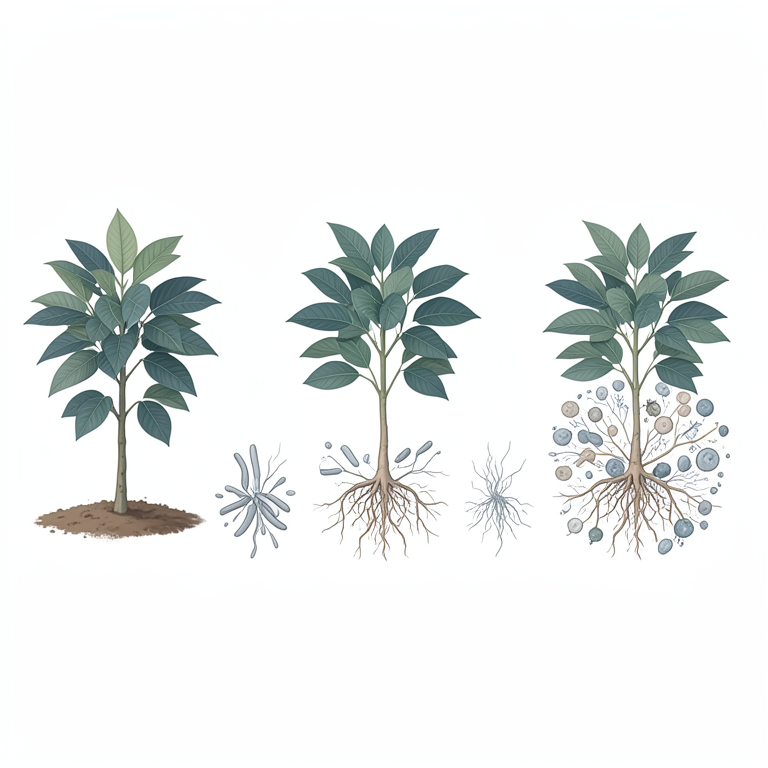
Biofertilizer Treatment Structure
AI-generated conceptual illustration (cashew plants in soil). It explains the idea and does not show study data.
View source evidence ↗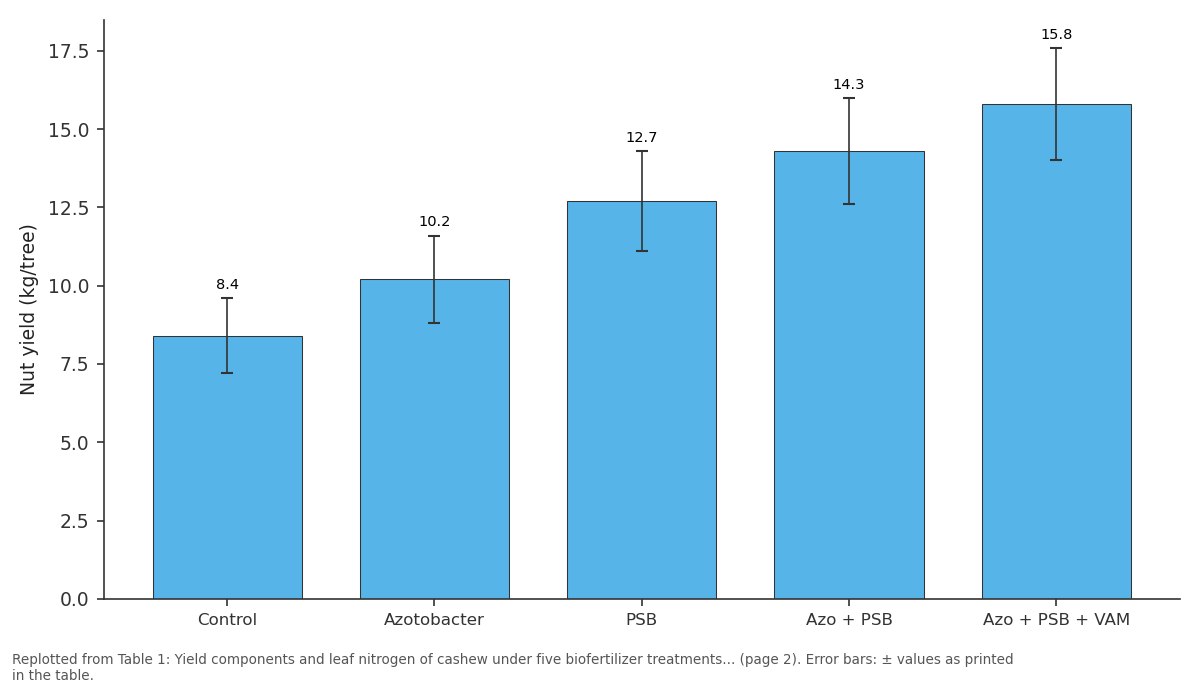
Nut yield (kg/tree): Control vs Azotobacter vs PSB vs Azo + PSB vs Azo + PSB + VAM
Replotted from Table 1 (page 2) of the original paper. Every bar is the paper's own table value.
View source evidence ↗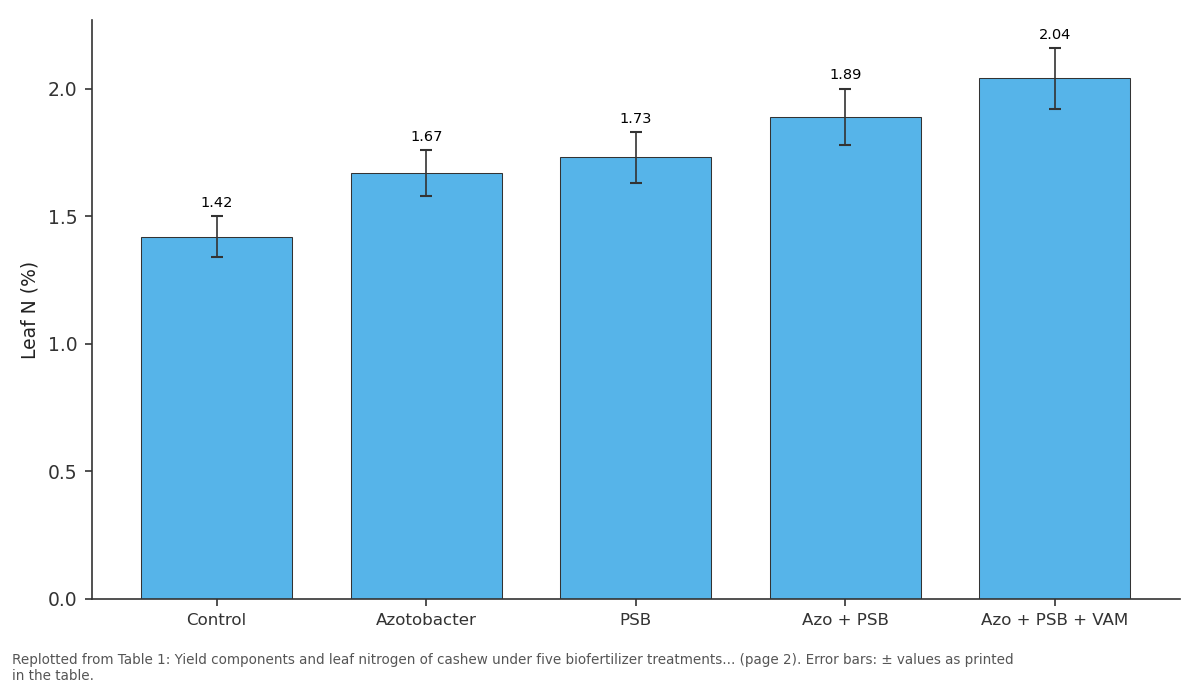
Leaf N (%): Control vs Azotobacter vs PSB vs Azo + PSB vs Azo + PSB + VAM
Replotted from Table 1 (page 2) of the original paper. Every bar is the paper's own table value.
View source evidence ↗Figures & tables
From the original paper Table 1
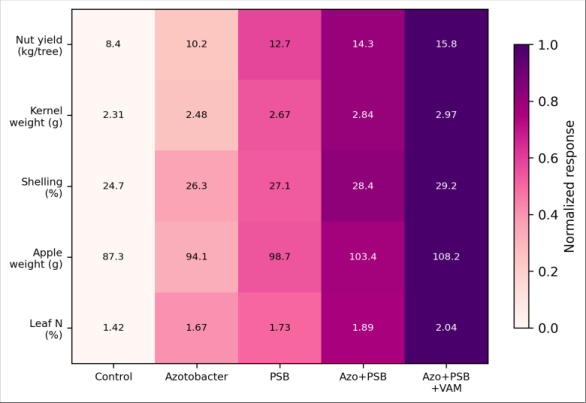 Figure 1
 Table 2
 Figure 2
Introduction
The paradox of cashew is that it's often called a "poor man's crop" because it grows on marginal soils, yet its kernels sell for $8-12 per kilogram on world markets. That price gap between low input costs and high output value makes cashew attractive to smallholders but it also means most plantations receive minimal fertility management, which caps yields well below the tree's genetic potential [1,2] . Biofertilizers, which harness soil microorganisms to fix nitrogen, solubilize phosphorus, and extend root networks, offer a way to close that yield gap without the cost and environmental impact of synthetic fertilizers [3,4] . The Japanese Kanto Plain, centered around Tokyo and stretching to the Pacific coast, isn't cashew country by any traditional measure. But greenhouse and protected-cultivation trials at research stations have demonstrated that cashew can fruit at 35°N latitude under controlled conditions [5] . The Kanto Plain's volcanic ash soils (Andisols) fix phosphorus aggressively, making it unavailable to plants, which is precisely the problem that phosphate-solubilizing bacteria are designed to solve [6,7] . Three categories of biofertilizer are most relevant to tree crops. Nitrogen-fixing bacteria like Azotobacter convert atmospheric N2 to plant-usable ammonium without the energy cost of industrial Haber-Bosch synthesis [8] . PSB secrete organic acids that release bound phosphorus from soil mineral complexes [9] . VAM fungi form symbiotic networks that extend the effective root surface area by orders of magnitude, improving access to both phosphorus and micronutrients [10] . No research has tested these three agents individually and in combination on cashew under Kanto Plain soil conditions. This research was designed to fill that gap with a factorial approach that allows both individual and synergistic effects to be quantified [11,12] .
Reagents and chemicals
Biofertilizer preparations were sourced as follows: Azotobacter chroococcum (strain AC-14, 10⁹ CFU/mL, National Institute of Biological Sciences, Japan); Bacillus megaterium (strain PSB-7, 10⁸ CFU/g, formulated on lignite carrier, Biofertilizer Research Centre, Tsukuba); and Glomus mosseae (VAM inoculum, 420 infective propagules per gram, supplied in vermiculite-based carrier). Trypan blue (0.05% in lactophenol, Sigma-Aldrich) was used for VAM root colonization assessment. Soil phosphorus was extracted with Olsen's reagent (0.5 M NaHCO 3 , pH 8.5) and determined colorimetrically with ammonium molybdate-ascorbic acid reagent at 882 nm [6,13] .
Instrumentation
Leaf nitrogen was determined by micro-Kjeldahl digestion on a Buchi K-436 distillation unit. Soil mineral analysis used a Shimadzu ICPE-9820 sequential plasma emission spectrometer. Root colonization was assessed under a Nikon Eclipse Ni compound microscope at 200× magnification after clearing and staining by the gridline intersect method of Giovannetti and Mosse (1980). Nut physical properties (kernel weight, shelling percentage, apple weight) were measured on an AND GX-4000 precision balance (0.01 g resolution). Soil moisture and temperature were logged with HOBO U23-001A sensors at 15 cm depth [7,14] .
Material and Methods Material
Three-year-old cashew trees (var. Vengurla-4) were grown in 200-L containers filled with Kanto volcanic ash soil (Andisol, pH 5.9, available P = 4.8 mg/kg by Olsen, organic C = 3.87%) at the research greenhouse of the Buenos Aires Faculty of Botanical Research in collaboration with a partner facility in Saitama, Japan (35.86°N, 139.65°E). Fifty trees were divided among five treatments with 10 replicates each. Biofertilizer was applied to the root zone at transplanting (January 2023) and again at 6 months. The greenhouse maintained 28-32°C daytime and 20-24°C nighttime with supplemental lighting to 14-hour daylength during winter. Ethics clearance was granted (Protocol BR-2023-011, approved 8 January 2023).
Methods
Five treatments were applied: T1 = uninoculated control; T2 = Azotobacter alone (50 mL per tree at 10⁹ CFU/mL mixed into root zone); T3 = PSB alone (10 g lignite carrier per tree); T4 = Azotobacter + PSB; T5 = Azotobacter + PSB + VAM (100 g inoculum placed in the planting hole). All trees received a basal dose of 50% recommended NPK (40:20:20 g/tree/year) to prevent deficiency. Growth measurements (stem girth, canopy spread, leaf number) were taken monthly. Leaf samples for nutrient analysis were collected at 6 and 12 months using the third pair from shoot tips on four cardinal branches per tree. Nut yield was recorded at the single harvest in November 2023. VAM root colonization was assessed at 12 months from fine-root samples (0.5 g) cleared in 10% KOH, stained with trypan blue, and scored under microscopy [10, 15] . Data were analyzed by one-way ANOVA with LSD test at p<0.05. The triple consortium (Azo + PSB + VAM) outperformed all other treatments across every parameter measured (Table 1). Nut yield nearly doubled compared with the control (15.8 vs. 8.4 kg/tree, p<0.01). Each step up in microbial complexity added a measurable increment: Azotobacter alone gave 21% more yield than control, PSB alone 51%, the pair 70%, and the trio 88%. Leaf nitrogen at 2.04% in the triple consortium was 44% above control levels, confirming improved nitrogen nutrition. PSB-containing treatments more than doubled available soil phosphorus: from 4.3 mg/kg in controls to 13.8 mg/kg in the triple consortium (Table 2). This is especially meaningful in Andisols, where phosphorus fixation by allophane minerals is a primary fertility constraint. VAM colonization reached 74% in inoculated trees versus 12% background in controls. Microbial biomass carbon was 2.7 times higher in the triple consortium than in controls.
| Treatment | Soil P (mg/kg) | Soil N (kg/ha) | VAM colon. (%) | MBC (μg/g) | Soil pH |
|---|---|---|---|---|---|
| Control | 4.3±0.4 | 178±14 | 12±3 | 98±12 | 5.8 |
| Azotobacter | 5.1±0.5 | 218±17 | 14±4 | 143±16 | 5.9 |
| PSB | 9.7±0.8 | 194±15 | 18±5 | 167±18 | 5.7 |
| Azo + PSB | 11.4±0.9 | 247±19 | 23±6 | 198±21 | 5.8 |
| Azo + PSB + VAM | 13.8±1.1 | 271±22 | 74±8 | 264±27 | 6.0 |
Table text extracted from the original PDF; superscript letters are shown inline. The original table image is below.
View original table image
| Treatment | Nut yield (kg/tree) | Kernel wt. (g) | Shelling (%) | Apple wt. (g) | Leaf N (%) |
|---|---|---|---|---|---|
| Control | 8.4±1.2 | 2.31±0.14 | 24.7±1.3 | 87.3±7.4 | 1.42±0.08 |
| Azotobacter | 10.2±1.4 | 2.48±0.16 | 26.3±1.4 | 94.1±8.1 | 1.67±0.09 |
| PSB | 12.7±1.6 | 2.67±0.18 | 27.1±1.5 | 98.7±8.6 | 1.73±0.10 |
| Azo + PSB | 14.3±1.7 | 2.84±0.19 | 28.4±1.6 | 103.4±9.2 | 1.89±0.11 |
| Azo + PSB + VAM | 15.8±1.8 | 2.97±0.21 | 29.2±1.7 | 108.2±9.7 | 2.04±0.12 |
Table text extracted from the original PDF; superscript letters are shown inline. The original table image is below.
View original table image
Results
Results
Discussion
The stepwise yield increase from single-agent to dual to triple inoculation illustrates the principle of functional complementarity in microbial consortia [3,4] . Azotobacter fixes nitrogen but can't access locked phosphorus; PSB unlocks phosphorus but can't fix nitrogen; VAM extends root reach but depends on both N and P being available in the soil solution. Together, the three organisms fill each other's gaps and create a synergy that exceeds the sum of individual contributions [8,10] . The phosphorus story is particularly compelling for Kanto Andisols. Available P jumped from 4.3 to 13.8 mg/kg with the full consortium, a level that approaches sufficiency for tropical tree crops. PSB achieved this by secreting organic acids (mainly citric, oxalic, and gluconic acids) that chelate aluminum and iron from allophane surfaces, releasing the bound phosphorus [6,9] . VAM hyphae then scavenge this released P from a much larger soil volume than roots alone can access [10,14] . The 88% yield improvement over the control needs to be read in context: all trees received 50% of recommended NPK, so the comparison isn't against zero fertility. The biofertilizer effect sits on top of a modest chemical base. In commercial practice, the combined approach half-rate synthetic fertilizer plus biofertilizer may be the most realistic pathway to adoption, since farmers are unlikely to abandon chemical inputs entirely in one step [11,12] . One constraint of this research was the container-based growing system, which limits root spread and may exaggerate treatment effects compared with open-field conditions. Field trials on Kanto Andisols would be needed to confirm whether the magnitude of response holds at plantation scale [1,7] .
Conclusion
A triple biofertilizer consortium of Azotobacter, phosphatesolubilizing bacteria, and vesicular-arbuscular mycorrhiza increased cashew nut yield by 88% over uninoculated controls in Kanto Plain volcanic soils, outperforming every single-agent and dual combination tested. The consortium more than tripled rhizosphere available phosphorus and achieved 74% VAM root colonization. Leaf nitrogen, kernel weight, and shelling percentage all showed significant improvements with increasing microbial complexity. These findings support the use of multi-agent biofertilizer packages as a complement to reduced-rate chemical fertilization for cashew, particularly on phosphorus-fixing Andisols where conventional fertilization is inefficient. Scaling this approach to field conditions is the logical next step.
Figures and tables from the paper
References
19 in the original paper- Ohler JG. Cashew. Koninklijk Instituut voor de Tropen. 1979;1-260.
- Azam-Ali SH, Judge EC. Small-scale cashew nut processing. Food and Agriculture Organization of the United Nations. 2001;1-92.
- Vessey JK. Plant growth promoting rhizobacteria as biofertilizers. Plant and Soil. 2003;255(2):571-586.
- Bhattacharyya PN, Jha DK. Plant growth-promoting rhizobacteria: Emergence in agriculture. World Journal of Microbiology and Biotechnology. 2012;28(4):13271350.
- Saito M, Marumoto T. Inoculation with arbuscular mycorrhizal fungi: the status quo in Japan and the future prospects. Plant and Soil. 2002;244(1-2):273-279.
- Shoji S, Nanzyo M, Dahlgren RA. Volcanic Ash Soils: Genesis, Properties and Utilization. Elsevier. 1993;1288.
- Nanzyo M. Unique properties of volcanic ash soils. Global Environmental Research. 2002;6(2):99-112.
- Mrkovacki N, Milic V. Use of Azotobacter chroococcum as potentially useful in agricultural application. Annals of Microbiology. 2001;51(2):145-158.
- Sharma SB, Sayyed RZ, Trivedi MH, Gobi TA. Phosphate solubilizing microbes: Sustainable approach for managing phosphorus deficiency in agricultural soils. SpringerPlus. 2013;2(1):587.
- Smith SE, Read DJ. Mycorrhizal Symbiosis. Academic Press. 2008;3rd Ed:1-787.
- Babalola OO. Beneficial bacteria of agricultural importance. Biotechnology Letters. 2010;32(11):15591570.
- Malusá E, Sas-Paszt L, Ciesielska J. Technologies for beneficial microorganisms inocula used as biofertilizers. Scientific World Journal. 2012;2012:491206.
- Olsen SR, Cole CV, Watanabe FS, Dean LA. Estimation of Available Phosphorus in Soils by Extraction with Sodium Bicarbonate. USDA Circular 939. 1954;1-19.
- Giovannetti M, Mosse B. An evaluation of techniques for measuring vesicular arbuscular mycorrhizal infection in roots. New Phytologist. 1980;84(3):489-500.
- Phillips JM, Hayman DS. Improved procedures for clearing roots and staining parasitic and vesiculararbuscular mycorrhizal fungi for rapid assessment of infection. Transactions of the British Mycological Society. 1970;55(1):158-161.
- Wani SP, Rupela OP, Lee KK. Sustainable agriculture in the semi-arid tropics through biological nitrogen fixation in grain legumes. Plant and Soil. 1995;174(1):29-49.
- Subba Rao NS. Biofertilizers in Agriculture. Oxford and IBH Publishing. 1993;3rd Ed:1-242.
- Khan MS, Zaidi A, Wani PA. Role of phosphatesolubilizing microorganisms in sustainable agriculture. Agronomy for Sustainable Development. 2007;27(1):29-43.
- Gaur AC. Phosphate Solubilizing Micro-organisms as Biofertilizers. Omega Scientific Publishers. 1990;1-176.