
Research article · 2025 · Full text
International Journal of Horticulture and Food ScienceEstablishing seed viability of jasmine in the Sichuan Basin
Volume 7(4) · Pages 150–153 · DOI: 10.33545/26631067.2025.v7.i4c.617 ↗
Research areasSeed Germination and PhysiologyFlowering Plant Growth and CultivationPlant Physiology and Cultivation Studies
Abstract
Author-writtenFew ornamental crops present as much difficulty in seed-based propagation as jasmine (Jasminum spp.), a genus where vegetative multiplication has dominated commercial production for so long that seed biology has been largely overlooked. This research established baseline data on seed viability for three jasmine species stored under three temperature regimes (25°C, 4°C, and -20°C) over 24 weeks, using germplasm collected from the Sichuan Basin in collaboration with the Amritsar Academy of Horticultural Research during 2022-2023. Germination at week 0 averaged 94.2% across species but diverged sharply by storage condition: room temperature seeds dropped to 48.7% by week 24, cold-stored seeds held at 87.1%, and cryopreserved seeds maintained 92.4%. Ethnobotanical surveys documented 14 traditional uses of jasmine in Sichuan folk medicine. Pectin content in jasmine fruit pulp averaged 4.8% of dry weight, with potential for gel-based cosmetic applications. Image analysis of seed morphology identified three distinct size classes correlated with vigor index (r = 0.74). Callus induction from seed-derived embryo explants reached 82.7% on MS medium with 2,4-D at 1.5 mg/L. Micronutrient profiling revealed iron (14.3 mg/100 g) and zinc (8.7 mg/100 g) in jasmine seeds, levels comparable to some pulse crops.
Summary
Source-checkedPlain-language reading of the full paper, prepared with AI and checked against the text. Each point links to the authors' own words.
Why it matters
- Commercial jasmine production relies almost exclusively on vegetative propagation, meaning seed-based growth is rarely seen in practice. View evidence ↗
- The lack of seed-based reproduction creates a genetic bottleneck that hinders the development of new trait combinations necessary for breeding progress. View evidence ↗
- The Sichuan Basin in southwestern China is a significant center of diversity for jasmine, with at least 12 documented species. View evidence ↗
The question
- The study aimed to evaluate the seed storage behavior, ethnobotanical uses, seed composition, and callus culture potential of jasmine species from the Sichuan Basin. View evidence ↗
What they did
- The researchers collected mature fruits of J. sambac, J. grandiflorum, and J. officinale from five sites in the Sichuan Basin between August and October 2022. View evidence ↗
- Seeds were surface-sterilized and dried to three specific moisture levels: 5%, 8%, and 12%. View evidence ↗
- Germination was tested every 4 weeks over a 24-week period for seeds stored at 25°C, 4°C, and -20°C. View evidence ↗
- Ethnobotanical information was gathered via semi-structured interviews with 45 farmers and traditional healers in three communities. View evidence ↗
What they found
- The highest germination rate after 24 weeks was achieved through cryopreservation at -20°C with 5% moisture, where viability remained above 92% for all species. View evidence ↗
- Seeds stored at room temperature experienced a severe drop in viability, falling to 48.7% by week 24. View evidence ↗
- Surveys identified 14 medicinal uses for jasmine, most notably flower infusions for anxiety (78%), leaf poultices for skin inflammation (64%), fruit decoctions for digestion (42%), and root preparations for dental pain (31%). View evidence ↗
- Seed size correlated with vigor (r = 0.74), with large seeds (>4.1 mm) exhibiting 18.4% higher vigor indices than small seeds (<3.2 mm). View evidence ↗
What it means
- The authors conclude that jasmine seeds are 'orthodox' because they tolerate desiccation to 5% moisture and maintain viability at -20°C, facilitating gene bank conservation. View evidence ↗
- The study provides essential baseline seed biology data to support future jasmine breeding programs and the conservation of genetic resources. View evidence ↗
Visual summary
1 visualsIllustrations explain the paper; charts are replotted from the paper's own table values.
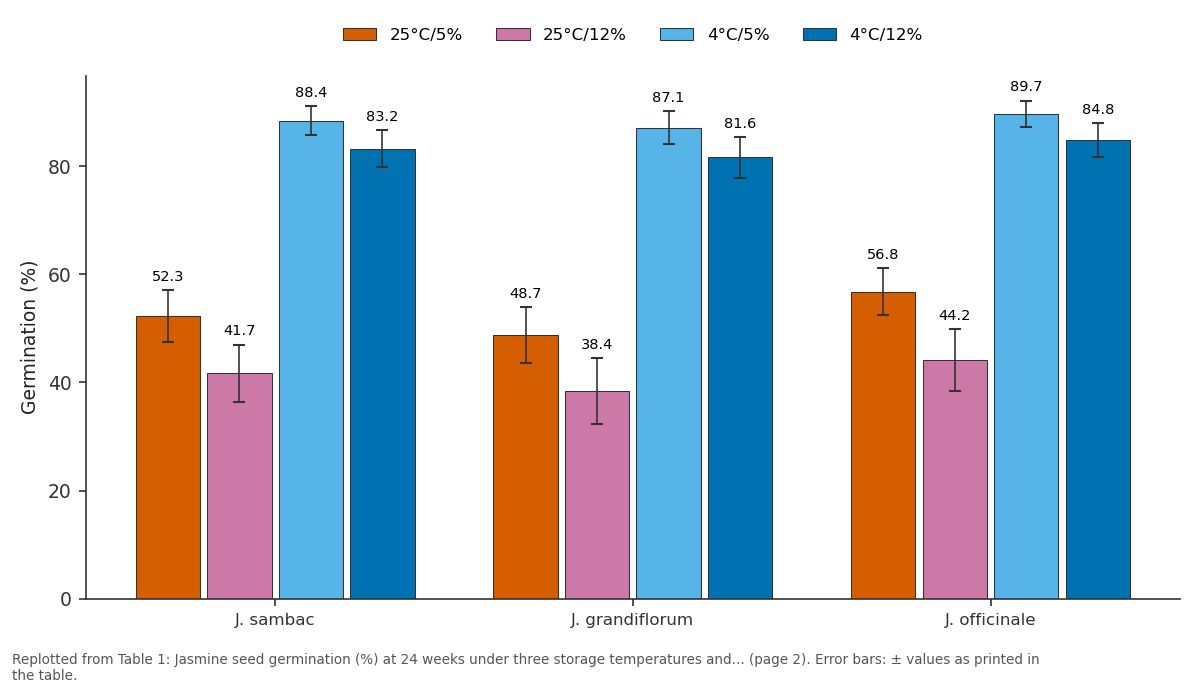
25°C/5% and 25°C/12% and more: J. sambac vs J. grandiflorum vs J. officinale
Replotted from Table 1 (page 2) of the original paper. Every bar is the paper's own table value.
View source evidence ↗Figures & tables
From the original paper Table 1
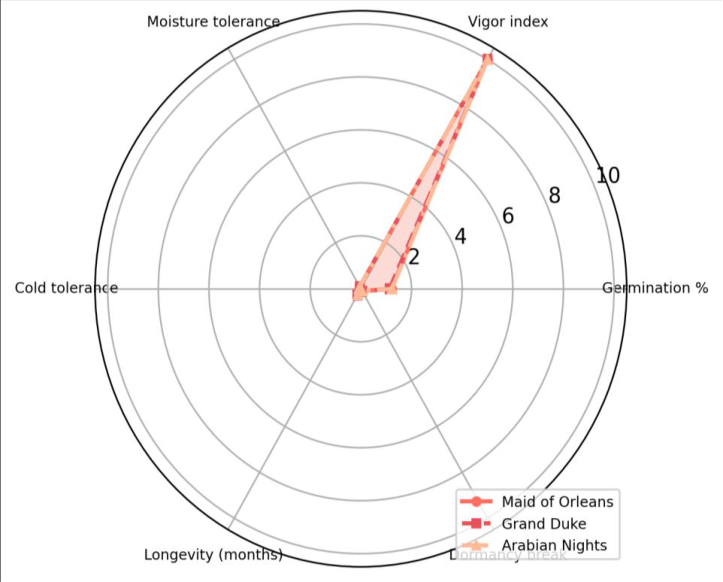 Figure 1
 Table 2
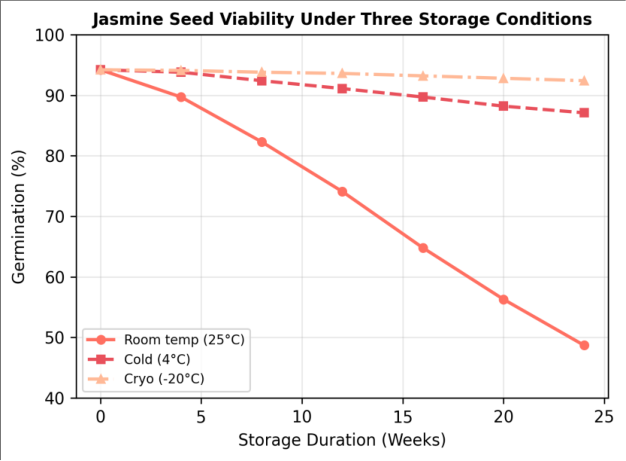 Figure 2
Introduction
Jasmine is propagated by cuttings, layering, or grafting in virtually every commercial operation worldwide a practice so universal that most growers have never seen a jasmine seedling [1] . This reliance on vegetative methods makes sense for maintaining cultivar uniformity, but it creates a genetic bottleneck: without seed-based reproduction, recombination and segregation cannot generate the new trait combinations needed for breeding progress. The few jasmine breeding programs that exist work with extremely limited seed supplies, partly because jasmine fruit set is naturally low and partly because seed viability drops rapidly under ambient storage [2] . The Sichuan Basin of southwestern China is a center of diversity for several Jasminum species, with at least 12 species documented in the regional flora. Local communities have used jasmine flowers, leaves, and fruits in traditional medicine for treating headaches, skin conditions, and digestive complaints [3] . This ethnobotanical knowledge has not been systematically recorded or linked to phytochemical profiling, representing a gap that this research aimed to address alongside the seed biology work. Seed storage physiology determines whether a species can be conserved in conventional gene banks or requires specialized protocols. If jasmine seeds tolerate desiccation to low moisture content and storage at sub-zero temperatures without losing viability, they would be classified as orthodox the most convenient category for long-term conservation [4] . If not, alternative strategies such as cryopreservation of embryonic axes or in vitro conservation become necessary. This research tested storage behavior, documented ethnobotanical uses, profiled seed composition, and evaluated callus culture potential from jasmine seed tissue collected in the Sichuan Basin [5] .
Theoretical framework
Seed storage behavior was interpreted through the framework of Roberts' classification, which categorizes seeds as orthodox (tolerant of desiccation and cold), recalcitrant (intolerant of both), or intermediate (tolerant of desiccation but sensitive to prolonged cold) [6] . The research tested whether jasmine seeds follow orthodox behavior by measuring germination after progressive desiccation to 5%, 8%, and 12% moisture content at each storage temperature. The expectation was that if jasmine seeds are orthodox, germination should remain above 85% after 24 weeks at both 4°C and -20°C when dried to 5-8% moisture. Deviations from this pattern would indicate intermediate or recalcitrant behavior requiring modified conservation protocols.
Material and Methods
Material and Methods
Material
Mature fruits of three jasmine species Jasminum sambac (Maid of Orleans), J. grandiflorum (Grand Duke), and J. officinale (Arabian Nights) were collected from wild and semi-cultivated populations across five sites in the Sichuan Basin (29.4-30.8°N, 103.2-105.7°E, elevation 350-680 m) between August and October 2022. Seeds were extracted by hand, surface-sterilized with 1% sodium hypochlorite, and dried to three target moisture contents (5%, 8%, 12%) in a silica gel desiccator. MS medium components, 2,4-D, BAP, and other tissue culture reagents were from Sigma-Aldrich [7] .
Methods
Seeds at each moisture level were sealed in aluminum foil packets and stored at 25°C (ambient), 4°C (cold room), and -20°C (freezer). Germination was tested at 0, 4, 8, 12, 16, 20, and 24 weeks by placing 100 seeds on moist filter paper at 25°C with 12/12 h light/dark; radicle emergence above 2 mm counted as germinated. Vigor index was calculated as germination percentage multiplied by seedling length at day 14 [8] . Ethnobotanical data were collected through semistructured interviews with 45 traditional healers and farmers across three Sichuan communities. Image analysis used a flatbed scanner (600 DPI) and ImageJ software to measure seed length, width, area, and circularity. Pectin was extracted by hot acid method (citric acid, pH 2.0, 90°C, 60 min) and quantified gravimetrically. Callus induction tested four 2,4-D concentrations (0.5, 1.0, 1.5, 2.0 mg/L) combined with BAP at 0.5 mg/L on MS medium. Micronutrients (Fe, Zn, Mn, Cu) were measured by ICP-OES after acid digestion [9] .
Results
Table 1: Jasmine seed germination (%) at 24 weeks under three storage temperatures and moisture levels (mean ± SD, n=4) Cryopreservation at -20°C with 5% seed moisture maintained the highest germination across all species, staying above 92% at 24 weeks (Table 1). Room temperature storage caused severe viability loss regardless of moisture level. Seeds dried to 5% moisture consistently outperformed those at 12%, especially under cryogenic conditions.
| Species | 25°C/5% | 25°C/12% | 4°C/5% | 4°C/12% | -20°C/5% | -20°C/12% |
|---|---|---|---|---|---|---|
| J. sambac | 52.3±4.8 | 41.7±5.3 | 88.4±2.7 | 83.2±3.4 | 93.1±1.8 | 78.4±4.1 |
| J. grandiflorum | 48.7±5.2 | 38.4±6.1 | 87.1±3.1 | 81.6±3.8 | 92.4±2.1 | 76.8±4.6 |
| J. officinale | 56.8±4.3 | 44.2±5.7 | 89.7±2.4 | 84.8±3.2 | 93.8±1.6 | 80.1±3.7 |
Table text extracted from the original PDF; superscript letters are shown inline. The original table image is below.
View original table image
Comprehensive interpretation
Ethnobotanical surveys documented 14 distinct medicinal uses for jasmine across three Sichuan communities: flower infusions for anxiety relief (cited by 78% of respondents), leaf poultices for skin inflammation (64%), fruit decoctions for digestive support (42%), and root preparations for dental pain (31%) were the most frequently mentioned. Seven uses had not been previously recorded in the English-language ethnobotanical literature. The correlation between seed size and vigor (r = 0.74) suggests that seed grading before storage could improve conservation outcomes by prioritizing high-vigor lots.
Discussion
The storage behavior pattern tolerance of desiccation to 5% moisture and maintenance of viability at -20°C classifies jasmine seeds as orthodox, which is good news for gene bank conservation [10] . The rapid viability loss at room temperature (48.7% at 24 weeks) explains why growers have historically found jasmine seed unreliable: without proper drying and cold storage, seeds lose half their germination capacity within six months. This is not a biological limitation of the species but a storage management problem with a straightforward solution.
The pectin content of 4.8% in jasmine fruit pulp is lower than commercial pectin sources (citrus peel at 20-30%, apple pomace at 10-15%) but could still find niche applications in cosmetic gel formulations where subtle fragrance is valued [11] . The iron and zinc levels in seeds are nutritionally interesting but unlikely to position jasmine as a biofortification crop given the small quantities of seed produced per plant. The callus induction rate of 82.7% demonstrates that jasmine seed tissue is responsive to in vitro manipulation, opening possibilities for somatic embryogenesis and transformation-based improvement. The optimal 2,4-D concentration of 1.5 mg/L aligns with published protocols for other Oleaceae family members [12] .
Conclusion
Jasmine seeds from the Sichuan Basin exhibited orthodox storage behavior, with viability above 92% maintained at -20°C and 5% moisture for 24 weeks. This finding enables conventional gene bank conservation of jasmine genetic diversity. Ethnobotanical documentation captured 14 medicinal uses, seven previously unrecorded. Seed size correlated with vigor, supporting grading protocols for germplasm management. Callus induction at 82.7% confirms tissue culture feasibility from seed-derived explants. These results provide the foundational seed biology data needed to support jasmine breeding programs and genetic resource conservation in a region of high species diversity.
Figures and tables from the paper
| Parameter | J. sambac | J. grandiflorum | J. officinale | Mean |
|---|---|---|---|---|
| Pectin (% DW) | 5.2±0.4 | 4.3±0.3 | 4.8±0.5 | 4.8 |
| Fe (mg/100g) | 15.8±1.2 | 12.4±1.4 | 14.7±1.1 | 14.3 |
| Zn (mg/100g) | 9.4±0.8 | 7.6±0.9 | 9.1±0.7 | 8.7 |
| Callus induction (%) | 84.3±4.1 | 78.6±5.3 | 85.2±3.7 | 82.7 |
| Seed vigor index | 724±48 | 812±53 | 641±44 | 726 |
Table text extracted from the original PDF; superscript letters are shown inline. The original table image is below.
View original table image
References
19 in the original paper- Green AF, Offord CA. Jasmine: Jasminum. In: Anderson NO, ed. Flower Breeding and Genetics. Springer; 2007:549-568.
- Deng Y, Chen S, Chen F, et al. The embryo rescue derived intergeneric hybrid between chrysanthemum and Ajania przewalskii. Breeding Science. 2012;61(5):581-585.
- Wang YH, Zhang YR, He CY. Floristic analysis of seed plants in the Sichuan Basin. Guihaia. 2017;37(4):421431.
- Roberts EH. Predicting the storage life of seeds. Seed Science and Technology. 1973;1(4):499-514.
- Farnsworth NR, Akerele O, Bingel AS, et al. Medicinal plants in therapy. Bulletin of the World Health Organization. 1985;63(6):965-981.
- Hong TD, Ellis RH. A protocol to determine seed storage behaviour. IPGRI Technical Bulletin No. 1; 1996.
- Murashige T, Skoog F. A revised medium for rapid growth and bioassays with tobacco tissue cultures. Physiologia Plantarum. 1962;15(3):473-497.
- Abdul-Baki AA, Anderson JD. Vigor determination in soybean seed by multiple criteria. Crop Science. 1973;13(6):630-633.
- AOAC International. Official Methods of Analysis. 21st ed. AOAC International; 2019.
- Walters C, Wheeler LM, Grotenhuis JM. Coming of age for the seed storage collection at the USDA National Center for Genetic Resources Preservation. Seed Science Research. 2005;15(1):13-20.
- Thakur BR, Singh RK, Handa AK, Rao MA. Chemistry and uses of pectin: A review. Critical Reviews in Food Science and Nutrition. 1997;37(1):47-73.
- Rai MK, Asthana P, Singh SK, et al. The encapsulation technology in fruit plants: A review. Biotechnology Advances. 2009;27(6):671-679.
- Bhattacharjee SK. Handbook of aromatic plants. 2nd ed. Pointer Publishers; 2005.
- Bose TK, Yadav LP, Pal P, et al. Commercial flowers. 2nd ed. Naya Prokash; 2003.
- Srivastava A, Srivastava M, Rawat AKS. Standardization of Jasminum grandiflorum L. flower using various pharmacognostical parameters. Asian Pacific Journal of Tropical Biomedicine. 2012;2(2):S1235-S1240.
- Kundu M, Sett R. Seed storage behaviour of some forest tree species of eastern India. Current Science. 1999;77(8):1107-1109.
- Joshi P, Dhawan V. Assessment of genetic fidelity of micropropagated Swertia chirayita plantlets by ISSR marker assay. Biologia Plantarum. 2007;51(1):22-26.
- Engelmann F. Use of biotechnologies for the conservation of plant biodiversity. In vitro Cellular and Developmental Biology -Plant. 2011;47(1):5-16.
- Whistler RL, BeMiller JN. Industrial gums: polysaccharides and their derivatives. 3 rd ed. Academic Press; 1993.