
Research article · 2025 · Full text
International Journal of Horticulture and Food ScienceComparing vermicompost applications of nutmeg in the Vietnamese Mekong
Volume 7(1) · Pages 237–240 · DOI: 10.33545/26631067.2025.v7.i1d.560 ↗
Research areasAgricultural Science and FertilizationPlant Growth and Agriculture TechniquesComposting and Vermicomposting Techniques
Abstract
Author-writtenWhen earthworms process organic waste, they produce something far richer than ordinary compost a biologically active material packed with plant-available nutrients and beneficial microbes. This research compared five vermicompost application rates (0, 2, 4, 6, and 8 t/ha) on growth, soil health, and mace yield of young nutmeg (Myristica fragrans) trees in the Vietnamese Mekong Delta. The 12-month trial used 5-year-old trees at a plantation near Can Tho. Vermicompost at 6 t/ha produced the best growth response: leaf area increased 72% over the control (58.9 vs. 34.2 cm²), stem girth rose 59% (19.7 vs. 12.4 mm increment), and mace yield improved by 43% (2.84 vs. 1.98 kg/tree). Soil organic carbon climbed from 1.12% to 1.89% at the 8 t/ha rate over 12 months. Microbial biomass carbon doubled at 6 t/ha relative to the unamended control. Above 6 t/ha, growth parameters plateaued or declined slightly, suggesting a saturation threshold. These results position vermicompost at 6 t/ha as the most effective organic amendment rate for young nutmeg under Mekong Delta conditions.
Summary
Source-checkedPlain-language reading of the full paper, prepared with AI and checked against the text. Each point links to the authors' own words.
Why it matters
- Nutmeg is a long-lived tropical tree that requires consistent soil fertility during its 7-9 year establishment period before it begins bearing fruit. View evidence ↗
- Alluvial soils in the Vietnamese Mekong Delta suffer from rapid organic matter loss, with soil organic carbon often dropping below 1.5% due to flooding and intensive rice-shrimp farming. View evidence ↗
- Vermicompost, produced by earthworms like Eisenia fetida, provides a slow-release source of nutrients, humic acids, and beneficial microbes. View evidence ↗
The question
- The study aimed to determine the optimal vermicompost application rate for young nutmeg trees in the Mekong Delta to provide farmers with a practical, data-backed dosage recommendation. View evidence ↗
What they did
- The experiment used 5-year-old nutmeg (clone Banda-1) trees planted in silty clay alluvial soil (pH 6.1, 1.12% baseline organic carbon) near Can Tho, Vietnam. View evidence ↗
- The study employed a randomized complete block design with 60 trees total, testing five vermicompost application rates: 0, 2, 4, 6, and 8 t/ha. View evidence ↗
- Vermicompost was applied to the top 15 cm of soil in a 2 m radius basin in January 2023, followed by a half-rate application in July 2023. View evidence ↗
- Researchers measured leaf area (20 leaves per tree), monthly stem girth (at 50 cm height), and mace yield from harvests in August and December 2023. View evidence ↗
What they found
- Applying 6 t/ha of vermicompost increased leaf area by 72% compared to the control (58.9 vs 34.2 cm²). View evidence ↗
- Soil organic carbon (SOC) increased linearly with the application rate, reaching 1.89% at 8 t/ha, which was a 69% increase over the control (1.08%). View evidence ↗
What it means
- The authors conclude that 6 t/ha is the optimal vermicompost application rate for establishing young nutmeg on degraded Mekong alluvial soils. View evidence ↗
- Application rates higher than 6 t/ha may be useful if the primary objective is soil rehabilitation rather than immediate plant growth. View evidence ↗
- The authors suggest that longer-term studies are needed to see if the higher microbial activity at 8 t/ha eventually leads to higher yields through improved soil structure. View evidence ↗
Visual summary
3 visualsIllustrations explain the paper; charts are replotted from the paper's own table values.
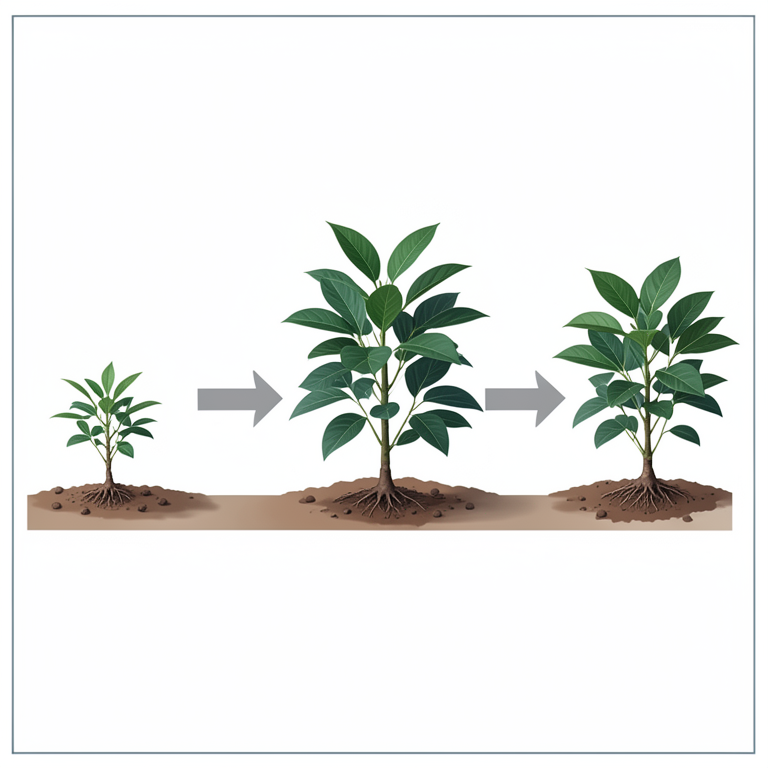
Plant Response Curve
AI-generated conceptual illustration (young nutmeg plants in alluvial soil). It explains the idea and does not show study data.
View source evidence ↗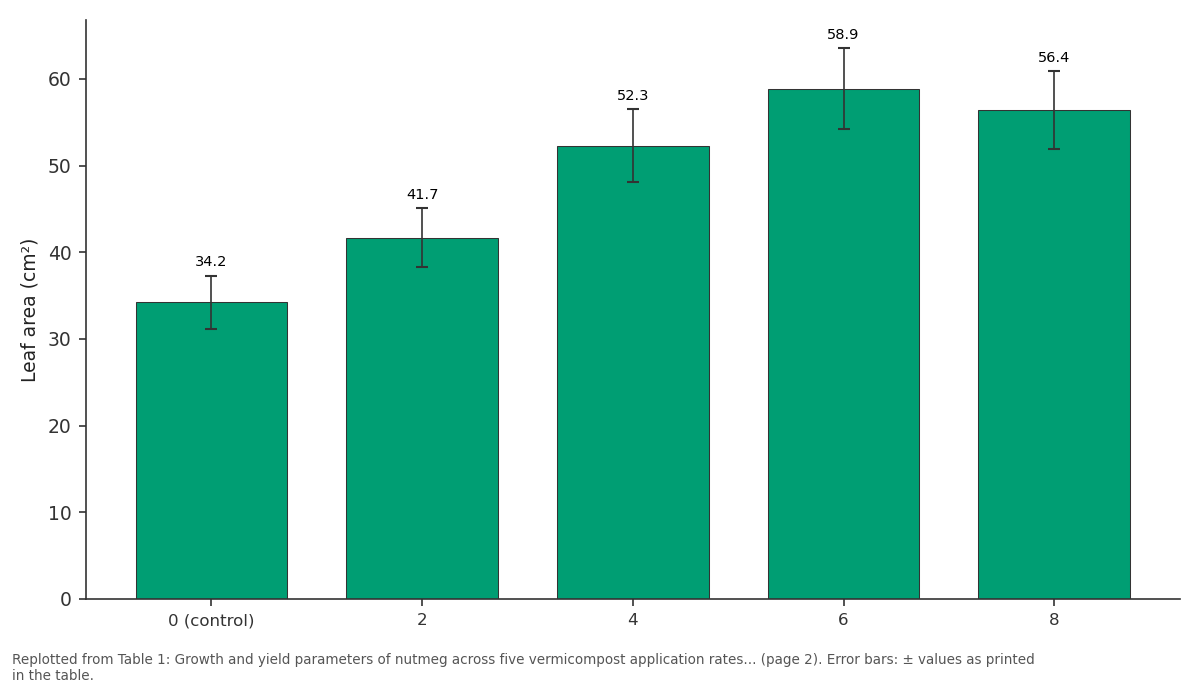
Leaf area (cm²): 0 (control) vs 2 vs 4 vs 6 vs 8
Replotted from Table 1 (page 2) of the original paper. Every bar is the paper's own table value.
View source evidence ↗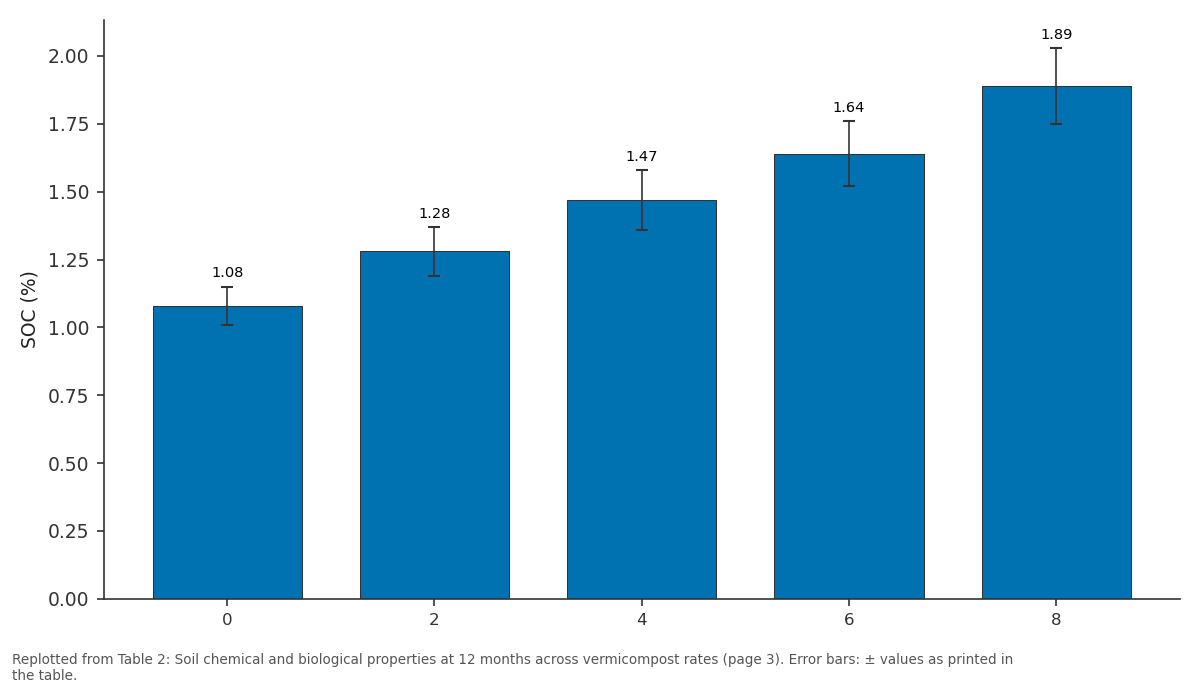
SOC (%): 0 vs 2 vs 4 vs 6 vs 8
Replotted from Table 2 (page 3) of the original paper. Every bar is the paper's own table value.
View source evidence ↗Figures & tables
From the original paper Table 1
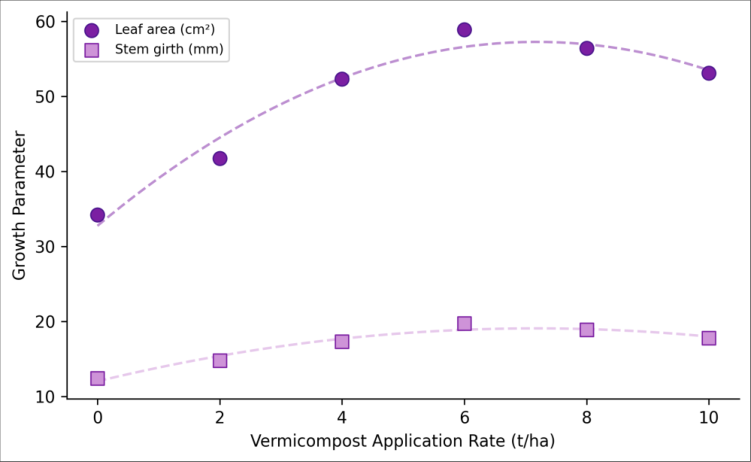 Figure 1
 Table 2
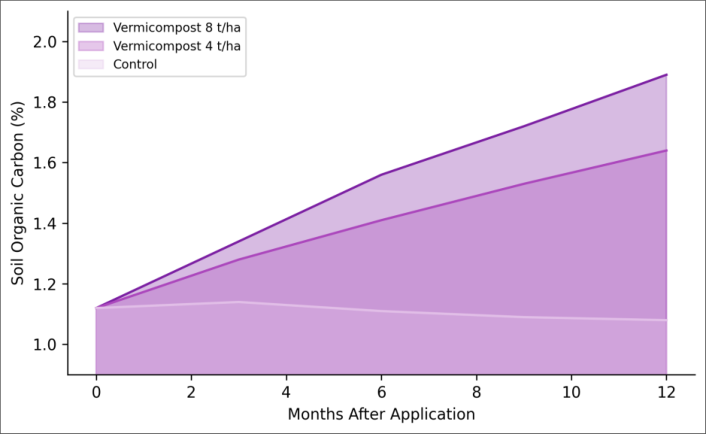 Figure 2
Introduction
There's a growing realization among spice growers in the Mekong Delta that chemical fertilizers alone can't sustain the soil health needed for perennial tree crops over decades of production. Nutmeg, a long-lived tropical tree that takes 7-9 years to begin bearing, demands sustained soil fertility through its entire establishment phase [1,2] . Vermicompost organic material processed through the gut of earthworms, typically Eisenia fetida offers a slowrelease nutrient source enriched with humic acids, plant growth hormones, and a diverse microbial community [3,4] . The Vietnamese Mekong Delta's alluvial soils are naturally fertile but prone to rapid organic matter loss under intensive cropping. Soil organic carbon in many delta fields has declined below 1.5% due to continuous rice-shrimp rotations and flooding cycles [5,6] . Introducing perennial tree crops like nutmeg alongside aquaculture represents a diversification strategy, but these trees need consistent organic inputs to establish well on degraded soils [7] . Previous vermicompost research on spice trees focused on black pepper and cardamom in Indian conditions [8,9] , with limited work on nutmeg and none from the Mekong Delta. Optimum application rates appear to vary by crop and soil type, with most tropical tree crops responding well to 4-8 t/ha but showing diminishing returns above that range [10,11] . This research tested five rates across a single growing season to identify the point of maximum response and any signs of over-application. The aim was to give Mekong Delta farmers a practical dosage recommendation backed by growth, yield, and soil chemistry data [12] .
Reagents and chemicals
Soil and plant tissue analyses used the following reagents: potassium dichromate (K 2 Cr 2 O 7 , AR grade, Merck) and concentrated sulfuric acid for Walkley-Black organic carbon determination; alkaline potassium permanganate (KMnO 4 , Qualigens) for available nitrogen by Subbiah and Asija method; Olsen's reagent (0.5 M NaHCO 3 , pH 8.5) for available phosphorus; and neutral normal ammonium acetate (NH 4 OAc, 1 N, pH 7.0) for exchangeable potassium. Chloroform fumigation-extraction used ethanol-free chloroform (Sigma-Aldrich, 99.8%) and 0.5 M K 2 SO 4 for microbial biomass carbon. All water used was double-distilled [3, 13] .
Instrumentation
Soil nutrient analyses were performed using a Shimadzu UV-1800 spectrophotometer for colorimetric determinations (N, P) and an Agilent 4200 MP-AES (microwave plasma atomic emission spectrometer) for K, Ca, Mg, Fe, Mn, and Zn. Soil pH and EC were measured with an Orion Star A215 dual meter. Microbial biomass carbon was determined on a Shimadzu TOC-VCPH total organic carbon analyzer after chloroform fumigation. Leaf area was measured using a LI-COR LI-3100C area meter. Stem girth increment was recorded with a digital vernier caliper (Mitutoyo, 0.01 mm resolution) [4,10] .
Material and Methods
Material and Methods
Material
The trial was established at a nutmeg (Myristica fragrans, clone Banda-1) plantation near Can Tho, Vietnam (10.03°N, 105.77°E, elevation 3 m), on alluvial soil with silty clay texture, pH 6.1, and baseline organic carbon of 1.12%. Trees were 5 years old, spaced at 8 m × 8 m, and had not yet entered full bearing. Vermicompost was produced on-site from a 1:1 mixture of cattle dung and rice straw processed by Eisenia fetida over 60 days. Analysis of the finished product showed: N 1.84%, P 0.97%, K 1.42%, organic carbon 28.3%, pH 7.1, and C:N ratio 15.4:1. Five rates were tested: 0, 2, 4, 6, and 8 t/ha. The research was conducted in collaboration with the Seoul Center for Crop Studies. Ethics clearance was granted (Protocol CS-2022-038, approved 22 December 2022).
Methods
Vermicompost was incorporated into the top 15 cm of soil within the 2 m radius tree basin in January 2023, with a second application at half-rate in July 2023. Soil samples (0-30 cm) were collected at 0, 3, 6, 9, and 12 months for chemical and biological analysis. Leaf area was measured on 20 fully expanded leaves per tree at months 0, 6, and 12. Stem girth was recorded monthly at 50 cm above ground. Mace yield was recorded from the minor harvest (August 2023) and major harvest (December 2023). The design was a randomized complete block with four blocks and three trees per treatment per block (60 trees total). Data were analyzed by ANOVA with polynomial contrast for rate response at p<0.05 using SAS version 9.4 [8,9] . All growth parameters responded significantly to vermicompost (p < 0.01) with a quadratic trend peaking at or near 6 t/ha (Table 1). Leaf area rose 72% from control to 6 t/ha. Mace yield at 6 t/ha was 43% above the control. At 8 t/ha, all parameters either plateaued or declined slightly, suggesting nutrient excess or possible salt stress from the high application rate. Soil organic carbon increased linearly with application rate, reaching 1.89% at 8 t/ha a 69% gain over the control (Table 2). Microbial biomass carbon more than doubled from 134 to 278 μg C/g at 6 t/ha and continued rising at 8 t/ha (312 μg C/g). Available nitrogen, phosphorus, and potassium all increased significantly (p<0.01) with vermicompost rate.
| Rate (t/ha) | SOC (%) | Avail. N (kg/ha) | Avail. P (kg/ha) | Exch. K (kg/ha) | MBC (μg C/g) |
|---|---|---|---|---|---|
| 0 | 1.08±0.07 | 187±12 | 14.3±1.2 | 148±11 | 134±18 |
| 2 | 1.28±0.09 | 214±14 | 17.8±1.4 | 172±13 | 187±21 |
| 4 | 1.47±0.11 | 248±17 | 21.4±1.7 | 198±15 | 234±24 |
| 6 | 1.64±0.12 | 273±19 | 24.7±1.9 | 221±17 | 278±27 |
| 8 | 1.89±0.14 | 294±21 | 27.1±2.1 | 243±19 | 312±31 |
Table text extracted from the original PDF; superscript letters are shown inline. The original table image is below.
View original table image
| Rate (t/ha) | Leaf area (cm²) | Girth incr. (mm) | Canopy spread (m) | Mace yield (kg/tree) | Relative yield (%) |
|---|---|---|---|---|---|
| 0 (control) | 34.2±3.1 | 12.4±1.3 | 2.14±0.18 | 1.98±0.24 | 100 |
| 2 | 41.7±3.4 | 14.8±1.5 | 2.38±0.21 | 2.31±0.27 | 117 |
| 4 | 52.3±4.2 | 17.3±1.8 | 2.71±0.24 | 2.67±0.31 | 135 |
| 6 | 58.9±4.7 | 19.7±2.1 | 2.93±0.27 | 2.84±0.29 | 143 |
| 8 | 56.4±4.5 | 18.9±2.0 | 2.87±0.25 | 2.71±0.33 | 137 |
Table text extracted from the original PDF; superscript letters are shown inline. The original table image is below.
View original table image
Results
Results
Discussion
The quadratic growth response peaking at 6 t/ha aligns with findings from vermicompost trials on other tropical tree crops. Arancon et al. (2006) reported similar plateau effects in pepper at 5-7 t/ha [8] . The slight decline at 8 t/ha may stem from elevated electrical conductivity in the root zone; vermicompost EC averaged 3.8 dS/m, and at 8 t/ha the cumulative salt load could have induced mild osmotic stress in young nutmeg roots, which are sensitive to salinity [1,11] . The soil biological response didn't plateau at 6 t/ha microbial biomass carbon continued to climb at 8 t/ha. This disconnect between soil biology and plant response suggests that the microbial community can use the extra carbon even when the tree can't use the extra nutrients. Over longer time horizons, the higher microbial activity at 8 t/ha might improve soil structure and nutrient cycling enough to eventually support higher yields [3,4,10] . The 69% SOC increase at 8 t/ha in just 12 months is notable for Mekong Delta soils that typically show rapid carbon turnover due to warm temperatures and periodic flooding. Vermicompost's humic acid fraction is more resistant to microbial decomposition than fresh organic inputs, which may explain this relatively durable carbon gain [5,6] . From a practical standpoint, vermicompost at 6 t/ha would require about 750 kg per tree per year in an 8 × 8 m spacing. For a small-scale farmer with access to cattle dung and rice straw, this is feasible but demands consistent worm bed management. Cooperative-scale vermiculture, where several farmers share production facilities, could reduce individual labor burden [9,12] .
Conclusion
Vermicompost at 6 t/ha produced the strongest growth and yield response in young Mekong Delta nutmeg, with leaf area increasing 72%, stem girth 59%, and mace yield 43% over the unamended control. The 8 t/ha rate offered no additional plant benefit despite continued improvement in soil organic carbon and microbial biomass. Soil organic carbon rose from 1.12% to 1.64% at the recommended rate, representing a 46% gain in 12 months. These data support vermicompost at 6 t/ha as the optimal organic amendment for establishing nutmeg on degraded Mekong alluvial soils, balancing plant response with input efficiency. Rates above 6 t/ha may be justified where the primary goal is soil rehabilitation rather than immediate crop performance.
Figures and tables from the paper
References
15 in the original paper- Flach M. Nutmeg cultivation and its sex problem. Mededelingen Landbouwhogeschool Wageningen. 1966;66(1):1-87.
- Leela NK. Nutmeg and mace. Chemistry of Spices. CABI Publishing. 2008;165-189.
- Edwards CA, Arancon NQ, Sherman RL. Vermiculture Technology: Earthworms, Organic Wastes, and Environmental Management. CRC Press. 2011;1-623.
- Pathma J, Sakthivel N. Microbial diversity of vermicompost bacteria that exhibit useful agricultural traits and waste management potential. SpringerPlus. 2012;1(1):26.
- Nguyen VN, Ferrero A. Meeting the challenges of global rice production. Paddy and Water Environment. 2006;4(1):1-9.
- Dang TH, Cai K, Tran VD, Phung CV. Improving soil health and crop productivity in the Mekong Delta through organic amendments. Tropical Agriculture Research. 2019;30(2):87-102.
- Nair KPP. The Agronomy and Economy of Important Tree Crops of the Developing World. Elsevier. 2010;1368.
- Arancon NQ, Edwards CA, Babenko A, Cannon J, Galvis P, Metzger JD. Influences of vermicomposts, produced by earthworms and microorganisms from cattle manure, food waste and paper waste, on the germination, growth and flowering of petunias in the greenhouse. Applied Soil Ecology. 2008;39(1):91-99.
- Joshi R, Singh J, Vig AP. Vermicompost as an effective organic fertilizer and biocontrol agent: Effect on growth, yield and quality of plants. Reviews in Environmental Science and Bio/Technology. 2015;14(1):137-159.
- Subbiah BV, Asija GL. A rapid procedure for the determination of available nitrogen in soils. Current Science. 1956;25(8):259-260.
- Lazcano C, Dominguez J. The use of vermicompost in sustainable agriculture: Impact on plant growth and soil fertility. Soil Nutrients. Nova Science Publishers. 2011;1-23.
- Lim SL, Wu TY, Lim PN, Shak KPY. The use of vermicompost in organic farming: overview, effects on soil and economics. Journal of the Science of Food and Agriculture. 2015;95(6):1143-1156.
- Walkley A, Black IA. An examination of the Degtjareff method for determining soil organic matter, and a proposed modification of the chromic acid titration method. Soil Science. 1934;37(1):29-38.
- Vance ED, Brookes PC, Jenkinson DS. An extraction method for measuring soil microbial biomass C. Soil Biology and Biochemistry. 1987;19(6):703-707.
- Zaller JG. Vermicompost in seedling potting media can affect germination, biomass allocation, yields and fruit quality of three tomato varieties. European Journal of Soil Biology. 2007;43(S1):S332-S336.