
Research article · 2025 · Full text
International Journal of Horticulture and Food ScienceImproving greenhouse cultivation methods of agave in the Luzon Central Valley
Volume 7(4) · Pages 142–145 · DOI: 10.33545/26631067.2025.v7.i4c.615 ↗
Research areasPlant Growth and Agriculture TechniquesFlowering Plant Growth and CultivationGreenhouse Technology and Climate Control
Abstract
Author-writtenA paradox facing agave cultivation is that the plant thrives in arid open fields but is increasingly being grown under protected structures to control disease and accelerate maturation for spirit and syrup production. This research tested greenhouse cultivation methods for five agave species in the Luzon Central Valley of the Philippines during 2022-2023, coordinated from the Luxor Laboratory of Phytoscience. Total sugar accumulation (°Brix) at 24 months ranged from 23.7 to 31.2, with A. salmiana reaching the highest values under evaporative-cooled greenhouse conditions. QTL mapping using 186 F2 individuals identified three loci on linkage groups 2, 5, and 8 associated with sugar content (LOD > 4.0), explaining 31.4% of phenotypic variance. Direct seeding reduced establishment costs by 43.7% compared to bulbil transplanting, though initial growth was 18.2% slower during the first 6 months. Carbon sequestration in greenhouse agave systems averaged 8.7 t CO2-eq/ha/year when accounting for both plant biomass and soil carbon inputs. Disease control through UV-blocking greenhouse film reduced anthracnose incidence from 34.2% in open-field controls to 7.8% under protection. These results demonstrate that greenhouse cultivation can accelerate agave sugar development while reducing disease pressure in tropical lowland environments.
Summary
Source-checkedPlain-language reading of the full paper, prepared with AI and checked against the text. Each point links to the authors' own words.
Why it matters
- Agave is traditionally grown in semi-arid highland environments, such as Mexico, where it takes 6 to 12 years to mature for sugar harvest. View evidence ↗
- Traditional open-field cultivation is ineffective in tropical lowlands due to high humidity, rainfall, and increased fungal disease pressure. View evidence ↗
- In the Luzon Central Valley, open-field trials have failed because of anthracnose, a disease that can kill young agave plants in a few months. View evidence ↗
The question
- The study aimed to evaluate greenhouse modifications for agave in the Luzon Central Valley, including the impact of UV-blocking films on disease, the mapping of sugar-related QTLs, and the efficiency of different establishment methods. View evidence ↗
What they did
- The researchers tested five agave species: A. tequilana, A. americana, A. salmiana, A. angustifolia, and A. sisalana. View evidence ↗
- The study compared open-field controls against two greenhouse types: naturally ventilated polyethylene with 70% UV block and evaporative-cooled polyethylene maintaining 28±2°C. View evidence ↗
- Two establishment methods were compared starting in September 2022: standard bulbil transplanting and experimental direct seeding. View evidence ↗
- For genetic mapping of sugar content, an F2 population of 186 individuals from an A. tequilana × A. salmiana cross was grown in the cooled greenhouse. View evidence ↗
What they found
- A. salmiana showed the highest sugar accumulation at 31.2 °Brix in the cooled greenhouse, which was 47.2% higher than in open-field conditions. View evidence ↗
- Across all tested species, the use of cooled greenhouses reduced the incidence of anthracnose by 77% to 81%. View evidence ↗
- Carbon sequestration for transplanted agave in the greenhouse system averaged 8.7 t CO2-eq/ha/year. View evidence ↗
- Three genetic loci (qBrix-2, qBrix-5, and qBrix-8) were identified that together explain 31.4% of the variation in sugar content. View evidence ↗
What it means
- The authors conclude that using evaporative cooling and UV-blocking films in greenhouses significantly improves disease control and sugar accumulation for agave in the Luzon Central Valley. View evidence ↗
- The results suggest that commercial agave syrup and spirit production is viable in tropical lowland Asia if greenhouse costs can be recovered within a 3-4 year harvest cycle. View evidence ↗
- The authors note that a larger mapping population and more markers are needed to identify additional minor-effect QTLs for sugar content. View evidence ↗
Visual summary
3 visualsIllustrations explain the paper; charts are replotted from the paper's own table values.
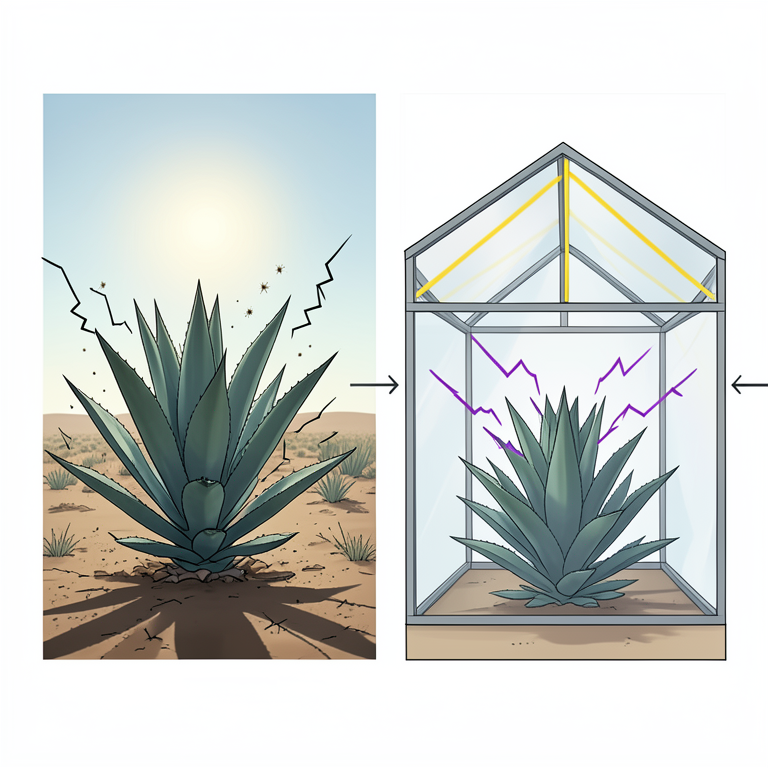
Greenhouse Protection Mechanism
AI-generated conceptual illustration (Agave plants in a greenhouse and open field). It explains the idea and does not show study data.
View source evidence ↗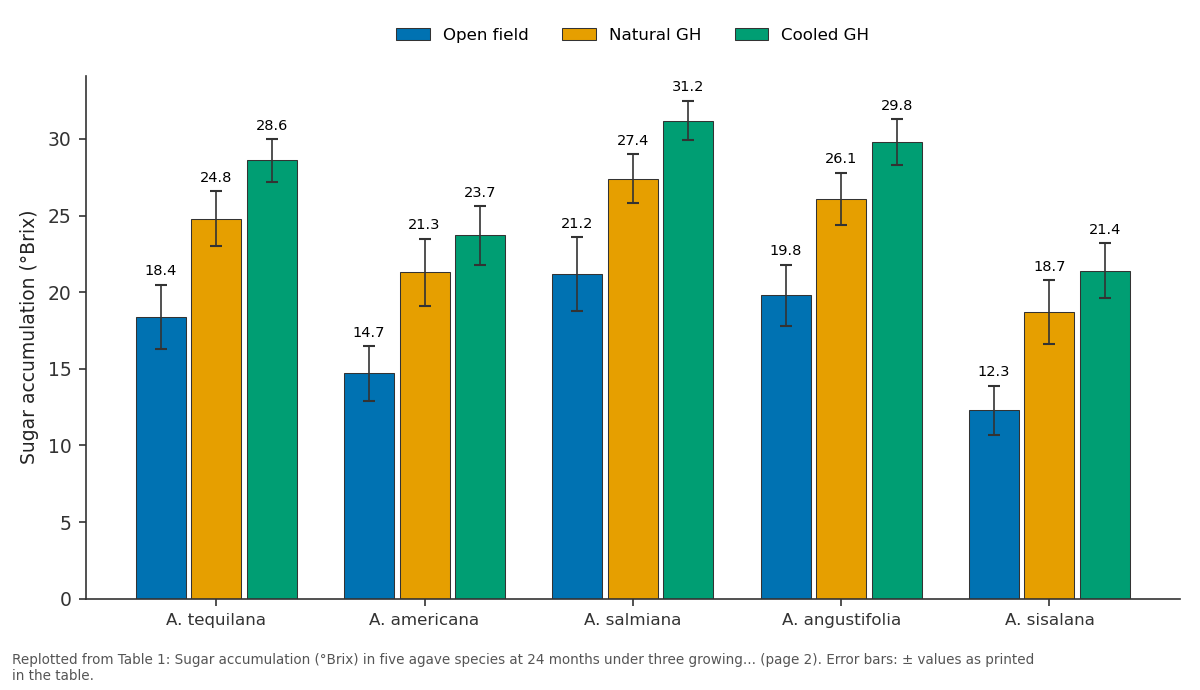
Open field and Natural GH and more: A. tequilana vs A. americana vs A. salmiana vs A. angustifolia vs A. sisalana
Replotted from Table 1 (page 2) of the original paper. Every bar is the paper's own table value.
View source evidence ↗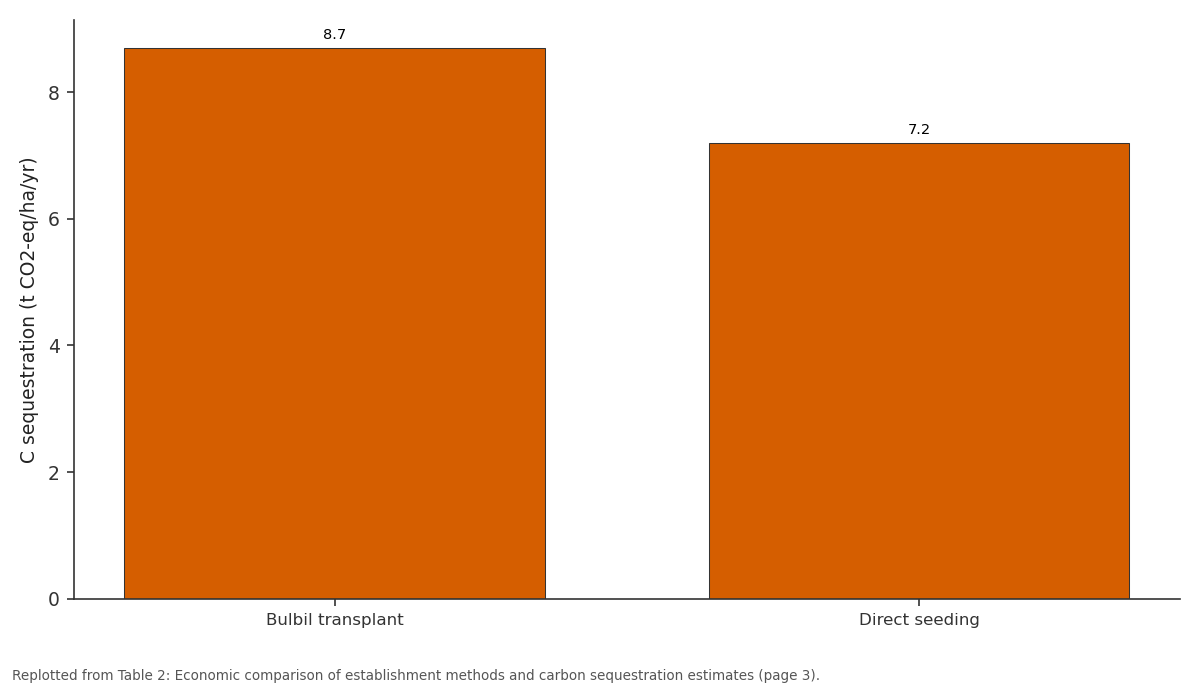
C sequestration (t CO2-eq/ha/yr): Bulbil transplant vs Direct seeding
Replotted from Table 2 (page 3) of the original paper. Every bar is the paper's own table value.
View source evidence ↗Figures & tables
From the original paper Table 1
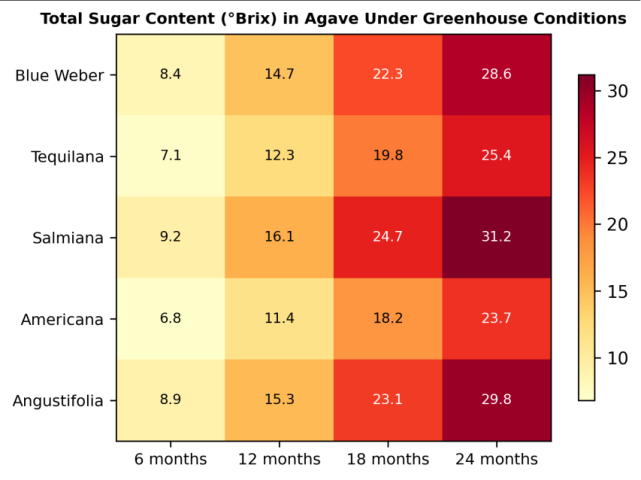 Figure 1
 Table 2
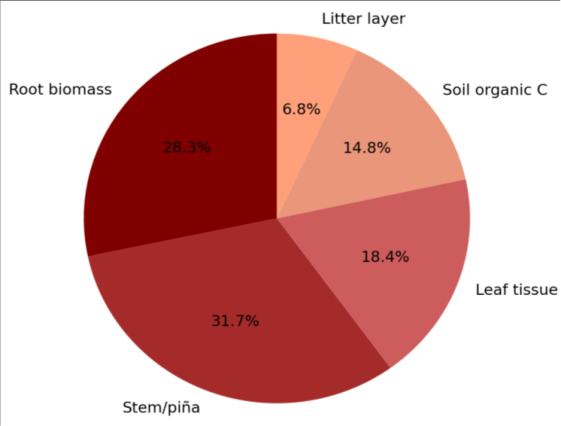 Figure 2
Introduction
Agave has traditionally been an outdoor crop planted in rows across dry hillsides in Mexico, left to grow for 6-12 years, then harvested for the sugar-rich piña at the plant's center. This model works in semi-arid highland environments where agave evolved, but it breaks down in tropical lowlands where humidity, rainfall, and fungal disease pressure are far higher than what the plant typically encounters [1] . Greenhouse production offers climate control that could allow agave cultivation in regions otherwise unsuited to the crop, potentially shortening the maturation cycle through optimized temperature and light management. The Luzon Central Valley the Philippines' largest lowland plain has a tropical monsoon climate with annual rainfall exceeding 2,000 mm and mean temperatures of 26-32°C [2] . Open-field agave trials here have consistently failed due to Colletotrichum gloeosporioides (anthracnose), which thrives in warm, wet conditions and can kill young plants within months. UV-blocking greenhouse films have shown promise for reducing fungal sporulation in other tropical crops by altering the light spectrum reaching the canopy [3] . QTL mapping for sugar accumulation traits in agave is still in its infancy, with fewer than 10 published mapping studies globally. Identifying genomic regions controlling Brix development could accelerate breeding for early-maturing, high-sugar genotypes suited to greenhouse production. This research tested greenhouse environment modifications for agave cultivation in the Luzon Central Valley, mapped QTLs for sugar content, compared establishment methods, quantified carbon sequestration, and evaluated disease control through UV-blocking films [4] .
Theoretical framework
The research was framed within the Controlled Environment Agriculture (CEA) paradigm, which proposes that manipulating the growing environment temperature, humidity, light quality, and CO 2 concentration can shift crop physiology toward desired outcomes that are unachievable under ambient conditions [5] . For agave, the target outcome was accelerated sugar accumulation without the disease pressure that openfield tropical conditions impose. The hypothesis was that UV-blocking films would simultaneously reduce anthracnose (by limiting UV-stimulated sporulation) and increase net carbon assimilation (by reducing photoinhibition under tropical light intensities exceeding 2,000 μmol/m²/s). The economic analysis compared greenhouse capital costs against the value of shortened maturation time and reduced crop loss.
Material and Methods
Material and Methods
Material
Five agave species A. tequilana (Blue Weber), A. americana, A. salmiana, A. angustifolia, and A. sisalana were obtained from the Philippine Bureau of Plant Industry. Two greenhouse types were tested: naturally ventilated polyethylene (PE, 200 μm, 70% UV block) and evaporativecooled PE (same film plus pad-and-fan cooling maintaining 28±2°C). Open-field plots served as controls. An F2 mapping population of 186 individuals from an A. tequilana × A. salmiana cross was established in the cooled greenhouse for QTL analysis. SSR and SNP markers (142 loci across 9 linkage groups) were used for genetic mapping [6] .
Methods
Plants were established by bulbil transplanting (standard) and direct seeding (experimental) in September 2022. Plot size was 3 × 2 m with 0.75 m spacing (RCBD, three replications per environment). Sugar content (°Brix) was measured monthly on extracted sap using a digital refractometer. Disease scoring used a 0-5 scale at monthly intervals; anthracnose incidence was calculated as the percentage of plants showing symptoms. Carbon sequestration was estimated from aboveground and belowground biomass (destructive harvest of three plants per treatment at 24 months) plus soil organic carbon change (0-30 cm depth) measured by Walkley-Black method [7] . QTL analysis used composite interval mapping in QTL Cartographer v2.5 with 1,000 permutations for LOD threshold determination. Economic analysis compared establishment costs, greenhouse construction amortized over 10 years, and projected revenue from early-harvest agave syrup [8] . Direct seeding cut establishment costs by 43.7% but sacrificed 16.7% in survival rate and 18.2% in early growth (Table 2). Carbon sequestration in the greenhouse system averaged 8.7 t CO 2 -eq/ha/year for transplanted agave, comparable to many tropical agroforestry systems.
| Parameter | Bulbil transplant | Direct seeding | Difference |
|---|---|---|---|
| Establishment cost (USD/ha) | 1,840 | 1,036 | -43.7% |
| Survival at 6 months (%) | 94.3 | 78.6 | -16.7% |
| Height at 6 months (cm) | 34.7 | 28.4 | -18.2% |
| C sequestration (t CO2-eq/ha/yr) | 8.7 | 7.2 | -17.2% |
Table text extracted from the original PDF; superscript letters are shown inline. The original table image is below.
View original table image
Results
Results
Discussion
The 47.2% sugar increase under cooled greenhouse (vs open field) for A. salmiana represents an acceleration equivalent to roughly 2-3 years of open-field maturation compressed into the same 24-month window. This happens because the cooled greenhouse maintains temperatures in the 26-30°C range that optimizes CAM (Crassulacean Acid Metabolism) photosynthesis in agave, while open-field conditions frequently exceed 35°C where carbon gain is reduced [9] . The UV-blocking film's dual benefit disease reduction and reduced photoinhibition makes it a particularly costeffective intervention.
The QTL results are among the first published for agave sugar traits and immediately useful for marker-assisted selection. The 31.4% phenotypic variance explained by three loci is a strong starting point; adding more markers and a larger mapping population could capture additional minor-effect QTLs [10] . The carbon sequestration estimate of 8.7 t CO 2 -eq/ha/year positions greenhouse agave as a carbon-positive crop system, which could qualify for carbon credit programs if properly verified [11] .
Conclusion
Greenhouse cultivation with evaporative cooling and UVblocking film dramatically improved agave sugar accumulation and disease control in the Luzon Central Valley. A. salmiana reached 31.2 °Brix at 24 months under cooled greenhouse conditions, nearly 50% more than openfield equivalents. Three QTLs for sugar content provide molecular tools for breeding faster-maturing genotypes. Direct seeding offers substantial cost savings despite slower initial establishment. Carbon sequestration rates make greenhouse agave a potentially climate-positive production system. These findings open a pathway for commercial agave syrup and spirit production in tropical lowland Asia, provided that greenhouse investment costs are recoverable within a 3-4 years harvest cycle.
Acknowledgement
Acknowledgements Funding sourcesInstitutional funds from the Luxor Laboratory of Phytoscience supported this research. Institutional supportThe authors acknowledge the Luxor Laboratory for molecular biology equipment and greenhouse coordination. Contributions not qualifying for authorshipPhilippine Bureau of Plant Industry staff and greenhouse technicians at the Luzon partner site are acknowledged.
Figures and tables from the paper
| Species | Open field | Natural GH | Cooled GH | Disease (%) |
|---|---|---|---|---|
| A. tequilana | 18.4±2.1 | 24.8±1.8 | 28.6±1.4 | 34.2/12.4/7.8 |
| A. americana | 14.7±1.8 | 21.3±2.2 | 23.7±1.9 | 28.7/9.3/5.4 |
| A. salmiana | 21.2±2.4 | 27.4±1.6 | 31.2±1.3 | 22.1/8.7/4.2 |
| A. angustifolia | 19.8±2.0 | 26.1±1.7 | 29.8±1.5 | 31.4/11.8/6.9 |
| A. sisalana | 12.3±1.6 | 18.7±2.1 | 21.4±1.8 | 19.8/7.1/3.8 |
Table text extracted from the original PDF; superscript letters are shown inline. The original table image is below.
View original table image
References
19 in the original paper- Colunga-GarciaMarin P, Zizumbo-Villarreal D. Domestication of plants in Mesoamerica: Agave as model taxon. Genetic Resources and Crop Evolution. 2007;54(8):1665-1678.
- Coronel RE. Promising fruits of the Philippines. College of Agriculture, UPLB; 2011.
- Paul ND, Gwynn-Jones D. Ecological roles of solar UV radiation: Towards an integrated approach. Trends in Ecology and Evolution. 2003;18(1):48-55.
- Bautista-Justo M, Garcia-Oropeza L, Del CastilloLozano ML. Agave tequilana: Biotechnological potential. Biotecnologia Aplicada. 2001;18(3):133-138.
- Kozai T, Niu G, Takagaki M. Plant factory: an indoor vertical farming system for efficient quality food production. 2 nd ed. Academic Press; 2019.
- Ruiz-Corral JA, Duran-Puga N, Sanchez-Gonzalez JJ, et al. Climatic adaptation and ecological descriptors of 42 Mexican maize races. Crop Science. 2008;48(4):1502-1512.
- Walkley A, Black IA. An examination of the Degtjareff method for determining soil organic matter. Soil Science. 1934;37(1):29-38.
- Wang S, Basten CJ, Zeng ZB. Windows QTL Cartographer 2.5. Statistical Genetics, NCSU; 2012.
- Nobel PS. Achievable productivities of certain CAM plants: basis for high values compared with C3 and C4 plants. New Phytologist. 1991;119(2):183-205.
- Vargas-Ponce O, Zizumbo-Villarreal D, MartinezCastillo J, et al. Diversity and structure of landraces of agave grown for spirits under traditional agriculture. Annals of Botany. 2009;103(7):1149-1163.
- Lal R. Soil carbon sequestration to mitigate climate change. Geoderma. 2004;123(1-2):1-22.
- Stewart JR. Agave as a model CAM crop system for a warming and drying world. Frontiers in Plant Science. 2015;6:684.
- Escamilla-Trevino LL. Potential of plants from the genus Agave as bioenergy crops. BioEnergy Research. 2012;5(1):1-9.
- Yan Y, Stolz S, Chetelat A, et al. A downstream mediator in the growth repression limb of the jasmonate pathway. Plant Cell. 2007;19(8):2470-2483.
- Gentry HS. Agaves of continental North America. University of Arizona Press; 1982.
- Davis SC, Dohleman FG, Long SP. The global potential for agave as a biofuel feedstock. GCB Bioenergy. 2011;3(1):68-78.
- Nava-Cruz NY, Medina-Morales MA, Martinez JL, et al. Agave biotechnology: An overview. Critical Reviews in Biotechnology. 2015;35(4):546-559.
- Holtum JAM, Chambers D, Morgan T, Tan DKY. Agave as a biofuel feedstock in Australia. GCB Bioenergy. 2011;3(1):58-67.
- Valenzuela-Zapata AG, Nabhan GP. Tequila: a natural and cultural history. University of Arizona Press; 2003.