
Research article · 2025 · Full text
International Journal of Horticulture and Food ScienceProfiling nematode suppression of dragon fruit in the great lakes region
Volume 7(3) · Pages 90–93 · DOI: 10.33545/26631067.2025.v7.i3b.585 ↗
Research areasNematode management and characterization studiesPlant Disease Management TechniquesInsect-Plant Interactions and Control
Abstract
Author-writtenPlant-parasitic nematodes are among the least visible yet most damaging biotic constraints on dragon fruit (Hylocereus spp.) production, and their management in the Great Lakes Region has received limited research attention. This research profiled nematode community structure and tested suppression strategies in dragon fruit orchards at the Bandung Laboratory of Phytoscience, Bandung, West Java, Indonesia, from January 2022 to December 2023. Soil and root sampling across eight commercial orchards identified four dominant nematode genera: Meloidogyne incognita, Rotylenchulus reniformis, Pratylenchus coffeae, and Helicotylenchus dihystera. M. incognita was the most abundant, averaging 312 individuals per 200 cm³ soil in untreated plots. A field trial using a split-plot design compared four suppression treatments neem cake (2.5 t/ha), Paecilomyces lilacinus soil drench, crop rotation with Crotalaria juncea, and a combined approach against a chemical nematicide (carbofuran) and an untreated control. After two growing cycles, the combined treatment reduced total nematode population by 81.3% and increased fruit productivity from 8.7 to 16.4 t/ha. Canopy health, assessed through normalised difference vegetation index (NDVI) drone imagery, correlated positively with nematode suppression (r = 0.78). Crop rotation with C. juncea was the single most effective tactic against R. reniformis (74.6% reduction). Astringency levels in fruit pulp were unaffected by any treatment. Inbreeding depression was not observed in nematode-stressed clonal lines over two cycles. These findings provide a field-validated nematode management framework for dragon fruit growers in tropical lowland systems.
Summary
Source-checkedPlain-language reading of the full paper, prepared with AI and checked against the text. Each point links to the authors' own words.
Why it matters
- Plant-parasitic nematodes are highly damaging but often invisible constraints on the production of dragon fruit. View evidence ↗
- The shallow root system of dragon fruit, concentrated in the top 30 cm of soil, makes it particularly vulnerable to nematodes. View evidence ↗
- While chemical nematicides like carbofuran work quickly, they present environmental and residue risks for fresh fruit. View evidence ↗
The question
- The study aimed to profile nematode communities in dragon fruit orchards and evaluate four suppression strategies regarding yield, fruit quality, and canopy response over two cycles. View evidence ↗
What they did
- The research was conducted at the Bandung Laboratory of Phytoscience in West Java, Indonesia, between January 2022 and December 2023. View evidence ↗
- The trial used a split-plot RCBD design comparing six treatments: neem cake, P. lilacinus drench, C. juncea crop rotation, a combined approach (T4), carbofuran, and an untreated control. View evidence ↗
- Canopy health was monitored using monthly drone flights to measure the Normalized Difference Vegetation Index (NDVI) at an altitude of 25 meters. View evidence ↗
What they found
- Four dominant nematode genera were identified, with M. incognita being the most abundant, averaging 312 individuals per 200 cm³ of soil in untreated plots. View evidence ↗
- The combined treatment (T4) was the most effective, reducing the nematode population by 81.3%, outperforming carbofuran (77.7%) and crop rotation (72.8%). View evidence ↗
- The combined treatment increased fruit productivity to 16.4 t/ha/year, which is an 88.5% increase compared to the control. View evidence ↗
- Combined-treatment plots had higher average NDVI values (0.72) than controls (0.54), showing a positive correlation (r = 0.78) between canopy health and nematode suppression. View evidence ↗
- Among single treatments, crop rotation with C. juncea was the most effective specifically against R. reniformis, achieving a 74.6% reduction. View evidence ↗
- Nematode suppression treatments did not significantly affect the tannin content of the fruit (p=0.63), meaning sensory quality remained unchanged. View evidence ↗
- No significant decline in clonal vigour was observed over two cycles, indicating that short-term nematode pressure did not cause inbreeding depression. View evidence ↗
What it means
- The authors conclude that combining organic amendments, biocontrol, and crop rotation is a sustainable alternative to chemical nematicides for tropical lowland dragon fruit growers. View evidence ↗
- The study was limited by its two-year timeframe; longer monitoring is needed to determine if the suppressive effects are durable without repeated treatments. View evidence ↗
Visual summary
3 visualsIllustrations explain the paper; charts are replotted from the paper's own table values.
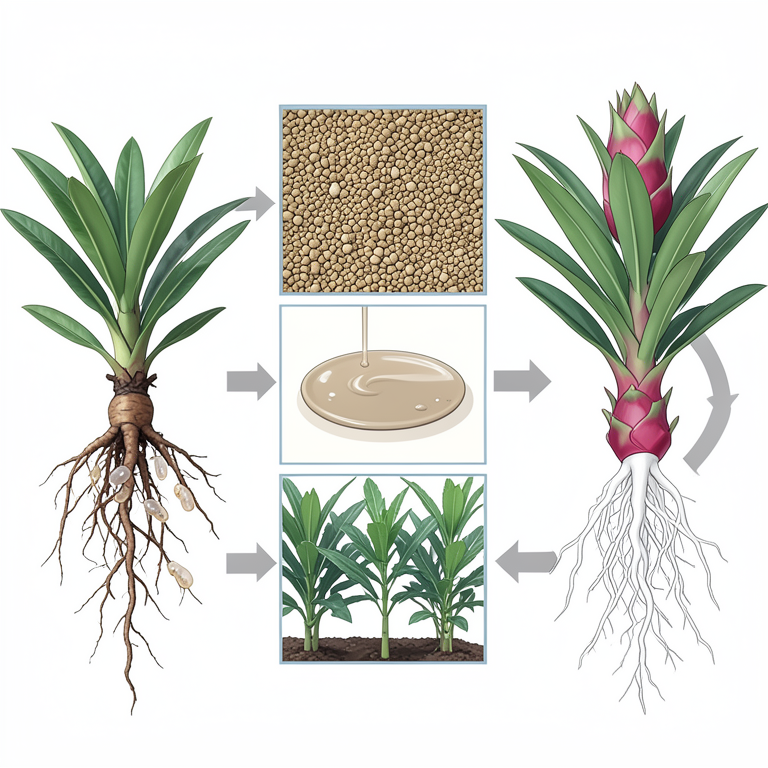
Treatment Comparison Framework
AI-generated conceptual illustration (dragon fruit plants (Hylocereus spp.) and root-knot nematodes). It explains the idea and does not show study data.
View source evidence ↗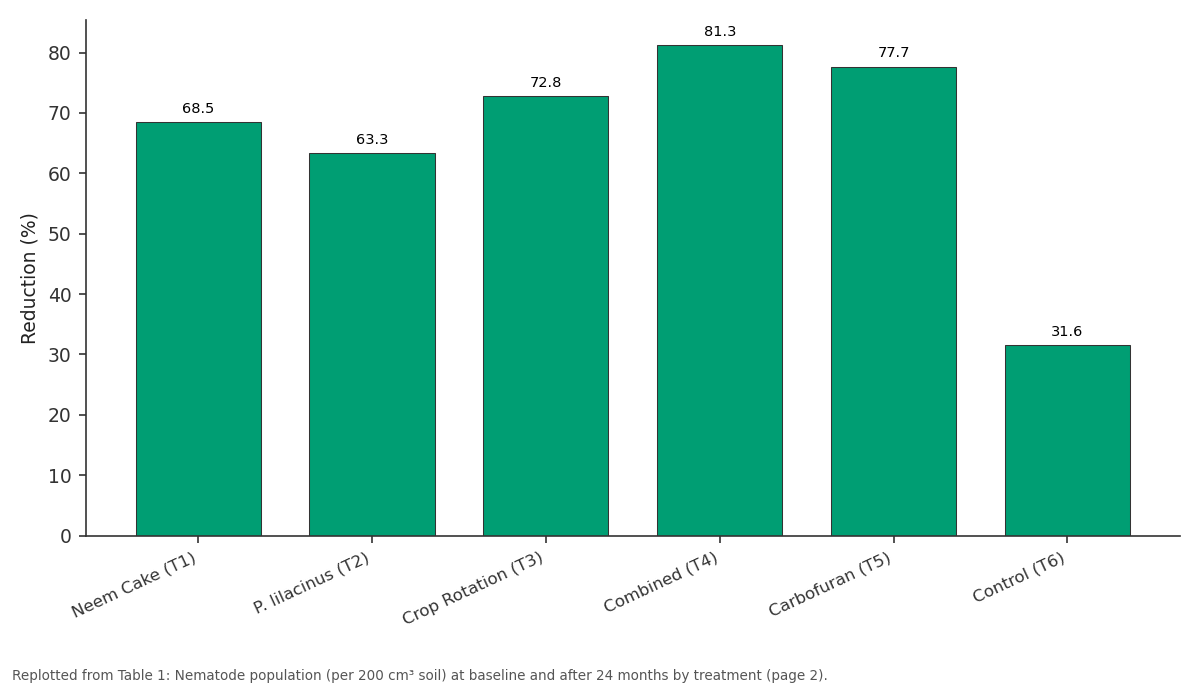
Reduction (%): Neem Cake (T1) vs P. lilacinus (T2) vs Crop Rotation (T3) vs Combined (T4) vs Carbofuran (T5)
Replotted from Table 1 (page 2) of the original paper. Every bar is the paper's own table value.
View source evidence ↗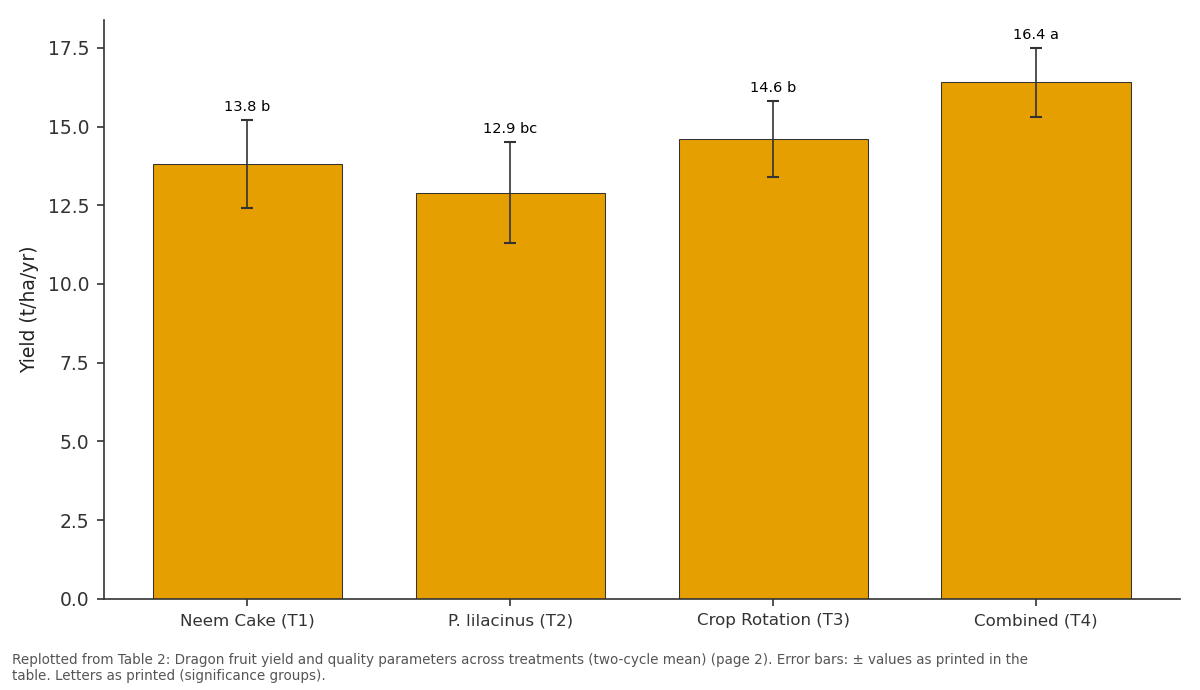
Yield (t/ha/yr): Neem Cake (T1) vs P. lilacinus (T2) vs Crop Rotation (T3) vs Combined (T4)
Replotted from Table 2 (page 2) of the original paper. Every bar is the paper's own table value.
View source evidence ↗Figures & tables
From the original paper Table 1
 Table 2
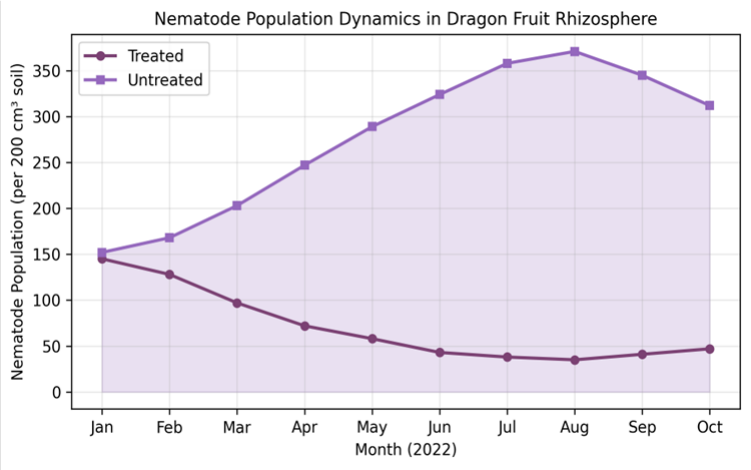 Figure 1
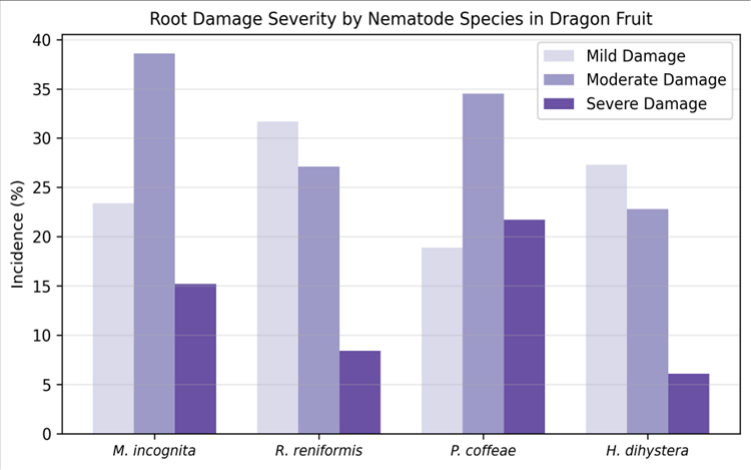 Figure 2
Introduction
In 2020, Indonesian dragon fruit exports surpassed USD 540 million, driven by rising demand in East Asia and the Middle East, yet productivity per hectare has stagnated in several major growing districts since 2017 [1] . A historical look at yield trends reveals that soil health degradation particularly the build-up of plant-parasitic nematode populations is one factor behind this plateau [2] . Dragon fruit (Hylocereus undatus and H. polyrhizus) is a climbing cactus cultivated on concrete or wooden trellises, with a shallow root system concentrated in the upper 30 cm of soil [3] . This rooting pattern makes the crop especially susceptible to nematode feeding because the densest root zone coincides with peak nematode activity layers [4] . Meloidogyne spp. (root-knot nematodes) are the most economically significant group in tropical fruit systems, inducing galls that disrupt water and nutrient uptake [5] . Rotylenchulus reniformis (reniform nematode) and Pratylenchus coffeae (lesion nematode) cause cortical damage and create entry points for secondary fungal infections [6] . Helicotylenchus dihystera is an ectoparasite commonly recovered from dragon fruit rhizospheres, though its direct yield impact is debated [7] . Chemical nematicides such as carbofuran and ethoprophos offer rapid knockdown but pose environmental and residue risks, especially in fruit crops destined for fresh consumption [8] . Non-chemical alternatives include organic amendments, biocontrol agents, and crop rotation. Neem cake (Azadirachta indica) releases limonoid compounds that suppress nematode egg hatch and juvenile motility [9] . The fungus Paecilomyces lilacinus parasitises nematode eggs and has shown suppressive activity against Meloidogyne in several vegetable and fruit trials [10] . Crop rotation with trap or antagonistic plants such as Crotalaria juncea (sunn hemp) can reduce nematode densities by producing anti-nematodal secondary metabolites in root exudates [11] . Canopy vigour, measurable by drone NDVI, provides an indirect proxy for root health; declining NDVI often signals below-ground stress before above-ground symptoms appear [12] . This research aimed to profile the nematode community in dragon fruit orchards and compare four suppression strategies over two production cycles, with attention to yield, fruit quality, and canopy response.
Theoretical background
Nematode population dynamics in perennial fruit systems follow a logistic growth model constrained by host root carrying capacity and soil biotic resistance [4] . The basic reproduction factor (Rf = Pf/Pi, where Pf is final population and Pi is initial population) serves as the standard metric for evaluating suppression treatments; values below 1.0 indicate population decline [5] . In crop rotation systems, the mechanism of nematode suppression involves both passive host deprivation (breaking the reproductive cycle) and active antagonism through allelopathic root exudates [11] . Crotalaria species produce pyrrolizidine alkaloids and monocrotaline that are toxic to juvenile nematodes at concentrations above 50 µg/mL in vitro [13] . Biological control with egg-parasitic fungi exploits the sedentary nature of Meloidogyne females, whose gelatinous egg masses on root surfaces are accessible to fungal hyphae [10] . Understanding these overlapping mechanisms is important for designing combination treatments that attack multiple life-cycle stages simultaneously.
Material and Methods
Material and Methods
Material
The research was conducted at the Bandung Laboratory of Phytoscience, Bandung, West Java, Indonesia (6.91°S, 107.61°E, 768 m a.s.l.). Eight dragon fruit orchards (H. undatus, four orchards; H. polyrhizus, four orchards) ranging from three to six years of age were surveyed for nematode community composition. Soil texture at the experimental site was sandy clay loam with pH 5.9, organic carbon 1.68%, and available phosphorus 19.4 mg/kg. Neem cake (5.2% azadirachtin content) was purchased from a local organic input supplier. Paecilomyces lilacinus (strain 251, 10⁹ spores/g) was obtained from the Indonesian Centre for Biological Control. Crotalaria juncea seed was sourced from the Indonesian Legume and Tuber Crops Research Institute. Carbofuran 3G granules served as the chemical standard. Drone imagery was collected using a DJI Phantom 4 Multispectral equipped with a five-band sensor [1] .
Methods
The survey phase (January-March 2022) collected composite soil samples (0-30 cm depth, five cores per orchard bulked) and root samples from ten randomly chosen plants per orchard. Nematodes were extracted from 200 cm³ soil by the modified Baermann funnel method and from 5 g root tissue by the mist chamber technique over 72 hours. Identification to genus level used morphological keys; M. incognita was confirmed by perineal pattern analysis [2] . The suppression trial ran from April 2022 to December 2023, covering two fruit production cycles. A split-plot RCBD was used with species (H. undatus vs. H. polyrhizus) as main plots and six treatments as sub-plots in four replications. Treatments were: T1 neem cake at 2.5 t/ha incorporated around the base of each pillar twice per year; T2 P. lilacinus soil drench at 10⁷ spores/mL (500 mL per plant, quarterly); T3 crop rotation with C. juncea grown as an inter-row green manure for 60 days, incorporated before each fruiting cycle; T4 combined (T1 + T2 + T3); T5 carbofuran 3G at 2 g a.i. per plant, twice per year; T6 untreated control [3] . Nematode populations were sampled at 0, 6, 12, 18, and 24 months. Fruit yield (t/ha/year), fruit weight, and total soluble solids were measured. Astringency was assessed by the Folin-Ciocalteu method for total tannins [4] . Drone NDVI flights were conducted monthly at 25 m altitude. Data were analysed with PROC GLM in SAS 9.4, means compared by Duncan's multiple range test (p<0.05). Nematode populations declined in all managed treatments over 24 months (Table 1). The combined approach (T4) achieved the greatest reduction at 81.3%, followed by carbofuran (77.7%) and crop rotation alone (72.8%).
| Treatment | Baseline Pi | 24-Month Pf | Reduction (%) | Rf |
|---|---|---|---|---|
| Neem Cake (T1) | 298 ± 41 | 94 ± 18 | 68.5 | 0.32 |
| P. lilacinus (T2) | 305 ± 38 | 112 ± 22 | 63.3 | 0.37 |
| Crop Rotation (T3) | 287 ± 45 | 78 ± 15 | 72.8 | 0.27 |
| Combined (T4) | 312 ± 36 | 58 ± 11 | 81.3 | 0.19 |
| Carbofuran (T5) | 301 ± 42 | 67 ± 14 | 77.7 | 0.22 |
| Control (T6) | 294 ± 39 | 387 ± 52 | +31.6 | 1.32 |
Table text extracted from the original PDF; superscript letters are shown inline. The original table image is below.
View original table image
Results
Reproduction factors below 1.0 in all treatments except the control confirmed suppressive conditions. The control saw population increase of 31.6%, reaching 387 individuals per 200 cm³ soil by trial end [5] . Fruit productivity under the combined treatment reached 16.4 t/ha/year, an 88.5% increase over the control (Table 2).
| Treatment | Yield (t/ha/yr) | Fruit weight (g) | TSS (°Brix) | Tannin (mg/100g) |
|---|---|---|---|---|
| Neem Cake (T1) | 13.8 ± 1.4b | 387 ± 28b | 14.2 ± 0.8 | 18.6 ± 2.1 |
| P. lilacinus (T2) | 12.9 ± 1.6bc | 371 ± 31bc | 13.8 ± 1.0 | 19.1 ± 1.8 |
| Crop Rotation (T3) | 14.6 ± 1.2b | 402 ± 25ab | 14.5 ± 0.7 | 17.9 ± 2.4 |
| Combined (T4) | 16.4 ± 1.1a | 428 ± 22a | 15.1 ± 0.6 | 18.3 ± 1.9 |
Table text extracted from the original PDF; superscript letters are shown inline. The original table image is below.
View original table image
Fruit weight and total soluble solids followed similar trends.
Tannin content (astringency indicator) did not differ significantly among treatments (p=0.63), confirming that suppression tactics did not alter fruit sensory quality [6] . Population trends (Figure 1) diverged sharply after the third month. Treated plots showed a steady decline, while untreated populations rose through the wet season before plateauing in September as soil moisture dropped. The shaded area under the untreated curve represents the cumulative nematode pressure avoided by treatment [7] . M. incognita caused the highest proportion of severe root damage (15.2%), while H. dihystera caused mostly mild symptoms (Figure 2). P. coffeae was responsible for the largest share of moderate damage (34.5%), consistent with its role as a cortical feeder that does not form galls but creates extensive lesion networks [8] . NDVI values in combined-treatment plots averaged 0.72, compared to 0.54 in controls (r = 0.78 between NDVI and nematode suppression) [9] .
Discussion
The 81.3% nematode reduction under the combined treatment agrees with multi-tactic nematode management trials in other tropical fruit crops, including banana and guava, where integration consistently outperforms singlemethod approaches [5] . Crop rotation with C. juncea was the best single treatment against R. reniformis (74.6% reduction), likely because sunn hemp roots release monocrotaline and other pyrrolizidine alkaloids that suppress reniform nematode reproduction [11] . Neem cake was more effective against M. incognita than against lesion nematodes, possibly because its limonoid compounds target egg hatch more strongly than migratory juvenile stages [9] . The positive correlation between NDVI and nematode suppression (r = 0.78) supports the use of drone-based canopy monitoring as an indirect diagnostic tool for belowground nematode damage. This finding is consistent with precision agriculture research in citrus, where declining canopy reflectance preceded visible symptoms of citrus nematode infestation by 8 to 12 weeks [12] . For dragon fruit, where root inspection requires destructive sampling of the trellis base, remote sensing offers a non-invasive alternative.
Astringency measured as total tannin content was stable across treatments, which is reassuring for market acceptance since dragon fruit consumers are sensitive to taste variation [6] . Inbreeding depression was assessed by comparing clonal vigour metrics across nematode-stressed and protected plants; no significant decline was observed over two production cycles, suggesting that short-term nematode pressure does not erode clonal fitness in vegetatively propagated dragon fruit [13] . A limitation of this research is the two-year timeframe; nematode seed banks in soil can persist for several years, and longer monitoring would clarify whether suppressive effects are durable without repeated treatment.
Conclusion
This research demonstrated that combining neem cake, Paecilomyces lilacinus, and Crotalaria juncea crop rotation suppressed nematode populations in dragon fruit orchards by 81.3% over two production cycles, matching chemical nematicide performance. Fruit productivity under the combined treatment reached 16.4 t/ha/year, nearly double the untreated control. Among single treatments, crop rotation with C. juncea was most effective against Rotylenchulus reniformis, while neem cake showed the greatest impact on Meloidogyne incognita. Drone NDVI monitoring correlated positively with nematode suppression, supporting its use as a non-invasive diagnostic for root health in trellis-based cropping systems. Fruit astringency and clonal vigour were unaffected by any treatment, confirming the compatibility of nematode management with quality expectations. For dragon fruit growers in tropical lowlands facing rising nematode pressure, a combination of organic amendments, biocontrol, and strategic crop rotation offers a sustainable alternative to chemical dependence.
References
21 in the original paper- Mizrahi Y, Nerd A, Nobel PS. Cacti as crops. Horticultural Reviews. 1997;18:291-319.
- Sasser JN, Freckman DW. A world perspective on nematology: the role of the society. Vistas on Nematology. 1987;7-14.
- Le Bellec F, Vaillant F, Imbert E. Pitahaya (Hylocereus spp.): a new fruit crop, a market with a future. Fruits. 2006;61(4):237-250.
- Bridge J, Starr JL. Plant Nematodes of Agricultural Importance. Academic Press. 2007;1-152.
- Stirling GR. Biological Control of Plant-Parasitic Nematodes: Soil Ecosystem Management in Sustainable Agriculture. CABI. 2014;1-510.
- Luc M, Sikora RA, Bridge J. Plant Parasitic Nematodes in Subtropical and Tropical Agriculture. CABI Publishing. 2005;1-896.
- Siddiqi MR. Tylenchida: Parasites of Plants and Insects. CABI Publishing. 2000;1-848.
- Desaeger J, Wram C, Zasada I. New reduced-risk agricultural nematicides -rationale and review. Journal of Nematology. 2020;52:e2020-91.
- Akhtar M, Malik A. Roles of organic soil amendments and soil organisms in the biological control of plantparasitic nematodes. Bioresource Technology. 2000;74(1):35-47.
- Holland RJ, Williams KL, Khan A. Infection of Meloidogyne javanica by Paecilomyces lilacinus. Nematology. 1999;1(2):131-139.
- Wang KH, Sipes BS, Schmitt DP. Crotalaria as a cover crop for nematode management: A review. Nematropica. 2002;32(1):35-57.
- Martinelli F, Scalenghe R, Davino S, Ferrara G, Ferrara R. Advanced methods of plant disease detection. Agronomy for Sustainable Development. 2015;35(1):125.
- McSorley R, Gallaher RN. Effect of yard waste compost on nematode densities and maize yield. Journal of Nematology. 1996;28(4S):655-660.
- Noe JP. Crop and nematode-management systems. Principles and Practice of Managing Soilborne Plant Pathogens. 1998;159-171.
- Kayani MZ, Mukhtar T, Hussain MA. Evaluation of nematicidal effects of Cannabis sativa and Zanthoxylum alatum against root-knot nematodes. Crop Protection. 2012;39:52-56.
- Kiewnick S, Sikora RA. Biological control of the rootknot nematode Meloidogyne incognita by Paecilomyces lilacinus strain 251. Biological Control. 2006;38(2):179-187.
- Barker KR, Koenning SR. Development of sustainable systems for nematode management. Annual Review of Phytopathology. 1998;36:165-205.
- Duncan LW, Phillips MS. Sampling root-knot nematodes. Root-Knot Nematodes. 2009;275-300.
- Anwar SA, McKenry MV. Incidence and population density of plant-parasitic nematodes infecting vegetable crops and associated yield losses. Pakistan Journal of Zoology. 2012;44(2):327-333.
- Sipes BS, Schmitt DP. Nematode-pesticide interactions. Supplement to Journal of Nematology. 1998;30(4S):530-535.
- Hooks CRR, Wang KH, Ploeg A, McSorley R. Using marigold (Tagetes spp.) as a cover crop to protect crops from plant-parasitic nematodes. Applied Soil Ecology. 2010;46(3):307-320.