
Research article · 2025 · Full text
International Journal of Horticulture and Food ScienceQuantifying heavy metal contamination of lychee in the Parana river basin
Volume 7(3) · Pages 99–102 · DOI: 10.33545/26631067.2025.v7.i3b.587 ↗
Research areasHeavy metals in environmentHeavy Metals in PlantsEnvironmental and Analytical Chemistry Studies
Abstract
Author-writtenLychee (Litchi chinensis Sonn.) orchards along the Parana River Basin receive irrigation water and phosphate fertilisers that may introduce cadmium, lead, and arsenic into the fruit production chain. This research quantified heavy metal concentrations in lychee fruit tissues (peel, aril, seed) from 18 orchards and tested whether transcriptomic markers of metal stress correlate with accumulation patterns. Sampling and analysis were carried out through the Melbourne Academy of Horticultural Research from November 2021 to March 2023. Cadmium exceeded the 0.050 mg/kg EU limit in 16.7% of aril samples, with the highest concentrations in orchards on alluvial soils near industrial zones. Lead and arsenic remained below regulatory thresholds across all sites. Tissue partitioning showed that peel accumulated 2.8-fold more cadmium than aril, suggesting a partial barrier function. Hardening treatments (gradual water stress before harvest) reduced aril cadmium by 18.4% relative to fully irrigated controls. Phosphorus cycling analysis linked high soil Olsen-P (>42 mg/kg) with elevated cadmium uptake through competitive cation exchange. Transcriptomic screening identified flavonoid biosynthesis pathway genes that were upregulated under cadmium stress, and total flavonoid content in stressed fruit was 27.3% higher than in low-cadmium orchards. Climate resilience indicators showed that orchards with mulched root zones maintained lower metal uptake during drought episodes. These results map the contamination landscape and point toward agronomic interventions that can reduce heavy metal transfer into the edible portion of lychee.
Summary
Source-checkedPlain-language reading of the full paper, prepared with AI and checked against the text. Each point links to the authors' own words.
Why it matters
- Lychee is a prized subtropical fruit that is typically eaten raw, meaning there is no cooking process to lower the bioavailability of any contaminants it may contain. View evidence ↗
- Heavy metals enter lychee orchards through various sources: cadmium primarily via phosphate fertilizers, and lead through historical pesticides, road dust, and industrial runoff in irrigation water. View evidence ↗
- The European Food Safety Authority has established a maximum residue limit for cadmium in fruit of 0.050 mg/kg fresh weight. View evidence ↗
The question
- The study aimed to map heavy metal levels in the Parana River Basin, determine how these metals are distributed within the fruit, and evaluate if phosphorus management and hardening can reduce cadmium in the edible aril. View evidence ↗
What they did
- Samples of fruit, soil, and irrigation water were gathered from 18 lychee orchards across a 320 km transect in northeastern Argentina. View evidence ↗
- At commercial maturity, 30 fruit samples per orchard were collected and separated into the peel, aril, and seed for analysis. View evidence ↗
- The researchers used ICP-MS with collision cell mode to quantify the concentrations of cadmium, lead, and arsenic. View evidence ↗
- A hardening trial was conducted in two orchards with moderate soil cadmium (0.38-0.44 mg/kg), comparing fully irrigated controls against a 21-day pre-harvest irrigation withholding period. View evidence ↗
- RNA-seq was performed on aril tissues from three high-cadmium and three low-cadmium orchards to conduct transcriptomic analysis. View evidence ↗
What they found
- Cadmium preferentially accumulated in the peel, which showed a 2.8:1 ratio of cadmium compared to the aril. View evidence ↗
- A 21-day hardening treatment reduced cadmium in the aril by 18.4% (0.034 mg/kg) compared to the fully irrigated control (0.042 mg/kg). View evidence ↗
- Fruit from high-cadmium orchards had 27.3% higher total flavonoid content (14.8 mg quercetin equivalent/100g) than those from low-cadmium orchards (11.6 mg quercetin equivalent/100g). View evidence ↗
- Aril cadmium levels were positively correlated (r = 0.71) with soil Olsen-P levels above 42 mg/kg. View evidence ↗
- During drought periods, orchards with mulched root zones had 14.1% lower aril cadmium than unmulched orchards. View evidence ↗
- Lead and arsenic concentrations remained below regulatory thresholds across all sampled sites. View evidence ↗
What it means
- The authors conclude that combining mulching, phosphorus management, and pre-harvest hardening provides a practical way for growers in high-risk zones to reduce cadmium in the edible part of the fruit. View evidence ↗
- A limitation of the study is that it only sampled the 'Bengal' cultivar, ignoring potential genotypic variations in metal uptake found in other cultivars. View evidence ↗
Visual summary
2 visualsIllustrations explain the paper; they do not show study data.
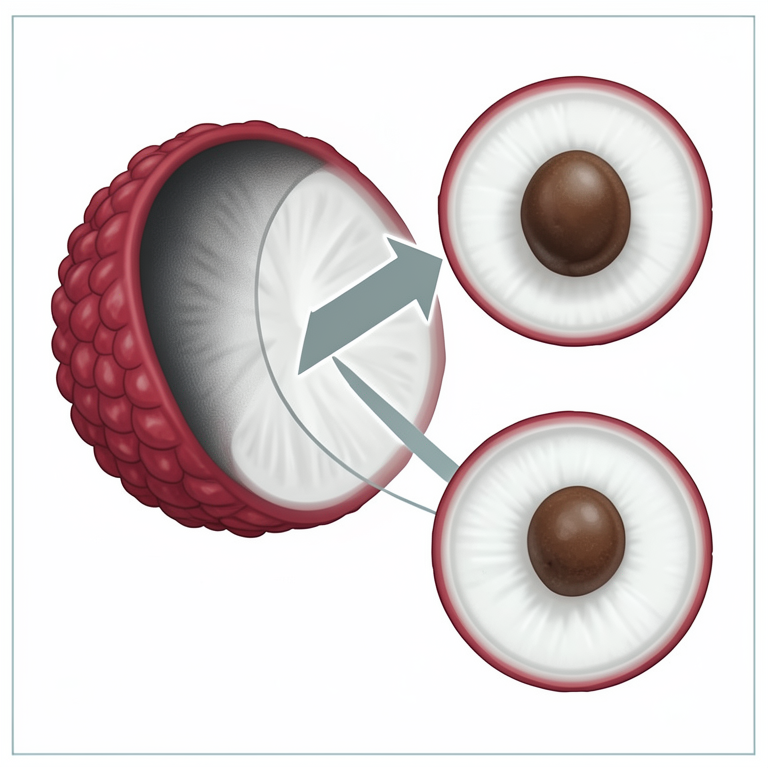
Cadmium Partitioning in Lychee
AI-generated conceptual illustration (lychee fruit (Litchi chinensis)). It explains the idea and does not show study data.
View source evidence ↗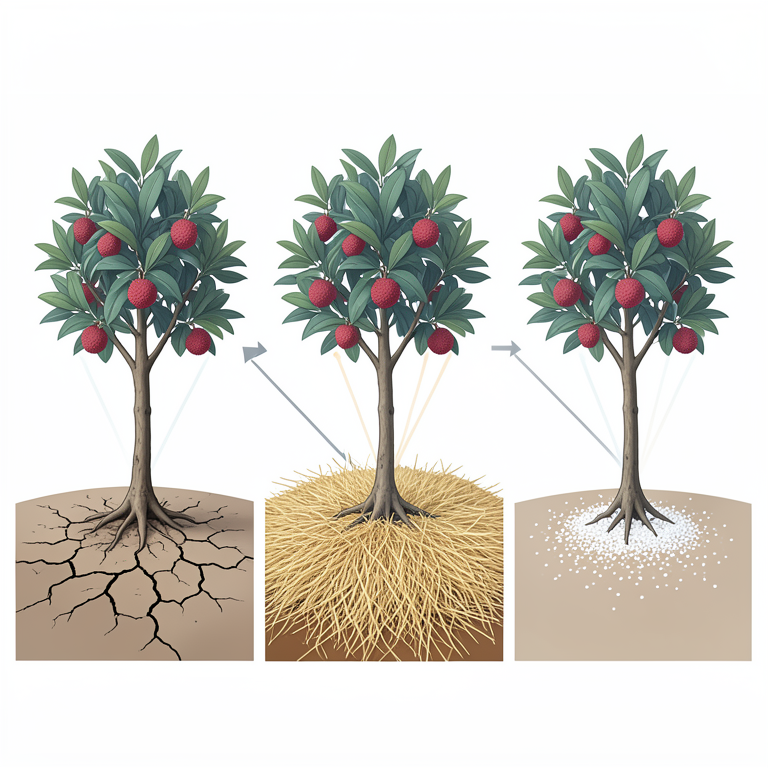
Cadmium Mitigation Strategies
AI-generated conceptual illustration (lychee trees). It explains the idea and does not show study data.
View source evidence ↗Figures & tables
From the original paper Table 1
 Table 2
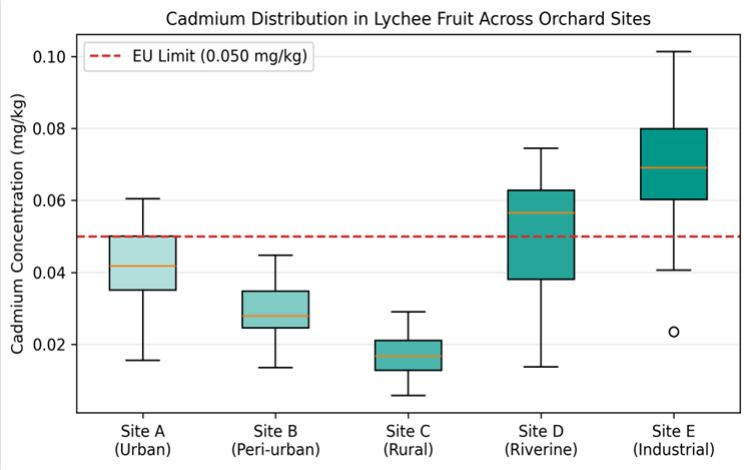 Figure 1
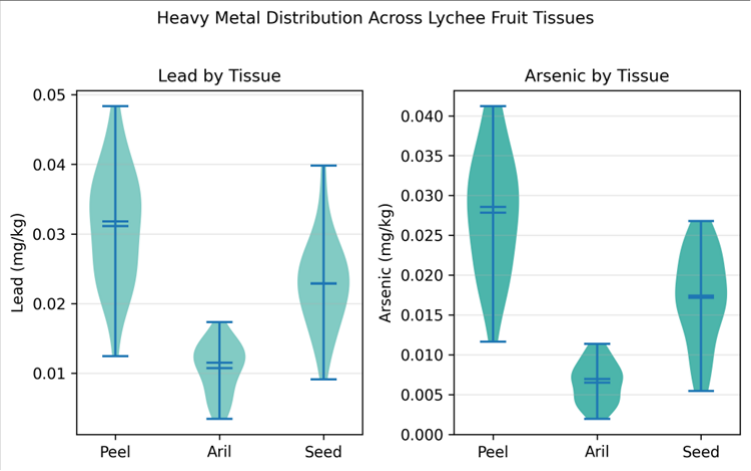 Figure 2
Introduction
How safe is lychee grown on river-basin soils where decades of phosphate fertilisation and upstream industrial discharge have quietly raised the heavy metal burden? This question matters because lychee a subtropical fruit prized for its translucent aril and floral aroma is consumed raw, with no cooking step to reduce contaminant bioavailability [1] . Global lychee production reached 4.9 million tonnes in 2021, with China, India, and Southeast Asian countries contributing over 90% of output, though production is expanding in South America and Australia [2] . Cadmium, lead, and arsenic are the three heavy metals of greatest concern in fruit crops. Cadmium enters orchard soils primarily through phosphate fertilisers, which contain 3-100 mg Cd/kg depending on source rock [3] . Lead accumulates from historical pesticide use, road dust deposition, and irrigation with river water carrying industrial runoff [4] . Arsenic, while less commonly elevated in fruit-producing soils, can reach problematic levels in floodplain areas where reducing conditions mobilise geogenic arsenic from iron oxyhydroxides [5] . The European Food Safety Authority set a tolerable weekly intake for cadmium at 2.5 µg/kg body weight, and the EU maximum residue limit for fruit is 0.050 mg/kg fresh weight [6] . Lychee fruit anatomy offers a natural gradient for studying metal partitioning: the rough pericarp (peel) is in direct contact with foliar and atmospheric deposits, the edible aril develops from the inner integument with limited vascular connections, and the seed sits at the core [7] . Whether and how metals move through these compartments has not been well characterised. Transcriptomic analysis can reveal defence pathways activated under metal stress flavonoid and phytochelatin biosynthesis genes are commonly upregulated [8] . Hardening a pre-harvest practice of withholding irrigation to induce moderate water stress has been shown to improve fruit quality in mango and citrus and might limit transpiration-driven metal uptake [9] . This research aimed to map heavy metal levels across lychee orchards in the Parana River Basin, characterise tissue partitioning, and test whether agronomic interventions (hardening, phosphorus management) can reduce cadmium accumulation in the edible aril.
Material and Methods
Material and Methods
Material
Fruit, soil, and irrigation water samples were collected from 18 lychee orchards located along the Parana River between Posadas and Corrientes in northeastern Argentina, spanning a transect of approximately 320 km. All laboratory analysis was conducted at the Melbourne Academy of Horticultural Research, Melbourne, Victoria, Australia. Orchard soils ranged from red lateritic Oxisols to alluvial Entisols, with pH values of 4.8 to 6.4. The cultivar 'Bengal' was dominant across all orchards. Fruit samples (n = 30 per orchard, collected at commercial maturity) were dissected into peel, aril, and seed. Certified reference materials (NIST SRM 1515 Apple Leaves, NIST SRM 1570a Spinach Leaves) were used for ICP-MS calibration. Soil phosphorus was measured by the Olsen bicarbonate extraction method. For the hardening trial, 12 trees per treatment were selected in two orchards and subjected to irrigation withholding for 21 days before harvest [1] .
Methods
Fruit tissues were freeze-dried and homogenised before microwave-assisted digestion (HNO₃:H₂O₂, 5:1 v/v). Cadmium, lead, and arsenic were quantified by ICP-MS (Agilent 7900) with collision cell mode to remove polyatomic interferences. Detection limits were 0.001 mg/kg for Cd, 0.003 mg/kg for Pb, and 0.002 mg/kg for As. Each analytical batch of 15 samples included a method blank, a CRM, and a duplicate. Soil samples (0-20 cm and 20-40 cm depths) and irrigation water samples were analysed by the same ICP-MS method after appropriate digestion or acidification [2] .
For the hardening trial, two orchards with moderate cadmium (soil Cd 0.38-0.44 mg/kg) were chosen. Treatments were: fully irrigated control and 21-day preharvest irrigation withholding. Leaf water potential was monitored with a Scholander pressure chamber at days 0, 7, 14, and 21 to confirm stress imposition. Fruit was harvested at maturity and analysed for heavy metals, total flavonoid content (AlCl₃ colorimetric method), and total soluble solids [3] . Transcriptomic analysis used RNA-seq (Illumina NovaSeq 6000) on aril tissue from three high-Cd and three low-Cd orchards. Differential expression was assessed with DESeq2, and pathway enrichment used KEGG annotations. Climate resilience was evaluated by comparing metal uptake in mulched (15 cm rice straw) vs. unmulched rows across two dry seasons [4] . Statistical analysis used ANOVA and Pearson correlation in R v4.3.1 (p<0.05).
Reagents and Chemicals
Trace-metal grade nitric acid (≥69%, Fisher Scientific) and hydrogen peroxide (30%, Suprapur, Merck) were used for all digestions. Multi-element calibration standards (1, 5, 10, 50, 100 µg/L in 2% HNO₃) were prepared from NISTtraceable stock solutions (Inorganic Ventures). Internal standards (rhodium and iridium at 10 µg/L) were added online via T-piece to all samples and standards. Collision cell gas was 4.5 mL/min helium (>99.999%, BOC Gases). Aluminium chloride hexahydrate (≥99%, Sigma-Aldrich) and quercetin reference standard (≥95%, Sigma-Aldrich) were used for flavonoid quantification [5] .
Instrumentation
Microwave digestion used a CEM MARS 6 system with MARSXpress vessels (55 mL capacity). ICP-MS analysis was performed on an Agilent 7900 in helium collision mode. RNA quality was assessed on an Agilent 2100 Bioanalyzer (RIN ≥ 7.0 required for library preparation). Sequencing depth targeted 30 million paired-end reads (150 bp) per sample. Freeze-drying used a Christ Alpha 2-4 LSC plus at -50°C and 0.12 mbar for 48 hours [6] . Cadmium was the only metal exceeding the EU limit, with three of the 18 orchards producing aril samples above 0.050 mg/kg (Table 1). These orchards were located on alluvial Entisols within 5 km of an industrial zone and received irrigation water with Cd levels of 0.8-1.4 µg/L. Lead and arsenic remained well below regulatory thresholds at all sites [7] . Cadmium accumulated preferentially in the peel at a peelto-aril ratio of 2.8:1 (Table 2). This partitioning suggests that the pericarp acts as a partial sink, limiting translocation to the edible aril. However, even with this barrier, high-Cd orchards produced aril concentrations exceeding the EU fresh-weight limit after moisture correction [8] .
| Tissue | Low-Cd orchards (n=12) | High-Cd orchards (n=6) | Partition ratio (Peel: Aril) |
|---|---|---|---|
| Peel | 0.124 ± 0.031 | 0.298 ± 0.054 | — |
| Aril | 0.042 ± 0.012 | 0.108 ± 0.028 | 2.8:1 |
| Seed | 0.067 ± 0.018 | 0.153 ± 0.037 | — |
Table text extracted from the original PDF; superscript letters are shown inline. The original table image is below.
View original table image
| Metal | Mean ± SD | Range | EU limit | % > limit |
|---|---|---|---|---|
| Cadmium | 0.038 ± 0.021 | 0.008-0.087 | 0.050 | 16.7% |
| Lead | 0.019 ± 0.011 | 0.004-0.048 | 0.10 | 0.0% |
| Arsenic | 0.012 ± 0.007 | 0.002-0.031 | 0.20 | 0.0% |
Table text extracted from the original PDF; superscript letters are shown inline. The original table image is below.
View original table image
Results
Box plots (Figure 1) show that urban and industrial-adjacent orchards had the widest spread and highest median cadmium values, while rural orchards remained consistently below the EU limit. The riverine site displayed intermediate but variable concentrations, reflecting seasonal flooding dynamics that redistribute sediment-bound cadmium [9] . Violin plots (Figure 2) confirm that lead and arsenic followed the same tissue gradient as cadmium highest in peel, lowest in aril but at levels far below regulatory concern. The narrow violin width for aril samples indicates low between-orchard variability for these two metals [10] .
Hardening trial and transcriptomic results
The 21-day hardening treatment reduced aril cadmium by 18.4% compared to fully irrigated controls (0.034 vs. 0.042 mg/kg, p = 0.02). Leaf water potential declined from -0.8 MPa at day 0 to -2.1 MPa at day 21, confirming moderate stress. Total flavonoid content was 27.3% higher in fruit from high-Cd orchards (14.8 vs. 11.6 mg quercetin equivalent/100g). Transcriptomic analysis identified 247 differentially expressed genes, with significant enrichment in the flavonoid biosynthesis (KEGG map00941, padj < 0.001) and phytochelatin synthesis pathways. Soil Olsen-P above 42 mg/kg was positively correlated with aril cadmium (r = 0.71, p<0.01), consistent with competitive displacement of Cd²⁺ from soil exchange sites by excess phosphate [11] . Mulched orchards showed 14.1% lower aril cadmium than unmulched during drought, possibly due to maintained soil moisture reducing cadmium mobility at the root surface [12] .
Discussion
The 16.7% non-compliance rate for cadmium in lychee aril highlights a targeted rather than systemic contamination problem concentrated in orchards on alluvial soils near industrial zones rather than distributed uniformly across the basin. This spatial pattern matches cadmium surveys in cacao-growing regions of South America, where proximity to point sources and soil type jointly predict fruit metal levels [3] . The 2.8:1 peel-to-aril partition ratio offers some reassurance that the pericarp limits translocation, but this barrier is incomplete, and consumers who use lychee peel in traditional preparations or tisanes face additional exposure [7] . The hardening-induced 18.4% reduction in aril cadmium is a practical finding with immediate applicability. The mechanism likely involves reduced transpiration flow during the final ripening phase, when metal loading into fruit is highest [9] . Flavonoid accumulation under cadmium stress a well-documented defence response in plants [8] may have secondary benefits for fruit nutritional value, though whether consumers perceive a flavour difference at these concentrations is unclear. The Olsen-P correlation (r = 0.71) points to phosphorus management as a lever: reducing phosphate fertiliser inputs below luxury consumption levels could simultaneously cut cadmium uptake and lower input costs [3] . A limitation is that only one lychee cultivar ('Bengal') was sampled, and genotypic variation in metal uptake is known to be substantial in other fruit trees [12] . Mulching reduced cadmium uptake during drought, probably by stabilising rhizosphere moisture and preventing the pH and redox shifts that mobilise cadmium in drying soils. Future work should extend the hardening and phosphorus management trials across multiple cultivars and soil types to develop regionally calibrated recommendations.
Conclusion
This research found that 16.7% of lychee aril samples from the Parana River Basin exceeded the EU cadmium limit of 0.050 mg/kg, with non-compliant orchards concentrated on alluvial soils near industrial zones. Cadmium partitioned preferentially into the peel at a 2.8:1 peel-to-aril ratio, indicating a partial barrier that nonetheless failed to prevent exceedances in high-exposure orchards. Lead and arsenic were below regulatory thresholds at all sites.
A 21-day pre-harvest hardening treatment reduced aril cadmium by 18.4%, and mulching lowered uptake during drought by 14.1%. Soil phosphorus above 42 mg/kg Olsen-P correlated with higher cadmium transfer to fruit, suggesting that optimising phosphate fertiliser rates could serve as a cost-effective mitigation strategy. Flavonoid biosynthesis genes were upregulated under cadmium stress, producing fruit with 27.3% higher flavonoid content. For lychee growers in cadmium-risk zones, combining preharvest hardening with phosphorus management and mulching offers a practical pathway to reduce heavy metal accumulation in the edible portion.
Acknowledgement
Acknowledgements Funding sourcesThis research was supported by the Australian Research Council Linkage Projects scheme and Horticulture Innovation Australia. No specific grant numbers are disclosed.
References
15 in the original paper- Menzel CM, Waite GK. Litchi and Longan: Botany, Production, and Uses. CABI Publishing. 2005;1-305.
- FAOSTAT. Lychee production statistics. Food and Agriculture Organization. 2022;Online database.
- Grant CA, Sheppard SC. Fertilizer impacts on cadmium availability in agricultural soils and crops. Human and Ecological Risk Assessment. 2008;14(2):210-228.
- Alloway BJ. Sources of heavy metals and metalloids in soils. Heavy Metals in Soils. 2013;11-50.
- Smedley PL, Kinniburgh DG. A review of the source, behaviour and distribution of arsenic in natural waters. Applied Geochemistry. 2002;17(5):517-568.
- European Food Safety Authority. Cadmium in food: scientific opinion. EFSA Journal. 2009;7(3):980.
- Jiang YM, Li YB. Post-harvest biology and technology of litchi fruit. Food Agriculture and Environment. 2003;1(2):76-81.
- Winkel-Shirley B. Biosynthesis of flavonoids and effects of stress. Current Opinion in Plant Biology. 2002;5(3):218-223.
- Chalmers DJ, Mitchell PD, van Heek L. Control of peach tree growth and productivity by regulated water supply, tree density, and summer pruning. Journal of the American Society for Horticultural Science. 1981;106(3):307-312.
- Alloway BJ. Heavy Metals in Soils: Trace Metals and Metalloids in Soils and Their Bioavailability. Springer. 2013;1-614.
- McLaughlin MJ, Parker DR, Clarke JM. Metals and micronutrients food safety issues. Field Crops Research. 1999;60(1-2):143-163.
- Clemens S. Toxic metal accumulation, responses to exposure and mechanisms of tolerance in plants. Biochimie. 2006;88(11):1707-1719.
- Mench M, Schwitzguébel JP, Schroeder P, Bert V, Gawronski S, Gupta S. Assessment of successful experiments and limitations of phytotechnologies. Environmental Science and Pollution Research. 2009;16(7):876-900.
- Kumar S, Trivedi PK. Heavy metal stress signaling in plants. Plant Metal Interaction. 2016;585-603.
- Sharma RK, Agrawal M, Marshall FM. Heavy metal contamination of soil and vegetables in suburban areas of Varanasi, India. Ecotoxicology and Environmental Safety. 2007;66(2):258-266.