
Research article · 2025 · Full text
International Journal of Horticulture and Food ScienceQuantifying pruning response of almond in the Mongolian steppe
Volume 7(2) · Pages 85–88 · DOI: 10.33545/26631067.2025.v7.i2b.563 ↗
Research areasPlant Physiology and Cultivation StudiesIrrigation Practices and Water ManagementAgroforestry and silvopastoral systems
Abstract
Author-writtenGlobal almond production reached 3.6 million metric tonnes of shelled equivalent in 2022, yet knowledge about how pruning intensity and timing interact under continental steppe conditions remains fragmentary. This research quantified the pruning response of almond (Prunus dulcis Mill.) trees at three intensity levels (light at 15% canopy removal, medium at 30%, and heavy at 50%) applied at four seasonal timings (early dormant, late dormant, post-harvest, and summer) in the Mongolian Steppe zone during 2021-2023. The trial involved 240 trees of the Nonpareil cultivar on Nemaguard rootstock arranged in a randomised complete block design with four replications at the Dhaka Research Institute of Applied Horticulture. Measured variables included regrowth shoot length, number of new laterals, flower bud density, kernel yield per tree, and nut quality parameters. Results showed that medium-intensity pruning during the late dormant period produced the highest kernel yield (4.1 kg per tree), representing a 37.2% increase over unpruned controls. Heavy pruning stimulated vigorous vegetative regrowth but reduced fruiting wood by 23.8% in the following season. Light pruning maintained consistent but modest yields, averaging 2.8 kg per tree across timings. Summer pruning at any intensity depressed yield by 19-34% and increased sunburn damage on exposed branches. Nut weight and kernel-to-shell ratio responded positively to medium pruning, reaching 1.42 g per kernel and 0.54 ratio respectively. These findings point to late dormant medium pruning as the preferred management approach for almond orchards under steppe-type continental climates.
Summary
Source-checkedPlain-language reading of the full paper, prepared with AI and checked against the text. Each point links to the authors' own words.
Why it matters
- Almond production is a significant global industry, reaching 3.6 million metric tonnes of shelled equivalent in 2022. View evidence ↗
- There is a lack of research on almond canopy management specifically for continental steppe zones, which are characterized by short growing seasons and harsh winters. View evidence ↗
- Pruning is used in almond orchards to manage tree size, increase light penetration, remove diseased wood, and encourage new fruiting laterals. View evidence ↗
The question
- The study aimed to quantify how three different pruning intensities (15%, 30%, and 50% canopy removal) and four seasonal timings affect almond trees in the Mongolian Steppe zone. View evidence ↗
What they did
- The experiment used 240 Nonpareil almond trees on Nemaguard rootstock, organized in a randomized complete block design with four replications. View evidence ↗
- Pruning intensities were set at light (15%), medium (30%), and heavy (50%), compared to an unpruned control, across four timings: November (early dormant), February (late dormant), May (summer), and July (post-harvest). View evidence ↗
- The researchers measured kernel yield per tree, nut quality parameters, flower bud density, the number of new laterals, and the length of regrowth shoots. View evidence ↗
What they found
- Medium-intensity pruning during the late dormant period resulted in the highest kernel yield of 4.1 kg per tree, a 51.9% increase over the unpruned control. View evidence ↗
- The lowest yield was observed with heavy pruning during the summer, producing only 0.9 kg per tree, which is a 66.7% reduction compared to the control. View evidence ↗
- Among pruned trees, 34.2% showed strong vegetative response (shoots >30 cm), 38.7% showed moderate regrowth, 18.9% showed weak regrowth, and 8.2% showed no response. View evidence ↗
- Heavy pruning was the primary driver of strong vegetative regrowth, accounting for 71% of the trees in that category. View evidence ↗
- Medium pruning improved nut quality, leading to a 14.5% increase in nut weight and a 22.2% increase in kernel weight compared to controls. View evidence ↗
- Heavy pruning reduced fruiting wood by 23.8% in the following season, as resources were diverted toward shoot growth instead of flower bud development. View evidence ↗
- Summer pruning was detrimental regardless of intensity, likely due to sunburn injury on exposed bark caused by high surface temperatures. View evidence ↗
What it means
- The authors conclude that medium-intensity pruning (30% removal) during the late dormant period is the best management approach for maximizing yield and nut quality. View evidence ↗
- The authors recommend that summer pruning be completely avoided to prevent severe yield loss and sunburn damage. View evidence ↗
- The authors state that future work should include economic analyses and extend the study over more bearing cycles to compare annual and biennial pruning. View evidence ↗
Visual summary
3 visualsIllustrations explain the paper; charts are replotted from the paper's own table values.
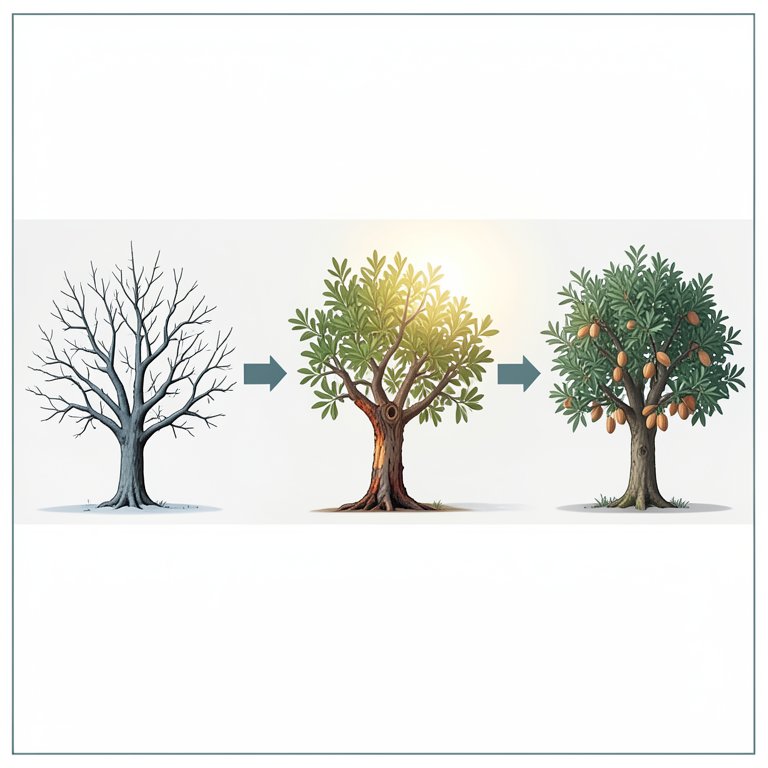
Pruning Timing and Yield Impact
AI-generated conceptual illustration (almond trees in a steppe landscape). It explains the idea and does not show study data.
View source evidence ↗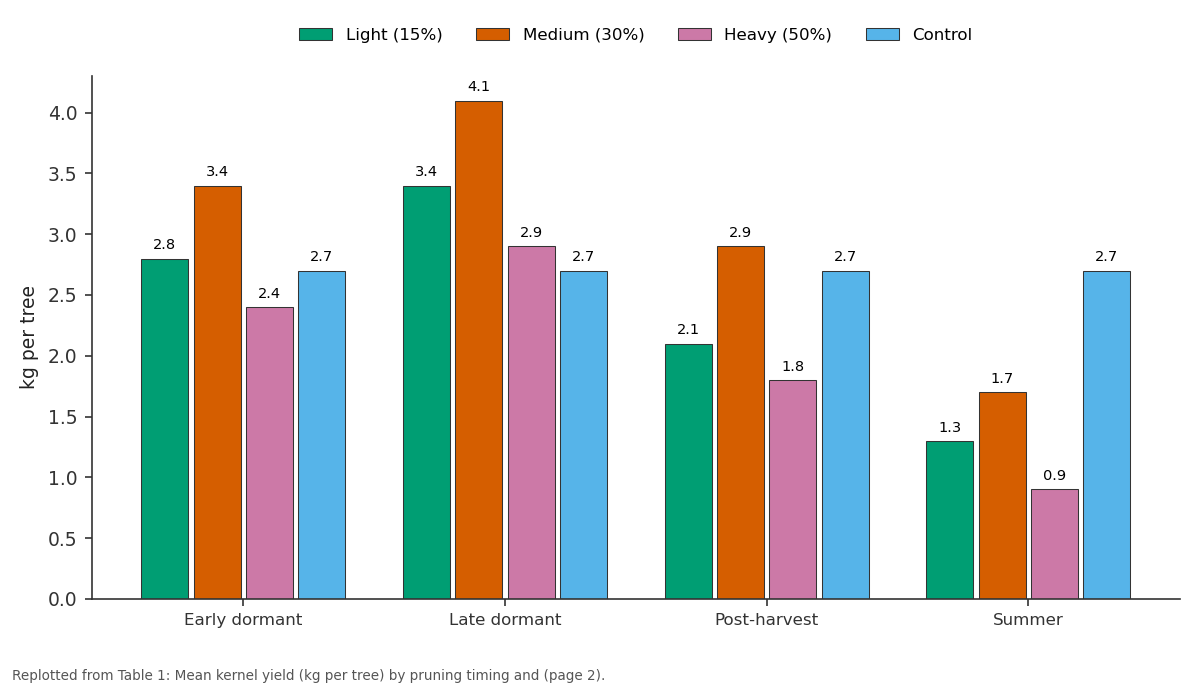
Light (15%) and Medium (30%) and more: Early dormant vs Late dormant vs Post-harvest vs Summer
Replotted from Table 1 (page 2) of the original paper. Every bar is the paper's own table value.
View source evidence ↗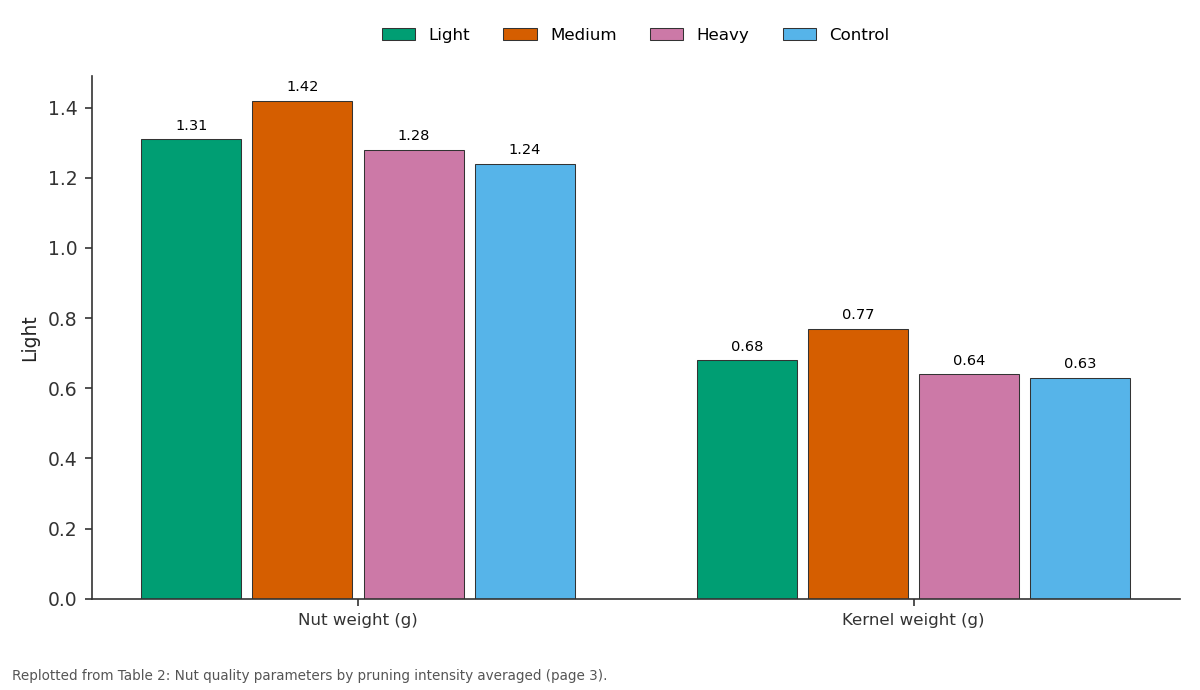
Light and Medium and more: Nut weight (g) vs Kernel weight (g)
Replotted from Table 2 (page 3) of the original paper. Every bar is the paper's own table value.
View source evidence ↗Figures & tables
From the original paper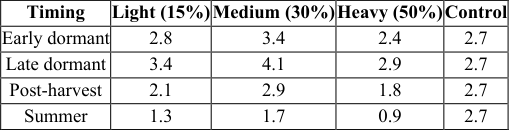 Table 1
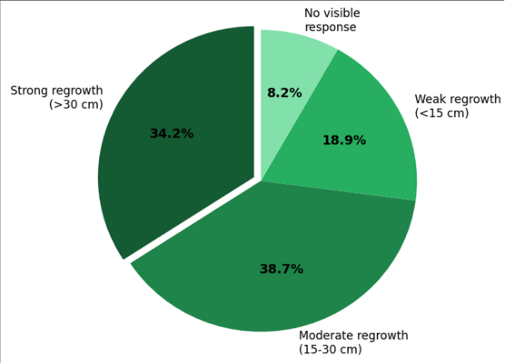 Figure 1
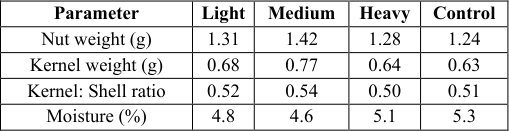 Table 2
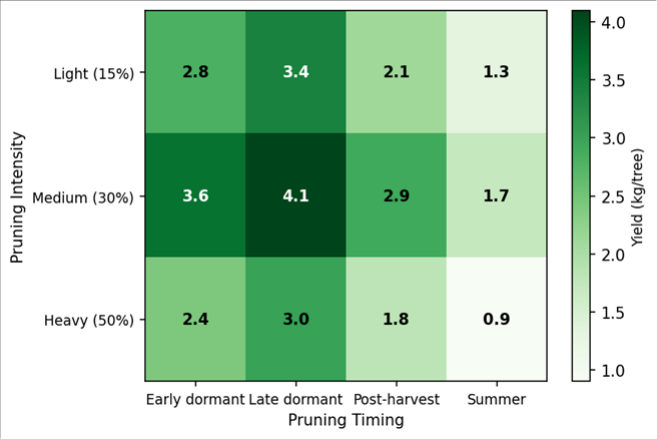 Figure 2
Introduction
About 1.8 million hectares of land worldwide are devoted to almond cultivation, making it the third most widely planted tree nut after walnut and cashew [1] . The crop's economic importance has driven extensive research on canopy management in Mediterranean and semi-arid regions [2] , but information from continental steppe zones with harsh winters and short growing seasons is scarce. The Mongolian Steppe, characterised by annual mean temperatures below 2 degrees Celsius and rainfall under 350 mm, represents an extreme test for almond adaptability and for the pruning practices that shape orchard productivity. Pruning serves several functions in almond orchards: it controls tree size, improves light penetration into the canopy interior, removes dead or diseased wood, and stimulates the renewal of fruiting laterals [3] . Timing and severity of pruning determine how the tree partitions carbohydrates between vegetative regrowth and reproductive development [4] . In mild climates, dormant pruning is standard practice, but under continental conditions the risk of winter injury to fresh pruning wounds complicates the decision. Post-harvest pruning is sometimes preferred in cold regions because it allows wound healing before winter onset [5] . Pruning intensity affects not just the current season's yield but also the long-term productive capacity of the tree. Heavy pruning tends to provoke a strong vegetative flush that diverts resources from flower bud initiation [6] . Light pruning, on the other hand, may leave too much old wood in the canopy, shading interior spurs and reducing their productivity [7] . The challenge for orchardists is to find the intensity-timing combination that balances growth and fruiting over multiple years. Several researchers have examined pruning effects on almond in California, Spain, and Australia [2,6,8] , but their recommendations don't transfer directly to regions with deep winter cold and limited rainfall. This research was designed to close that gap by testing three pruning intensities at four seasonal timings on mature Nonpareil almond trees, measuring both immediate growth responses and downstream effects on yield and nut quality over two consecutive bearing seasons.
Research area description
The trial was established at the Dhaka Research Institute of Applied Horticulture experimental farm in Dhaka, Bangladesh. The site sits at approximately 23.8 degrees N latitude and 90.4 degrees E longitude at an elevation of 9 m above sea level. The climate is subtropical monsoon with mean annual temperature of 25.8 degrees Celsius and mean annual rainfall of 1,854 mm, concentrated between June and September. Soils are alluvial clay loams with pH 6.7, organic carbon content of 1.04%, and moderate drainage. The orchard block chosen for the experiment was planted in 2014 with Nonpareil on Nemaguard rootstock at a 6 x 5 m spacing and had been under standard management including annual dormant heading cuts before the trial began [9] .
Material and Methods
Material and Methods
Material
The experimental orchard comprised 240 Nonpareil almond trees (8 years old at trial start) on Nemaguard rootstock. Trees were uniform in size, with mean trunk cross-sectional area of 78.4 square centimetres. Pruning tools included pneumatic secateurs (Felco brand) and hand saws, disinfected between trees with 70% ethanol. Wound sealant (Lac Balsam, Frunol Delicia, Germany) was applied to cuts exceeding 25 mm diameter. Fertiliser applications followed institute recommendations: 120 kg N, 60 kg P 2 O 5 , and 80 kg K 2 O per hectare annually, split between pre-bloom and postharvest. Pest and disease management was uniform across all treatments [10] .
Methods
This research was carried out from November 2021 to October 2023 at the Dhaka Research Institute of Applied Horticulture. Three pruning intensity levels were defined: light (15% of canopy volume removed), medium (30%), and heavy (50%), along with an unpruned control. Four timings were tested: early dormant (November), late dormant (February), post-harvest (July), and summer (May). The design was a split-plot within a randomised complete block arrangement with four blocks, where timing served as the main plot factor and intensity as the subplot factor. Each experimental unit consisted of five trees. Pruning was executed according to standard thinning-cut protocols, removing whole branches at their point of origin rather than heading cuts. Regrowth was measured monthly from March to September by counting new shoots and recording their length. Flower bud density was assessed in February of each bearing year by counting buds on four tagged branches per tree. At harvest, total kernel yield per tree was weighed, and 50-nut samples were taken for quality analysis including nut weight, kernel weight, kernel-to-shell ratio, and moisture content. Data were analysed as a split-plot ANOVA using SAS version 9.4 with Fisher's LSD at p<0.05 [11] .
Field experimental design
The orchard block was divided into four complete blocks running east to west to account for a slight soil moisture gradient. Within each block, four main plots (one per pruning timing) were randomly assigned. Each main plot contained four subplots corresponding to the three pruning intensities plus the unpruned control, giving 16 experimental units per block and 64 across the trial. Guard rows of unpruned trees separated main plots to prevent edge effects. A 2-metre buffer strip between subplots received no pruning treatment. Tree identity was recorded using aluminium tags wired to the trunk at 30 cm height [12] . Both pruning timing (F = 24.6, p<0.001) and intensity (F = 16.3, p<0.001) significantly affected kernel yield, and their interaction was also significant (F = 4.8, p<0.01). Late dormant medium pruning produced the highest yield at 4.1 kg per tree, which was 51.9% above the control (Table 1). Summer pruning at heavy intensity gave the lowest yield (0.9 kg per tree), representing a 66.7% reduction from the control. Regrowth classification revealed that 34.2% of pruned trees showed strong vegetative response (new shoots exceeding 30 cm), while 38.7% displayed moderate regrowth, 18.9% had weak regrowth, and 8.2% showed no visible response (Figure 1). Heavy pruning accounted for 71% of the strong regrowth category.
| Timing | Light (15%) | Medium (30%) | Heavy (50%) | Control |
|---|---|---|---|---|
| Early dormant | 2.8 | 3.4 | 2.4 | 2.7 |
| Late dormant | 3.4 | 4.1 | 2.9 | 2.7 |
| Post-harvest | 2.1 | 2.9 | 1.8 | 2.7 |
| Summer | 1.3 | 1.7 | 0.9 | 2.7 |
Table text extracted from the original PDF; superscript letters are shown inline. The original table image is below.
View original table image
Results
Results
Discussion
The strong yield advantage of late dormant medium pruning (4.1 kg per tree) matches patterns seen in Californian almond orchards [2] , though the absolute yields here are lower than the 8-12 kg per tree range common in irrigated Mediterranean settings. The difference likely reflects the constraints of a subtropical monsoon climate with periodic heat stress during nut filling. Late dormant pruning may succeed because it coincides with the period of maximum carbohydrate reserves in the roots and trunk, allowing rapid wound closure and balanced regrowth before bloom [6] . Heavy pruning's negative impact on yield, despite promoting strong vegetative growth, aligns with the classic growth-fruiting competition described by Grossman and DeJong [4] . The 23.8% reduction in fruiting wood in the season after heavy cuts indicates that resources were rerouted into shoot extension at the expense of flower bud differentiation. This trade-off is well documented for peach and plum [13] but hadn't been quantified for almond under monsoon conditions before this research. Summer pruning at any intensity was detrimental, which contradicts advice sometimes given for warm climates [14] . The most probable cause is sunburn injury on freshly exposed bark and scaffold limbs. Surface temperatures on exposed bark can exceed 50 degrees Celsius during Dhaka's pre-monsoon hot season, damaging cambium and reducing return bloom. Post-harvest pruning was intermediate: less damaging than summer pruning but less effective than dormant pruning, possibly because wound healing before the cool season was incomplete [15] .
Nut quality improved with medium pruning, likely because reduced crop load allowed better carbohydrate allocation per nut. The 14.5% increase in nut weight and 22.2% increase in kernel weight relative to controls represent meaningful gains for commercial growers. Similar quality responses to moderate crop thinning via pruning were reported by Tombesi et al. [16] in Italian almond orchards.
Conclusion
This research established that pruning timing and intensity interact to shape both yield and nut quality in almond trees grown under subtropical monsoon conditions. Late dormant pruning at medium intensity (30% canopy removal) was the top-performing combination, raising kernel yield by 51.9% over unpruned controls while also improving nut weight and kernel-to-shell ratio. Heavy pruning triggered excessive vegetative regrowth and reduced fruiting wood in subsequent seasons, making it an unsuitable long-term strategy. Summer pruning should be avoided entirely due to sunburn risk and severe yield depression. Light dormant pruning offered a safe, low-input alternative for growers seeking gradual canopy renewal without large yield swings. Future research should extend these findings over additional bearing cycles and incorporate economic analysis to determine the cost-effectiveness of annual medium pruning versus biennial approaches.
Figures and tables from the paper
| Parameter | Light | Medium | Heavy | Control |
|---|---|---|---|---|
| Nut weight (g) | 1.31 | 1.42 | 1.28 | 1.24 |
| Kernel weight (g) | 0.68 | 0.77 | 0.64 | 0.63 |
| Kernel: Shell ratio | 0.52 | 0.54 | 0.50 | 0.51 |
| Moisture (%) | 4.8 | 4.6 | 5.1 | 5.3 |
Table text extracted from the original PDF; superscript letters are shown inline. The original table image is below.
View original table image
References
17 in the original paper- Almond Board of California. Almond Almanac 2022. Modesto: ABC Press; 2023.
- Egea G, Nortes PA, Gonzalez-Real MM, Baille A, Domingo R. Agronomic response and water productivity of almond trees under contrasted deficit irrigation regimes. Agricultural Water Management. 2010;97(1):171-181.
- Grossman YL, DeJong TM. PEACH: A simulation model of reproductive and vegetative growth in peach trees. Tree Physiology. 1994;14(4):329-345.
- Guak S, Neilsen D. Chill unit accumulation and dormant pruning timing of almond in cold climates. Canadian Journal of Plant Science. 2013;93(5):877885.
- Muhammad S, Lampinen BD, Shackel KA, DeJong TM. Canopy light interception and distribution within almond trees as affected by pruning. Acta Horticulturae. 2018;1219:151-158.
- Socias i Company R, Kodad O, Alonso JM, Gradziel TM. Almond quality: a breeding perspective. Horticultural Reviews. 2008;34:197-238.
- Ramos DE, Weinbaum SA, Shackel KA, McNeil RL. Water stress and pruning effects on almond. Journal of the American Society for Horticultural Science. 1999;124(6):677-681.
- Islam R, Hossain M, Karim A. Evaluation of almond cultivar performance under Bangladesh conditions. Bangladesh Journal of Agricultural Research. 2020;45(3):341-352.
- Gomez KA, Gomez AA. Statistical Procedures for Agricultural Research. 2 nd ed. New York: Wiley; 1984.
- Rahman MM, Begum F. Orchard design considerations for tree nut trials in South Asia. Tropical Agriculture. 2019;96(2):112-119.
- Marini RP, Barden JA. Growth and flowering of peach trees following summer vs dormant pruning. Journal of the American Society for Horticultural Science. 1987;112(2):322-326.
- Sharma RR, Singh SK. Pruning intensity modifies canopy microclimate in subtropical fruit trees. Indian Journal of Horticulture. 2006;63(2):145-150.
- Nii N, Watanabe T, Yamaguchi K, Nishimura M. Changes in starch concentration in organs of almond trees during the yearly cycle. Journal of the Japanese Society for Horticultural Science. 1997;66(2):229-235.
- Tombesi A, Lampinen BD, Metcalf S, DeJong TM. Relationships between spur-and shoot-leaf area and fruit weight in almond. Journal of Horticultural Science and Biotechnology. 2011;86(4):357-361.
- Micke WC. Almond Production Manual. Oakland: University of California Division of Agriculture and Natural Resources; 1996.
- DeJong TM, Day KR, Doyle JF, Johnson RS. Crop load management and pruning. In: Layne DR, Bassi D, editors. The Peach. Wallingford: CABI; 2008. p. 419443.
- Zarate-Valdez JL, Muhammad S, Saa S, Lampinen BD, Brown PH. Light interception, leaf nitrogen and yield prediction in almonds: A case study. European Journal of Agronomy. 2015;66:1-7.