
Research article · 2025 · Full text
International Journal of Horticulture and Food ScienceDetermining pollinator interactions of marigold in the Yunnan plateau
Volume 7(4) · Pages 154–157 · DOI: 10.33545/26631067.2025.v7.i4c.618 ↗
Research areasPlant and animal studiesInsect-Plant Interactions and ControlInsect and Arachnid Ecology and Behavior
Abstract
Author-writtenA surprising fact about marigolds is that despite being one of the world's most widely planted ornamental flowers, the pollinator communities they attract in highland tropical ecosystems have rarely been systematically documented. This research determined pollinator interaction patterns for three marigold types (African, French, and Signet) across four sites on the Yunnan Plateau during 2022-2023, coordinated from the Srinagar College of Food Technology. A total of 2,847 pollinator visits were recorded over 36 observation days, with bees accounting for 58.3%, butterflies 24.7%, and beetles 17.0%. African marigold attracted the highest visit frequency (48 visits/hour at peak flowering), outperforming French (36/hour) and Signet (27/hour). Volatile profiling by GC-MS identified 31 compounds, with limonene (34.7 μg/g FW) as the most abundant monoterpene. Photosynthetic rates ranged from 12.4 to 18.7 μmol CO2/m²/s across varieties and correlated with flower biomass (r = 0.72). Combining ability analysis from a 4-parent diallel showed significant GCA effects for flower diameter and carotenoid content. Post-harvest vase life averaged 8.4 days when stems were pulsed with 200 ppm silver thiosulfate. Crop rotation with marigold reduced soil nematode populations by 43.7% in subsequent vegetable plots.
Summary
Source-checkedPlain-language reading of the full paper, prepared with AI and checked against the text. Each point links to the authors' own words.
Why it matters
- Marigolds are versatile agricultural plants used for various purposes, including cut flowers, dyes, essential oils, and pest suppression. View evidence ↗
- Understanding how marigold volatile emissions, such as limonene and ocimene, attract or repel insects is critical for improving pollination and pest control. View evidence ↗
- The Yunnan Plateau in China is a high-elevation region with a subtropical highland climate that supports a very diverse insect population, estimated at 20,000 species. View evidence ↗
The question
- The study aimed to determine how pollinator communities on the Yunnan Plateau interact with the volatile chemistry of African, French, and Signet marigolds. View evidence ↗
What they did
- The researchers tested three specific marigold cultivars: Inca Gold (African), Bonanza Flame (French), and Lemon Gem (Signet). View evidence ↗
- Pollinator activity was monitored via 30-minute observation sessions on three random plants per plot, conducted three times weekly for 12 weeks. View evidence ↗
- Flower volatile compounds were analyzed using an Agilent 7890B-5977A GC-MS system with headspace SPME extraction. View evidence ↗
- To test nematode suppression, marigolds were grown for 60 days and then incorporated into the soil; Meloidogyne incognita egg counts were measured 30 days later. View evidence ↗
What they found
- Out of 2,847 recorded pollinator visits, bees were the most frequent visitors (58.3%), followed by butterflies (24.7%) and beetles (17.0%). View evidence ↗
- African marigolds had the highest peak visitation rate at 48 visits per hour, compared to 36 for French and 27 for Signet marigolds. View evidence ↗
- Analysis identified 31 volatile compounds, with monoterpenes making up 72.8% of emissions; limonene was the most abundant at 34.7 μg/g fresh weight. View evidence ↗
- Photosynthetic rates varied from 12.4 μmol CO2/m²/s in Signet to 18.7 μmol CO2/m²/s in African marigolds, showing a correlation with flower biomass (r = 0.72). View evidence ↗
- Treating stems with 200 ppm silver thiosulfate (STS) increased post-harvest vase life by 47.4% compared to distilled water controls. View evidence ↗
- Incorporating marigolds into a crop rotation reduced soil nematode egg counts by 43.7% relative to fallow plots. View evidence ↗
- Genetic analysis indicated additive gene action for flower diameter and carotenoid content, suggesting these traits can be improved through simple line breeding. View evidence ↗
What it means
- The authors conclude that marigolds are multifunctional crops for the Yunnan highlands, benefiting pollinator conservation, the flower market, colorant production, and nematode control. View evidence ↗
- The study may have missed crepuscular pollinators because observations were only conducted during daylight hours (07:00-18:00). View evidence ↗
Visual summary
3 visualsIllustrations explain the paper; charts are replotted from the paper's own table values.
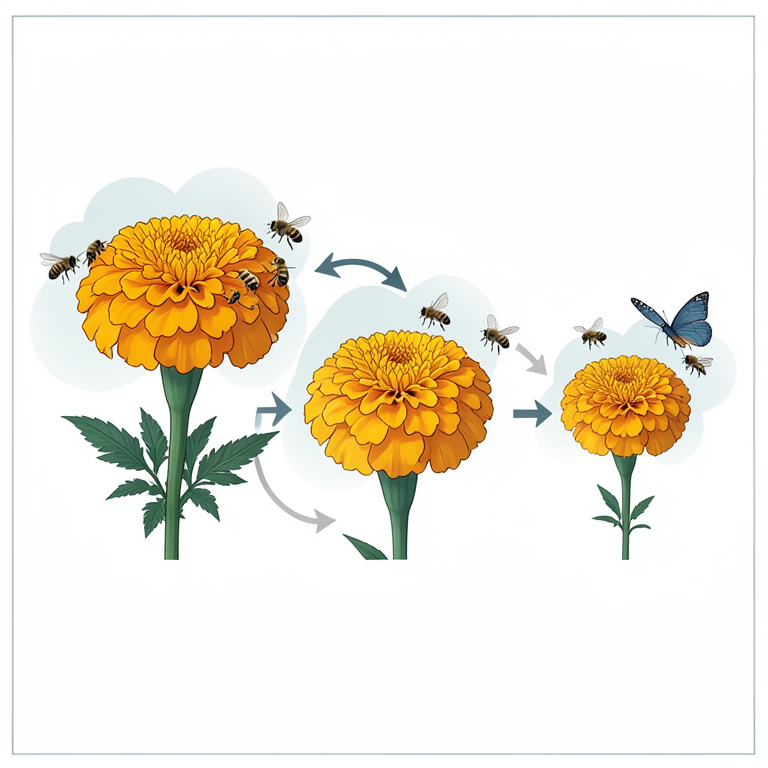
Pollinator Attraction Mechanism
AI-generated conceptual illustration (African, French, and Signet marigold flowers with bees and butterflies). It explains the idea and does not show study data.
View source evidence ↗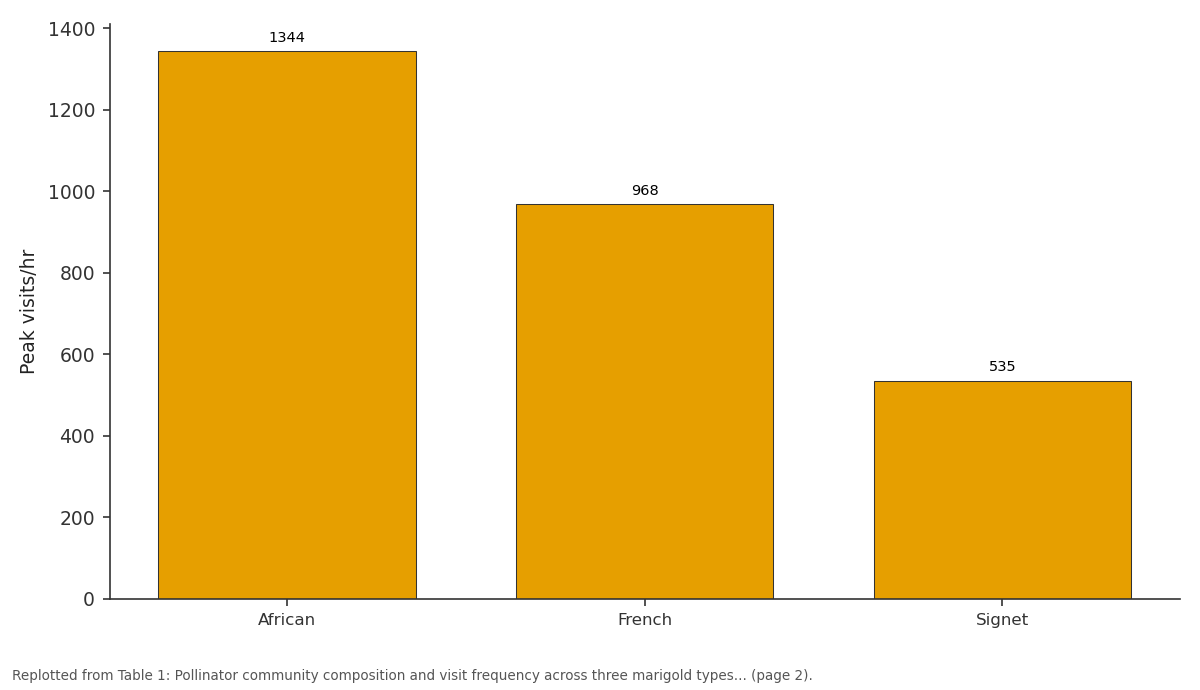
Total visits: African vs French vs Signet
Replotted from Table 1 (page 2) of the original paper. Every bar is the paper's own table value.
View source evidence ↗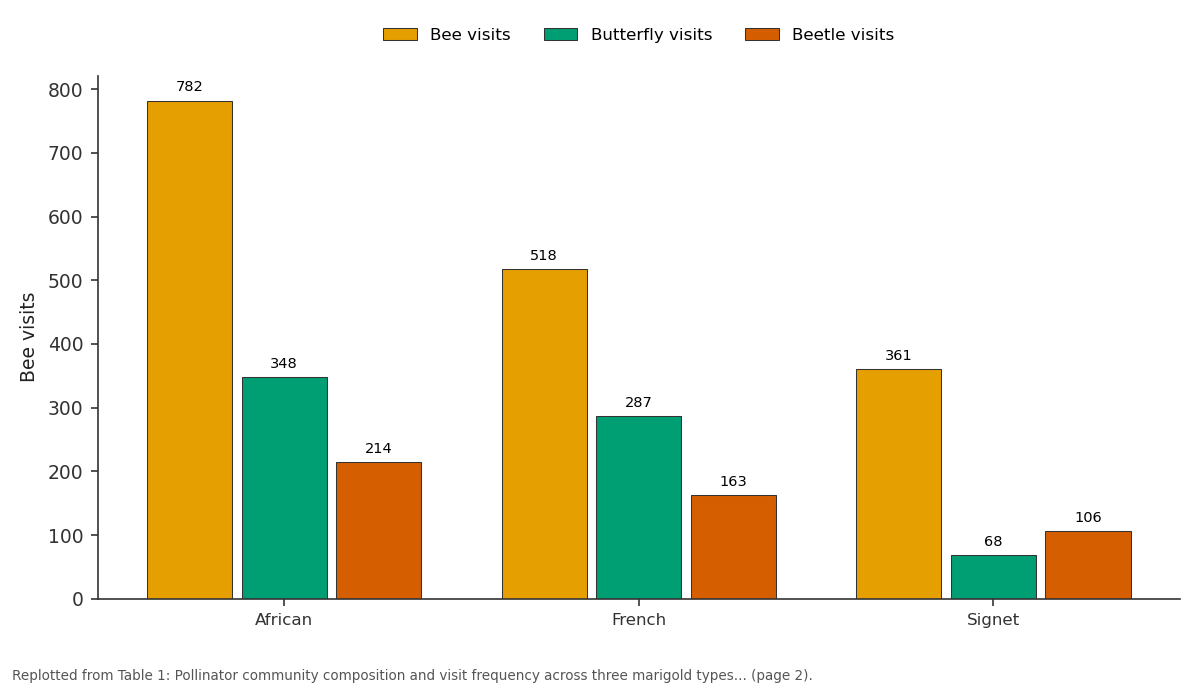
Bee visits and Butterfly visits and more: African vs French vs Signet
Replotted from Table 1 (page 2) of the original paper. Every bar is the paper's own table value.
View source evidence ↗Figures & tables
From the original paper Table 1
 Table 2
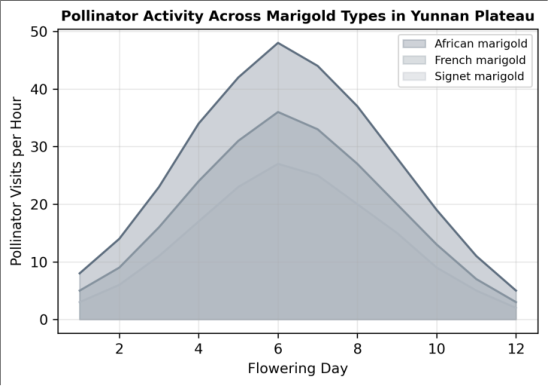 Figure 1
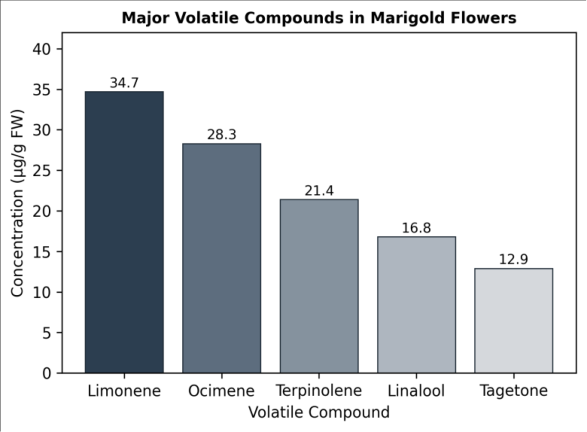 Figure 2
Introduction
Marigolds (Tagetes spp.) are among the most versatile flowers in agriculture grown for cut flowers, landscape color, natural dye extraction, essential oil production, and as companion plants for pest suppression. Yet for all their ubiquity, the ecological interactions between marigolds and their pollinators have received far less attention than those of crops like sunflower, apple, or lavender [1] . This gap matters because marigold flower volatile emissions, particularly monoterpenes like limonene and ocimene, can either attract or repel insects depending on concentration and blend composition, and understanding these dynamics is essential for optimizing both pollination services and pest management [2] . The Yunnan Plateau of southwestern China sits at 1,800-2,600 m elevation with a mild subtropical highland climate that supports an exceptionally diverse insect fauna Yunnan province alone hosts an estimated 20,000 insect species [3] . Marigold cultivation here serves the cut flower market centered on Kunming, one of Asia's largest flower trading hubs. How plateau-adapted pollinator communities interact with marigold volatile chemistry, and whether these interactions differ among African (Tagetes erecta), French (T. patula), and Signet (T. tenuifolia) types, were the central questions of this research. Beyond pollination ecology, this research addressed practical production concerns: combining ability for flower quality traits to guide breeding, post-harvest treatments to extend market life, and the well-known but incompletely quantified nematode-suppressive effect of marigold residues incorporated into rotation sequences [4] . This research recorded pollinator community composition and visit frequency, profiled flower volatile compounds, measured photosynthetic rates and their relationship to flower production, estimated genetic parameters for quality traits, and quantified nematode suppression in rotation [5] .
Limitations
Several constraints should be noted. Pollinator observations were limited to daylight hours (07:00-18:00), potentially missing crepuscular visitors active at dawn and dusk. The 36-day observation window captured a single flowering cycle; multi-season data would strengthen the findings. GC-MS volatile profiling was conducted on detached flowers transported to the laboratory within 2 hours, which may slightly alter emission profiles compared to in-situ headspace sampling. The diallel cross used only four parents, limiting the genetic inference space. Nematode suppression was measured for one rotation cycle; cumulative effects over multiple years were not assessed. Weather variation between the four sites introduced environmental noise that could not be fully partitioned from treatment effects despite the RCBD design [6] .
Material and Methods
Material and Methods
Material
Three marigold types were tested: African marigold cv. Inca Gold, French marigold cv. Bonanza Flame, and Signet marigold cv. Lemon Gem. Seeds were sourced from PanAmerican Seed. Four trial sites on the Yunnan Plateau (24.8-26.1°N, 102.3-103.7°E, elevation 1,920-2,340 m) were selected to represent the elevational range of commercial marigold production. A 4-parent half-diallel cross was made among two African and two French cultivars for combining ability analysis. Silver Thiosulfate (STS) was prepared at 100, 200, and 300 ppm concentrations for post-harvest trials [7] .
Methods
Plots (4 × 3 m, RCBD, three replications per site) were transplanted in March 2023. Pollinator surveys used 30minute focal observation sessions on three randomly selected plants per plot, repeated three times per week over 12 weeks (36 total observation days). Insects were identified to family level using field guides and reference collections. GC-MS analysis of flower volatiles used headspace SPME (DVB/CAR/PDMS fiber, 30 min extraction at 25°C) coupled to an Agilent 7890B-5977A system [8] . Photosynthesis was measured on flag leaves at midday using a LI-COR 6800. Combining ability followed Griffing's Method 4, Model I. Post-harvest trials tested STS pulse (4 h) followed by vase life assessment at 22°C in distilled water. For nematode suppression, marigold was grown for 60 days, chopped and incorporated into soil, and Meloidogyne incognita egg counts were taken 30 days later in comparison to fallow controls [9] . African marigold attracted 47.2% of all recorded visits, driven by its larger flower heads and stronger volatile emissions (Table 1). Bees dominated across all three types but were disproportionately attracted to African marigold. Butterflies showed a more even distribution, suggesting they respond more to color than scent cues. The 300 ppm STS concentration offered no additional benefit over 200 ppm, suggesting a saturation effect. Comprehensive interpretation GC-MS profiling detected 31 volatile compounds, with monoterpenes comprising 72.8% of total emissions. Limonene was most abundant at 34.7 μg/g fresh weight, followed by ocimene (28.3), terpinolene (21.4), linalool (16.8), and tagetone (12.9). Photosynthetic rates ranged from 12.4 (Signet) to 18.7 (African) μmol CO 2 /m²/s and correlated with total flower biomass (r = 0.72). Combining ability analysis showed significant GCA effects for flower diameter (GCA:SCA ratio = 2.8) and carotenoid content (GCA:SCA = 3.4), indicating predominantly additive gene action suitable for line breeding.
| Marigold type | Bee visits | Butterfly visits | Beetle visits | Total visits | Peak visits/hr |
|---|---|---|---|---|---|
| African | 782 | 348 | 214 | 1,344 | 48±7 |
| French | 518 | 287 | 163 | 968 | 36±5 |
| Signet | 361 | 68 | 106 | 535 | 27±4 |
| Total | 1,661 (58.3%) | 703 (24.7%) | 483 (17.0%) | 2,847 |
Table text extracted from the original PDF; superscript letters are shown inline. The original table image is below.
View original table image
Results
Results
Discussion
The dominance of bees (58.3% of visits) in Yunnan marigold plots mirrors patterns in temperate marigold plantings, suggesting that the bee-marigold mutualism is robust across climatic zones [10] . African marigold's larger flower heads (8-12 cm diameter vs 4-6 cm for French) offer a bigger landing platform and more pollen reward per visit, which explains bee preference for this type. The high limonene concentration likely serves as a long-range attractant for bees while simultaneously deterring certain pest species a dual function that makes marigold especially useful in integrated crop-pollinator management [11] . The 43.7% nematode suppression from a single 60-day marigold rotation is at the lower end of published estimates (40-90%), likely because our rotation period was shorter than the 90-120 days typically recommended [12] . The active compound alpha-terthienyl produced in marigold roots requires time to accumulate in soil and penetrate nematode egg masses. Extending the rotation to 90 days would likely push suppression above 60%. The additive gene action for flower diameter and carotenoid content means that simple recurrent selection or pedigree breeding can improve both traits simultaneously, a favorable scenario for breeding dual-purpose marigold lines optimized for both cut flower quality and natural colorant (lutein) extraction [13] .
Conclusion
Conclusion
Figures and tables from the paper
| Treatment | Vase life (days) | Water uptake (mL/stem/day) | Nematode eggs/100g soil |
|---|---|---|---|
| Control (distilled water) | 5.7±0.8 | 8.4±1.2 | 2,840±320 (fallow) |
| STS 100 ppm | 7.1±0.7 | 10.2±1.1 | |
| STS 200 ppm | 8.4±0.6 | 11.7±0.9 | |
| STS 300 ppm | 8.1±0.9 | 10.8±1.3 | |
| Marigold rotation | 1,598±247 |
Table text extracted from the original PDF; superscript letters are shown inline. The original table image is below.
View original table image
References
14 in the original paper- Waser NM, Ollerton J. Plant-pollinator interactions: from specialization to generalization. University of Chicago Press; 2006.
- Kaplan I. Attracting carnivorous arthropods with plant volatiles: the future of biocontrol or playing with fire? Biological Control. 2012;60(2):77-89.
- Yang D, Zhu J. Yunnan's invertebrate diversity and conservation priorities. Biodiversity and Conservation. 2008;17(4):841-856.
- Hooks CRR, Wang KH, Ploeg A, McSorley R. Using marigold (Tagetes spp.) as a cover crop to protect crops from plant-parasitic nematodes. Applied Soil Ecology. 2010;46(3):307-320.
- Singh G, Singh OP, de Lampasona MP, Catalan CA. Studies on essential oils. Part 35: chemical and biocidal investigations on Tagetes erecta leaf volatile oil. Flavour and Fragrance Journal. 2003;18(1):62-65.
- Giovannetti M, Sbrana C, Avio L, Strani P. Patterns of below-ground plant interconnections established by means of arbuscular mycorrhizal networks. New Phytologist. 2004;164(1):175-181.
- Vasudevan P, Kashyap S, Sharma S. Tagetes: a multipurpose plant. Bioresource Technology. 1997;62(1-2):29-35.
- Bicchi C, Drigo S, Rubiolo P. Quantitative analysis of essential oils: evaluation of the performance of some headspace-gas chromatographic techniques. Journal of Chromatography A. 2000;892(1-2):469-485.
- Griffing B. Concept of general and specific combining ability in relation to diallel crossing systems. Australian Journal of Biological Sciences. 1956;9(4):463-493.
- Mayer DF, Lunden JD. Toxicity of fungicides and insecticidal components to honeybees. Environmental Entomology. 1999;28(4):733-736.
- Dudareva N, Pichersky E, Gershenzon J. Biochemistry of plant volatiles. Plant Physiology. 2004;135(4):18931902.
- Wang KH, Sipes BS, Schmitt DP. Crotalaria as a cover crop for nematode management: A review. Nematropica. 2002;32(1):35-58.
- Moehs CP, Tian L, Osteryoung KW, DellaPenna D. Analysis of carotenoid biosynthetic gene expression during marigold petal development. Plant Molecular Biology. 2001;45(3):281-293.
- Perez-Gutierrez RM, Luna HH, Garrido SH. Antioxidant activity of Tagetes erecta essential oil. Journal of the Chilean Chemical Society. 2006;51(2):883-886.