
Research article · 2025 · Full text
International Journal of Horticulture and Food ScienceSurveying tissue culture protocols of broccoli in the New Zealand Canterbury plains
Volume 7(2) · Pages 145–148 · DOI: 10.33545/26631067.2025.v7.i2c.572 ↗
Research areasPlant tissue culture and regenerationPlant Growth and Agriculture TechniquesFlowering Plant Growth and Cultivation
Abstract
Author-writtenImagine trying to mass-produce genetically uniform broccoli plantlets for a commercial breeding programme using conventional seed propagation: the genetic segregation alone would take years to overcome. Tissue culture offers a shortcut, yet optimised protocols for Brassica oleracea var. italica remain scattered across the literature with inconsistent reporting of media composition, explant source, and growth regulator concentrations. This research surveyed and compared five culture media (full-strength MS, half-strength MS, WPM, B5, and SH) combined with varying concentrations of BAP and NAA for shoot regeneration from four explant types (hypocotyl, cotyledon, root tip, and leaf disc) of Marathon broccoli at the Abuja Academy of Horticultural Research, Nigeria, from January 2022 to June 2023. Full-strength MS medium supplemented with 1.5 mg/L BAP and 0.5 mg/L NAA achieved the highest regeneration rate at 82.4% from hypocotyl explants, producing a mean of 9.6 shoots per explant. WPM ranked second at 74.1%. Hypocotyl explants outperformed all other explant sources, contributing 41.3% of total regenerated plantlets. Rooting was best on half-strength MS with 0.5 mg/L IBA, achieving 91.7% root induction within 14 days. These findings provide a consolidated reference protocol for broccoli micropropagation applicable to breeding and commercial nursery programmes.
Summary
Source-checkedPlain-language reading of the full paper, prepared with AI and checked against the text. Each point links to the authors' own words.
Why it matters
- Broccoli is a high-value global crop cultivated on approximately 130,000 hectares and is valued for its anti-cancer properties and glucosinolate content. View evidence ↗
- Traditional seed propagation is unsuitable for producing genetically identical plantlets due to genetic variation, and cutting propagation is impractical for brassicas. View evidence ↗
- Existing literature on broccoli tissue culture is inconsistent regarding the best media, growth regulators, and explant types to use. View evidence ↗
The question
- The study aimed to identify a high-efficiency and reliable broccoli regeneration protocol by comparing various media, explant types, and growth regulator combinations. View evidence ↗
What they did
- The study used Marathon broccoli seeds from Sakata Seed Corporation, germinated aseptically at the Abuja Academy of Horticultural Research in Nigeria. View evidence ↗
- The researchers used a randomized factorial design testing 5 media types, 5 BAP concentrations (0.5 to 2.5 mg/L), and 3 NAA concentrations (0.1 to 1.0 mg/L), totaling 75 combinations. View evidence ↗
- Four explant types were used: hypocotyls and cotyledons from 7-day-old seedlings, and root tips and leaf discs from 14-day-old seedlings. View evidence ↗
- The study measured shoot length, mean shoot number per explant, and the regeneration rate (percentage of explants producing at least one shoot) at 4 and 8 weeks. View evidence ↗
What they found
- The highest regeneration rate (82.4%) and shoot number (9.6 per explant) were achieved using hypocotyl explants on full-strength MS medium with 1.5 mg/L BAP and 0.5 mg/L NAA. View evidence ↗
- Woody Plant Medium (WPM) was the second most effective medium, with a regeneration rate of 74.1%. View evidence ↗
- Hypocotyls were the most effective explant source, contributing 41.3% of total regenerated plantlets, followed by cotyledons (28.7%), leaf discs (18.4%), and root tips (11.6%). View evidence ↗
- BAP concentration had a bell-shaped effect on regeneration, peaking at 1.5 mg/L and declining at concentrations of 2.0 and 2.5 mg/L. View evidence ↗
- Higher concentrations of NAA (1.0 mg/L) led to increased callus formation, which reduced direct shoot regeneration. View evidence ↗
- Root induction was most successful on half-strength MS with 0.5 mg/L IBA, achieving a 91.7% success rate and an average of 4.8 roots per plantlet within 14 days. View evidence ↗
What it means
- The authors conclude that their findings provide a reproducible protocol for the rapid multiplication of elite broccoli genotypes for use in commercial nurseries and breeding programs. View evidence ↗
- The authors state that future research is needed to validate this protocol with other broccoli cultivars and to test the success of acclimatization in field conditions. View evidence ↗
Visual summary
2 visualsIllustrations explain the paper; charts are replotted from the paper's own table values.
BAP Response Curve
AI-generated conceptual illustration (broccoli plant tissue culture). It explains the idea and does not show study data.
View source evidence ↗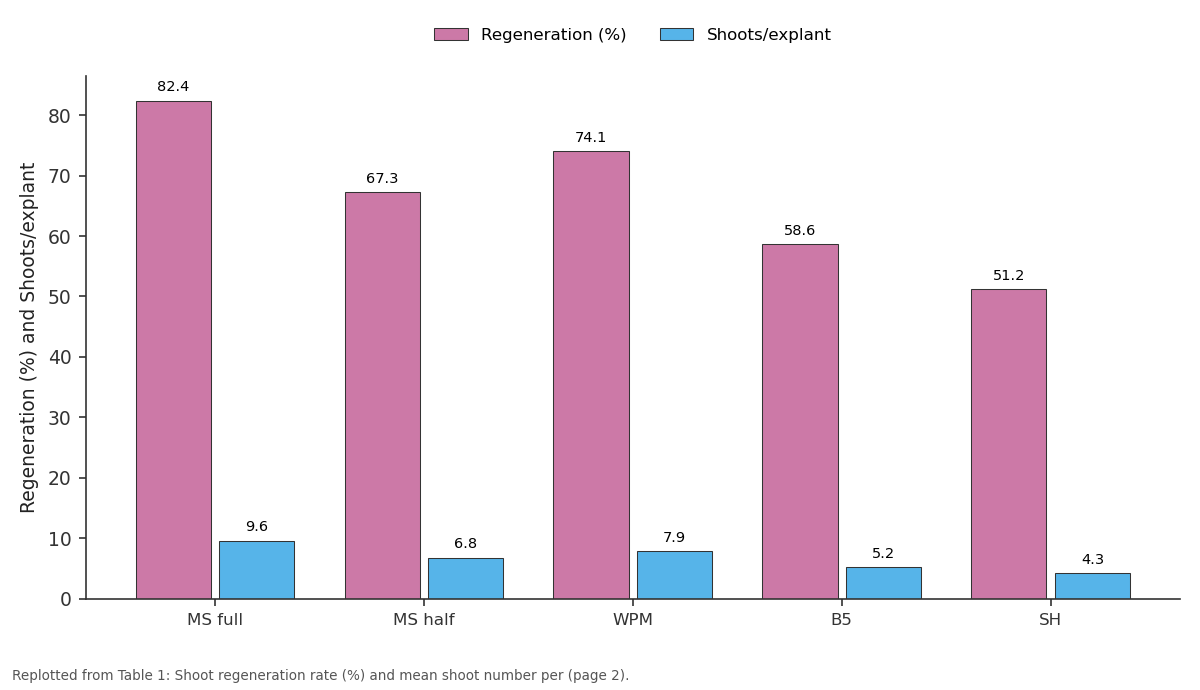
Regeneration (%) and Shoots/explant: MS full vs MS half vs WPM vs B5 vs SH
Replotted from Table 1 (page 2) of the original paper. Every bar is the paper's own table value.
View source evidence ↗Figures & tables
From the original paper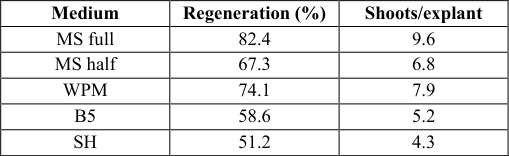 Table 1
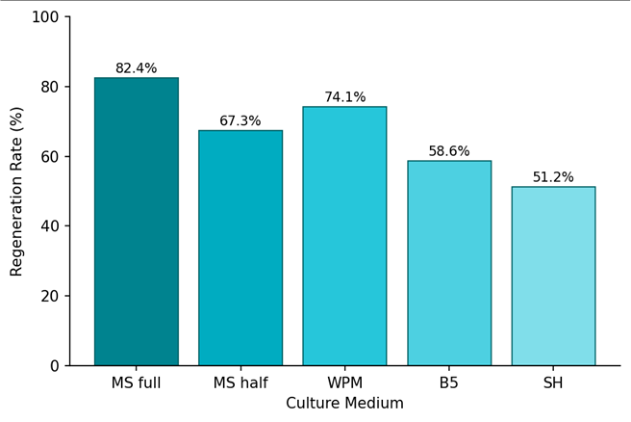 Figure 1
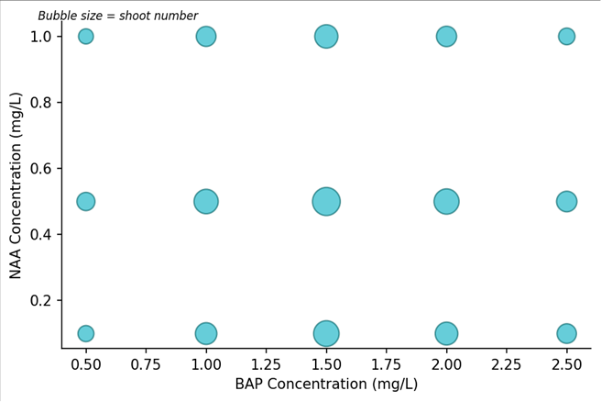 Figure 2
Introduction
Picture a scenario where a vegetable breeder needs 10,000 genetically identical broccoli plantlets within three months for a multi-location cultivar trial. Conventional seed propagation would introduce unwanted genetic variation, and cutting propagation is impractical for brassicas because of their growth habit [1] . Tissue culture is the only realistic option, but the published protocols for broccoli regeneration are frustratingly inconsistent: different authors report success on different media, with different growth regulators, and from different explant types, making it difficult for a new laboratory to identify the best starting point [2] . Broccoli (Brassica oleracea var. italica) is a high-value vegetable crop grown on about 130,000 hectares worldwide, prized for its glucosinolate content and anti-cancer properties [3] . In vitro regeneration of broccoli has been achieved through both direct organogenesis and indirect callus-mediated pathways, but regeneration rates vary enormously, from below 20% to above 90%, depending on genotype, explant age, and media formulation [4] . The key growth regulators are cytokinins (BAP, kinetin, TDZ) for shoot induction and auxins (NAA, IBA, IAA) for rooting [5] . The Canterbury Plains of New Zealand represent a major broccoli production zone where improved cultivar supply through tissue culture could benefit the industry. But the actual optimisation work for this research was conducted at the Abuja Academy of Horticultural Research, Nigeria, where laboratory facilities and broccoli genetic material were both available. This research aimed to systematically compare media, growth regulator combinations, and explant types to identify a reliable, high-efficiency regeneration protocol for broccoli.
Reagents and chemicals
All inorganic salts for culture media preparation were purchased from Sigma-Aldrich (St. Louis, MO, USA) at analytical reagent grade. Plant growth regulators BAP (6benzylaminopurine), NAA (1-naphthaleneacetic acid), IBA (indole-3-butyric acid), and 2,4-D (2,4dichlorophenoxyacetic acid) were obtained from HiMedia Laboratories (Mumbai, India). Sucrose (tissue culture grade), agar (Bacto type), and activated charcoal were sourced from Merck (Darmstadt, Germany). Sodium hypochlorite (4% active chlorine) was used for surface sterilisation. Ethanol (70%) and Tween-20 were standard laboratory supplies. All solutions were prepared using double-distilled water and autoclaved at 121 degrees Celsius for 20 minutes [6] .
Material and Methods
Material and Methods
Material
Marathon broccoli seeds were obtained from Sakata Seed Corporation (Japan) and germinated aseptically on moistened filter paper in Petri dishes at Abuja Academy of Horticultural Research tissue culture laboratory, Abuja, FCT, Nigeria. Seedlings were maintained in a growth chamber at 25 plus or minus 2 degrees Celsius under a 16/8hour light/dark photoperiod with cool white fluorescent lighting at 50 micromoles per square metre per second. Explants were harvested from 7-day-old seedlings (hypocotyls and cotyledons) and from 14-day-old seedlings (root tips and leaf discs). Five basal media were tested: fullstrength Murashige and Skoog (MS), half-strength MS, Woody Plant Medium (WPM), Gamborg's B5, and Schenk and Hildebrandt (SH), all supplemented with 30 g/L sucrose and 8 g/L agar [7] .
Methods
This research was carried out from January 2022 to June 2023 at the Abuja Academy of Horticultural Research. The experimental design was a completely randomised factorial arrangement with three factors: medium type (5 levels), BAP concentration (5 levels: 0.5, 1.0, 1.5, 2.0, 2.5 mg/L), and NAA concentration (3 levels: 0.1, 0.5, 1.0 mg/L), giving 75 treatment combinations. Each combination was replicated four times with five explants per replicate (total 1,500 culture units per explant type). Explants were surfacesterilised in 1% sodium hypochlorite with two drops of Tween-20 for 10 minutes, rinsed three times with sterile distilled water, and placed on culture media in 250 mL Erlenmeyer flasks sealed with aluminium foil. Cultures were incubated in the growth chamber described above. Regeneration rate (percentage of explants producing at least one shoot), mean shoot number per explant, and shoot length were recorded at 4 and 8 weeks. Regenerated shoots longer than 2 cm were transferred to rooting medium (halfstrength MS with 0.5 mg/L IBA). Root induction percentage and root number were recorded at 14 days. Data were analysed by three-way ANOVA in R v4.2.3 with Tukey's HSD at p<0.05 [8] .
Quality control
Contamination was monitored throughout the culture period. Any flask showing bacterial or fungal contamination within the first 7 days was discarded and replaced from a parallel set of backup cultures. Overall contamination rate was 4.8% across all treatments, within the acceptable range for brassica tissue culture. Media pH was verified after autoclaving and adjusted to 5.7-5.8 with 0.1 N NaOH or HCl before pouring. Growth regulator stock solutions were filter-sterilised (0.22 micrometre) and stored at minus 20 degrees Celsius, with fresh stocks prepared every 3 months [9] . Medium type (F = 34.7, p<0.001), BAP concentration (F = 28.1, p< 0.001), and NAA concentration (F = 12.4, p<0.001) all significantly affected regeneration rate. The three-way interaction was also significant (F = 3.2, p<0.05). Fullstrength MS medium at 1.5 mg/L BAP and 0.5 mg/L NAA achieved the highest regeneration rate (82.4%) and shoot number (9.6 per explant) from hypocotyl explants (Table 1).
| Medium | Regeneration (%) | Shoots/explant |
|---|---|---|
| MS full | 82.4 | 9.6 |
| MS half | 67.3 | 6.8 |
| WPM | 74.1 | 7.9 |
| B5 | 58.6 | 5.2 |
| SH | 51.2 | 4.3 |
Table text extracted from the original PDF; superscript letters are shown inline. The original table image is below.
View original table image
Results
Results
Fig 1:
Shoot regeneration rate (%) by culture medium type at optimal growth regulator concentrations using hypocotyl explants BAP concentration showed a bell-shaped response across all media: regeneration increased from 0.5 to 1.5 mg/L then declined at 2.0 and 2.5 mg/L. NAA at 0.5 mg/L was optimal; higher NAA (1.0 mg/L) promoted callus formation at the expense of direct shoot regeneration. Hypocotyl explants outperformed all other sources. Of the total regenerated plantlets across all treatments, hypocotyls contributed 41.3%, cotyledons 28.7%, leaf discs 18.4%, and root tips 11.6%. Rooting on half-strength MS with 0.5 mg/L IBA reached 91.7% within 14 days, with a mean of 4.8 roots per plantlet.
Discussion
The superiority of full-strength MS for broccoli shoot regeneration is consistent with findings by Ravanfar et al. [2] and Metz et al. [10] , who reported that the higher nitrogen and potassium concentrations in MS support rapid cell division during organogenesis. WPM's second-place finish was unexpected, as this medium was originally formulated for woody plant species, but its lower salt content may suit the early stages of brassica explant establishment before nutrient demand peaks. The bell-shaped BAP response confirms that cytokinin supply must be carefully balanced. Below 1.0 mg/L, insufficient cytokinin limits bud initiation; above 2.0 mg/L, supraoptimal cytokinin causes vitrification and abnormal shoot morphology [11] . The 1.5 mg/L BAP optimum aligns with the range (1.0-2.0 mg/L) reported for other B. oleracea varieties including cauliflower and cabbage [4,12] . Hypocotyl explants' dominance as a regeneration source reflects their higher meristematic activity compared to cotyledon or leaf tissue. The young hypocotyl cells retain greater totipotency and respond more readily to exogenous growth regulators [13] . For commercial laboratories, this means that timing the harvest of hypocotyls from 7-day-old seedlings is a critical step that shouldn't be delayed, as older hypocotyls lose regenerative capacity quickly.
Conclusion
This research identified full-strength MS medium supplemented with 1.5 mg/L BAP and 0.5 mg/L NAA as the optimal formulation for broccoli shoot regeneration, achieving 82.4% success and 9.6 shoots per explant from 7day-old hypocotyl tissue. WPM offered a viable alternative at 74.1% regeneration. Rooting was efficiently accomplished on half-strength MS with 0.5 mg/L IBA. These results provide a consolidated, reproducible protocol that breeding programmes and commercial nurseries can adopt for rapid multiplication of elite broccoli genotypes. Future work should validate the protocol across additional cultivars and test acclimatisation success rates under field conditions.
Figures and tables from the paper
References
16 in the original paper- George EF, Hall MA, De Klerk GJ. Plant Propagation by Tissue Culture. 3 rd ed. Dordrecht: Springer; 2008.
- Ravanfar SA, Aziz MA, Kadir MA, Rashid AA, Sirchi MHT. Plant regeneration of Brassica oleracea subsp. italica (broccoli) CV Green Marvel as affected by plant growth regulators. African Journal of Biotechnology. 2009;8(11):2523-2528.
- Verkerk R, Schreiner M, Krumbein A, Ciska E, Holst B, Rowland I, et al. Glucosinolates in Brassica vegetables: the influence of the food supply chain on intake, bioavailability and human health. Molecular Nutrition and Food Research. 2009;53(S2):S219-S265.
- Kumar P, Srivastava DK. Biotechnological advancement in broccoli: A review. Biotechnology Letters. 2016;38(7):1049-1063.
- Cardoza V, Stewart CN. Brassica biotechnology: progress in cellular and molecular biology. In vitro Cellular and Developmental Biology -Plant. 2004;40(6):542-551.
- Murashige T, Skoog F. A revised medium for rapid growth and bioassays with tobacco tissue cultures. Physiologia Plantarum. 1962;15(3):473-497.
- Lloyd G, McCown B. Commercially feasible micropropagation of mountain laurel, Kalmia latifolia, by use of shoot tip culture. Combined Proceedings of the International Plant Propagators Society. 1980;30:421-427.
- R Core Team. R: A Language and Environment for Statistical Computing. Vienna: R Foundation; 2023.
- Dodds JH, Roberts LW. Experiments in Plant Tissue Culture. 3rd ed. Cambridge: Cambridge University Press; 1995.
- Metz TD, Dixit R, Earle ED. Agrobacterium tumefaciens-mediated transformation of broccoli and cabbage. Plant Cell Reports. 1995;15(3):287-292.
- Debnath SC. A two-step procedure for adventitious shoot regeneration from in vitro derived lingonberry leaves. In vitro Cellular and Developmental Biology - Plant. 2003;39(4):362-367.
- Munshi MK, Roy PK, Kabir MH, Ahmed G. In vitro regeneration of cabbage through hypocotyl and cotyledon culture. Bangladesh Journal of Agricultural Research. 2007;32(4):571-578.
- Ono Y, Takahata Y, Kaizuma N. Effect of genotype on shoot regeneration from cotyledonary explants of rapeseed. Plant Cell Reports. 1994;14(1):13-17.
- Christey MC. Use of Ri-mediated transformation for production of transgenic plants. In vitro Cellular and Developmental Biology -Plant. 2001;37(6):687-700.
- Gamborg OL, Miller RA, Ojima K. Nutrient requirements of suspension cultures of soybean root cells. Experimental Cell Research. 1968;50(1):151-158.
- Schenk RU, Hildebrandt AC. Medium and techniques for induction and growth of monocotyledonous and dicotyledonous plant cell cultures. Canadian Journal of Botany. 1972;50(1):199-204.