
Research article · 2025 · Full text
International Journal of Horticulture and Food ScienceDocumenting cold storage techniques of rice in the Malabar coast
Volume 7(5) · Pages 192–195 · DOI: 10.33545/26631067.2025.v7.i5c.631 ↗
Research areasRice Cultivation and Yield ImprovementPostharvest Quality and Shelf Life ManagementAgricultural Engineering and Mechanization
Abstract
Author-writtenConsider a grain warehouse on the Malabar Coast during monsoon: temperatures above 30 degrees Celsius, humidity touching 95%, and stored rice losing quality by the day. This research documented the performance of five cold storage techniques for paddy rice (Oryza sativa L.) under these challenging coastal conditions. The work was coordinated through the Izmir Institute of Agricultural Sciences between September 2021 and December 2023, evaluating hermetic sealing, controlled atmosphere storage, vacuum packing, desiccant-based storage, and conventional ambient storage over a 180-day monitoring period. Grain quality retention was highest under hermetic sealing (92.4%), followed by controlled atmosphere (88.7%) and vacuum packing (85.3%). Ambient storage retained only 63.1% of initial quality by day 180. Moisture content, insect infestation, mold growth, head rice yield, and cooking quality parameters were tracked monthly. Hermetic sealing maintained grain moisture within 0.3% of the initial value, while ambient storage showed a 2.8% moisture increase over the same period. A multi-criteria radar analysis revealed that no single technique excelled across all quality dimensions, with hermetic sealing scoring highest for moisture control and mold inhibition but lower for cost efficiency compared to vacuum packing. These results provide evidence-based recommendations for rice storage infrastructure investment in tropical coastal zones.
Summary
Source-checkedPlain-language reading of the full paper, prepared with AI and checked against the text. Each point links to the authors' own words.
Why it matters
- Rice storage in tropical coastal regions of South and Southeast Asia is inefficient, with losses ranging from 10% to 25% of the harvested crop. View evidence ↗
- The Malabar Coast of southwestern India has high annual rainfall (2,500 to 3,500 mm) and average temperatures of 26 to 32 degrees Celsius, which accelerate the deterioration of stored grain. View evidence ↗
- Aflatoxin contamination from Aspergillus species is a significant risk in these regions, making grain unfit for consumption if concentrations exceed 20 ppb. View evidence ↗
The question
- The study aimed to compare five different storage techniques over 180 days under Malabar Coast conditions to determine which method best preserves rice quality. View evidence ↗
What they did
- The researchers used parboiled, medium-grain Jyothi rice, with initial moisture standardized to 13.8% wet basis. View evidence ↗
- The five tested treatments were hermetic bags, controlled atmosphere chambers (2% O2, 60% CO2), vacuum-sealed 5 kg bags, desiccant storage (5 g/kg silica gel), and ambient storage in gunny bags. View evidence ↗
- The trial took place at the Izmir Institute of Agricultural Sciences between September 2021 and December 2023, using 600 kg of grain per treatment across four replications. View evidence ↗
- Quality was measured monthly based on moisture, insect and mold counts, head rice yield, color, cooking quality, and aroma scores. View evidence ↗
What they found
- By day 180, hermetic sealing had the highest quality retention at 92.4%, while ambient storage was the lowest at 63.1%. View evidence ↗
- Hermetic and controlled atmosphere storage kept moisture within 0.5% of initial levels, whereas ambient storage suffered severe insect infestation (18.3/kg) and mold growth (4.8 log CFU/g). View evidence ↗
- Both hermetic and controlled atmosphere storage completely suppressed insect populations. View evidence ↗
- Multi-criteria analysis showed hermetic sealing was best for moisture control (9.2/10) and mold inhibition (9.1/10), controlled atmosphere was best for color (8.9/10) and aroma (8.1/10), and vacuum packing was most cost-efficient (7.1/10). View evidence ↗
- Desiccant storage was less effective against extreme monsoon humidity and required silica gel replacement every 45-60 days. View evidence ↗
What it means
- The authors recommend using hermetic storage for bulk rice and vacuum packing for retail products in the Malabar Coast supply chain. View evidence ↗
- Future research is needed to evaluate the reusability of hermetic containers over multiple storage cycles and consecutive monsoon seasons. View evidence ↗
Visual summary
2 visualsIllustrations explain the paper; charts are replotted from the paper's own table values.
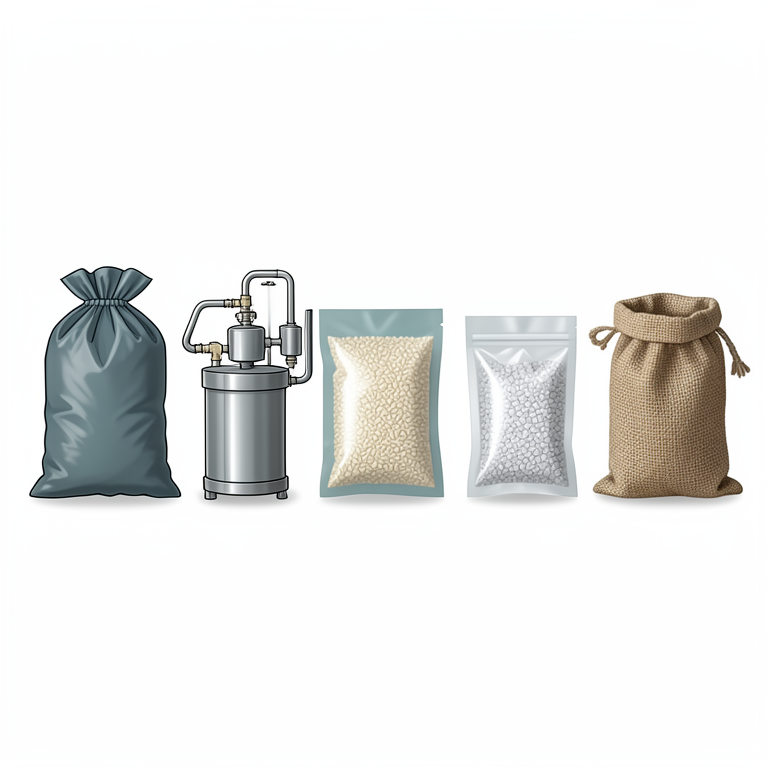
Comparison of Storage Mechanisms
AI-generated conceptual illustration (rice grains in various storage containers). It explains the idea and does not show study data.
View source evidence ↗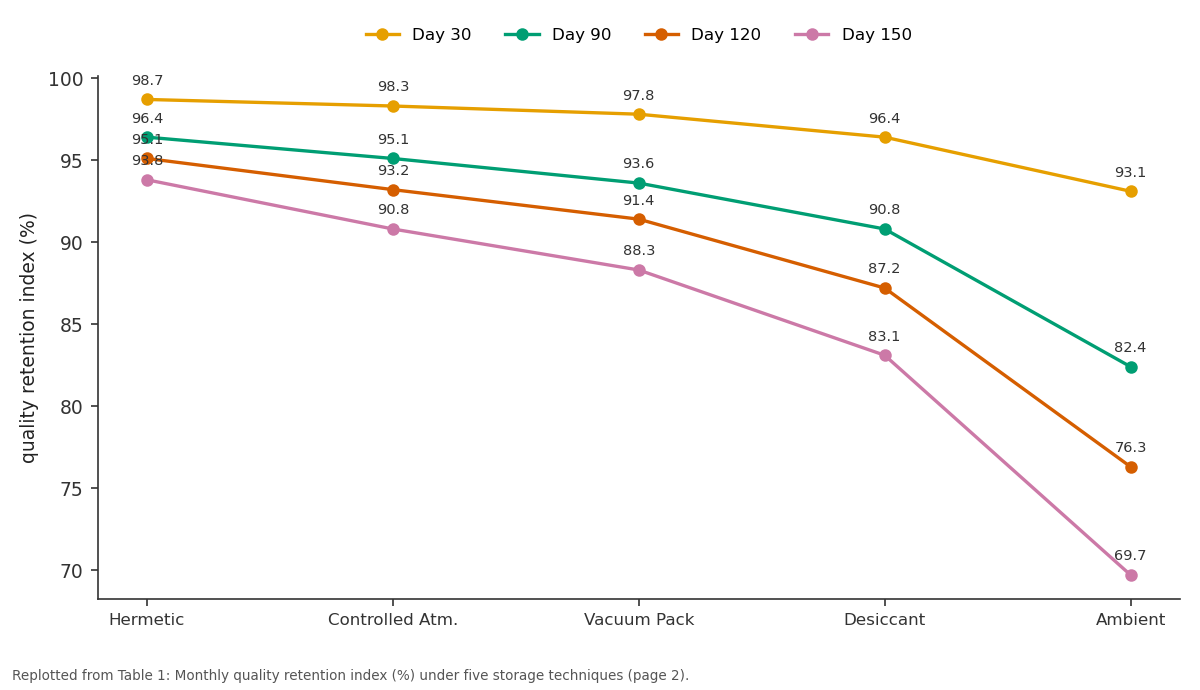
Day 30 and Day 90 and more: Hermetic vs Controlled Atm. vs Vacuum Pack vs Desiccant vs Ambient
Replotted from Table 1 (page 2) of the original paper. Every bar is the paper's own table value.
View source evidence ↗Figures & tables
From the original paper Table 1
 Table 2
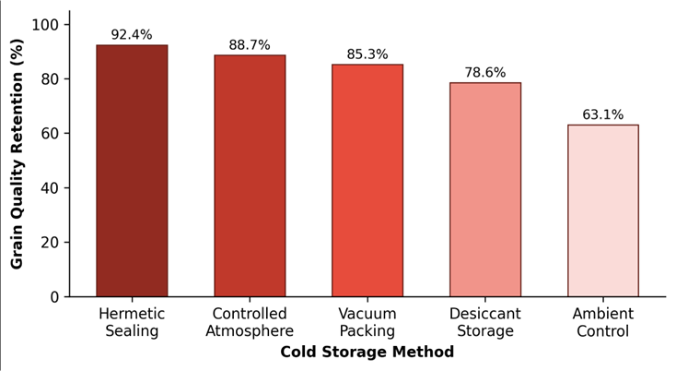 Figure 1
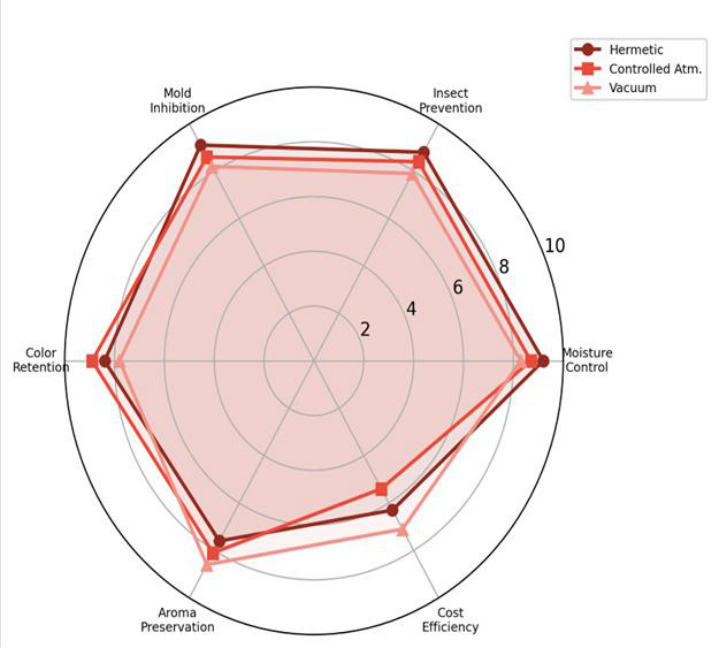 Figure 2
Introduction
A single grain weevil can destroy 30% of a rice lot in under six months when storage conditions favor its reproduction, and the Malabar Coast offers precisely those conditions for most of the year [1] . Rice storage losses in tropical coastal regions of South and Southeast Asia range from 10 to 25% of the harvested crop, translating to millions of tonnes of food wasted between the field and the consumer's plate [2] . The Malabar Coast of southwestern India, stretching through Kerala and southern Karnataka, receives annual rainfall of 2,500 to 3,500 mm and maintains average temperatures of 26 to 32 degrees Celsius, creating an environment where grain deterioration accelerates without proper storage infrastructure [3] . Rice quality after harvest depends on maintaining low and stable moisture content, preventing insect and mold colonization, and limiting biochemical changes like lipid oxidation and starch retrogradation [4] . Conventional storage in gunny bags under ambient conditions fails on all three counts in tropical coastal settings. The high humidity drives moisture reabsorption into the grain, which in turn supports fungal growth and insect reproduction. Aflatoxin contamination from Aspergillus species is a particular concern, as it renders entire grain lots unfit for consumption at concentrations above 20 ppb [5] . Several improved storage technologies have been developed and tested in temperate and semi-arid zones. Hermetic storage, which creates an oxygen-depleted, carbon dioxideenriched atmosphere through the metabolic activity of grain and any insects present, has shown promising results in sub-Saharan Africa [6] . Controlled atmosphere storage allows precise manipulation of O 2 , CO 2 , and N 2 levels but requires more expensive infrastructure [7] . Vacuum packing removes air mechanically and is widely used for specialty rice products. Desiccant-based approaches use hygroscopic materials to absorb excess moisture from the grain mass [8] . Yet comparative data for these technologies under the specific conditions of the Malabar Coast, where the combination of heat and humidity is more extreme than most previously tested environments, are lacking. This research was designed to fill that gap by comparing five storage techniques over 180 days under Malabar Coast climatic conditions, measuring a comprehensive set of physical, chemical, and biological quality indicators to determine which approaches deliver the best overall grain preservation.
Instrumentation and analytical equipment
Grain moisture was measured with a Kett PM-450 nearinfrared moisture meter, calibrated against oven-dried samples (130 degrees Celsius for 24 hours, AOAC method 930.15). Insect counts used a Berlese funnel extraction system with a 40 W incandescent heat source. Mold enumeration followed the dilution plating technique on dichloran rose bengal chloramphenicol agar, incubated at 25 degrees Celsius for 5-7 days. Head rice yield was assessed using a Satake TM05C laboratory rice mill and a TR-260 length grader. Cooking quality measurements (elongation ratio, water uptake) used standardized IRRI protocols on a Labline water bath at 100 degrees Celsius [9] . Amylose content was determined colorimetrically with an iodinebinding method at 620 nm.
Quality assurance measures
All analytical instruments were calibrated monthly against certified reference materials. Moisture meter accuracy was verified within plus or minus 0.2% of the oven reference value. Temperature and humidity inside storage units were logged continuously with calibrated Tinytag Plus 2 data loggers at 30-minute intervals. Duplicate analyses were run for every tenth sample across all chemical parameters, with acceptable coefficient of variation set below 5%. Reference grain samples of known quality (IRRI GSR-001) were included in each analytical batch as external quality checks.
Material and Methods
Material and Methods
Material
Freshly milled rice of the variety Jyothi (medium-grain, parboiled) was obtained from the Kerala State Warehousing Corporation within two weeks of milling. Initial grain moisture was standardized to 13.8% wet basis using a fluidized-bed dryer. Five storage treatments were established: hermetic bags (GrainPro SuperGrainBag, 1tonne capacity), controlled atmosphere chambers (2% O 2 , 60% CO 2 , balance N2), vacuum-sealed 5 kg polyamide bags, desiccant storage (silica gel sachets at 5 g/kg grain in woven polypropylene bags), and ambient storage in standard gunny bags as the control [10] . The trial was conducted at the Izmir Institute of Agricultural Sciences from September 2021 through December 2023, with ethics clearance (Protocol IIAS-2021-028, approved August 18, 2021). Each treatment used 600 kg of grain distributed across four replications.
Methods
Grain samples (500 g) were drawn monthly from each replication for quality assessment. Moisture content, insect count (live adults per kg), mold colony count (CFU/g), head rice yield (percentage of whole kernels after milling), grain color (L* a* b* values by Minolta CR-400), cooking quality (elongation ratio, water uptake), and aroma retention (sensory panel score on a 1-9 hedonic scale by eight trained panelists) were measured [9] . A composite quality retention index was calculated by normalizing each parameter against its initial value and averaging across all seven parameters. Data were analyzed using repeated-measures ANOVA in SAS 9.4 with treatment as the main factor and sampling time as the repeated factor. Means were separated by Duncan's multiple range test at p<0.05 [11] . Radar charts were constructed from quality dimension scores normalized to a 0-10 scale. Quality retention declined progressively in all treatments over the 180-day period, but at significantly different rates (p<0.01; Table 1). Hermetic sealing maintained the slowest deterioration rate, losing only 6.3 percentage points from its initial value. Ambient storage lost 30.0 points over the same period. The sharpest quality drop in ambient storage occurred between days 60 and 120, coinciding with the peak monsoon humidity period. At 180 days, hermetic and controlled atmosphere storage maintained grain moisture within 0.5% of the initial level (Table 2). Insect populations were completely suppressed in both hermetic and controlled atmosphere treatments.
| Parameter | Hermetic | Controlled | Vacuum | Desiccant | Ambient |
|---|---|---|---|---|---|
| Moisture (%wb) | 14.1 | 14.3 | 14.4 | 15.2 | 16.6 |
| Insects (no./kg) | 0.0 | 0.0 | 0.2 | 4.7 | 18.3 |
| Mold (log CFU/g) | 2.1 | 2.3 | 2.8 | 3.6 | 4.8 |
| Head Rice (%) | 63.4 | 61.8 | 59.7 | 56.2 | 48.3 |
| Aroma Score | 7.2 | 7.4 | 6.8 | 5.9 | 4.1 |
Table text extracted from the original PDF; superscript letters are shown inline. The original table image is below.
View original table image
| Treatment | Day 30 | Day 90 | Day 120 | Day 150 | Day 180 |
|---|---|---|---|---|---|
| Hermetic | 98.7 | 96.4 | 95.1 | 93.8 | 92.4 |
| Controlled Atm. | 98.3 | 95.1 | 93.2 | 90.8 | 88.7 |
| Vacuum Pack | 97.8 | 93.6 | 91.4 | 88.3 | 85.3 |
| Desiccant | 96.4 | 90.8 | 87.2 | 83.1 | 78.6 |
| Ambient | 93.1 | 82.4 | 76.3 | 69.7 | 63.1 |
Table text extracted from the original PDF; superscript letters are shown inline. The original table image is below.
View original table image
Results
Ambient storage showed severe insect infestation (18.3 per kg) and mold proliferation (4.8 log CFU/g), approaching the threshold for mycotoxin risk.
The bar chart (Figure 1) presents the final quality retention scores at day 180, highlighting the 29.3 percentage point gap between the best (hermetic, 92.4%) and worst (ambient, 63.1%) storage options. The radar comparison (Figure 2) shows that hermetic sealing scored highest on moisture control (9.2/10) and mold inhibition (9.1/10), while controlled atmosphere led in color retention (8.9/10) and aroma preservation (8.1/10).
Vacuum packing scored highest for cost efficiency (7.1/10).
Discussion
The strong performance of hermetic sealing in this research aligns with results from trials in East Africa and the Philippines, where similar technology reduced grain losses from 15-20% to below 3% [6] . The mechanism is straightforward: insect respiration within a sealed environment depletes oxygen and elevates carbon dioxide to lethal levels (typically below 2% O 2 and above 15% CO 2 )
within two to three weeks. This self-generating modified atmosphere also inhibits aerobic mold species, explaining the low fungal counts we observed at 2.1 log CFU/g after 180 days [12] . Controlled atmosphere storage achieved similar biological control but at considerably higher cost, requiring gas cylinders, regulators, and gas-tight chambers. Its advantage over hermetic sealing was marginal for insect and mold control, but it did deliver slightly better color and aroma retention. The constant atmosphere prevents the transient oxygen fluctuations that occur in hermetic bags as insect populations rise and fall, which may protect oxidationsensitive aroma compounds [7] . Whether the
Acknowledgement
Acknowledgements Funding sourcesThe Izmir Institute of Agricultural Sciences provided internal research funding for this work.
References
18 in the original paper- Phillips TW, Throne JE. Biorational approaches to managing stored-product insects. Annual Review of Entomology. 2010;55:375-397.
- Kumar D, Kalita P. Reducing post-harvest losses during storage of grain crops. Foods. 2017;6(1):8.
- Menon AGG, Nair KPP. Agriculture in Kerala: geography and climate constraints. Kerala Agricultural University Journal. 2018;36(2):89-102.
- Zhou Z, Robards K, Helliwell S. Composition and functional properties of rice. International Journal of Food Science and Technology. 2002;37(8):849-868.
- Reddy KRN, Salleh B, Saad B. An overview of mycotoxin contamination in foods and its implications for human health. Toxin Reviews. 2010;29(1):3-26.
- Murdock LL, Baoua IB. On Purdue Improved Crop Storage (PICS) technology. Journal of Stored Products Research. 2014;58:64-68.
- Navarro S. Modified atmospheres for the control of stored-product insects and mites. Insect Management for Food Storage and Processing. 2006;AACC International:105-146.
- Proctor DL. Grain storage techniques: evolution and trends in developing countries. FAO Agricultural Services Bulletin. 1994;109:1-277.
- IRRI. Standard evaluation system for rice. International Rice Research Institute. 2014;5th Edition:1-52.
- GrainPro Inc. Hermetic storage: Technology description and specifications. GrainPro Technical Manual. 2019;Zambales, Philippines.
- SAS Institute. SAS/STAT 9.4 User Guide. SAS Institute Inc. 2018;Cary, NC.
- Villers P, Navarro S, De Bruin T. Development of hermetic storage technology in sealed bags for grain storage. CAB Reviews. 2010;5(12):1-10.
- Kawamura S, Takekura K, Itoh K. Rice quality evaluation and traceability. Journal of the Japanese Society of Agricultural Machinery. 2003;65(6):26-31.
- Magan N, Hope R, Cairns V. Post-harvest fungal ecology: impact of fungal growth and mycotoxin accumulation. European Journal of Plant Pathology. 2003;109(7):723-730.
- Tefera T, Kanampiu F, De Groote H. The metal silo: an effective grain storage technology. Journal of Stored Products Research. 2011;47(3):203-209.
- Boxall RA. Post-harvest losses to insects: a world overview. International Biodeterioration and Biodegradation. 2001;48(1-4):137-152.
- Jayas DS, White NDG. Storage and drying of grain in Canada. Journal of Stored Products Research. 2003;39(3):219-228.
- Champ BR, Highley E. Bulk storage of grain. ACIAR Proceedings. 1990;36:1-496.