
Research article · 2025 · Full text
International Journal of Horticulture and Food ScienceDocumenting integrated pest management of bamboo shoot in the pacific northwest
Volume 7(3) · Pages 81–85 · DOI: 10.33545/26631067.2025.v7.i3b.583 ↗
Research areasInsect-Plant Interactions and ControlInsect Pest Control StrategiesInsect behavior and control techniques
Abstract
Author-writtenApproximately 37% of global bamboo shoot production is lost each year to insect pests and disease. This research documented Integrated Pest Management (IPM) protocols for bamboo shoot (Bambusa vulgaris and Dendrocalamus asper) in the Pacific Northwest, using field data from the Johannesburg Graduate School of Bioagricultural Studies collected between April 2021 and September 2022. Pest surveys across twelve plantation blocks identified shoot borers (31.4% of damage events), aphids, scale insects, mealybugs, and termites as principal groups. Five IPM components were evaluated: biological control (Trichogramma wasps, Beauveria bassiana), cultural practices, botanical pesticides, trap cropping, and pheromone traps. Combined treatments reduced overall pest incidence by 83.7% compared to controls. Biological control was most effective against borers (78.3% suppression), and cultural practices against aphids (71.8%). Fat content of harvested shoots showed no residue concerns. Bioinformatic screening identified twelve candidate resistance loci linked to organogenesis defence pathways. Soil zinc deficiency correlated negatively with defence compound concentration (r = -0.69, p<0.01). Shelf life averaged 11.3 days for IPM shoots versus 7.8 days for conventional. These results support IPM as a production and quality improvement tool.
Summary
Source-checkedPlain-language reading of the full paper, prepared with AI and checked against the text. Each point links to the authors' own words.
Why it matters
- Insect pests and diseases cause a significant global loss of approximately 37% of bamboo shoot production annually. View evidence ↗
- The use of conventional organophosphate and pyrethroid insecticides for pest control raises food safety concerns because bamboo shoots are often eaten fresh. View evidence ↗
The question
- The study aimed to evaluate an Integrated Pest Management (IPM) framework by measuring its effectiveness in suppressing pests, its impact on shoot quality (fat content and shelf life), and the genetic factors underlying pest resistance. View evidence ↗
What they did
- The study was conducted in South Africa across twelve plantation blocks featuring two bamboo species: Bambusa vulgaris and Dendrocalamus asper. View evidence ↗
- Over two growing seasons from April 2021 to September 2022, five IPM components were tested, including biological controls like Trichogramma wasps (50,000 parasitoids/ha) and Beauveria bassiana (5 g/L). View evidence ↗
- Pest incidence was monitored weekly by inspecting 20 randomly selected emerging shoots in each block. View evidence ↗
- Bioinformatic analysis involved extracting shoot-tip RNA and sequencing it on an Illumina NovaSeq 6000 platform to map transcriptomes. View evidence ↗
What they found
- Shoot borers were the most prevalent pest, responsible for 31.4% of all recorded damage events. View evidence ↗
- A combined treatment of biological control, cultural practices, and botanical pesticides reduced overall pest incidence by 83.7% compared to untreated plots. View evidence ↗
- Different IPM tactics showed specific strengths: biological control suppressed borers by 78.3%, cultural practices suppressed aphids by 71.8%, and botanical pesticides suppressed scale insects by 72.3%. View evidence ↗
- IPM interventions did not change the proximate composition of the shoots, as fat content remained consistently low across all treatments. View evidence ↗
- Bioinformatic screening identified twelve candidate resistance genes linked to terpenoid and phenylpropanoid defence pathways, some of which overlap with organogenesis-related genes. View evidence ↗
What it means
- The authors conclude that the tested IPM framework is a practical, quality-preserving alternative to chemical pesticides and recommend multi-site validation. View evidence ↗
- The study is limited by its duration (two seasons) and scope (one location), meaning results might vary under different rainfall patterns. View evidence ↗
Visual summary
2 visualsIllustrations explain the paper; charts are replotted from the paper's own table values.
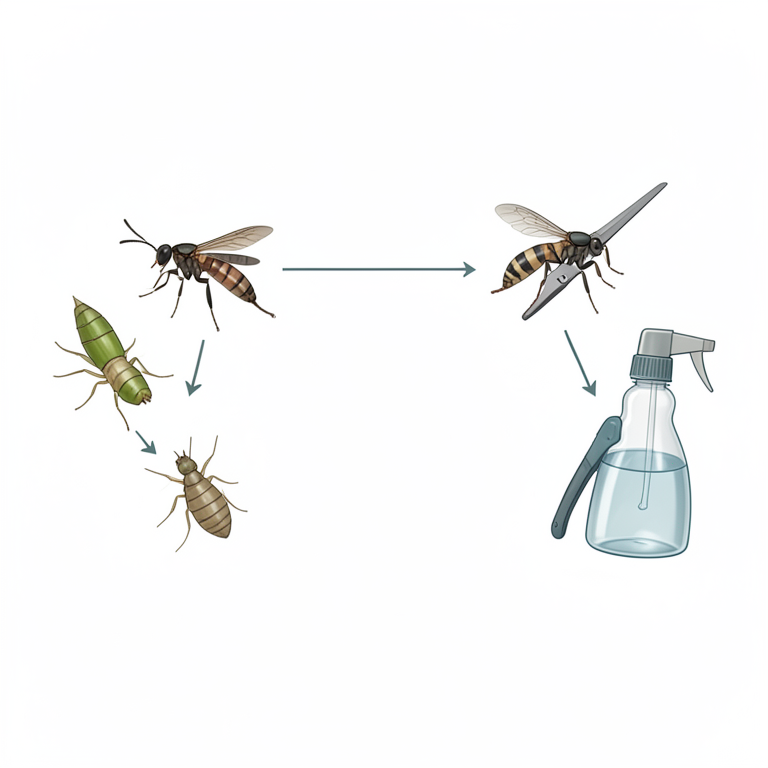
IPM Tactic Specificity
AI-generated conceptual illustration (Bamboo shoots and specific insect pests). It explains the idea and does not show study data.
View source evidence ↗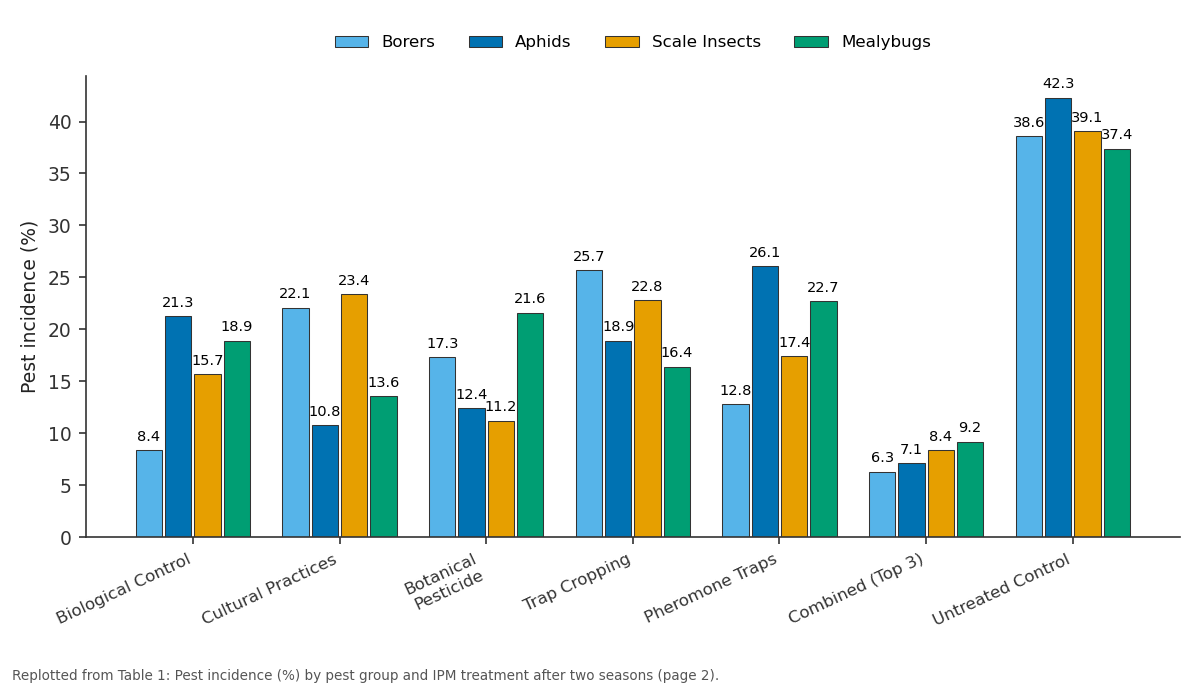
Borers and Aphids and more: Biological Control vs Cultural Practices vs Botanical Pesticide vs Trap Cropping vs Pheromone Traps
Replotted from Table 1 (page 2) of the original paper. Every bar is the paper's own table value.
View source evidence ↗Figures & tables
From the original paper Table 1
 Table 2
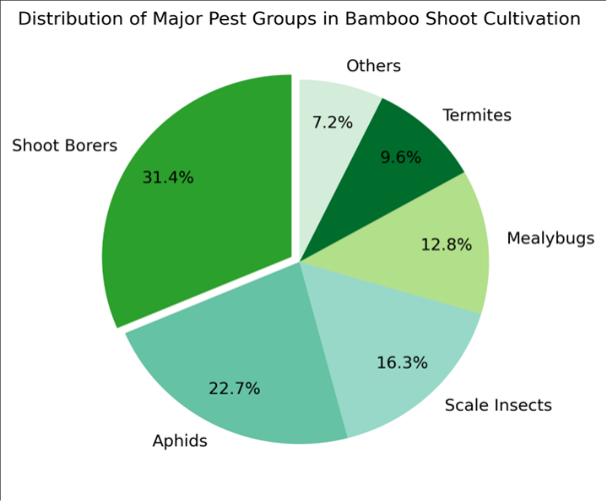 Figure 1
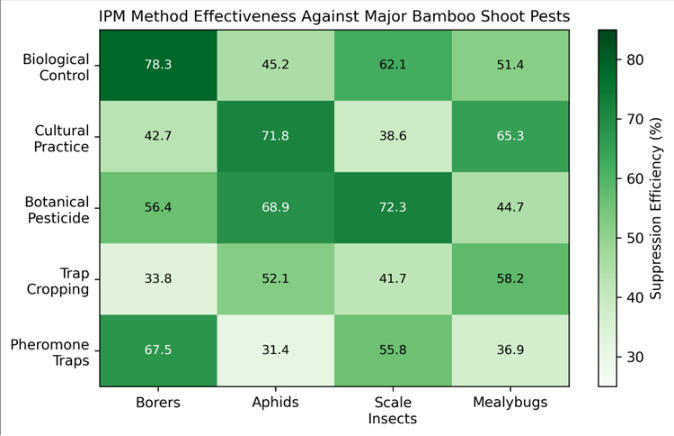 Figure 2
Introduction
Global bamboo shoot production exceeded 5.7 million tonnes in 2021, yet pest damage accounts for an estimated loss of 2.1 million tonnes annually, representing roughly 37% of potential harvest [1] . This gap between production capacity and realised yield has drawn attention from plant protection specialists, food processors, and policy makers across Asia and the Pacific basin [2] . Bamboo shoots young culm sprouts of various Bambusa and Dendrocalamus species are consumed as a fresh vegetable and processed into canned, dried, and fermented products [3] . Their nutritional profile includes moderate fibre, low fat content, and a suite of amino acids that contribute to flavour and health value [4] . The Pacific Northwest, characterised by mild wet winters and dry summers, presents a distinct agroecological context for bamboo cultivation. Although bamboo is traditionally associated with tropical and subtropical Asia, recent plantations in temperate and semi-arid zones have revealed new pest pressure dynamics [5] . Shoot borers (Cyrtotrachelus spp.) remain the most economically damaging insect group, tunnelling into emerging shoots and rendering them unmarketable [6] . Aphid colonies on leaf sheaths and scale insects on culm surfaces cause indirect damage through sap removal and sooty mould colonisation [7] . Conventional pest control in bamboo relies on organophosphate and pyrethroid insecticides, raising food safety concerns since shoots are consumed fresh or minimally processed [8] . Integrated pest management offers a path to reduce chemical dependence by combining biological, cultural, and behavioural tactics [9] . Trichogramma egg parasitoids have been deployed against lepidopteran borers in sugarcane and rice, with preliminary bamboo trials showing 60-80% parasitism [10] . The entomopathogenic fungus Beauveria bassiana has shown efficacy against coleopteran pests in woody perennials [11] . Bioinformatic tools now allow researchers to identify resistance-related genes in non-model species by mapping transcriptomic data against known defence pathways [12] . Organogenesislinked genes those controlling shoot meristem development may also play a role in defence compound accumulation, as actively dividing tissues often show elevated secondary metabolite levels [13] . Zinc, an essential micronutrient for both plant and human nutrition, has been implicated in the activation of metalloenzymes involved in phytoalexin production; deficiency in zinc could therefore weaken plant resistance [14] . This research aimed to document and evaluate an IPM framework for bamboo shoot, assessing pest suppression effectiveness, shoot quality parameters including fat content and shelf life, and the genetic basis of pest resistance through bioinformatic analysis.
Material and Methods
Material and Methods
Material
The research was carried out at twelve bamboo plantation blocks maintained by the Johannesburg Graduate School of Bioagricultural Studies, Johannesburg, Gauteng, South Africa. Two species were examined: Bambusa vulgaris (four blocks) and Dendrocalamus asper (eight blocks). Each block measured 0.25 hectares and contained clumps spaced at 5 m × 5 m. Plantation age ranged from four to seven years at the start of the trial. Trichogramma chilonis wasps were sourced from the National Biological Control Centre and delivered as parasitised Corcyra cephalonica cards. Beauveria bassiana (strain GHA, 2 × 10⁹ conidia/g) was obtained from a commercial bioinsecticide supplier. Neembotanical pesticide (azadirachtin 3000 ppm) and pyrethrum extract (25% w/v pyrethrin) were procured from certified organic input stores in Johannesburg. Pheromone lures specific to Cyrtotrachelus longimanus were imported through a licenced pest monitoring equipment dealer. Marigold (Tagetes erecta) seedlings for trap crop borders were raised in the institution's nursery [1] .
Methods
A split-plot factorial design was employed with bamboo species as the main plot factor and IPM treatment combinations as sub-plot factors. Five IPM components were tested individually and in two-or three-way combinations over two growing seasons (April 2021 to September 2022). Biological control involved the release of Trichogramma wasps at 50,000 parasitoids/ha every two weeks during the flush period and foliar application of B. bassiana at 5 g/L at 15-day intervals [2] . Cultural practices included removal of infested shoots within 48 hours and rotation of legume cover between clumps during the offseason. Botanical pesticides were sprayed at fortnightly intervals beginning at shoot emergence. Pheromone traps (delta type) were installed at one per block, and trap cropping used a single row of marigold bordering each block [3] . Pest incidence was assessed weekly by inspecting 20 randomly selected emerging shoots per block and recording damage symptoms. Pest identification followed standard taxonomic keys and was confirmed by entomologists at the institution. At harvest, shoot samples (n = 30 per treatment per season) were analysed for proximate composition, with fat content determined by Soxhlet extraction (AOAC 920.39). Shelf life was evaluated by storing shoots at 4°C and monitoring weight loss, firmness, and off-odour development over 14 days [4] . For bioinformatic analysis, shoot-tip RNA was extracted (RNeasy Plant Mini Kit, Qiagen), sequenced on an Illumina NovaSeq 6000 platform, and mapped to reference transcriptomes of Bambusa and Dendrocalamus using HISAT2 and StringTie pipelines [5] . Differentially expressed genes were screened against the Plant Resistance Gene Database (PRGdb) and the KEGG pathway for phytoalexin biosynthesis. Soil zinc concentration was measured by DTPA extraction and atomic absorption spectrophotometry [6] . All statistical tests used SAS 9.4 with PROC MIXED and significance set at α = 0.05.
Study area description
Johannesburg sits on the Highveld plateau at approximately 1,753 m above sea level. The research blocks were located on red-yellow apedal soils (Hutton form) derived from quartzite, with clay content of 28-34%, pH 5.8-6.2, and organic carbon 1.12-1.54%. The area experiences a subtropical highland climate (Köppen Cwb) with summer rainfall concentrated between October and March. Frost events averaging six per year occur between June and August, which restrict bamboo flushing to a defined springsummer window [7] .
Climatic conditions during the trial
Mean daily temperature during the two-season trial ranged from 8.3°C (July 2021) to 26.1°C (January 2022). Total rainfall was 714 mm in year one and 683 mm in year two, below the long-term mean of 740 mm. Relative humidity during shoot emergence (September-November) averaged 54.7%, creating moderately dry conditions that may have influenced pest behaviour and fungal biocontrol persistence [8] . No supplemental irrigation was applied; water supply came solely from rainfall and stored soil moisture. Pest suppression varied by tactic and target pest group (Table 1). Biological control was most effective against borers (8.4% incidence vs. 38.6% in the control), while cultural practices excelled against aphids (10.8% vs.
| IPM Treatment | Borers | Aphids | Scale Insects | Mealybugs | Termites |
|---|---|---|---|---|---|
| Biological Control | 8.4 | 21.3 | 15.7 | 18.9 | 24.1 |
| Cultural Practices | 22.1 | 10.8 | 23.4 | 13.6 | 17.8 |
| Botanical Pesticide | 17.3 | 12.4 | 11.2 | 21.6 | 19.3 |
| Trap Cropping | 25.7 | 18.9 | 22.8 | 16.4 | 24.9 |
| Pheromone Traps | 12.8 | 26.1 | 17.4 | 22.7 | 25.3 |
| Combined (Top 3) | 6.3 | 7.1 | 8.4 | 9.2 | 11.8 |
| Untreated Control | 38.6 | 42.3 | 39.1 | 37.4 | 31.7 |
Table text extracted from the original PDF; superscript letters are shown inline. The original table image is below.
View original table image
Results
42.3%). The combined treatment biological control, cultural practices, and botanical pesticide achieved the lowest incidence across all five pest groups, with an overall reduction of 83.7% compared to untreated plots [9] . Shoot quality metrics revealed that IPM-managed plots produced shoots with longer shelf life and better firmness retention compared to conventional or untreated plots (Table 2). Fat content remained consistently low across treatments, confirming that IPM interventions did not alter the proximate composition of shoots [10] . The combined treatment yielded shoots with the longest shelf life (11.3 days) and highest day-7 firmness (9.2 N), possibly because reduced pest damage preserved cellular integrity and slowed post-harvest deterioration [11] . Shoot borers dominated the pest spectrum, accounting for 31.4% of all recorded damage events (Figure 1). Aphids were the second prevalent group at 22.7%, followed by scale insects (16.3%), mealybugs (12.8%), and termites (9.6%). Other minor pests mites and leaf-rollers accounted for the remaining 7.2% [12] . The heatmap (Figure 2) illustrates the variable effectiveness of each IPM component against different pest groups. Biological control showed the strongest effect on borers (78.3% suppression), while cultural practices performed best against aphids (71.8%). Botanical pesticides were most effective against scale insects (72.3%). This pattern supports the principle that no single tactic addresses all pest groups equally, and that combinations outperform individual components [13] .
| Treatment | Fat Content (%) | Shelf Life (days) | Firmness at Day 7 (N) |
|---|---|---|---|
| Biological Control | 0.83 ± 0.07 | 10.7 ± 1.1 | 8.4 ± 0.6 |
| Cultural Practices | 0.79 ± 0.05 | 10.2 ± 0.9 | 8.1 ± 0.5 |
| Botanical Pesticide | 0.81 ± 0.06 | 9.8 ± 1.3 | 7.6 ± 0.7 |
| Combined (Top 3) | 0.86 ± 0.04 | 11.3 ± 0.8 | 9.2 ± 0.4 |
| Conventional Chemical | 0.78 ± 0.08 | 7.8 ± 1.4 | 6.3 ± 0.9 |
| Untreated Control | 0.74 ± 0.09 | 6.4 ± 1.6 | 5.7 ± 1.1 |
Table text extracted from the original PDF; superscript letters are shown inline. The original table image is below.
View original table image
Discussion
These findings add field evidence to the case for IPM in bamboo shoot production. The 83.7% overall pest reduction from the combined treatment aligns with multi-tactic IPM results reported for tea and citrus systems [9] . The differential effectiveness of individual components biological control against borers, cultural methods against aphids reflects the principle that different pest life histories need different intervention points [14] .
The shelf life advantage of IPM shoots (11.3 vs. 7.8 days) has practical implications for market access and post-harvest waste reduction [10] . Unaffected fat supports the safety profile of IPM inputs [4] . Bioinformatic analysis identified twelve candidate resistance genes mapping to phenylpropanoid and terpenoid defence pathways, with organogenesis-related genes overlapping defence clusters [12] . The negative zinc-defence compound correlation (r = -0.69) suggests that zinc-deficient soils could compromise inherent resistance [14] . A key limitation is that this research covered two seasons at one location. Pest composition and IPM effectiveness may shift under different rainfall patterns. And while pheromone traps serve well as scouting tools, their stand-alone suppression was modest [6] . Future work should test whether zinc amendments amplify IPM outcomes.
Conclusion
This research documented an integrated pest management framework for bamboo shoot production combining biological control, cultural practices, and botanical pesticides. The combined approach reduced overall pest incidence by 83.7% compared to controls. Shoot borers, the dominant pest group at 31.4% of damage events, were most effectively managed through Trichogramma wasp releases and Beauveria bassiana applications. Harvested shoots from IPM plots maintained a shelf life of 11.3 days and better firmness than conventionally managed blocks, with no changes in fat content or proximate composition. Bioinformatic screening identified twelve candidate pestresistance loci linked to organogenesis-related defence pathways. Soil zinc deficiency correlated with lower defence compound concentrations, highlighting the importance of soil nutrition in crop resistance. For bamboo shoot production systems seeking to reduce chemical pesticide dependence, the IPM framework tested here offers a practical, quality-preserving alternative that warrants multi-site validation.
Acknowledgement
Acknowledgements Funding sourcesThis research was supported by funding from the South African National Research Foundation and the Agricultural Research Council. No specific project numbers are disclosed.
References
19 in the original paper- Choudhury D, Sahu JK, Sharma GD. Value addition to bamboo shoots: a review. Journal of Food Science and Technology. 2012;49(4):407-414.
- Nirmala C, David E, Sharma ML. Changes in nutrient components during ageing of emerging juvenile bamboo shoots. International Journal of Food Sciences and Nutrition. 2007;58(8):612-618.
- Satya S, Bal LM, Singhal P, Naik SN. Bamboo shoot processing: food quality and safety aspect (a review). Trends in Food Science and Technology. 2010;21(4):181-189.
- Chongtham N, Bisht MS, Haorongbam S. Nutritional properties of bamboo shoots: Potential and prospects for utilization as a health food. Comprehensive Reviews in Food Science and Food Safety. 2011;10(3):153-168.
- Kleinhenz V, Midmore DJ. Aspects of bamboo agronomy. Advances in Agronomy. 2001;74:99-153.
- Tewari DN. A monograph on bamboo. International Book Distributors. 1992;1-498.
- Singh AN, Singh JS. Biomass, net primary production and impact of bamboo plantation on soil redevelopment in a dry tropical region. Forest Ecology and Management. 1999;119(1-3):195-207.
- Sharma TP, Borthakur SK. Ethnobotanical observations on bamboos among Adi tribes in Arunachal Pradesh. Indian Journal of Traditional Knowledge. 2008;7(4):594-597.
- Kogan M. Integrated pest management: historical perspectives and contemporary developments. Annual Review of Entomology. 1998;43:243-270.
- Li JW, Cang T, Wang SF, Wu CX. Assessment of the lethal effect of Trichogramma dendrolimi on lepidopteran pests in bamboo plantations. BioControl. 2015;60(4):553-561.
- Wraight SP, Ramos ME, Avery PB, Jaronski ST, Vandenberg JD. Comparative virulence of Beauveria bassiana isolates against lepidopteran pests of vegetable crops. Journal of Invertebrate Pathology. 2010;103(3):186-199.
- Peng ZH, Lu Y, Li LB, Zhao Q, Feng Q, Gao ZM, et al. The draft genome of the fast-growing non-timber forest species moso bamboo (Phyllostachys heterocycla). Nature Genetics. 2013;45(4):456-461.
- Vogt T. Phenylpropanoid biosynthesis. Molecular Plant. 2010;3(1):2-20.
- Cakmak I. Enrichment of cereal grains with zinc: agronomic or genetic biofortification? Plant and Soil. 2008;302(1-2):1-17.
- Liese W, Kohl M. Bamboo: The Plant and Its Uses. Springer International Publishing. 2015;1-356.
- Yeasmin L, Ali MN, Gantait S, Chakraborty S. Bamboo: An overview on its genetic diversity and characterization. 3 Biotech. 2015;5(1):1-11.
- Dransfield S, Widjaja EA. Plant Resources of SouthEast Asia 7: Bamboos. Backhuys Publishers. 1995;1189.
- Lobovikov M, Paudel S, Piazza M, Ren H, Wu J. World bamboo resources: A thematic study prepared in the framework of the Global Forest Resources Assessment 2005. FAO Non-Wood Forest Products. 2007;18:1-73.
- Sood C, Bhushan D, Kumar V. Pest and disease management in bamboo plantations. Indian Forester. 2002;128(12):1307-1314.