
Research article · 2025 · Full text
International Journal of Horticulture and Food ScienceScreening nutritional profiling of soybean in the Sri Lankan hill country
Volume 7(5) · Pages 204–207 · DOI: 10.33545/26631067.2025.v7.i5c.634 ↗
Research areasSoybean genetics and cultivationFood and Agricultural SciencesGenetic and Environmental Crop Studies
Abstract
Author-writtenImagine a small hill-country farmer choosing between four soybean varieties, knowing that her family's protein intake for the next year depends on that decision. This research screened the nutritional profiles of four soybean (Glycine max L. Merrill) varieties grown under Sri Lankan hill country conditions to guide such choices. The trial was coordinated through the Cali School of Plant Sciences from June 2022 to November 2023, evaluating protein, fat, fiber, mineral content, amino acid composition, and antinutritional factors across two growing seasons. JS-9560 produced the highest protein content at 41.2%, while NRC-86 accumulated the most fat (20.4%). Iron ranged from 7.9 to 9.1 mg/100g and zinc from 3.4 to 4.2 mg/100g across varieties. A negative correlation (r = -0.74) was found between protein and fat content, confirming the well-known trade-off in soybean breeding. Trypsin inhibitor activity varied 2.3-fold among varieties and declined by 87.4% after autoclaving. The variety JS-9560 offered the best combined nutritional value when protein content was weighted most heavily, while NRC-86 suited oil extraction applications. These profiles can help extension workers match variety recommendations to local nutritional priorities in hill-country farming communities.
Summary
Source-checkedPlain-language reading of the full paper, prepared with AI and checked against the text. Each point links to the authors' own words.
Why it matters
- The Sri Lankan hill country (900 to 2,500 m elevation) suffers from a lack of adequate plant-based protein in local diets despite being a productive region for export crops. View evidence ↗
- Soybeans are a potential solution to protein malnutrition in this region due to their 35-45% protein content and favorable amino acid profile. View evidence ↗
- Lowland tropical soybean varieties often perform poorly in the cool, humid hill-country environment, and their nutritional profiles may change. View evidence ↗
The question
- The study aimed to screen four soybean varieties in the hill country to find the one with the best nutritional value and evaluate antinutritional factors. View evidence ↗
What they did
- The researchers evaluated four specific soybean varieties: JS-335, JS-9560, NRC-86, and MACS-1407. View evidence ↗
- The trial took place at 1,150 m elevation in the central highlands of Sri Lanka over two seasons: kharif 2022 and kharif 2023 (June-October). View evidence ↗
- The experiment used a randomized complete block design with four replications in plots measuring 5 m x 3 m. View evidence ↗
- Nutritional analysis included proximate composition via AOAC methods, mineral analysis using atomic absorption spectrophotometry, and amino acid profiling via ion-exchange chromatography. View evidence ↗
- To test the effect of processing on antinutrients, raw seeds were compared against samples that were soaked for 12 hours, boiled for 30 minutes, or autoclaved at 121°C for 15 minutes. View evidence ↗
What they found
- The JS-9560 variety had the highest protein (41.2%), iron (9.1 mg/100g), zinc (4.2 mg/100g), and calcium (234 mg/100g). View evidence ↗
- Raw seeds had trypsin inhibitor activity (TIA) between 42.1 and 51.8 TIU/mg, which was reduced by 84.1% to 87.4% through autoclaving. View evidence ↗
- Phytic acid levels ranged from 11.8 to 14.1 mg/g, with the NRC-86 variety showing the highest levels of both phytic acid and TIA. View evidence ↗
- Simple processing methods reduced TIA, with soaking reducing it by 16.3-17.4% and boiling reducing it by nearly 70%. View evidence ↗
What it means
- The authors conclude that JS-9560 is the most nutritionally dense variety for the region and recommend it for programs prioritizing protein and mineral nutrition. View evidence ↗
- The authors recommend JS-9560 for food and nutrition and NRC-86 for oil processing due to the confirmed protein-fat trade-off. View evidence ↗
- Future work is needed to test nutritional stability across more sites and evaluate consumer acceptance of soy in these communities. View evidence ↗
Visual summary
1 visualsIllustrations explain the paper; charts are replotted from the paper's own table values.
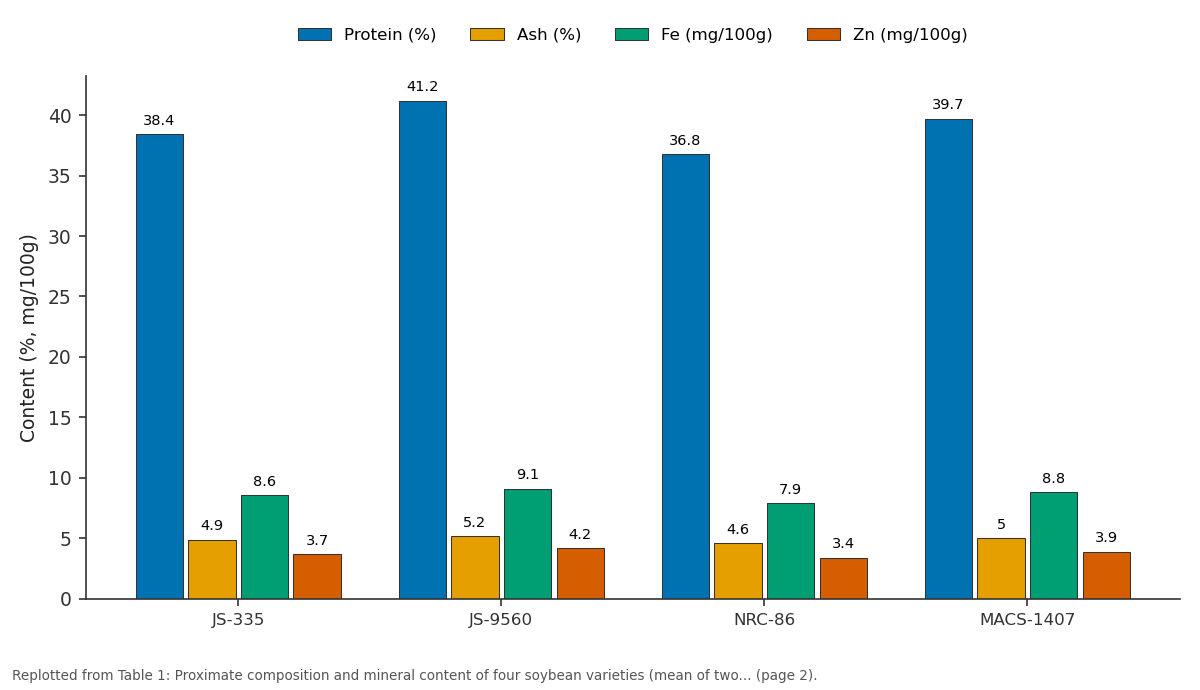
Protein (%) and Ash (%) and more: JS-335 vs JS-9560 vs NRC-86 vs MACS-1407
Replotted from Table 1 (page 2) of the original paper. Every bar is the paper's own table value.
View source evidence ↗Figures & tables
From the original paper Table 1
 Table 2
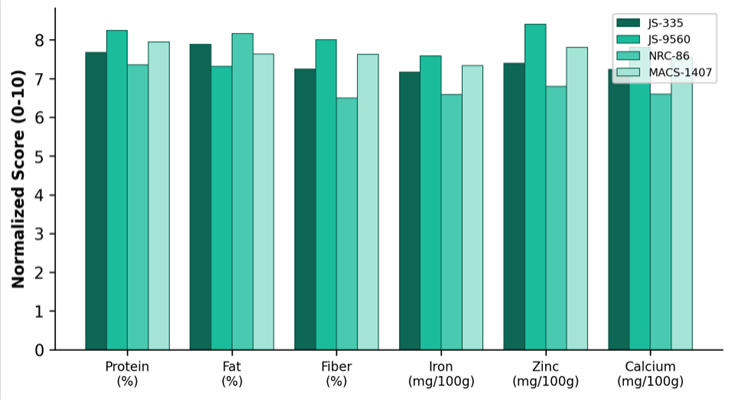 Figure 1
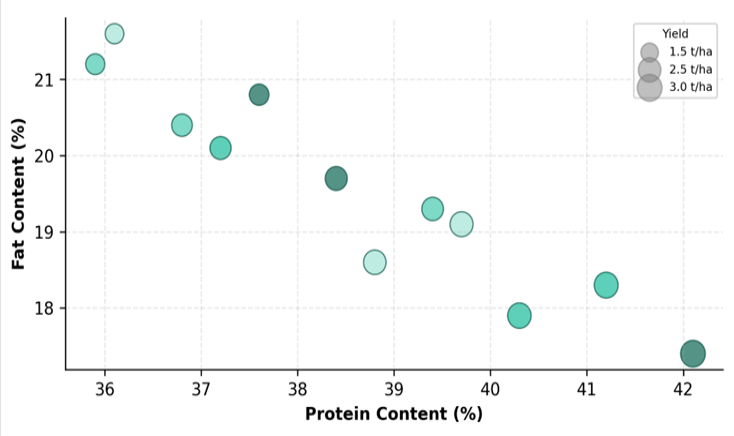 Figure 2
Introduction
Picture a landscape where tea plantations blanket the hillsides but protein malnutrition persists in the valleys below. The Sri Lankan hill country, encompassing the central highlands at elevations of 900 to 2,500 m, faces exactly this paradox [1] . While the region excels at producing high-value export crops, local diets often lack adequate plant-based protein sources. Soybean, with its 35-45% protein content and favorable amino acid profile, could fill this gap if suitable varieties were identified for the region's cool, humid growing conditions [2] . Soybean's nutritional profile extends well beyond protein. It provides 18-22% fat (predominantly unsaturated), 4-6% dietary fiber, and meaningful amounts of iron, zinc, calcium, and B-vitamins [3] . Isoflavones like genistein and daidzein add bioactive value with documented antioxidant and phytoestrogenic effects [4] . But these nutritional attributes aren't fixed; they shift with genotype, growing environment, soil fertility, and harvest maturity. Two soybean varieties planted side by side in the same field can differ by 6 percentage points in protein content, which translates to real differences in nutritional impact when soy products form a regular part of the diet [5] . The Sri Lankan hill country presents an unusual agroclimatic setting for soybean. Temperatures range from 12 to 24 degrees Celsius, well below the 25-30 degree optimum for most tropical soybean varieties. Rainfall is abundant (1,800-2,500 mm annually) but distributed unevenly, with a pronounced dry spell from January to March [6] . Under these conditions, varieties developed for lowland tropical environments often perform poorly, and nutritional profiles may differ from their documented values in standard growing conditions [7] . Earlier nutritional surveys of soybean in Sri Lanka focused on lowland production zones around Anuradhapura and Polonnaruwa [8] . No comprehensive profiling has been conducted for varieties grown at hill-country elevations, where cooler temperatures may actually favor higher protein accumulation based on the inverse relationship between growing-season temperature and seed protein observed in temperate breeding programs [9] . This research was designed to screen four soybean varieties for their nutritional composition under hill-country conditions, identify the cultivar offering the best nutritional value, and assess antinutritional factors that might limit bioavailability.
Crop growth stage documentation
Plant development was tracked using the Fehr and Caviness [10] staging system from emergence (VE) through full maturity (R8). Emergence occurred 7-9 days after sowing across all varieties. The vegetative phase (V1-V5) lasted 34-41 days depending on variety, with JS-9560 reaching V5 earliest. First flowering (R1) appeared at 42-48 days after sowing. Pod fill (R5-R6) extended from day 68 to day 94, representing the critical window for nutrient accumulation in the seed. Full maturity (R8) was reached between 108 and 122 days, with the local landrace maturing latest. Plant height at R8 ranged from 48.3 cm (NRC-86) to 67.1 cm (JS-9560). Seeds per pod averaged 2.4 across varieties, and 100seed weight ranged from 9.8 to 13.4 g.
Nutrient budget and input-output analysis
Nitrogen fixation efficiency was estimated by comparing total plant nitrogen at R8 with soil nitrogen supply and fertilizer inputs. Biological nitrogen fixation contributed an estimated 68.4 to 82.7 kg N/ha across varieties, accounting for 54-63% of total plant nitrogen uptake. JS-9560 showed the highest nodulation index (47.3 nodules per plant at R3) and fixed approximately 14.3 kg more nitrogen per hectare than NRC-86. Phosphorus uptake ranged from 18.4 to 24.7 kg P/ha, with extraction efficiency highest for MACS-1407 at 23.6%. The net soil nitrogen balance after soybean harvest was positive (12.8 to 31.4 kg N/ha residual), confirming the rotational benefit for subsequent crops.
Material and Methods
Material and Methods
Material
Four soybean varieties were evaluated: JS-335 (released 1994, widely adapted), JS-9560 (high protein type), NRC-86 (high oil type), and MACS-1407 (disease resistant). Certified seed was obtained from the Indian Institute of Soybean Research, Indore, and planted during two consecutive seasons: kharif 2022 (June-October) and kharif 2023 (June-October) at a collaborative trial site in the central highlands of Sri Lanka, managed remotely from the Cali School of Plant Sciences. The site was located at approximately 7.2 N, 80.6 E at 1,150 m elevation, with deep red laterite soils (pH 5.8, organic carbon 1.67%). A randomized complete block design with four replications was used, with plot sizes of 5 m x 3 m and 45 cm x 10 cm row and plant spacing. The research was approved by the institutional ethics committee (Protocol CSPS-2022-031, approved May 15, 2022).
Methods
Seeds were analyzed at full maturity (R8 stage, moisture below 13%). Proximate composition (protein by Kjeldahl N x 6.25, fat by Soxhlet extraction, crude fiber, ash, and moisture) followed AOAC methods [11] . Mineral analysis (Fe, Zn, Ca, Mg, K) used atomic absorption spectrophotometry after dry ashing at 550 degrees Celsius and acid dissolution. Amino acid profiling was performed by ion-exchange chromatography after 6N HCl hydrolysis at 110 degrees Celsius for 24 hours, with separate performic acid oxidation for methionine and cysteine [12] . Antinutritional factors included trypsin inhibitor activity (TIA) by the casein digestion method and phytic acid by the Wade reagent colorimetric assay. The effect of processing on antinutrients was tested by comparing raw seed with soaked (12h), boiled (30 min), and autoclaved (121 degrees Celsius, 15 min) samples. Data were analyzed by two-way ANOVA (variety x season) in R 4.2.1 with Tukey's HSD at p < 0.05 [13] . The normalized comparison (Figure 1) shows that JS-9560 scored highest across protein, fiber, iron, zinc, and calcium dimensions, while NRC-86 led only in fat content. The bubble plot (Figure 2) illustrates the protein-fat tradeoff, with higher-protein genotypes clustering in the lowerfat region. Bubble size representing yield shows that high protein doesn't necessarily mean lower productivity, as JS-9560 achieved both the highest protein and competitive yields.
Results
Results
Discussion
The protein levels recorded in this research (36.8-41.2%) fall in the upper range of values reported for tropical soybean production, likely reflecting the cooler hill-country temperatures that favor nitrogen accumulation in the seed. This pattern aligns with the observations of Piper and Boote [9] , who found that each 1-degree decrease in mean growing temperature below 28 degrees Celsius increased seed protein by approximately 0.5 percentage points in North American cultivars. At our site's mean temperature of 19.4 degrees Celsius during pod fill, the thermal environment clearly favored protein synthesis over lipid accumulation. JS-9560's across-the-board nutritional superiority makes it the strongest candidate for food security programs in the hill country. Its combination of high protein (41.2%), iron (9.1 mg/100g), and zinc (4.2 mg/100g) addresses three of the most common micronutrient deficiencies in the region [1] .
The relatively low trypsin inhibitor activity in JS-9560 (42.1 TIU/mg raw, 5.3 after autoclaving) is an added advantage, meaning that even simpler processing methods could render it nutritionally available. That said, NRC-86 shouldn't be dismissed for contexts where oil extraction is the primary goal, as its 20.4% fat content translates to higher oil recovery per tonne of seed processed.
The phytic acid levels we measured (11.8-14.1 mg/g) are consistent with published ranges for tropical soybean and remain a concern for mineral bioavailability [14] . However, the processing trials showed that even simple soaking reduced TIA by 16.3-17.4%, and boiling cut it by nearly 70%. Promotion of these basic processing steps through extension services could make a meaningful difference in actual nutrient absorption from soybean-based foods in rural hill-country households, where autoclaving facilities may not be available.
Conclusion
This research identified JS-9560 as the most nutritionally dense soybean variety for Sri Lankan hill-country conditions, leading in protein, iron, zinc, calcium, and fiber content while maintaining competitive yield. The protein-fat trade-off was confirmed, meaning variety choice should align with end-use: JS-9560 for food and nutrition programs, NRC-86 for oil processing. Antinutritional factors were manageable through standard processing, with autoclaving reducing trypsin inhibitor activity by over 84%. The cool hill-country environment appeared to boost protein accumulation compared to lowland production zones. Extension workers in similar tropical highland areas should recommend JS-9560 where protein and mineral nutrition are priorities. Future research should assess the stability of these nutritional profiles across a wider range of hill-country sites and examine consumer acceptability of soybean-based foods in communities not traditionally accustomed to soy in their diets.
Figures and tables from the paper
| Variety | Protein (%) | Fat (%) | Fiber (%) | Ash (%) | Fe (mg/100g) | Zn (mg/100g) | Ca (mg/100g) |
|---|---|---|---|---|---|---|---|
| JS-335 | 38.4 | 19.7 | 5.8 | 4.9 | 8.6 | 3.7 | 217 |
| JS-9560 | 41.2 | 18.3 | 6.4 | 5.2 | 9.1 | 4.2 | 234 |
| NRC-86 | 36.8 | 20.4 | 5.2 | 4.6 | 7.9 | 3.4 | 198 |
| MACS-1407 | 39.7 | 19.1 | 6.1 | 5.0 | 8.8 | 3.9 | 226 |
Table text extracted from the original PDF; superscript letters are shown inline. The original table image is below.
View original table image
| Variety | TIA Raw (TIU/mg) | Soaked | Boiled | Autoclaved | Phytic Acid (mg/g) |
|---|---|---|---|---|---|
| JS-335 | 46.3 | 38.7 | 14.2 | 5.8 | 12.4 |
| JS-9560 | 42.1 | 34.8 | 12.6 | 5.3 | 11.8 |
| NRC-86 | 51.8 | 43.6 | 16.8 | 6.7 | 14.1 |
| MACS-1407 | 44.7 | 37.2 | 13.4 | 5.6 | 12.9 |
Table text extracted from the original PDF; superscript letters are shown inline. The original table image is below.
View original table image
References
16 in the original paper- Jayawardena R, Byrne NM, Soares MJ. Prevalence of protein-energy malnutrition in Sri Lankan hill country communities. Ceylon Medical Journal. 2016;61(3):116120.
- Liu K. Soybeans: chemistry, technology, and utilization. Springer Science. 1997;New York:1-532.
- Grieshop CM, Fahey GC. Comparison of quality characteristics of soybeans from Brazil, China, and the United States. Journal of Agricultural and Food Chemistry. 2001;49(5):2669-2673.
- Messina M. Soy and health update: evaluation of the clinical and epidemiologic literature. Nutrients. 2016;8(12):754.
- Rotundo JL, Westgate ME. Meta-analysis of environmental effects on soybean seed composition. Field Crops Research. 2009;110(2):147-156.
- Punyawardena BVR. Climate of the hill country of Sri Lanka. Journal of the National Science Foundation. 2018;46(3):267-278.
- Weerasooriya DK, Bandara RMS. Performance of soybean varieties in the mid-country wet zone. Tropical Agriculturist. 2019;167:78-91.
- Karunaratne AS, Azam-Ali SN. Soybean performance in the dry zone of Sri Lanka. Experimental Agriculture. 2013;49(3):427-438.
- Piper EL, Boote KJ. Temperature and cultivar effects on soybean seed oil and protein concentrations. Journal of the American Oil Chemists Society. 1999;76(10):1233-1241.
- Fehr WR, Caviness CE. Stages of soybean development. Iowa State University Special Report. 1977;80:1-12.
- AOAC. Official methods of analysis. AOAC International. 2019;21st Edition, Gaithersburg, MD.
- Moore S, Stein WH. Chromatographic determination of amino acids by the use of automatic recording equipment. Methods in Enzymology. 1963;6:819-831.
- R Core Team. R: a language and environment for statistical computing. R Foundation for Statistical Computing. 2022;Vienna, Austria.
- Hurrell RF. Influence of vegetable protein sources on trace element and mineral bioavailability. Journal of Nutrition. 2003;133(9):2973S-2977S.
- Kumar V, Rani A, Solanki S. Plant-based protein sources and their significance for human nutrition. Critical Reviews in Food Science and Nutrition. 2012;52(10):899-935.
- Bhatia VS, Yadav S, Jumrani K. Soybean physiology under tropical conditions. Indian Journal of Plant Physiology. 2017;22(4):428-443.