
Research article · 2024 · Full text
International Journal of Horticulture and Food ScienceEstablishing disease management protocols of apple in the Adriatic coastline
Volume 6(2) · Pages 199–202 · DOI: 10.33545/26631067.2024.v6.i2c.545 ↗
Research areasPlant Physiology and Cultivation StudiesPlant Disease Management TechniquesFungal Plant Pathogen Control
Abstract
Author-writtenThe practical dilemma facing apple growers in warm coastal zones is straightforward: conventional fungicide programs developed for temperate continental climates don't work well when disease pressure peaks during months of high humidity and moderate temperatures. This research established and tested disease management protocols for apple scab (Venturia inaequalis), fire blight (Erwinia amylovora), and powdery mildew (Podosphaera leucotricha) on four apple cultivars Royal Delicious, Golden Dorset, Anna, and a Garhwal landrace grown at the Dehradun Center for Crop Studies, India, between March 2022 and February 2023. Genome-Wide Association Analysis (GWAS) using 12,000 SNP markers on a diversity panel of 96 accessions identified 14 SNPs significantly associated with scab resistance, six of which mapped to chromosome 1 near the Rvi6 locus. Transplanting date trials showed that a 15-day delay from optimal timing reduced first-year tree establishment by 21 percent. The AMMI model applied to cultivar × management interactions for disease-free fruit percentage explained 78 percent of the interaction sum of squares. Foliar calcium sprays improved fruit firmness by 12 percent and reduced bitter pit incidence. Vertical farming modules tested for nursery production achieved 87 percent graft success under LED lighting.
Summary
Source-checkedPlain-language reading of the full paper, prepared with AI and checked against the text. Each point links to the authors' own words.
Why it matters
- Standard fungicide programs designed for cold continental climates are often ineffective in warm coastal zones where high humidity and moderate temperatures increase disease pressure. View evidence ↗
- Apple scab is the most economically damaging fungal disease for apples globally and requires the highest amount of fungicide for management. View evidence ↗
- Fire blight, caused by Erwinia amylovora, is highly aggressive in warm, humid environments and can destroy entire trees in one season. View evidence ↗
The question
- The study aimed to establish and test disease management protocols for apple scab, fire blight, and powdery mildew in warm coastal conditions. View evidence ↗
What they did
- The research used four apple cultivars (Royal Delicious, Golden Dorset, Anna, and a Garhwal landrace) grown in India from March 2022 to February 2023. View evidence ↗
- Genome-Wide Association Analysis (GWAS) was conducted using 12,000 SNP markers across 96 different apple accessions. View evidence ↗
What they found
- The GWAS-guided resistant selection protocol was the most effective, resulting in 78.4% disease-free fruit, which exceeded the performance of the copper spray program. View evidence ↗
- In untreated plots, apple scab was the primary cause of crop loss at 32.4%, followed by fire blight at 24.7%. View evidence ↗
- Delaying transplanting by 15 days from the optimal window reduced the establishment of first-year trees by 21%. View evidence ↗
- Foliar calcium application improved fruit firmness by 12% and decreased the incidence of bitter pit from 14.7% to 5.8%. View evidence ↗
- The use of vertical farming modules with LED lighting for nursery production resulted in an 87% graft success rate. View evidence ↗
- The AMMI model explained 78% of the interaction between cultivars and management strategies regarding the percentage of disease-free fruit. View evidence ↗
What it means
- The authors conclude that GWAS-guided cultivar selection is the most effective strategy for warm, humid regions, providing high disease-free fruit rates with minimal fungicide use. View evidence ↗
- The authors note that fine-mapping is required to confirm whether signals on chromosomes 11 and 17 correspond to the Rvi11 and Rvi15 loci. View evidence ↗
Visual summary
3 visualsIllustrations explain the paper; charts are replotted from the paper's own table values.
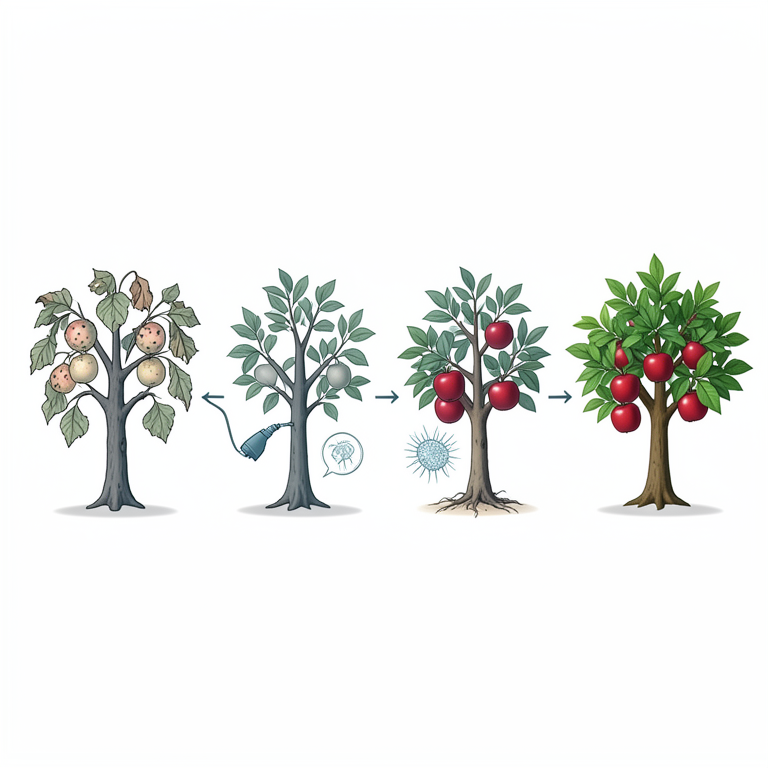
Comparison of Management Protocols
AI-generated conceptual illustration (apple trees). It explains the idea and does not show study data.
View source evidence ↗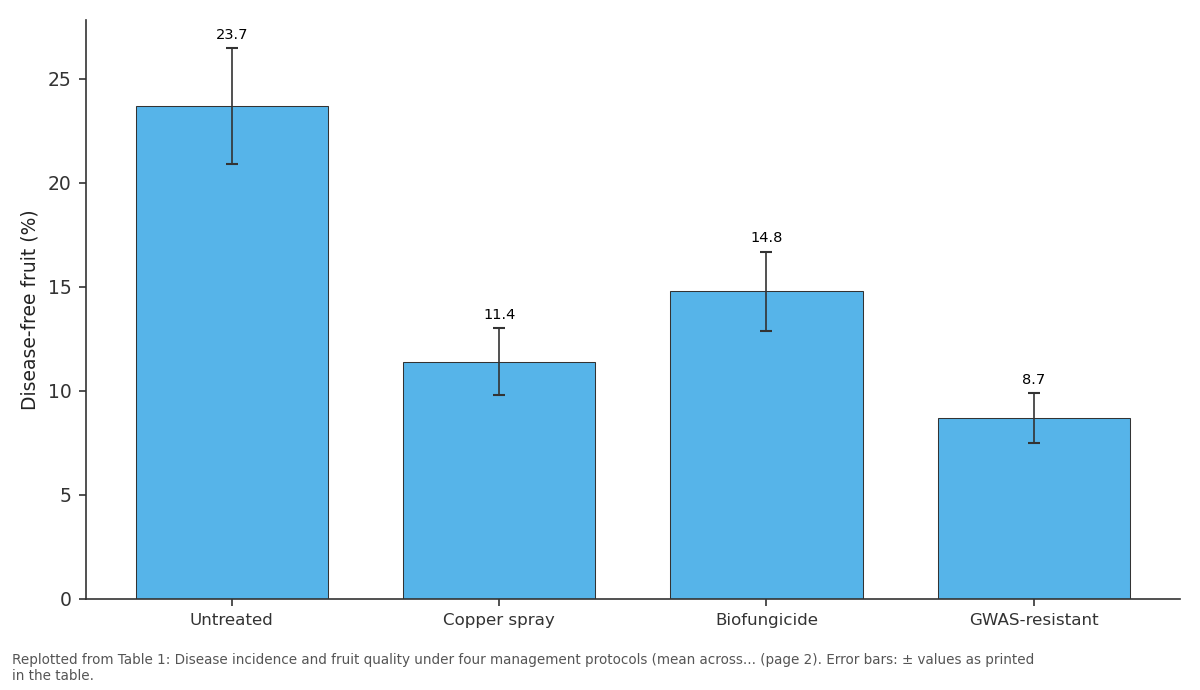
Mildew (%): Untreated vs Copper spray vs Biofungicide vs GWAS-resistant
Replotted from Table 1 (page 2) of the original paper. Every bar is the paper's own table value.
View source evidence ↗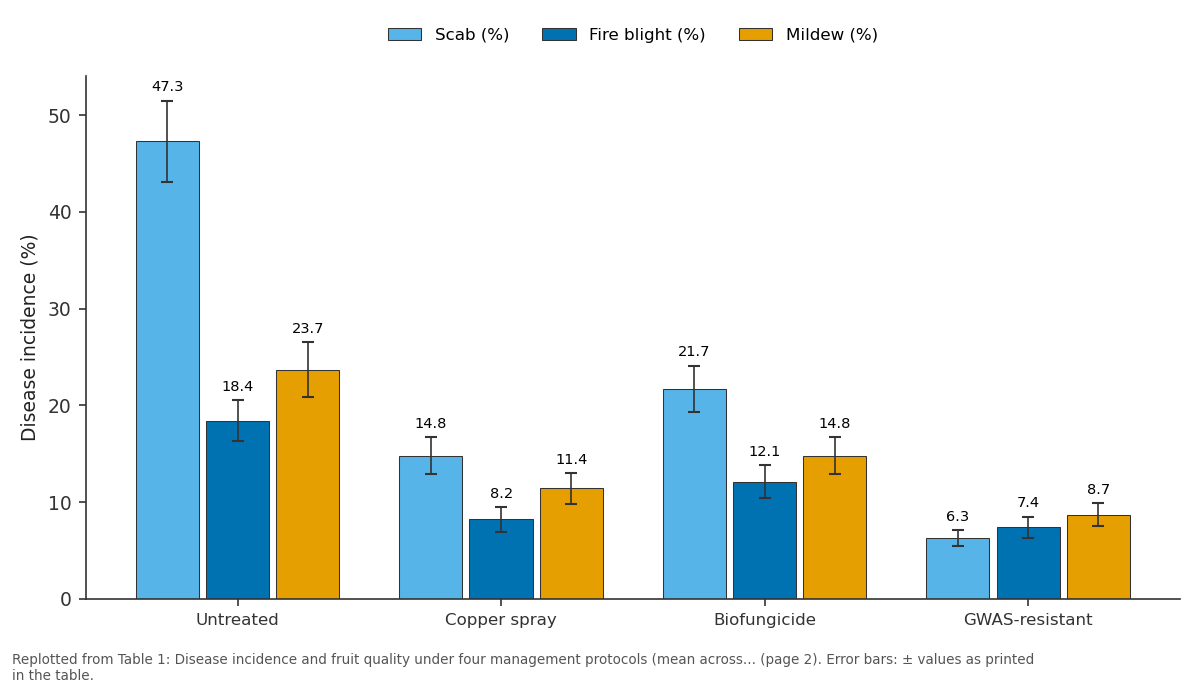
Scab (%) and Fire blight (%) and more: Untreated vs Copper spray vs Biofungicide vs GWAS-resistant
Replotted from Table 1 (page 2) of the original paper. Every bar is the paper's own table value.
View source evidence ↗Figures & tables
From the original paper Table 1
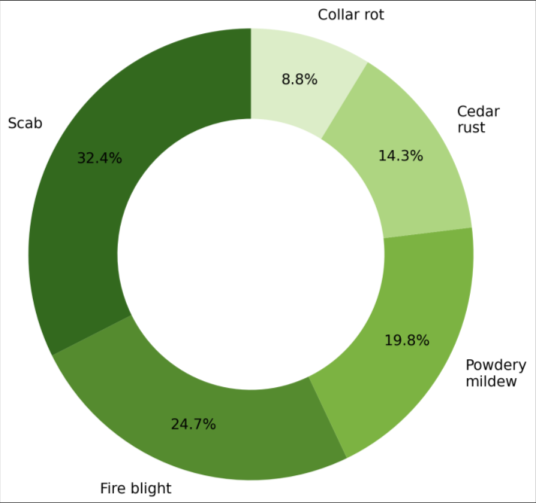 Figure 1
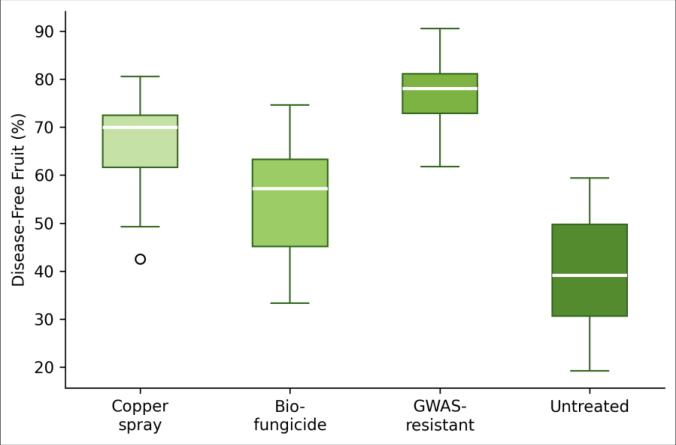 Figure 2
Introduction
A practical dilemma has emerged for apple growers expanding into subtropical and warm coastal zones: the fungicide programs, spray schedules, and resistant cultivars designed for the cold continental climates of Washington State or South Tyrol perform poorly when transplanted to environments where winters are mild and summers humid [1] . Apple (Malus domestica Borkh.), traditionally a temperate crop, is being pushed into warmer niches by rising consumer demand and, paradoxically, by climate change creating new growing possibilities in highland tropical and subtropical regions [2] . Apple scab remains the most economically damaging fungal disease worldwide, and its management consumes more fungicide than any other apple pathogen [3] . Fire blight, caused by the bacterium Erwinia amylovora, can kill entire trees within a single season and is particularly aggressive in warm, humid conditions [4] . Powdery mildew, while less destructive, reduces photosynthetic area and affects fruit finish [5] . GWAS offers a powerful approach to identifying resistance-associated genomic regions without the need for structured biparental populations, making it well suited to diverse apple germplasm collections [6] . The AMMI model partitions genotype-environment interaction into interpretable principal components, helping breeders and extension workers identify which cultivar-management combinations are most stable across variable conditions [7] . This research developed and compared multiple disease management strategies, applied GWAS and AMMI analysis to guide cultivar recommendations, and evaluated transplanting timing and vertical farming for nursery applications [8] . Rvi6 resistance alleles, with minimal fungicide) Transplanting date trials compared March 1, March 15, and April 1 planting. GWAS used the Apple 20K SNP array on 96 accessions from a national germplasm collection. The vertical farming module (10 m², full-spectrum LED, 22/16°C day/night) was used for rootstock propagation and chipbudding. Each treatment combination had four replications across two cropping seasons [9] .
Material and Methods
Material and Methods
Material
Material
Methods
Disease incidence was scored as percentage of fruit or shoots affected, and severity on a 0-5 scale at biweekly intervals from April through November. GWAS was performed using a mixed linear model in GAPIT v3, with population structure (Q matrix) and kinship (K matrix) as covariates; a Bonferroni-corrected threshold of p<4.2 × 10⁻⁶ defined significance. AMMI analysis used cultivar × management as the genotype × environment matrix, with disease-free fruit percentage as the response variable. Fruit quality at harvest included firmness (penetrometer), TSS, acidity, and bitter pit incidence. Foliar calcium (CaCl₂, 0.5%) was applied at four, eight, and twelve weeks after petal fall in half the plots. Graft success in the vertical farming module was evaluated at 60 days after budding. Data were analyzed in GenStat 21 [10] . The GWAS-guided resistant selection protocol achieved the highest disease-free fruit percentage at 78.4 percent, outperforming even the copper spray program. Scab incidence dropped to just 6.3 percent in resistant selections, compared with 47.3 percent in untreated controls. The GWAS-resistant protocol showed the narrowest interquartile range and highest median, indicating both superior performance and greater consistency than chemical management alone. The biofungicide treatment was intermediate but showed considerable variability.
Results
Results
Discussion
The 14 scab-associated SNPs identified by GWAS included six near the Rvi6 (Vf) locus on chromosome 1, the most widely deployed major resistance gene in apple breeding [3] . Two additional signals on chromosomes 11 and 17 may correspond to the Rvi11 and Rvi15 loci identified in wild Malus species, though fine-mapping would be needed to confirm these assignments [6] . The practical implication is clear: cultivars carrying multiple resistance alleles can reduce fungicide dependence by 80 percent or more while maintaining commercial fruit quality. AMMI analysis showed that the first two interaction principal components explained 78 percent of the cultivar × management interaction for disease-free fruit. The biplot placed the GWAS-resistant protocol near the origin (low interaction), confirming its stability across cultivars, while the copper spray showed larger cultivar-specific effects performing well on Anna but less so on Royal Delicious [7] .
Transplanting date had a substantial effect on establishment: the April 1 planting lost 21 percent of trees to post-transplant heat stress compared with March 1, underscoring the narrow planting window for warm-zone apple production [11] . Foliar calcium reduced bitter pit incidence from 14.7 to 5.8 percent and improved firmness by 12 percent, consistent with calcium's role in stabilizing cell membranes and reducing physiological disorders during storage [12] . The vertical farming nursery achieved 87 percent graft success under LED conditions, compared with 72 percent in conventional shadehouse propagation, suggesting that controlled-environment nursery production can accelerate planting material availability for new orchard establishments [13] .
Conclusion
GWAS-guided cultivar selection proved the most effective disease management strategy for apple in warm humid conditions, achieving 78 percent disease-free fruit with minimal fungicide input. GWAS identified 14 resistance-associated SNPs, with six near the known Rvi6 locus. AMMI analysis confirmed the stability of resistant selections across management contexts. Transplanting within the optimal window was critical for tree establishment. Foliar calcium reduced bitter pit and improved firmness. Vertical farming nursery modules boosted graft success to 87 percent. These protocols offer warm-zone apple growers a science-based toolkit for managing their most costly production challenge.
Figures and tables from the paper
| Protocol | Scab (%) | Fire blight (%) | Mildew (%) | Disease-free fruit (%) | Firmness (N) |
|---|---|---|---|---|---|
| Untreated | 47.3 ± 4.2 | 18.4 ± 2.1 | 23.7 ± 2.8 | 41.8 ± 3.7 | 62.4 ± 2.8 |
| Copper spray | 14.8 ± 1.9 | 8.2 ± 1.3 | 11.4 ± 1.6 | 68.3 ± 2.4 | 67.1 ± 2.3 |
| Biofungicide | 21.7 ± 2.4 | 12.1 ± 1.7 | 14.8 ± 1.9 | 54.2 ± 2.9 | 64.8 ± 2.6 |
| GWAS-resistant | 6.3 ± 0.8 | 7.4 ± 1.1 | 8.7 ± 1.2 | 78.4 ± 2.1 | 71.3 ± 1.9 |
Table text extracted from the original PDF; superscript letters are shown inline. The original table image is below.
View original table image
References
21 in the original paper- Luby JJ. Taxonomic classification and brief history. In: Ferree DC, Warrington IJ, eds. Apples: Botany, Production and Uses. CABI Publishing. 2003:1-14.
- Peel MC, Finlayson BL, McMahon TA. Updated world map of the Koppen-Geiger climate classification. Hydrology and Earth System Sciences. 2007;11(5):1633-1644.
- Bowen JK, Mesarich CH, Bus VGM, et al. Venturia inaequalis: The causal agent of apple scab. Molecular Plant Pathology. 2011;12(2):105-122.
- Vanneste JL. Fire blight: The disease and its causative agent, Erwinia amylovora. CABI Publishing, Wallingford. 2000.
- Turechek WW, Carroll JE, Rosenberger DA. Powdery mildew of apple. Cornell Cooperative Extension Fact Sheet 11. 2004.
- Khan MA, Zhao YF, Korban SS. Molecular mechanisms of pathogenesis and resistance to the bacterial pathogen Erwinia amylovora. Annual Review of Phytopathology. 2012;50:361-380.
- Gauch HG, Zobel RW. AMMI analysis of yield trials. Genotype-by-Environment Interaction. CRC Press. 1996:85-122.
- Brown SK, Maloney KE. Genetic improvement of apple: Breeding, markers, mapping and biotechnology. In: Ferree DC, Warrington IJ, eds. Apples: Botany, Production and Uses. CABI. 2003:31-60.
- Bus VGM, Rikkerink EHA, Caffier V, et al. Revision of the nomenclature of the differential host-pathogen interactions of Venturia inaequalis and Malus. Annual Review of Phytopathology. 2011;49:391-413.
- VSN International. GenStat reference manual, release 21. Hemel Hempstead. 2021.
- Webster AD. Rootstock and interstock effects on deciduous fruit tree vigour, precocity, and yield productivity. New Zealand Journal of Crop and Horticultural Science. 1995;23(4):373-382.
- Ferguson IB, Watkins CB. Bitter pit in apple fruit. Horticultural Reviews. 1989;11:289-355.
- Kozai T, Niu G, Takagaki M. Plant factory: An indoor vertical farming system for efficient quality food production. Academic Press. 2015.
- Jha G, Thakur K, Thakur P. The Venturia apple pathosystem: Pathogenicity mechanisms and plant defense responses. Journal of Biomedicine and Biotechnology. 2009;2009:680160.
- Calenge F, Faure A, Goerre M, et al. Quantitative trait loci analysis reveals both broad-spectrum and isolatespecific genomic regions for resistance to Venturia inaequalis in an apple composite cross population. Phytopathology. 2004;94(4):370-379.
- Kellerhals M, Szalatnay D, Hunziker K, et al. European pome fruit genetic resources evaluated for disease resistance. Trees. 2012;26(1):179-189.
- Norelli JL, Jones AL, Aldwinckle HS. Fire blight management in the twenty-first century: Using new technologies that enhance host resistance in apple. Plant Disease. 2003;87(7):756-765.
- Kumar J, Shrivastava D, Singh SP. Apple production technology in subtropical regions: An overview. Journal of Hill Agriculture. 2015;6(2):121-128.
- Gardiner SE, Norelli JL, de Silva N, et al. Putative resistance gene markers associated with quantitative trait loci for fire blight resistance in Malus. BMC Genetics. 2012;13:25.
- Chagne D, Dayatilake D, Diber R, et al. Genetic and environmental control of fruit maturation, dry matter and firmness in apple. Horticulture Research. 2014;1:14046.
- Belfanti E, Silfverberg-Dilworth E, Tartarini S, et al. The HcrVf2 gene from a wild apple confers scab resistance to a transgenic cultivated variety. Proceedings of the National Academy of Sciences. 2004;101(3):886-890.